































































Article Contents:
- What is a garland for the portal
- Where to Use Decorative Garland
- On the door portal
- On the fireplace portal
- On the arch
- On the mirror portal
- In the niche
- Polyurethane or wooden garland for the portal — which to choose
- Selection table
- Polyurethane overlays with the "Garland" pattern in the STAVROS catalog
- Vertical garland NPU-316
- How to choose the garland size for a portal
- How to combine a garland with moldings, pilasters, and cornices
- Portal style and suitable garland type
- Mistakes when choosing a garland for a portal
- Installing a garland on a portal
- Why it's convenient to choose decor for a portal at STAVROS
- FAQ: answers to popular questions about garlands for a portal
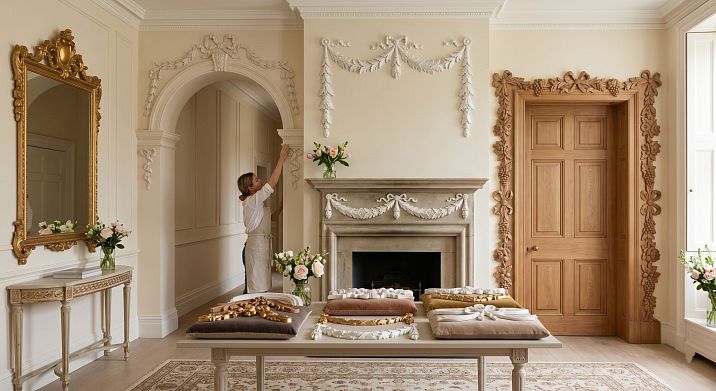
A portal is not just an opening. It is an architectural statement. A door without framing is a passage. A fireplace without decor is a technical appliance. A mirror without accents is a utilitarian object. But add a properly chosen garland to any of them — and the space around begins to sound different. Louder, more solemn, more meaningful.
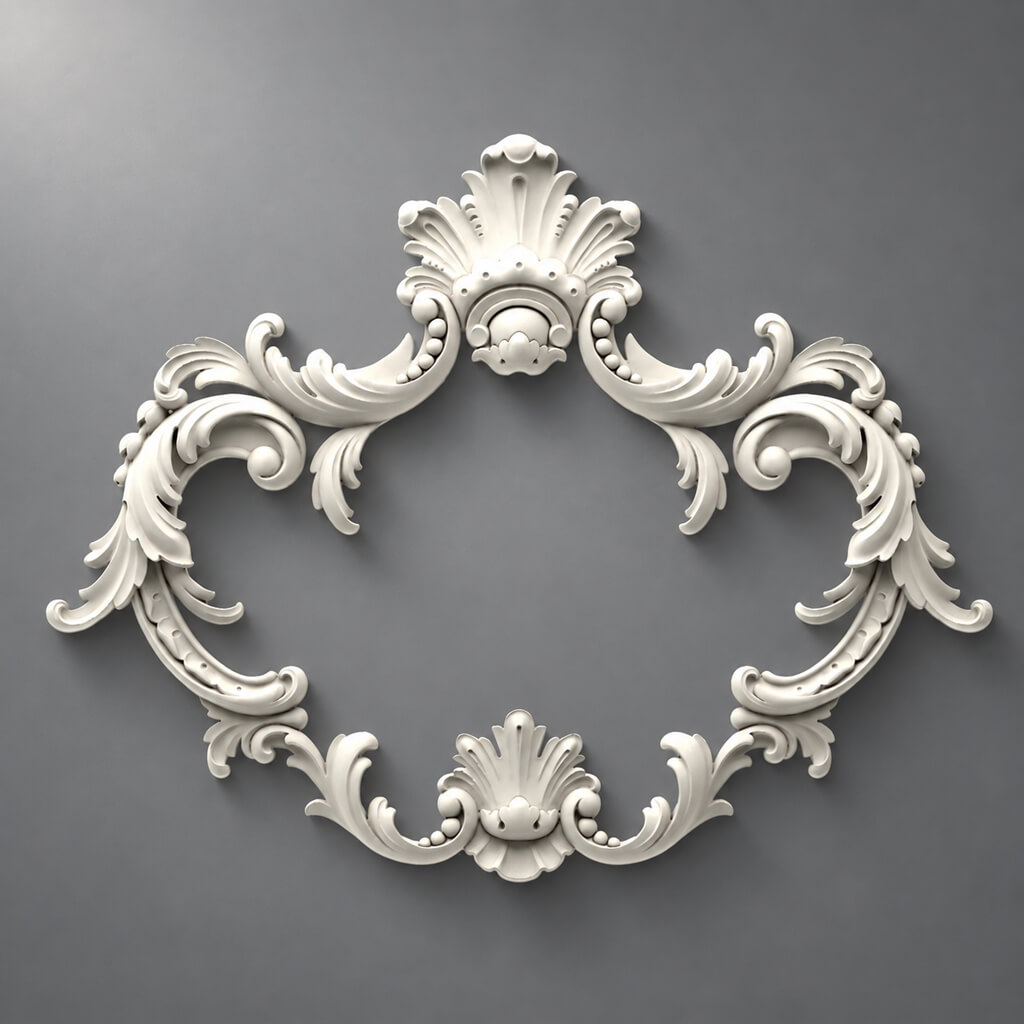
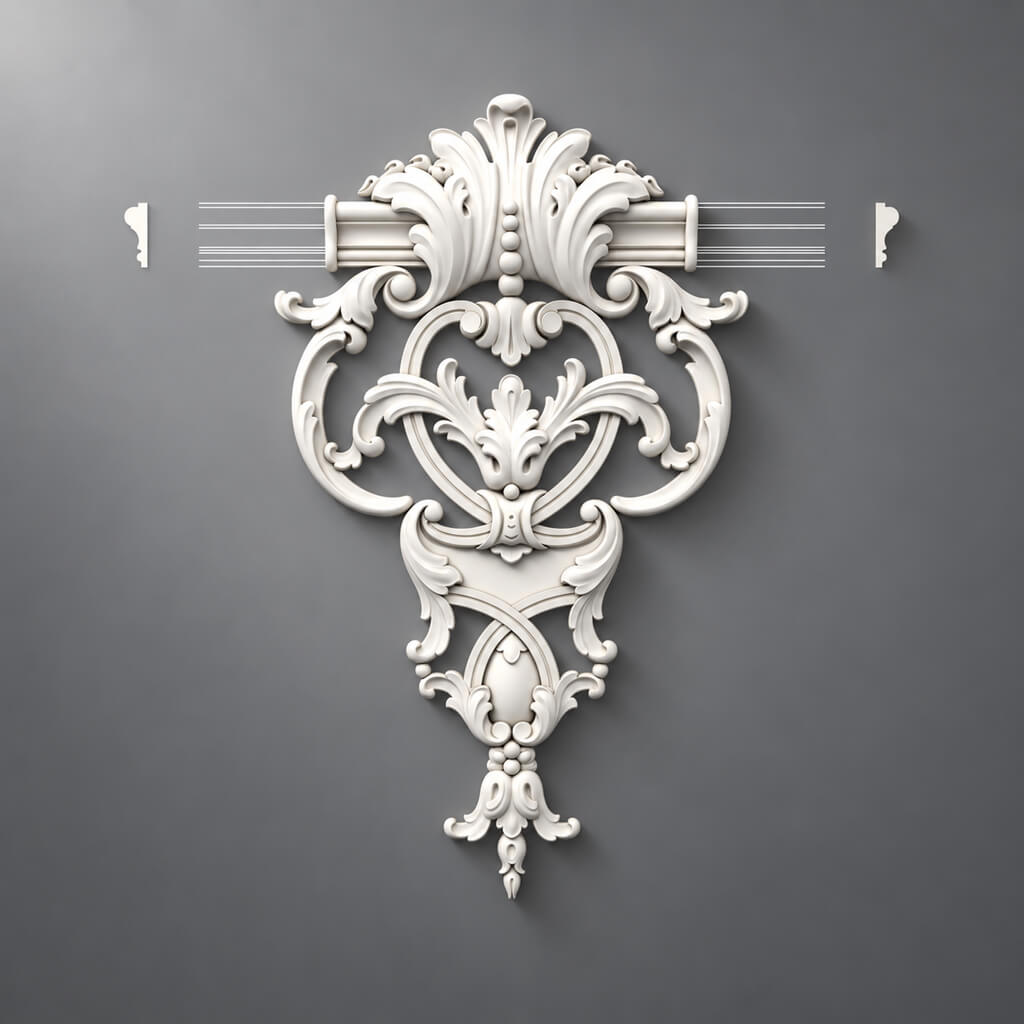
Garland for a portal — this is an ornamental overlay with a floral, botanical, or classical motif, installed as a decorative accent on a doorway, fireplace area, arch, mirror, or niche. Unlike molding, which divides and frames, a garland is a living ornament: it tells a story, decorates, and creates an image. That is why experienced designers and decorators choose it where the geometry of a frame alone is not enough.
This article provides a comprehensive practical analysis: which type of garland is needed for which portals, how to correctly choose the material, size, and relief, how to avoid common mistakes—and how to assemble a full classical architectural composition from a garland, moldings, pilasters, and a cornice.


What is a garland for a portal
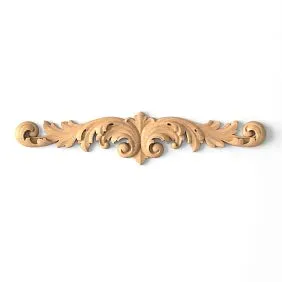
In the language of architectural decor, "garland" is a historically established ornamental type. The Greeks used it in the form of fruit clusters on altars and friezes. The Romans adopted the motif and expanded it into a full decorative language: flower stems, laurel branches, intertwined leaves—all became part of the architectural ornament adorning portals, arches, and colonnades.
In an interior, a garland as a decorative overlay works in several scenarios. First, a horizontal top overlay above the opening: it is placed in the center of the architrave or the upper plane of the portal, creating the main semantic accent. Second, vertical side overlays along the posts: they elongate the portal, give it solemnity, and emphasize height. Third, corner and central inserts in a system of moldings: a garland inside a decorative frame becomes a complete architectural detail.
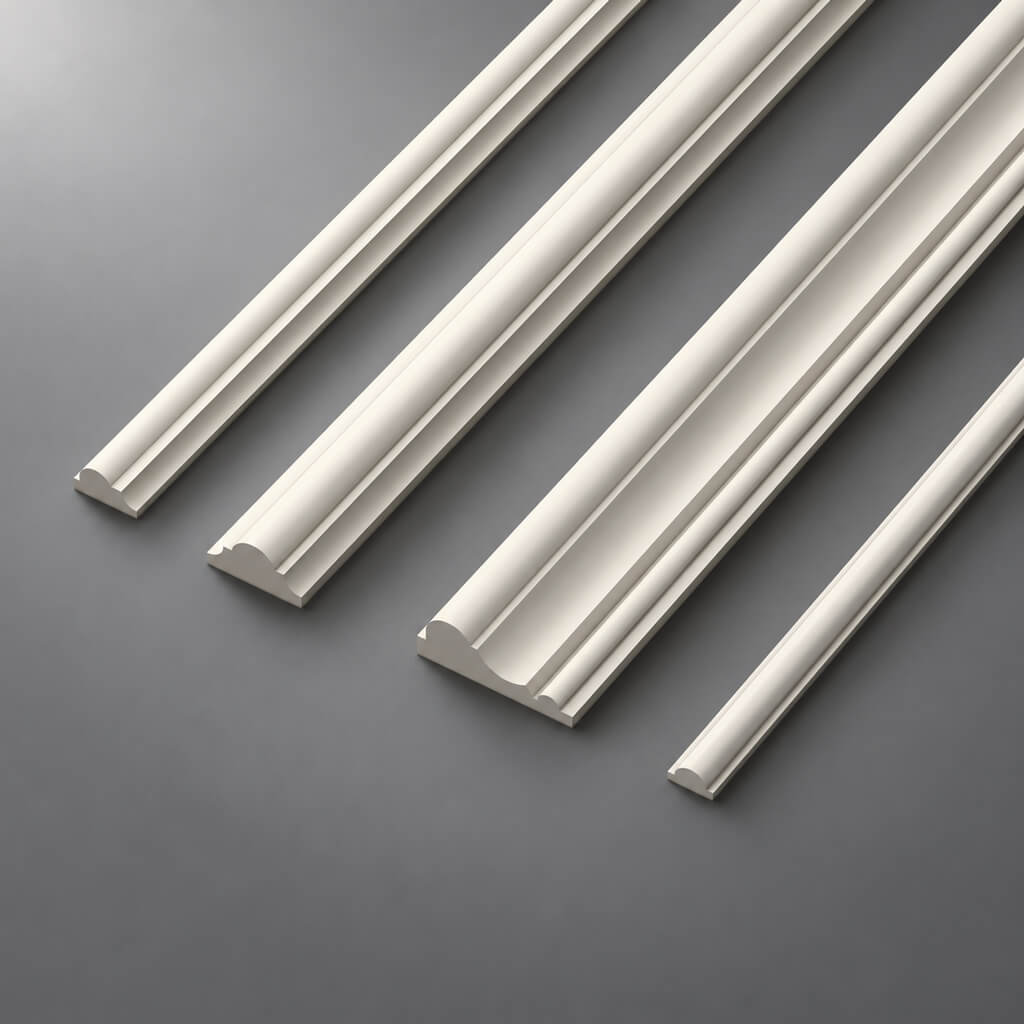
Key difference from molding: Moldings made of polyurethane create structure—frames, profiles, dividers. A garland creates an image. In a good decorative system, they work together: molding defines the space, the garland populates it.
An important commercial nuance that immediately affects the choice: portals can be wooden, wall-mounted (plaster, painted, faced), furniture, or mixed. For each type, the optimal overlay material is different—and we will discuss this in detail.




Where to use a decorative garland
Five main application areas—we will analyze each separately, because each has its own logic, scale, and requirements for the overlay.
Our factory also produces:


On a door portal
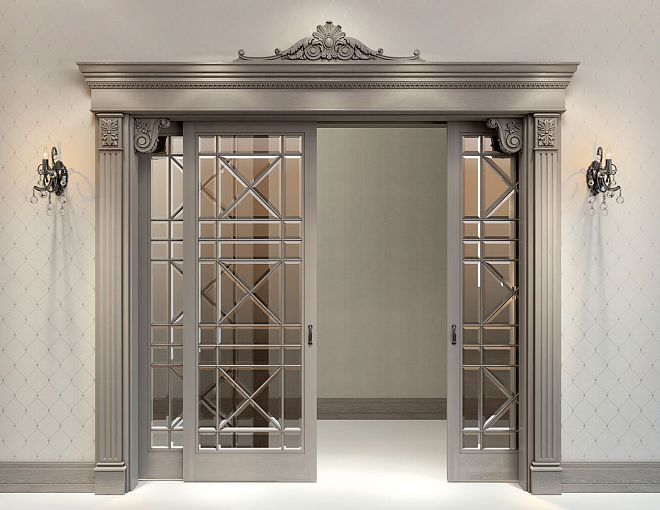
A door portal is the entire framing of a doorway: jambs, architrave, casing, possible pilasters. It is the first thing a person sees when entering a room and the last when leaving. A decorative garland here works as the portal's "signature" — a mark of its architectural quality.
Traditional positions of the garland on a door portal: in the center of the upper horizontal part — above the opening, inside or under the architrave. This is a horizontally oriented detail that "stops" the gaze at the most important point. On the sides of the jambs — vertical overlays that echo the height of the portal and create a solemn framing of the opening.
For a wooden door portal — a natural choice Wooden decorative inlays of beech or oak. An overlay made of the same material as the portal itself creates a unified object, rather than the feeling of "attached" decor. For wall portals made of plaster or MDF with an enamel coating — molded decoration made of polyurethane with a pronounced relief, painted to match the wall color.
A separate area is the decor of the door portal jambs. Here the concept of a pilaster appears: if the portal jamb is designed as a pilaster with a base, shaft, and capital, the garland is placed on the pilaster shaft as a central ornament. How this system works as a whole is detailed in the material by STAVROS "Decor for fireplace, doors, and pilasters made of polyurethane".
Get Consultation
On the fireplace portal
A fireplace is the main architectural accent of a living room or study. The fireplace portal is a frame structure around the firebox: jambs, top shelf, pediment or cornice part. It is here that the decorative garland reveals itself in full force: the scale allows it, the context demands it, and tradition confirms it.
On the fireplace portal, the garland can occupy several positions. Above the shelf, in the center of the pediment part — as the main ornamental accent of the entire fireplace area. On the sides of the firebox, on the vertical jambs — as paired elements framing the fire. In decorative panels on the sides of the portal — inside molding frames.
For a fireplace portal, it is especially important that STAVROS develops the theme of the fireplace wall as a single architectural unit — with moldings, panels, decorative overlays, and ready-made kits. More details in the article. "Decorating a Wall with a Polyurethane Fireplace". The garland in this system is a key ornamental element that "enlivens" the geometrically strict molding program.
The choice of material for a fireplace portal is almost always polyurethane. There are several reasons: high heat in the fireplace area requires a material that does not warp with temperature changes. Polyurethane is stable. A wooden overlay near a heat source may begin to deform with prolonged use.
Polyurethane overlays with the "Garland" ornament — a specialized category in the STAVROS catalog, created specifically for such tasks.
On the arch
A decorative arch is an architectural element that simultaneously serves as a portal and a structural dominant of the space. The garland on the arch is traditionally placed in the keystone area — at the top point of the arch span, where the "keystone" is located. This is a horizontally or diamond-oriented accent that holds the entire arch composition.
On the sides of the arch — where the arch vault transitions into straight posts — small vertical garlands or corner decorative elements are placed. Combined with moldings, pilasters, and capitals, they create a complete classical arch system.
Decor for Molding — corner inserts and ornamental elements naturally complement the garland in the arch composition. They fill the corner points of the frame and complete the system where the garland creates a semantic center.
On the mirror portal
A mirror in a classic interior is not just a reflective surface. It is an object with architectural status: frame, pedestal, top accent, side elements. The garland on the mirror portal works in two ways.
First — as a top horizontal accent: the overlay is placed on the top horizontal part of the frame or above the mirror, creating a "crown" of the object. Second — as side vertical accents: a pair of garlands along the edges of the frame creates a ceremonial framing, turning the mirror into something resembling a door to another space.
For solid wood frames — wooden carved overlays in the same wood species. For plastered or plaster frames — PU overlays with subsequent painting in the overall tone.
In a niche
A decorative niche is one of the most advantageous areas for placing a garland. The niche itself is already a portal: it has side walls, a top plane, and a bottom. A garland inside the niche — on the back wall, at the top, or on the sides — greatly enhances the architectural character of this element.
In a niche, the garland can work both as a separate decor and as part of a wall panel system: molding frames on the back wall of the niche + garland inside the central frame + console or shelf.
Polyurethane or wooden garland for a portal — what to choose
Material is not a question of "what is better." It is a question of "what is appropriate for a specific portal, specific finish, and specific scale."
Selection table
| Task | Better to choose |
|---|---|
| Painted wall portal | Polyurethane |
| Fireplace wall with moldings | Polyurethane |
| Wooden door portal | Wooden carved garland |
| Solid wood mirror frame | Wood |
| Portal for dense enamel | Beech or polyurethane |
| Portal for tinting | Oak |
| Large stucco accent | Polyurethane |
| Natural carved accent | Wood |
| Paired side elements | Vertical overlays |
| Central top accent | Horizontal garland |
| Proximity to heat source | Polyurethane |
| Restoration of a wooden portal | Wood of the same species |
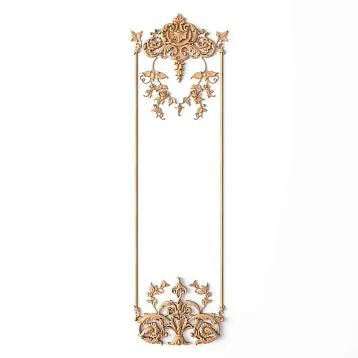
Polyurethane wins where scale, ease of painting, part lightness, and environmental resistance matter. Vertical garland NPU-316 — is a clear example of such a product: it is described as a vertical composition of stylized flower buds, made of moisture-resistant polyurethane with the possibility of painting and adhesive mounting. It is a versatile tool for the side posts of any portal — door, fireplace, or arch.
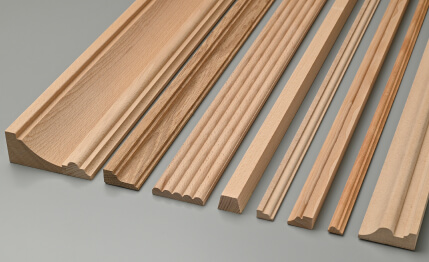
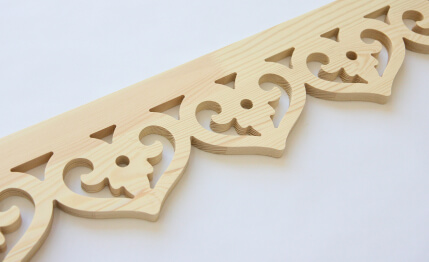
Wood wins where the organic nature of the material, natural texture, and belonging to the same material program as the portal itself are important. Wooden decorative inlays STAVROS — over 400 models in beech and oak, including symmetrical and asymmetrical products, central and corner elements, as well as mirrored models for paired compositions.
A rule that works in 90% of cases: if the portal is wooden — choose wood. If the portal is wall-mounted, plaster, or assembled from moldings — choose polyurethane.
Polyurethane overlays with the "Garland" ornament in the STAVROS catalog
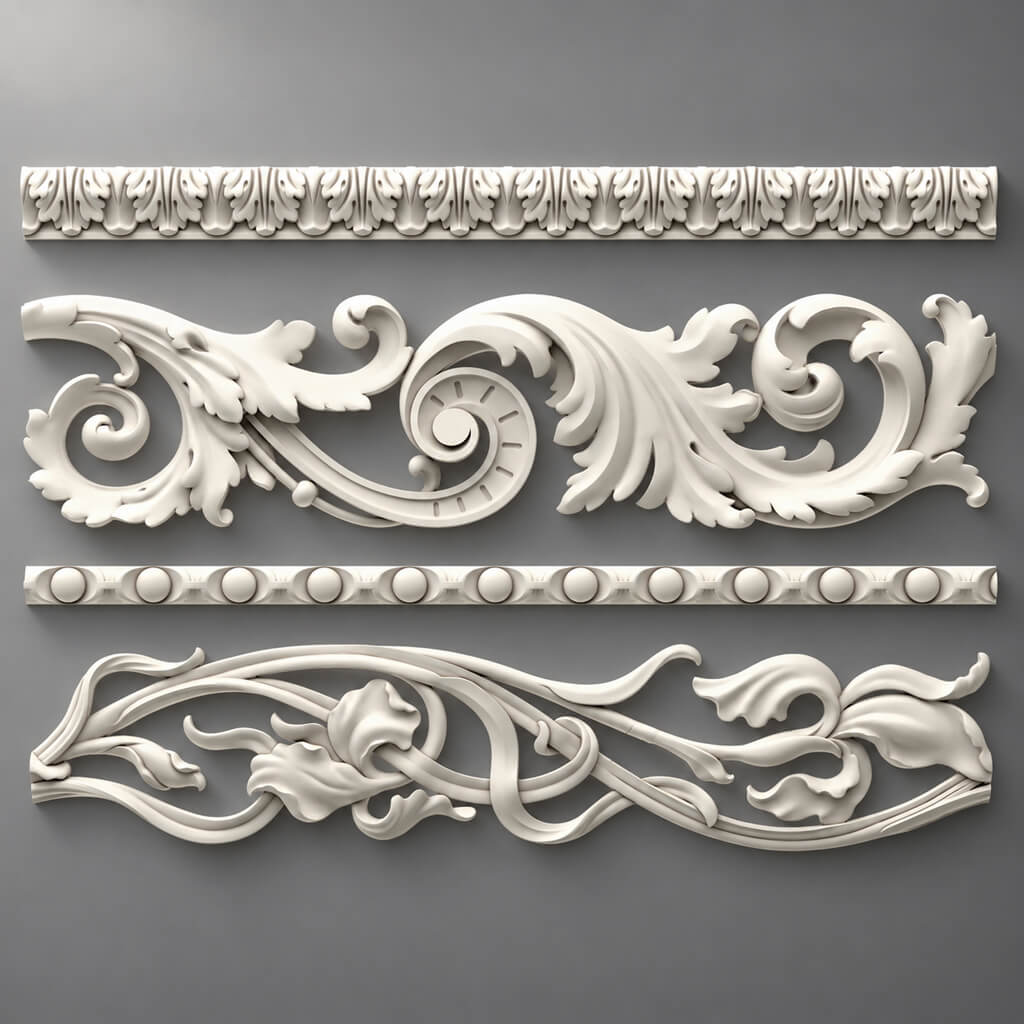
In the PU overlays with the "Garland" ornament precisely those products are collected that are intended for portals, walls, fireplace zones, and decorative panels. This is a strong commercial position for those looking for stucco decor for painting with a specific floral ornament.
Why is this section important? Because it contains not just "overlays in general," but overlays ornamentally qualified specifically as garlands. This means: leaves, buds, stems, fruits — all motifs associated with a classic architectural garland. By choosing from this section, you immediately fall into the correct ornamental range.
Additional convenience: for a number of items in this category, the paired placement format is directly indicated. This means that when choosing an overlay here, you are already working with the logic of portal symmetry, rather than a single element.
Vertical garland NPU-316
NPU-316 — a polyurethane vertically oriented garland of stylized flower buds. This is a "workhorse" for the side posts of any portal: door, fireplace, arched. The vertical orientation of the ornament emphasizes the height of the post, the flower buds add plasticity and liveliness, and the polyurethane material allows any painting.
Application: side posts of a door portal, side panels of a fireplace portal, pilaster shafts, vertical fields of wall panels in narrow piers. In pairs — one per post — creates a symmetrical framing of the opening or firebox.
Installation: polymer-based adhesive, standard fixing process. The surface accepts enamel, patina, imitation gold or stone without additional preparatory operations — only priming.
How to choose the size of a garland for a portal
Size is a parameter where most mistakes are made. The visual perception of a photo in a catalog does not convey the real scale. You need to work with millimeters and the actual dimensions of your portal.
Portal width is the starting point. For a horizontal top garland, its length should be 40–60% of the opening width. Opening width 900 mm — garland 360–540 mm in length. Opening 1200 mm — garland 480–720 mm. A garland occupying less than 30% of the width will be lost. More than 70% will overload.
Post height — for vertical overlays. A vertical garland on a portal post should occupy 40–65% of the post height, leaving breathing room at the top and bottom. For a post of 1200 mm — overlay 480–780 mm.
Relief thickness — in accordance with the portal scale. A large fireplace portal with massive posts — relief of 20 mm or more is convincing. A door portal with a thin casing — relief of 10–15 mm. A wooden mirror frame — relief of 6–11 mm.
Ceiling height — a contextual parameter. In a room with ceilings of 2.5 m, a 500 mm high overlay on a door portal is a lot. In a hall with ceilings of 3.5 m, the same detail will look delicate. The scale of the decor should be coordinated with the scale of the space, not just the portal itself.
Selection tool: draw a paper template at full scale, apply it to the portal. Evaluate visually. This takes 10 minutes and eliminates any scale errors.
How to combine a garland with moldings, pilasters and cornice
A portal system is not a random set of parts. It is a well-thought-out architectural program where each element supports its neighbor.
Classic door portal system:
-
Base: pilaster base or plinth block
-
Shaft: vertical molding with a garland in the center
-
Capital: decorative insert above the shaft
-
Architrave: horizontal molding above the opening
-
Central accent: horizontal garland in the center of the architrave
This scheme reproduces the logic of a classical order portal. Each of its elements can be assembled from the STAVROS catalog: Moldings, Decor for Molding, PU overlays — everything from one program, everything in a unified style, everything under a single color scheme.
For a fireplace portal, the system is similar, but the scale is larger. Here, a horizontal shelf is often added between the lower and upper parts of the portal — this is a "crosspiece," on which a horizontal garland can be placed as central decor.
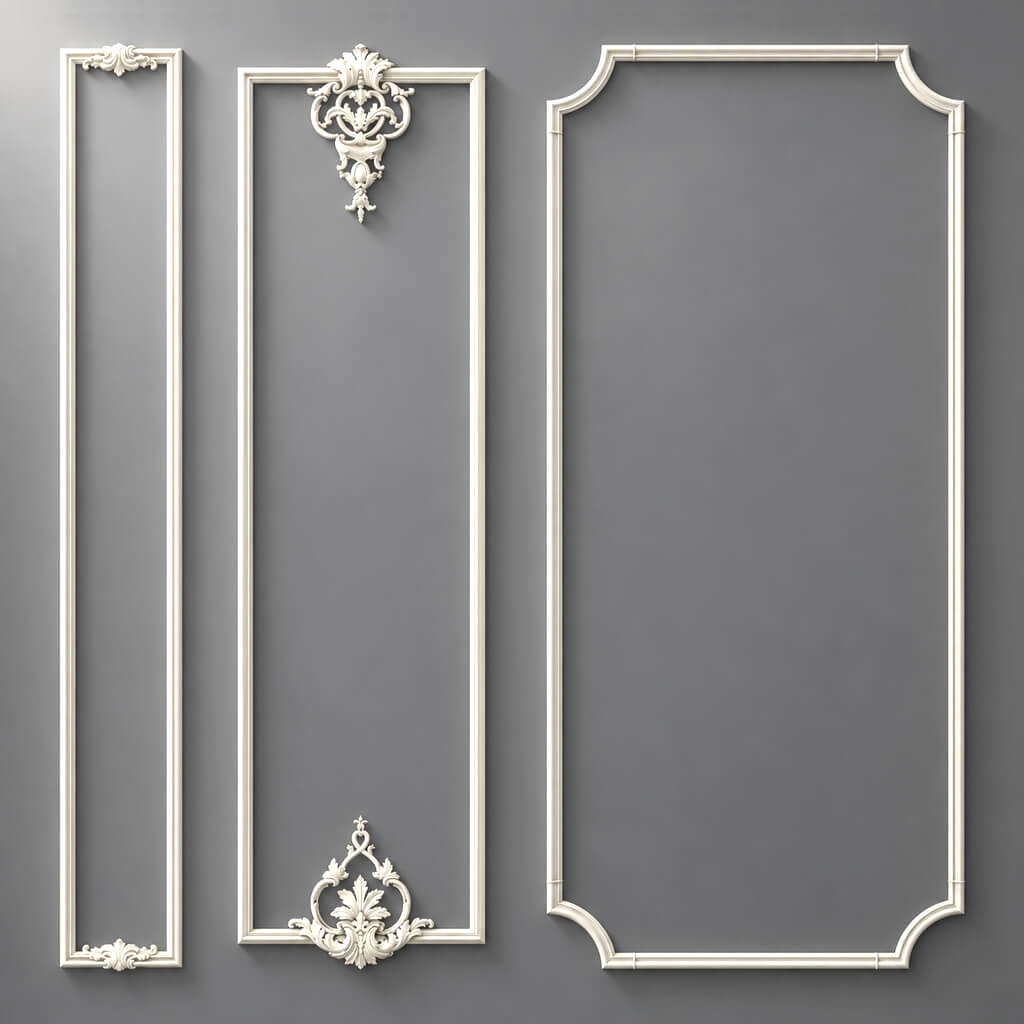
A garland inside a molding frame is the "cleanest" scheme: the molding frame creates a rectangular field, and the overlay occupies its center. This works on posts, wall panels, and niches. Ratio: the free field around the overlay should be 1.5–2 times larger than the part itself.
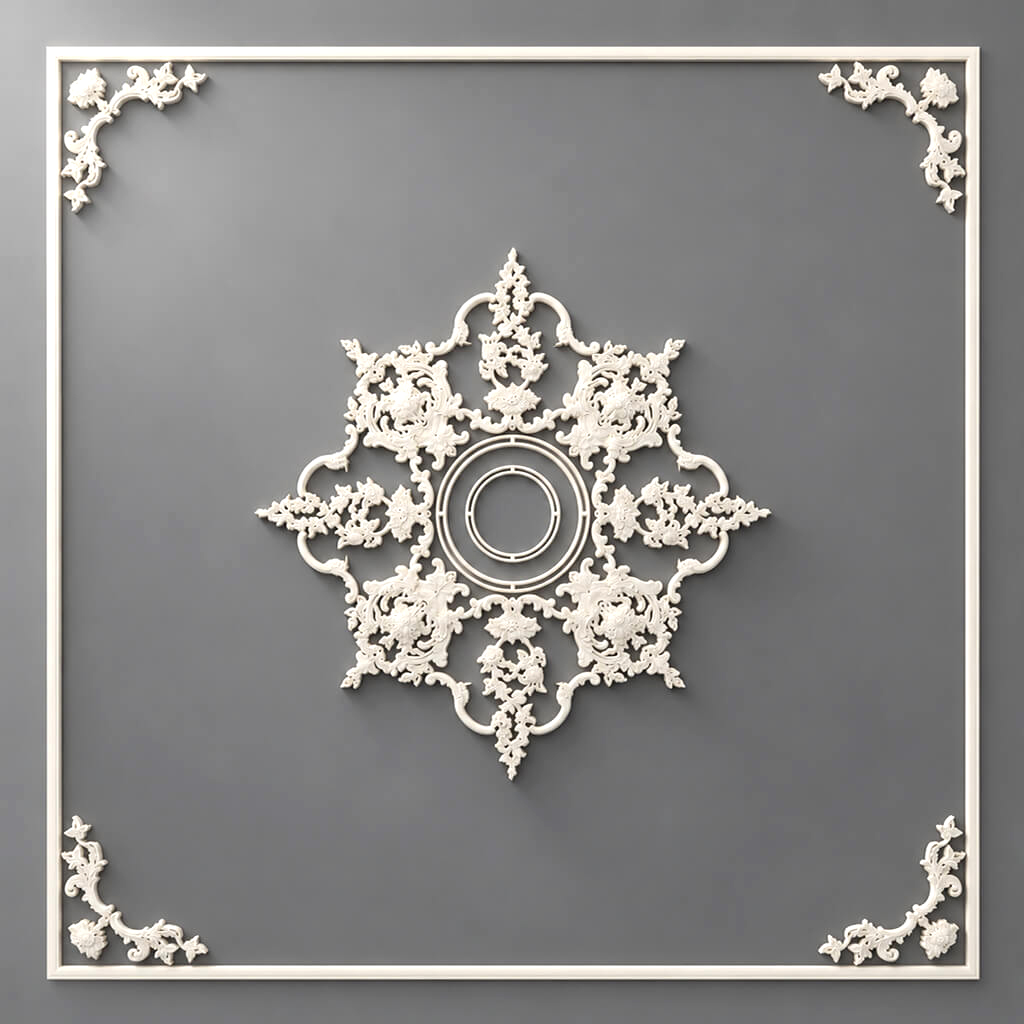
Corner elements at the intersection points of the moldings complete the system. Without them, a molding frame is just a frame. With corner decorative inserts, it becomes a classic panel. Category 'Decor for moldings' on STAVROS includes exactly such corner and central inserts.
Portal style and suitable type of garland
The ornamental language of the detail must match the language of the space. Let's consider the main styles.
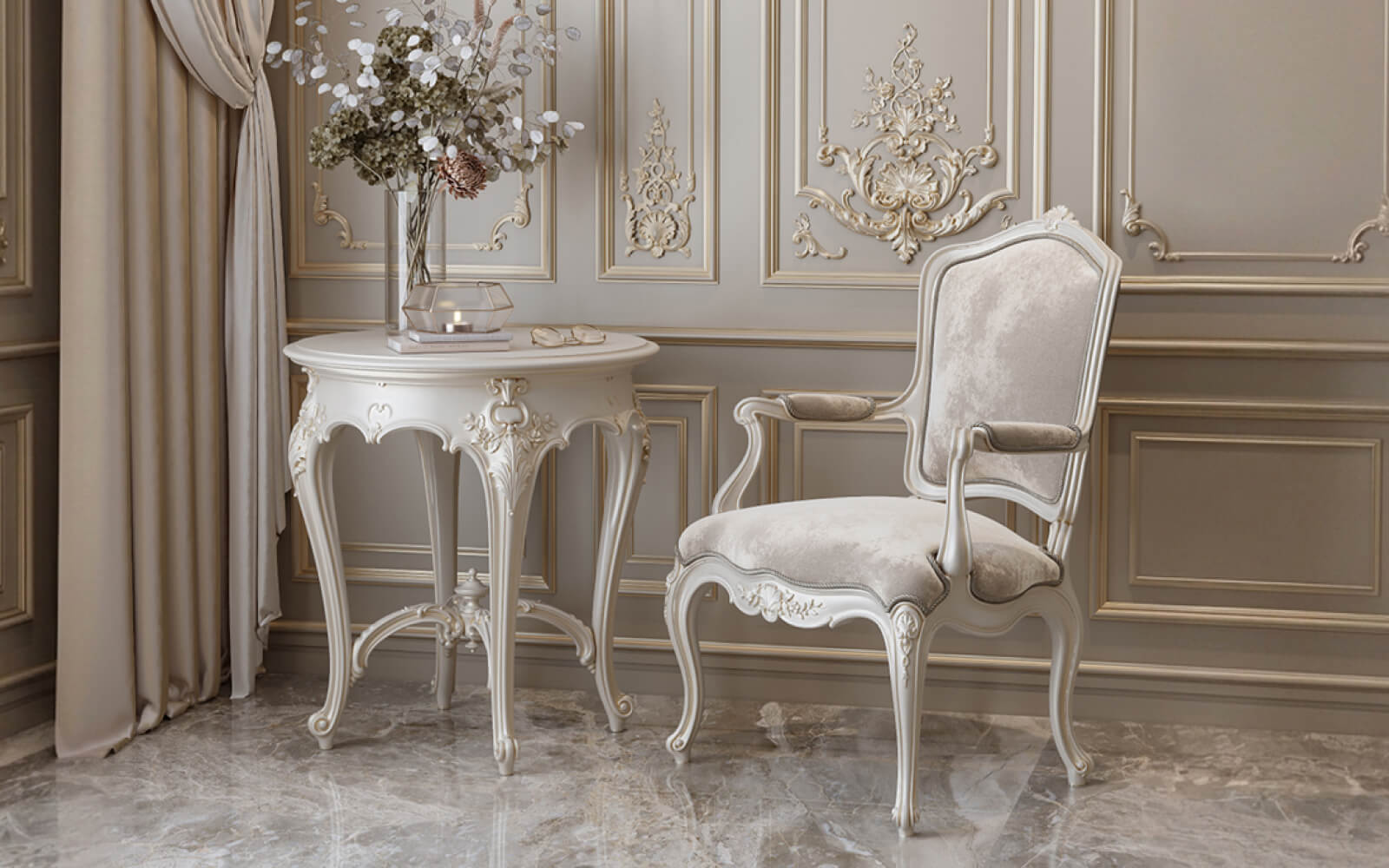
Classic and Baroque. Rich, dense ornament: curls, flower heads, acanthus leaves, fruits, ribbons. Deep relief, rich plasticity. For a palace or historical interior, the more expressive the detail, the more convincing the result. Polyurethane with patina or for gilding.
Neoclassicism. The same botanical vocabulary, but in a more restrained execution. The garland as one clean accent inside the frame, painted in the wall color — only volume, only shadow. This is a modern approach to classic decor: presence without overload.
Empire. Strictness, geometry, military and natural symbols. Laurel branches, palm leaves, geometrically precise motifs. No "fluidity" of baroque curls — only discipline of form.
Modern classic. A portal with thin moldings, one central garland above the opening, painted in the same color as the wall. The detail becomes visible only at a certain angle of lighting — like a relief whisper against a background of silence.
Provence and French country. Delicate floral motifs, lavender, roses, light stems. A wooden carved overlay in ivory with light patina in the recesses.
Mistakes when choosing a garland for a portal
-
They buy one overlay instead of a pair. Two garlands on the sides of a doorway or fireplace are the standard of a classic system. One is incompleteness.
-
They don't consider the width of the portal. A small garland on a wide fireplace portal will get lost just as surely as a large one on a narrow doorway will overwhelm it.
-
They take a detail that is too small for the fireplace area. A fireplace is a large architectural object. The overlay must match its scale.
-
They take a detail that is too large for a narrow doorway. An 800 mm opening and a 600 mm overlay is 75% of the width, which is overload.
-
They don't check the thickness of the relief. 6 mm will get lost on a wall portal. 20 mm on a thin wooden casing will protrude.
-
They don't think about compatibility with adjacent elements. A baroque-style garland and empire-style moldings in one system is an inconsistency that catches the eye.
-
They install without a central axis. In a classic interior, a 5 mm shift from the axis is read as an error. Always find the vertical and horizontal before installation.
-
They mix ornaments without a concept. Three different motifs on one portal is chaos. One motif in different scales is a system.
-
They buy decor before final understanding of dimensions. The portal is not measured, meaning the purchase is premature.
-
The overlay is painted before installation. First, installation, puttying the joints, then final painting.
Installing the garland on the portal
Technically, installation on a portal is more complex than on furniture: the scale is larger, surfaces are often vertical, and sometimes height requires a stepladder.
Marking. Find the central vertical and horizontal lines of the portal. For the horizontal top garland: mark the center of the top plane and measure half the length of the overlay to each side from it. For the vertical side overlays: determine the center height of each part on the post.
Surface preparation. The wall or molding must be dry and clean. On painted surfaces, lightly sand the mounting area for better adhesion.
Applying glue. For polyurethane overlays on a wall, use construction adhesive on a hybrid polymer base (Tytan, KUDO, Soudal) applied in dots or a zigzag pattern. Apply to the part, allow 2–3 minutes of open time, then press onto the surface. For wooden overlays on a wooden portal, use woodworking PVA or construction adhesive.
Fixation. Press the part firmly and hold for 15–20 seconds. For large overlays, secure with painter's tape until fully set (30–60 minutes). On horizontal surfaces at the top, additional fixation with tape is mandatory: the adhesive does not hold yet, and the part may slide.
Finish. Assemble all elements of the system, putty the joints with finishing putty, allow to dry completely, prime, and paint for the final finish. The paint "integrates" the parts into the surface and creates a unified object.
Why choosing decor for a portal is convenient at STAVROS
STAVROS interior decor — it is a system, not just a catalog of parts. For portal tasks, everything is available here: horizontal and vertical garlands in polyurethane, Carved Wooden Appliqués In a wide range: moldings, cornices, decor for moldings, corner inserts. All elements were developed as a compatible program — they can be combined in one project, creating a cohesive classical system.
For the specialized query "garland for portal" there is in the catalog PU overlays with "Garland" ornament — this is not a general section, but an ornamentally qualified category for those who clearly understand what they want.
Production — in Saint Petersburg, from certified materials. Order from 1 piece, Contact us to confirm shipping to your destination. via CDEK, production time 3–10 working days. Showrooms in Saint Petersburg and Moscow allow you to see the details in person, assess the relief and scale before purchase.
FAQ: answers to popular questions about garlands for portal
What is a garland for portal?
A decorative overlay with floral, botanical, or classical ornament, installed as an accent on a door, fireplace, or mirror portal, arch, niche.
Where is it best to use: above a door, fireplace, or arch?
Everywhere there is a portal zone with vertical posts or an upper horizontal plane. Above the door — a horizontal central garland. On the posts — vertical paired overlays. On the arch — at the keystone point and on the sides.
What to choose for a portal — polyurethane or wood?
Wall or fireplace portal — polyurethane. Wooden door portal or mirror frame made of solid wood — wood in the same species.
Can a garland be used on a doorway?
Yes, this is a classic application. A horizontal garland above the opening + vertical ones on the posts + moldings = a full-fledged classic door portal.
Is a decorative garland suitable for a fireplace portal?
Yes, and this is where it is most expressive. Polyurethane is recommended — due to its resistance to temperature changes near the heat source.
How to choose the size?
Horizontal garland: 40–60% of the opening width. Vertical on the post: 40–65% of the post height. Make a full-size paper template.
Do you need one garland or two paired overlays?
For framing the portal on the sides — always two: a symmetrical pair. One central horizontal one is the only one in its position.
Can a garland be combined with moldings and pilasters?
Not only can it — it should be. A garland without a system is a detail without context. In a system with moldings and pilasters, it becomes the center of the architectural composition.
How to paint a polyurethane garland?
Prime with a universal primer, apply enamel in 2–3 coats. For patina: apply a base color, then a thin layer of patinating compound with wiping of the relief — recesses darken, protrusions lighten.
Where to buy a decorative garland for a portal?
In the Stavros catalog — PU overlays with "Garland" ornament, vertical NPU-316, Wooden Inlays made of beech and oak. Production in Saint Petersburg, Contact us to confirm shipping to your destination.
Correctly chosen Garland for a portal — is a detail that turns an opening into an architectural statement. Polyurethane overlays for painting for wall and fireplace portals, wooden carved overlays for doors and mirror frames — and in each case, the system is completed by moldings, cornices, and corner elements from a single program.
STAVROS company produces molded decoration made of polyurethane и Carved wooden decoration in Saint Petersburg since 2002. STAVROS has participated in the restoration of the Hermitage, Konstantinovsky and Alexander Palaces. Order from 1 piece, Contact us to confirm shipping to your destination., showrooms in Saint Petersburg and Moscow — all so that your portal becomes exactly what it should be: an architectural event in the space.