









































































Article Contents:
- What is a picture frame baguette: profile, depth, decor
- Why a wooden frame looks more expensive than plastic: material comparison
- How to choose a baguette frame profile: from minimalist to carved
- Narrow minimalist profile
- Medium profile
- Wide profile
- Carved Profile
- How to choose the size and width of the baguette: relationship between painting, wall and furniture
- Proportion rule
- Profile depth and canvas thickness
- Wall size and viewing distance
- Gallery hanging and frames of the same series
- How to choose the color of a wooden frame: oak, walnut, patina, and gold
- Natural oak and light wood species
- Walnut and dark wood species
- Patina and aged wood
- Golden and gilded frames
- Black frame
- What interiors are suitable for wooden molding frames
- Classic Interior
- Neoclassicism
- Modern classic and 'light' interior
- Office and Library
- Living Room
- Bedroom
- Country house
- Molding frame for painting, poster, and mirror: selection nuances
- What to check before buying a wooden frame
- Tips for creating an interior composition with framed paintings
- Where to buy a wooden baguette frame: what to look for
- FAQ: everything you ask about wooden baguette frames
- STAVROS: wood that remembers its place
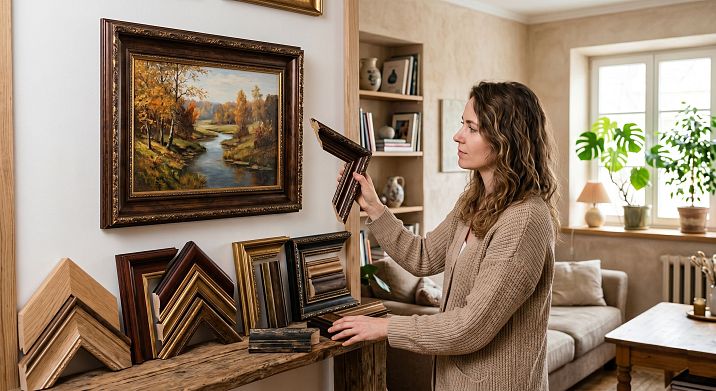
A painting without a frame is like a phrase without a period. It can be beautiful, but not complete. A frame is not a border. It is an architectural gesture: the boundary between the image and the space, between art and the wall, between what you hung and what you created. And if the frame is wooden, if the profile is carved from solid wood, if the texture of the wood breathes next to the canvas — that's a whole different conversation.
A wooden baguette frame for a painting is what makes the work complete. It sets the scale, enhances the color, emphasizes the style, and integrates the work into the interior so that everything around begins to sound different. Choosing it correctly means not just finding the "right size," but building a logic: profile, width, color, texture, interior, placement on the wall.
This is exactly what this article is about — choosing a wooden frame for a painting as a conscious interior decision.


What is a baguette frame for a painting: profile, depth, decor
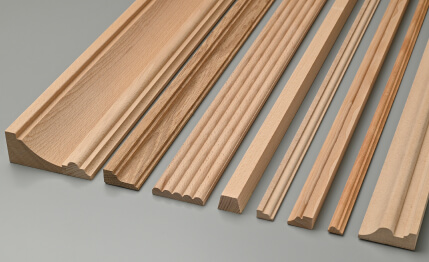
The word "baguette" as applied to frames comes from the French language and means a decorative profile — a complex shaped molding from which the frame is assembled. Four segments cut at 45 degrees and joined at the corners — that is a classic baguette frame. A simple description that hides a huge variety: profiles, depths, ornaments, coatings, and materials.
What distinguishes a real baguette frame from a simple frame:
-
Profile. A simple frame is flat or has a minimal bevel. A baguette is a complex shaped profile with several levels of relief: chamfer, shelf, scotia, carved ornament, or a sleek, minimalist bevel.
-
Depth. A frame has no pronounced depth. A baguette frame takes into account the thickness of the canvas, stretcher, or mat — it has a "rabbet" (inner recess) to secure the artwork.
-
Decorativeness. A baguette is always a visual element. It does not hide but asserts itself: through the texture of the wood, coating, ornament, or the minimalism of the profile.
-
Material. A real wooden baguette is solid wood or high-quality glued timber. Not plastic with a printed texture and not MDF with foil.
In the STAVROS catalog Frames for paintings are made from natural wood — with a real texture that cannot be confused with anything synthetic. This is exactly what matters for an interior where the painting is not a poster but an object.




Why a wooden frame looks more expensive than a plastic one: comparison of materials
This question is asked less often than it should be. Most buyers choose a frame based on the principle of "inexpensive and fits the size." And then they wonder why a good piece of work on the wall does not make the right impression.
Let's break it down by materials:
| Material | Appearance | Durability | Combination with interior | For painting |
|---|---|---|---|---|
| Natural wood | Living texture, depth | Decades | Organically | Ideally |
| MDF with film | Smooth, "dead" | 5–10 years | Fragile | Not recommended |
| Plastic | Glossy, flat | 3–7 years | Neutral | No |
| Glued laminated timber | Close to solid wood | Decades | Good | Good |
Natural wood has something that cannot be reproduced synthetically: it changes with the angle of lighting. In the morning, the frame looks different than in the evening. Side light from a floor lamp reveals the texture of the grain — and the frame comes alive. This is that "expensive feeling" that cannot be imitated by film on MDF.
Wooden Picture Frame A wooden array is also an argument for durability. If a painting is meaningful to you, even after twenty years, the wood will remain wood, not peel at the corners or turn yellow.
An additional argument: wood 'talks' to wooden furniture, parquet, wooden doors, and moldings. It integrates into the interior as if it belongs—because it is native to any living space.
Our factory also produces:


How to choose a baguette frame profile: from minimalist to carved
The profile is the 'silhouette' of the baguette when viewed in cross-section. It is the profile that determines the character of the frame: strict or rich, modern or classic, delicate or powerful.
Get Consultation
Narrow minimalist profile
Width 15–30 mm, minimal relief. The frame almost disappears—it only marks the boundary between the image and the wall. Suitable for:
-
Modern interior
-
Posters and graphics
-
Small works in gallery-style hanging
-
When you need to emphasize the painting itself, not the frame
Colors: natural oak, wenge, dark walnut, black, white.
Medium profile
Width 30–60 mm. The working area for most interior tasks. Expressive enough to structure the wall, yet restrained enough not to draw too much attention. Good for:
-
Neoclassicism and modern classic
-
Medium-format paintings (40×50, 50×60, 60×80 cm)
-
Interiors that feature Wooden moldings and other wooden decor
-
Living rooms and studies
Wide profile
Width 60–120 mm and more. The frame becomes an independent architectural element. Good for:
-
Classic interiors with rich decor
-
Large paintings (80×100 and larger)
-
Formal spaces: living room, hall, executive office
-
When you need to give a painting "weight" and solemnity
Carved profile
A classic choice for those unafraid of opulence. Carved ornament along the baguette profile—acanthus leaves, garlands, stepped reliefs—is a historically accurate way to frame paintings in a classic interior.
Carved wooden decoration STAVROS complements wooden frames organically: when the frame is carved and the interior decor is carved, they speak the same language.
For a carved frame, the quality of the corner joint (the carved ornament must be mirror-symmetrical at each corner) and the finish (varnish, patina, gilding—depending on the style) are important.
How to choose the size and width of the baguette: the relationship between the painting, the wall, and the furniture
One of the most frequently ignored parameters is the ratio of the frame width to the painting size. Yet this is a proportion that the eye immediately registers—even without specialized knowledge.
Proportion rule
The width of the baguette should be proportional to the area of the painting:
-
Painting up to 40×50 cm — baguette width 20–40 mm
-
Painting 50×70 cm — baguette width 30–55 mm
-
Painting 70×100 cm — baguette width 45–70 mm
-
Painting 100×120 and larger — baguette width 60–100+ mm
Too narrow a baguette on a large painting — the frame gets lost, the work looks unfinished. Too wide on a small one — the frame overwhelms the image, and the viewer sees the frame, not the painting.
Profile depth and canvas thickness
For canvas paintings, there is a stretcher — a wooden frame onto which the canvas is stretched. Standard stretcher thickness: 18–20 mm (thin) and 35–40 mm (deep). The rabbet of the baguette frame must accommodate this thickness. Check: rabbet depth ≥ stretcher thickness + 2–3 mm clearance.
For posters and reproductions on paper or cardboard, this parameter is not critical — the base thickness there does not exceed 3–5 mm.
Wall size and viewing distance
A painting on a large wall requires a corresponding frame scale. If the wall is 3 × 3 m and the painting is 40 × 50 cm with a narrow profile — it will simply get lost. Either enlarge the painting, choose a wider profile, or hang several works in a gallery layout.
Viewing distance: if the painting hangs in a hallway (viewed from 1.5–2 m), a thin profile works. If in a large living room (viewed from 4–6 m), a more pronounced frame is needed — otherwise it won't be readable.
Gallery hanging and frames from the same series
If you are hanging several works, the frames should be from the same series. Same profile width, same finish. This does not mean "identical" — different sizes are allowed. But stylistically, the frames should form a family, not a random collection.
How to choose the color of a wooden frame: oak, walnut, patina, and gold
The color of the frame is not about "liking it," but about logic. Each wood shade has its own "family" of compatible interior elements.
Natural oak and light wood species
A light warm shade. Works perfectly in Scandinavian style, modern classic, and light interiors with white or beige walls.
Pairs with: light parquet, white and gray furniture, beige fabrics. Looks good next to wooden moldings in the same shade.
Suitable for paintings: landscapes, watercolors, botanical illustrations, neutral abstractions.
Walnut and dark wood species
Deep, rich tone. Adds weight and seriousness to the painting and the wall. Ideal for studies, libraries, living rooms with dark furniture.
Pairs with: dark parquet, leather furniture, dark doors and wooden molding in tone. Works as a contrast on a light wall.
Suitable for paintings: portraits, oil paintings, still lifes, academic painting.
Patina and aged wood
This is a special effect: wood with a 'history' — the surface is slightly worn, the tone is uneven, the shade is warm and slightly 'dusty'. Patina creates a sense of authenticity — frames with this finish look as if they have been through several generations.
Pairs with: Provencal style, Tuscan classics, interiors with rough plaster and aged furniture. In neoclassicism, patina adds a touch of noble 'wear'.
Golden and gilded frames
A classic of the genre. A gilded or golden frame is the language of European painting of the 18th–19th centuries. It doesn't need justification: if the interior is classic, gilding is organic.
Important: a gold frame requires a rich context. On white IKEA walls with laminated chipboard furniture, it will look like a masquerade. In an interior with stucco, heavy curtains and carved wooden decor — this is a statement about taste.
Black frame
A modern and versatile choice. The black profile provides a strong contrast that "holds" the painting on a wall of any shade. It is especially good for graphics, monochrome works, and photographs.
For a classic interior — only in a very specific application (a study in the "dark library" style). In a modern one — it is almost a sure win.
For which interiors are wooden baguette frames suitable
Classic interior
Classics require a frame with an expressive profile. Wide carved baguettes, gilding, patina, dark walnut work here. In a classic interior, the frame is not a border, but part of the decor. It should be as serious as the stucco on the ceiling, as Carved wooden decoration on the furniture, as the heavy curtain fabrics.
In a classic interior, one large painting in an expensive frame is worth ten small ones in plastic frames.
Neoclassicism
Neoclassicism is classicism translated into a modern language. Here, a wooden frame with a moderate profile (40–60 mm), without excessive ornamentation, in a shade close to the furniture or to the moldings on the walls. Everything works through proportions, not through decorative richness.
A good guideline: if the interior has Wooden moldings on walls or ceilings — the frame should be from the same "family" in terms of profile and shade.
Modern classic and "light" interior
A laconic wooden profile in a natural shade, without unnecessary ornament. The painting "breathes", the frame does not dominate. This approach works well in apartments with white walls, light parquet, and a neutral palette of furniture.
It is especially appropriate here Wooden trim as a base for the frame: a clean, precisely turned profile of natural wood without excessive decoration — this is modern classic.
Office and library
In a study, a painting is not a decoration. It is a statement of priorities. A dark frame of walnut or wenge on a dark or dark green wall — a strong, masculine, authoritative solution. Next to books, a leather armchair, and a wooden table, such a frame is organic without any reservations.
Living Room
The main interior scene. Here the painting must "hold" the wall — meaning the frame must be proportionate. A wide profile, confident color, quality joints at the corners. For a large living room — at least 60×80 or 80×100 cm canvas in a frame no narrower than 50 mm.
Bedroom
A more delicate context. A narrow or medium frame in a warm shade: oak, cherry, light walnut. A painting in the bedroom should create a mood — the frame should not interfere with it.
Country house
Here natural wood reveals itself in full force. Wood in a wooden house is not a technique, it is the logic of material culture. Wide warm frames, rough profiles, aged patina — all of this works in the context of the natural wood around.
Bagette frame for painting, poster, and mirror: nuances of selection
A question that is often left unsaid: is a picture frame and a poster frame the same thing?
In size — almost. In purpose — no.
For a canvas painting: you need a rabbet depth for the stretcher, a tight fit, and the possibility of tensioning if necessary. The profile can be anything — from narrow to wide.
For a poster and paper reproduction: the rabbet is shallow (5–8 mm is enough), glass or plexiglass is important for dust protection. The profile is usually moderate; if the poster is expensive, a full wooden frame with protective glass.
For a mirror: technically, a mirror frame is the same wooden picture frame, only without a rabbet for canvas and with a mirror panel inside. Here, the profile width can be significantly larger than that of a picture frame — a mirror in a classic interior often has a frame width of 80–150 mm, which itself is an architectural element.
One fundamental difference: a mirror is hung where it reflects something specific — light, a window, furniture. A painting is hung where it itself is the source of visual content.
What to check before buying a wooden frame
To avoid disappointment upon unpacking or after six months of use, check these parameters:
Canvas size. The inner size of the frame (along the rabbet) must exactly match the size of the painting. Standard: the painting fits into the rabbet with a gap of 2–3 mm on each side. Without a gap — risk of damage during humidity changes.
Depth of the rebate. Must be ≥ the thickness of the stretcher or the painting's base.
Quality of joints at corners. The 45° angle must be perfectly precise. Gaps, steps, uneven ornament at corners indicate low quality workmanship. A good corner: the ornament on each of the two parts of the joint mirrors perfectly.
Coating. Varnish — even, without bubbles or runs. Patina — uniform, not smudged. Gilding — without the base showing through at transitions.
Weight and rigidity. A good wooden frame is heavy and rigid. If the frame 'gives' and bends in your hands, it is either thin MDF or poorly glued laminated timber.
Mounting. The frame must have either brackets for attaching the painting to the frame or loops for hanging. Check that the loop is installed symmetrically at the top of the frame — otherwise the painting will hang crooked.
Compatibility with the interior. Do not buy a frame online without comparing it with actual interior elements. Bring a sample of the parquet, a photo of furniture, a door trim — and compare shades in real lighting.
Tips for creating an interior composition with framed paintings
Buying the right frame is half the task. The other half is properly placing the painting on the wall.
-
The center of gravity of the painting should be at 150–160 cm from the floor (eye level of a standing person). This is the classic gallery hanging rule.
-
Above a sofa or console — the bottom edge of the painting should be 20–30 cm above the back of the furniture.
-
Gallery wall — the center of the entire composition is at a level of 150–160 cm. Individual works may be higher or lower, but the visual center of the group is at this level.
-
Symmetrical pair — two identical frames with identical works, at the same level, with equal spacing between them. A classic approach for wall sections on either side of a doorway or fireplace.
-
Above the fireplace — a painting in a wide wooden frame, proportionate to the width of the fireplace. If the fireplace is 1200 mm, the painting is 900–1000 mm. Furniture Decoration from Wood The fireplace surround and the picture frame should be stylistically coordinated.
Where to buy a wooden picture frame: what to look for
The frame market is huge. A quick online purchase without checking parameters is a common mistake. How to choose correctly:
-
Check what material the frame is made of (solid wood, glued timber, MDF).
-
Clarify the exact internal size along the rebate.
-
Request close-up photos of the corner joints.
-
Check the mounting method and whether hardware is included.
-
Compare the frame shade with actual interior elements (when buying online, ask for a sample or additional photos in different lighting).
In the STAVROS catalog Buy picture frames can be made of natural wood — in several profiles and shades. Nearby in the same catalog — Wooden trim for making frames yourself and Wooden moldings for creating decorative panels around pictures on the wall.
Everything from one source — meaning everything from the same wood, with coordinated shades and profiles.
FAQ: everything you ask about wooden baguette frames
What is a baguette frame for a picture?
This is a decorative frame with a shaped profile (baguette) made of wood, MDF, or other material, which frames a painting, poster, or mirror. A full-fledged wooden baguette is solid wood or glued timber with a rebate for securing the canvas.
How is a baguette frame different from a regular frame?
A frame is flat or with minimal bevel. A baguette is a complex shaped profile with several levels of relief, a rebate for the canvas, and decorative coating. A frame is functional. A baguette is both functional and decorative.
How to choose a wooden frame for a painting?
Determine: the size of the painting (by the rebate), the thickness of the stretcher (by the depth of the rebate), the interior style (by the profile and width), the color scheme (by the wood shade and finish).
What width of molding is suitable for a large painting?
For paintings from 70×100 and larger — molding width from 50–60 mm and above. A too narrow profile on a large canvas looks insubstantial.
How to choose the frame color to match the interior?
The frame color should echo at least one element in the room: parquet, furniture, doors, or moldings. It doesn't have to match exactly — it's important to be 'in tone'.
What is better for a painting: wood, plastic, or MDF?
Natural wood — by all parameters. Living texture, durability, organic combination with the interior. Plastic and MDF with film are budget substitutes with a limited service life.
Is a wooden molding suitable for a modern interior?
Yes, if you choose a laconic narrow or medium profile in a neutral shade (natural oak, black, white). Wood is universal — it's only a matter of choosing the profile.
Can a molding frame be used for a poster?
Yes. For a poster, a small bevel and, preferably, protective glass or plexiglass inside the frame are sufficient. A wooden profile will make even a poster look more presentable.
How to choose a frame for a painting in a classic style?
Wide profile (from 60 mm), carved ornament or stepped relief, patina or gilding finish, dark or golden shade.
Where to buy a wooden picture frame for a painting?
In the STAVROS catalog — section of solid wood frames и wooden trim. Natural wood, quality joints, several profiles and shades.
STAVROS: wood that remembers its place
A painting in a good frame doesn't just hang on the wall. It takes its place — as if it was meant to be there. That is the task of a real wooden frame: not just to hold the canvas, but to give it the right context.
STAVROS manufactures Wooden Frames for Artworks made of natural wood — in several profiles and shades. In the same catalog — Wooden trim for DIY frame assembly, Wooden moldings for decorative wall panels, Carved Decor и planks from solid wood for furniture near paintings.
The entire STAVROS wooden decor system is coordinated in material, shades, and style — so that the frame, wall moldings, and furniture decor form a single ensemble, not a random collection of individual purchases.
STAVROS is interior decor made of wood, where every detail knows its place.