










































































Article Contents:
- NPU-300 in numbers: what is known before starting the layout
- Three sizes that need to be written down together
- A paper rectangle solves more than a product photo
- The geometric center and the visual center may not coincide
- Repeatability is more important than a randomly perfect position of a single part
- Why the frame cannot be added after counting NPU-300
- A simple formula for a repeating pattern
- The distance between two overlays is more important than mathematical symmetry
- Three working schemes for a dresser
- Why you need to look at the cabinet with doors closed
- Upper cabinets can get decor, lower ones can stay calm
- Handle below NPU-300
- Handle nearby
- Handle in the center
- A photo of the reference helps not to lose the solution during installation
- Mistake 1. Buying one NPU-300 and only then deciding where to place it
- Mistake 2. Considering one facade separately from the entire furniture
- Mistake 3. Automatically placing one on each door
- Mistake 4. Buying two per facade because one seems small on the table
- Mistake 5. Not accounting for the handle
- Mistake 6. Measuring the entire door instead of the inner field
- Mistake 7. Adding molding after approving the layout
- Mistake 8. Using small overlays as a replacement for one large decor without checking
- Mistake 9. Buying a universal percentage of spare
- Error 10. Not fixing the orientation
- Error 11. Drilling handles before approving the decor
- Error 12. Trying to cover old holes with a 55 × 89 mm size
- Error 13. Buying glue only based on the word 'polyurethane'
- Error 14. Painting the entire series before the test assembly
- Error 15. Mixing different patterns on identical doors
- Error 16. Adding more decor because NPU-300 is small
- What is the size of NPU-300?
- What material is NPU-300 made of?
- Will NPU-300 fit a furniture facade?
- How many NPU-300 units are needed for one door?
- How many to order for two identical wardrobe doors?
- How many are needed for a dresser with three identical drawers?
- How many are needed for a cabinet with four doors?
- Where is the best place to install NPU-300 — in the center or at the top?
- Do I need to consider the handle?
- Can I install two NPU-300 units side by side?
- Is NPU-300 suitable for a tall door?
- Do I need a molding around NPU-300?
- How do I calculate the quantity for a kitchen?
- Should I order extra?
- Can NPU-300 cover old handle holes?
- What should I do if one NPU-300 looks too small?
- What should I do if two look too heavy?
- Can NPU-300 be used on all facades of different sizes?
- How to make the same position on a series of doors?
- Do I need to paint the facade first or glue the decor?
- What glue is needed for NPU-300?
- Can NPU-300 be glued onto an already painted facade?
- Will NPU-300 be suitable for a molding frame?
- Can NPU-300 be used on a wall composition?
- How does NPU-300 differ from a large overlay?
- Where can I see other overlays if 55 × 89 mm is not suitable?
- Where to look for additional elements for a frame composition?
- How to place an order for a furniture maker?
- Can I order NPU-300 first as a single piece for a trial fit?
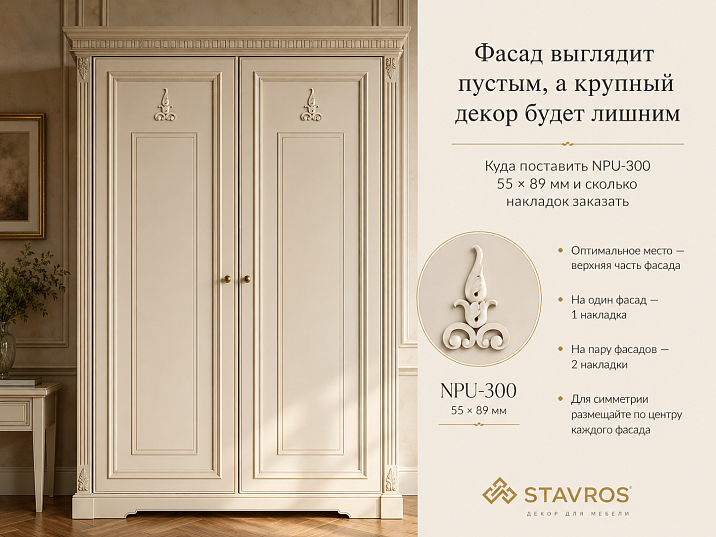
A large furniture door sometimes asks for an expressive center, while a small facade is hindered by large molding: the relief comes too close to the edges, conflicts with the handle, and visually makes the surface feel cramped. In such a situation, a different scale is useful—the compact molding decor NPU-300 measuring 55 × 89 × 8 mm. But a small overlay raises a new question for the buyer. If it takes up little space, is one piece enough? Should NPU-300 be repeated on each facade? Where to place the ornament—strictly in the center, closer to the upper third, inside a molding frame, or as a symmetrical pair?
For a wardrobe, dresser, nightstand, kitchen furniture, and doors, the answer cannot be obtained from a photo of a single item. NPU-300 must be considered together with the number of facades, their sizes, handles, and the overall composition of the furniture. The same overlay on a single door works as a small accent, on four identical facades it turns into a repeating motif, and with a scheme of "two per door" it already forms a full rhythm. Therefore, the buyer should count not just pieces in the cart, but decorative positions across the entire furniture.
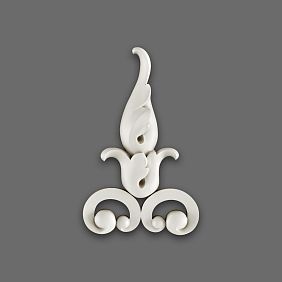
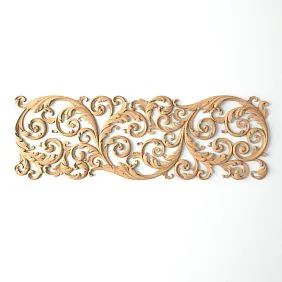
The size of NPU-300 is confirmed: 55 × 89 × 8 mm, material—polyurethane. This is a compact overlay, so it is convenient to try it on small fields, inside frames, and on a series of identical facades. If this pattern is already chosen, you can buy the molding decor NPU-300, but the quantity is better to enter into the cart only after a simple layout of the entire furniture to scale.
The main idea of the article is simple: first, determine the role of NPU-300 on each facade, then count the repetitions, after that add molding and mounting compound if they are truly needed for the project. This order protects against two mistakes at once—a lonely small detail on a huge door and, conversely, an excessive number of overlays on compact furniture.
NPU-300 in numbers: what is known before starting the layout
Before design decisions, it is useful to record the facts. There is no need to invent a second size, special configuration, or non-existent material options.
| Parameter | Confirmed value | What this gives the buyer |
|---|---|---|
| Article number | NPU-300 | Allows you to accurately record the product in the order |
| Product type | Molded decorative element, overlay | Used as a separate relief motif |
| Size A × B × C | 55 × 89 × 8 mm | Allows you to make a full-size template before purchase |
| Material | Polyurethane | Determines the selection of compatible mounting compound and finish |
| Main scenarios | Furniture, doors, interior surfaces | Provides the ability to work not only with one type of facade |
| Quantity in the project | Calculated according to the layout | You cannot automatically count "1 facade = 1 overlay" without fitting |
| Fixation method | The adhesive pattern is selected based on the base | The adhesive is checked before final finishing |
The size here is not just a card line. It sets the scale of the entire article. 55 × 89 mm means that the overlay occupies a small rectangular field. But the furniture surface itself can have a width of 300, 450, 600, or more millimeters, and handles, panels, and moldings may be nearby. Therefore, "compact" does not mean "fits anywhere."




Three sizes that need to be recorded together
When designing, it is useful to keep three groups of numbers nearby:
-
55 × 89 × 8 mm — NPU-300 dimensions;
-
width and height of the clean facade field;
-
coordinates of the handle or other fittings.
If only the first group is known, the choice is not yet made. If all three are known, a working mockup can be prepared.
Our factory also produces:



Small decor is chosen not because the furniture is small
A compact element is often perceived as an option exclusively for nightstands and drawers. This limits the possibilities of NPU-300 without reason. On a large facade, a small ornament can also work perfectly — if it is given the right role.
On a large door, NPU-300 can be placed inside a narrow molding frame. Then the scale is set not by a single overlay, but by the entire frame composition. On a wide cabinet, several identical NPU-300s can be repeated across the doors and tie the furniture into a single row. On a tall door, a compact detail can be placed in the upper part as a light motif, without fully occupying the center.
Therefore, the choice between "small" and "large" decor cannot be made only by the size of the furniture. First, the task is defined:
-
one center is needed;
-
rhythm is required on a series of facades;
-
the overlay should complement the molding;
-
a small panel needs to be filled;
-
Large relief is deliberately excluded due to the handle, frame, or overall style.
It is precisely in these scenarios that the NPU-300 gets a clear function.
Get Consultation
Start not with the entire piece of furniture, but with a clean decorative field.
The cabinet has an overall size, but the ornament is not placed "on the cabinet in general." It is installed on a specific door, drawer, panel, or inner frame area.
We will call a clean decorative field a surface area where the NPU-300 can be located without intersecting with the edge, handle, routing, molding, or functional elements.
For example, a door is 450 mm wide and 700 mm high. But a 50 mm wide frame runs along the perimeter. The actual inner field is already noticeably smaller. If a handle is located in the middle, the free area is additionally divided.
Therefore, the measurement is performed in two stages:
-
full facade dimension;
-
actual field available for decor.
Only the second one gets the 55 × 89 mm template applied.
A paper rectangle solves more than a product photo
You don't need to print a complex ornament pattern right away. Cut a 55 × 89 mm rectangle out of paper. If you need to check the relief, place cardboard about 8 mm thick underneath as a mock 3D model.
Secure the template with masking tape and look at the furniture from a normal distance. Then move it across the facade: center, upper third, area inside the frame.
This makes it visible:
-
whether the NPU-300 gets lost;
-
whether it comes too close to the handle;
-
whether a second overlay is needed;
-
whether the free margin is preserved;
-
whether to add a molding.
These questions cannot be resolved from a catalog photo because the image scale doesn't match the scale of your furniture.
Central overlay: the calmest option for a single facade
If the facade is low and symmetrical, one NPU-300 in the center is a natural first layout to check.
The center should not always be found by the outer edges. If the door has a frame, focus on the center of the inner field. If the handle is offset, evaluate the composition together with it.
One central element works well when:
-
there is enough free surface around;
-
the furniture has simple geometry;
-
the handle does not clash with the decor;
-
relief is needed as a small accent, not as the main decoration;
-
the same motif is repeated on adjacent facades.
The geometric center and the visual center may not coincide
Imagine a narrow door with a large handle at the top. If the NPU-300 is placed exactly at the geometric center, the two parts may appear visually too close. Shifting the overlay slightly lower sometimes makes the composition calmer.
On another facade, the handle is on the side, and the geometric center remains a good reference point.
Therefore, first place the template in the center, then evaluate it together with the hardware. Changing the position is acceptable if it is repeated on identical facades and recorded in the layout.
Upper third: when the center seems too formal
On a tall narrow door, small decor sometimes works better not in the middle, but above the center. This technique is especially useful if the lower part of the facade is visually occupied by a handle, plinth, or adjacent furniture.
But the "upper third" should not turn into a random point. Choose a baseline and repeat it across the entire group of doors.
For example, you can tie the top of the NPU-300 to the same distance from the top edge of the inner field. Then, even with slight variations in furniture dimensions, the row remains aligned.
Repeatability is more important than a randomly perfect position of a single part
If the cabinet consists of four identical doors, the viewer reads them as a series. A difference in overlay positions of 10–15 mm between adjacent doors will be more noticeable than a slight overall shift of the entire group up or down.
Therefore, for multiple facades, it is better to use one marking template.
NPU-300 inside a molding frame: a small detail gets a large scale
A large facade does not always require a large overlay. Sometimes it is enough to create an architectural field from molding, leaving NPU-300 as the central accent.
The frame performs two functions at once:
-
limits the empty surface;
-
increases the visual scale of the composition around a small ornament.
If such a scenario is needed, the frame is designed first, then the NPU-300 template is placed inside it.
For linear design, you can look at the section that presents polyurethane moldings buy for frames and other linear solutions. The molding itself is chosen based on the width of the specific facade, not just as "something to go with the overlay."
Why the frame cannot be added after calculating NPU-300
Suppose two overlays are already planned for each of the four doors. Then the idea arises to frame each door with molding. The free field decreases, and two NPU-300 may turn out to be too dense.
So, the quantity needs to be recalculated.
Correct sequence:
frame → clean field inside → NPU-300 layout → quantity.
Not the other way around.
One or several: this is where the order quantity is decided
A small size provokes buying 'with a larger reserve.' For a decorative project, this is not the best approach. Extra elements then often start looking for a random place, and the furniture becomes overloaded.
The quantity of NPU-300 is calculated not by area, but by the number of planned decorative positions.
| Scenario | Basic scheme | Quantity calculation |
| One small facade | 1 central overlay | 1 pc. |
| Two symmetrical doors | 1 per door | 2 pcs. |
| Chest of drawers with 3 identical drawers | 1 per drawer | 3 pcs. |
| Cabinet with 4 fronts | 1 per door | 4 pcs. |
| Two doors, 2 elements on each | Symmetrical pair | 4 pcs. |
| 6 fronts, 1 element each | Rhythm across the entire group | 6 pcs. |
| 6 fronts, decor only on the two central ones | Accent in the center of the cabinet | 2 pcs. |
These are layout options, not mandatory standards. Even on three identical boxes, you can use one overlay only on the central one — if that's how the design is built.
A simple formula for a repeating pattern
If all facades are identical and each uses the same number of NPU-300:
Q = F × N
Where:
-
Q— the total number of overlays; -
F— the number of facades; -
N— the number of NPU-300 on one facade.
For example, 4 panels × 2 overlays = 8 pcs.
The formula is elementary, but it disciplines the order. The buyer first approves N on one facade, then scales the solution to the series.
Why "one per facade" is not always the best option
Symmetry seems safe: there are four doors — we buy four overlays. But furniture can have hierarchy.
For example, a wardrobe consists of four doors, with the two central ones wider than the side ones. If you put the same NPU-300 on each, the difference in facade sizes will become even more noticeable. Perhaps it is better to leave the decor only on the central pair.
A dresser may have three small top drawers and two large bottom ones. Identical repetition on each level will create too frequent a pattern. Sometimes one motif on the top group and a different approach on the bottom looks calmer.
The quantity should follow the furniture's architecture.
A symmetrical pair on one facade: when a single NPU-300 seems lonely
Two compact elements can be arranged symmetrically relative to the vertical or horizontal axis.
This scenario is useful if:
-
the facade is wide;
-
the handle is centered and divides the space;
-
one overlay looks too small;
-
the composition is built inside a wide molding frame.
Before ordering two elements for each door, make two paper templates. One template, which you alternately move, does not show the real density of the pair.
The distance between two overlays is more important than mathematical symmetry
You can perfectly split the facade in half and still get a bad result if the two elements are too close together.
Look at the free space between them and to the edges. If the ornaments start to be perceived as one merged spot, you need to either increase the distance or go back to a single element.
Vertical pair: a good technique for a tall narrow door.
Two NPU-300 one above the other can support the verticality of the door without a large ornament.
This scheme is worth trying when one element gets lost in height, and large decor is undesirable.
However, a vertical pair doubles the quantity. For a cabinet with four doors, that is already 8 overlays. Therefore, the solution is first approved on one full door mockup.
Buying eight items "to try" is not necessary.
Horizontal pair: when the facade is wide
For a wide drawer or cabinet, two elements can be located to the left and right of the handle.
Here, the handle becomes part of the composition: overlay — handle — overlay.
Check:
-
are the distances the same;
-
does the relief interfere with the hand grip;
-
does the central zone look too dense;
-
is there space left to the side edges.
If the handle is long, even compact 55 × 89 mm may be excessive on both sides. In that case, one NPU-300 above or below the handle will be calmer.
Dresser: you need to count not drawers, but visual levels
A dresser seems like a simple example: three drawers — three overlays. But facades often differ in height.
Let's imagine four levels:
-
two small top drawers;
-
one medium;
-
one tall bottom.
If you place an NPU-300 on each, the top becomes especially busy due to the two elements side by side. You can get a beautiful effect, or you can create visual noise.
So first, photograph the dresser strictly from the front and overlay conditional rectangles of 55 × 89 mm on all intended positions.
Three working layouts for the dresser
Layout 1. One on each drawer. Suitable when the fronts are similar in size and an even rhythm is needed.
Layout 2. Only the central fronts. Suitable when a subtle accent is desired without full repetition.
Layout 3. A pair on wide drawers, no decor on narrow ones. Suitable when the sizes of the levels differ greatly.
No scheme is universally correct. The choice is determined by the layout.
Cabinet with two doors: one overlay turns into a pair automatically
A two-door cabinet is perceived symmetrically. If the NPU-300 is installed on one door, almost always the second one needs to be checked simultaneously.
Two parts can be positioned:
-
in the centers of the doors;
-
closer to the common central axis;
-
closer to the outer edges;
-
in the upper third;
-
inside identical molding frames.
The safest first layout is the same position on each door.
After that, you can experiment.
If the solution is approved, order NPU-300 made of polyurethane better to order for the entire wardrobe at once, so that a single quantity is fixed in the specification.
Four-door wardrobe: the rhythm is stronger than a single overlay
On four doors, NPU-300 is no longer perceived only as a small decorative detail. The repetition creates an independent horizontal row.
Check two alternatives:
-
one NPU-300 on each door;
-
NPU-300 only on the two central doors.
The first scheme is uniform. The second forms a center.
If the wardrobe has side sections of a different size, the second option often better emphasizes the hierarchy of the furniture.
Why you need to look at the cabinet with the doors closed
Marking each door individually can be perfect, but the overall row is not. Gaps between doors, handles, and different section widths change perception.
Therefore, the final layout is evaluated only on a fully closed facade.
Kitchen facades: small decor quickly becomes mass-produced
In the kitchen, there are dozens of doors and drawers. Even a pattern of "one overlay each" may require 12, 18, or 24 pieces.
Therefore, it is especially dangerous here to make a decision based on one facade without a general expanded view of the kitchen set.
For the kitchen, it is useful to divide surfaces into groups:
-
upper cabinets;
-
lower cabinets;
-
tall tall cabinets;
-
drawers;
-
Decorative end panels.
It is not necessary to use NPU-300 on all groups.
Upper cabinets can get decor, lower ones can remain calm.
This approach reduces the quantity and lightens the composition.
Another option is overlays only on tall cabinets and the central group.
The third is one repeat on each facade if the kitchen is small and the furniture itself is very calm.
The quantity comes from the chosen rhythm, not from the number of doors as such.
Nightstand: one NPU-300 is often sufficient.
A small nightstand is a natural scenario for compact decor. But even here you need to decide where the main plane is.
If the nightstand has one door, a central NPU-300 can fully fulfill the decorative task.
If there are two boxes, two options are possible:
-
one on each;
-
one on the common central field of the body, if the design allows it.
A large ornament on such furniture can indeed be excessive. NPU-300 allows leaving a noticeable free field around the relief.
Narrow door: check the orientation of 55 × 89 mm
The size has two sides — 55 and 89 mm. Therefore, before installation, you need to decide how the ornament is oriented in a specific composition according to its pattern and card.
On a narrow door, not only the overall dimension matters, but also which side is across the facade.
Do not rotate the element arbitrarily just to make it "fit." The orientation must preserve the artistic logic of the ornament itself.
It is better to use the product image and a physical sample as a guide, and mark the top on the layout in advance.
Panel: the NPU-300 should live inside it, not accidentally touch the frame
If a furniture front has a panel, the overall dimensions of the door become secondary. The main working area is the inner field.
Make a template of 55 × 89 mm and place it inside.
If too little space remains to the profile, the overlay will look cramped. If the field is huge, a single NPU-300 may get lost.
In the first case, it's worth abandoning this position on the specific front. In the second, add a frame composition or check the paired layout.
Molding frame and NPU-300: first draw the entire system
One of the biggest mistakes is buying the overlay and molding independently.
The molding sets the outer geometry. The NPU-300 works inside it.
Therefore, on paper or in a graphic editor, you need to see:
-
the size of the front;
-
frame distance from edge;
-
width of the selected molding;
-
inner field;
-
position of NPU-300;
-
handle.
Only after this is the basket clear.
Furniture stucco: not the entire category should go into one project
The request for furniture stucco covers dozens of options: overlays, moldings, corner elements, and other decorative shapes. But a specific facade rarely needs all of them at once.
If NPU-300 already covers the task of a small accent, there is no need to add several more large ornaments nearby just for richness.
When an alternative is needed, the section Relief Decoration helps compare overlays by scale and shape. But comparison should start with the dimensions of the free field, not with the number of beautiful pictures.
When the NPU-300 is too small
A commercial article should be able to tell the buyer, "this product is not for your task."
NPU-300 may be too compact if:
-
the door is very tall and the decor is used without a frame;
-
a large central motif needs to be formed;
-
the facade is wide, and one detail looks like a random dot;
-
the design requires an ornament occupying a significant part of the field;
-
the overlay must cover a large technical or decorative area.
In such a situation, you don't need to buy four small elements just because one is small. Sometimes it's better to choose one larger item.
If a different scale is required, you can to buy molding after comparing categories and sizes.
When the NPU-300 becomes too large
Yes, even 55 × 89 mm may not fit harmoniously.
This happens on:
-
a very narrow cabinet;
-
a small door;
-
a tight panel;
-
a facade with a large handle;
-
a surface where there is already active milling.
If the paper template fits close to the edges and the free margin disappears, don't convince yourself that everything will become easier after painting. The geometry will remain the same.
The handle is the second decorative object that cannot be ignored.
A furniture handle has not only a function but also its own visual size. A metal bracket 160 mm long and a small button interact with the NPU-300 differently.
Therefore, the layout is always done together with the hardware.
Handle below NPU-300
Classic scheme: the plate in the center of the upper part, the handle below.
We check the distance and the overall vertical axis.
Handle nearby
If the handle is on the side, the NPU-300 can remain in the center of the clean field. But you need to make sure that the hand does not touch the relief when opening.
Handle in the center
Then the plate often has to be shifted higher or use a pair on the sides. A mockup is mandatory.
Plate and handle holes: the drilling order matters
On new furniture, it's better to first approve the entire composition.
If the holes for the handle haven't been drilled yet, don't rush to drill. The NPU-300 paper template can show that the hardware is better raised, lowered, or shifted.
If the holes already exist, the decor adapts to them. You cannot expect that a small overlay will necessarily cover unnecessary holes: its shaped contour is not equal to a 55 × 89 mm rectangle.
If the goal is to hide a defect, you need the actual contour of the product.
Decorative molding and color: one overlay can become more noticeable without increasing its size
Scale isn't the only way to enhance NPU-300.
If the overlay is painted in the color of the facade, it's perceived mainly through light and shadow.
With a contrasting color, even a compact element becomes significantly more noticeable.
Therefore, before doubling the quantity, try changing the color scheme on a mockup.
Two overlays in the same tone and one contrasting one are completely different in terms of impact.
Polyurethane and 8 mm thickness: the relief needs to be seen from the side
A flat paper template shows the area, but not the protrusion.
The NPU-300 has a thickness of 8 mm. On a furniture facade, this is the actual depth that creates a side shadow and requires space next to the handle and edge.
If the facade is near an adjacent opening door, check whether a mechanical conflict occurs.
If the overlay is installed on a door, assess the adjacent trims and the movement of the panel.
Painting: first approve the quantity, then the finish
If several NPU-300 units are to be painted together with the facades, their quantity and placement must be finalized before the final finish.
Otherwise, after painting, it may turn out that:
-
one overlay is not enough;
-
the second one does not fit next to the handle;
-
The adjacent facade needs the same decor;
-
The frame requires a change in position.
Before finishing, take a photo of the approved layout and record the anchor dimensions.
Mounting compound: do not buy "just glue" together with the decor
For a polyurethane overlay, a compound compatible with the material and the specific substrate is needed. Painted MDF, wood, a prepared wall, and a door leaf may require different preparation.
Therefore, before installation, it is useful to study the material molded decoration adhesive and then check the recommendations of the chosen compound for your specific facade.
Glue should not become a way to fix an incorrect layout. First the position, then the fixing technology.
What to order together with NPU-300
The set depends on the composition. The minimum purchase may consist only of the required number of NPU-300 and a suitable mounting compound. For a framed facade, moldings are added. For a complex composition, other compatible decorative elements.
| Position | Why it's needed | When to add | What to check |
| NPU-300 | Main compact ornament | After layout approval | Quantity, position, orientation |
| Additional overlays | Continuation of the motif | Only if one shape is not enough | Scale and density of composition |
| Polyurethane molding | Frame formation | For frame facades and doors | Inner field size after installation |
| Decor for moldings | Development of frame scheme | For complex corners and compositions | Scale compatibility |
| Mounting compound | fixation | After determining the base | Compatibility with polyurethane and facade |
If you need this exact product item, buy polyurethane overlay decor for furniture you can do so directly in the NPU-300 card after calculating the quantity for the entire furniture set. For additional shapes, it is better to move to the category only after NPU-300 has already found its place on the layout.
Decor for moldings: when it helps, and when it only overloads
A small overlay inside a frame sometimes calls for a corner or connecting element. But this feeling is better checked on the layout.
If the four corners of the frame are already expressive on their own, additional decor is not needed.
If the frame is complex and requires a connecting motif, you can buy polyurethane decor after comparing sizes with the NPU-300.
The main criterion is not the number of details, but the hierarchy. The NPU-300 should remain readable, not disappear among a dozen neighboring ornaments.
One piece of furniture — one rhythm: do not change the layout from door to door without a reason
Imagine a cabinet with six identical fronts. On the first, the NPU-300 is centered, on the second it is higher, on the third closer to the handle. Each decision individually may be acceptable, but together they look like an installation error.
If the fronts are identical, the alignments should also repeat.
The exception is a deliberate hierarchy: for example, the central doors have two overlays each, the side ones have one. Then the difference is built into the design and reads symmetrically.
How to make a template for a series of fronts
For repeated furniture, a simple template made of thick cardboard is useful.
On it, mark:
-
top edge of the facade;
-
side base;
-
center of NPU-300;
-
outline 55 × 89 mm;
-
handle position.
The template is alternately applied to each door.
This way the placement is repeated without constant measurements.
If the facades are of different sizes, a separate template is created for each group.
How to calculate the quantity for a complex kitchen set
When furniture consists of several types of facades, it is convenient to make a list.
| Facade group | Number of facades | NPU-300 per facade | Total |
| Upper doors | 6 | 1 | 6 |
| Lower doors | 4 | 0 | 0 |
| Tall cabinets | 2 | 2 | 4 |
| Drawers | 3 | 1 | 3 |
| TOTAL | 13 |
The numbers in the example are conditional, but the principle works: each group gets its own scheme.
This way you don't forget the small facade and don't buy extra elements for surfaces where decor is not intended.
Is a reserve of NPU-300 needed
A universal percentage for a piece decorative item is not needed.
If the project consists of two overlays on a cabinet, automatic '+10%' is meaningless.
If a large series of furniture is being designed and there is a risk of damage during installation or a reference sample is required, a reserve may be justified. But the amount of reserve is determined by the project itself.
The main purchase must match the approved items.
What to do if the layout results in an odd number
An odd number by itself is not an error.
A dresser with three identical drawers quite naturally requires 3 NPU-300.
The problem only arises where mirror symmetry is intended, and the number violates it.
For example, two identical doors should receive the same number of elements. Then the total for that pair will be even.
Check not the arithmetic as such, but the structure of the furniture.
Door: NPU-300 may be too light as a center, but a good detail inside a frame
A tall door leaf is a large scale. One 55 × 89 mm overlay in the middle may get lost.
But this does not mean that NPU-300 cannot be used on a door.
Working scenarios:
-
inside a small panel;
-
at the top;
-
in the center of the molding frame;
-
repeated in several identical fields;
-
as a supporting element next to a larger architecture.
If the door is smooth and lacks other lines, be sure to compare one NPU-300 with a larger-scale alternative.
Series of doors in a corridor: the quantity is counted by the visible system
Suppose there are five identical doors in a corridor. You can install NPU-300 on each one — that makes 5 pieces. But if two doors are almost always hidden in side niches, and three form the main perspective, the designer may choose decor only for the visible group.
This is no longer a furniture calculation of "number of panels = number of elements," but an interior composition.
The article helps avoid automatically buying five pieces when the project needs three.
Small wall frame: NPU-300 extends beyond furniture
The compact relief can also be used on an interior surface. In a small molding frame, it can become the focal point.
The same logic applies here:
-
measure the inner field;
-
place the template;
-
decide whether it's one overlay or several;
-
only then count the number of identical frames.
If there are six identical fields on the wall, it's not necessary to install NPU-300 in all six. You can highlight the two central ones.
Commercial interior: a small element is only beneficial with precise quantities
In a cafe, salon, hotel, or store, the same decor often repeats on dozens of furniture panels.
Here, a quantity error is especially unpleasant: two missing overlays can halt the finish of the entire series, while an extra dozen turns into unnecessary leftover.
Therefore, first one reference facade is established. Then the scheme is scaled according to the specification.
For a large series, it is useful to store:
-
a photo of the reference;
-
NPU-300 coordinates;
-
orientation;
-
color;
-
installation method;
-
quantity per furniture unit.
Small decor and a large handle: what should be the main focus
If an expressive long handle is installed on the facade, NPU-300 does not have to compete with it.
You can make the handle the main functional accent, and the overlay a quiet support at the top.
Attempting to place two or four NPU-300 around large hardware sometimes creates too many focal points.
Therefore, on the mockup it is useful to cover the overlay with your hand or a sheet of paper and compare the facade. If the composition is already saturated without it, NPU-300 may not be needed on that particular door.
A small handle and an empty field: here NPU-300 is especially appropriate
The opposite situation — a small button on a large smooth surface.
The handle does not fill the field, and the facade seems empty.
NPU-300 can add relief without turning the furniture into a heavy decorative composition.
This is one of the most natural scenarios for the product: not to replace the entire facade architecture, but to add a small motif where a large overlay would be excessive.
How not to confuse NPU-300 with wooden N-300
The catalog contains products with similar designations. Therefore, the full article number is important in the order.
NPU-300 is a polyurethane molded decor measuring 55 × 89 × 8 mm.
A similar numeric designation does not mean the same product in a different material and does not give the right to automatically transfer characteristics between cards.
In the specification, always write NPU-300, not just "300".
How not to confuse compact decor with a large central overlay
The main difference is in the role.
NPU-300 is convenient where:
-
a small motif is needed;
-
the decor repeats;
-
the field is limited;
-
there is a handle nearby;
-
the frame already sets the scale.
A large overlay is needed when one element must independently hold a large field.
If you are forced to install six NPU-300 just to visually replace one large center, perhaps the wrong type of product was chosen.
How not to confuse an overlay with molding decor
Practical selection: furniture is already in place, but seems empty
There is no need to remove the facades right away.
First, cut out several paper NPU-300 and secure them with painter's tape.
Try one, two, a repeat on several doors.
Take a photo of each option.
The next day, review the photos: decorative density is better assessed after a short pause than during endless rearranging of templates.
What to do with an already painted facade
If the furniture is ready, before gluing you need to check the condition of the coating and the compatibility of the mounting compound.
You cannot assume that any glue works equally well on any paint.
First, the base is studied, then a test is performed on an inconspicuous or test area according to the manufacturer's recommendation for the compound.
It is better to make markings with painter's tape to avoid leaving unnecessary marks.
What to do with a new facade for painting
On a new project, there is more freedom.
Before painting, you can:
-
approve the exact position;
-
align the NPU-300 with the frame;
-
adjust the handles;
-
decide whether the overlay is painted together with the facade or separately.
But there is no need to glue the decor without understanding the entire technological sequence. The coating and installation system must be agreed upon in advance.
Tone-on-tone or contrast: how color affects quantity
This is a non-obvious but useful criterion.
If the NPU-300 is painted in the color of the facade, the two elements can be perceived softly.
If the overlays are contrasting, the same two parts become stronger.
Therefore, the "two each" scheme in a monochrome version and the "two each" scheme in a contrasting version are visually different.
Before increasing the quantity, first determine the color.
Relief and side light: 8 mm start to work more actively
Under frontal diffused light, the overlay looks calmer.
Under side lighting, the shadow increases the contrast of the relief.
In the kitchen, this could be under-cabinet lighting, in the bedroom — sconces, in the hallway — track lighting.
If light runs along the facades, the NPU-300 may look more noticeable than in a daytime photo without shadows.
Therefore, the mockup should be viewed in the evening under the room's working lighting.
What to buy together: not a set, but a complete scheme
A commercial order must match the project.
If a simple single overlay is needed, the cart is minimal.
If a series of framed facades is being designed, the cart expands.
Example logic:
NPU-300 → quantity per the list → molding along frame perimeters → additional decor only if necessary → installation compound.
To select adjacent overlays, you can Buy Molded Decoration after the scale of the NPU-300 is known. This way, additional items complement the project rather than randomly altering it.
Control facade before the series: one fitting should answer all questions
When the NPU-300 is planned to be used not on a single item but on a series of identical facades, the most useful purchasing operation occurs before placing the full quantity. You need to select one control facade and assemble the entire future look on it at a 1:1 scale.
The control facade does not necessarily have to be already manufactured. To check proportions, a sheet of cardboard, foam board, or another material cut to the real dimensions of the door is suitable. On it, mark the edges, molding frame, handle, and the outline of the NPU-300 55 × 89 mm. If two overlays are intended, the mock-up must have exactly two. If the order will have one per door, then one.
Why such preparation when the dimensions are already known? Because arithmetic answers the question "does it fit," while the facade mock-up answers "does it look intentional." There is a big difference between these answers. An overlay may physically fit with a huge margin but appear too small. Or, conversely, it may fit confidently, but together with the handle and frame create too dense a center.
On the control facade, it is convenient to confirm five decisions at once:
-
the number of NPU-300 per door;
-
position relative to the vertical and horizontal axes;
-
distance to the handle;
-
presence or absence of a molding frame;
-
color logic — tone-on-tone or contrast.
After this, one facade becomes the standard for the entire group. If a cabinet has six identical doors, there is no need to reinvent each one: the approved scheme is simply repeated six times. If the set consists of three types of doors, a separate standard is needed for each type.
A photo of the standard helps not to lose the solution during installation
After approval, take a photo of the facade strictly from the front and make one side shot where the protrusion of the overlay is visible. In the photo, it is useful to label the distances to the base edges. Such a simple document saves from a situation where the designer approved the layout, the purchaser ordered the correct quantity, and the installer, weeks later, recalls the scheme from correspondence or a random screenshot.
For a small home project, this is a matter of convenience. For a series of furniture, it is already a matter of repeatability of the result.
Layout on facades of different heights: the same number from the edge does not always give the same impression
Imagine a cabinet where the lower doors have one height and the upper mezzanine doors have another. If all NPU-300 are set to the same distance of 120 mm from the top edge, technically the marking will be uniform. Visually — not necessarily.
On a low mezzanine door, such a distance may place the overlay almost in the center. On a tall door, the same offset will leave it clearly in the upper part. Therefore, identical facades are marked with one template, and different groups of facades are evaluated separately.
Two methods of anchoring are useful here.
The first is absolute: the center of the NPU-300 is at a specific distance from the top and side edges. It is convenient for series of identical parts.
The second is compositional: the overlay is centered within a clean field or a molding frame. It works better when the facade sizes differ.
There is no need to declare one method correct in advance. It is enough to specify in the specification the one that produced a convincing layout.
Overlays on adjacent facades should form a common line
If several doors are placed side by side, the eye connects identical NPU-300 into a horizontal row. Therefore, the placement height must be checked not only within each door, but also between adjacent facades.
This is especially noticeable on a long kitchen unit or a wall-to-wall wardrobe. A shift of one overlay seems small when measuring a single door, but in a row of six elements it turns into a noticeable "jump" in the line.
Before installation, draw a common horizontal line through the centers of all overlays on the layout. If the facades are of equal height, such a row should usually be level. If the door sizes differ, a different logic is allowed, but it must be consciously readable—for example, each NPU-300 is centered within its own frame.
The amount of molding and the number of NPU-300 are calculated in different ways
In a frame composition, it is easy to mix two calculation systems. NPU-300 is a piece item. Molding is a linear element. Therefore, the cart is assembled using two separate calculations.
For overlays, the number of decorative positions is used: facades are multiplied by the number of NPU-300 on each.
For molding, the perimeter of the frames is calculated taking into account the actual dimensions and cutting of the selected profile.
If there is one overlay on each of four facades, you need 4 NPU-300. But the amount of molding cannot be derived from the number "4" — you need the width and height of each frame. A wide facade and a narrow facade each have one overlay, yet the linear footage consumption differs.
This division protects against a typical purchasing mistake: "four facades means four sets of everything." The decorative system has different units of calculation.
A preliminary layout helps to understand whether additional decor is needed at all.
After the NPU-300 is placed, it is useful to remove all other future decorations from the layout for a few minutes and look only at the facade, the overlay, and the handle. If the composition already looks complete, there is no need to add elements just to make the cart seem "full."
Then you can return the molding frame, corner decor, or a second NPU-300 one by one. This method clearly shows the contribution of each detail. If after adding an element the facade does not become clearer but only denser, that item can be excluded.
For the buyer, this is a direct commercial win: exactly the items that are part of the approved project are ordered. For the appearance, too: a small NPU-300 retains its strong point, namely a neat scale and free space around the relief.
Mistakes that turn small decor into a big problem
Mistake 1. Buy one NPU-300 and only then decide where to place it
This way the product starts dictating the project. It is more correct to first make a 55 × 89 mm template and find a place.
Mistake 2. Consider one facade separately from the entire piece of furniture
On a series of doors, repetition creates a strong rhythm. You need to look at the entire cabinet or set.
Mistake 3. Automatically placing one on each door
The quantity should follow the hierarchy of the furniture, not the arithmetic of the panels.
Mistake 4. Buying two per facade because one seems small on the table
On a real surface, two pieces may turn out to be too dense. You need two full-size templates at the same time.
Mistake 5. Not accounting for the handle
After installation, the hardware will not disappear. It must be part of the layout.
Mistake 6. Measuring the entire door instead of the inner field
Panels and frames reduce the available space.
Mistake 7. Adding molding after the layout has been approved
The frame changes the internal field, so the NPU-300 needs to be tried on again.
Error 8. Using small overlays as a replacement for one large decor without checking
Four small ornaments create rhythm, not one large center. These are different compositions.
Error 9. Buying a universal percentage of reserve
For piece goods, the reserve is determined by the risk of a specific project.
Error 10. Not fixing the orientation
On a series of facades, rotating one detail can destroy the overall rhythm.
Error 11. Drilling handles before approving the decor
On new furniture, it is better to first see both parts together.
Error 12. Trying to cover old holes with a size of 55 × 89 mm
The shaped overlay does not fill the entire rectangle. A real contour is needed.
Error 13. Buy glue only by the word "polyurethane"
The material and coating of the base must be taken into account.
Error 14. Paint the entire series before the control assembly
If the layout has to be changed, reworking finished facades will become more difficult.
Error 15. Mix different patterns on identical doors
The repetition must be exact. Exceptions are made only as a deliberate hierarchy.
Error 16. Add more decor just because the NPU-300 is small
The free field is part of the design. The emptiness around the ornament does not necessarily mean a lack of detail.
When the NPU-300 is really suitable
This overlay is especially interesting if you need:
-
a subtle relief on a furniture facade;
-
a repeating motif on a series of doors;
-
decoration inside a molding frame;
-
a neat element next to a handle;
-
a paired composition on a wide facade;
-
a small detail for a door or interior panel.
The compact size allows you to work with quantity and rhythm, rather than forcing you to build the entire surface around one large ornament.
When to choose a different article
NPU-300 does not need to be used at any cost.
A different decor is more reasonable if:
-
55 × 89 mm is too small for a single center;
-
even such a size is too tight for a panel;
-
a corner element is needed;
-
an elongated vertical shape is required;
-
a large central motif is needed;
-
the pattern does not match the furniture;
-
the composition requires a different type of element.
In this case, the request to buy polyurethane stucco decor is better used as a reason to compare the category, rather than multiplying the quantity of unsuitable NPU-300.
How to format the specification so that the quantity is not lost
Bad entry:
NPU-300 — several pieces.
Good record:
NPU-300, polyurethane, 55 × 89 × 8 mm — 8 pcs.; 2 pcs. per 4 facades; placement according to the approved template.
For other furniture:
NPU-300, polyurethane, 55 × 89 × 8 mm — 3 pcs.; 1 pc. per each dresser drawer.
This way, the buyer, the furniture maker, and the installer understand the same scheme identically.
How to buy NPU-300 on STAVROS and not return to recalculating
Before adding the quantity to the cart, prepare a short list.
Write down:
-
number of facades of each type;
-
number of NPU-300 per facade;
-
group total;
-
grand total;
-
presence of frames;
-
need for assembly adhesive.
After this, the product card becomes the final point of purchase, not a place for design considerations.
If the scheme is approved, you can buy NPU-300 molding decor immediately in the calculated quantity for the entire furniture set.
Pre-payment check: seven questions
First. Has the 55 × 89 mm size been verified on a real facade using a template?
Second. Has the position been agreed upon together with the handle?
Third. If there are several facades, are all templates shown simultaneously?
Fourth. If there is a molding, is the inner field calculated after the frame?
Fifth. Is the quantity calculated by facade groups?
Sixth. Is the orientation of each overlay determined?
Seventh. Is the mounting compound selected for polyurethane and the specific substrate?
If all questions have answers, the order is no longer based on assumptions.
FAQ: NPU-300 55 × 89 mm on furniture and doors
What is the size of NPU-300?
The confirmed size is 55 × 89 × 8 mm.
What material is NPU-300 made of?
made of polyurethane.
Will the NPU-300 fit on a furniture facade?
Yes, the item is considered a compact decorative overlay for furniture and other interior surfaces. The specific placement needs to be checked on the facade.
How many NPU-300 units are needed for one door?
Most often, one is tried on first. If it gets lost on a wide field, you can check a paired layout. There is no strict standard.
How many should I order for two identical wardrobe doors?
If using one overlay on each — 2 pcs. If using two on each — 4 pcs. The decision is made after a mock-up of both doors simultaneously.
How many are needed for a dresser with three identical drawers?
With the "one per each" scheme — 3 pcs. But you can decorate only part of the facades if the composition is built that way.
How many are needed for a wardrobe with four doors?
With a uniform scheme of one per door — 4 pcs. With decoration of only the central pair — 2 pcs. With a paired layout on each — 8 pcs.
Where is the best place to install the NPU-300 — in the center or at the top?
First, check the center of the clean decorative field. The upper third is useful on tall facades or when there is a conflict with the handle.
Do I need to take the handle into account?
Definitely. It occupies part of the field and affects the visual center.
Can I place two NPU-300 units side by side?
A paired layout can be considered on a wide facade. Before ordering, place two full-size templates at the same time.
Will the NPU-300 suit a tall door?
It may suit as a small element inside a panel or molding frame. For a standalone center on a large smooth door, it may be too compact.
Is molding needed around NPU-300?
Not necessarily. On a small facade, a single overlay can work on its own. A frame is needed when it solves the composition task.
How to calculate the quantity for a kitchen?
Divide the facades into groups, set the number of NPU-300 per facade in each group, and add up the results.
Do we need to take a reserve?
There is no universal percentage. For piece decor, the reserve is determined by the project scale and installation risk.
Can NPU-300 cover old handle holes?
Only after checking the actual contour. The 55 × 89 mm dimension does not mean that polyurethane covers this entire rectangle.
What to do if one NPU-300 looks too small?
Try a frame, a paired layout, or another larger item. No need to automatically buy many small pieces.
What to do if two look too heavy?
Go back to one or change the position. The free space around the decor also contributes to the appearance.
Can NPU-300 be used on all facades of different sizes?
It is possible if a separate fitting on each facade type shows a normal scale. The same article number does not have to have the same layout on different sizes.
How to achieve the same position on a series of doors?
Use a cardboard template with base edges and the center of the overlay.
Do you need to paint the facade first or glue the decor?
The sequence depends on the chosen finishing system and adhesive. It is better to determine it before starting finishing work.
What adhesive is needed for NPU-300?
You need a mounting compound compatible with polyurethane and the specific substrate. A universal choice without checking the substrate should not be made.
Can NPU-300 be glued onto an already painted facade?
The possibility depends on the coating and the adhesive composition. You need to check the strength of the coating and the compatibility of the materials.
Will NPU-300 be suitable for a molding frame?
Well, as a possible central motif, if the size of the inner field fits. First, the frame is built, then the overlay is tried on.
Can the NPU-300 be used on a wall composition?
It can be considered as a compact relief element of an interior surface. The quantity is determined by the number of frames or decorative fields.
How does the NPU-300 differ from a large overlay?
First of all, by scale and role. It is convenient as a small independent accent or a repeating motif; large decor more often holds a large surface on its own.
Where can I see other overlays if 55 × 89 mm does not fit?
In the category, you can buy stucco decor after comparing the sizes and purposes of other items.
Where should I look for additional elements for a frame composition?
In the section of decorative polyurethane elements and in the molding category. Add them only after approving the main NPU-300 layout.
How do I finalize an order for a furniture maker?
Write down the article number, size, quantity, number of parts for each type of facade, and attach a layout diagram.
Can I order NPU-300 first as a single piece for fitting?
The product is sold per piece in the listing, so the quantity can be selected in the order. Current availability and shipping conditions are checked right before purchase.
A small overlay requires great attention to quantity
NPU-300 solves a very specific task. When a facade seems empty, but a large relief would take up too much space, the compact 55 × 89 × 8 mm allows adding a decorative motif neatly. But the advantage of the small size is only revealed when the buyer manages the repetition.
One NPU-300 on a door is an accent. Two are a pair. Four identical overlays on a cabinet create rhythm. Eight on four facades already form a rich decorative system. Therefore, the quantity cannot be chosen separately from the layout.
Before purchasing, it is enough to do a few simple things: measure the clear field, cut out templates, place handles in position, show all identical facades at once, and count each approved item. If NPU-300 is used inside a frame, the molding is designed first. If the facade is already saturated, it is better to skip the additional overlay. If 55 × 89 mm gets lost on a large door, it is more appropriate to compare larger decor rather than mechanically multiply small elements.
STAVROS company allows assembling such a composition sequentially: choose a specific NPU-300, compare other polyurethane overlays, select moldings, and figure out the mounting compound. But the best order starts not with the 'add to cart' button, but with a ready layout.
First, decide where each NPU-300 goes and why it is needed there. Then count the quantity. After that, you can place the entire set without accidentally overdoing the decor on already finished furniture.