Article Contents:
- What is an architrave and why it is more important than it seems
- What types of wooden architraves are there
- By Profile
- By width
- By coating
- How to choose the width of an architrave: proportion and scale
- Principle of proportion
- Narrow architrave (30–50 mm)
- Medium architrave (60–80 mm)
- Wide architrave (90–120 mm and more)
- Smooth, shaped or carved: what to choose
- Smooth trim: for those who value purity of form
- Shaped trim: architectural classic
- Carved trim: heritage of a living craft
- How to choose the color of a wooden trim
- Door color
- To match the color of the wooden baseboard
- Matching the floor color
- To match the furniture color
- For painting
- Contrast
- Trims and baseboards: how to make a beautiful joint
- Rule one: a unified system
- Rule two: thickness coordination
- Rule three: height coordination
- Rule four: one profile
- Complex joints
- Trims for different doors and openings
- Interior Doors
- Openings without a door
- Doors in a country house
- Classic paneled doors
- Modern invisible doors
- Wooden trims in different interior styles
- Classic
- Neoclassicism
- Russian style
- Modern Interior
- Jatoba
- Loft
- Advantages of wooden trims over MDF and plastic
- Mistakes when buying wooden trims
- What to buy together with wooden trims
- How to buy wooden trims without mistakes: step-by-step algorithm
- About the Company STAVROS
- FAQ: answers to popular questions about wooden architraves
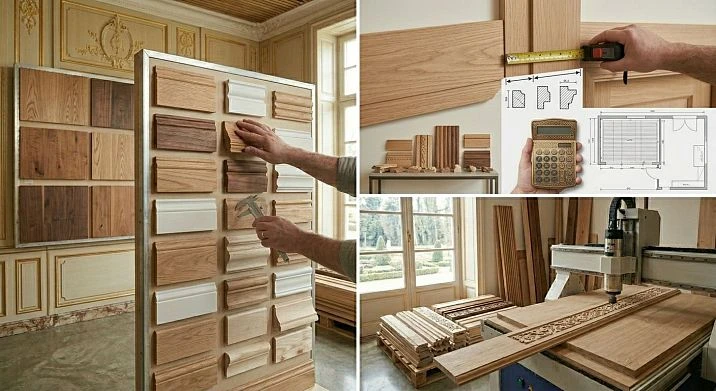
There are details that go unnoticed — and it is they that hold the interior together. A wooden door architrave is one of them. When it is right: the right size, the right profile, the right tone — the room looks complete, the door is integrated into the space, and everything seems natural. When the architrave is chosen at random — narrow next to a high skirting board, plastic on a wooden door, dark against light walls without any system — the eye stumbles, not understanding what exactly is wrong. And what is wrong is precisely the architrave.
If you want to buy wooden architraves and do it professionally — with an understanding of width, profile, junction with the skirting board, matching the door and overall finish — this guide will cover all the questions. There is no fluff and no theory for theory's sake. Only specifics that can be used right now.
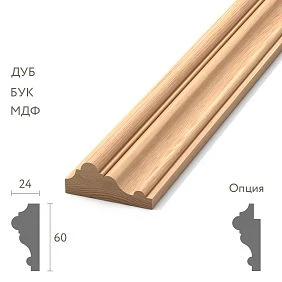
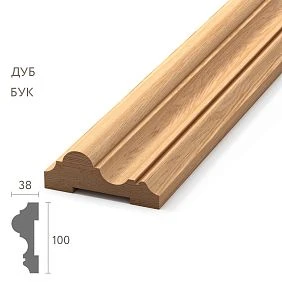
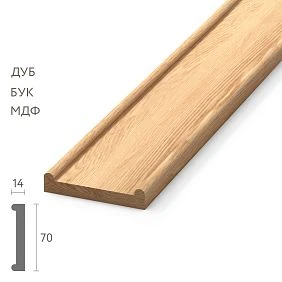
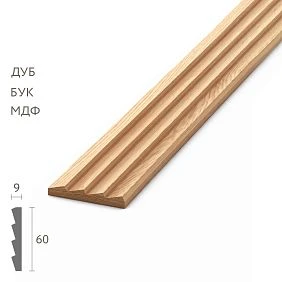
What is an architrave and why it is more important than it seems
An architrave is a decorative strip that covers the joint between the door frame and the wall. Technically, it is a simple detail. Architecturally, it is one of the most significant in the interior, because the architrave is seen every time you enter a room or walk past.
Functions of a wooden architrave:
-
covers the installation gap between the frame and the wall;
-
protects the edge of plaster or drywall from chips and damage;
-
visually frames the doorway, making it architecturally complete;
-
connects the door with the skirting board, moldings, floor, and furniture into a unified system;
-
in a classic interior, it becomes a decorative element carrying a stylistic statement;
-
in the Russian style and a country house, it can be a carrier of carved ornamentation and national wooden character.
That is why the casing is not a "technical" choice made by default. It is a conscious decision made in the context of the entire finish.




What types of wooden casings are there
Before moving on to a specific choice, it is important to understand the typology. Wooden casings they are divided according to several criteria.
Our factory also produces:
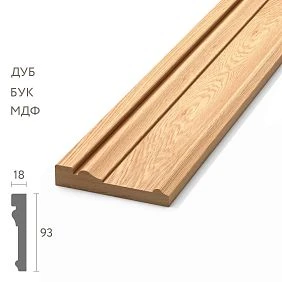
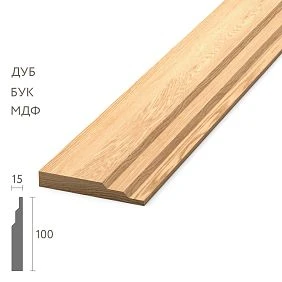
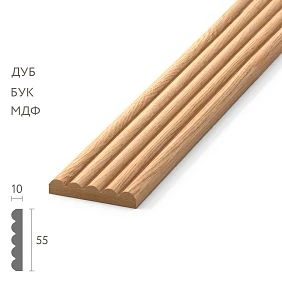
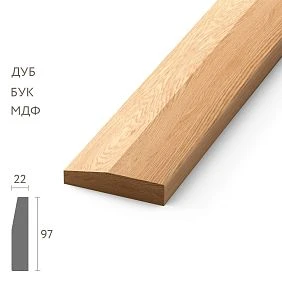
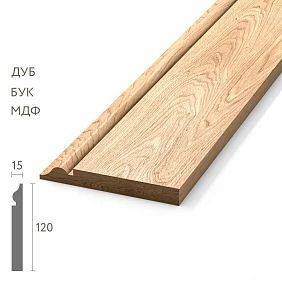
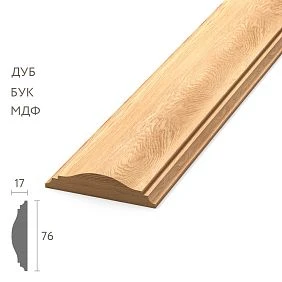
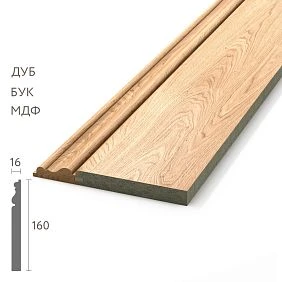
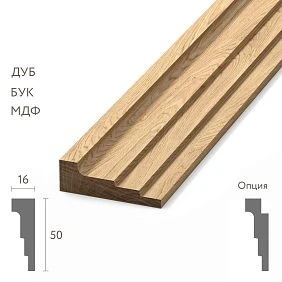
By profile
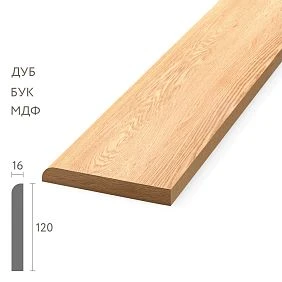
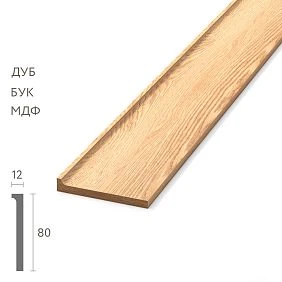
A smooth casing — a rectangular cross-section with minimal chamfers or roundings. Laconic, architectural, requires no additional context. Works well in modern interiors, minimalism, Japandi.
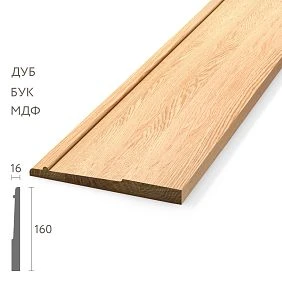
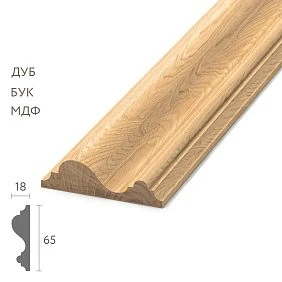
A shaped casing — a profile with several transitions, shelves, fillets, or steps. A classic option for paneled doors, neoclassicism, and interiors where Wooden moldings и Wooden baseboard they create a unified architectural system.
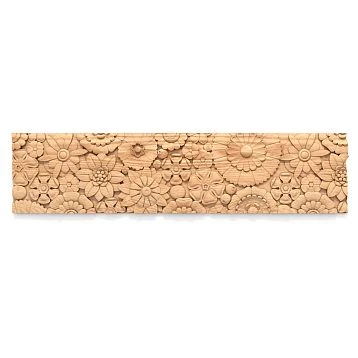
A carved casing — with ornamentation made by wood carving. For the Russian style, country houses, interiors with wooden decor. A carved wooden door casing with a pattern is already an artistic product that sets the tone for the entire room.
Get Consultation
By width
Narrow (30–50 mm), medium (60–80 mm), wide (90–120 mm and more). The width is chosen depending on the door size, ceiling height, and the overall "weight" of wooden details in the interior.
By coating
Under varnish, under oil, under stain, for painting, or without coating. Each option opens different possibilities: varnish preserves the natural color, oil highlights the texture, stain changes the tone, painting allows you to "integrate" the trim into the color of the walls or doors.
How to choose the width of the trim: proportion and scale
The width of the trim is the first thing to decide. It sets the visual scale of the doorway.
Principle of Proportion
A good guideline: the width of the trim should be approximately 1/15–1/20 of the door leaf width. For a standard door 800 mm wide, this is 40–55 mm. For a 900 mm door — 45–60 mm. For grand double doors — 70–100 mm.
But proportion is only a starting point. Context matters more than math.
Narrow trim (30–50 mm)
Minimalistic, almost invisible. Good for modern and Scandinavian interiors, where the door should be part of the wall, not an accent. If the room has high Wooden baseboard 100–120 mm, a narrow 30 mm trim will look disproportionate — the baseboard will "outweigh" it.
Medium casing (60–80 mm)
A universal solution for most apartments. Expressive but not aggressive. Pairs well with baseboards 70–100 mm. Suitable for standard-height interior doors in living rooms.
Wide casing (90–120 mm and more)
An architectural statement. Ideal for classic, neoclassical styles, studies, living rooms with high ceilings, and country houses. A wide wooden casing adds grandeur to the doorway — especially when paired with a tall baseboard made of the same material and solid wood moldings from the same series.
Smooth, shaped, or carved: what to choose
This is a stylistic decision — and it depends not only on taste but also on the doors, furniture, wall finishes, and everything else already present or planned in the room.
Smooth casing: for those who value purity of form
A smooth wooden door casing is not a "modest" or "cheap" choice. It is a choice of architectural purity. In an interior built on geometry and material quality without excessive decoration — a smooth oak casing with clear oil looks more expressive than the most intricate carved profile.
Smooth casings are chosen for:
-
of a modern interior with laconic doors;
-
of Japandi and Scandinavian style;
-
of minimalism with an emphasis on natural texture;
-
a bedroom where there should be few details, and each one should be precise.
Shaped architrave: architectural classic
A shaped profile — several steps, fillets, or shelves in cross-section — is an architrave with 'character'. It doesn't just cover the gap; it forms the frame of the doorway, making it visually more majestic.
It is worth buying a shaped wooden architrave when:
-
doors with panels or classic glazing bars;
-
the interior has Wooden moldings or decorative wooden frames;
-
the baseboard has a more complex profile;
-
interior style — classic, neoclassical, art deco.
Carved architrave: a legacy of living craftsmanship
Carved wooden decoration on the architrave — it is no longer a finishing detail, but a work of art. The ornamental pattern, executed by carving in solid wood, turns the doorway into an architectural accent of the entire room.
A wooden door architrave with a pattern is chosen for:
-
a country house with wooden beams, staircase, and natural finishes;
-
Russian style, where carving is part of the national aesthetic;
-
studies and libraries, where wood carries semantic weight;
-
entrance areas and stairwells, where the opening is the main architectural event.
How to choose the color of a wooden architrave
The color of the trim is not a separate decision. It is an answer to the question: what exactly should the trim create unity with?
Matching the door color
A trim of the same tone as the door makes the opening monolithic. The door together with the frame is perceived as a single object. This is a strict, geometrically precise solution. Good for modern interiors where the door is part of the wall, not an accent.
In the color of the wooden baseboard
If there is {name} in the room Wooden baseboard made of solid wood, a trim of the same tone creates a "wooden contour" of the space: below — the baseboard, around the doors — the trims, along the ceiling — the cornice or molding. This is the highest level of architectural consistency.
Matching the floor color
A soft, calm solution. The gaze glides from the floor to the door, without noticing the transition. Good for bedrooms and children's rooms where an atmosphere of peace is important.
Matching the color of furniture
For a study with dark wooden shelves, dark doors, and a massive desk — a trim of the same dark tone creates internal logic. Wooden handles on cabinets and drawers in the same shade finalize the system.
For painting
When a wooden profile is needed, but the color must match white or painted doors — Solid wood casings without coating, they are primed and painted. Solid wood holds paint more firmly and longer than MDF: fewer cracks, fewer delaminations, more resistance to deformation.
Contrast
A dark trim on a light wall is a design technique that only works when supported by a system: dark doors, dark baseboard, dark furniture. Contrast for the sake of contrast — without repetition in details — looks accidental.
Casing and baseboard: how to make a beautiful joint
The joint of the casing with the floor baseboard is the main technical and aesthetic node when finishing a doorway. It is here that "ugly" moments most often occur, which everyone then notices, although they find it difficult to explain what exactly is wrong.
Rule one: a unified system
Wooden baseboard и Wooden casings should be chosen together — from the same series, from the same material, in the same tone. This is not a recommendation, but a condition for a good result. Pogonazh iz massiva is produced precisely as a system: casings, baseboards, moldings, cornices are coordinated in geometry and tone within one series.
Rule two: thickness coordination
The thickness of the casing should be equal to or slightly greater than the thickness of the baseboard. If the baseboard is thicker than the casing, a step forms at the base of the door, which looks like a mistake. If the casing is thicker, the baseboard "goes" under its base, and this is already correct architectural logic.
Rule three: height coordination
A baseboard 120 mm high next to a casing 30 mm wide is a visual imbalance. A high Wooden baseboard requires a casing of proportionate width. A medium baseboard 70–80 mm goes well with a casing 60–80 mm.
Rule four: one profile
For classic style — a shaped profile for both the casing and the baseboard. For a modern interior — a straight profile for both. Mismatched profile styles are one of the most common reasons why "something is off," but it's unclear what.
Complex joints
In situations where the casing and baseboard meet at a non-standard angle, in a niche, or near a threshold, additional elements are needed. A neat 45° cut or a special corner piece from solid wood trim — is better than trying to fix the joint on-site with makeshift tools.
Casings for different doors and openings
There is no universal casing — because there is no universal context. The type of door, type of opening, and room conditions dictate the solution.
Interior doors
This is the main scenario. Bedroom, living room, study, children's room, dressing room — each room has its own scale, its own lighting, its own rhythm of life. For a bedroom — a quieter profile, soft tone, natural texture. For a study — a more expressive, status profile, dark tone, connection with wooden furniture and decorative inlays.
Openings without a door
An open doorway without a door requires careful edge finishing. Without a casing, the edge of the wall or drywall looks unfinished. A wooden casing on an open opening makes it architectural — forming a frame for the transition between rooms.
Doors in a country house
In a country house, the architrave works in a powerful wooden context: beams, stairs, wooden floors, wooden frames, solid wood furniture. Here the architrave must be of the same language: wide profile, natural wood, varnish or oil without masking the texture. Carved ornament is organic in a country house — it doesn't need justification, it belongs there.
Classic doors with panels
Doors with vertical and horizontal panels require a shaped architrave — it continues the architectural logic of the door leaf itself. A smooth architrave next to a paneled door is a stylistic dissonance.
Modern invisible doors
Hidden doors built into the wall usually do without a traditional architrave — or use a minimal aluminum profile. If a wooden architrave is still needed in such an interior, it should be as smooth and light as possible.
Wooden architraves in different interior styles
Classic
Tall, shaped, coordinated with wooden moldings and baseboard. Color — natural oak or walnut tone, or white for painting. In classic style, the architrave is part of the architectural hierarchy: from baseboard through architrave to cornice — everything in a single wooden language.
Neoclassicism
A calmer profile, light shades, precise geometry. A neoclassical architrave is classic without baroque. There are molding transitions, but they are soft, not overloaded. It pairs well with white or light gray walls.
Russian Style
Carved wooden door trims are not an exotic choice but a historically grounded one. Russian wooden architecture has always revolved around carving: trims, shutters, cornices, and eaves. In a country house in the Russian style, a carved trim with floral or geometric ornamentation is not a tribute to fashion but a cultural statement.
Modern interior
A straight profile, clean geometry, color matching the door or wall. A wooden trim in a modern interior is a "living detail" amidst concrete, glass, and metal. The natural texture of wood makes the space warmer without compromising its strictness.
Japandi
Natural wood without ornamentation. Ash or oak with a clear matte oil. The simplest profile. No paint, no staining—only the living texture. In Japandi, a wooden trim is a gesture of respect for the material.
Loft
In a loft, a wooden trim works as a contrast to brick, concrete, or metal. A wide profile of dark wood next to a brick wall is an architectural dialogue of materials.
Advantages of wooden trims over MDF and plastic
Why should you choose solid wood trims rather than MDF or plastic? The answer lies in the material's properties.
Durability. Solid oak or beech lasts for decades without losing shape. MDF can swell and lose geometry in high humidity (hallway, bathroom).
Restoration. A wooden trim can be sanded and repainted, reapplied with oil or varnish—and it will look like new. MDF cannot withstand such a procedure.
Resistance to mechanical impact. A blow from a furniture corner or an accidental chip—wood can be repaired with wood putty and repainting. Plastic remains permanently deformed after such an impact.
Texture. Natural wood has a living grain pattern—unique in every detail. This cannot be replicated in any coating.
Eco-friendliness. For interiors with children or in a home where natural choices matter, solid wood is safer than any synthetic material.
Mistakes when buying wooden architraves
Here are mistakes that occur regularly — and that later cost a lot.
Buying architraves without considering the skirting board. This is one of the most common mistakes. The architrave and skirting board are related details, and they should be chosen simultaneously from the same series.
Choosing a profile only from a photo. A photo does not convey the scale of the cross-section. An architrave 60 mm wide and 90 mm wide look different only in real life — next to an actual door and actual skirting board.
Not checking the thickness. If the architrave is thinner than the skirting board, there will be a visible step at the base of the opening. That is not what anyone wants to see after finishing renovations.
Not considering the door color. A dark oak architrave next to a white door is a contrast that requires support in the interior. Without it, it looks random.
Mixing different wood shades. Ash in the living room, walnut in the bedroom, pine in the hallway — without a single logic, this is not eclecticism, it is chaos. The system is one tone for the entire floor or one tone for one room.
Choosing too narrow an architrave for a massive door. A double door 2.2 m high with an architrave 30 mm wide is disproportionate. The scale of the door requires a corresponding architrave.
Using a carved architrave without support. Carved Decor A massive element on the casing. A single carved casing in an interior made of LDSP and plastic will look like a foreign object. Carving requires a wooden context.
Forgetting about extensions. If the wall thickness is greater than the door frame depth, extensions are needed — wooden planks that cover the inner part of the opening. Without extensions, the casing will not fully cover the wall.
Not accounting for wall curvature. In old houses, walls are never perfectly straight. A wide rigid casing on a curved wall will leave a gap. Before purchasing wide profiles, check the wall geometry.
Not allowing for extra material. A door set consists of three planks: two vertical and one horizontal. For each door, you need extra material for cutting corners and possible defects. Allow 10–15% above the calculated quantity.
What to buy together with wooden casings
A proper finishing system is not just a casing alone. Here is what you should select together:
-
Wooden casings — the main item, from the same series as the rest of the trim;
-
solid wood baseboard — in a matching profile and tone;
-
Wooden moldings and cornices — for decorating the ceiling line, walls, and transitions;
-
Pogonazh iz massiva — a complete system of wooden profiles: casings, baseboards, cornices, moldings in one series;
-
Carved wooden decoration — overlay elements for carved architraves or opening decorations;
-
Decorative wooden inlays — for furniture, doors, and walls in the same tone;
-
wooden furniture handles — for matching wooden furniture parts with architraves;
-
wooden frames — mirrors, paintings, decorative objects in the same tone;
-
Solid Wood Items — a full catalog of wooden interior details.
How to buy wooden architraves without mistakes: step-by-step algorithm
-
Measure the height and width of the door opening. Height — to calculate the length of vertical planks. Width — for the horizontal crossbar.
-
Check the wall thickness and the need for extensions. If the wall protrudes beyond the frame, extension planks are needed.
-
Choose the width of the architrave. Based on door height, ceiling height, and baseboard width.
-
Determine the profile. Smooth — for modern, shaped — for classic, carved — for country houses and Russian style.
-
Select color and finish. To match the door, baseboard, floor, furniture, or for painting.
-
Check the joint with the floor baseboard. Coordinate thickness, height, and profile.
-
Calculate the number of sets. One set per door + 10–15% spare.
-
Select matching trim. Baseboard, moldings, cornices — in the same series.
-
Go to catalog wooden architraves и of solid wood.
About the company STAVROS
STAVROS is a Russian manufacturer of wooden trim and finishing products made from solid oak, beech, ash, and other species. The company's catalog includes complete wooden finishing systems: architraves, baseboards, moldings, cornices, trim, carved decor, decorative overlays, furniture handles, and wooden frames. STAVROS produces coordinated series of products — so that the architrave, baseboard, and molding in one room look like a single architectural solution, not a set of random details. Full-cycle production, working with private clients, designers, and construction organizations. Contact us to confirm shipping to your destination.
FAQ: answers to popular questions about wooden architraves
Which wooden architraves are best to buy for a door?
The choice depends on the door style, opening width, room height, and baseboard color. For classic — a figured profile made of oak in the door tone. For a modern interior — a smooth, laconic profile. For a country house — wide, possibly carved, in a natural wood tone.
What is better: a smooth or carved architrave?
A smooth architrave is more versatile and suitable for most modern and neutral interiors. Carved is appropriate in Russian style, country house, classic, and where wood is the main interior material. Carving requires a wooden context — one carved architrave in a plastic interior will not be enough.
How to choose a casing to match the baseboard?
Look at the thickness, width, profile, and tone. The casing and baseboard should be from the same series or at least from the same material and tone. The thickness of the casing is equal to or slightly greater than the thickness of the baseboard. The profile is consistent in style.
Are extensions needed along with casings?
If the wall thickness exceeds the depth of the door frame — yes, they are needed. The extension covers the inner part of the opening, the casing covers the outer edge. Without an extension, the casing will not cover all the space between the frame and the wall.
Can wooden casings be used in a modern interior?
Yes. A smooth wooden casing with clear oil or for painting works great in a modern interior. It adds the warmth of natural wood without disrupting the strict geometry of the space.
What type of wood is best for casings?
For strength and durability — oak or beech. For a light neutral tone — beech or ash. For a natural country interior — any species with expressive texture. Pine is more affordable but softer — suitable for rooms without heavy traffic.
How many sets of casings are needed for an apartment?
One set for each door plus a 10–15% reserve for trimming. A standard set includes two vertical strips and one horizontal strip. Count based on the number of door openings, including open passages without doors.