










































































Article Contents:
- NPU-217 is not a full portal, but a separate above-door accent
- Confirmed specifications of NPU-217
- Why the 600 × 109 mm template should be made before opening the cart
- One template needs to be checked in at least three positions
- In the color of the existing facade decor
- In the color of the wall
- Contrasting Accent
- Too thin trim
- Too massive trim
- What to measure when there is a canopy
- Example 3. Modern smooth door under a flat canopy
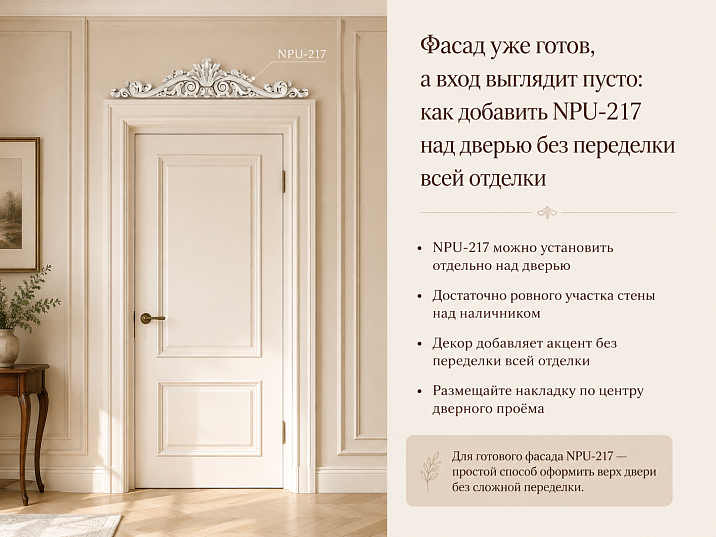
The house is already plastered. The facade is painted. The entrance door is installed, the slopes are finished, and the trim or simple framing is already in place. Technically everything is ready — but from a few meters away, the entrance looks too empty. It is at this moment that a practical question arises: is it necessary to redesign a full portal, dismantle part of the finishing, and add several facade elements, or is one expressive above-door accent enough?
For such a task, consider the NPU-217 measuring 600 × 109 × 23 mm. This is a polyurethane decorative overlay that STAVROS directly recommends for installation above a doorway, for decorating entrance groups, doors, and facades. In scale, it is more noticeable than a regular narrow strip, but it does not automatically require the buyer to assemble a full system of pilasters, a massive cornice, trims, and other details around the door.
The main advantage of this scenario is not that the NPU-217 can be "glued anywhere." On the contrary: a good result is only achieved when the finished facade is first checked as a complete architectural composition. The overlay must match the width of the entrance area, not conflict with the trims, not fall into too tight a space under the canopy, and not look like a random separate "crown" on a fully minimalist wall.
Therefore, the task of the article is very specific: how to understand whether the NPU-217 is suitable above an already installed entrance door, how to check the existing base, how to try on the 600 × 109 mm size, what to consider due to the 23 mm depth, and what to order together without redoing the entire facade.
If this logic matches your entrance area, you can buy the NPU-217 stucco decor after a preliminary fitting based on the actual dimensions of the opening.

NPU-217 is not a full portal, but a separate above-door accent
A full door portal is a system. It can include vertical side elements, architraves, pilasters, cornice, pediment, keystone elements, and other details. This approach is appropriate when the entrance group is designed from scratch or deliberately rebuilt.
NPU-217 solves a different task.
This is a separate decorative overlay, 600 mm long and 109 mm high, which can be placed above the door opening as a top accent. It does not automatically turn a simple door into an architectural portal and does not replace all other facade elements. But if the door framing already exists and the upper area looks too empty, a single detail may be enough to complete the composition.
This approach is especially interesting after renovation: instead of a large intervention, the buyer works in a limited area above the door.




Confirmed characteristics of NPU-217
| Parameter | Value | What this means for the finished facade |
|---|---|---|
| Article number | NPU-217 | A specific decorative overlay |
| Size | 600 × 109 × 23 mm | Need to check the width, height, and protrusion above the door |
| Material | Polyurethane | Can be used as molded decor, including on facades |
| Purpose | Above doors, entrance groups, facades, decorative zones | Fits exactly the scenario in question |
| Paintability | Provided | The color can be matched to existing finishes |
| Application type | Overlay decorative element | Does not require building a new portal as a structure |
| Price at the time of writing the article | 6 220 ₽ | Before payment, check the current price in the product card |
Dimensions matter more here than any photo. 600 mm is already a noticeable horizontal line. 109 mm is sufficient height for the ornament to be readable from a distance. 23 mm is real volume that creates shadow and protrudes above the facade plane.
It is the combination of these three dimensions that needs to be tried on, not just the length.
Our factory also produces:



Why the 600 × 109 mm template should be made before opening the cart
From the photo of NPU-217, it is easy to overestimate or underestimate its size.
On the card, the product is shown large. On the facade of the house, it will be next to a door about two meters high, trim, lights, a canopy, steps, and a large wall surface. The scale changes completely.
The fastest way to check the size is to cut out a 600 × 109 mm rectangle from cardboard, thick paper, or another lightweight material.
Attach it with painter's tape in the intended installation area and step back to where the entrance is usually seen:
-
from the gate;
-
from the path;
-
from the parking area;
-
from the opposite corner of the yard;
-
from the point where a person approaches the door.
This makes it clear whether the 600-millimeter overlay is perceived as a completion of the entrance or as a too-small detail on a large wall.
Get Consultation
One template needs to be checked in at least three positions.
The first option is strictly centered above the door leaf.
The second is centered relative to the outer edges of the trim.
The third is relative to the entire entrance composition, if the door is offset in a niche or there is side glazing nearby.
These centers do not always coincide.
If you choose the axis only with a tape measure, not visually, even precise installation can look strange.
The width of the door and the width of the entrance area are not the same thing.
Suppose the door leaf has a width of 900 mm.
This does not mean that NPU-217 should be centered on 900 mm.
If there is trim around the door, the actual compositional width may be 1050–1200 mm. If there is a side transom or glass section, the entrance area becomes even wider.
Therefore, before ordering, take three different measurements:
-
the width of the door leaf itself;
-
the width of the outer frame;
-
the width of the entire visual entrance area.
After that, 600 mm can be compared with the real context.
When 600 mm looks convincing
There is no universal formula, because the same size is perceived differently on a smooth facade, in a deep niche, or above a wide portal.
But there is a practical criterion.
NPU-217 should be read as the top semantic detail of the entrance, not as a random short insert.
If the overlay occupies a clear central part above the door and leaves calm side margins, the scale works.
If on a wide portal it turns into a small ornament in the middle of a large horizontal line, it is better to consider a different composition rather than try to compensate for the size with color.
When 600 mm may turn out to be too wide
A narrow door in a tight niche.
A small side wall section.
A very narrow space between vertical trim pieces.
Lights almost flush with the opening.
In such cases, a paper template will immediately reveal the problem.
Do not expect that a shaped contour will "visually reduce" 600 mm enough for the element to automatically fit into a tight space.
Depth of 23 mm: something easy to forget when fitting with paper
A paper template shows length and height, but it is flat.
The real NPU-217 has a depth of 23 mm.
This means that after installation, the element will protrude from the facade plane and create its own shadow.
For a decorative effect, this is a plus. But technically, you need to check:
-
whether a canopy is hanging nearby;
-
whether the drip edge comes too close;
-
whether there are wires, cameras, or sensors above the door;
-
whether the protrusion intersects with a decorative light fixture;
-
whether the door itself is too deeply recessed into the niche;
-
whether the existing trim creates an even larger protrusion.
If the space is tight, 23 mm becomes an important parameter.
NPU-217 works especially well where the door already has some kind of architectural support.
A single decorative "crown" above a completely bare technical door can look random.
A completely different situation is when the following already exist:
-
calm architraves;
-
symmetrical slopes;
-
a plinth line;
-
the house cornice;
-
classical or neoclassical finishing;
-
a repeating color of decorative elements;
-
a pronounced entrance axis.
Then NPU-217 does not start the architecture from scratch, but completes an existing one.
This is a key criterion.
When one overlay can really be sufficient
A small private house with a simple classic door.
The facade already has moderate decor around the windows.
The entrance door is framed with a casing, but there is no accent on top.
The color palette is calm.
In such a situation, one above-door element can tie the door to the rest of the facade details without adding a full portal.
When one NPU-217 is most likely not enough
If the door is set in a very wide, tall portal, and the surrounding plane is completely empty, 600 × 109 mm may look too local.
If there are large columns, massive cornices, or developed window framing nearby, one relatively compact overlay can get lost.
If the facade is already built on strict minimalist geometry without ornament, a carved element may contradict the overall architecture.
Then the question is no longer whether NPU-217 can be glued, but whether the very idea of such decor is appropriate.
How to check that the crown won't look random
Look not at the detail, but at the repetition of motifs.
NPU-217 has a plant ornament and pronounced relief. This means that on the facade it works well when at least one of the similar features is already present:
-
classic profiles;
-
plant decor;
-
figured architraves;
-
soft curvilinear forms;
-
decorative cornices;
-
accentuated entrance axis.
It is not necessary to look for exactly the same pattern. More important is that the overlay is not the only complex ornament on a completely geometric house.
A finished facade does not mean that the base is ready for gluing
This is a fundamental point.
The phrase "facade is already painted" describes visual readiness, but says nothing about the strength of the surface.
Under the layer of paint there may be:
-
strong plaster;
-
loose plaster;
-
old chalking;
-
poorly adhering paint layer;
-
local cracks;
-
textured coating;
-
contamination;
-
dust;
-
residues of a water repellent or other compound.
If you glue decor to a weak top layer, the adhesive bond may hold better than the paint itself holds to the plaster. Then the problem will not be in the polyurethane or the glue, but in the substrate.
"Without redoing the entire finish" does not mean "without any preparation at all"
The correct scenario looks different.
The main plane of the facade is preserved.
Under NPU-217, the installation area is checked locally and, if necessary, prepared.
This may include:
-
cleaning;
-
removal of the loose layer;
-
leveling of small local defects;
-
surface preparation according to the requirements of the selected installation compound;
-
restoration of the finish around the product after installation.
This approach indeed allows avoiding a complete rework of the entrance group, but it does not turn installation into mechanical gluing over any coating.
Simple check of existing paint before ordering
Run your hand over the installation area.
If dust or chalk marks remain, the base requires attention.
Inspect the surface from the side in daylight.
If bulges, cracks, or peeling are visible, the base issue is addressed first.
Carefully test the durability of the coating on a small inconspicuous area.
If the top layer separates easily, the decorative element cannot be considered reliably installed just because a good adhesive was chosen.
Textured plaster complicates the task more than smooth
On a smooth base, the back surface of the overlay contacts the plane more predictably.
On large textures, local high points and voids remain.
This does not automatically mean a prohibition.
But for strongly pronounced textures, it is necessary to assess in advance whether sufficient and uniform mounting support can be achieved.
Sometimes local preparation of the strip for the product is safer than trying to fill all irregularities with an excessive layer of adhesive.
You need to level the mounting area, not the entire facade.
This is where the topic really differs from a major renovation.
If the defect is local and the area around the door is generally finished, there is no need to remove the cladding from the entire wall.
They work only where the NPU-217 will be located and where careful joining is required.
This preserves the main finish of the house.
If the plaster is deteriorating, it is too early to buy decor yet.
There are situations where honest advice is to postpone the order.
If above the door:
-
large cracks;
-
peeling plaster;
-
damp stain;
-
signs of deterioration;
-
unstable paint;
-
damage to the canopy junction,
first eliminate the cause.
NPU-217 should not be used as a patch that simply covers the defect.
The decor does not replace base repair.
Why NPU-217 material is convenient for spot finishing of the entrance
NPU-217 is made of polyurethane.
For the task at hand, it is important not to list all properties of the material in general, but to understand its practical role.
The polyurethane overlay does not need to be cut from a solid block or molded on site. The finished ornament already has its size and relief. The buyer only needs to check the location, prepare the base, choose a mounting system, and finish.
That is, a complex decorative shape is purchased ready-made.
If you need to look at a broader Relief Decoration, it makes sense to compare it only after you have measured the area above the door and understood what exactly does not suit you about NPU-217: length, height, pattern, or overall scale.
The color of NPU-217 should be chosen relative to the existing facade
Since the facade is already painted, color becomes part of the renovation task, not an abstract design project.
There are three main scenarios.
In the color of the existing facade decor
If the windows and cornices already have a light or other contrasting trim, NPU-217 can be tied to them using the same color principle.
This is the most understandable way to integrate a new part into an existing system.
Matching the wall color
If you want the relief to be calmer, the overlay can be visually brought closer to the main plane of the facade.
Then the form will be read through light and shadow.
This option is especially useful when the house should not look more decorative than it was before adding the element.
Contrast accent
Contrast can make NPU-217 the main object of the entrance area.
But the more the color differs from the wall, the more noticeable the question becomes: why is this particular detail highlighted?
Therefore, contrast requires more support from the entire entrance architecture.
Painting after installation helps to bring the part and the facade together into one system
When a decorative element is installed on an already finished wall, the junction point is especially noticeable.
Finishing after installation allows visually merging the overlay with the base if the chosen coating system is compatible with the material and facade conditions.
Do not expect that a single coat of paint will fix uneven installation. The finish completes a properly prepared installation, not masks geometry errors.
Where NPU-217 should not be used just to fill a void
An empty space by itself is not a defect.
A minimalist house can look complete precisely without ornament.
You should skip NPU-217 if:
-
the entire facade is built on strict straight lines;
-
the entrance door is flat and modern, without classic detailing;
-
there is not a single ornamental element nearby;
-
there is little air above the door;
-
the visor already serves as a strong upper accent;
-
The composition becomes overloaded after the template.
Good decor does not have to be present in every free space.
One NPU-217 or a full portal: comparison on a real task
| Situation | NPU-217 as a separate accent | Full portal |
| The facade is already finished | Convenient for local finishing | Requires more serious rework |
| Only need to complete the top of the door | Fits the logic of the task | Redundant |
| Need side pilasters and developed architecture | Insufficient on its own | Fits better |
| Limited scope of intervention | Yes | No |
| Need to quickly test the idea with a template | Yes | Will require a mockup of several elements |
| The entrance is completely devoid of architectural structure | May look random | Provides a system |
| There are already trims and facade decor | Can complement well | Not always needed |
| A major entrance renovation is planned | Temporary or partial solution | It is more logical to design the system |
This table helps not to overestimate the capabilities of a single overlay.
NPU-217 is a good product precisely when the buyer consciously chooses a point completion of the entrance group, rather than trying to replace an entire architectural system with a single part.
Existing trims: the main neighbor of NPU-217
If there are already trims above the door on the sides and top, you need to understand where exactly the overlay will be relative to them.
Two principles are possible.
The first — NPU-217 is located above the horizontal trim and is perceived as a separate "crown."
The second — it visually connects with the upper framing and becomes part of a more cohesive composition.
Which option is better depends on the width and shape of the existing profiles.
Too thin trim
Against the background of a massive ornamental overlay, a very narrow simple profile may look weak.
This is not always a problem, but the template should be evaluated from a distance.
Too massive casing
If there is already a large horizontal bar above the door, adding NPU-217 can create two competing top elements.
In such a situation, one of them must clearly be the main one.
An awning above the door can make NPU-217 redundant
An awning is not just technical protection.
It forms a strong horizontal line above the entrance.
If there is a small strip left between the top of the door and the bottom of the awning, you don't need to try to fit a 109 mm high overlay there.
Even if it physically fits, the composition can become cramped.
What to measure when there is an awning
Measure:
-
the distance from the top edge of the trim to the bottom surface of the awning;
-
the depth of the awning;
-
the position of the brackets;
-
width of the free zone;
-
location of the luminaire or camera.
The template should be placed in a real free area, not "approximately above the door."
The entrance luminaire can change the entire layout
The luminaire centered above the door and the NPU-217 centered simultaneously occupy the same semantic point.
There are three solutions:
-
move the light higher, if technically possible and justified;
-
leave the light fixture and refuse NPU-217;
-
use side lighting instead of central lighting, if provided for by the project.
Do not build the decor so that the relief partially covers the light fixture or the fixture housing hangs over the ornament by accident.
Camera, sensor, and intercom are trifles only on the drawing
A modern entrance group is often already equipped with technology.
On a finished facade, moving each device means extra work, holes, and restoration of the coating.
Therefore, before ordering NPU-217, you need to mark on the photo:
-
camera;
-
motion sensor;
-
lighting;
-
wiring;
-
doorbell;
-
house number;
-
plate.
If the overlay intersects with one of these elements, local modernization may cease to be local.
How to create a diagram of the entrance group in a single photo
Take a photo of the door strictly from the front.
In the image, mark:
-
outer boundaries of the door;
-
trim;
-
upper free section;
-
visor;
-
light;
-
camera;
-
input axis.
Then overlay a rectangle with a 600:109 aspect ratio on the photo.
This way, even before the paper template, you can understand which zone has space.
The paper fitting should not last just five minutes
Attach the template — and don't remove it right away.
Look at it:
-
in the morning;
-
in the evening;
-
with the exterior light on;
-
with the door open;
-
with the door closed;
-
from the street side.
Sometimes an element that seems small during the day becomes more noticeable in the evening due to shadows.
Why is the 23 mm relief especially visible under side lighting
Any protruding decor creates a shadow.
Under frontal diffused light, NPU-217 will look calmer.
With side sunlight or a lamp, the relief will become more contrasting.
This should be taken into account if the facade already has an active texture.
On a rough wall, plus a deep ornament, can create an overly saturated surface.
Polyurethane facade molding should support the architecture, not argue with it
In general facade projects, decor is assembled as a system. Here the task is narrower: not to design everything from scratch, but to check whether one detail can exist in the finished architecture.
If you want to understand the overall logic deeper and how to choose facade polyurethane molding, it is useful to compare the entrance with other areas of the house: windows, cornice, corners.
But in our scenario, this is not a reason to add everything at once.
The goal is to understand whether NPU-217 is sufficient.
How to connect NPU-217 with windows
If window openings already have decorative top elements, NPU-217 above the door should support them in three parameters:
-
scale;
-
color;
-
degree of ornamentation.
It is not necessary to repeat the shape literally.
But if the windows are very minimalist, and the entrance gets a complex acanthus ornament, you need to make sure that the entrance area really should be richer than the rest.
How to connect NPU-217 with the house cornice
The cornice creates the upper horizontal line of the entire facade.
NPU-217 is a local horizontal line above the door.
They can work well together if they do not compete in scale.
If the house is small and the cornice is very elaborate, another complex decorative element above the entrance may add excessive density.
If the cornice is calm, NPU-217 can become the only expressive accent of the first floor.
If the windows are completely without decoration
This is not an automatic prohibition.
The entrance can be the only ceremonial point of the house.
But then it is especially important that the door, handle, color, and shape of the canopy support a more decorative character.
Otherwise, one carved element will look like a separate random purchase.
Practical scenarios: how NPU-217 behaves on different finished facades
Scenario: white classic door on a light facade
Here, NPU-217 can be painted in the color of the existing door frame.
The relief will be read through shadow.
The composition will remain calm.
This approach works especially well if the windows already have light trim.
Scenario: dark door on a light facade
If the door is graphite, brown, or black, and the facade is light, there are two paths.
The first is to make NPU-217 light, linking it with the wall and window decor.
The second is to support the dark door.
But the dark carved element will become much more active.
Before choosing contrast, you need to see the mockup of the entire entrance area.
Scenario: brick facade with a plastered entrance area
If the NPU-217 is installed not directly on the brick, but on an already prepared plastered surface around the door, the task is compositionally simpler: the element works within a separate entrance panel.
If direct attachment to textured masonry is intended, the preparation of the base must be assessed separately.
Brick and smooth plaster cannot be considered identical mounting surfaces.
Scenario: facade with decorative "bark beetle" plaster or large texture
The main issue is the quality of contact between the rear part and the base.
A large wall relief may require local preparation.
Attempting to compensate for strong texture only with a thick layer of adhesive without checking the mounting system is risky.
Scenario: the door is located in a deep niche
If the opening is recessed, the NPU-217 can be installed:
-
on the external plane of the facade;
-
inside the niche above the door.
These are two different visual effects.
On the outer plane, the element works across the entire facade.
Inside the niche, it only works at the entrance.
The depth of the niche, lighting, and width of the upper lintel determine the choice.
Scenario: narrow side wall next to the door
If the door is offset toward the corner of the house, centering NPU-217 on the door may create a visual impression that the overlay is too close to the corner.
Then you need to evaluate not only local symmetry but the entire wall plane.
Sometimes it's better to forgo the element than to create artificial symmetry where the architecture doesn't support it.
Scenario: double entry door
A wide double door can make 600 mm visually too short.
A paper template will show this immediately.
If NPU-217 is lost over a wide entrance group, do not try to stretch the pattern with distances. The element itself has a fixed size.
Scenario: door with a glass side section
The center of the entire entrance group may shift relative to the door leaf.
If the overlay is placed strictly above the door, it will appear shifted to the side.
In this case, it is worth comparing two template positions: above the leaf and centered on the door plus glazing.
Fixed size is an important limitation of NPU-217
600 × 109 × 23 mm is the finished size.
For a single purchase, one cannot assume that the element can simply be ordered at 700 or 800 mm.
If a different scale is needed, you need to look at other products or discuss a special project only under confirmed conditions.
The article should not promise individual size modification for a regular purchase.
Can two NPU-217 be placed side by side
Technically, two identical elements can be placed in one zone, but that is already a different composition.
For a single doorway, joining two overlays side by side will rarely look like one solid "crown" without a specially designed scheme.
If 600 mm is too little, it's better not to double it automatically.
How to understand that NPU-217 is too small for the entrance
Signs:
-
the pattern is lost relative to the width of the portal;
-
it is barely readable from a distance;
-
huge empty zones without compositional meaning remain between the edges of the overlay and the side elements;
-
A wide double door visually overwhelms the decor.
Then a different scale or a more developed upper system is needed.
How to understand that NPU-217 is too large
The signs are the opposite:
-
The side edges almost touch the trim;
-
there is not enough free air above the door;
-
the canopy tightly presses the element from above;
-
the relief dominates over the small door;
-
neighboring lights are too close.
Is an exact center needed
For a classic symmetrical door — almost always yes.
But if the entire entrance is asymmetrical, the formal center of the panel may not be the visual center of the composition.
Therefore, first mark several axes and evaluate them from a distance.
The level mark is more important than the measurement from the cornice.
Do not tie NPU-217 to a random horizontal line of the house just because it is convenient to measure.
The overlay should be primarily connected to the door.
Use a level for horizontality, and determine the height based on the composition of the entrance group.
The distance above the trim cannot be set with a universal number.
There is no single correct offset in millimeters for all doors.
The height of the free zone depends on:
-
the trim;
-
the canopy;
-
the door height;
-
facade width;
-
NPU-217 relief;
-
lighting.
Again, the template helps.
The installation area must be accessible to the tool and hand.
Even if the element fits beautifully, you need to think about the actual work.
If the NPU-217 is wedged under a low canopy, the craftsman may physically lack convenient access for applying the compound, positioning, and final finishing.
The composition must be not only beautiful but also feasible for installation.
What to buy together: the minimum set depends on the facade condition.
| What may be needed | Why | When required |
| NPU-217 | The overdoor accent itself | After template approval |
| Mounting compound | Element anchoring | Almost always, but the specific type depends on the base |
| Materials for local preparation | Reinforcement/leveling of the installation area | If the coating is weak or uneven |
| Material for joints | Neat edge finishing | According to the selected installation technology |
| Primer/finish | Link a new part to the facade | If painting and restoration of the area is required |
| Painting materials | Protection of finished finish | For local work |
If you need buy mounting materials for stucco decor, the choice of composition should be made after assessing the base and outdoor application conditions, not just by the name "glue".
Why you cannot blindly recommend any mounting adhesive
The facade operates under conditions different from a dry wall indoors.
There is humidity, temperature changes, heating by the sun, and possible freezing of the base.
In addition, the wall covering can be different.
Therefore, the specific composition must be compatible:
-
with polyurethane;
-
with the existing base;
-
with outdoor conditions;
-
with the chosen finishing system.
The universal phrase "glue with liquid nails" is insufficient for such an article.
The product card itself suggests the direction of configuration.
In the related products block, NPU-217 STAVROS shows mounting adhesive.
This is a good sign: the trim should be viewed not as a standalone item bought without preparation, but as part of a small installation task.
But the specific consumption and technique depend on the substrate.
What you don't need to buy automatically
A full set of pilasters.
A large facade cornice.
Rustication.
Corner decor.
Window surrounds.
If the task is to finish the entrance pointwise, there's no need to expand the cart to a full facade project just for the sake of "systematicity."
Systematicity can be achieved through color, scale, and the existing architecture.
When it is still worth moving from a single overlay to a full-fledged entrance group
If after the template it turns out that NPU-217 looks too lonely alone.
If the side parts of the door are completely empty and require vertical decoration.
If the entrance is significantly wider than 600 mm.
If the house is initially classic and other openings have rich framing.
If replacement of platbands is planned.
Then it is better to stop and design the portal as a system rather than gluing elements one by one without a general drawing.
Polyurethane decor for house facades: the category is needed as a backup route
If NPU-217 doesn't match in scale, ornament, or geometry, there's no need to adjust the door to fit one selected overlay.
In the general section, you can Polyurethane facade decoration for the house choose from other products.
But it's better to start the search with already recorded free zone dimensions.
When a broad category is truly useful
After the template, you already know:
-
600 mm is too little or too much;
-
109 mm is too high or normal;
-
whether an ornament is needed at all;
-
what depth is acceptable;
-
whether one part or a system is needed.
With such data, the catalog becomes a selection tool, not an endless feed of beautiful products.
Polyurethane facade decor should not mask construction problems
Crack above the door.
Wetting.
Problematic canopy.
Plaster detachment.
Cold joint.
These defects are first diagnosed and repaired.
NPU-217 must be mounted on a stable area, not to hide the problem.
The entrance area must be dry and finished before installation
If the facade has just been painted, the coating needs to go through the drying and property development period specified by the technology.
The article will not assign a universal number of hours or days, because it depends on the specific facade finishing system.
You should be guided by the coating manufacturer's requirements.
Strong sun changes the perception of color and texture.
The south side of the house receives harsher light.
The NPU-217 relief will produce expressive shadows.
On the north side, the pattern may look softer.
Therefore, a color that seems calm on a sample may be perceived differently on the actual facade.
Combination with house number
If the number plate is already above the door, it competes for space.
Do not place NPU-217 so that the number accidentally ends up inside the ornament or too close to it.
Either the plate becomes a separate lower/side element, or the entire zone is proj
Example 3. Modern smooth door under a flat canopy
The house is made in strict geometry. Windows without trim. The facade has almost no ornament. A thin metal canopy already runs above the door.
NPU-217 physically fits.
But the paper template with a conventionally indicated ornament shows that one classic carved "crown" becomes the only figured detail on the entire facade.
Here, refusing to buy may be more correct than buying itself. An empty zone does not require mandatory filling if it matches the architecture of the house.
Five decisions to make before NPU-217 ends up in the order
First — scale. Is 600 × 109 mm suitable for your specific door?
Second — axis. Relative to what will the element be centered?
Third — base. Is there a solid mounting surface under the finished paint?
Fourth — color. Does the overlay continue the existing facade decor or become an independent contrasting accent?
Fifth — scope of work. What will be needed for local installation and finish restoration?
If at least one decision remains uncertain, what should be postponed is not the renovation, but only the purchase by one stage — until the trial fitting.
How to convey the task to the craftsman so that he does not choose the composition on site
The phrase "glue this thing above the door in the center" is too vague.
It is much more reliable to prepare a short brief:
-
article NPU-217;
-
size 600 × 109 × 23 mm;
-
photo of the entrance;
-
marked vertical axis;
-
distance from the selected baseline to the element;
-
color;
-
information about the facade covering;
-
agreed installation composition;
-
the need for local paint restoration.
Then the craftsman is responsible for the quality of installation, rather than being forced to simultaneously become a designer and decide where exactly the overlay should be located.
Why it is better to mark the final height on the wall before the product is delivered
After delivery, you want to immediately apply the real decor. On a freshly painted facade, repeated fittings are inconvenient and may leave marks.
A paper template allows you to set precise control marks in advance.
When the NPU-217 arrives, it is no longer moved along the wall in search of a beautiful position, but is matched against the approved markings.
This is especially useful if the installation is performed by someone other than the person who chose the decor.
Checking the entire entrance area after marking
After the position of the NPU-217 is chosen, step back again and look not at the overlay, but at the entire facade.
Check:
-
has the door become visually too heavy at the top;
-
has the center shifted due to the side window;
-
does the ornament conflict with the house number;
-
has too small a gap to the canopy appeared;
-
is the future color coordinated with the windows;
-
is the entrance readable as a single group.
This final check is often more important than millimeter-level adjustments.
When it is better to order NPU-217 now, and when to postpone it until the next stage of renovation
It is reasonable to order now when the entrance geometry is final, the facade is stable, the lights and equipment are already in place, and the color scheme is known.
It is worth postponing the purchase if the following is planned in the near future:
-
a new canopy;
-
replacement of trim;
-
relocation of lighting;
-
facade insulation;
-
repainting the entire wall;
-
changing the door.
Otherwise, the beautiful element will have to be re-integrated into the already changed architecture.
Mistakes that turn one beautiful overlay into random facade decor
Mistake 1. Ordering only based on a photo of the product.
The card shows the shape but not the scale relative to your door. Without a 600 × 109 mm template, it's easy to make a mistake.
Mistake 2. Checking only the 600 mm length.
The 109 mm height and 23 mm depth are no less important. They determine how much air remains under the canopy and how strongly the relief protrudes from the wall plane.
Mistake 3. Centering on the door leaf without noticing the trim.
The visual center of the entrance may run along a different axis.
Mistake 4. Assuming finished paint is a guaranteed durable base.
If the paint is peeling off the plaster, good adhesive won't fix a weak layer.
Mistake 5. Mounting over loose decorative plaster.
First, check the local strength and geometry of the mounting area.
Error 6. Trying to cover a crack with a patch.
Decor does not replace facade repair.
Error 7. Installing NPU-217 under a too-low canopy.
Physical compatibility does not equal good composition. The top needs air.
Error 8. Not accounting for the light fixture.
Central lighting and central ornamentation easily start to compete.
Error 9. Ignoring the camera and sensor.
After purchase, it may turn out that for the sake of decor, you will have to move equipment and restore the finish.
Mistake 10. Using one complex ornament on a completely minimalist facade.
Sometimes emptiness really is better.
Error 11. Making NPU-217 the most contrasting element of the house without a reason.
Color enhances the pattern. What looks calm in the facade color can become overly active in contrast.
Error 12. Buying a full set of facade moldings "just in case."
Spot finishing does not automatically require redoing windows, corners, and cornices.
Error 13. Choosing adhesive only by the principle of "the strongest."
Compatibility with polyurethane, the base, and outdoor conditions is needed.
Mistake 14. Not protecting the existing finish.
The installation work must be local and neat.
Mistake 15. Painting before the entire composition is understood.
Color can change the visual scale of an element.
Mistake 16. Deciding that 600 mm is too little and automatically installing two NPU-217 units.
Two separate ornaments do not automatically become a single pediment.
Mistake 17. Evaluating the entrance only from arm's length.
The facade is read from the path and the street.
Mistake 18. Not checking the card before payment.
Price, availability, and order terms may change. Size, article number, and material must be checked again immediately before purchase.
Who NPU-217 is truly suitable for
This item is especially interesting to a buyer who has already completed the main facade finishing and has no desire to return to a large construction phase.
It is appropriate if:
-
the entrance door has a clear central axis;
-
there is a free zone above the door;
-
the architecture of the house allows for a plant relief;
-
trim or other details already create the basis of the composition;
-
600 × 109 mm look proportionate after the template;
-
the base is solid or can be locally prepared;
-
you want to finish exactly the entrance, not rebuild the entire facade.
For such a scenario, you can order NPU-217 made of polyurethane as a separate top accent after checking all constraints.
Who should first look at other solutions
NPU-217 is not suitable for every home.
Better to continue searching if:
-
the opening is very wide;
-
the free zone above the door is noticeably less than 600 mm;
-
the facade is strictly minimalist;
-
there is already a massive canopy;
-
the ornament conflicts with the windows;
-
the plaster requires serious repair;
-
The entrance is planned to be completely redone in the near future;
-
A large pediment composition is needed, not a local overlay.
In these cases, it is more useful Facade decoration made of polyurethane to select based on the specific architectural task.
Decorative polyurethane elements are needed not for quantity, but to support the idea
If after trying on NPU-217 it seems lonely, the buyer is tempted to add a few more decorations around it.
Take your time.
In the section decorative polyurethane elements You can compare additional forms, but each new detail must answer the question: what does it fix?
If the answer is only "to make it richer," it is better not to complicate the composition.
How to create a small list instead of a large project
Even a single overlay deserves a short specification.
Example:
| Position | Parameter |
| Main element | NPU-217 |
| Size | 600 × 109 × 23 mm |
| Material | Polyurethane |
| Quantity | 1 pc. |
| Location | Above the entrance door |
| Axis | According to the approved layout |
| Base | Checked before installation |
| Mounting compound | Selected based on the base and external conditions |
| Finish | According to the approved color scheme |
Such a list seems redundant for a single part only until it becomes clear on site that the foreman and the owner understand the installation height differently.
First the facade, then the basket: a ready-made procedure
-
Take a photo of the entrance strictly from the front.
-
Measure the door, trim, and the free space above.
-
Cut out a template 600 × 109 mm.
-
Find the visual axis.
-
Check the canopy, light, camera, and signs.
-
Assess the texture and strength of the plaster.
-
Look at the template from the street.
-
Determine the color.
-
Choose a mounting system suitable for the actual base.
-
Only now place the order.
This sequence protects against purchasing a part that is appealing in itself but does not work on a specific house.
How to understand that the solution is already ready to be given to the master
You should have not just a screenshot of the NPU-217 card.
You need:
-
a photo of the facade with the marked axis;
-
installation height;
-
clearance zone dimensions;
-
position of technical devices;
-
color;
-
information about the base;
-
selected mounting system;
-
understanding of final restoration.
Then the task turns from "let's try it over the door" into proper local work.
Why one overlay is sometimes enough for a sense of completeness
The eye is especially sensitive to the top point of the doorway.
The vertical boundaries of the door already exist.
The bottom is set by the threshold and steps.
And at the top of a simple door, often only an empty horizontal line remains.
NPU-217 adds precisely the upper decorative point.
Therefore, a local detail can have a noticeable impact without increasing the amount of decor across the entire facade.
Why one overlay is sometimes not enough
If the door has no side framing and the wall itself is very large, the eye may perceive NPU-217 as a separate decoration rather than as part of the entrance.
In that case, the problem is not with the product.
It's just that the architectural task is broader.
Then it's worth solving the entire entrance group.
It's better to open the catalog of facade decor already with measurements.
When you need polyurethane decor for a facade, the catalog quickly offers dozens of shapes. But an exterior piece cannot be moved tomorrow as easily as an interior item. It is tied to the foundation, paint, and architecture of the house, so the choice is better finalized with a measurement and a mockup, not just a photo.
The ornament above the door should be noticeable but not out of scale.
For facade stucco decor, NPU-217 is noticeable enough: a length of 600 mm and a depth of 23 mm give a readable relief. But visibility is not an end in itself.
A good accent above the door is read after the overall impression of the house, not before the entrance itself.
If from the street the ornament is the first thing seen, then the contrast or scale may be too active.
On a finished house, new architectural details require restraint.
On a new project, the architect can distribute decor across the entire facade.
After renovation, the initial solutions are already set.
Therefore, a point addition must respect what already exists.
This is not a limitation but an advantage: the buyer has a real house where every solution can be tested.
One new element sometimes works better than five
One strong upper accent can:
-
mark the entrance;
-
connect the door with window casings;
-
add relief;
-
fill a compositional void.
Five new elements can create a new problem — overload.
Therefore, NPU-217 is interesting precisely as a minor intervention.
What to check in the NPU-217 card before payment
article number.
Dimensions: 600 × 109 × 23 mm.
Material — polyurethane.
Current price.
Availability or production time.
Delivery conditions.
Product drawing.
If everything matches the layout, you can buy NPU-217 for the entrance group.
When a wide catalog is useful after choosing NPU-217
Sometimes trying on NPU-217 confirms the very idea of above-door decor, but not the specific item.
For example, 600 mm is not enough.
Or the pattern is too complex.
Or 109 mm is too high.
Then it's already clear which parameters to look for.
In that case, you can Buy polyurethane molding of a different scale, comparing options not blindly, but with a specific template in mind.
FAQ: NPU-217 above an already finished entrance door
What is the exact size of NPU-217?
The size of the overlay is 600 × 109 × 23 mm.
What material is NPU-217 made of?
made of polyurethane.
Can NPU-217 be used on the facade?
Yes. The product card allows use on facades and in entrance groups.
Can it be installed directly above the door?
Yes. Installation above the door opening is one of the direct use cases for NPU-217.
Do I need to create a full portal just for one trim piece?
No. If the existing entrance architecture already supports an above-door accent, NPU-217 can work as a standalone detail.
Can NPU-217 be glued directly onto finished paint?
Only after checking the coating's strength and the mounting system's compatibility. Finished paint alone does not confirm the reliability of the base.
Do I need to remove all the facade cladding?
No. In the scenario in question, it's about local preparation of the mounting area, if required.
What to do if the plaster is crumbling?
First, repair and stabilize the base. The overlay cannot be used to mask damage.
Is a paper template needed?
Yes. A 600 × 109 mm rectangle allows you to assess the scale and position before ordering.
How to account for the 23 mm depth with a flat template?
Separately check protruding elements nearby: the canopy, light fixture, camera, trim, and niche depth.
Where to center the NPU-217?
You need to compare the center of the door leaf, the center of the outer frame, and the center of the entire entryway.
What offset should be left above the trim?
There is no universal value. The offset is chosen based on the actual free space and the layout.
Can the NPU-217 be placed under the canopy?
This option can be considered if there is enough space in height, depth, and for installation work. A tight area needs to be checked with a template.
What to do if there is already a light fixture above the door?
You need to decide which object remains the main one. The light fixture and NPU-217 should not accidentally compete for the same central point.
Can the NPU-217 be made in the color of the facade?
Yes, if the chosen finish coating system is suitable for polyurethane and outdoor conditions.
Can it be made contrasting?
It can, but contrast increases visual activity. This option needs to be evaluated on the entire facade.
Will the NPU-217 suit a minimalist home?
Not always. If the facade has no ornamental logic at all, a complex carved overlay may look alien.
Will it suit a classic facade?
Often this scenario looks more natural, especially when there are architraves, cornices, and other architectural details. But the final decision is still made by the layout.
Can two NPU-217 be placed above a wide door?
Such a composition can be designed separately, but two elements should not automatically be considered a replacement for one wider decor.
What to do if 600 mm is not enough?
Select another element or design a more developed upper composition.
What to do if 600 mm is too much?
Consider another article of a smaller scale.
Are additional decorative elements needed?
Only if they truly support the entrance architecture. For point finishing, one NPU-217 may be sufficient.
What glue to use?
The specific mounting compound is selected based on compatibility with polyurethane, the type of substrate, and outdoor conditions.
Can it be mounted on textured plaster?
The possibility depends on the prominence of the texture and the strength of the surface. Sometimes local preparation of the mounting area will be required.
Do I need to paint NPU-217 before installation?
The order depends on the chosen finishing system. In any case, the junction areas are assessed after installation.
Can a crack above the door be covered with a trim plate?
No. First, the cause must be eliminated and the base restored.
What should be ordered together with NPU-217?
Mounting compound and materials needed for local preparation and final restoration. The specific list depends on the condition of the facade.
How to quickly determine if the trim plate is suitable?
Make a template 600 × 109 mm, secure it above the door, and evaluate it from several real viewpoints.
Can I buy just one overlay?
The product card allows you to place one product item; before ordering, you should check the current sales terms and availability.
What is most important before ordering?
Three things: the scale of 600 × 109 mm, the strength of the base, and the ornament matching the existing architecture.
The finished facade does not need to be completely redone if the entrance really only lacks the top accent.
NPU-217 is interesting precisely because it allows solving a local decorative task.
This is not a promise to "refresh any house with one detail."
This is a specific tool for a situation where the front door is already installed, the facade is finished, and the upper zone of the opening looks unfinished.
The size of 600 × 109 × 23 mm immediately sets the boundaries of the solution. The overlay must physically and visually fit. Its depth must align with the canopy, trim, and lighting. The ornament must support the architecture of the house. And the finished plaster must be not just beautiful, but also strong enough for local installation.
If all these checks are passed, the need to build a new portal just for the top accent truly disappears.
First, make a template.
Then check the base.
Next, determine the color and mounting system.
And only after that, place your order.
In the STAVROS catalog you can to buy molding both for a full facade project and for targeted finishing of an already completed house. In the case of NPU-217, the value lies precisely in the accuracy of the solution: not changing the entire facade, but adding one detail where it truly completes the entrance group.
A good result here is determined not by the amount of decor.
It is determined by how accurately one new overlay fits the scale, axis, color, and architecture of the existing entrance.