










































































Article Contents:
- What is polyurethane facade stucco and why is it needed
- Where exactly does facade stucco work
- Where to start choosing facade stucco: not with details, but with the big picture
- What to evaluate before purchasing
- The principle of a unified style
- Stucco around windows: the main focal point of facade decor
- What does window framing consist of
- Which window framing option to choose
- How many windows to design
- Window frame color
- Stucco for the front door: the main accent of the facade
- What is included in the entrance area decor
- How not to overload the entrance area
- Painting the entrance area decor
- House corners: facade architecture starts here
- Corner design options
- How to choose the height of corner elements
- Connection of corner elements with window framing
- Cornice line: the house must be completed from above
- What is a facade cornice
- How to choose the height of the cornice
- Cornice profile to match the facade style
- Horizontal belts and interfloor rods
- How not to overload the facade with stucco: the rule of measure
- The main rule: a system, not a collection
- Practical rules of measure
- Three verification questions before purchase
- Ready-made scenarios: what to buy for specific tasks
- Scenario one: only the windows need to be framed
- Scenario two: the entrance area needs to be highlighted
- Scenario three: a unified facade is needed
- Installation of facade moldings: key requirements
- Adhesive for facade installation
- Dowel fastening for large elements
- Joint sealing
- Painting facade moldings
- Table: facade moldings for tasks and styles
- FAQ: answers to main questions before purchase
- About the Company STAVROS
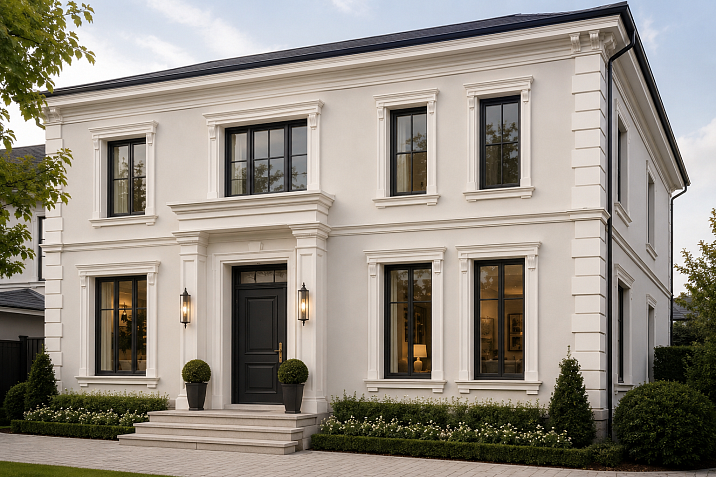
A house faces the world with its facade. It is the first thing a guest, a passerby, a neighbor sees. It is what remains in memory. And that is precisely why the question "how to design a facade" is not a question of vanity, but a question of architectural honesty: the house must look finished, cohesive, intentional.
Polyurethane moldings for the facade is a tool that, for a reasonable cost and without a global reconstruction, allows you to turn an ordinary house into a house with character. Frame the windows. Highlight the entrance door. Accentuate the corners. Complete the cornice line. Make the facade read not as a set of random planes, but as a well-thought-out architectural system.
But it is precisely the systematic approach that matters here. A single decoration on one window while the rest of the facade remains bare is not an ornament, it is a mistake. Facade stucco works when it is chosen as a set: a unified style, a unified logic of placement, a unified scale of elements.



What is polyurethane facade stucco and why is it needed
Facade stucco is architectural decor for the external surfaces of buildings: window frames, entrance door decor, corner elements, cornice strips, facade moldings, architraves, pilasters, friezes. Everything that turns a bare plastered wall into an architectural statement.
Historically, stucco on facades was made from stone, plaster, or cement mortar. It was expensive, heavy, and required skilled craftsmen. Today Facade molding polyurethane offers the same architectural solution — without excess weight, without complex installation, without the risk of destruction during frosts and temperature fluctuations.
Polyurethane does not absorb moisture. It does not deform in frost and does not crack when heated. It is lightweight — attachment with glue without dowels and complex structures. The surface accurately reproduces the relief of the ornament — finished products look the same as classic stone counterparts. At the same time You can buy ready-made stucco matching the Baroque style. Calculate the quantity: linear meters of cornices and moldings, number of rosettes, pilasters, consoles, corner elements. Add a ten to fifteen percent allowance for trimming. facade stucco costs several times cheaper than ordering work in stone or concrete.




Where exactly does facade stucco work
Five zones where polyurethane decor radically changes the appearance of the facade:
-
Windows — framing and a top keystone element above the opening
-
Entrance door — portal and side plane decor
-
House corners — vertical corner elements, pilasters
-
Cornice — horizontal line under the roof
-
Wall planes — facade moldings, horizontal belts
Each of these zones has its own selection logic. Let's examine each in detail.
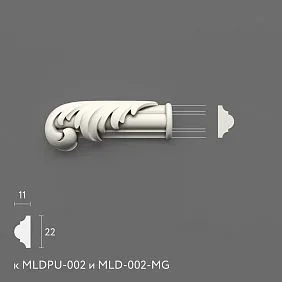
Our factory also produces:




Where to start choosing facade stucco: not with details, but with the whole
The main mistake when choosing facade decor is starting with a separate element. Saw a beautiful casing, bought it. Saw corner decor — bought it. As a result, the facade looks like a storefront of random finds.
The correct order is the opposite. First the facade as a whole, then the elements.
Get Consultation
What to evaluate before purchasing
House style. This is the first and most important. A classic house with symmetrical windows and a high roof — one set of elements. A modern house with panoramic windows and a flat roof — another. A house in Provence, country, art deco, minimalist style — each has its own stucco 'grammar'.
Color and texture of the facade. Light facade — stucco of the same color or slightly lighter. Dark facade — stucco in a neutral tone, not white (sharp contrast overloads). Facade with textured plaster — elements with a clear pattern that "rises" above the texture.
Height and scale of the building. One-story house — modest elements. Two- to three-story building — a more monumental scale can be used. A cornice 80 mm high on a one-story house is normal. On a three-story one — it's too small.
Window shape. Standard rectangular windows, arched windows, non-standard sizes — each option requires its own framing. Arched windows allow for richer decor. Rectangular ones — classic or modern trims.
Existing finish. If the facade is already finished with decorative textured plaster — elements should be sufficiently protruding to "emerge" above the texture. If the facade is smooth — any profiles will work.
Principle of unified style
All facade elements — window frames, door decor, corner elements, cornice — should work in the same stylistic key. This means: do not mix baroque ornament with minimalist rectangular profiles. Do not place thin modern moldings around windows and a lush cartouche above the door.
One style — one ornamental language. Either smooth strict profiles everywhere. Or moderate classic ornament everywhere. Or expressive classic everywhere. Mixing styles on the facade always reads as a lack of concept.
Stucco around windows: the main point of application of facade decor
Windows are what the eye focuses on first. They structure the facade, set the rhythm, create scale. And it is around windows facade stucco works with maximum efficiency.
Even one properly designed window opening changes the perception of the entire facade. And when all windows are designed in a unified system, the result gives the impression of expensive architectural work.
What does window framing consist of
A complete classic window frame includes several elements:
Side casings — vertical elements on the sides of the opening. This is the basis of the framing. The width of the casing depends on the window size and the scale of the house. For a standard window 1400×1000 mm — a casing width of 60–80 mm. For a large window — 80–100 mm.
Upper architrave — a horizontal element above the window. It can be a simple horizontal profile or a more complex one — with a keystone in the center.
Keystone — a decorative wedge-shaped element in the center above the window. A classic architectural technique that gives the window completeness and monumentality. One small keystone completely changes the character of the window framing.
Window sill belt — a horizontal element under the window. It fixes the lower boundary of the opening and emphasizes the horizontal rhythm of the facade.
Corner blocks — decorative elements in the corners of the framing. Used in classical and neoclassical styles to complete the window frame.
Which window framing option to choose
Minimalist option. Only side trims and a top bar. No corner blocks, no keystone. Suitable for a modern home with clean geometry. facade decoration made of polyurethane in this case — a subdued profile, smooth or with a slight heel.
Classic option. Trims + top architrave + keystone + corner blocks. Full frame around the window. This is a classic architectural technique — it works on houses in the neoclassical, Empire, and Italian Renaissance styles. Profile with ornament — Ionic band, pearl string, meander.
Accent option. Only the top decorative element above the window — a keystone or a small architrave. No side trims. This is a more restrained technique that adds character without overloading the facade.
How many windows to frame
All or none — that's the hard rule. If only some windows are framed, the facade will look unfinished and random. If some windows are decorated differently (e.g., the first floor richer than the second), it must be a deliberate architectural decision, not a result of cost-cutting.
Exception: highlighting one accent window — a bay window, a central formal window — can be more elaborate. But it's an accent, not a coincidence.
Color of the window framing
In the color of the facade — the stucco "blends" into the wall plane, creating a relief effect without contrast. Modern, delicate.
Lighter than the facade — the stucco is readable, creating a soft accent. Works well with warm neutral facades.
White on a colored facade is a classic technique. Strong contrast, clear graphic decor. Works well with saturated facade colors.
Stucco molding for the front door: the main accent of the facade
The front door is not just an opening. It is the semantic center of the facade. The point to which all paths lead. The place where the impression of the house begins. And that is why the decor of the entrance area deserves special attention.
An empty rectangular box of the front door in the wall mass is an architectural failure. Even with beautiful facade finishing, an untreated doorway looks like unfinished work.
Relief Decoration for the entrance area is what turns a door from a technical element into a ceremonial portal.
What is included in the decor of the entrance area
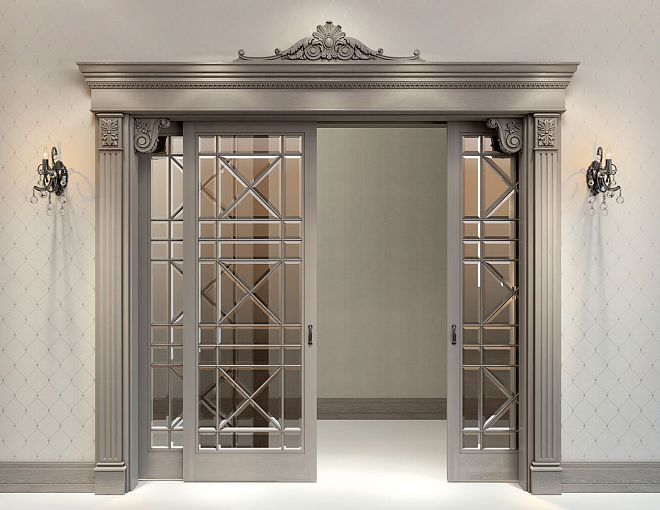
Side pilasters or architraves are vertical elements on the sides of the doorway. Pilasters are a more monumental option, with a capital and base. Architraves are a simpler, linear option. The choice depends on the style and scale of the house.
Upper cornice or pediment is a horizontal element above the door. This is a key element of the portal. There are several options: a straight horizontal cornice, a triangular pediment (classic), an arched pediment. Each sets its own stylistic tone.
Keystone above the door — if the upper architrave is straight, a keystone in the center adds expressiveness. If the pediment is triangular, a keystone is not needed.
Decorative overlays — Buy Moldings for placement in the wall plane next to the door: medallions, cartouches, ornamental bands. They enrich the entrance area without overloading it.
Stepped portal — a stepped recess of a doorway with successive frames. This is a monumental technique typical of classical architecture. Three successive frames around the door create a sense of depth and grandeur.
How not to overload the entrance area
The entrance area should be the main accent of the facade — but not the only "screaming" element. If the door decor is too rich and the windows are modestly framed, a visual imbalance occurs.
Rule of proportions: the decor of the entrance area should be more expressive than the window decor, but not so much that the windows seem insignificant. If the windows have full classical framing — the door portal should be slightly richer. If the windows have minimalist trim — the door portal can be significantly more expressive.
Painting the decor of the entrance area
Color consistency with window framing is especially important here. If the windows are white — the door portal is white. If the windows match the facade color — the portal matches the facade color. Different colors for window and entrance area decor destroy the unity of the facade.
The only exception: intentional highlighting of the entrance area with a gold accent when white or light elements are on the windows. This is a ceremonial technique for representative buildings.
Corners of the house: facade architecture begins here
The corner of the house is where two planes meet. A bare corner is just an edge. A decorated corner is an architectural gesture that gives the house volume and monumentality.
It is the corner elements of the facade that first come into view when looking at the house from an angle. And if the corners are decorated — the house is perceived as built, not as a hastily painted volume.
Corner design options
Corner pilasters are vertical flat columns at the corner. This is the most monumental option. A pilaster at the corner sets a vertical rhythm, lifts the gaze upward, and makes the house appear taller.
Corner moldings are a more modest option. Vertical profiles at the corner that fix the building's edge and create a clear architectural line. Suitable for houses of any style.
Corner rustication is an imitation of stone masonry at the corner. A classic technique for houses in the Renaissance and Classicism styles. Rustication creates a sense of massiveness and solidity of the wall.
Decorative corner overlays — Decorative stucco for accentuating corners without full pilasters. Small decorative elements that fix the corner without creating a monumental effect.
How to choose the height of corner elements
For a one-story house, corner pilasters or moldings run from the blind area to the cornice. For a two-story house, two options are possible:
-
Single corner pilasters through both floors — a monumental option
-
Pilasters on each floor separately with a horizontal dividing belt at the level of the interfloor ceiling
The second option visually makes the building lower. The first makes it higher.
Connection of corner elements with window framing
Corner elements and window frames should be of a unified scale. A wide monumental pilaster next to a thin window casing creates imbalance. Optimal: the width of the corner pilaster is 1.5–2 times greater than the width of the window casing.
Cornice line: the house must be finished at the top
The cornice — a horizontal line under the roof overhang — is the upper boundary of the facade. This is where the wall ends and the sky begins. And this place needs an architectural solution no less than windows and doors.
A bare transition from a plastered wall to the roof overhang is incompleteness. Even with beautifully designed windows and an entrance area, the absence of a cornice leaves a feeling of an unfinished house.
What is a facade cornice
A facade cornice is a horizontal profile installed along the entire perimeter of the building under the roof overhang. It serves several functions:
Decorative: creates a clear horizontal line that completes the vertical of the wall. Visually "closes" the facade from above.
Architectural: coordinates the scale of facade elements — windows, doors, corner pilasters — with the overall volume of the building.
Practical: protects the wall from rainwater flowing off the roof overhang.
How to choose the cornice height
The height (vertical dimension) of the cornice is determined by the building height:
-
Single-story house up to 4 m — cornice 80–120 mm
-
Two-story house — cornice 120–160 mm
-
Three-story building — cornice 160–200 mm
A wider cornice creates a monumental, solemn transition. A narrower one creates a neat, delicate look.
Cornice profile to match the facade style
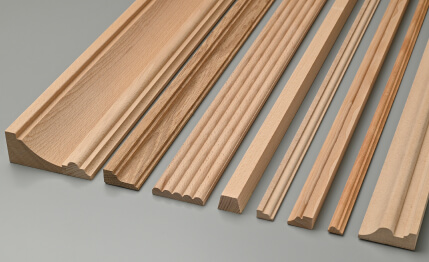
Smooth profile — for modern, minimalist, Scandinavian homes. A clear horizontal accent without ornamentation.
Stepped profile — universal. Suitable for modern and transitional styles. Several horizontal ledges create good chiaroscuro.
Ornamented profile — for classic and neoclassical houses. Dentil band, ionic, meander — classic cornice ornaments.
Cornice with brackets — for houses in Italian and Renaissance styles. Brackets — decorative support elements under the cornice — create a characteristic rhythmic motif.
Horizontal bands and interfloor cornices
In addition to the main cornice under the roof, multi-story houses use horizontal decorative bands — interfloor cornices. They are divided into:
-
Interfloor cornice — a horizontal band at the level of the interfloor ceiling. Separates floors, creates a horizontal rhythm.
-
Base band — a horizontal element separating the base from the main wall.
-
Frieze — a decorative horizontal band between the wall and the cornice. It may contain ornamentation or be smooth.
All these elements together form the horizontal system of the facade — a rhythm of lines that makes the building architecturally thoughtful.
How not to overload the facade with stucco: the rule of measure
Facade stucco is not a competition in the number of details. An overloaded facade is as bad as an empty one. The task is to find a balance between architectural expressiveness and visual calm.
Main rule: a system, not a collection
A well-designed facade is a system. All elements work together. No element exists on its own. Each decorative element answers an architectural question: why is this opening, corner, or line important for the whole?
A poorly designed facade is a collection of random prettiness. You liked a cartouche — you put it. You saw a beautiful corner element — you added it. You found an interesting ornament — you stuck it on. As a result, no element works because they all compete with each other.
Practical rules of measure
Do not decorate every wall plane. Gaps between windows, smooth piers — these are important architectural 'air'. Decoration gains expressiveness precisely against the background of neutral surfaces.
Limit yourself to three or four active decoration zones. Windows — yes. Door — yes. Corners — yes. Cornice — yes. This is enough for most houses. Adding decoration to piers, across the entire wall plane between windows — is already excessive.
One ornament — one profile. Do not mix several ornamental motifs on one facade at once. Choose one — and consistently apply it everywhere: in the cornice, in window casings, in the door portal.
Scale of elements — to the scale of the house. A small one-story house will not withstand monumental columns at the entrance. A two-story cottage deserves more expressive decoration than a country house.
Do not mix styles. If you chose classic — stick to classic throughout the facade. If minimalism — stick to minimalism.
Three verification questions before purchase
Before placing an order, ask yourself three questions:
-
Do all selected elements belong to the same style?
-
Are the scales of all elements consistent with each other?
-
Is there "air" on the facade — neutral surfaces against which the decor looks expressive?
Three "yes" — you can buy.
Ready-made scenarios: what to buy for specific tasks
Now let's move to practice. Let's break down three typical requests.
Scenario one: only windows need to be decorated
This is the most common and most economical scenario. The result is immediately noticeable — the facade gains structure and character.
What to buy:
-
facade stucco — side trims for each window
-
Upper architrave for each window
-
Optionally, a keystone above each window
-
Construction adhesive for exterior use (frost-resistant, moisture-resistant)
-
Acrylic facade paint matching the facade color
-
Acrylic sealant for joints
Meterage calculation: two side trims per window height + one upper architrave per window width + 15% extra for trimming. Multiply by the number of windows.
Second scenario: need to highlight the entrance area
The entrance area is the most noticeable element of the facade. It's important not to skimp here — a too modest portal on a large house looks out of place.
What to buy:
-
Buy Molded Decoration — a keystone above the opening or a pediment element
-
Side trims or pilasters for the entrance opening
-
Upper cornice or architrave
-
optionally — Buy decorative stucco to enrich the input plane
-
Mounting adhesive and sealant
-
Paint matching the facade or in white (depending on the color scheme)
Scenario three: a solid facade is needed
This is a complete set. The result is a house that looks like an architectural project, not a construction task.
What to buy:
-
Window frames for all openings
-
Entrance area decor — a portal with a cornice or pediment
-
Corner elements — moldings or pilasters on all corners
-
Cornice around the perimeter of the building under the roof overhang
-
Interfloor belt (for a two-story house)
-
Mounting adhesive, sealant, paint
When purchasing a kit, it is important to ensure that all elements are from the same line — or at least from the same style family.
Installation of facade stucco molding: key requirements
Installation of polyurethane facade stucco molding differs from interior installation. Outdoors, there are different loads: moisture, frost, thermal expansion.
Adhesive for facade installation
Regular interior acrylic adhesive is not suitable for the facade. A special compound with the following characteristics is needed:
-
Frost resistance: operating range from -40°C to +80°C
-
Moisture resistance: class D3 or D4
-
Elasticity: compensates for thermal expansion of elements
-
Open time: at least 10 minutes (for precise installation)
Dowel fastening for large elements
For large elements — cornices longer than 1 m, wide pilasters — additional mechanical fastening is recommended. Glue + dowel screw through polyurethane into the wall. This eliminates the risk of detachment during strong wind or snow load.
Joint sealing
On the facade, all joints between elements must be sealed. An open joint is a path for water, and water when freezing breaks the connection. Use frost-resistant neutral silicone or acrylic sealant with good adhesion.
Painting of facade stucco
Polyurethane elements must be painted before installation on the facade. Painting before installation is more convenient — it is easier to paint the ornament. After installation, a final coat is applied together with the facade surface.
Paint — only facade acrylic. It is resistant to ultraviolet light, does not fade, does not crack in frost. Two coats — minimum. For dark colors — three coats.
Table: facade stucco for tasks and styles
| Task / House style | What to buy |
|---|---|
| Modern minimalist house | Smooth trims 60–80 mm, stepped cornice |
| Classic cottage | Full window framing, portal with pediment, pilasters at corners |
| Frame only windows | Trim + upper architrave + keystone |
| Highlight the entrance area | Side pilasters + upper cornice or pediment + keystone |
| Two-story house, unified facade | Windows + door + corners + cornice + interfloor belt |
| Small one-story house | Light trim + simple cornice + corner moldings |
| House with dark facade | Stucco molding in the color of the facade or a light neutral tone |
FAQ: answers to key questions before purchasing
Can regular interior stucco molding be used on the facade?
Only if the manufacturer explicitly states outdoor use is allowed. Most interior elements are not designed for frost and prolonged moisture exposure. You need to check the specifications of the specific product.
How to choose facade stucco molding for a plaster facade?
For textured plaster, choose elements with sufficient projection from the wall — at least 15–20 mm. Otherwise, the pattern will be lost in the plaster texture.
Where to start decorating the facade?
Start with windows and the entrance area — they provide maximum visual effect with minimal investment. Add corners and cornice if budget and desire allow to make the facade fully complete.
How to avoid mistakes with the scale of elements?
Basic rule: the width of the window casing should be about 5–7% of the window opening width. The cornice height should be about 2–3% of the floor height. The corner pilaster should be 1.5–2 times wider than the window casing.
How long does polyurethane stucco molding last on the facade?
With proper painting and installation — 15–20 years without replacement. Polyurethane does not rot, is not destroyed by frost, and does not fade when using facade paint with UV protection.
Can facade stucco be painted independently?
Yes. Acrylic facade paint, brush, two coats. If the elements are already installed — apply the final coat together with painting the entire facade. This will ensure perfect color matching.
Which one buy decorative moldings for facade decor above the door?
Keystone (cornerstone) is a universal option. Cartouche — for a richer portal in a classic style. Ornamental medallion — for accent decor on the wall plane next to the door.
Is a professional installer needed for facade stucco molding?
For small elements (trim, keystones, cornice strips) — installation is accessible independently with basic skills. For large pilasters and monumental portals — it is better to hire a specialist.
About the company STAVROS
The facade of a house is its face for decades to come. And this face deserves a material that will not let you down: it will not crack after three winters, will not absorb moisture, will not lose its relief under a layer of peeling paint.
STAVROS is a Russian manufacturer of decorative polyurethane products for interiors and facades. The STAVROS catalog offers a full range moldings from polyurethane for exterior and interior use: Relief Decoration for accent zones, Decorative stucco for window and door frames, corner and cornice elements.
All STAVROS products are made of high-quality dense polyurethane with a clear relief pattern. They are ready for painting, require no special installation skills, and, when properly installed, last more than two decades. Delivery across Russia. STAVROS specialists will help you choose a set of facade stucco molding for your home — taking into account style, dimensions, color scheme, and budget. Because a facade that looks like a concept, not an accident, starts with the right choice.