Article Contents:
- Short answer: if the leaves open independently, one solid MLDPU-3-2.1 cannot be carried across their joint
- What exactly is MLDPU-3-2.1
- Why a closed double door deceives the eye when designing decor
- One element at the joint of two leaves: why this is not a working scheme
- Two MLDPU-3-2.1: the logic of a symmetrical pair
- Example with an 800 mm leaf: how much space remains around the decor
- What you get on 700, 750, 800, 850, and 900 mm leaves
- Installation height matters more than it seems
- The central axis of the opening and the two axes of the leaves are three different lines
- What to do if the leaves are of different widths
- Handles and locks: a check that cannot be postponed until installation
- The panel is already there: center it relative to the panel or the inner field
- Relief 33 mm: why the depth cannot be ignored
- When one MLDPU-3-2.1 is still appropriate on a double-leaf door unit
- One element on one leaf
- One element above the doors
- One element inside a common fixed composition
- One leaf is actually a fixed panel
- In the color of the door leaf
- In the color of the molding frame
- Contrasting Accent
- Treating the entire closed door as one mounting surface
- Buying two pieces right after the message 'one through the joint does not fit'
- Centering by the outer panel, ignoring the inner panel
- Not accounting for the 33 mm relief
- Aligning the second element 'by the first one'
- Saving by leaving one element on one of two identical leaves
- Buying smaller decor only by size
- Two identical leaves of 800 mm each, smooth top section
- Main leaf 800 mm and additional leaf 400 mm
- Two identical leaves of 800 mm each, but top panel 500 mm wide
- Can one MLDPU-3-2.1 be glued to only one door leaf, leaving half over the second?
- Is it necessary to install two decor pieces if the door leaves are identical?
- Is MLDPU-3-2.1 suitable for a door leaf 700 mm wide?
- What is more important: the door width or the panel width?
- Do I need to buy left and right versions?
- Can one element be cut in half along the door joint line?
- If the second door leaf opens once a year, can the joint be covered?
- Is it necessary to make a molding frame around MLDPU-3-2.1?
- Can one MLDPU-3-2.1 be placed above two doors?
- What to do if two elements look too heavy?
- Can I finish only one side of the door?
- How much do four elements cost for two sides of two leaves?
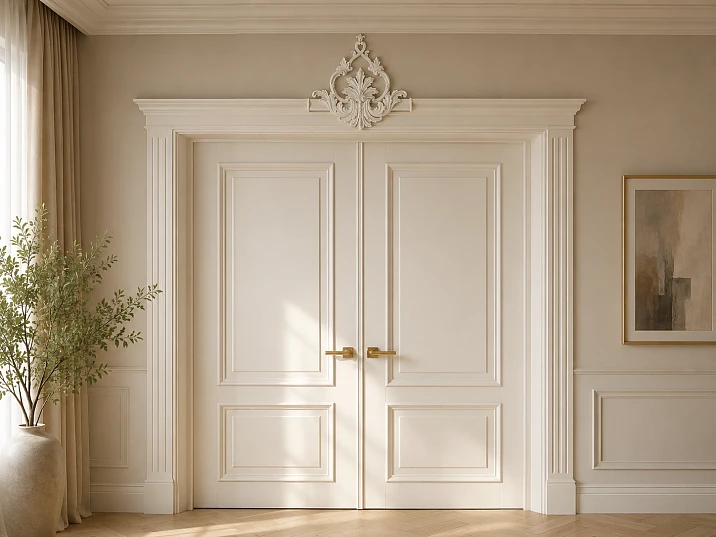
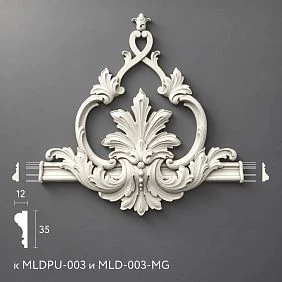
Short answer: if the leaves open independently, a single solid MLDPU-3-2.1 cannot be placed across their joint
A double door in a closed state is perceived as one large symmetrical plane. It is this image that most often provokes a mistake: you want to find a common center of the entire opening, attach a large square decor to it, and get one expressive accent. For a fixed wall panel, such logic would be normal. For two door leaves, it is not.
If the left and right leaves open independently, there is a working line of separation between them. Each leaf has its own geometry, its own hinges, and its own trajectory of movement. Therefore, a single solid central decor MLDPU-3-2.1 cannot be glued to two leaves at once so that the seam between the doors passes through the product. At the first relative movement of the leaves, such a scheme ceases to be a solid structure.
For symmetrical decoration of two identical leaves, the basic logic is different: one leaf — one independent decorative composition. If the size 375 × 375 mm fits each leaf, the buyer orders two identical MLDPU-3-2.1 and places them at the same height along the axis of each leaf.
This does not mean that two pieces are always needed. One MLDPU-3-2.1 can be the right solution if it is placed entirely on one leaf, on a fixed transom, on a common fixed panel above the doors, or in another area that does not cross the movable joint. But for the classic symmetrical scheme "in the center of each identical swing leaf," we are already talking about two products.
The current central decor MLDPU-3-2.1 has a size of 375 × 375 × 33 mm and is made of polyurethane. The price at the time of checking is 15,990 ₽ per piece. This means the difference between ordering one and two pieces is another 15,990 ₽, and the cost of a symmetrical pair is 31,980 ₽. Before such a purchase, it is reasonable to first check not the overall door opening, but each individual leaf.
Buy central decor MLDPU-3-2.1 made of polyurethane




What exactly is MLDPU-3-2.1
MLDPU-3-2.1 — central decor made of polyurethane. Its function differs from that of a linear molding, corner piece, or small decorative overlay. A molding forms a line and perimeter, a corner element frames a frame joint, while central decor creates an independent focal point in the composition.
For MLDPU-3-2.1, this is especially noticeable due to its scale. A 375 × 375 mm square cannot be perceived as a small addition to fill in randomly leftover space. On a door leaf, such an element becomes one of the main visual accents. That is why the door's architecture is checked first, and only then is the quantity decided.
| Parameter | MLDPU-3-2.1 |
|---|---|
| Product type | Central decor |
| Material | Polyurethane |
| Size | 375 × 375 × 33 mm |
| Shape | Square |
| Price per 1 pc. | 15 990 ₽ |
| Cost for 2 pcs. | 31 980 ₽ |
| The script of this article | 1 or 2 pcs. for a double door |
On the product card, door application is highlighted separately: central decor is placed in the central part of the upper section of the door leaf. For the buyer, this is a significant hint. The manufacturer specifically refers to the leaf, meaning an independent door plane, not an attempt to cover the joint of two moving sashes with a single piece.
The 375 × 375 mm size is symmetrical both horizontally and vertically, so the element itself does not dictate a left or right orientation. For a pair of doors, L and R versions are not needed: if the decision is made to decorate both sashes identically, two identical MLDPU-3-2.1 units are purchased. Mirror symmetry here is achieved not through different SKUs, but through the identical positioning of identical elements relative to the axes of the two leaves.
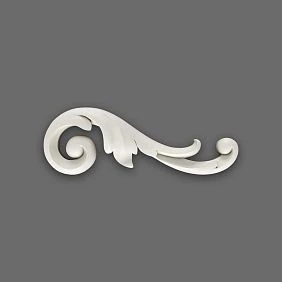
Our factory also produces:
Why a closed double door deceives the eye when designing decor
In the closed position, a pair of sashes forms a common rectangle. The central line of the opening seems like a natural place for a decorative accent: equal width on the left and right, handles often converge near the middle, and casings form a single outer frame. If you look only at the front sketch, a single square decor can indeed look convincing.
The problem is that the front sketch fixes the door in one position. A real door is a kinematic object. When opening, the left sash rotates relative to the right, and the right relative to the left. The joint line is not decorative marking, but the boundary of two parts that must retain the ability to move independently.
Hence a simple design rule: any applied part glued to a door leaf must belong entirely to the part with which it moves. This applies not only to MLDPU-3-2.1. For the same reason, a solid molding cannot be run from one leaf to another without a special design solution and expect both leaves to continue working freely.
For a static composition, the axis of the entire opening and the axis of the decor may coincide. For a double door, first determine the axis of each leaf. The common axis is needed to control the symmetry of the pair, but it does not turn two leaves into one surface.
This is exactly where the article saves money before ordering. A buyer may see a beautiful visualization with a single central ornament, buy one part, and only during fitting discover that the only "ideal" position falls exactly on the door seam. Then they either have to move the element to one side and accept asymmetry, buy a second one, or completely change the decorative scheme.
Get Consultation
One element at the junction of two leaves: why this is not a working scheme
Imagine two identical leaves, each 800 mm wide. The overall decorative center of the closed door is on their contact line. The MLDPU-3-2.1 square is 375 mm wide, so when precisely centered relative to the entire block, roughly half of the product will be on the left leaf and half on the right.
Visually, with the door closed, this may look like a single medallion. Physically, a fundamental problem arises: the back plane of one solid product would have to be connected to two independent bases at once. As soon as one leaf changes position relative to the other, the bases cease to lie in the same plane. The decor cannot simultaneously follow two different trajectories.
The idea of gluing the product to only one leaf, leaving the other half "overhanging" over the adjacent one, does not solve the problem either. First, a large protruding section without support appears. Second, when opening, it is necessary to check whether it will collide with the second leaf, handle, rebate, or casing. Third, the closed composition will depend on the precision of the leaves' position: a slight difference in plane will immediately become noticeable around the relief square.
It is even worse to cut a ready-made central decor in half just to align with the door seam, if the manufacturer does not provide for such a scheme. Then a new visible joint appears inside the ornament, which should be perceived as solid. Moreover, the two halves will diverge every time the door is opened. This turns the central element from a solid part into an improvised paired system for which it was not originally designed.
Therefore, for a standard double-leaf swing door, the question is not "how to make one part cross the seam," but what composition respects the boundary of the two leaves.
Two MLDPU-3-2.1: the logic of a symmetrical pair
If the door leaves are identical in width, pattern, and height, the two central elements create the most comprehensible architectural rhythm. Each decor belongs only to its own leaf, but both pieces together form a symmetrical pair.
The main advantage of this scheme is the alignment of decorative and structural logic. The left leaf retains a complete composition of its own when opened, and so does the right one. If one door is open, the closed one retains a finished central accent. If both are closed, the viewer sees two coordinated centers located at the same height.
This approach is especially appropriate when each leaf already has its own panel or rectangular frame. Then MLDPU-3-2.1 is placed not in the abstract center of the entire door, but in the center of the selected section of each leaf. The frame and the central element work as a single local system.
Two identical decors require stricter marking than one. A small error in one element is often not noticeable without a point of comparison. In a pair, any discrepancy is immediately visible: one square is higher than the other, one is closer to the central joint, the other to the outer edge, one falls in the center of the panel, the other is offset relative to it. Therefore, with two elements, both leaves are first fully marked, two full-size paper templates are applied, and only after checking symmetry do they proceed to installation.
In terms of cost, the solution is simple: two pieces cost 31,980 ₽ at the current price. But the purchase decision should not be made on the principle of "two doors — automatically two decors," but after checking the actual width of each leaf, the position of the handles, the existing milling, and the free area for a 375 mm square.
Example with an 800 mm leaf: how much space remains around the decor
For a clear calculation, let's take a door leaf 800 mm wide. If MLDPU-3-2.1, 375 mm wide, is centered on the horizontal axis of the leaf, the following remains:
800 − 375 = 425 mm of free width.
With a symmetrical position:
425 / 2 = 212.5 mm on each side.
That is, from the overall decorative contour to the left and right edges of the panel, theoretically 212.5 mm remains on each side. This is a fairly noticeable margin, so the square does not fill the leaf from edge to edge. But the arithmetic remainder does not mean that this entire zone is actually free.
Inside the 212.5 mm, there may be a molding frame, panel, handle, lock plate, decorative layout, or an area that should visually remain empty. Therefore, calculating the distance only to the outer edge of the panel is too rough. It is more correct to measure the available decorative section.
If the upper section is limited by a molding with a width of, for example, 600 mm, then exactly 600 mm becomes the working size for checking the 375 mm square. Then the margins within the section will be not 212.5 mm, but 112.5 mm on each side. If the frame section is even narrower, the visual density increases.
This difference explains why two doors of the same width may require different solutions. On a smooth 800 mm panel, a large square may look free. On the same width, but inside a narrow ready-made panel, it can turn out to be too massive. Before ordering, you need to measure not only the leaf as a product, but also the specific zone where the decor is intended to be placed.
What will happen on leaves of 700, 750, 800, 850, and 900 mm
To avoid repeating the same calculation five times, it is more convenient to view the range in a single table. It shows only the geometric remainder in width when MLDPU-3-2.1 is precisely centered on a smooth panel. This is not a ready-made design standard, but a way to quickly understand the scale.
| Width of one panel | Remainder after 375 mm | Margin on each side when centered | Share of width occupied by decor |
| 700 мм | 325 мм | 162.5 mm | 53,6% |
| 750 мм | 375 мм | 187.5 mm | 50,0% |
| 800 мм | 425 мм | 212.5 mm | 46,9% |
| 850 мм | 475 мм | 237.5 mm | 44,1% |
| 900 мм | 525 мм | 262.5 mm | 41,7% |
On a 700 mm leaf, the square takes up more than half the width. This is already a large dominant element, and it is especially important to check whether it competes with the panel and handle. It is 700 mm that the manufacturer specifies as the lower limit for the door leaf in their application scenario, so smaller leaves cannot automatically be considered suitable just because 375 mm fits mathematically.
At 800 mm, the ratio becomes calmer: the decor takes up about 46.9% of the width. This is still a large accent, but noticeable free space remains around it.
On a 900 mm leaf, the element takes up about 41.7% of the width. Here the square is perceived more freely, and additional molding lines are easier to place without pressing them against the ornament.
This table is not needed for choosing an "ideal" width, but for a preliminary filter. After it, a full-size fitting is still required, because the actual composition is determined not by the external size of the leaf, but by its pattern.
Installation height matters more than it seems
The square element is convenient to calculate only by width, but on a door the vertical coordinate often decides more. Decor measuring 375 mm in height takes up a significant part of the standard upper section. If raised too high, it approaches the top edge of the frame. If lowered, it may start to compete with the handle or the central horizontal crossbar.
For a pair of doors, there is another requirement: both parts must be at the same actual height relative to the common floor and relative to the same structural lines of the panels. If you mark each leaf separately, but one leaf has sagged slightly on its hinges, the two geometric centers of the panels may not produce a visually straight line.
Therefore, before installation, it is useful to check the door in a closed working position. First, draw a common horizontal reference line through both leaves, then mark the vertical axis of each. The intersection points become the basis for templates. If the existing panels have their own centers, additionally compare them with the common horizontal line.
You cannot simply measure, for example, the same distance from the top edge of two panels without checking whether the edges themselves are at the same level. In an old or already used door, one leaf may differ by a few millimeters. For a smooth surface, this is almost unnoticeable, but two identical squares turn into precise "rulers" that make the misalignment visible.
The correct sequence is to first adjust the door, then mark the decor. The molding should not mask a geometric problem with the hanging.
The central axis of the opening and the two axes of the leaves are three different lines
In a symmetrical double door, it is easy to confuse three concepts.
The first line is the common axis of the door unit. With identical leaves, it usually coincides with the line of the joint.
The second is the axis of the left leaf. It passes through the middle of the width of the left leaf.
The third is the axis of the right leaf. It passes through the middle of the right one.
If one decor piece is placed on a fixed panel above the door, it is logical to align it with the common axis of the opening. If two decor pieces are installed on the leaves, each is tied to its own axis, and the common line is used to control the symmetry of the entire pair.
For leaves of 800 mm, the panel axes will be offset from the central joint by approximately 400 mm to the left and right, if you do not take into account rebate features and measure by the visible width of identical leaves. It is at these points that the geometric center of each MLDPU-3-2.1 is located in the simplest scheme.
This creates a completely different rhythm than one square in the middle. One central accent unites the entire block into a single static composition. Two accents emphasize pairing. For swinging doors, the second principle more often corresponds to their actual design.
If the project requires the feeling of "one large door," it is better to unite the leaves with common fixed elements around them: casings, upper decor above the opening, a common color scheme, or a symmetrical pattern that does not physically connect the two moving parts.
What to do if the leaves are of different widths
Not all double doors are symmetrical. A common scheme is one main wide leaf and a narrower additional one. For example, 800 + 400, 800 + 500, or 900 + 450 mm. In the closed state, such a block can still look integral, but the idea of two identical MLDPU-3-2.1 becomes significantly less obvious.
On a wide leaf, the 375-mm decor can be proportionate. On a narrow leaf of 400–500 mm, the same square will take up almost the entire width and leave minimal margins. Even if the product physically fits, visually two identical pieces will be in completely different conditions.
In such a situation, you should not buy a second element just for the formal symmetry of quantity. There is still no symmetry: the panels differ. It is much more logical to first determine the architectural hierarchy. If the wide leaf is the main one, one MLDPU-3-2.1 can become its deliberate accent. The narrow leaf then remains calmer or receives another, smaller decor from a coordinated system.
Another possibility is to completely abandon the large central square on the panels and move the overall decorative center to the fixed area above the door. Then one piece can again work for the entire opening, because it does not cross the moving boundary.
It is the asymmetric door that shows why the rule "two leaves = two pieces" cannot be applied mechanically. For identical panels, it is natural. For different ones, the compositional task is solved first.
Handles and locks: a check that cannot be postponed until installation
When choosing a location for the MLDPU-3-2.1, you need to consider not only the rectangle of the door leaf, but also the working area of the door hardware. The handle protrudes from the plane, and free space is needed around it for the hand, and the lock line itself often visually defines the middle part of the panel.
If the central decor is installed in the upper section, there may be no direct conflict with the handle. But a large 375 mm square can drop quite low, especially on a door with a low upper panel. Then the lower part of the relief begins to approach the hardware.
You need to check not only the distance "by the ruler," but also the action by hand. Apply a cardboard template and open the door several times as usual: grab the handle, pull the leaf toward you, push it away. If your fingers or forearm end up near the protruding relief, the location is poorly chosen.
A separate issue is two handles or one active leaf. On a classic double door, one leaf may be fixed with a bolt and used less often. This does not negate its mobility. If it opens at least periodically, the decor on it should be considered as an element of an independent panel.
You should not design the molding as if the rarely opened leaf is a wall. Today it is opened once a month, tomorrow a full opening for furniture may be needed — and the decorative scheme should survive this without restrictions.
The panel already exists: center it on the leaf or on the inner field
If the door is smooth, choosing the axis is relatively simple. On a paneled door, additional geometry appears. The upper section may be narrower than the leaf, have an elongated proportion, shaped milling, or its own molding contour.
In such a case, the central decor should usually obey the center of the decorative section in which it is located, rather than automatically the center of the entire leaf width. If the panel is shifted due to a structural stile or hardware, trying to tie the square to the outer edge of the leaf can produce a noticeable visual misalignment within the frame.
Before ordering, measure:
-
the width of the entire leaf;
-
width and height of the selected top section;
-
distances from the section to the edges of the door leaf;
-
handle position;
-
actual free plane without protrusions or milling;
-
distance between the intended decor and the inner contour of the frame.
If the section is 600 mm wide, a 375 mm square leaves 112.5 mm on each side when centered. If the section width is 500 mm, only 62.5 mm on each side. The second layout already looks much denser, even though the door leaf itself may be wide.
Hence the practical conclusion: the door leaf size is needed for the first filter, and the panel size for the final decision.
33 mm relief: why depth cannot be ignored
In discussions of central decor, people usually look at 375 × 375 mm and forget the third dimension — 33 mm. Yet it is the relief that determines how much the element protrudes from the door plane.
On a wall, such protrusion is almost always perceived only visually. The door moves, passes near the casing, furniture, another leaf, the wall, and sometimes opens almost 180 degrees. Therefore, protruding decor must be checked along the trajectory.
When the door is fully open, the relief must not hit the wall or protruding casing before the intended limiter. If furniture is behind the door, the new maximum dimension of the leaf must be assessed. 33 mm alone is small, but together with the door handle, casing, and small clearance, it can change the actual distance.
On a pair of leaves, it is necessary to check the mutual position at different opening angles. This is especially relevant for doors with non-standard rebate or folding logic, although ordinary hinged panels more often diverge in opposite directions.
A full-size paper template does not show depth. For a final check, it is useful to temporarily attach to it a strip of cardboard or foam material about 33 mm thick in the most protruding area. Such a simple mock-up gives a much more realistic idea of the behavior of the future relief.
When one MLDPU-3-2.1 is still appropriate on a double-leaf door unit
The prohibition concerns not the quantity as such, but the attempt to physically connect two movable leaves with one product. One central decor can be a completely correct solution in several scenarios.
One element on one leaf
If the composition is intentionally asymmetrical, MLDPU-3-2.1 can be placed entirely on the main leaf. Such a move is possible, for example, with different widths of the leaves. It should look deliberate, not like "the second part was forgotten to be bought."
One element above the doors
If there is a fixed transom, panel, or decorative above-door area of suitable size above the leaves, one square can be centered relative to the entire opening exactly there. Then it truly unifies the block and does not participate in the movement of the leaves.
One element within a common fixed composition
Sometimes doors are enclosed in a portal, and the central accent is placed on the wall or in a decorative panel above the casing. For such a solution, the common axis of the opening again becomes correct.
One leaf is effectively a fixed panel
If the structure is not double-leaf in the usual sense, but consists of an active door and a truly stationary panel, the movement rules are different. But even in this case, the joint cannot be automatically covered: you need to understand how the panel is secured, whether there are technical gaps, and whether it may ever need to be dismantled.
What unites all these cases is this: the MLDPU-3-2.1 is entirely attached to one fixed or one movable base. This is precisely what distinguishes a working scheme from a decorative "bridge" across the joint.
When two identical MLDPU-3-2.1 units are the most logical solution
Two elements are justified if several conditions are met simultaneously:
-
the leaves are identical or nearly identical;
-
both are full-fledged independent panels;
-
each has a free section where a 375 × 375 mm square looks proportionate;
-
the decors can be placed at the same height;
-
the hardware does not conflict with the relief;
-
the door stylistically carries two major accents;
-
the buyer wants to emphasize the pairing, not hide it.
The pair works especially convincingly on a double door with repeating panels. There, the structure itself already says 'two identical modules,' and the identical central decor continues this rhythm.
If the door is very wide, but each leaf is visually simple, two squares can help avoid emptiness. If, on the contrary, the leaves are already saturated with carving, complex milling, glass, or decorative grilles, two more large ornaments can overload them.
Therefore, the quantity cannot be chosen separately from the saturation of the existing design. Two MLDPU-3-2.1 is not a neutral doubling. It is two large relief centers that will be noticeable even from a distance with the door closed.
Order MLDPU-3-2.1 375 × 375 mm
When 375 × 375 mm turns out to be too large
Physical placement and good proportion are different things. On a 700 mm leaf, the square fits with margin at the edges, but already takes up more than half the width. In a small room, on a low door, or inside a compact panel, such a scale can be excessive.
Signs that a smaller central decor should be considered:
-
almost no calm flat surface remains around the template;
-
the ornament approaches the molding frame and begins to visually merge with it;
-
the lower part is too close to the handle;
-
the upper one is too close to the edge of the section;
-
the two elements together turn the door into a continuous relief without pauses;
-
the door itself has thin profiles, and the 33-millimeter relief looks too heavy;
-
the room is designed for close perception, and the large pattern dominates the entire wall.
The assortment of central elements includes smaller formats. For example, MLDPU-4-2.1 has a size of about 198 × 208 × 18 mm, and MLDPU-2-2.1 — 235 × 237 × 21 mm. This does not mean they are automatically interchangeable: the series, pattern, and compatibility with moldings differ. But the very fact that a smaller scale exists is useful as a direction for selection.
If the full-size template MLDPU-3-2.1 looks excessive, it is better to choose decorative elements made of polyurethane of a different scale than to buy two expensive parts and try to "squeeze" them into an already finished door.
If molding frame is needed around the decor
MLDPU-3-2.1 can work as a standalone accent, but the product belongs to the central elements of the molding system. Therefore, on a paneled or specially decorated door, the question of a frame naturally arises.
The frame changes the way it is perceived. Without it, the square reads as a separate ornament on the plane. With it, it becomes the center of an organized section. On two leaves, this means two independent framed compositions.
It is important not to make a new mistake: do not run one continuous molding from the left leaf to the right through the central joint. Like the central decor, the trim on movable panels must account for the movement boundary. Each door gets its own closed or structurally completed contour.
If a framed scheme is planned, first choose a compatible system, then calculate the molding length, and only then the position of the central element. The MLDPU-3-2.1 card indicates compatibility with moldings of the MLDPU / MLD-MG series, and the related products block features MLDPU-003.
For the buyer, this means that the choice of frame cannot be made only by a similar pattern. If a full system composition is needed, it is better to check the compatibility of the specific central element and profile.
One decor on one leaf: when asymmetry looks intentional
Asymmetry itself is not a mistake. The mistake is random asymmetry, when one element ended up on one leaf only because the second was not ordered or the first could not be placed along the common center.
A deliberate option can work on a door with unequal leaves. For example, the wide main leaf is used daily, while the narrow additional one is visually subordinate to it. Then the large MLDPU-3-2.1 on the main door emphasizes the hierarchy.
Another scenario is an interior where the door is part of an asymmetrical wall composition. On one side there is a wardrobe, on the other a mirror or panel, and strict mirror symmetry of the leaves themselves is not the goal. In such a project, a single accent can be part of a larger balance.
The check is simple: close the door and mentally remove the explanation of "why so." If one square looks like a lost half of a pair, the solution is weak. If it clearly belongs to the main panel and is supported by other asymmetric interior elements, the composition can be convincing.
For a regular symmetrical double door with identical panels, one element only on the left or only on the right is more often perceived as incompleteness. Therefore, such a solution should not be chosen to save 15,990 ₽. Savings should lead to a cohesive, simpler scheme, not to half of a symmetrical scheme.
How to make two full-size templates before purchasing
For MLDPU-3-2.1, the template is especially useful: a 375 mm square is easy to reproduce without plotter printing.
You need two sheets of paper or cardboard at least 375 × 375 mm. Cut out two identical squares. On each, draw vertical and horizontal axes. If you have a photo or outline of the ornament, you can conditionally apply it, but for scale assessment, the overall size is sufficient.
Next:
-
close and adjust both panels;
-
find the axis of the selected section of the left door;
-
find the axis of the same section on the right;
-
align the templates along these axes;
-
temporarily secure with masking tape;
-
step back to the usual viewing distance;
-
check the door in the closed position;
-
open the left leaf;
-
open the right one;
-
open both;
-
check the handles and the trajectory;
-
compare the distances to the frames and edges.
You need exactly two templates at the same time. If you try one square first on the left, then on the right, it is harder for the brain to assess the density of the whole pair. Two cardboard elements at once show whether the door is becoming overloaded.
After such a fitting, the answer "buy two pieces or look for a smaller scale" becomes much more reliable than after viewing the product card on the screen.
Marking two elements without error accumulation
For a symmetrical pair, it is dangerous to mark the second decor "based on the first." If the first is accidentally shifted by 4 mm, and you repeat the second relative to it with another error, the final misalignment may become noticeable.
It is better to build both positions from common baselines.
First, check the verticality and level of the door block. Then choose a common horizontal line — for example, the center of the upper identical panels. This line is transferred across both leaves using a laser level or a long level with the door closed.
After that, separately find the vertical axis of each leaf or each frame section. This gives two independent central points on the same horizontal line.
From each point, set off half of the decor's overall dimension:
375 / 2 = 187.5 mm.
That is, the overall square extends 187.5 mm up, down, left, and right from its center.
At this stage, do not apply glue. Draw only light reference marks or use painter's tape along the edges. Attach both items or their templates. Compare diagonally: the upper left corner of one and the upper right corner of the other should appear on the same line, as should the lower corners.
Only after visual and measured verification of symmetry can the elements be fixed.
What to check on an already painted door
Since the door is already installed, the surface may be painted, varnished, coated with enamel, film, or have a factory finish. The fact that the decor is polyurethane and involves adhesive mounting does not automatically mean that any mounting compound is compatible with any coating.
Before starting work, it is necessary to determine the material of the door leaf, the type of finish layer, and the condition of the surface. The weak point is sometimes located not between the adhesive and the decor, but deeper: decorative paint may adhere poorly to the base. Then high-quality adhesive will hold the paint layer, but the layer itself will peel off the leaf together with MLDPU-3-2.1.
For a finished door, a trial check in an inconspicuous area is especially important. It is not necessary to roughly sand a large area around the future decor without need if, after a test fit, it turns out that the position needs to be changed. First, the final marking is fixed, then only the area that will actually be covered by the product or provided for by the chosen technology is prepared.
If the door is covered with film, veneer, varnish, or complex factory enamel, the preparation technology should be selected for the specific coating. There is no universal recipe of "degrease and glue" for all doors. In the article, it is important to separate the confirmed fact about the polyurethane decor itself from the conditions of the specific base.
Before purchasing a pair for 31,980 ₽, it is also useful to decide whether the decor will be painted separately. A contrasting option can be prepared before installation. If the task is to visually "grow" the relief into the leaf and achieve a single color, the final finish may require work after fixation.
Painting of two central decors: three different results
In the color of the door leaf
The calmest scheme. Two large squares do not turn into two contrasting spots, but are read due to their own relief and chiaroscuro. For MLDPU-3-2.1 with a 33 mm protrusion, this is often enough: even with the same color, the ornament does not become flat.
This option is especially useful when the door already has panels, moldings, or complex trim. The color does not add another level of fragmentation, so the two elements fit more easily into the existing architecture.
In the color of the molding frame
If a separate frame section is created on each leaf, the central decor can be included in the same color as the profile. Then a complete "contour + center" system emerges. On two leaves, it repeats mirror-wise in position.
In this scheme, it is important that the shade and degree of gloss of the two MLDPU-3-2.1 match. The symmetrical parts are located next to each other, so the difference between two batches of paint or different coating thicknesses is more visible than on elements spaced across different walls.
Contrast accent
A dark, metallic, or other contrasting color makes the MLDPU-3-2.1 the main graphic center of each panel. This is a strong technique, but it doubles the visual intensity: instead of one contrasting square, the viewer gets two.
Before such finishing, it is useful to paint paper templates in an approximate color and hang them on the doors again. Simple white squares can look calm, while the same two dimensions in black or gold become much heavier. Color here changes not the size, but the perceived scale.
What to do if one panel is active and the second is rarely opened
Many double doors have one panel used daily, while the second is fixed with a bolt and opens only when necessary. It is easy to mistake this for an almost stationary structure and decide that one decoration can be "thrown over" the central joint.
The criterion is different: can relative movement occur between the panels. If the second panel structurally opens, the answer is yes. Frequency of use does not change the principle.
Moreover, rare
The cost of the solution and the point where you need to stop before the basket
At the current price, one MLDPU-3-2.1 costs 15,990 ₽.
| Package contents | Quantity | Cost of decoration |
| Single independent accent | 1 pc. | 15 990 ₽ |
| Symmetrical pair on two panels | 2 pcs. | 31 980 ₽ |
| Difference between options | +1 pc. | +15 990 ₽ |
The second element is not a minor addition. Therefore, it is useful to pause right before moving from one detail to two and answer three questions.
First: do we have two equivalent decorative zones? If the panels are identical, most likely yes. If one panel is half the width of the other, the answer is no longer obvious.
Second: is 375 × 375 mm suitable for each zone separately? You cannot prove the suitability of the second detail by the fact that the first looks good on a wide panel.
Third: is a repetition of a large center really necessary? On a minimalist door — possibly. On an intricate carved one — a pair may become excessive.
In addition to the cost of the decors themselves, moldings, mounting compound, preparation, painting, and labor may be added. Therefore, two paper templates costing a few rubles are one of the most economical stages of the entire purchase.
Mistakes before ordering: causes, consequences, and verification
Treating the entire closed door as one mounting surface
Reason — visual integrity of the opening. Consequence — one square lands exactly on the movable joint. Verification method — open each leaf separately with the template. Solution — treat each panel as an independent base.
Buy two pieces immediately after concluding "one through the joint doesn't fit"
A correct technical conclusion doesn't yet prove that the second option is automatically good. Two squares may turn out to be too large. Verification — two templates simultaneously, not one that is moved from door to door.
Center on the outer panel, ignoring the inner panel
The geometric center of the panel and the visual center of the framed section may not coincide. Consequence — a perfectly measured decor looks shifted. Solution — first determine which architectural zone the element belongs to.
Not accounting for 33 mm of relief
In a frontal photo, depth is barely noticeable. On a real door, it adds a protruding dimension. Verification — a temporary 3D mockup and full opening of the leaf.
Align the second element "by the first"
If the first is shifted, the error is replicated. Solution — a common horizontal line and two independent vertical axes from the door's structural geometry.
Save money by leaving one element on one of two identical leaves
If the entire door is built on mirror symmetry, one square may look like the missing half of a pair. Either make a full pair, or choose a different cohesive composition.
Buying smaller decor only by dimension
An alternative item must match not only in size, but also in style, role, and compatibility with the intended molding. Reducing the size is a reason to re-check the system, not just replace the number 375 with 208.
When it's better not to buy MLDPU-3-2.1 for this door at all
The usefulness of a choice also shows in rejecting an unsuitable product.
The order should be postponed if the free section of the panel does not provide a calm area around the 375-millimeter square. The same applies when the decor physically fits but almost touches the frame, glass, or hardware.
A door already saturated with large carving is not a good candidate. MLDPU-3-2.1 itself is a prominent central element. Adding two such accents on top of an existing active pattern just because there is space on the panel is not necessary.
It's also worth declining when the relief interferes with the opening path, and changing the door's position or the limiter is impossible.
Another stop signal is significantly different panels, where two identical elements create different scales. Here, it's better to look for a hierarchical or asymmetric scheme.
If you want a single common center, but the only place turns out to be a moving joint, that's also a reason not to buy the product for the current idea. First, find a stationary common surface—a transom, an above-door panel, a portal—or change the composition.
Choose decorative polyurethane overlays makes sense if the large square does not solve the task.
Practical algorithm before purchasing
-
Close the door and check that both panels are aligned evenly.
-
Measure the width of each panel separately.
-
Measure the selected top section or panel.
-
Mark handles, locks, glass, and existing routing.
-
Make two squares 375 × 375 mm.
-
Find the axis of the left decorative section.
-
Find the axis of the right one.
-
Draw a common horizontal line for the pair.
-
Secure both templates simultaneously.
-
Evaluate the closed door from the room and from the adjacent space.
-
Open the left leaf.
-
Open the right one.
-
Open both.
-
Check the future protrusion of 33 mm.
-
Decide whether a separate molding frame is needed on each panel.
-
Determine the color.
-
If the two templates look proportionate, place an order for two MLDPU-3-2.1.
-
If the scale is too large, switch to a smaller central element.
-
If you need a single center for the entire opening, look for a fixed platform.
-
Do not apply the mounting compound until you have finally checked two positions.
This order is more useful than the abstract advice "place symmetrically" because it turns design into a sequence of verifiable actions.
Decision tree: one piece, two, or another model
Should the decor be placed directly on the door panels?
If not, check the fixed area above the door. There, one MLDPU-3-2.1 can work for the entire block.
If yes, the next question.
Do both leaves open independently?
If yes, we exclude a single integral element across the joint.
If no and we are indeed dealing with a stationary composite panel, we evaluate the structure separately.
Are the panels identical in width and pattern?
If yes — we try on two identical templates.
If no — we evaluate the main and additional panels separately.
Does 375 × 375 mm fit each selected section?
If yes — we check the pair for style and hardware.
If no — we choose a smaller central decor.
Do two squares not overload the door?
If yes — two pieces give a logical symmetrical system.
If no — we simplify the composition.
Is one element kept only for the sake of economy?
On identical door panels, this is a weak reason. Better to have either a full pair or another complete scheme.
Inspection upon receiving two MLDPU-3-2.1
Before applying glue, place the two items side by side and compare them under the same lighting. Check the article number, dimensions, integrity of corners and relief, and absence of transport damage.
Then attach both actual elements to the door. The paper square shows the scale but does not convey the pattern and depth. The real relief may visually appear larger than the template, especially under side lighting.
If pre-painting is planned, treat the pair with the same material and in the same sequence. A difference in gloss or shade on two symmetrical squares is more noticeable than on elements placed in different rooms.
After painting, compare the parts again before installation. If one seems darker due to layer thickness, it is easier to fix this on the table than after gluing it to the door.
Also check the back surfaces: they should be free of dirt, accidental paint drops, or damage that would prevent even adhesion. If the packaging was stored in the cold, it is reasonable to let the items reach room temperature before fitting and finishing operations.
Only after a trial fitting of both parts simultaneously proceed to final fixation.
Why a molding will not fix the mistake with one central element
Suppose one part has already been purchased. The idea arises to leave it on one panel and run molding lines so that they visually connect both doors. This is only possible as a specially designed separate system.
Molding on movable panels should also not thoughtlessly cross the joint line. In the closed state, two segments may coincide and create a continuation of the pattern, but each section must move with its own door.
Therefore, trim can visually unite the leaves, but it does not turn one MLDPU-3-2.1 into a common physical center. If the overall frame is "cut" by the door seam, the break point must be provided for in the design.
On identical panels, it is simpler and cleaner to repeat the local frame system: a separate contour and a separate center on the left door, the same on the right.
If a profile is needed for such a composition, it should be chosen as part of a compatible system, not as a cosmetic way to hide an erroneously purchased quantity.
Trims, portal, and two large squares: three levels of decor
A double door almost always has an outer contour—trim or portal. Sometimes a cornice, pediment, capital, or other large stucco molding is already located above it. Two MLDPU-3-2.1 add another level of relief inside.
It is convenient to evaluate the composition as three nested scales.
The first is the outer contour of the opening. It connects the door to the wall.
The second is the contour of each leaf, if there are panels or moldings.
The third is the central decor.
If all three levels are equally contrasting and saturated with ornament, the door can become overloaded. Then it is not necessary to remove the MLDPU-3-2.1 itself: sometimes it is enough to paint it in the color of the leaf or abandon the additional frame.
If the outer portal, on the contrary, is laconic, the two central squares get more visual air and can become the main theme of the door.
The decision on the quantity therefore cannot be separated from the environment. Two elements are evaluated not against the white background of the product card, but within the already existing door ensemble.
If the door has glass
On a glazed double-leaf door, the outer width of the leaf says little. The free solid part can be significantly narrower and lower.
If the glass occupies the upper section, the MLDPU-3-2.1 has to be either moved down or another zone found. But the lower part is usually closer to the handle and is perceived differently in composition.
You should not automatically stick the element onto the glass surface just because the square fits. The installation technology for the specific glass, coating, and adhesive composition must be separately confirmed. In the original task, we have confirmed door application of the product, but this does not equal confirmation for any base material.
If the glass is the main decorative component of the door, large polyurethane squares may be excessive. Sometimes it is better to decorate the portal or choose thin overlays.
If there is a wide solid transom section above the glass on each leaf, two identical elements can be tried there, again counting each leaf separately.
If the door already has carving or deep milling
For adhesive decor, a clear mounting surface is needed. Complex milling can intersect the rear contour of MLDPU-3-2.1, creating areas without proper support.
Do not expect that a thick layer of mounting compound will automatically compensate for any unevenness. Such technology must be confirmed for the selected adhesive and substrate.
From a design perspective, a second conflict arises: the existing carving and the new floral relief may compete. If both patterns are large, the door becomes visually noisy.
Here, it is useful to supplement the cardboard square with a printed photo of the ornament itself. This shows not only the area but also the actual density of the pattern.
If there is no free smooth section, it is better to choose a different type of decorative element or embed the molding into a pre-prepared framed area, rather than placing a large square over random lines.
Separately, assess the symmetry of the existing milling on the two door leaves. If the pattern already differs slightly, two absolutely identical central squares may highlight this difference more strongly. Then, before purchasing, it is useful to first decide what to consider the main axis of each door.
Why one width calculation cannot solve the entire task
The formula for an 800 mm leaf gives an honest answer: after 375 mm, 425 mm remains, 212.5 mm on each side. But it does not answer whether the door is convenient to open, whether the height is suitable, whether the decor intersects with the panel, how active the relief looks, and whether the surface can withstand installation.
Several independent measurements are required to solve this:
-
horizontal scale;
-
vertical position;
-
free plane;
-
relief depth;
-
movement trajectory;
-
symmetry of two leaves;
-
hardware;
-
existing decor;
-
color;
-
the cost of the pair.
It is multidimensional checking that distinguishes a meaningful choice from a decision based on a single dimension. The card reports characteristics. The buyer's task is to understand how these characteristics will behave on a specific installed door.
If at least one of the listed variables causes a conflict, it is pointless to compensate for it by the fact that the element "fits" in width. In such a case, the position, scale, or the entire principle of composition is changed.
Installation of two elements: why sequence matters
After deciding "two pieces are needed," a separate task begins — to install them so that the pair truly looks like a pair. The riskiest sequence is to completely finish the left leaf and then transfer measurements to the right one. Any error on the first side becomes the starting point for the second.
It is more reliable to prepare both leaves simultaneously. First, check the door geometry and the overall horizontal level, then mark the vertical axes, then place both items without glue. Only after this does it become clear whether the height, side margins, and relation to panels match.
If the elements are intended to be painted in the door color, it is technologically convenient to decide in advance where the boundary of the finish layer will run. With a neat factory surface, it is sometimes more advantageous to paint the decor separately and minimally interfere with the panel. When creating a monolithic frame system, a common finish may be required. The specific technology depends on the door covering.
A practical sequence looks like this:
-
adjust the door;
-
clean and inspect both mounting areas;
-
draw a common horizontal line;
-
find two vertical axes;
-
apply two MLDPU-3-2.1 simultaneously;
-
check the door closed;
-
check each leaf in motion;
-
clarify the dimension taking into account the 33-millimeter relief;
-
remove elements;
-
prepare the base according to the technology of the selected mounting compound;
-
re-check the layout;
-
secure the first element;
-
immediately align the second with the overall horizontal line;
-
secure the second;
-
perform the specified finishing after the strength has been achieved.
The key principle is that symmetry is decided before the adhesive. After fixing a large element, correcting a few millimeters becomes much more difficult than before installation.
Is it necessary to finish the back side of a double door
After choosing two elements for the front side, a new question arises: should the same composition be repeated from the adjacent room.
There is no automatic rule. If a door connects two formal spaces—for example, a living room and a hall—identical finishing on both sides may be justified. Then, for two door leaves, four central elements will be needed, two on each side.
But that is a different budget and a different visual load. Four MLDPU-3-2.1 at the current price—63,960 ₽ just for central decors, without moldings, painting, or installation. Such a calculation is useful to make before ordering, so that the decision about the second side does not arise only after the first is completed.
If the adjacent room is intimate or utilitarian, the reverse side can be left more subdued. An interior door does not have to be identical on both sides if the interior design tasks differ.
With two-sided decor, a trajectory check is added: the relief appears on both planes of the door leaf. It is also necessary to ensure that the positions of the elements by height are coordinated if the door is often seen open and both sides can be compared.
The main rule does not change: on each side, each integral element belongs to one door leaf. The quantity increases due to the number of surfaces being decorated, not because one square can be transferred across the central seam.
Three typical doors and three different purchase outcomes
Two identical leaves of 800 mm each, smooth upper section
This is the most straightforward scenario. On each leaf, MLDPU-3-2.1 with a width of 375 mm leaves 212.5 mm to the side edges when centered across the entire width. If the upper section is truly free, the handle is located lower, and two templates look calm, the logical order is 2 pcs.
Here, one element through the common center is not needed: it would fall on the joint. One only on the left or right door would destroy the expected symmetry.
Main leaf 800 mm and additional leaf 400 mm
Two identical elements no longer provide balance. On a wide door, the square occupies 46.9% of the width, on a narrow one — 93.75%. These are two fundamentally different scales. Ordering a pair just for the sake of the same article number is unreasonable.
Possible solutions: one MLDPU-3-2.1 on the main leaf; a smaller decor on the additional one; abandoning decor on the panels and one common accent above the opening.
Two identical leaves of 800 mm each, but the top panel is 500 mm wide
On the outer panel, everything looks comfortable, but the actual working section leaves only 62.5 mm around the square on the sides. Two elements may appear visually squeezed inside the frames.
The commercial result here may not be "two pieces," but "choose a smaller model." That is why the article cannot turn the 800 mm width into a universal guarantee.
If the leaves are 850 or 900 mm: more space does not always mean better
On wide panels, the free margins increase, and it seems that MLDPU-3-2.1 automatically looks better. But at the same time, the character of the entire door changes.
On a 900-mm leaf, the square occupies about 41.7% of the width. This gives more breathing room, but if the top section is very tall, the element may seem insufficiently connected to the frame and require an additional molding contour.
On a wide smooth door, a single central decor inside each panel can look like an independent medallion. On a complex classic door, it more often requires connection with frame lines.
Therefore, increasing the width solves the problem of tightness, but may open another task — how to assemble the surroundings around the center. This is a good example of why scale cannot be assessed only by the formula "the larger the field, the better."
If after the template it seems that the square is "floating" on a large empty plane, it is not always necessary to enlarge the decor itself. Sometimes it is enough to properly organize a molding frame.
Influence of viewing distance
A door in a narrow corridor and a door in a large living room are perceived differently. In a corridor, a person sees the relief from one and a half to two meters and reads every detail. In a spacious room, the same door can be assessed from five to six meters as part of the wall.
The large MLDPU-3-2.1 is designed for a prominent role. Two elements side by side in a narrow space are perceived much more actively than on a wide wall of a large hall.
Therefore, after installing paper templates, you cannot look only at close range. Walk along your usual routes: enter the room, sit on the sofa, look from the corridor, evaluate the open door. These are the points that will give an honest understanding of scale.
If two squares seem excessive only from a close distance, but the door is usually perceived from afar, the solution may remain good. If they dominate from every point, smaller decor will give a calmer result.
This is not abstract aesthetics, but part of the purchase: viewing distance helps to understand whether a second large detail is needed in your particular interior.
Light and 33 mm relief
Large relief changes its appearance depending on the direction of light. With frontal diffused lighting, MLDPU-3-2.1 looks calmer because the shadows are soft. With side lighting, the ornament becomes more contrasting.
For two elements, this is especially noticeable if a window or lamp is on the side. The left decor may receive light at one angle, the right at another. As a result, absolutely identical details visually seem different in depth.
Before choosing a contrasting color, look at the door in the morning, afternoon, and evening. Sometimes two white elements look restrained in daylight, but become the main sculptural accent under evening side lighting.
If the door is already near wall sconces or directional lights, their position should be considered in the layout. A slight change in height can alter the character of the shadows.
The size itself does not change, but the perceived scale changes significantly. This is another reason not to make a decision based on a flat product card image.
How not to confuse "central decor" with the task of a regular overlay
MLDPU-3-2.1 should not be chosen just because you need to "decorate the door with something." Its large square format implies the role of a centerpiece.
If the panel requires a small accent above the handle, a corner finish, a decorative insert in a narrow panel, or a local floral detail, it is better to look at another type of product. Central decor does not have to solve every molding task.
The correct name of the product type here has practical meaning: the word "central" immediately sets its role and prevents perceiving the large square as a universal small overlay for any free space.
On a double door, MLDPU-3-2.1 is logically considered when there are two full central zones. If there are no such zones, you should not artificially create them just because you liked the article number. First, determine the function of the decor on the panel, then check whether the specific size matches it.
If the task comes down to a small local accent, the product type itself already suggests that you need to look for a smaller element. This is better than trying to make a large central decor play the role of a detail of a different scale.
Can a visually unified pattern be made without physically connecting the panels
Yes. Two leaves can form a common composition in the closed state if all parts are physically separated along the joint line.
For example, molding lines on the left and right doors can continue a single horizontal line. Two identical MLDPU-3-2.1 units can be positioned mirror-symmetrically relative to the central axis. Colors and frames can be coordinated so that the entire door is perceived as a single ensemble.
When opened, the composition naturally splits into two complete halves.
This is much more reliable than trying to achieve unity with a single piece that crosses the seam. Architectural integrity does not require physical continuity. It can be built on repetition, axis, rhythm, and identical proportions.
For the buyer, this removes the main psychological barrier: two elements do not necessarily 'split' the door. With proper layout, they can, on the contrary, make the pairing intentional and more cohesive.
This is especially evident when both leaves are open: each square remains in the center of its own door, rather than looking like part of a pattern that 'broke' during movement. Such a test is useful to conduct even on paper templates.
Checklist before payment
Before adding one or two pieces to the cart, run a quick check:
-
I know the exact actual width of each leaf.
-
I measured the free decorative section specifically, not just the panel.
-
I made two templates of 375 × 375 mm.
-
Templates are installed simultaneously.
-
One element does not cross the movable joint.
-
Two templates are at the same height.
-
Handles and working grip are checked.
-
The 33 mm relief protrusion is taken into account.
-
Both doors open fully.
-
The existing panel does not conflict with the back plane of the decor.
-
I decided whether molding is needed around each center.
-
The painting option is determined.
-
If the doors are different, the second decor is not purchased automatically.
-
If 375 mm is too large, a different model is selected before ordering.
-
I understand the final cost of one and two parts.
If all points for a symmetrical pair are confirmed, purchasing two MLDPU-3-2.1 becomes a conscious decision, not a result of guesswork.
Final recommendation
For a standard double-leaf interior door with two independently opening panels, one solid MLDPU-3-2.1 cannot be installed along the common central axis so that it crosses the joint of the leaves. The closed door is visually unified, but structurally consists of two movable bases.
If the leaves are identical and the goal is to achieve symmetrical decoration, the most logical scheme is 2 identical central decor elements MLDPU-3-2.1, one on each panel. For an 800 mm leaf, a 375 mm square leaves 212.5 mm of side margin with simple centering, but the final decision is not made by this calculation, but by the size of the actual panel and a full-size fitting.
One element remains a normal choice if it entirely belongs to one main leaf in a deliberately asymmetrical project or is placed on a common fixed area above the doors.
If two 375 × 375 mm templates look too large, there is no need to buy a pair. The correct next step is to switch to a smaller-scale central decor or change the entire frame composition.
The commercial route becomes simple: measure each leaf → try two templates → check movement and relief → determine 1, 2, or another size → only then order.
FAQ
Can one MLDPU-3-2.1 be glued to only one leaf, leaving half over the second?
For a standard swing door, this is a poor base scheme. The overhanging part creates additional dimensions and requires collision checks, and the composition itself depends on the precise closed position of the panels. It is better to keep the entire element within one base.
Is it necessary to install two decors if the panels are identical?
No. Two elements are needed not by a formal rule, but if you want a symmetrical central accent on both panels and the size fits each one. You can leave the doors without a central decor or move one accent to the fixed area.
Is MLDPU-3-2.1 suitable for a panel width of 700 mm?
The STAVROS card indicates door application on a panel width from 700 mm. But at 700 mm, the square takes up about 53.6% of the width, so a full-size fitting is especially important.
What is more important: the door width or the panel width?
For the first filter — the panel width. For the final decision — the actual free section where the element will be installed.
Do I need to buy left and right versions?
No. MLDPU-3-2.1 is a square central element. For a symmetrical pair, two identical SKUs are used, not L/R.
Can one element be cut in half along the door joint line?
Without a direct factory recommendation, such a modification should not be included in the project. The central ornament is designed as a single piece, and a cut will create a movable seam inside the pattern.
If the second leaf opens once a year, can the joint be covered?
If it is structurally designed to open, there is no reason to consider it a fixed surface. The decorative system must preserve the possibility of normal movement.
Is it mandatory to make a molding frame around MLDPU-3-2.1?
No. The central decor can work independently. The frame is needed when the chosen system and the proportions of the panel require it.
Can one MLDPU-3-2.1 be installed above two doors?
Yes, if there is a fixed area of suitable size above them. Then one element can indeed be centered on the common axis of the entire opening.
What to do if two elements look too heavy?
First, try the option in the color of the panel. If the issue is specifically about scale, switch to a smaller central decor. Do not reduce the visual fields to a minimum just to keep a specific article.
Is it possible to decorate only one side of the door?
Yes. If the decor is needed only on the side of the formal room, the reverse side does not have to be repeated. This is a separate design decision.
How much do four elements cost for two sides of two leaves?
At the current price of 15,990 ₽ per piece, four elements cost 63,960 ₽. Before such an order, it is especially important to check both sides of the door against the templates.