








































































Article Contents:
- Why a single central overlay gets lost on a wide double door
- The pair works not by quantity, but by the direction of the pattern
- Comparison of four ways to decorate the center of a wide door
- From which point to measure the position of the pair
- It is impossible to assign a universal distance between overlays in advance
- Option one: closer to the central joint
- Option two: farther from the center
- Option three: inside the future molding frames
- Option four: remove one template
- If one leaf is significantly wider than the other
- Two overlays on one leaf
- Two pairs on one door
- Active and rarely opened leaf require different checks
- The relief has a thickness of 11 mm
- One frame on each leaf
- Top and bottom sections
- The frame should not fit tightly against the overlay
- Why you cannot simply count the total number of parts
- NPU-186L and NPU-186R — a paired system of two orientations
- One symmetrical overlay — an independent center
- The molding sets the boundaries of the field
- Decor for moldings belongs to the frame system
- Smooth white double door without panels
- The door is already divided by panels
- Each leaf has a separate handle
- Handle only on the active leaf
- A very tall double-leaf door
- A door between two richly decorated rooms
- A door in a calm modern interior
- One color — when the relief matters more
- Contrast — when the pair should become the main focal point
- The finish should be decided before final installation
- First the horizontal, then the height
- Measure from the same points on the templates themselves
- Check both the closed and open door
- Treat the entire double door as one fixed plane
- Place parts at different heights
- Move the overlays too close to the handles
- Set the distance between NPU-186L and NPU-186R without fitting
- Try to fix insufficient scale with a large number of overlays
- Make the molding frame too tight
- Choose only based on a close-up photo of the product
- Treat the pair as a single product
- Calculate total cost based on known price of NPU-186R only
- Add decor to fill empty space
- Ignore 11 mm thickness
- Very narrow panels
- Door is already rich with carving
- Need a single strict geometric frame without floral decor
- Requires a large central medallion
- Panels differ greatly in width
- Decor conflicts with hardware
- Living Room
- Bedroom
- Office
- Entryway or hall
- Commercial interior
- Can I install only NPU-186L without NPU-186R?
- Are NPU-186L and NPU-186R the same?
- How many overlays are needed for one double door?
- Can I put both overlays on one door leaf?
- Should NPU-186L and NPU-186R be placed flush against the central joint?
- How to determine the distance between paired overlays?
- Can overlays be placed above the handles?
- Are moldings needed for NPU-186L and NPU-186R?
- Where to view moldings for such a composition?
- Can the frame be supplemented with other carved decor?
- How to check the size of NPU-186L/R before purchasing?
- Does the 11 mm thickness matter?
- Can the overlay be placed directly over the central seam of two door leaves?
- How to understand that the overlays are too small for the door?
- Can the NPU-186L/R be used without a contrasting color?
- Is it mandatory to place the overlays strictly in the center of each door leaf?
- What to do if one door leaf is wider than the other?
- How many NPU-186L and NPU-186R are needed for two identical doors?
- Can I order several sets at once without trial marking?
- What is the price of a pair of NPU-186L and NPU-186R?
- Where can I buy paired carved overlays NPU-186L and NPU-186R?
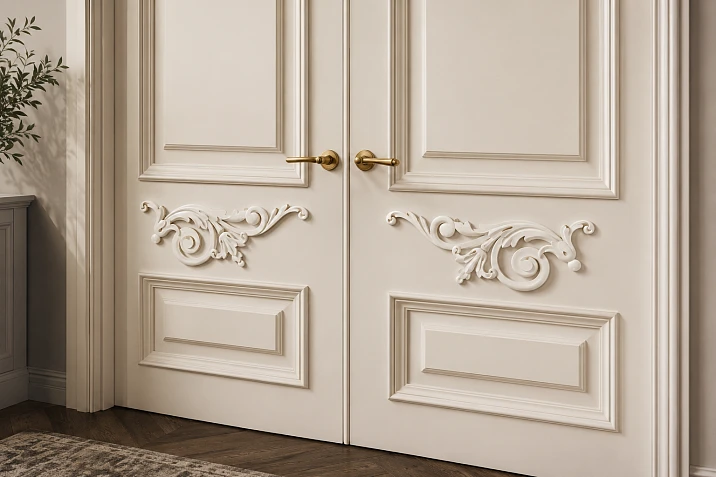
A wide double door requires a different scale of decor than a regular single-leaf door. What looks confident in the center of a single-leaf door can literally get lost on two panels: too much empty space remains around, the central joint divides the surface in half, handles shift the visual balance, and one small overlay seems like a randomly glued detail. Therefore, moldings for doors in this case should be selected not only by the beauty of the ornament, but also by the very logic of the double-door structure.
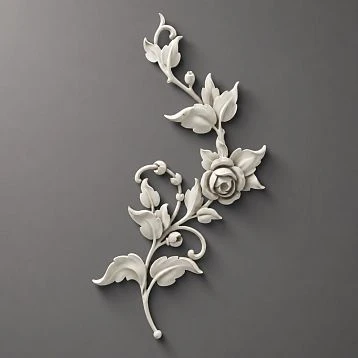
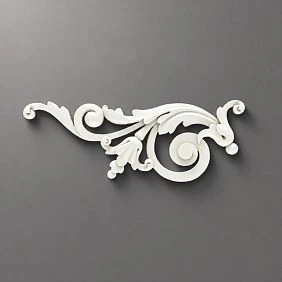
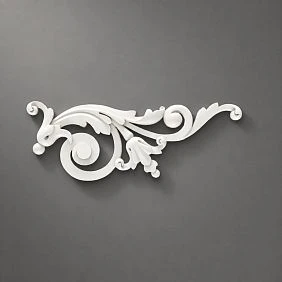
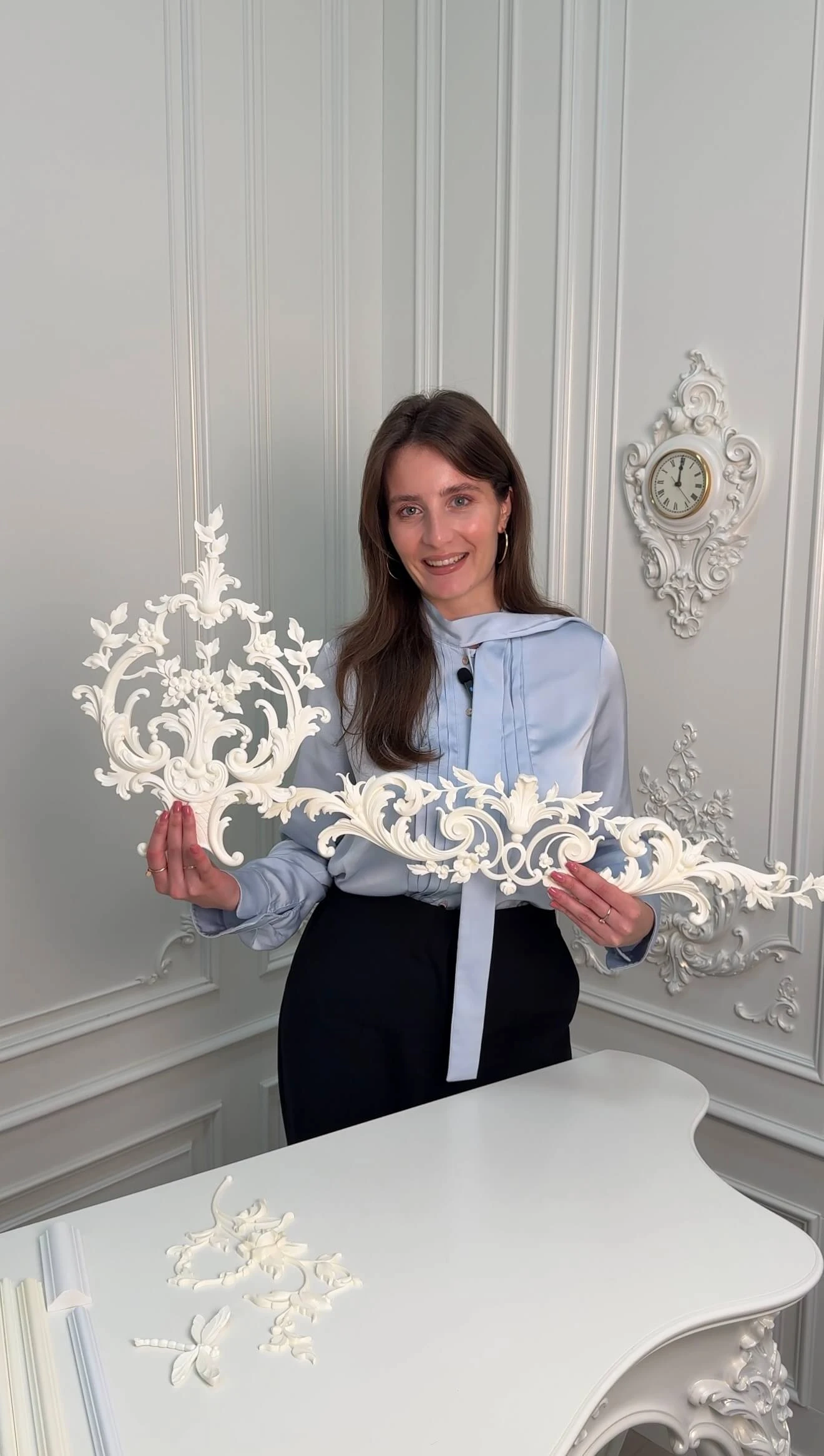
One way to solve this problem is to abandon the attempt to find one huge central detail and use paired decorative overlays. The left NPU-186L and right NPU-186R made of polyurethane have the same dimensions of 170 × 63 × 11 mm, but mirror orientation. Thanks to this, they can be placed relative to the central axis of the door as a connected pair: one detail on each leaf, or, if the geometry of a specific panel requires it, assemble a local composition from two elements on one wide surface.
This approach is especially interesting because the decor begins to take into account the door's construction itself. Two leaves — two independent planes. Instead of masking this and trying to make one detail visually "step over" the central joint, you can emphasize symmetry. The left overlay corresponds to the left part of the design, the right one to the right. Between them remains adjustable space that can be tailored to the door width, handles, molding frame, and panel proportions.
If you are just starting to select polyurethane molding for doors, it is useful to first determine the type of future composition: whether you need one central accent, a mirrored pair, a frame system, or a more complex surround. In the general catalog, you can You can buy ready-made stucco matching the Baroque style. Calculate the quantity: linear meters of cornices and moldings, number of rosettes, pilasters, consoles, corner elements. Add a ten to fifteen percent allowance for trimming. and compare different types of decorative elements. If it is already clear that what is needed is precisely applied carved decor, it is easier to continue the selection in the category where you can Buy decorative polyurethane overlays.
But for NPU-186L and NPU-186R, the main idea is not to "add molding to the door." The task is much more precise: to create a paired ornament on a wide double door and preserve the ability to use each leaf separately.
Why one central overlay gets lost on a wide double door
The problem of a wide door is not reduced to the number of square centimeters. Much more important is how a person perceives its geometry.
A single-leaf door has one obvious vertical axis. Even a relatively compact decorative overlay, placed in the right spot, can become the center of the entire composition. With a double-leaf structure, the picture is different. The central line is already occupied by the joint of two movable panels, and the surface itself is divided into two parts.
If you place a small decor on only one leaf, asymmetry arises. If you place the same detail on each leaf without considering the orientation of the ornament, you get two independent decorations. They may match in size but do not form a common composition.
Attempting to place one large overlay directly over the central joint is even more problematic. The two leaves must move independently. The decorative element should not mechanically connect them to each other.
This is exactly where a mirrored pair gains practical meaning. NPU-186L and NPU-186R allow you to distribute the design on both sides of the central axis without overlapping the joint itself.
This does not mean that any double door automatically requires two carved overlays. First, you need to assess the door leaf itself. If the door already has complex panels, pronounced trims, figured milling, and massive hardware, an additional pair may be redundant. But if the surface is too plain and a single overlay gets lost, a mirrored composition turns out to be much more logical.
The pair works not by quantity, but by the direction of the pattern
Two identical symmetrical pieces and two mirrored pieces are not the same thing.
In the first case, the eye perceives two repetitions. In the second, two fragments of a single movement. Left and right orientation create the feeling that the ornament either opens from the center to the edges or, conversely, gathers toward the central axis. Which option turns out to be more expressive depends on the pattern itself and the placement of the overlays.
Therefore, the L and R designations cannot be ignored when ordering. For a paired composition, two different product items are needed. If the left part is required, you can buy the carved overlay NPU-186L. For the mirrored right part, a separate carved overlay NPU-186R.
This seems obvious until the buyer starts counting the quantity and accidentally adds two identical items of the same SKU to the order. On a regular symmetrical overlay, such an error is not visible. In a mirrored pair, the direction is part of the composition itself.
Our factory also produces:
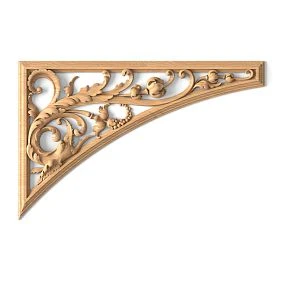

NPU-186L and NPU-186R: what you need to know before marking the door
Both overlays are decorative carved elements made of polyurethane. For each, the size 170 × 63 × 11 mm is confirmed. This is a compact enough dimension to work with a single sash, but when paired, the two pieces form a more extended composition.
As of the check, the price for NPU-186R is 1,090 ₽. The cost of NPU-186L should be checked separately in its card before ordering, and the total cost of the pair should only be calculated after verifying the current prices of both items.
| Parameter | NPU-186L | NPU-186R | What this means when choosing |
|---|---|---|---|
| Type | Carved decorative overlay | Carved decorative overlay | Both pieces are intended for overlay decorative finishing. |
| Material | Polyurethane | Polyurethane | Both overlays belong to the same group of polyurethane molded decor. |
| Size | 170 × 63 × 11 mm | 170 × 63 × 11 mm | You can prepare two paper templates in full size in advance. |
| Orientation | Left | Right | For a mirror composition, you cannot simply replace one model with the other. |
| Article number | NPU-186L | NPU-186R | When placing an order, you need to check both items. |
| The script of this article | Left part of the paired design. | Right part of the paired design. | The main option is symmetrical placement relative to the axis of a double door |
| Price | Check in the product card before ordering | 1,090 RUB at the time of checking | The total cost of a pair cannot be calculated based only on the price of the right part |
| Product | NPU-186L | NPU-186R | Open both product cards before placing a paired order |
The dimensions here have another meaning. 170 × 63 mm is a size that is easy to check on the door itself before purchase. There is no need to imagine the overlay from a photo or mentally convert millimeters to the scale of the door leaf. It is enough to cut out two rectangular templates of this size, mark L on one and R on the other, and attach them with painter's tape to the intended locations.
Yes, paper will not convey the pattern and depth of the relief. But it immediately answers another, more important question: is the pair not too small for your door, are the parts too close to the handles, is there enough space between them, and are they not squeezed between the frames.
It is wiser to start with this fitting, rather than with choosing glue or color.
Get Consultation
A mirror pair and two identical overlays give completely different results
With a wide door, there is often a temptation to solve the problem by simple doubling: if you like an overlay, buy two identical ones and place them symmetrically.
Sometimes it works. But with an asymmetrical plant or directional ornament, two identically oriented pieces can create a strange effect. Imagine two arrows, both pointing to the right. Geometrically they stand symmetrically, but the pattern still "pulls" the composition to one side.
With mirrored elements, the logic is different.
NPU-186L and NPU-186R can be perceived as the left and right halves of a single decorative gesture. They do not have to touch. On the contrary, the distance between them becomes one of the design tools.
On a narrow composition, the pieces can be visually brought closer together. On a very wide door, they can be spread further apart. If there are two handles between the leaves, the distance is determined not only by aesthetics, but also by the grip zone.
This is one of the advantages of a paired solution over a single large overlay: the width of the composition can be changed without changing the article itself.
Comparison of four ways to design the center of a wide door
| Option | How it is perceived | When it fits | Main risk |
|---|---|---|---|
| One compact central overlay | One local accent | When the free field is relatively small | On a very wide door, it can get lost |
| Two identical overlays | Two repeating accents | If the pattern itself is symmetrical or repetition is intentional | A directional ornament may look inconsistent |
| NPU-186L + NPU-186R | A linked mirror pair | When a composition is needed on both sides of a central axis | Need to correctly determine orientation and distance |
| Molding frames with overlays | A more complex architectural system | For a large canvas where one pair is not enough | You can overload the door with the number of details |
The last option is important as an alternative. If after fitting it turns out that the pair of NPU-186L and NPU-186R takes up too small a part of the huge panels, the problem is not necessarily solved by buying four more overlays. Sometimes it is more correct to create a larger geometry using a profile. In this case, you can buy polyurethane moldings for doors and place paired carved elements inside or next to the frame system.
The central joint of the leaves is not a place for an overlay, but the axis of the entire scheme
When decorating a double door, the central joint should be perceived primarily as a functional boundary.
The leaves open independently. One can be constantly active, the second can open only when necessary. A working gap must be maintained between the panels. If the structure has locking or fixing elements, they also require free access.
Therefore, stucco decor cannot be designed as if we have one solid immovable slab in front of us.
NPU-186L and NPU-186R are convenient precisely because they allow leaving the central line free.
From which place to measure the position of the pair
The most common mistake is measuring the same distance only from the outer edges of the panels. At first glance, everything looks symmetrical, but relative to the central seam, the overlays may end up poorly positioned.
For a central composition, it is more convenient to first determine the axis of the entire door, then work outward.
If the panels are of equal width, the central seam already sets a natural axis. From it, you can measure equal distances to the inner boundaries of the future templates.
If the panels differ in width, the task is more complex. Mechanical symmetry relative to the seam and the visual balance of the entire door may not coincide. Then it is worth making two marking options: one strictly relative to the central joint, and the second considering the width of the panels and hardware. It is better to compare them not from arm's length, but from the point in the room where the door is most often seen in full.
You cannot pre-assign a universal distance between overlays
Specifying a single number—for example, "leave exactly so many millimeters between NPU-186L and NPU-186R"—would be incorrect.
On one door, there is nothing in the center except the seam. On another, there are two handles. On a third, there is one handle, and the second panel is passive. On a fourth, each panel already has a decorative panel inside.
The distance between paired overlays is determined by several conditions at once:
-
the size of the free field;
-
the position of the handles;
-
central joint;
-
existing milling or paneling;
-
presence of a molding frame;
-
pattern orientation;
-
whether the pair should look like a compact central accent or a more widely spread ornament.
Therefore, instead of a magic number, it's better to use a real fitting.
Two paper templates 170 × 63 mm solve half the questions before purchase
This is one of the most useful techniques specifically for paired decor.
Cut out two templates measuring 170 × 63 mm. Write NPU-186L in large letters on one, and NPU-186R on the other. If you have a photo of the ornament, you can schematically mark the pattern direction with an arrow.
Now the door ceases to be an abstract diagram on the screen.
Secure the paper with painter's tape and look at the pair in several variations.
First option: closer to the central joint
This way the composition becomes more cohesive. The two overlays are read primarily as a pair.
This option is appropriate if the central part of the door is free of large hardware and you want to create a decorative center between the panels.
But you cannot move the templates so close to the joint that the relief ends up in the potential contact zone of the panels or interferes with the handles.
Second option: further from the center
When the overlays are spread toward the middles of the panels, each one relates more strongly to its own leaf. This approach may work better on a very wide door.
The pair still maintains a mirror connection, but no longer looks like a single small medallion in the center of a huge surface.
Third option: inside future molding frames
Draw a frame with regular painter's tape. No actual molding is needed at this stage.
Now place the NPU-186L and NPU-186R inside the resulting fields. It will immediately become clear whether the door needs additional lines.
If the overlays look lost without frames, but the composition comes together inside the outlined fields, the problem was not the size of the NPU-186L/R. The wide door simply required a larger architectural grid.
In this case, further selection can continue in the section that presents polyurethane moldings for doors.
Option four: remove one template
This test seems strange, but it is necessary.
Remove the NPU-186R and look only at the NPU-186L. Then do the opposite.
If one piece suddenly looks more convincing than the pair, the original task may have been formulated incorrectly. Perhaps the door does not need strict symmetry, or one panel is compositionally more important than the other.
A pair is justified only when two mirror overlays truly improve the door, not just increase the amount of decor.
One overlay per panel is the main, but not the only, scenario
The most natural scheme for a double door looks like this:
NPU-186L — on the left leaf, NPU-186R — on the right.
In this case, the structure and decor speak the same language. The two panels receive two connected parts of the ornament.
This method works especially well on leaves of equal width. The central seam remains free, each overlay is on its own moving surface, and the overall composition is visible when the door is closed.
However, not all double doors are the same.
If one leaf is significantly wider than the other
There are designs where the active leaf is wide, and the additional one is noticeably narrower. Strictly identical placement on each may emphasize the width difference in an unfavorable way.
Here, you cannot rely only on the word "paired." Make templates and evaluate both options.
If the narrow leaf does not provide enough free space, it may be better to build the decorative composition on the wide active leaf and keep the second one calmer. But then NPU-186L and NPU-186R no longer work as mirror elements of two panels, but as a pair within one field.
Two overlays on one leaf
Such placement is possible if one leaf is large enough and it is precisely on it that an elongated ornament is needed.
In this case, the principle of mirroring is preserved: L and R can be turned toward each other or outward depending on the pattern.
But here it is especially important not to confuse the task. If we are indeed dealing with a wide double door with two equal panels, the space usually benefits from distributing the pair across the two leaves. Using both pieces on only one side disrupts the natural symmetry of the structure.
Two pairs on one door
On a very large panel, there may be a desire to use four pieces: two at the top and two at the bottom, or a pair in each decorative frame.
This is a different system in terms of density. It is possible but requires precise marking. The more repetitions, the more noticeable any difference in distances.
And here the principle is especially useful: first assemble the entire layout with paper templates, then decide how many pieces actually need to be ordered.
The handle and lock are more important than perfect symmetry on paper
A decorative door remains a door. It is used by hands every day.
If the overlay is positioned exactly along a beautiful axis but constantly falls under fingers, catches clothing, or is too close to the handle, good geometry will not save the solution.
Therefore, after the initial marking, a separate usability test is needed.
Approach the door as you normally would. Take hold of the handle. Open the leaf. Close it. Repeat several times.
The template must not fall into the natural trajectory of the hand.
An active and a rarely opened leaf require different checks.
If one leaf is used constantly, the work area around its handle needs to be especially clean.
On the second leaf, the hardware may be used less often, but this does not mean it can be ignored. When the opening is fully revealed, both parts must remain functional.
A paired composition looks better when symmetry is not bought at the cost of inconvenience.
If slightly increasing the distance between NPU-186L and NPU-186R is needed to preserve the grip zone, that is more reasonable than mechanically sticking to a beautiful layout.
The relief has a thickness of 11 mm.
The third dimension of each overlay is 11 mm. When designing in a plane, it is easy to forget about this value.
However, the door moves. You need to check not only the front view, but also the space around the opening leaf.
If there is another surface nearby, such as a casing, furniture, or a limiter, evaluate the door's movement taking into account the protruding decor. Do not draw conclusions based on a single number of 11 mm — you need to check the specific geometry of your structure.
This is especially relevant where the leaf, when fully open, ends up close to a wall or cabinet.
When NPU-186L and NPU-186R are sufficient without moldings
Not every door needs to be turned into a complex portal.
Sometimes it is the absence of additional frames that makes paired decor more expressive.
Imagine wide, smooth panels in a calm color. Each leaf features one mirrored carved overlay. A large clean surface remains around it. The ornament reads well, but the door does not become heavy.
This scenario is especially reasonable when:
-
the door leaf already has good proportions;
-
the overlays are noticeably visible even from a distance;
-
The handles themselves are expressive enough;
-
there are already moldings or other decor on the walls nearby;
-
the interior requires one decorative focal point, not a multitude of frames;
-
after trying paper templates, the door looks finished.
The last criterion is more important than the others.
Don't add moldings just because classic stucco decoration "usually" implies a frame. If two pieces already solve the problem of an empty center, an additional line may not improve the result.
That's why before buying accompanying decor, it's useful to first choose the overlays themselves. You can open the category and Buy decorative polyurethane overlays, comparing NPU-186L/R with other formats, and only after trying them decide whether a more complex system is needed around them.
When a molding frame truly improves a double door
The opposite situation happens. The door is so wide or tall that two overlays remain a small island in the middle of a large empty surface.
There is no point in endlessly increasing the amount of carved decor.
It is much more effective to divide the plane with larger lines.
Molding creates a field. The overlay then works within that field.
Let's compare perception.
Without a frame, the eye sees the entire panel and evaluates NPU-186L relative to its full area.
With a frame, vision first perceives the inner decorative field, then the overlay within it. The scale of comparison changes—and a small detail no longer seems lost.
One frame on each panel
This is the most understandable scheme.
On the left panel, a frame with NPU-186L is formed; on the right, a mirrored frame with NPU-186R.
This option looks especially neat when the frames have the same dimensions and are positioned at the same height.
Upper and lower sections
On a tall door, each panel can be divided into two decorative fields. But here the question arises: where exactly to use paired overlays?
If you place them in each section, you get four elements. If only in the upper one, the lower part remains calmer.
The second scheme is often more interesting precisely because of the hierarchy: the top gets ornament, the bottom supports geometry without extra pattern.
The frame should not fit tightly against the overlay
Even beautiful elements need a background.
If the inner size of the molding field almost matches the dimensions of NPU-186L or NPU-186R, the carving ends up cramped. It is better to check at the painter's tape stage whether there is enough free surface around the overlay.
If this design path is chosen, it makes sense buy polyurethane moldings for doors only after the dimensions of the future frames have been determined, not the other way around.
When additional decor for moldings is needed
There are doors where a single frame and a pair of overlays are enough. There are projects that require a richer system: corner inserts, additional central elements, or other details that work together with the profile.
But it's easy to cross the line here.
NPU-186L and NPU-186R already have their own carved pattern. If you add several active elements to each frame, competition arises within a small area.
Therefore buying polyurethane molding decor is reasonable when it's clear in advance what function it will perform.
For example:
-
will decorate the corners of the frame;
-
will give a separate center to another panel;
-
will connect the door design with wall moldings;
-
will continue the unified system in the adjacent room.
A bad reason sounds different: "there's empty space left — we need to add something."
Empty space around a carved ornament is often not a problem, but a necessary background.
What to buy together with paired overlays
Paired decor has one feature: the base purchase already consists of at least two different SKUs. Therefore, the set needs to be checked more carefully than an order for a single symmetrical overlay.
For one mirror pair, you need:
-
one NPU-186L;
-
one NPU-186R.
If two identical double doors are being ordered, then accordingly two pieces of each SKU are needed.
If the project involves two pairs on each door, the quantity doubles again.
Related products depend on the specific scheme.
| What to add | Why this is needed | When it makes sense | Internal link |
|---|---|---|---|
| NPU-186L | Left part of the mirror pair | For each paired composition that uses NPU-186R | buy the carved overlay NPU-186L |
| NPU-186R | Right part of the mirror pair | For each paired composition where NPU-186L is used | Buy carved overlay NPU-186R |
| Other decorative overlays | For matching scale and building a more complex system | If one pair is not enough or a different format is needed | Buy decorative polyurethane overlays |
| Moldings | To create a frame field on each leaf | If NPU-186L/R without frames get lost on a large surface | buy polyurethane moldings for doors |
| Decor for moldings | For a more complex frame system | If the project truly requires additional decorative points | buying polyurethane molding decor |
| General stucco decor | To match the door with other interior zones | If not only the door is being styled | ordering polyurethane molding decor |
The main thing here is not to turn the table into a mandatory shopping list. The basic idea of the article implies precisely the rational reduction of the number of details.
If a pair of NPU-186L/R already looks good on the door, there is no need to buy additional frames and inserts just to complicate things.
How to calculate the number of overlays for one, two, and several doors
With paired products, the calculation looks very simple, but errors occur precisely because of the letters L and R.
For one standard paired composition:
1 × NPU-186L + 1 × NPU-186R.
For two doors:
2 × NPU-186L + 2 × NPU-186R.
For three:
3 × NPU-186L + 3 × NPU-186R.
Formula for identical doors:
Quantity of NPU-186L = number of paired compositions.
Quantity of NPU-186R = number of paired compositions.
If one door has two mirror pairs, the number of pairs is counted first, not doors.
For example, three doors × two pairs = six left and six right overlays.
Why you can't just count the total number of parts
Imagine that four doors need to be finished. A person writes: "need eight overlays." Then orders eight NPU-186R.
By number, everything is correct. By composition, it's not.
Therefore, in the specification, it's better to always make two lines:
-
NPU-186L — 4 pcs.;
-
NPU-186R — 4 pcs.
If the project has several rooms, you can additionally specify the distribution by doors.
Such simple accounting protects against a situation where installation begins and half of the mirror elements are missing.
How not to confuse paired overlays with central decor and decor for moldings
In the catalog of polyurethane moldings, there are many elements that may appear similar in purpose. In reality, their buyer scenarios are different.
NPU-186L and NPU-186R are a paired system of two orientations
The main sign is letter indices and mirror logic.
For the article, what matters is not just the shape of each individual overlay, but the ability to place the left and right parts as connected elements.
One symmetrical overlay is an independent center
Such decor does not require a second mirror half.
If the door is not too wide and one central element holds the scale well, a paired system may be redundant.
The molding sets the boundaries of the field
It does not replace NPU-186L or NPU-186R. The molding solves a different task: it outlines a rectangle, a vertical or horizontal line, and divides the surface.
That is why a carved overlay and molding can work together.
Decor for moldings belongs to the frame system.
Such elements make sense to select when the composition itself is already built around moldings.
If the task is stated as "we need two mirrored carved details on a smooth double door," it is more logical to start with polyurethane decorative overlays, rather than trying to assemble a complex set of elements for frames.
Choosing for specific door situations
The same NPU-186L/R set can look different depending on the door construction. Therefore, it is more useful to consider not abstract "styles," but real initial situations.
Smooth white double door without panels
This is the most understandable scenario.
A large free surface provides enough space for a paired composition. First, check the position relative to the central joint and handles. If paper templates read well without additional framing, you can limit yourself to two overlays.
This option is especially valuable for its simplicity: the door gets carved decor without assembling a complex molding system.
The door is already divided by panels
Here you cannot place NPU-186L/R on top of existing geometry randomly.
The overlay must relate to a specific field. If each leaf has a large upper panel, it is inside it that the paired system can look most natural.
If the dimension 170 × 63 mm does not fit into the free field with normal margins, it is better not to try to squeeze the product in.
Each leaf has a separate handle
The handles become part of the central composition.
First place functional elements, then decorative ones. Not the other way around.
If the handles are close to each other, NPU-186L and NPU-186R can be spread apart. If the decorative pair becomes too stretched, it may be wiser to move it above the handles.
Handle only on the active leaf
Asymmetry of fittings already exists. Therefore, mirror plates do not necessarily have to be located directly near the handle.
A calmer option is to raise them to the upper decorative field, where functional differences between the leaves have less impact on perception.
Very tall double door
Height increases the free area. A pair measuring 170 × 63 mm may seem small.
Here, it is worth trying a molding structure first: the frame reduces the perceived field and helps the plate work at the correct scale.
If this is not enough, a more complex decor system should be considered, rather than chaotically adding identical NPU-186L/R.
Door between two richly decorated rooms
In such a situation, the door itself should connect the interiors, but not necessarily compete with them.
Paired overlays can be a good compromise: the ornament is present, but the number of details is limited.
Door in a calm modern interior
Carved decor here requires particularly strict dosing.
One mirrored pair without extra moldings can be more interesting than a complex classical system. Most of the panel remains calm, while the historically readable ornament becomes a deliberate contrast.
Paint the overlays together with the door or highlight them with contrast
Color changes the perception of size no less than the distance between NPU-186L and NPU-186R.
If the project involves painting the decor together with the door leaf, the eye will first see relief, light, and shadow. The dimensions of the overlays will be perceived more calmly.
With a contrasting color, everything happens the other way around. First, two color spots are read, then the carved pattern.
Therefore, two overlays of the same size can seem completely different depending on the finish.
One color — when relief matters more
This is a good approach if the door should look solid, as if the decorative elements were originally part of the panel.
On a wide double-leaf structure, this method allows using a pair noticeably enough, but not turning it into two separate "appliqués".
Contrast — when the pair should become the main focal point
Contrasting trim emphasizes the mirroring more strongly.
But here it is especially easy to overload the door. If the handles are also contrasting, moldings of a different color run around, and the casings have separate finishing, the number of active lines quickly grows.
Therefore, it is wiser to check the contrast on a sketch or at least on a photo of the door with colored templates overlaid.
It is better to decide on the finishing before the final installation
It is not necessary to do all the work in advance, but you need to understand the future color scheme already at the stage of choosing the amount of decor.
If the pair will be brightly highlighted, two overlays may be quite enough.
If everything is painted in a single color and the relief is perceived more delicately, the door can sometimes accept an additional molding frame.
The specific compatibility of finishing materials with polyurethane and the existing door coating should be checked before work.
Practical marking without reference to random numbers
Good markup starts not with the question "how many centimeters to indent," but with defining all fixed points.
First, mark:
-
the central seam of the doors;
-
the actual boundaries of each panel;
-
the position of the handles;
-
existing panels and profiles;
-
the upper and lower boundaries of the intended decorative zone.
After this, a working field appears.
Inside it, NPU-186L/R templates are placed.
First horizontal, then height
For a mirror pair, it is especially noticeable if one overlay is higher than the other.
Therefore, first define one common horizontal axis or level on which the parts should be positioned.
Only after that, adjust the distance from the central joint.
Measurements must be taken from the same points on the templates themselves.
For example, if the distance is checked from the central seam to the inner boundary of the NPU-186L, on the right side you need to measure to the analogous inner boundary of the NPU-186R.
Do not mix measuring to the center of one part and to the edge of another.
You should check both the closed and open door.
On the closed door, the composition is evaluated.
On the open one, functionality and distances to adjacent surfaces are evaluated.
Both checks are mandatory because a beautiful closed panel may turn out to be inconvenient to use.
Installation preparation: first the base and fitting, then final fixation.
For this topic, there is no point in turning the article into a universal guide for gluing polyurethane. The specific installation depends on the material and condition.
Consider the entire double door as one fixed plane.
The central seam cannot be ignored.
Each overlay must remain on its own working surface and not bind the two door leaves together.
Place the parts at different heights.
On a carved pattern, a slight misalignment sometimes seems less noticeable during installation than on the finished door.
From a distance, the eye first reads the overall line. Therefore, the level of the pair is more important than the local beauty of each piece.
Move the overlays too close to the handles.
The decor ends up in a constant touch zone and visually conflicts with the hardware.
First, mark out the handle's working area, then place the ornament.
Set the distance between NPU-186L and NPU-186R without fitting
A number that fits one door has no value for another.
Use templates.
Trying to fix insufficient scale with a large number of overlays
If two parts get lost on a huge canvas, four do not always solve the problem.
Sometimes a door needs molding architecture, not an extra scattering of carving.
Making the molding frame too tight
NPU-186L/R get a frame but lose free background.
Better to enlarge the field or abandon the frame.
Choosing only by a close-up photo of the product
A large photo shows the ornament but hides the ratio of the 170 × 63 mm size to your door.
A real template is more useful.
Count the pair as a single product
NPU-186L and NPU-186R are two SKUs. When ordering, you need to monitor both items.
Calculate the total cost based on the known price of only NPU-186R
The price for the right overlay is 1,090 ₽, but this is not a reason to automatically double it and calculate the cost of the pair. The current price of NPU-186L should be checked separately.
Add decor to fill the empty space
Free space around the overlay helps to see the pattern.
Not all empty space requires decoration.
Ignore the 11 mm thickness
The layout on the front sketch does not show the protrusion relative to the surface.
Be sure to evaluate the open sash and adjacent objects.
When paired NPU-186L and NPU-186R are truly appropriate
This pair is especially interesting to a buyer who already understands what they don't want.
You don't want one small overlay in the center of a huge door.
You don't want a single detail across the joint.
You don't want to assemble a composition that feels heavy from dozens of elements.
Symmetry is needed, but not mechanical repetition.
In such a case, the left and right carved overlays fit the task well.
They are especially appropriate when:
- the door has two well-readable panels;
- the central part seems empty;
- one wants to distribute the ornament over both halves;
- one overlay looks too small;
- the large central decoration seems excessive;
- it is necessary to preserve a free joint;
- the interior allows for floral or carved decor;
- the size 170 × 63 × 11 mm looks good after fitting.
When it's better to choose another option
an honest selection implies the opposite answer as well.
NPU-186L/R should not be bought just because the door is double-leaf.
Very narrow panels
If after placing the template there is almost no free space around it, the pair is too large for the specific structure.
The door is already saturated with carving
Existing milling, complex panels, active handles, and decorative trim may fully cover the need for additional ornament.
Need one strict geometric frame without floral decor
Then it makes more sense to look immediately polyurethane moldings for doors.
A large central medallion is required
A mirror pair solves a different task. There is no need to make it depict one large symmetrical center.
The panels differ greatly in width
Paired placement is possible, but it must be checked with templates. Sometimes it is better to choose a different composition.
The decor conflicts with the hardware.
Functionality takes priority.
If the NPU-186L/R cannot be placed without falling into the working area of the handles or the movement of the panels, the layout needs to be changed or a different decor selected.
Door moldings in different rooms: one pair, different roles.
Living room
A double door to the living room is often visible from several points at once. Here, the overall symmetry is especially well perceived.
The NPU-186L/R can be positioned so that the closed door has a pronounced central pattern, but when opened, each part remains on its own panel.
If the living room itself is already rich in moldings, it is reasonable to limit the door to a pair without additional elements.
Bedroom
In the bedroom, the calmness of the overall surface is usually more important.
Paired overlays can be used as a delicate relief detail, especially if the finish combines them with the panel.
Excessive contrast is not always needed here.
Cabinet
The wide double-leaf office door can receive a more architectural layout.
If frameless pairs are not enough, the NPU-186L/R can be fitted into molding fields on both leaves.
Entryway or hall
Here, the door is often perceived frontally and in full. Any difference in the height of paired elements will be especially noticeable.
Marking should be checked from the far entry point, not just up close.
Commercial interior
In a hotel, salon, office, or other space with several identical doors, repeatability is especially important.
First, one reference door is finished, all distances are recorded, and then the layout is transferred to the others.
It is here that the correct calculation of NPU-186L and NPU-186R by individual part numbers becomes especially important.
How to connect door decor with molding on walls and furniture
Paired overlays do not necessarily have to exist in isolation.
If the room already has stucco molding, the door can be included in the same system not by direct copying, but by repeating the principles.
For example, molding frames are used on the walls, but only NPU-186L/R on the door.
There is a connection: the relief decorative language is repeated. But the door does not literally copy the wall.
Another option is that frames are present on both the wall and the door, but carved overlays appear only on the door leaves. Then it is the door that becomes a more saturated point.
The third way is to repeat similar decorative elements on the furniture facade, if the project supports it.
With this approach, a common section is useful, where you can ordering polyurethane molding decor and compare different types of products not as separate purchases, but as parts of one interior system.
The main thing is not to put the same ornament on every free surface. Repetition works as long as there remains a difference between the main and the secondary.
Ready-made selection logic before purchase
Before ordering NPU-186L and NPU-186R, it is useful to go through a short route.
First, close the door and look at it as a whole.
Not at the ornament. At the door.
Does it really seem too empty? Will one central detail really get lost? Is the symmetry of the two panels an important part of its appearance?
If so, move on to the templates.
Cut out two pieces measuring 170 × 63 mm.
Place them on either side of the center.
Check the handles.
Check the height.
Open both panels.
Step back a few meters.
Take a photo.
After that, it will become clear whether one pair is enough.
If it is enough, do not complicate the solution.
If not, draw molding frames with painter's tape. Evaluate again.
Only after such a test should you decide whether it is necessary buy polyurethane moldings for doors together with the overlays.
And only then is the exact quantity of goods compiled.
How to order NPU-186L and NPU-186R on STAVROS
For such a purchase, it is more convenient to move from the general category to two specific product cards.
If you are still comparing different options and are not sure about the size or pattern style, open the section where you can Buy decorative polyurethane overlays.
If the pair has already been chosen, check both cards separately:
buy the carved overlay NPU-186L.
Before placing an order, you need to verify:
- L and R article numbers;
- size of each part — 170 × 63 × 11 mm;
- required quantity of left overlays;
- required quantity of right overlays;
- current prices for both items;
- parameters and conditions specified in the cards at the time of purchase.
If the door is decorated with moldings, the frame layout must be ready first. You should not buy profile "approximately around the perimeter" without dimensions.
If only one paired composition is needed, the main order remains extremely clear: one left NPU-186L and one right NPU-186R.
FAQ: questions before purchasing NPU-186L and NPU-186R
Can I install only NPU-186L without NPU-186R?
NPU-186L can be considered as a separate decorative part if a specific composition requires it. But in the scenario of a wide symmetrical double door, the main value of the models in question lies precisely in the mirrored pair. Before deciding, try attaching one template and both templates: the door itself will show whether a second element is needed.
Are NPU-186L and NPU-186R the same?
No, these are left- and right-oriented overlays. Their dimensions are the same — 170 × 63 × 11 mm, but the direction of the parts differs. For a mirror composition, you need to control both part numbers.
How many overlays are needed for one double door?
For one basic mirror composition, two parts are needed: one NPU-186L and one NPU-186R. If the project includes two pairs, you will need two overlays of each part number.
Can both overlays be installed on one door leaf?
Yes, if the dimensions and composition of the specific panel allow it. However, for equal double doors, a more natural initial option is one mirror part on each leaf. The final decision is best made after fitting the templates.
Do NPU-186L and NPU-186R need to be placed flush against the central joint?
No. There should be enough space between the overlays and the joint for normal door operation and proper perception of the ornament. There is no universal distance: it is determined by the panel dimensions, handle positions, and overall composition.
How to determine the distance between paired overlays?
Make two templates of 170 × 63 mm and move them relative to the central seam until the pair looks good and does not conflict with the hardware. This method is more reliable than a universal number.
Can overlays be placed above the handles?
Yes, such placement can be considered if it matches the door geometry. On panels with active hardware, a raised paired composition is sometimes more convenient than placing it directly near the central handles.
Are moldings needed for NPU-186L and NPU-186R?
Not necessarily. If two overlays fill the empty field well and the door already looks complete, frames may be unnecessary. Moldings make sense to add when the pair visually gets lost on a very large surface and a larger geometric structure is required.
Where can I see moldings for such a composition?
The appropriate product group can be opened via the link buy polyurethane moldings for doors. Before ordering, first determine the actual frame dimensions directly on the panel.
Can the frame be supplemented with other carved decor?
Yes, if the additional elements have a clear role and the door does not become overloaded. For complex frame systems, you can buying polyurethane molding decor, but it is better to start with the NPU-186L/R pair itself and decide after fitting whether anything else is needed.
How to check the size of NPU-186L/R before purchasing?
Cut out two paper templates measuring 170 × 63 mm. This won't show the relief, but it will allow you to see the actual dimensions of the overlays on a specific door leaf, check the distance to the handle, and assess the overall width of the paired composition.
Does the 11 mm thickness matter?
Yes. The front sketch only shows the area of the overlay, but in reality, the part protrudes relative to the plane. You need to check the opening of the door leaf and the distance to the wall, furniture, and other nearby surfaces.
Can the overlay be installed directly over the central seam of two door leaves?
The paired scenario implies a different solution: each part is placed on its own surface, and the central joint remains free. You cannot design a fixed decorative element so that it connects two independently opening door leaves.
How to understand that the overlays are too small for the door?
Look at the door as a whole from a typical viewpoint. If two templates are perceived as random small spots within a huge plane, first try creating molding fields around them. If even then the scale remains weak, it's better to consider a different decorative scheme.
Can NPU-186L/R be used without a contrasting color?
Yes, if the chosen finishing system provides a unified color solution. With a close color of the overlays and the door, the relief is more pronounced; with a contrasting one, the shape of the pair itself is more prominent. Compatibility of specific finishing materials should be checked before work.
Is it mandatory to place the overlays strictly in the center of each leaf?
No. The center is just one of the options. The actual position depends on the handles, panels, frames, and the width of the door leaf. But if a mirrored pair is used, any offsets must be deliberate and verified on the entire door.
What to do if one leaf is wider than the other?
First, try two paper templates. A strictly symmetrical layout relative to the central joint may look bad on panels of different widths. In such a case, it is acceptable to look for a different placement or a different type of composition.
How many NPU-186L and NPU-186R are needed for two identical doors?
If each door uses one mirrored pair, you will need 2 pcs. of NPU-186L and 2 pcs. of NPU-186R. Each item number must be counted separately.
Can I order several sets at once without trial marking?
Technically, the quantity can be calculated in advance, but for several identical doors it is wiser to first check the composition with at least templates on one panel. An error in scale, multiplied across several doors, will cost significantly more than a preliminary fitting.
What is the price of the NPU-186L and NPU-186R pair?
The confirmed price of NPU-186R at the time of checking is 1,090 ₽. The price of NPU-186L needs to be checked separately in its card, so the correct total cost of the pair should only be calculated after checking both items.
Where to buy paired carved overlays NPU-186L and NPU-186R?
Both parts are presented as separate product items. For a paired composition, you need buy the carved overlay NPU-186L and separately Buy carved overlay NPU-186R, checking the quantity of each item before placing the order.
Two doors — two mirror parts: when this logic makes the door more convincing
A wide double door has a quality that a regular panel lacks: its symmetry is already built into the design. The two doors meet along the center line, spread apart when opened, and come together again into one common plane when the door is closed. Therefore, a decorative solution that takes this mechanics into account usually looks more convincing than a random detail glued to the center.
NPU-186L and NPU-186R provide exactly this opportunity. The pair has the same dimensions of 170 × 63 × 11 mm, but left and right orientation. Instead of trying to pick one overly large overlay, you can assemble a mirror ornament stretched across the width, while the central joint remains free, and each door retains its independence.
But the fact that the products belong to a pair does not guarantee a good result. Before purchasing, you need to check four things: the scale of the overlays relative to the doors, the distance to the central joint, the position of the handles, and the mounting height. Two paper templates of 170 × 63 mm allow you to do this before ordering.
If the templates confidently hold a large surface, one pair may be enough. There is no need to automatically add frames, rosettes, and additional overlays. If NPU-186L/R get lost on a very tall or wide door, it is better to first increase the architectural scale with moldings rather than fill the emptiness with many random elements.
In the STAVROS catalog, you can start with a general selection and You can buy ready-made stucco matching the Baroque style. Calculate the quantity: linear meters of cornices and moldings, number of rosettes, pilasters, consoles, corner elements. Add a ten to fifteen percent allowance for trimming., then go to the category where items are displayed Polyurethane decorative appliquesFor the composition in question, two specific positions are needed: NPU-186L and mirrored NPU-186R.
This is where the strength of paired decor shines: a wide door doesn't have to be adorned with one large element. Sometimes it's more precise to split the ornament into two mirrored parts, subordinate it to the geometry of the door panels, and leave exactly as much space between them as the specific door requires. Then the stucco doesn't look like it was added after purchasing the door leaf—it becomes part of a well-thought-out composition.