Article Contents:
- What is MLD-064 23×8 mm?
- Why does MLD-064 look different in the morning, afternoon, and evening?
- In diffused daylight
- With light from above
- With grazing side light
- Under a directed spotlight
- MLD-064 is worth adding if
- MLD-064 can be skipped if
- What to do with the test section
- The color boundary runs along the center of the molding
- The color changes along the top edge
- The color changes along the bottom edge
- MDF 2600 mm
- Beech or oak 2400 mm
- What size is MLD-064?
- Why is MLD-064 called beveled?
- What is the profile depth?
- How does MLD-064 look under side lighting?
- Can MLD-064 be placed between two wall colors?
- Is it necessary to install a molding on a smooth paint edge at all?
- Should MLD-064 be painted in the top or bottom color?
- Can oak be left natural?
- What to choose — MDF, beech, or oak?
- Is there an MLD-064 with a length of 1000 mm?
- Can I first take a short profile as a sample?
- What is the length of MLD-064 made of MDF?
- What is the length of beech and oak MLD-064?
- How many MLD-064 pieces are needed for a 5100 mm wall?
- Can the quantity be calculated only by total length?
- Where is the best place to make the joint?
- Where can I buy wooden molding?
- Where to buy MLD-064?
- How to order MLD-064?
- How to check the current price?
- Can MLD-064 hide an uneven paint line?
- Why is a small sample sometimes misleading?
- Do I need to turn off spotlights if MLD-064 casts too strong a shadow?
- When is it too early to buy MLD-064?
- When can MLD-064 already be ordered?
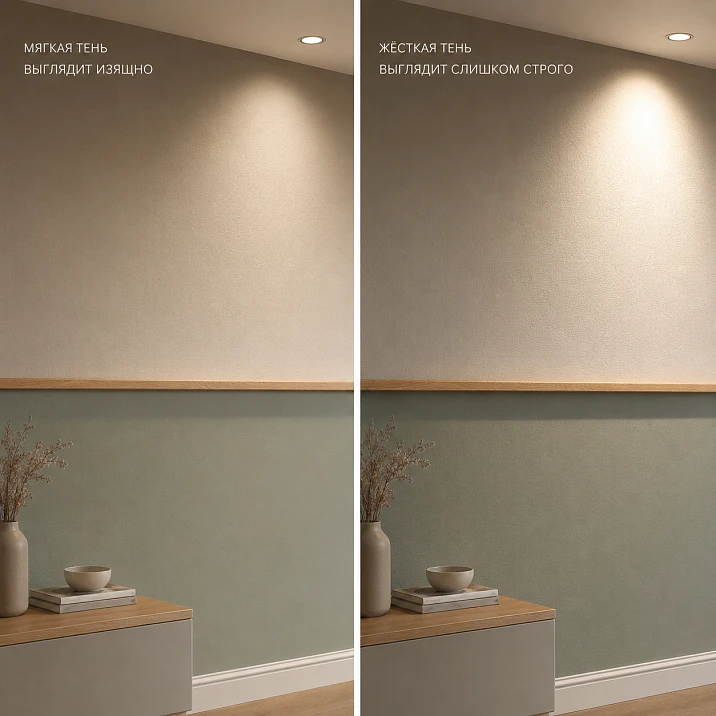
The spotlights were turned on only after painting. During the day, the boundary between the two colors looked calm: a smooth horizontal line, without defects and without the need to cover anything. In the evening, the designer applied a short beveled profile to this line — and the wall changed more than expected. A long shadow appeared, the transition itself became more graphic, and the molding began to be perceived not as a thin decorative strip, but as a separate architectural belt.
It is precisely in such a situation that MLD-064 should not be bought just because it looks neat and compact in the product photo. Its cross-section is 23×8 mm, but the main effect is created not by these numbers themselves, but by the bevel and the direction of light. Under diffused daylight, the profile can look almost neutral. Under a ceiling spotlight that glides along the wall, the same MLD-064 can produce a noticeable dark line.
Therefore, the first question here is not "which material is cheaper?" or "how many slats are needed?". First, you need to decide whether you want this shadow at all.
If yes — MLD-064 can turn an ordinary color transition into an expressive decorative belt.
If no — even a perfect oak or beech profile will be unnecessary, because the problem is not in the material, but in the geometry of light.
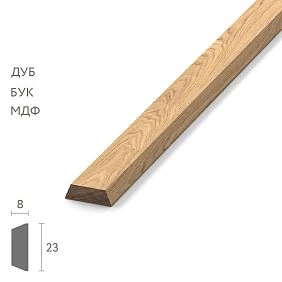
What is MLD-064 23×8 mm
MLD-064 is a beveled decorative molding with a uniform cross-section of 23×8 mm in various materials and lengths.
At the time of checking, the card shows:
| Material | Size | Length | Price at the time of check |
|---|---|---|---|
| MDF | 23×8 mm | 2600 мм | 400 ₽ |
| Beech | 23×8 mm | 1000 мм | 480 ₽ |
| Oak | 23×8 mm | 1000 мм | 680 ₽ |
| Beech | 23×8 mm | 2400 мм | 990 ₽ |
| Oak | 23×8 mm | 2400 мм | 1 450 ₽ |
For a long horizontal wall, MDF 2600 mm and solid wood 2400 mm are usually of interest. Short beech and oak options of 1000 mm are useful in another scenario—when you want to first see the natural material and its shadow on the object, rather than buying the entire long batch at once.
If the light test was successful, you can buy the wooden molding MLD-064 23×8 mm in the required execution.




Why MLD-064 looks different in the morning, afternoon, and evening
The beveled profile acts as a small architectural edge.
On a flat wall, light is distributed relatively evenly. On MLD-064, at least two surfaces appear that receive different amounts of light. One edge is more illuminated, the other falls into shadow. The sharper the angle of light incidence, the more noticeable the difference.
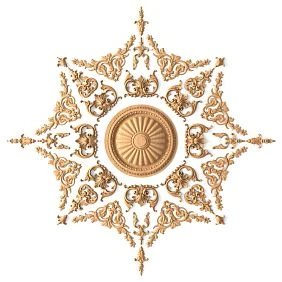
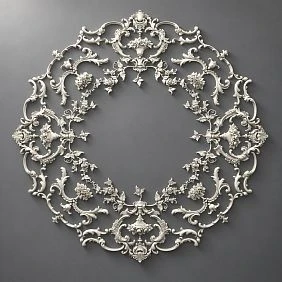
Our factory also produces:
In diffused daylight
The profile looks calmer. Its shape is readable, but the shadow is soft.
Get Consultation
Under top light
The bottom edge may become darker, and the horizontal line more noticeable.
Under raking side light
The bevel shows most strongly. Even a slight relief can cast a long continuous shadow.
Under a directed spotlight
Local intensification appears. In one part of the wall, the profile may look expressive, while in another, too harsh.
That is why the decision cannot be made based on a single sample in the showroom. Light in the room is part of the product.
The two colors are already evenly separated: is a molding needed at all
This is a fair question, because there is no technical need to cover a defect.
MLD-064 is worth adding if
the border should become an independent architectural belt;
the profile should support door trims, furniture, panels, or other horizontals;
its shadow works for the composition;
two colors by themselves look too "flat."
MLD-064 can be skipped if
a smooth border already looks finished;
sliding light already makes the wall active;
additional shadow fragments the surface;
there are already many horizontal lines in the interior.
Commercially, this is an important conclusion: sometimes the best choice is to add nothing.
How to check MLD-064 with a physical sample
For such a project, you need neither a printed outline nor a strip of cardboard 23 mm wide.
A real volume is needed.
You can check it either with a real short MLD-064 or with an accurate mock-up of the 23×8 mm cross-section.
The useful length of the test fragment should be at least 500–1000 mm. On a 50–100 mm piece, the shadow looks local and does not show what will happen on a five-meter wall.
If you want to first check natural wood, the card contains short versions of MLD-064, 1000 mm long, made of beech and oak.
What to do with the test section
Attach it precisely to the future line.
Look at it in the morning.
Look at it in the afternoon.
Turn on only ceiling spotlights.
Turn on the main light.
Step back 1 meter.
Step back 3 meters.
Look from the entrance.
Look from the sofa or armchair.
Take a photo of the wall in the evening.
After such a test, it becomes clear whether you like the long shadow itself, not just the shape of the profile in your hand.
Why a paper strip 23 mm wide is misleading
Paper only answers the question of scale.
Yes, it shows whether the horizontal line seems too wide.
But MLD-064 has a depth of 8 mm and a bevel. It is these that create the chiaroscuro.
It is not visible on paper:
-
how far the edge protrudes;
-
where the dark line forms;
-
how light refracts on the bevel;
-
whether the joint will be visible;
-
how noticeable the profile is from a distance.
For this article, a physical mock-up is more important than any visualizations.
MLD-064 in the color of the upper part of the wall
If the molding is painted in the upper color, it visually belongs to the upper zone.
The lower color ends beneath it, and the profile itself seems to become the lower boundary of the upper field.
This option works especially well if the upper part of the wall is lighter.
But even with a complete color match, MLD-064 will not disappear. Sliding light will still create a shadow along the beveled edge.
MLD-064 in the color of the lower part of the wall
Here the profile works the other way: it completes the lower field.
This option is closer to the classic horizontal division of the wall.
If the lower part is darker, the molding can enhance the sense of a "base" zone.
But you need to check whether the dark shadow does not become another stripe between the two colors.
Contrasting MLD-064 between two colors
The most active scenario is a molding of a third color.
For example:
-
white between gray and beige;
-
natural oak between two painted fields;
-
dark graphite profile on a light wall.
Here, three layers already appear:
-
the lower color;
-
molding;
-
the upper color.
If sliding light adds a dark shadow as well, the composition can become overloaded.
Therefore, a third color is justified only when it is connected to other interior elements.
Oak MLD-064: when natural wood is truly needed
An oak profile is especially appropriate if there is already oak in the room:
-
floor;
-
doors;
-
furniture;
-
countertop;
-
wall panels;
-
open wooden elements.
Then MLD-064 doesn't look like a random wooden strip.
It connects materials together.
Under side light, oak works even more actively because the bevel, shadow, and wood texture are all visible at once.
Therefore, it's better to test the tint on a real sample specifically under your spotlights.
Beech MLD-064 under enamel
Beech can be chosen if you need a wooden profile but don't plan to show the texture.
Under an opaque finish, the main thing remains:
-
geometry;
-
quality of preparation;
-
color;
-
chiaroscuro.
After painting, the bevel doesn't disappear. Therefore, beech under enamel still needs to be tested the same way as oak.
MLD-064 from MDF 2600 mm: when it's more rational than solid wood
If the profile is to be fully painted, MDF is often the simplest option.
It has a length of 2600 mm and a current price of 400 ₽.
For a long wall, this reduces the number of joints compared to a 2400 mm solid wood piece.
Compare the versions in the section buy solid wood and MDF trim.
MDF is especially logical if:
-
natural texture is not needed;
-
the profile is painted to match the wall color;
-
you want a longer standard plank;
-
the interior is built on clean color planes.
Where should the boundary between two colors be relative to the molding
This is one of the most important questions, often decided on site.
There are three normal schemes.
The color boundary runs along the center of the molding.
Half of the profile visually belongs to the upper color, half to the lower.
This option requires very careful painting.
The color changes along the top edge.
The entire MLD-064 belongs to the lower part of the wall.
The color changes along the bottom edge.
The profile belongs to the upper part of the wall.
No scheme is universally correct.
The choice depends on which part of the wall the molding is meant to finish.
What to do if the paint edge is slightly uneven
MLD-064 can indeed cover a small unevenness in the transition.
But it cannot be promised that 23 mm automatically hides any defect.
You need to measure the actual problematic strip.
If the paint error extends beyond the future profile, part of the defect will remain visible.
If the line wanders a few millimeters within the 23-millimeter zone, the molding can solve the task.
That is, before purchasing, not only the wall length is measured, but also the width of the problematic area.
Switches, sconces, and thermostats on a horizontal line
This is not the main topic of the article, but on a finished wall it becomes practical.
If the color boundary is already established, MLD-064 cannot always be simply raised or lowered by 20–30 mm.
On the path there may be:
-
switches;
-
thermostats;
-
wall sconce;
-
sockets;
-
control panels.
If the profile passes through such a zone, you need to decide in advance whether it will be interrupted or go around the element.
Do not change the ideal height of the color transition just because the molding was ordered before the layout.
A test section of 500–1000 mm is more important than a small sample
A 10 cm profile shows the cross-section.
A 1 m profile already shows the line.
And for a two-color wall, the line is the most important thing.
On a long test section you can see:
-
shadow persistence;
-
reaction to multiple spots;
-
possible ripple;
-
surface quality;
-
visibility of the joint;
-
real visual weight.
If there is doubt, a test piece is almost always cheaper than a full redo.
Short MLD-064 1000 mm as a sample of natural material
The card shows beech and oak versions with a length of 1000 mm.
This is unusually convenient for such a project.
If you doubt whether natural oak is needed on a two-tone wall, you can first check a short piece in real light.
Short options are currently listed with a production time of 5–10 days, so availability and lead time need to be rechecked before ordering.
Wall 5100 mm: how many MLD-064 will be needed
The quantity is calculated after the lighting and design have been approved.
But the example shows why the material affects the cutting layout.
MDF 2600 mm
2600 × 2 = 5200 mm.
For a 5100 mm wall, nominally remains:
5200 − 5100 = 100 mm.
That is, two original planks cover the wall in length.
Beech or oak 2400 mm
2400 × 2 = 4800 mm.
Missing:
5100 − 4800 = 300 mm.
So, for solid wood, at least three original planks are needed, or a different layout.
But you cannot conclude that "MDF is better because you need two pieces." These are different materials and different visual tasks.
Where to make the joint on a long wall
Under grazing light, the joint may be more noticeable than under normal lighting.
Therefore, it's better not to place it:
-
directly under the most active spot;
-
near a corner;
-
in the center of an empty feature wall, if there is a more logical place;
-
where light runs almost parallel to the profile and highlights any unevenness.
Sometimes it's better to align the joint with furniture, a doorway, or another vertical element.
Compare MLD-064 with a calmer profile
If the test shows too harsh a shadow, there's no need to disable well-configured spots.
It's better to open the section Buy wooden molding and compare MLD-064 with options:
-
flatter;
-
narrower;
-
with a different bevel;
-
with less depth.
For a wide selection, you can also open buy wooden cornices, moldings, and baseboards.
Price MLD-064: why it's better to catch an error on a sample
The current card shows:
-
MDF 2600 mm — 400 ₽;
-
beech 2400 mm — 990 ₽;
-
oak 2400 mm — 1,450 ₽.
On one short wall, the mistake is inexpensive.
On the long perimeter, the price is multiplied by the number of slats, finishing, trimming, installation, and repainting of the wall.
Therefore, a real sample is not an extra step, but a way to avoid buying a full set blindly.
When MLD-064 is not yet needed to purchase
It is better to postpone the order if:
-
spotlights are not installed yet;
-
the direction of light changes;
-
two wall colors are not yet approved;
-
the profile was only seen on the website;
-
the real shadow from the 23×8 mm cross-section has not been checked;
-
color boundary position relative to the molding is not selected;
-
material is chosen before the finish;
-
switches and sconces are not yet applied to the elevation;
-
cutting layout is already calculated, but the profile design itself is not verified.
When MLD-064 can already be ordered
The purchase becomes justified when:
-
two-tone painting is completed;
-
lighting is finally adjusted;
-
MLD-064 is verified with a real sample;
-
shadow is satisfactory in the morning and evening;
-
profile position relative to the color transition is determined;
-
whether MDF, beech, or oak is selected;
-
color or tint selected;
-
wall lengths measured;
-
cutting layout 2600/2400 mm built;
-
joint locations agreed;
-
current price and availability have been rechecked.
After that, you can order beveled molding MLD-064.
Example of a specification:
MLD-064 / 23×8 mm / MDF 2600 or beech/oak 2400 / horizontal belt at height ___ mm / lower color ___ / upper color ___ / color boundary position ___ / light direction ___ / profile finish ___ / wall length ___ / cutting ___ / quantity ___.
Where to check material and delivery
Before choosing the wood species, it is useful to open materials and quality of wooden moldings.
For a wider selection — Wood and MDF moldings.
Before ordering long parts — delivery conditions for wooden moldings.
Summary: MLD-064 is needed only when you like its particular shade
On a two-color wall, MLD-064 doesn't just cover the paint boundary.
It adds a third thing — relief.
And the relief under sliding light adds a fourth — shadow.
So the purchase decision looks like this:
finished two-color wall → switched-on spotlights → real MLD-064 sample → checking the long shadow → choosing the profile color → material → cutting → order.
If without the molding the wall looks too flat, and with MLD-064 it gets the right architectural horizontal — the profile works.
If the even color boundary is already good, and the bevel creates an extra black stripe, there's no need to buy MLD-064 just for the idea that "there should be a molding on the boundary."
For this product, light is not a background. Light actually becomes part of its form.
FAQ
What size is MLD-064?
23×8 mm.
Why is MLD-064 called beveled?
Because its face geometry has a bevel that creates a pronounced light-and-shadow effect.
What is the profile depth?
8 mm.
How does MLD-064 look under side lighting?
The bevel produces a more noticeable shadow than a flat profile.
Can MLD-064 be installed between two wall colors?
Yes, if a real sample confirms that the shadow and profile scale suit the interior.
Is it necessary to install molding at all on a clean paint boundary?
No. If the transition already looks finished, the profile may be unnecessary.
Should MLD-064 be painted in the upper or lower color?
Both options are possible. The choice depends on which wall zone the profile should visually belong to.
Can oak be left natural?
Yes, if natural wood is supported by other interior materials and the light-and-shadow effect is satisfactory.
What to choose — MDF, beech, or oak?
MDF is rational for a smooth opaque paint finish, beech is for a wooden profile under enamel or other finishing, oak is when an open texture is needed.
Is there an MLD-064 with a length of 1000 mm?
Yes, the card shows short beech and oak versions of 1000 mm.
Can I first take a short profile as a sample?
Yes, the short solid wood is especially convenient for checking the light-and-shadow effect and natural texture.
What is the length of MLD-064 made of MDF?
2600 mm.
What is the length of the beech and oak MLD-064?
The main long version is 2400 mm; there are also 1000 mm options.
How much MLD-064 is needed for a 5100 mm wall?
For MDF length, two strips of 2600 mm are enough. For beech or oak 2400 mm, at least three initial strips will be needed.
Can the quantity be calculated only by total length?
No. Individual walls, the length of initial strips, and the position of joints must be taken into account.
Where is the best place to make the joint?
In a place where it is less exposed to raking light and is logically connected to the wall's architecture.
Where can I buy wooden molding?
In the STAVROS wooden molding category via the link in the article.
Where to buy MLD-064?
In the card of a specific product.
How to order MLD-064?
Provide the material, lengths, color or tint, profile position, cutting layout, and quantity.
How to check the current price?
Open the product card before payment: prices and availability may change.
Can MLD-064 hide an uneven paint line?
It can cover the defect if the problem area falls within its actual width. This needs to be checked by measurement.
Why does a small sample sometimes mislead?
On a short section, you cannot see the continuous shadow that the profile will create on a long wall.
Do I need to turn off spotlights if MLD-064 casts too strong a shadow?
No. First, it is wiser to compare a calmer profile or abandon the molding.
When is it too early to buy MLD-064?
When the lighting is not ready, the two colors are still changing, or the profile has not been tested with a real sample.
When can MLD-064 already be ordered?
When the two-tone wall and lighting are final, the test section is confirmed, the material is selected, and the cutting layout is calculated.