Article Contents:
- Short answer: when you need a wooden corner
- What is a wooden corner
- Where wooden corners are used
- For walls and panels
- For furniture
- For door and window openings
- For niches and protrusions
- For decorative finishing
- How a wooden corner differs from a batten and a trim
- How to choose the size of a wooden corner
- How to choose a profile for the task
- Material and coating: what is important before purchasing
- Wooden corner for furniture
- Wooden corner for wall panels and slats
- Mistakes when choosing a wooden corner
- What to buy together with a wooden corner
- FAQ: Answers to Popular Questions
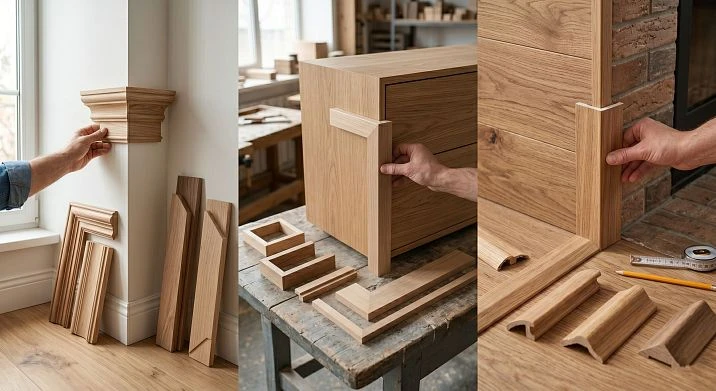
Wooden Miter for Finishing — this is a solid wood corner profile that covers the joint, protects the edge, and turns a technical solution into an architectural detail. Small in size, but significant in role. It is installed at the final stage — and it is what puts the finishing touch on the renovation story.

Short answer: when you need a wooden corner piece
If you came for a specific answer — you'll get it right away.
Wooden corner bracket is needed when a regular batten or trim does not neatly cover the corner joint. Where two planes meet at a 90° angle — inside a room, outside, on furniture — a profile is needed that will cover both ends simultaneously.
For an external wall corner — to protect the edge and make the transition between two planes clean. For an internal corner — to close the gap between panels and hide unevenness. For the edge of a furniture body — to protect the end from chips and decorate the corner. For window and door openings — to cover the joint between the frame and wall finish. For niches and protrusions — to give complex architectural elements a finished look.
And finally — for a decorative effect. A wooden corner piece in a visible area is not just a closed gap. It is a line that organizes the surface, creates an accent, and speaks to the quality of the finish.




What is a wooden corner piece
A precise understanding of the product is the first step to making the right choice.
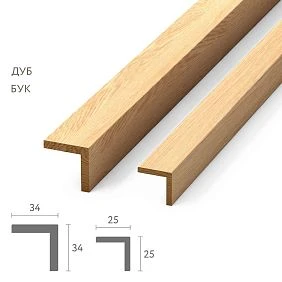
Wooden angle — this is a linear profile made of solid wood with a cross-section in the shape of the letter "G" or "L". The two shelves of the profile — called "shelves" or "faces" — are positioned at a 90° angle to each other. Each shelf covers one of the two planes that meet at the corner joint.
Technically, it is a simple but functionally indispensable element. Without it, the corner joint of two panels, two wall planes, or two furniture surfaces is open, vulnerable, and untidy. With it, it is closed, protected, and finished.
A wooden corner can be technical—then it is practically invisible, its purpose purely protective. Or decorative—then it itself is a finishing element, its shape and material adding an extra accent to the interior.
In the classification solid wood trim the corner occupies a place alongside the batten, trim, baseboard, molding, and cornice. All these elements solve one task—they bring the finish to perfection—but each in its own area of application. The corner is a specialist in corner zones.
A well-sanded wooden corner made of high-quality solid wood accepts any coating: paint, varnish, stain, oil. This means it looks equally organic in natural wood finishes, painted interiors, and classic white walls.
Our factory also produces:
Where a wooden corner piece is used
Get Consultation
For walls and panels
Wooden wall panels—slats, clapboard, MDF panels, plywood—inevitably encounter corners during installation. External corner: two walls meet in an outward protrusion. Internal corner: walls form a concave joint.
For an external corner Wooden Miter for Finishing —the cleanest solution. It covers both ends of the panels and protects the edge from mechanical damage. The external corner is the most vulnerable spot of the finish: it gets bumped when moving furniture, during cleaning, or from accidental impacts. The wooden corner takes these impacts upon itself.
For an internal corner, the corner hides the gap that inevitably occurs between the ends of the panels during installation. Fitting panels perfectly into a corner is practically impossible: walls are never perfectly straight. The wooden corner profile completely eliminates this problem.
Decorative wooden wall made of It begins with understanding the basic principles of visual perception of space. The golden ratio, the rule of thirds, symmetry and asymmetry — all these classical principles are applied in wooden wall decoration. or layouts takes on a finished look precisely when all its edges and corners are covered with the correct profile. The corner piece completes the decorative wall just as Skirting completes the wall at the floor.
For furniture
Furniture made of wood or MDF has exposed body edges. On the sides of a cabinet, on the ends of a nightstand, on the corners of the body — the MDF or plywood edge is vulnerable: it chips upon impact, swells from moisture, and looks untidy.
A wooden corner piece for furniture protects the edge and simultaneously serves as a decorative accent. On a cabinet body covered with a wooden corner piece, three things are visible: the front, the side panel, and a thin wooden line along the edge. This line organizes the form and gives the item a sense of quality.
In solid wood furniture, wooden corner pieces from the same species create a monolithic look: no visible joint, no exposed edge, no visual break. This is furniture as a single piece, not a set of fastened parts.
In classic and neoclassical furniture, a decorative wooden corner piece with a light profile is an element that enhances the architectural quality of the form. A cabinet with wooden corner pieces on the edges, overlay panels on the fronts and legs made of solid wood is a furniture ensemble, not furniture from a catalog.
For door and window openings
A doorway is a place where several materials meet: the door frame, the wall, plaster, or paneling. The joint of these materials requires neat finishing.
In the classic solution, the opening angle is covered by a platband. However, if the wall finish is made of wooden panels, a wooden corner profile becomes a natural transition between the panel and the slope. It covers the panel end at the opening and creates a clean vertical line.
For window slopes finished with wood, a corner piece around the perimeter of the slope covers the joints between the slope board and the wall finish. This is especially important in wooden houses, where all finishing elements are made of natural materials: Wooden plank for wall, slope, windowsill — and a wooden corner piece along the edge of the slope.
For niches and protrusions
Niches in walls — decorative or functional — have internal corners. A niche for a TV, a book niche, a decorative niche with backlighting — all have ends and internal right angles. A corner piece here is a technically neat and visually calm solution.
Protrusions and columns: in interiors with load-bearing columns or decorative pilasters, a wooden corner piece frames the edges of the protrusions. This is typical for classic interiors, where a column with wooden corner pieces on the edges is an element of architectural decor.
The piers between windows in wooden houses, covered with clapboard or slats — their external vertical edges are finished with a wooden corner piece. This creates a neat line that completes the finish from floor to ceiling.
For decorative finishing
When the corner should not just be technically covered, but beautifully designed — a decorative wooden corner piece with a light profile or a small chamfer goes beyond the technical task.
A decorative corner piece is a line that is seen. It creates contrast or unity with the surface it adjoins. On a light wall, a dark wooden corner piece is an expressive graphic accent. On a wooden wall, a corner piece of the same species is a single continuous wood.
A decorative corner profile in a classic interior is often combined with solid wood moldings — horizontal profiles on the walls. Corners on vertical edges and moldings on horizontals create a wooden architectural frame for the interior.
How is a wooden corner different from a batten and a trim strip?
This is a question that arises for everyone who starts choosing trim for finishing. We will answer honestly and clearly.
| Element | When to use |
|---|---|
| Wooden corner | For closing corners, edges, and joints at 90° |
| wooden plank | For vertical and horizontal lines, wall and partition decor |
| Wooden molding | For flat joints, decorative frames, and inserts on facades |
| Moldings from solid wood | For decorative frames on walls and in interior compositions |
| Skirting made of solid wood | For the joint between floor and wall |
| Wooden Picture Frame | For frames of paintings, mirrors, panels, and decorative borders |
The fundamental difference between a corner and a batten: a batten has one working plane (it covers a line on one surface), while a corner has two planes at an angle. A batten cannot cover a corner. A corner is not intended for a flat wall.
The fundamental difference between a corner piece and a trim: wooden corner slat is specifically designed for corner areas and is a type of trim with an angular profile. A wooden corner piece is a more universal profile for covering technical and decorative corner joints.
Knowing these differences helps you immediately choose the right element — and not waste time on returns and replacements.
How to choose the size of a wooden corner
Size is a functional parameter. An incorrect size makes the corner piece either useless (does not cover the joint) or visually coarse (too large for a thin joint).
Shelf width. This is the main parameter. Each shelf of the corner piece must overlap the corresponding surface with a margin of 3–5 mm on each side. If the wall panel is 18 mm thick, the corner piece shelf must overlap at least 20–25 mm. For thicker materials, correspondingly more.
Standard sizes of wooden corner pieces: 10×10 mm, 15×15 mm, 20×20 mm, 25×25 mm, 30×30 mm, 40×40 mm. These are equilateral corner pieces where both shelves are equal. There are also unequal ones: for example, 20×30 mm — for cases where the two materials being covered have different thicknesses.
For furniture. Small cabinets, dressers, bookshelves — corner pieces 10×10 or 15×15 mm. Massive wardrobes and case furniture — 20×20 or 25×25 mm. A too large corner piece on a small item visually weighs it down.
For wall panels. Wall slats or paneling 12–20 mm thick — corner pieces 20×20 or 25×25 mm. Thicker decorative panels — 30×30 or even 40×40 mm. For an external wall corner, the width margin is important: it is better to overlap with a margin than to leave an exposed edge.
For openings. Door and window slopes made of wood 20–30 mm thick — corner pieces 25×25 or 30×30 mm. For thin slopes 12–15 mm — 15×15 or 20×20 mm.
Measurement practice. Before purchasing: measure the thickness of both materials that meet at the corner joint. Add 5 mm to each shelf. This is the minimum size of the corner piece. For a decorative effect, you can take a shelf 5–10 mm wider — this will create a visible shadow and an additional accent.
The thickness of the corner itself. In addition to the width of the flanges, the thickness of the corner material is important. The standard is 8–12 mm for technical corners, 12–18 mm for decorative ones. A corner that is too thin is fragile — it may crack during installation or use. A corner that is too thick looks unattractive on thin materials.
How to choose a profile based on the task
The corner profile is the shape of its cross-section and the geometry of the flanges. Even within the "corner" category, the choice is important.
Simple smooth corner. Both flanges are flat, the edge is straight or slightly rounded. Minimal profile without decoration — for areas where the corner should be functional and unobtrusive. On white walls under white enamel, a smooth corner almost blends with the finish.
A smooth corner is the choice for a modern minimalist interior, for office and public spaces, for furniture with clean lines.
Decorative corner with a chamfer or profiled edge. On the edge of the corner, there is a small 45° chamfer, rounding, or decorative band. This adds a shadow line that makes the corner a visible element of the finish. A decorative corner is for visible areas where it should work as an architectural detail.
paired with solid wood moldings и with wooden cornices A decorative corner creates a system of wooden interior decor — from floor to ceiling, from the corner to the central wall.
Narrow corner — for furniture and thin joints. Flanges 10–15 mm — minimal profile for delicate work. Finishing furniture edges, covering thin gaps between panels — the area of a narrow corner. It is almost invisible but eliminates all technical imperfections.
Wide corner — for walls, panels, and openings. Flanges 30–40 mm — a full-fledged architectural element. On wall panels, a wide corner itself becomes a frame organizing the corner. It pairs well with wide wooden skirting boards и decorative slats on the walls.
Corner for painting. An unfinished wooden corner is an ideal base for enamel. After priming and 2–3 coats of acrylic or alkyd enamel, the corner takes on an even color. Under white enamel — standard for classic and Scandinavian interiors.
Corner for varnish or stain. If the wooden corner should retain the texture and tone of the solid wood — clear matte varnish or stain followed by varnishing. An oak corner under oil varnish — a warm, natural accent.
Material and coating: what matters before purchase
Quality wooden corner pieces is determined not only by shape but also by material. Let's consider the key parameters.
Wood species. For decorative indoor use — pine (affordable, easy to work with, paints well), beech (dense, with uniform texture), oak (durable, expressive, long-lasting). For external corners and areas with high humidity — larch or oak with mandatory moisture-resistant treatment.
Pine is the most common material for budget corners intended for painting. Its soft structure accepts enamel well and creates a smooth surface. Oak and beech are for decorative corners under clear varnish, where the beauty of the texture is important.
Quality of sanding. This is a parameter rarely paid attention to when ordering — but it determines the quality of the final coating. A corner sanded to grit 150–180 on the faces and 120 on the ends accepts any coating evenly. A poorly sanded corner with fiber tears under paint will produce a textured surface — a defect that cannot be fixed by repainting without removing the coating.
Geometry. A precise right angle is critically important. A corner with a deviation from 90° will fit unevenly against the walls: one flange tight, the other with a gap. A gap is a place that cannot be hidden by coating.
Absence of chips and cracks. Before installation, each corner should be checked manually: a chip on the edge, a surface crack at the end — defects that will become visible under paint. Buying with a 10% margin is insurance against rejection.
Moisture content. A wooden corner made from raw wood after installation and drying will develop cracks at the ends and warping. Moisture content no more than 8–10% is the standard for quality millwork. To check: measure with a moisture meter or visually — raw wood is darker, heavier, and less elastic when bent.
Compatibility with other elements. The wooden corner should be from the same species as Wooden planks, Baseboards и Moldingsthose used in the same area. With a single paint job, this is done automatically. With a natural finish — the species matters: different species under the same varnish give different tones.
Wooden corner piece for furniture
This is a separate topic deserving detailed consideration. Furniture made of wood and MDF is the main area of application for thin decorative corners.
Design of side edges. The side panel of the cabinet, visible from the room, has an open end. This end is a vulnerable area: MDF crumbles upon impact, plywood delaminates. A wooden corner on the edge of the side panel protects the end and simultaneously serves as a decorative vertical line in sight.
For a cabinet 600 mm wide and 2,000 mm high — two vertical corners, one on each front edge. This creates four vertical wooden lines that shape the architectural silhouette of the cabinet. On a white facade — white corners. On a veneer facade — corners made of the same wood species.
Protection of body corners. The lower corners of the furniture body are in a special risk zone. They are hit by feet, vacuum cleaners, and during rearrangement. A wooden corner in the lower area of the body provides additional protection, absorbing impacts instead of the thin MDF end.
Furniture restoration. An old body with damaged ends — putty, sand, cover with new wooden corners. Combined with new wooden furniture handles, new overlay panels and new legs — the furniture is completely transformed without replacing the body.
Classic furniture. For a classic or neoclassical cabinet with white enamel, a wooden corner with a slight chamfer is an architectural technique that transfers the principle of "pilaster" to the furniture body. Corners as vertical pilasters + horizontal Moldings as friezes + Cornice as a crowning — a classic architectural triad on the furniture body.
Furniture in the kitchen. In the kitchen, edge protection is especially important: moisture, grease, mechanical impacts. A wooden corner on the edges of kitchen cabinets under polyurethane varnish is durable protection with a decorative effect.
Wooden corner for wall panels and slats
Decorative wooden walls are one of the main trends in interior design today. wooden planks on the wall create a rhythmic texture, warm atmosphere, accent zone. But a decorative wall requires proper finishing around the entire perimeter.
Closing panel ends. Wooden slats nailed vertically to one wall have open ends on the sides — where the slats meet the side walls. A wooden corner at these transitions closes the ends of the slats and creates a neat vertical transition line.
Design of external corners. A decorative wall made of slats that goes around an external corner of the room — both ends of the slats in the corner area are covered with a wooden corner. It creates a smooth wooden line along the edge of the corner: neat, durable, without open edges.
Transition between slats and wall. If the decorative slatted panel occupies only part of the wall (up to a height of 1200–1500 mm), its top end also requires finishing. Here, a corner rotated 90° works as a horizontal finishing element along the top edge of the panel. This is a function angular arrangement of wooden.
Combination with other trim. Wooden Miter for Finishing works in a system: at the bottom — Wooden baseboard, on the sides — corners, at the top — a finishing profile from trim or molding. At the corners vertically — corners. All from the same wood species. All in the same coating. This is a wooden finishing system where each element is in its place.
Wooden block — an additional element for mounting structures and battens under panels. In a wooden wall system, the batten is the base on which slats are mounted, while corners and trims complete the visible surface.
Mistakes when choosing a wooden corner
These mistakes are made often — and fixing them is expensive.
Taking a corner that is too narrow. A corner with a 10 mm shelf on an 18 mm thick panel — the shelf does not cover the panel end. The gap remains visible. Always add 5–7 mm to the material thickness — this is the minimum shelf allowance.
Choosing without considering panel thickness. For different materials with different thicknesses — you need an unequal-sided corner or two different corners. You cannot use the same symmetrical corner where materials differ significantly in thickness.
Not checking the angle geometry. Before buying a corner — make sure the angle itself is right. If the walls give an angle of 88° or 92° — a standard 90° corner will fit with a gap. Angle adjustment to bring the wall to 90° is needed, or special corner profiles.
Mixing different wood species without painting. A pine corner next to an oak slat under natural varnish — different tones, different texture, obvious dissonance. Either one species everywhere, or a uniform coating that neutralizes the difference.
Forgetting about painting. Gluing a corner and then trying to paint it — a painting nightmare. The correct sequence: coat the corner before installation (or at least apply primer), then install, then finish coating at the joint.
Using a construction corner made of PVC or metal instead of wood. In a wooden interior, a PVC corner is a foreign material. Even under paint, it reveals itself by its relief and difference in behavior: plastic does not accept paint the same way as wood. For wooden finishing — Wooden angle.
Not matching the corner with the baseboard and slats. A 40×40 mm corner and a 15 mm baseboard — a disproportionate pair. The sizes of all profiles in one area should be proportionate: corner, baseboard, slats — in a unified scale system.
Do not order without spare stock. 10% of the calculated quantity is the minimum. The corner piece is a linear material that is cut to size. One bad cut and the element is scrap. Without spare stock, installation will stop.
What to buy together with the wooden corner piece
A corner is the connection point of the system. What makes up this system?
Wooden planks — vertical or horizontal wall decor, the main material of a decorative wooden wall. Corner pieces complete the slatted wall around the perimeter.
Wooden molding — for flat joints and decorative frames on facades and walls. Works in pair with the corner piece: the trim is for horizontal and vertical lines on a plane, the corner piece is for corner areas.
wooden corner slat — a specialized element for corner finishing with a decorative function. Complements the wooden corner piece where a more expressive profile is needed.
Moldings from solid wood — horizontal decorative profiles for walls. In the system with corner pieces, they create a complete wooden interior architecture: moldings on horizontals + corner pieces on verticals.
with a classic profile creates a sense of solidity, reliability. — the lower finishing element of the wall. Made from the same wood species as the corner piece — a horizontal wooden line at the floor.
wooden cornice — the upper finishing element above a cabinet or at the ceiling. Made from the same wood species — a wooden horizontal line of the upper tier.
Wooden Picture Frame — for framing frames, mirrors, decorative panels. In the wooden finishing system, it is the finishing decorative element for vertical surfaces.
Wooden decor — overlays — for furniture facades and decorative walls. Overlays on planes + corner pieces on edges = a complete decorative furniture or wall ensemble.
wooden furniture handles — if corner pieces go on a furniture body, handles should be from the same wood species. A unified wooden furniture system.
Wooden legs — for furniture bodies. Corner pieces + legs from the same wood species — top and bottom of furniture in unity.
decorative bracket — for open shelves. A wooden bracket from the same wood species as the trim corner pieces — connects the wall and open storage into a single wooden system.
FAQ: Answers to popular questions
What is a wooden corner piece for?
Wooden Miter for Finishing it is needed to cover and protect corner joints — external wall corners, internal panel joints, furniture edges, ends of door and window openings, edges of niches and protrusions. It is the final element that eliminates all technical imperfections of corner joints and gives the finish a complete look.
How is a wooden corner piece different from a trim strip?
Wooden molding covers flat joints and creates decorative lines on a single plane. Wooden angle works on two planes at a 90° angle — specifically for corner joints. wooden corner slat — intermediate version with corner profile and decorative function.
Can you paint a wooden corner piece?
Yes — a solid wood corner piece accepts any coating perfectly. White enamel for classics, clear varnish for natural wood, stain for tinting to the desired shade — everything works. The quality of the result depends on sanding the surface before installation.
How to choose the size of a wooden corner piece?
Measure the thickness of both materials at the corner joint. Add 5–7 mm to each shelf of the corner piece. This is the minimum shelf size. For decorative effect, you can increase by 5–10 mm. Choose from the standard range: 15×15, 20×20, 25×25, 30×30, 40×40 mm.
Where is it best to use a decorative wooden corner piece?
In visible areas of the interior: on wall panels made of slats, on furniture bodies, near door and window openings, on niches and decorative protrusions, on the edges of columns and pilasters. Where the corner should not just be covered, but also beautifully designed — choose wooden corner piece with decorative profile.