

























Article Contents:
- What is a wooden handrail: an underestimated function
- Safety function
- Decorative function
- How a handrail differs from railings and balusters: understanding the terms
- Where wooden handrails are used: from stairs to balconies
- Wooden staircase inside the house
- Balustrade on the second floor (double-height space)
- Terrace and porch
- Veranda, balcony, gazebo
- Hall and corridor with ramp or steps
- How to choose a profile shape: handrail anatomy
- Rounded profile (semicircular or oval)
- Shaped (profiled) handrail
- Wide flat handrail
- Narrow cylindrical handrail
- Handrail for painting vs handrail for varnish
- Grip comfort: what matters more than beauty
- What is a comfortable grip
- Grip zone shape
- Surface: smoothness and grip
- Temperature comfort
- How to choose handrail material: oak, beech, pine, larch
- Oak
- Oak
- Spruce
- Larch
- Comparison table of wood species for handrails
- How to combine handrail with balusters, posts, and finials
- Handrail and balusters: unity of wood species and finish
- Handrail and posts: proportions and transitions
- Handrail and finials: the finishing touch
- Handrail and carved staircase decor
- Handrail for terrace and porch: outdoor use
- Choosing wood species for outdoor use
- Coating system for outdoor handrail
- Design features of outdoor handrail
- How to calculate the length of a wooden handrail
- For a straight flight of stairs
- For a turning staircase
- For a balustrade
- Handrail height: standards and ergonomics
- Standard height
- Ergonomic height for an adult
- Mistakes when choosing a wooden handrail
- Installation of a wooden handrail: key points
- Handrail attachment to balusters
- Attaching the handrail to posts
- Cutting to the angle of the flight
- Sanding and finishing after installation
- Where to buy a wooden stair handrail with quality guarantee
- FAQ: Answers to Popular Questions
- About the manufacturer

Think of the staircase differently. Not as a structure between floors, but as the first tactile experience of the home. The first thing a hand touches when entering a space is the handrail. Not the floor, not the wall, not the door handle. It is the handrail. And that is why its selection deserves more attention than is customary.
Wooden stair handrail — is both a functional and decorative element. It ensures safety when moving along the staircase, sets the style of the railing, and is the visual "cap" of the entire balustrade system. An incorrectly chosen handrail ruins even the most beautiful staircase. The right one makes it whole, warm, and alive.
This article is a detailed analysis of the topic. We'll break down what a handrail is and how it differs from railings and balusters, how to choose a profile for your hand, which material is best for interiors and exteriors, how to coordinate the handrail with balusters, posts, and finials — and how to avoid the mistakes most people make.


What is a wooden handrail: the underestimated function
First of all — a definition, because confusion in terminology is common here.
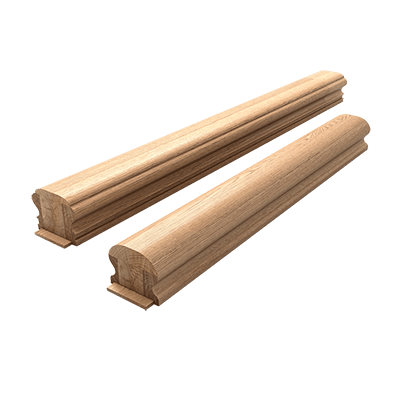
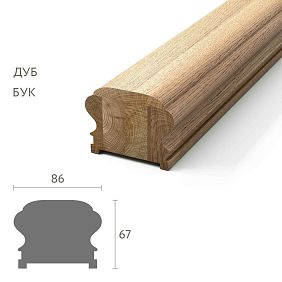
A handrail is the upper horizontal (or inclined, on a flight of stairs) element of a railing that is grasped by hand when moving. It crowns the railing system: rests on balusters or is attached to a wall, connects posts, and sets the top line of the entire railing.
The handrail has two functions, both equally important.
Safety function
The handrail is a support. When climbing stairs, descending, or taking an awkward step. It must withstand lateral and vertical loads, not sag or "wobble" at connections. The standard load on a handrail is at least 100 kg per linear meter in the horizontal direction. This is modest, but it ensures reliable support in case of an accidental fall.
Our factory also produces:


Decorative function
The handrail is the top horizontal line of the railing. It sets the visual "horizon" of the staircase. The perception of the entire staircase depends on how beautiful and correctly the profile is chosen. A thin, elegant handrail lightens the structure. A wide, massive one adds weight and status. A profiled, shaped one creates a classic look.
Get Consultation
How a handrail differs from railings and balusters: breaking down the terms
This confusion should be cleared up once and for all.
A railing is the entire system of a staircase or balustrade assembly: posts + balusters + handrail + possibly a bottom rail. A railing is an "ensemble."
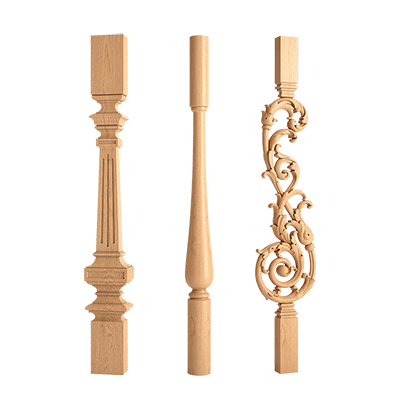
Balusters are vertical posts that stand in a row between the posts and support the handrail from below. Balusters for staircase they can be turned (volumetric, lathe-turned) and flat — depending on the style.
A handrail is specifically the top profiled element that sits on the balusters and is attached to the posts. It is what the hand holds onto. It is chosen separately — by profile, material, finish, and comfort.
Understanding the difference is important when purchasing: components for wooden staircases — it is a system where each element has its role. The handrail should be purchased as part of a system with balusters, posts, and finials — then the staircase becomes cohesive.
Where wooden handrails are used: from stairs to balcony
Wooden handrail — a universal element that works in a wide variety of situations.
Wooden staircase inside the house
The most obvious application. A straight staircase to the second floor in a private house, townhouse, or country estate. The handrail runs along the flight at an angle and ends with horizontal sections on the landings. Here, grip comfort and coordination with balusters and posts are especially important.
Balustrade on the second floor (double-height space)
The balustrade encloses the open space of the second floor, which overhangs the first. The handrail runs horizontally along the entire balustrade — it is a long continuous element, clearly visible from the first floor area. For such a handrail, straightness and the correct style are especially important.
Terrace and porch
A wooden handrail on the terrace and porch is an outdoor application. Requirements for moisture resistance and coating are added. The handrail for the terrace must be made of hardwood or larch with proper outdoor treatment.
Veranda, balcony, gazebo
Verandas, balconies of wooden houses, summer gazebos — all these structures use the handrail as a finishing element of the railing. On wooden country buildings, a pine handrail for painting is a traditional and practical solution.
Hall and corridor with a ramp or steps
Even one or two steps in an interior require a handrail for safety — especially in homes with elderly people. Here, the handrail can be mounted directly to the wall (wall-mounted) without balusters or posts.
How to choose a profile shape: the anatomy of a handrail
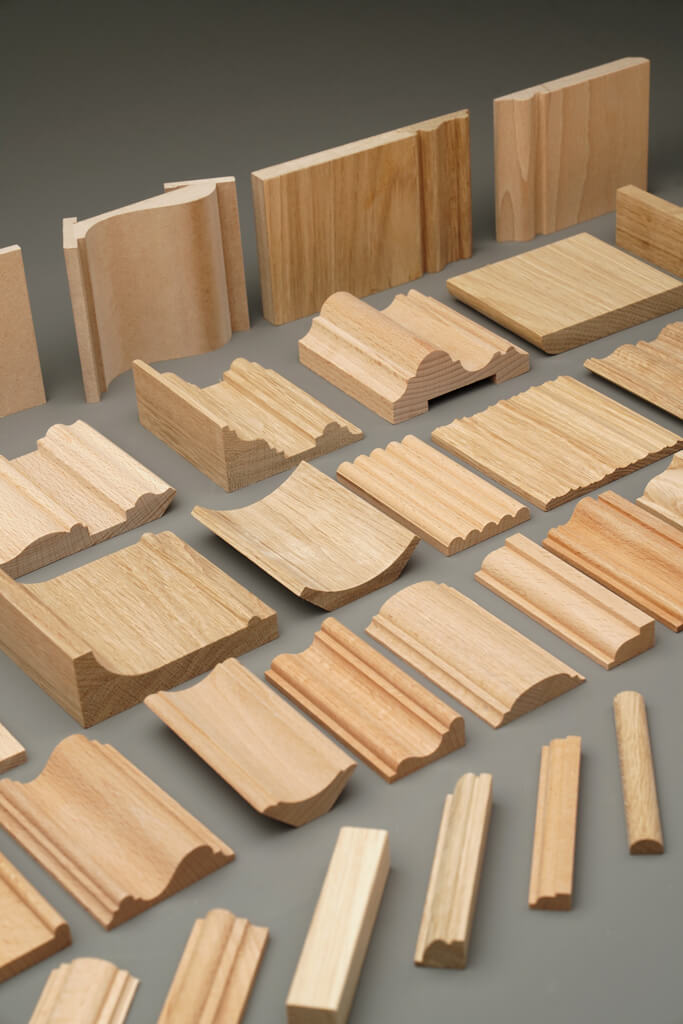
The profile is the cross-section of the handrail. It determines how comfortably the hand fits, how the handrail looks in the interior, and how well it holds the coating.
Rounded profile (semicircular or oval)
This is the most common and functionally justified profile. The cross-section is a semicircle or soft oval, flat or slightly concave at the bottom for attachment to balusters.
Why it works: the hand naturally wraps around the rounded surface. There are no sharp edges, no discomfort during prolonged contact. This is a physiologically correct shape for gripping.
Dimensions of a rounded handrail:
-
Width (outer diameter): 50–80 mm.
-
Profile height: 40–65 mm.
-
Most common standards: 50 × 50 mm, 60 × 40 mm, 70 × 50 mm.
Round profile is the choice for most wooden staircases: versatile, comfortable, and looks good in any style.
Shaped (profiled) handrail
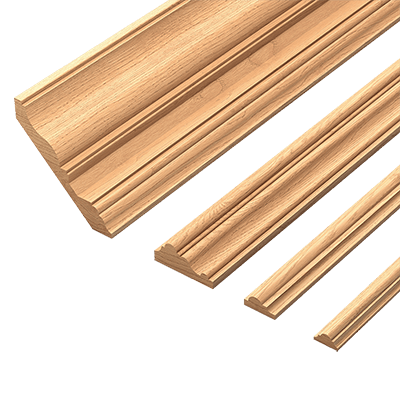
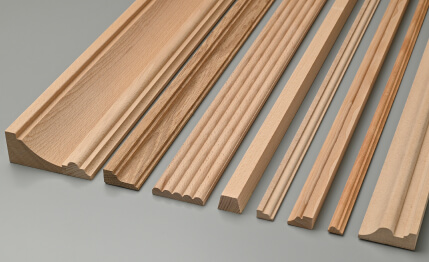
The shaped profile has a complex cross-section: a rounded top with side undercuts, cornice shelves, or decorative fluting on the sides. This is an "architectural" handrail option — for classic staircases, neoclassical interiors, homes with wooden moldings and profiles.
A shaped handrail is visually richer, creating a play of light and shadow on the side edges. It is appropriate where the entire staircase is a classic decorative ensemble: carved balusters, turned posts, Wooden Caps with expressive forms.
Dimensions of a shaped handrail are typically wider: 60–90 mm in width, up to 55 mm in height.
Wide flat handrail
A handrail with a wide flat top surface and rounded or beveled side edges. Width — 80–120 mm, height — 30–45 mm. This is a "modern" option: minimalist, horizontal, with an emphasis on the horizontal line.
Good for minimalist interiors, Scandinavian style, modern country houses. A wide handrail visually "weighs down" the top line of the railing, making it more substantial and horizontally pronounced.
The grip comfort of a wide handrail is slightly worse than that of a round one: the hand does not fully wrap around it. But for staircases with a low angle of ascent, this is not critical.
Narrow cylindrical handrail
Round cross-section, diameter 40–50 mm. This is a "tube-shaped" handrail — minimalist, strict. It harmonizes well with metal elements and is used in modern interiors with wooden inserts and metal structures.
For a classic wooden staircase, a cylindrical handrail is an atypical choice. For a modern one, it is appropriate.
Handrail for painting vs handrail for varnishing
This is not so much a shape as a surface condition. A handrail "for painting" is made of pine or beech, with minimal sanding, intended for applying primer and enamel. A handrail "for varnishing" is made of beech or oak, with thorough sanding up to 180–220 grit, with a pronounced texture, intended for transparent or tinting coatings.
The choice depends on the final finish: if the staircase is white, choose a handrail for painting. If it is natural wood, choose one for varnishing.
Grip comfort: what matters more than beauty
This is the central section, and intentionally so. The handrail is what you hold onto. And this requirement is primary.
What is a comfortable grip
A comfortable grip is when the hand rests on the handrail without tension, the thumb and index finger close without effort, and the palm does not slip. The physiologically optimal grip for an adult hand is 45–65 mm in diameter.
A handrail wider than 70–80 mm in outer diameter — the hand cannot close around it. This is not a problem for a straight balustrade that is rarely held, but it is inconvenient for a steep staircase flight.
A handrail narrower than 40 mm — too thin, the hand "squeezes" it, no feeling of a reliable support.
The sweet spot for a staircase handrail: 50–65 mm in outer diameter or width.
Shape of the grip zone
The lower part of the handrail — the one grasped by the hand from below — should be rounded or flat without sharp edges. Sharp edges are painful when leaning with the palm.
Grooves on the sides of a shaped handrail create a "belt" that naturally accommodates the fingers. This is an ergonomically sound solution: the hand does not slide along the handrail during movement.
Surface: smoothness and grip
A too smooth handrail is slippery, especially if hands are wet. A too rough one is unpleasant during prolonged contact.
The correct surface: sanded to 120–180 grit, finished with oil-wax or a matte or semi-matte lacquer. Oil-wax creates an ideal tactile sensation: the wood feels "alive," warm, slightly matte, with good grip.
Glossy lacquer on a handrail looks beautiful but is slippery. This is especially critical for elderly people and children. Matte or semi-matte lacquer is a compromise between aesthetics and safety.
Temperature comfort
Wood is a warm material. This is not a metaphor, it's physics: wood has low thermal conductivity, it doesn't draw heat from your hand. That's why Wooden handrail it feels more pleasant to the touch than metal or glass: your hand touches a warm surface, not a cold one.
For outdoor handrails (porch, terrace) this is especially important in winter: a metal handrail is unpleasant in the cold, while a wooden one feels neutral.
How to choose handrail material: oak, beech, pine, larch
The handrail material affects everything: strength, appearance, durability, processing options, and price.
Oak
Oak is the benchmark for wooden stair handrails. Dense wood (700–750 kg/cu m) with a pronounced, slightly coarse texture. It holds profile shape well, does not deform with humidity changes, and accepts oil, wax, and varnish excellently.
An oak handrail is the choice for classic, neoclassical, and modern wooden stairs where status and durability matter. Dark oak under oil gives a rich, expressive, 'living' look. Oak under tinting ranges from light golden to dark chocolate.
The cost of an oak handrail is above average. But with proper care, its service life is decades.
Beech
Beech is a dense, uniform, fine-textured wood. The surface is very smooth, the grain is restrained. That's why beech is an ideal base for painting: the surface accepts primer and enamel evenly, without dips or knots.
Beech handrail under white or colored enamel is a classic solution for modern and classic interiors. Under clear varnish, beech is slightly inferior to oak in expressiveness, but it is also good when tinted.
Beech does not tolerate constant humidity well — it is not recommended for outdoor structures without proper protection.
Spruce
Pine is a soft and affordable wood. A pine handrail is a choice for country houses with a moderate budget, for structures intended for painting.
Cons: softness means the handrail surface can scratch and dent under heavy use. For the main staircase in a house, pine is a compromise. For a veranda, country house, or porch, it is a practical choice.
Pine accepts antiseptic impregnation and painting with facade paints well, which is important for outdoor use.
Larch
For outdoor handrails, larch is unrivaled. Its natural resin content and density (600–700 kg/cu m) make it resistant to moisture and rot. Larch on a porch or open terrace lasts significantly longer than pine with similar care.
The texture of larch is expressive, with clearly defined annual rings. Under oil or tinting, it looks rich and luxuriously rustic.
Comparison table of wood species for handrails
| Species | Hardness | For interior | For exterior | For varnishing | For painting |
|---|---|---|---|---|---|
| Oak | High | Excellent | Good | Excellent | Good |
| Beech | High | Excellent | Poor | Good | Excellent |
| Spruce | Low | Satisfactory | Good | Satisfactory | Excellent |
| Larch | Medium | Good | Excellent | Good | Good |
How to combine a handrail with balusters, posts, and finials
The handrail is part of the system. How well it is chosen within this system determines the final appearance of the staircase.
Handrail and balusters: unity of wood species and finish
First rule: the handrails for the staircase и Balusters for staircase must be made of the same wood species with the same finish. This is fundamental.
A light beech handrail over dark oak balusters is a conflict that no design can 'explain away.' A handrail from the same batch of oak as the balusters is integrity.
A combination is acceptable: natural wood handrail + balusters for painting (or vice versa). But only if it is a deliberate design decision, not an accident.
If used Flat wooden balusters — the handrail is selected considering their shape: for minimalist flat balusters, a restrained rounded or wide handrail. For ornamental carved balusters, a shaped profiled handrail.
Handrail and posts: proportions and transitions
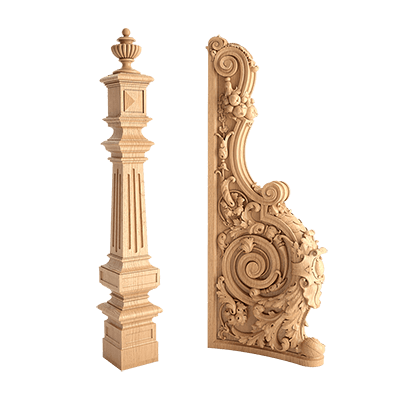
Newel posts are large vertical supports at the beginning and end of a flight. The handrail is attached to them and "extends" beyond them into the horizontal section. The transition of the handrail from inclined (on the flight) to horizontal (on the landing) must be clean and neat.
This transition is executed using special turning elements (wooden corner joints or shaped parts). Their profile must match the profile of the handrail — otherwise the "seam" will be visible and unsightly.
A square-section newel post with a shaped profile + a shaped handrail is a classic combination. A round-section newel post + a rounded handrail is modern and minimalist.
Handrail and finials: the final touch
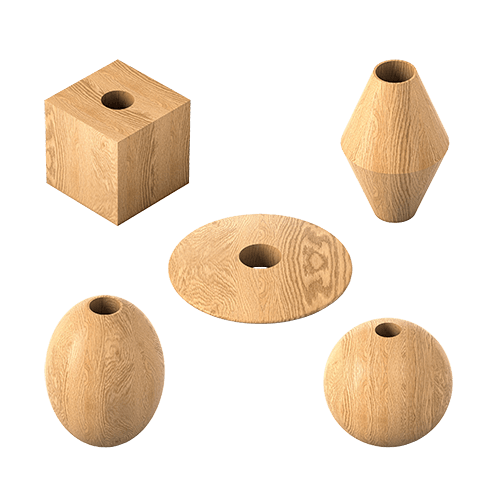
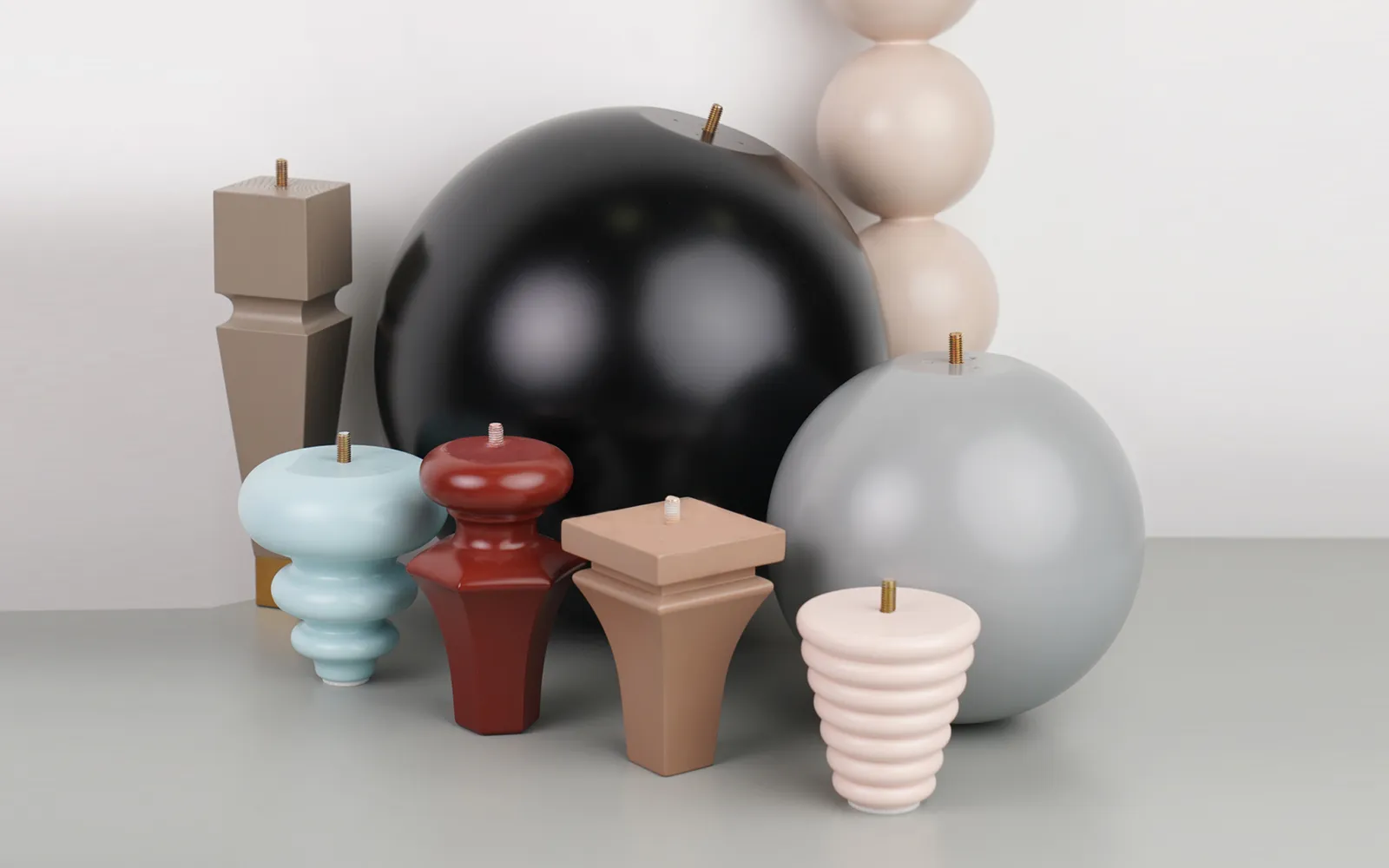
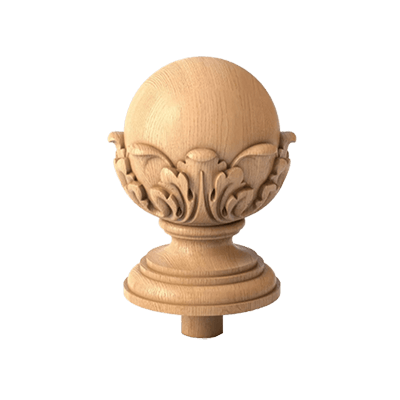
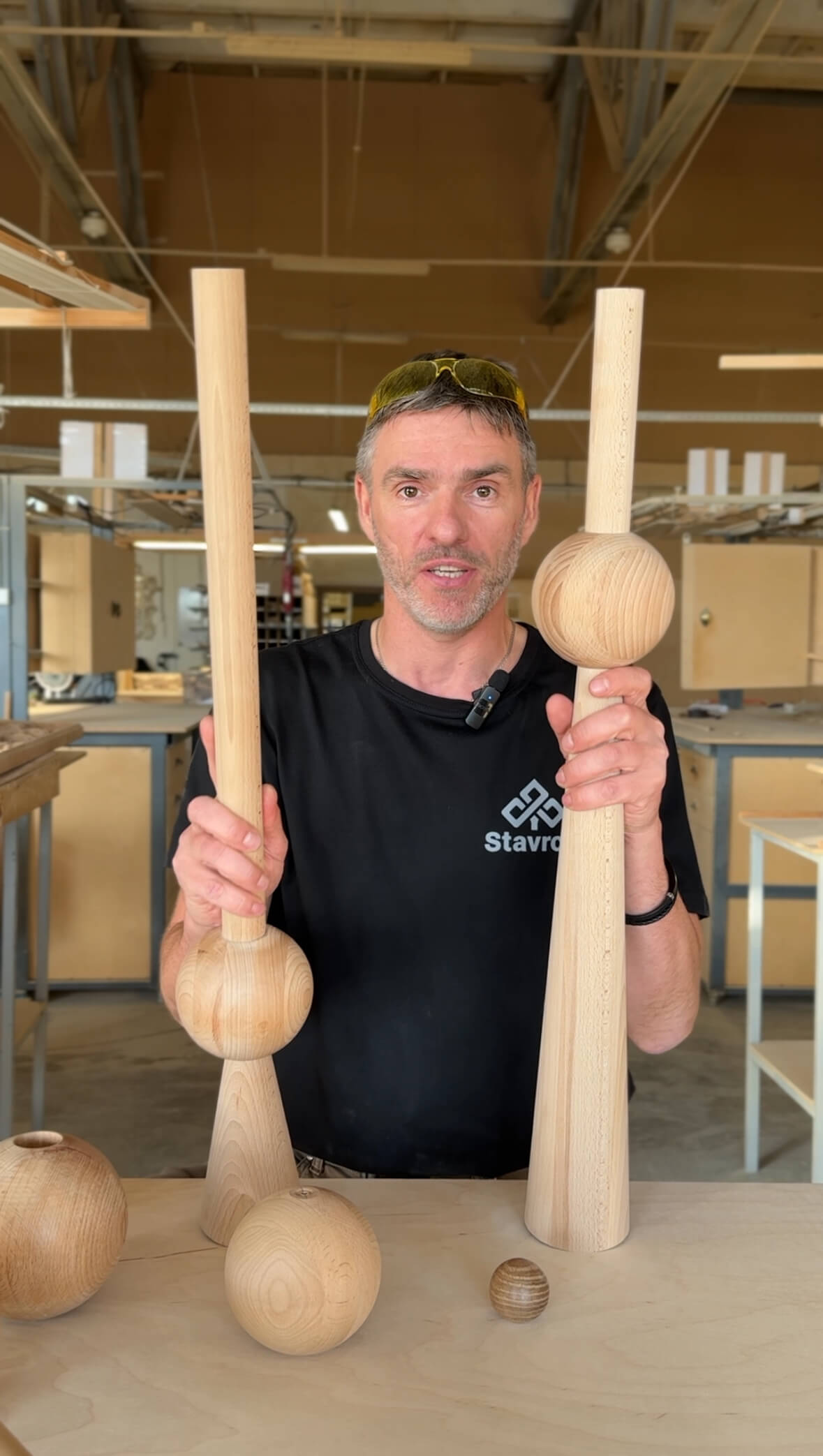
Wooden Caps on newel posts — this is the "final accent" of the stair railing. A spherical, pyramidal, or shaped finial completes the newel post and creates a focal point.
The finial must be made of the same wood species as the handrail — this is mandatory. The style of the finial is coordinated with the handrail profile: a shaped finial with a turned profile + a classic profiled handrail. A simple spherical finial + a rounded minimalist handrail.
Wooden products for interior — handrails, balusters, newel posts, finials — must form a unified system, selected from a single source or with careful coordination.
Handrail and carved stair decor
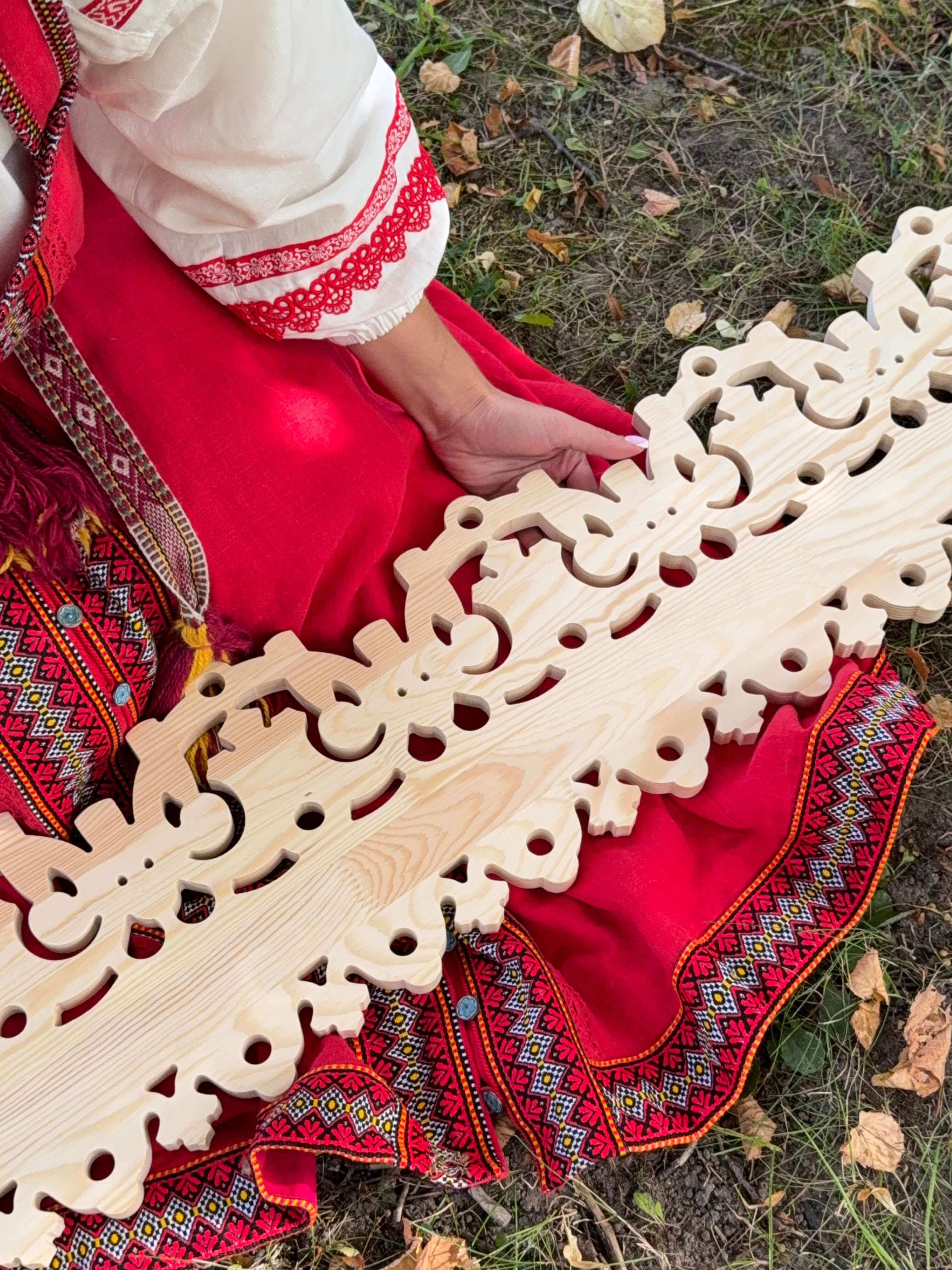
If the staircase includes Carved wooden decoration — applied elements on the stringer fascia, decorative overlays on newel posts — the handrail must be "in dialogue" with this decor. Rich carved decor on the stringer + a simple rounded handrail is acceptable if the handrail is made of the same wood species. A simple staircase without decor + a complex shaped handrail also works as a single decorative accent.
Handrail for terrace and porch: outdoor use
Going outside is a different story. The physical requirements for a handrail are fundamentally stricter here.
Choosing wood species for outdoor use
As already mentioned — larch, oak, or properly treated pine. Beech is not recommended for outdoor structures without special need: it does not tolerate prolonged contact with moisture.
Coating system for outdoor handrail
Outdoor Wooden stair handrail or terrace requires systematic protection:
Step 1. Antiseptic impregnation — protection against rot and fungus. Applied before the final coating to all surfaces, including ends.
Step 2. Final coating — one of the options:
-
Oil for outdoor use: penetrates the structure, does not form a film. Requires renewal every 1–2 years. Preserves the "living" look of the wood.
-
Alkyd varnish for exterior use: forms a protective film, more durable. If damaged — remove and reapply completely.
-
Facade enamel: for painting to match the house color. Reliable, practical, hides texture.
Step 3. Regular maintenance: annual inspection, coating renewal as needed.
Design features of the exterior handrail
On an open terrace, the handrail accumulates snow and water on top. To prevent water stagnation:
-
The handrail should have a slight cross-sectional slope — or a rounded top surface from which water drains.
-
Joints and connections — thoroughly sealed with sealant or exterior-grade dowel glue.
-
Ends of the handrail — must be treated with impregnation before installation: the end grain absorbs moisture most actively.
How to calculate the length of a wooden handrail
Calculation is a simple task but requires attention.
For a straight flight of stairs
Handrail length for a straight flight = stringer length + horizontal sections on landings (if any).
The stringer length is measured not horizontally or vertically, but along the stringer itself — along its inclined length. To do this, place a tape measure along the stringer from the bottom post to the top.
Add to the obtained length:
-
Horizontal handrail sections on the lower and upper landings (if provided by the design).
-
A margin of 5–10% for angle trimming and unforeseen situations.
For a turning staircase
At turns, the handrail bends. This is either a curved laminated wood element (shaped part) or a metal adapter with a wooden profile. For corner sections, special turning elements are needed — they are purchased separately.
When calculating for a turning staircase: break the handrail path into straight sections and corner elements. Calculate each section separately.
For a balustrade
For a horizontal balustrade, the handrail runs strictly horizontally. Length = balustrade length + allowance for attachment to posts at the ends. A horizontal handrail is easier to install than an inclined one: there is no need to cut at the angle of the flight.
Handrail height: standards and ergonomics
Handrail installation height is a regulated parameter. Deviation from the standard is both an inconvenience and a violation of building codes.
Standard height
-
For stairs inside the house: handrail height — 900–1000 mm from the step surface (measured vertically from the step nosing to the top of the handrail).
-
For open areas (terrace, balcony): at least 900 mm, for balconies above the second floor — at least 1100 mm.
-
For children's institutions: 500–600 mm — an additional child handrail on the same staircase.
Ergonomic height for an adult
The optimal handrail height for an average-height adult (170–180 cm) is 900–950 mm. At this height, the hand rests on the handrail without leaning the body: the elbow is bent at approximately 120–130°, which is a comfortable working position.
A handrail below 850 mm — the person leans over, which is uncomfortable. Above 1050 mm — the arm is extended upward, and the handrail loses its support function.
Mistakes when choosing a wooden handrail
Each item on this list is a real mistake that costs rework.
Choosing only by appearance. A beautiful wide handrail of 100 mm that is uncomfortable to grip is a bad choice for a working staircase. The grip function is primary.
Not checking the grip comfort. Before buying, wrap your hand around the sample. Your hand should rest naturally. If your fingers don't close, the handrail is too wide.
Choosing a profile without considering the balusters. A complex shaped handrail over simple cylindrical balusters is a mismatch of 'languages'. The handrail profile should echo the style of the balusters.
Not considering the railing height. The handrail is installed at a height of 900–1000 mm. If the posts are chosen with the wrong height, the handrail will end up in the wrong place.
Mixing different wood species. A handrail made of light beech over balusters made of dark walnut breaks material unity. All wooden railing elements should be from the same species.
Forgetting about coating for outdoor use. Immediately after installing an outdoor handrail, apply coating. Unprotected wood will crack and darken after one season.
Choosing a handrail that is too wide for a light staircase. A wide, massive handrail of 100 mm on a light wooden staircase with thin balusters creates visual imbalance. Proportions should match: a light staircase requires an elegant handrail.
Buying the handrail separately from the posts and finials. Getting a cohesive system from elements of different manufacturers is difficult. It is better to buy components for wooden staircases From one catalog: guarantee of stylistic and material unity.
Installation of a wooden handrail: key points
Installing a handrail is not a difficult but responsible task. Let's break down the main principles.
Handrail Fastening to Balusters
The handrail is placed on top of the balusters and attached to each of them from below — through screws or special metal pins. Important:
-
Screws are driven from the bottom up through the body of the baluster into the handrail — a hidden fastening that is not visible from the front side.
-
The attachment points must align with the centers of the balusters.
-
Before installation, the handrail and the top ends of the balusters are adjusted to the plane: gaps and unevenness are unacceptable.
Attaching the handrail to the posts
The handrail is attached to the posts using metal brackets, pins, or special connectors. This is a hidden connection: only wood is visible from the outside.
Cutting at the angle of the flight
On an inclined flight, the upper ends of the balusters are cut at an angle corresponding to the angle of ascent. The handrail is placed on top and also trimmed at the ends at corner transitions. Precision of trimming is a key condition for a neat appearance.
Sanding and finishing after installation
After installation, the handrail is sanded along the grain to remove installation marks. Then, a final coating is applied. Important: all surfaces, including the bottom of the handrail (facing the balusters), must be coated: unprotected surfaces absorb moisture.
Where to buy a wooden handrail for stairs with quality guarantee
Wooden stair handrail in the STAVROS catalog — it is not a one-time item, but part of a complete system of stair components. Alongside handrails — Balusters for staircase of various shapes, including Flat balusters, Wooden Caps for posts and a full range staircase components. Everything from one system — without the risk of mismatch in profile, wood species, and coating.
FAQ: Answers to popular questions
How to choose a wooden handrail for stairs?
Determine the style of the stairs, choose a profile for comfortable grip (50–65 mm), select the wood species (oak or beech for interiors, larch for outdoors), ensure the handrail matches the balusters and posts in wood species and coating.
How is a handrail different from a railing?
A railing is the entire guard system (posts + balusters + handrail). A handrail is specifically the top element that you hold with your hand. The railing includes the handrail as a component.
What handrail profile is more comfortable for the hand?
A rounded or slightly oval profile with a width of 50–65 mm is the most physiologically comfortable. The hand grips it without strain, and there are no sharp edges.
How to choose a handrail for balusters?
The same wood species, the same finish. The profile style is coordinated with the style of the balusters: a shaped handrail for classic turned balusters, a rounded minimalist one for flat or cylindrical balusters.
Is a wooden handrail suitable for a terrace?
Yes, with the right choice of wood species (larch or oak) and finish (oil for exterior use or alkyd varnish). Without protective coating, a wooden handrail outdoors deteriorates within 2–3 seasons.
Which is better for a handrail: oak or beech?
For interiors under natural varnish — oak: expressive texture, hardness, durability. For painting — beech: a smooth, fine-textured surface takes enamel perfectly. For outdoors — larch or oak with proper treatment.
Can a wooden handrail be painted?
Yes. For painting, beech or pine is better. The surface is primed, sanded, then enamel is applied (2–3 coats). For outdoors — facade enamel with UV filter.
How to calculate the length of a handrail?
Measure the length of the string (inclined, not horizontal), add horizontal sections on landings and 10% allowance for trimming. For spiral staircases — calculate each straight section separately plus corner elements.
Is a handrail necessary for a balustrade?
Absolutely. A balustrade without a handrail is an incomplete structure. A horizontal handrail for a balustrade is the same profile as on a stair flight.
Where to buy a wooden handrail for a staircase?
In the STAVROS catalog: the handrails for the staircase from natural solid wood with a full range of staircase components and Contact us to confirm shipping to your destination.
About the manufacturer
STAVROS is a Russian manufacturer of solid wood products for staircases, interiors, and country houses. The range includes — Wooden handrails for stairs, balusters, Newel posts, Carved Decor and all components for wooden staircases in a unified system. Whether you are building a staircase, updating a terrace railing, or choosing a handrail for the porch of a country house — STAVROS offers a professional range with delivery across all of Russia.