Article Contents:
- What is wooden molding and how is it different from a regular batten
- Solid wood molding: why wood species matters
- Where to use wooden molding: spaces and scenarios
- Furniture fronts: frames, inlays, verticals and horizontals
- Wall panels and boiserie: rhythm, scale, wall architecture
- Cabinets and furniture portals: vertical molding as structure
- Kitchens: decorative slats, portals, side panels
- Types of wooden molding: what to choose for which task
- Frame profile: the basis of a furniture facade
- Wooden baguette molding: framing with character
- Round wooden molding: rounded lines in decor
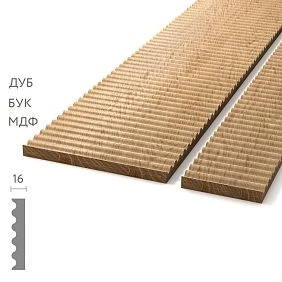
- Decorative planks and slats made of solid wood
- How to choose wooden molding by purpose: a practical table
- How to choose the profile size: from measurement to installation
- Step 1: Measure the facade or wall section
- Step 2: Determine the layout scheme
- Step 3: Choose the profile width
- Step 4: Calculate the number of linear meters
- Step 5: Check thickness and relief
- Bagette molding and frame profile: what is the fundamental difference
- Finishing of wooden molding: enamel, tinting, varnish, patina
- Enamel: white, cream, gray — or any project color
- Wood Toning
- Clear varnish
- Patina: classic with history
- How to combine wooden molding with other STAVROS decor
- Molding + moldings and cornices
- Molding + decor for moldings
- Molding + pilasters
- Molding + carved overlays
- Molding + handles and legs
- Mistakes when choosing wooden molding: what not to do
- Mistake 1: Buying molding without a layout diagram
- Mistake 2: Not considering the facade width when choosing a profile
- Mistake 3: Mixing different profiles in one composition
- Mistake 4: Not allowing for trimming waste
- Mistake 5: Choosing molding only from a photo
- Mistake 6: Mixing construction molding with interior decor
- Mistake 7: Not planning the finishing before installation
- Mistake 8: Not coordinating molding with trim and picture frames
- Where to buy STAVROS wooden molding: manufacturer, warehouses, delivery
- Frequently asked questions about wooden trim
- About the Company STAVROS
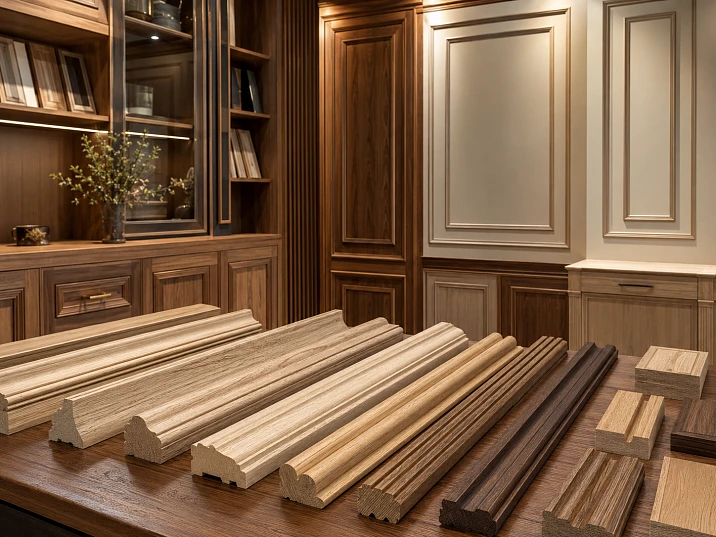
There are things that are not visible — but without which nothing holds together. Molding is exactly that element. It doesn't shout about itself, doesn't claim to be the main character of the interior. But remove the wooden profile from a furniture facade, from the frame of a wall panel, from the edging of a niche — and the space immediately loses its completeness. Edges without transitions, corners without logic, planes without rhythm remain.
Buy wooden trim today means getting not just a long wooden strip. It's a choice of the language in which furniture and walls will speak to the interior. Solid wood molding is a system of lines that organizes space: divides it into readable parts, marks boundaries, adds relief and shadow where everything would be monotonous without them.
buy wooden trim is a task that requires understanding. Not 'which one I liked in the photo,' but 'which one suits a specific facade, a specific wall panel, a specific scale.' That's what we'll talk about — in detail, to the point, with practical guidelines.
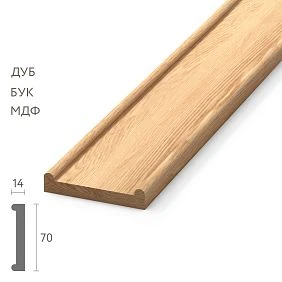
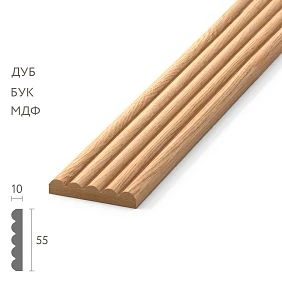
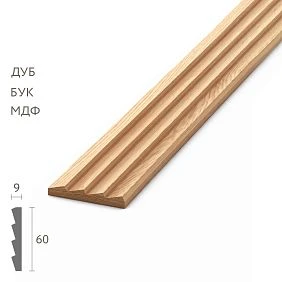
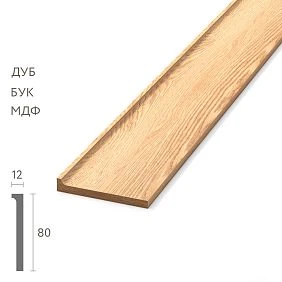
What is wooden molding and how it differs from a regular strip
The question is simple only at first glance. In practice, it divides people into those who get a beautiful result and those who don't understand why 'something is wrong.'
Wooden trim is a long-length wooden profile with a constant cross-section. It is sold in linear meters and cut to size on site. It can have a straight, beveled, shaped, frame, baguette, or rounded profile.
But here's what's fundamental: molding is not just a wooden plank. It is a profile with a specific cross-sectional geometry, created for a particular decorative application. A regular strip is a rectangle. Molding is a complex cross-section: shelves, fillets, chamfers, bevels, roundings, protrusions. It is the cross-sectional shape that determines how the molding works in the system — how it creates transitions, shadows, frame effects.
The question 'what is wooden molding' is most often asked by those who have faced the task of decorating a furniture facade or wall panel and realized that a regular strip from a hardware store doesn't give the desired result. The difference is precisely in the profile.




Solid wood molding: why the type of wood matters
The manufacturer produces wooden moldings from different types of wood. For furniture and interior applications, several parameters are important.
Beech is a dense, homogeneous wood. It holds thin profile edges well. Neutral texture that does not conflict with the finish. For moldings intended for painting or tinting, it is the optimal choice.
Oak has a more pronounced texture. It is good under clear varnish or dark tinting. For accent use in expensive interiors.
Pine is an affordable wood with a pronounced resinous texture. It is suitable for construction applications. For thin-profile furniture moldings, it is worse than beech: pine is more porous, and thin profile details hold their shape less well under paint.
For STAVROS moldings, solid beech is used — a proven material for thin-profile decorative items that must hold relief and accept a final coating.
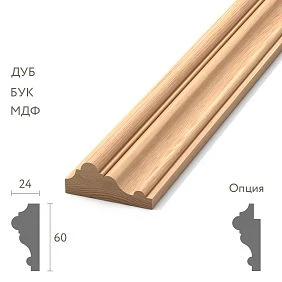
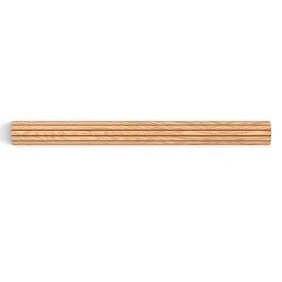
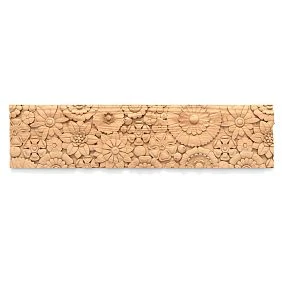
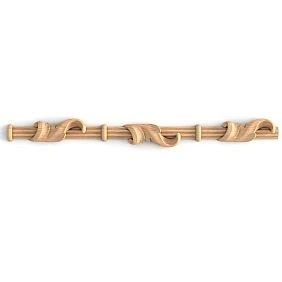
Our factory also produces:
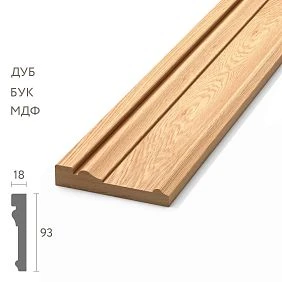
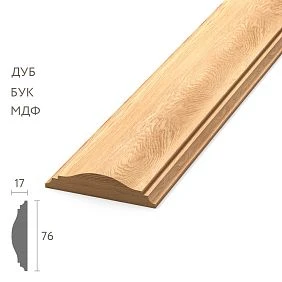
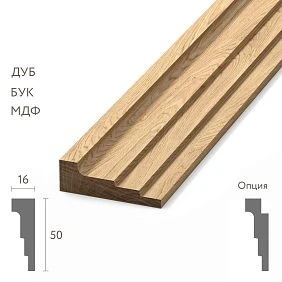
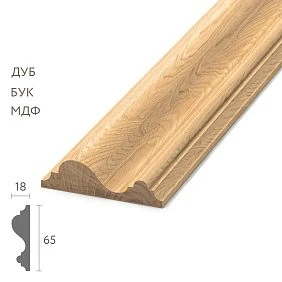
Where to use wooden moldings: spaces and scenarios
Get Consultation
Furniture facades: frames, layouts, verticals and horizontals
The furniture facade is the most common application of moldings in an interior context. And the most demanding in terms of selection accuracy.
The essence of the task: a flat facade needs decorative division. A frame made of moldings makes the facade "readable" — it breaks it into parts, creates a field inside the frame and a border around it. This is a simple but extremely effective technique.
Frame layout on the facade. Four pieces of molding form a rectangular frame on the facade. Outside is the "field" of the frame, inside is the "panel" with a smooth or textured surface. A Carved Insert for Furniture — and then the facade receives a full decorative accent.
Horizontal division of the facade. One or two horizontal strips of molding at a height of 1/3 or 2/3 from the bottom edge divide the facade into zones. This technique is typical for cabinets, tall cabinets, and doors.
Vertical division. A vertical molding strip in the center of the facade or along the side thirds creates a sense of sectionality. It is used on wide facades and in situations where one facade needs to be visually broken into parts.
Furniture restoration. When an old cabinet or chest of drawers has worn but geometrically correct facades, molding for restoration becomes a way to 'rethink' the piece. A new frame layout, consistent in style, and the facade looks different.
For working with furniture, STAVROS solid wood molding is combined with wooden decorative elements, decor for moldings и carved inlays — forming a unified decorative program.
Wall panels and boiserie: rhythm, scale, wall architecture
Boiserie and wall panels — one of the most extensive uses of molding in interiors. Here, the solid wood profile works not as a furniture detail, but as an element of architectural wall finishing.
Boiserie — the French system of wooden wall cladding — consists of vertical posts, horizontal belts, and frames between them. Molding forms the entire linear component of this system: frame profiles, horizontal belts, top and bottom cornice elements.
Lower belt (panel section). The wall is divided into lower and upper zones. The lower — 'panel' — section is finished with wood: vertical panels framed by frame molding. Height of the lower belt: typically 90–110 cm from the floor (windowsill or countertop level).
Upper belt. Above the panel zone, a lighter design follows — smaller-scale frames or a complete absence of panels while maintaining a linear rhythm of moldings.
Cornice belt. At ceiling height, a horizontal cornice profile ties the entire wall system together. For this, Wooden Picture Frame a cornice molding is used.
Baseboard line. At the bottom, the system is closed by a baseboard from the same line as the rest of the moldings. A unified profile of the baseboard and frames is a sign of a planned system.
In the STAVROS boiserie system, all elements — moldings, wooden moldings, cornices, and baseboardsbaguettes, pilasters — are designed in a unified ornamental and proportional key.
Cabinets and furniture portals: vertical moldings as a structure
Cabinet decoration are impossible without vertical linear elements. Here, moldings serve several functions at once.
Framing of cabinet sides. A vertical profile along the front edge of the side wall creates a "corner" — a transition from the facade plane to the side. Without this, the cabinet corner looks "bare." With the profile, it looks complete.
Portal system around the cabinet. Moldings as part of a furniture portal: vertical profiles on the sides of the niche or cabinet + a horizontal profile on top + a cornice. For TV niches, built-in cabinets, library sections. For more details on use in such scenarios, see the section TV zones and frames.
Profile for a bookcase. Horizontal profiles between shelves create a frame effect in the book section. This is not just decor — it is a visual division of the huge flat facade of the library into parts.
Built-in furniture in a niche. The molding frames the transition "furniture — wall": the profile at the joint closes the gap and decoratively shapes the border. This is especially important when the niche and furniture are painted the same color — the profile adds the necessary line.
Kitchens: decorative strips, portals, side panels
В in kitchen decor Solid wood molding is used both in classic painted cabinets and in mixed solutions with wooden facades.
Decorative strips on facades. Horizontal molding strips on the upper kitchen facades — a simple technique that adds horizontal rhythm and creates a "frieze" at the level of the upper cabinets.
Portal above the hood. Vertical profiles on the sides of the hood area + a horizontal cornice profile on top = a decorative portal. Here the molding works in pair with wooden pilasters, if the kitchen style involves developed vertical decor.
Side panels of the kitchen. The visible side panels of the outermost cabinets are the "cheeks" of the cabinet set. The layout of molding on the side panel turns it from a technical surface into a decorative element coordinated with the facades.
Tall cabinets and island. Tall cabinets with a frame layout of molding — and a standard module acquires the character of a "furniture" item rather than a "kitchen" one. An island with molding on the end sections looks like a furniture piece, not just a functional block.
Types of wooden molding: what to choose for which task
Frame profile: the basis of a furniture facade
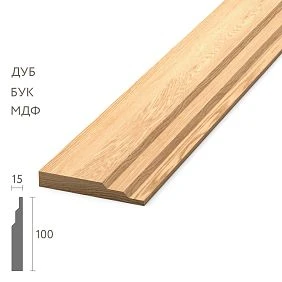
A frame profile is the most common type of molding for furniture use. Its cross-section: a profiled outer edge and a flat inner one. On the facade, it creates a frame with a decorative outer edge and a clean inner border.
Frame profiles vary in width (from 12 to 50+ mm), relief height (from 3 to 15 mm), and outer profile shape (straight, with a fillet, with a quarter, with a chamfer, with a scotia).
For small facades (dresser drawer, cabinet door) — a profile width of 15–20 mm. For medium ones (60 cm cabinet door) — 20–30 mm. For large ones (90 cm door and above) — 30–40 mm. These are not strict rules, but a guideline: the proportion between the profile width and the facade width should remain in the range of 4–7%.
Bagette wooden molding: framing with character
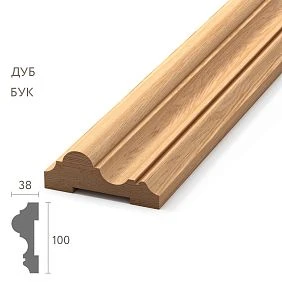
Molded wooden trim — a more complex, "expressive" type of profile. Its cross-section has a developed relief: several horizontal levels, protrusions, profiled edges. It works where you need not just to indicate a frame, but to create an architectural "line" with weight and volume.
The difference between a regular frame profile and a bagette is like the difference between a simple frame and a frame with ornamental decor. A regular profile is quiet, neutral. A bagette speaks for itself, creates shadow, reveals relief under lighting.
For classic interiors, boiserie, furniture portals, kitchen portals, and library cabinets — bagette molding is preferable.
Wooden Picture Frame — a close relative of molding. The fundamental difference: baguette is more often used as a ready-made frame element (frames for mirrors, paintings, TVs). Molding is a linear profile for cutting to any size.
Round wooden molding: rounded lines in decor
wooden round balusters — a special type with a round or semi-round cross-section. This is not a construction blank, but a decorative element with clear areas of application.
Where round wooden molding is appropriate:
-
Accent horizontal lines on the facade or wall panel: the round profile creates a distinct "bead" or "column" in the horizontal belt
-
Decorative inserts between frame profiles: corner "balls" or short cylindrical inserts at frame junction points
-
Interior details: railings, decorative slats in architectural elements
It makes sense to buy round wooden molding for projects where sharp angular profiles are complemented by rounded accent lines — this creates a contrasting play of shapes.
Decorative planks and slats from solid wood
Flat decorative planks are the simplest type of molding in cross-section (a rectangle with straight or beveled edges), but one of the most widely used. They are used as:
-
vertical dividers between panels
-
horizontal belts between finishing zones
-
decorative trims around niches and openings
-
frame elements without complex profile (for minimalist classic)
How to choose wooden moldings by purpose: practical table
| Task | Profile type | Key parameters |
|---|---|---|
| Frame on a furniture facade | Frame or baguette | Width 15–35 mm, relief height 3–12 mm |
| Wall panel | Frame or decorative strip | Width 20–40 mm, matching panel scale |
| Boiserie | Bagette or frame | Developed profile, compatibility with moldings |
| Portal for cabinet or TV | Bagette | Expressive profile, coordinated with the cornice |
| Niche | Framing profile | Exact size for niche depth |
| Restoration | Close to original | Color, size, shape for old style |
| Kitchen facade | Frame or flat strip | Exact size for facades and handles |
How to choose profile size: from measurement to installation
Theory without practice is useless. Therefore, a specific method.
Step 1: Measure the facade or wall section
Write down: width × height of each element. Not "approximately", but exactly to the millimeter. Because the molding is cut to size — and an error of 5 mm on each of the four frame segments gives a total error of 20 mm.
Step 2: Determine the layout scheme
Draw a diagram on paper (or in an editor): where the frames go, how they are positioned, whether there is symmetry, whether there are repeating elements. This is the "installation map", without which it is easy to make a mistake when ordering molding.
Step 3: Choose the profile width
Rule: the width of the frame profile for a furniture facade is 4–7% of the smaller side of the facade. Facade width 45 cm → profile 18–32 mm. Facade width 60 cm → 24–42 mm.
For wall panels: profile width — 3–5% of the smaller side of the panel.
Step 4: Calculate the number of linear meters
For each frame: perimeter = 2 × (width + height). Plus 10–15% allowance for 45-degree cuts and possible errors.
If there are multiple frames — sum the perimeters. For a wall system of 10 panels measuring 80 × 120 cm: perimeter of one = 2 × (80 + 120) = 400 cm = 4 m. Ten panels = 40 m + 10% = 44 m.
Step 5: Check thickness and relief
The relief height of the profile determines how much it 'protrudes' from the facade plane. Minimal relief (3–5 mm) — thin, airy, readable in oblique lighting. Developed relief (8–15 mm) — expressive, creates volume, clearly visible from a distance.
For furniture in a small room — smaller relief. For wall panels in a spacious hall or living room — more developed.
Bagette molding and frame profile: what is the fundamental difference
This question is important because people often confuse Wooden Picture Frame and molding — considering them synonyms. This is not the case.
Wooden linear molding is a long-length profile sold by the meter and intended for cutting to a specific size. It is used as a linear decorative element.
Wooden baguette is also a long-length profile, but traditionally associated with frame applications (frames for mirrors, pictures, televisions, decorative panels). The cross-section of a baguette is usually more complex and "wrapping" — it is designed to beautifully "hold" corner joints.
Wooden baguette molding is a molding with a profile close to baguette: more developed relief, a "framing" shape suitable for frame solutions. This is the most expressive type of molding for classic interiors.
When to choose a baguette profile:
-
living room with boiserie in classic style
-
furniture portal with expressive top horizontal
-
bookcase cabinet with framed sections
-
TV zone with architectural framing
When a simple frame profile is sufficient:
-
neoclassicism with concise lines
-
Kitchen fronts with enamel finish
-
Small fronts with minimal decor
Finishing of wooden moldings: enamel, tinting, varnish, patina
STAVROS solid wood moldings are supplied without a finish coating — "white", ready for finishing. This is a key advantage: you choose the finish for a specific project, rather than taking what is available.
Enamel: white, cream, gray — or any project color
Wooden profile for enamel painting is the most popular option for kitchens, boiserie, and furniture in the neoclassical style. The profile is painted in the same color as the fronts or wall panels — and "melts" into the surface. Only the relief remains, which plays with light and shadow.
Enamel finishing scheme: sanding → acrylic primer (2 coats) → finish enamel (2 coats, brush or sprayer). Main layers — before installation. Final coat — after installation, at the joints.
Wood toning
Moldings for tinting — for interiors where the wood texture should remain visible. Water-based stain of the desired shade, then varnish (matte, semi-matte, or satin) 2–3 coats. Tinting "reveals" the structure of beech, adds warmth.
For coordination with other wooden elements, it is important: all wooden parts of the project — moldings, Wooden furniture legs, wooden furniture handles, Wooden moldings — must be tinted in the same shade, from the same series of stains.
Clear varnish
For natural beech without tinting, a clear varnish highlights the warm color and soft texture of the solid wood. It looks great in projects with natural wood: parquet + wooden furniture details + wooden millwork under varnish.
Patina: classic with history
For classic interiors with an antique touch, millwork with patina. Dark base tinting → sanding of protruding profile edges → effect of "aged" wood with lighter edges and dark recesses.
Patina excellently reveals the profile relief: every curve, every fillet is read separately. This is a finish that "shows" the profile completely.
How to combine wooden millwork with other STAVROS decor
Millwork is a linear element. It sets geometry, rhythm, and boundaries. But it becomes complete only in a system with other decor elements.
Millwork + moldings and cornices
wooden moldings, cornices, and baseboards — horizontal profiles that work at the upper and lower levels of a wall or furniture system. Millwork is the working element of frames and layouts.
In a boiserie system: baseboard at the bottom + horizontal belt at the height of the lower belt + cornice at the top + frame millwork inside each section. This is a complete wall architecture.
Important: the profiles of moldings and millwork should be from the same stylistic line. A sharp difference in the scale of relief or style of sections is a sign of an ill-considered choice.
Molding + decor for moldings
Decor for Molding — corner inserts, rosettes at intersection points of horizontal and vertical profiles. In a boiserie system or on a furniture facade with frame layout: in each corner of the frame — a corner element. This turns a "geometric frame" into a "decorative frame".
Molding + pilasters
wooden pilasters and columns — vertical architectural elements. Molding works together with pilasters at several points: the horizontal profile "enters" the pilaster, creating a node; the cornice profile "rests" on the pilaster capital.
In a portal system: pilasters on the sides + horizontal frieze molding + cornice = architectural portal.
Molding + carved overlays
Carved decorative inserts for furniture — central accents inside frames made of molding. The frame sets the field; the overlay accents the center of this field. This is a classic division of "background" and "accent" in facade decor.
Stylistic rule: the ornament of the overlay and the style of the molding profile must belong to the same "vocabulary". Classic carved ornament + classic frame profile. Minimalist profile + restrained overlay.
Molding + handles and legs
wooden furniture handles и wooden furniture legs complete the system of furniture decor. When handles are made in the same style as molding, pilasters, and overlays — the piece looks custom.
Mistakes when choosing wooden moldings: what not to do
Mistake 1: Buying moldings without a layout diagram
This is the most costly mistake — literally. Without a diagram, you don't know the exact quantity, you don't account for 45° cuts, you don't know where and how the frames are positioned. Result: either you bought too little, or too much, or the wrong profile.
Mistake 2: Not considering the facade width when choosing a profile
A 35 mm wide profile on a 30 cm wide facade will take up 12% on each side of the frame — that's too much. The frame will 'compress' the field into a tiny rectangle. Look at the proportion, not just the absolute size.
Mistake 3: Mixing different profiles in one composition
Two different profiles on one facade or in one boiserie system is a mistake that is immediately visible. All profiles in the system should be from the same line: a unified style, a unified relief scale.
Mistake 4: Not allowing for cutting waste
Corner joints of the frame are cut at 45°. Cutting 'takes away' part of the profile length. Minimum allowance: 10%. For complex projects with many corners and short segments — 15%.
Mistake 5: Choosing moldings only from a photo
The photo does not convey the scale of the relief, the actual width, or the height of the protrusion. Always request a cross-section drawing or technical dimensions. This is especially important: the height of the relief from the facade plane.
Error 6: Mixing construction trim with interior decor
A construction-grade pine trim strip with an unverified profile is not the same as decorative trim made from solid beech. The difference lies in surface quality, relief clarity, and behavior under painting.
Error 7: Not planning the finish before installation
If the profile is painted after installation, the joints get filled with paint, the relief becomes less readable, and corners may obscure small details. The correct approach: apply the main layers of finish before installation, and the final layer after.
Error 8: Not coordinating trim with moldings and baguettes
The trim is chosen. The moldings are chosen. But they are from different styles and scales. On the wall, this looks like a 'designer's mistake.' All linear profiles in the system should be coordinated at the project stage.
Where to buy STAVROS wooden trim: manufacturer, warehouses, delivery
STAVROS solid wood trim is manufactured in Russia from solid beech. The profiles come without a finish coating, ready for the customer's finishing.
Buy wooden moldings and get them quickly — it's possible: warehouses in Moscow and St. Petersburg, delivery to all regions of Russia.
Buy wooden moldings from the manufacturer — means getting a product without intermediary markup, with quality control.
Complete system of wooden decor in the STAVROS catalog:
-
solid wood millwork — profiles for furniture, walls, portals
-
Wooden Picture Frame — frame profiles
-
wooden moldings, cornices, and baseboards — horizontal profiles of the system
-
Decor for Molding — corner elements
-
wooden decorative elements — rosettes, inserts
-
Carved decorative inserts for furniture — central accents
-
wooden pilasters and columns — vertical architectural decor
-
STAVROS carved decor — complete line
-
Solid Wood Items — entire catalog
Frequently Asked Questions about Wooden Trim
What is wooden molding and how is it different from a batten?
Molding is a long-length wood profile with a constant shaped cross-section. A regular batten is a rectangular blank. Molding is created for a specific decorative application: frames, trims, edgings. Its cross-sectional shape determines how it works with shadow and light.
Can wooden molding be used for furniture facades?
Yes, this is one of the main applications. A solid wood frame profile is mounted on the facade, forming a frame — a decorative field with a border. It can be supplemented with a carved overlay inside the frame.
What is the difference between baguette molding and regular frame molding?
Baguette profile has a more developed relief and works as a "wrapping" frame. Frame profile is more neutral, often laconic. For classic with pronounced decor — baguette. For neoclassicism and minimalist classic — frame.
How to calculate the amount of molding for wall panels?
Perimeter of each frame = 2 × (width + height). Multiply by the number of panels. Add 10–15% reserve for trimming and possible errors. Consider that some pieces will be very short — they are taken from leftovers.
Can wooden molding be painted with enamel?
Yes, solid beech accepts enamel well. Scheme: sanding → acrylic primer → 2 coats of enamel. Main coats — before installation. Final coat — after installation at the joints.
Where is it better to use round wooden molding?
As accent horizontal lines within frames, decorative inserts in corner nodes, or rounded profiles in interior details. Works well in contrast with angular frame profiles.
What to combine with STAVROS wooden molding?
With wooden baguette, moldings, baseboards, molding decor, carved overlays, decorative elements, pilasters, and all elements from the solid wood product line.
Which linear profile to choose for boiserie?
For boiserie, a baguette or developed frame profile with a relief height of 8 mm or more is optimal. All linear profiles of the system are from the same line. Finish — to match wall panels or furniture.
About the company STAVROS
A line drawn precisely is already architecture. Linear profile seems like a simple element. But it sets the rhythm, divides space into parts, creates transitions between materials and zones. It determines whether the interior will look planned or random.
STAVROS is a Russian manufacturer of wooden furniture and interior decor from solid wood. Linear profiles, baguettes, moldings, cornices, baseboards, pilasters, overlays, decorative elements, handles, legs — a complete system where each profile is designed in coordination with the others.
Production in Russia. Warehouses in Moscow and St. Petersburg. Delivery across the country. Direct sales from the manufacturer.
STAVROS is wooden decor that knows how to be a system.