Article Contents:
- What is a wooden skirting board and why is it needed
- What types of wooden skirting boards for floors are there
- Solid wood skirting board
- Oak skirting
- Beech skirting
- MDF skirting board
- Moisture-resistant MDF
- How to choose skirting board height
- How to choose a profile: straight, shaped, wide, "boot"
- Which material is better: solid wood or MDF
- Oak skirting board: when to choose solid oak
- How to choose the color of a wooden skirting board
- Under the floor level
- To match the doors
- Matching wall color
- White baseboard
- Contrasting skirting board
- How to match skirting boards with architraves, doors and moldings
- How much does a wooden baseboard cost
- Where to buy a wooden baseboard
- FAQ: answers to popular questions about wooden baseboards
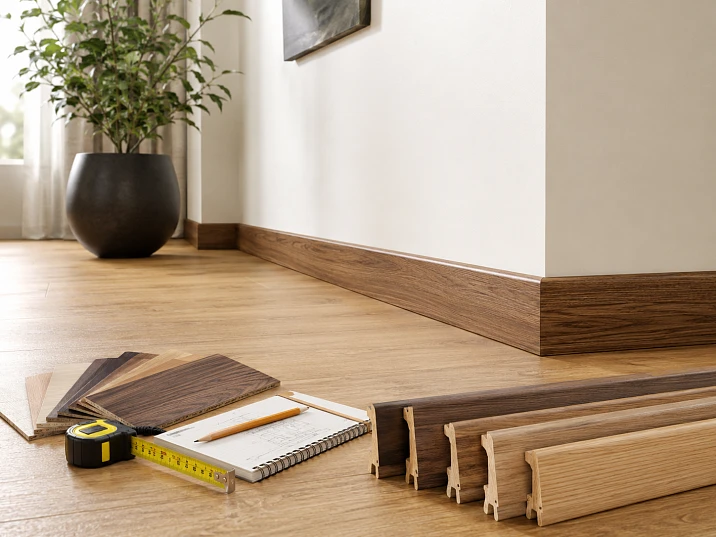
A baseboard is that interior element that is noticed last when planning a renovation, but is immediately noticed when it is chosen incorrectly. A wooden floor baseboard covers the technical gap between the flooring and the wall, protects the bottom edge of the wall from impacts and moisture, hides utilities, and — when chosen wisely — becomes a full-fledged architectural element that sets the tone for the entire room.
Today the market offers a wide range: wooden floor baseboards made of solid oak and beech, MDF baseboards for painting or veneer, moisture-resistant MDF for kitchens and bathrooms, various profiles — from straight minimalist to shaped classic "boot". How not to get confused, how to choose correctly, and how much does it all cost? We break it down in detail.
What is a wooden baseboard and why is it needed
At first glance, the question seems naive. But this is where the key to the right choice lies: understanding the function, you understand which baseboard your room needs.
Functions of a wooden floor baseboard:
-
Covers the expansion gap between the flooring (parquet, laminate, engineered wood) and the wall — a gap without which natural materials cannot expand properly with changes in temperature and humidity
-
Protects the lower part of the wall from accidental impacts from furniture, vacuum cleaner, children's toys
-
Hides wires along walls — many baseboards have a cable channel or cavity for laying electrical cables
-
Creates a visual completion of the space, forming a clear boundary between the floor and wall
-
Sets the interior style: wooden baseboards for floors made of solid oak or beech immediately signal a premium class of finishing
A wooden floor baseboard is not just a functional detail. It is an architectural element that connects the floor and walls into a single complete system. That is why professional interior designers always choose baseboards in a unified system with architraves, moldings, and other linear elements.
Wooden floor baseboards have an undeniable advantage that plastic and polystyrene lack: they are alive. Natural wood breathes, has a unique fiber pattern, a warm feel to the touch, and the ability to be restored — an old wooden baseboard can be sanded and coated with new varnish, turning a time-worn plank into a product that looks like new.




What types of wooden floor baseboards are there
Before talking about sizes and profiles, you need to understand the materials. The durability, appearance, maintenance requirements, and — to a large extent — the price depend on the material.
Our factory also produces:
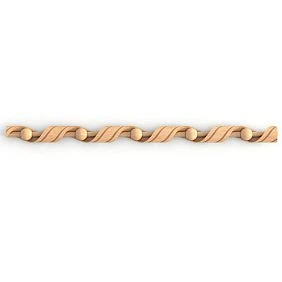
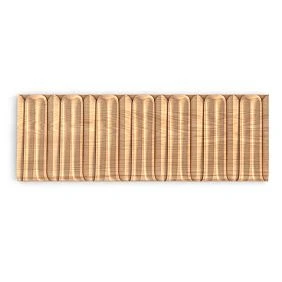
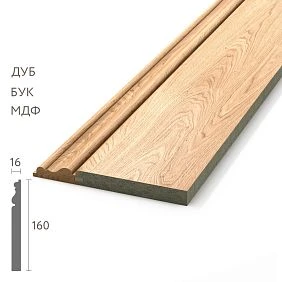
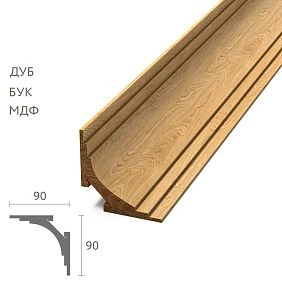
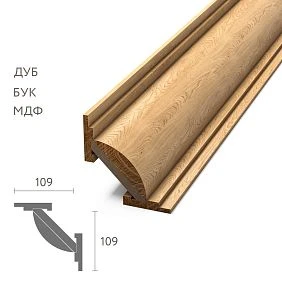
Solid wood baseboard
A solid wood baseboard is a solid piece cut from a tree trunk and profiled on milling equipment. No glue layers, no pressing, no fiberboards. Only wood — with its characteristic texture, living pattern, and natural shades.
solid oak and beech wooden baseboardsThis is the highest category of floor linear elements. Solid wood has maximum hardness, resistance to loads, and, with proper care, a virtually unlimited service life. Such a baseboard can be repeatedly restored, polished, and have its color changed with tinting — it will last as long as the oak parquet beneath it.
An important nuance: a solid wood baseboard requires kiln drying of the material. Undried wood, when installed in a warm room, will begin to shrink and crack. Products from serious manufacturers always undergo controlled drying to a moisture content of 8–12%.
Get Consultation
Oak skirting board
Oak skirting board is a separate topic worthy of detailed discussion. Oak is a species with a density of 700–800 kg/m³, making it one of the hardest and most wear-resistant materials among hardwoods. The characteristic medullary rays in the structure of oak wood create a unique play of light and dark veins — this is the "trademark" of oak, which cannot be confused with any other wood.
Buying an oak skirting board is an investment for decades. With proper care, an oak skirting board does not lose its shape, does not chip at the corners, is not susceptible to mold, and lasts as well as the parquet itself. It can be tinted in any color — from light "bleached oak" to dark "mocha" — and the tint can be changed during subsequent renovations.
STAVROS offers oak skirting boards for purchase in Moscow and with Contact us to confirm shipping to your destination. — in a wide range of profiles, heights, and finishing options. The oak skirting board in the catalog is presented both in a finished version for varnish or oil, and in a version for painting — with preliminary priming.
Beech skirting
Beech skirting board is a worthy alternative to oak. Beech has a more uniform and fine texture, a light pinkish-cream shade, and a density of about 680–730 kg/m³. It is slightly softer than oak, but not critically so: for a floor skirting board, the strength of beech is more than sufficient.
Beech skirting board is especially good in light Scandinavian interiors, in Provence and neoclassical styles. Its uniform fine texture without large pores accepts tints and varnishes well, giving an even, aristocratically restrained result. In combination with beech architraves and moldings, beech trim creates a complete system of interior decor — from skirting board to cornice.
MDF skirting board
MDF skirting boards is one of the most popular options on today's market. MDF (medium-density fiberboard) is made from fine wood fiber pressed under high pressure with binding resins. The board has a uniform structure without knots, cracks, or grain irregularities — that is, everything that makes solid wood unpredictable.
Buying an MDF floor skirting board is a choice for those who want a quality result with a reasonable budget. MDF skirting board sands well, has a perfectly smooth surface, and accepts primer and paint well. A painted white MDF floor skirting board is a classic solution for modern interiors, and MDF is the optimal material for its implementation: the surface is smooth, uniform, without visible pores.
An important point: standard MDF is not moisture-resistant. When purchasing an MDF floor skirting board for the kitchen, hallway, or bathroom, you need to clarify what type of board it is made from.
Moisture-resistant MDF
Moisture-resistant MDF baseboard is a special category that deserves a separate mention. Moisture-resistant board (MDFV, HMR — High Moisture Resistance) is produced with the addition of water-repellent compounds that reduce water absorption to 8–12% — compared to 30–40% for standard MDF. Such a baseboard does not swell, delaminate, or deform in rooms with periodic moisture exposure.
Floor baseboard made of moisture-resistant MDF is a reasonable choice for the kitchen, hallway, children's room, as well as for country houses with temperature and humidity fluctuations during the off-season. At the same time, in terms of appearance and finishing options, it is in no way inferior to standard MDF: the same smooth surface, the same receptiveness to paint and primer.
How to choose skirting board height
Height is one of the key selection parameters. This is not just a matter of taste: the height of the baseboard affects the visual perception of the entire room.
Basic guidelines:
-
40–60 mm — minimalist baseboard for low ceilings (up to 2.5 m) and modern styles (minimalism, loft, Scandinavian)
-
60–80 mm — universal option for standard apartments with ceilings of 2.5–2.7 m, suitable for most styles
-
80–100 mm — medium-wide baseboard, creates a sense of solidity; works well in rooms with ceilings from 2.8 m
-
100–120 mm — high wooden baseboard, characteristic of classic and neoclassical interiors, for rooms with ceilings from 3 m
-
120 mm and above — formal wide baseboard for high spaces, mansions, office and representative premises
Buying 80 mm floor baseboards is the most common request. An 80 mm high baseboard is a kind of 'gold standard': expressive enough to set the style, but not so large as to overload the space. An 80 mm floor baseboard made of oak or MDF looks equally good in classic and modern interiors.
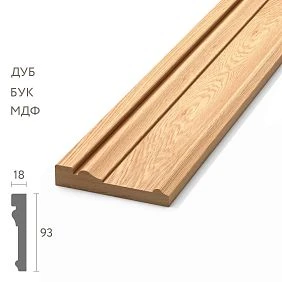
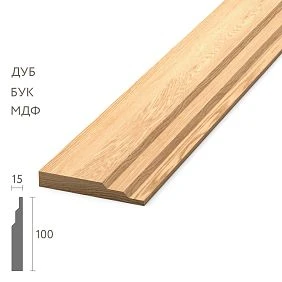
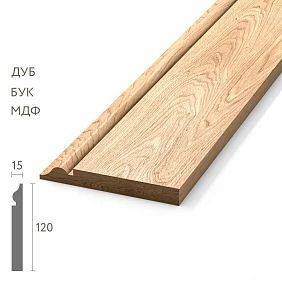
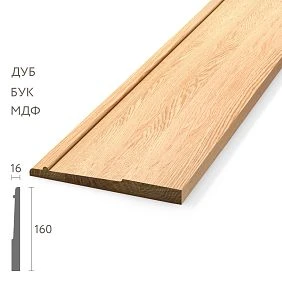
Buying a high wooden skirting board with a height of 100–120 mm means betting on monumentality and grandeur. In spacious rooms, such a skirting board creates a sense of architectural weight and solidity. In the STAVROS catalog, for example, there iswooden skirting board PLT-001-1 size 120×16/15 mmmade of oak, beech, MDF, and moisture-resistant MDF — a wide classic profile that fits organically into interiors of any scale.
Buying a 60 mm floor skirting board is the right choice for small rooms or styles that value conciseness. In a Scandinavian interior or modern minimalism, a thin straight skirting board 60 mm high looks more elegant than a large figured one.
An important principle: proportionality. The skirting board should harmonize not only with the ceiling height but also with the rest of the decor — door trims, moldings, cornices. The higher the cornice under the ceiling, the larger the skirting board at the bottom can be.
How to choose a profile: straight, figured, wide, "boot"
The profile is the shape of the skirting board's cross-section. It is the profile that determines how "classic" or "modern" the skirting board will look in the interior.
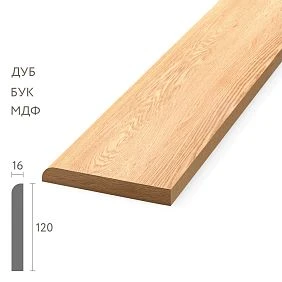
A straight skirting board (a flat rectangular plank) is the most concise option. A straight-profile wooden floor skirting board is characteristic of minimalism, loft, hi-tech, and Scandinavian style. No curves, no ornaments — only pure geometry. A high wooden skirting board with a straight profile looks especially striking: a monumental plank without decorations creates an architectural accent with minimalist means.
A figured skirting board with a profiled relief is a tradition of classic interiors. A figured wooden skirting board has a curved cross-section: ogee, heel, shelves, rounded protrusions. This profile is characteristic of classic, neoclassic, baroque, and empire styles. A figured skirting board made of solid oak with a milled profile creates a feeling of real joinery work — well noticeable even without special knowledge in architecture.
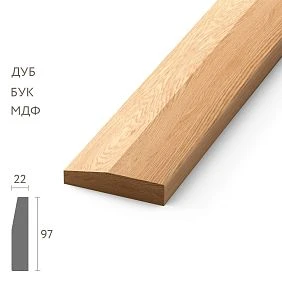
A boot skirting board is a special shape with a curve that imitates the shape of a boot sole. Those who appreciate a classic look with retro elements prefer to buy a wooden "boot" skirting board. The lower widened part of the "boot" is pressed to the floor, the upper part is tilted to the wall at an angle. This shape well hides unevenness at the base of the wall and creates an expressive line around the perimeter of the room.
Wide wooden floor skirting board — height from 80 to 120+ mm, often with a shaped profile. A wide skirting board looks especially advantageous in rooms with high ceilings, next to massive wooden furniture, and with parquet floors made of large planks. It "holds" the bottom of the wall, giving the interior weight and completeness.
Skirting board with cable channel — a pragmatic option where the profile includes a hidden cavity for wires. Typically, these are straight or simple MDF profiles.
When choosing a profile, be guided by the style of the entire interior, not just your own preferences regarding the skirting board itself. A shaped skirting board in a minimalist room will look awkward, like a white tuxedo on a beach. A straight skirting board in a formal classic hall will be inexpressive, like a handshake without eye contact.
Which material is better: solid wood or MDF
This question arises for most buyers. There is no one-word answer here: it all depends on the task, budget, and type of room.
| Criterion | Solid wood (oak, beech) | MDF | Moisture-resistant MDF |
|---|---|---|---|
| Appearance | Natural texture, natural pattern | Smooth surface for finishing | Smooth surface, suitable for painting |
| Durability | Very high, 50+ years | Depends on coverage and conditions | Above standard MDF |
| Moisture resistance | Medium (requires processing) | Low | High |
| Restoration possibility | Yes (sanding, repainting) | Limited | Limited |
| Painting | Possible for tinting / varnish | Convenient, smooth result | Convenient, smooth result |
| Ecological | Maximum | Medium (depends on resins) | Medium |
| Price | Higher | More affordable | Medium |
| Application | Premium interiors, parquet, classic | Any interiors | Wet rooms, kitchens |
Buying a wooden floor plinth made of solid oak is the right decision if you are laying parquet or parquet board made of natural wood and want a single premium ensemble. Buying an MDF floor plinth is a reasonable choice for a painted interior when you need a perfectly smooth, flawless surface in any color.
Buying solid oak skirting boards is worth it even when you are sure you are doing a renovation "forever". Solid wood will outlast several floor coverings and several owners of the apartment. MDF, as a rule, is replaced along with the floor covering during each renovation.
Oak skirting board: when to choose solid oak
Oak is the choice of those who understand what exactly makes an interior expensive. Not the size of the room, not the number of square meters, not the price of the chandelier. An expensive interior is a sequence of details: an oak skirting board, an oak architrave, an oak door, oak parquet. When these elements are united by one wood species, one tone, one profile language — that feeling of integrity arises, which cannot be bought piece by piece.
Buying an oak skirting board in Moscow is a task that STAVROS handles fully: the catalog presents the entire range of oak moldings — from skirting boards tooak moldings and wooden moldings. You can buy a solid oak skirting board with Contact us to confirm shipping to your destination., not only in Moscow and St. Petersburg.
When it is especially worth choosing an oak skirting board:
-
When laying oak parquet — for an ideal match of texture and shade
-
In classic and neoclassical interiors with wooden doors
-
In historical buildings with high ceilings, where monumentality of details is needed
-
In interiors in the style of dark classic, art deco, English style — where dark tinted oak looks especially impressive
-
In long-term projects designed for decades of service without replacing the baseboard
Buy oak floor baseboard in Moscow — and receive a finished product that has undergone chamber drying, processing, and profiling on STAVROS production equipment. No surprises with geometry, no twisted planks.
How to choose the color of a wooden baseboard
The color of the baseboard is a topic about which professional designers could write entire monographs. We will outline the key principles.
To match the floor
A classic technique: the baseboard matches the tone of the flooring or is one or two shades darker. This creates the effect of a baseboard 'growing out of the floor' — the interior visually looks stable and harmonious. An oak baseboard next to oak parquet is a canonical example of such a solution.
A wooden floor baseboard made of beech next to beech parquet or light oak board creates an almost monochrome transition from floor to wall — calm, Scandinavian in spirit.
Matching the door color
The second most popular technique is matching the baseboard with doors and architraves. If the doors are dark oak, and the baseboard is dark oak — the interior looks cohesive and professional. That is why professionals always advise buying baseboards in a unified system with architraves:wooden architraves and cornersin the STAVROS catalog are matched to the linear baseboards by collections — 'Classic', 'Modern Classic', 'Art Deco'.
Matching the wall color
A less common but very effective technique is a baseboard in the color of the wall. A light gray baseboard under a light gray wall — the wall looks like a single plane going into the floor. This is a modern minimalist approach where the baseboard is not accentuated but dissolves.
White baseboard
Buy white floor baseboard — the most popular request among color preferences. White works in most interiors: it is clean, neutral, and always relevant. A white wooden MDF baseboard for painting or factory white lacquer is an ideal choice for light, Scandinavian, modern, and classic spaces.
Buying a white wooden baseboard made of solid wood is a slightly more complex task: the solid wood is painted white while preserving the texture (bleached oak, white beech), which gives a more lively and warm result than white MDF. Buying white wooden baseboards means getting the natural texture of wood in a modern white palette.
Contrasting baseboard
A contrasting baseboard is a bold solution for those who want expressiveness. A black floor baseboard on a light floor and white walls is a modern classic in the literal sense: sharp, graphic, memorable. A graphite floor baseboard is a softer version of contrast, working well with gray and warm concrete surfaces.
Beige floor baseboard and light baseboard are compromise options, where the baseboard stands out slightly against light walls without reaching outright contrast.
How to combine baseboard with architraves, doors, and moldings
This is perhaps the most important section of the article for those who think about the interior systematically, rather than element by element.
Professional interior design is built on the logic of a unified set: all wooden trim elements in a room should work in one system. Baseboard, architrave, molding, cornice — these are not four separate products, but four voices of one score.
Trim products made of oak, beech, and MDF STAVROS — cornices, moldings, baseboards, architraves, slats, and corners — are produced in unified collections, allowing you to create a complete set of decor for a room while maintaining unity of profile, scale, and style.
How the wooden trim system works:
The baseboard at the bottom sets a horizontal rhythm at the base of the wall. Door casings provide a vertical accent. Wall moldings form a horizontal-vertical frame system. The cornice under the ceiling is the upper horizontal belt. When all these elements are executed in the same profile language and the same wood, the room acquires a coherence that is difficult to describe in words but easy to feel.
Practical rules for combining:
-
The baseboard and door casings must be made of the same type of wood (oak with oak, beech with beech) or at least the same tint.
-
The height of the baseboard and the width of the door casing are related: a wide baseboard requires a wide door casing.
-
The profile of the baseboard and the profile of the door casing must belong to the same stylistic system — classical or modern.
-
It is better to choose wall moldings from the same collection as the baseboard: then the decor for moldings and corner elements will also be compatible.
Wooden moldings in stock in Saint Petersburg— the full STAVROS assortment, including baseboards, cornices, moldings, door casings, slats, and corner pieces, is available for pickup and delivery.
A common mistake when purchasing independently is buying baseboards in one place, door casings in another, and moldings in a third. As a result, the profiles do not match, the wood type differs, and the scale of elements is inconsistent. The room looks like a set of unrelated parts rather than an architecturally thought-out interior.
How much does a wooden baseboard cost
The question of price is practically the first one a buyer asks. Let's try to answer honestly, without naming specific figures that change: it's better to break down the factors affecting the cost.
Wood species. Oak is more expensive than beech, beech is more expensive than pine, and all are more expensive than MDF. The density, hardness, and rarity of the species directly affect the price. The price per meter of an oak wooden baseboard is always higher than that of MDF. But the service life is also significantly longer.
Height and cross-section. The higher the baseboard, the more material is used per linear meter. An 80 mm baseboard is cheaper than a 120 mm one made from the same species. The price per linear meter of wooden baseboards for 40–60 mm products is significantly lower than for wide 100–120 mm ones.
Profile. A shaped baseboard requires more complex milling than a straight one. The richer the profile, the higher the cost. A solid shaped wooden baseboard is one of the most labor-intensive options.
Coating. An uncoated baseboard (for varnishing by the customer) is cheaper than one with factory finishing—staining, varnish, or oil. An MDF baseboard for painting is the most affordable option in the category.
Order volume. When purchasing in large batches, the price typically decreases—manufacturers offer wholesale terms. STAVROS offers special terms for construction companies and designers.
Manufacturer. Products from the direct manufacturer are always more advantageous than analogs from resellers: there is no distributor markup, and there is a guarantee of precise dimensions and processing quality.
It is best to check current prices for specific items in the product cards on the website: prices are regularly updated, and any figure mentioned in the article will become outdated before it can be useful.
Where to buy wooden baseboards
This question—'where to buy wooden baseboards'—is one of the most common during renovations. And the correct answer here is not about a specific store address, but about the principles of choosing a supplier.
Manufacturer vs. intermediary. Buying a wooden baseboard directly from the manufacturer is the right strategy. The manufacturer has a full range, precise dimensions, quality standards, and the ability to complete sets. Intermediaries often have limited stock, cannot always match corner pieces or add-ons, and the price is higher.
Online vs. showroom. Buying a wooden skirting board from the manufacturer's online store is convenient: you can study all articles, view photos, compare sizes and profiles, and calculate the quantity. But before making a final decision — especially for expensive oak moldings — it's worth seeing a sample in person: to evaluate the texture, shade, and weight.
Buy a wooden skirting board in Moscow and with Contact us to confirm shipping to your destination. — both options are available at STAVROS. In Moscow and St. Petersburg, self-pickup is possible; across Russia, delivery by transport companies.
Kit or piece by piece. Buying wooden floor skirting boards in Moscow is only the first step. Plan all the moldings at once: skirting boards, architraves, moldings, corner elements, cornices. Ordering a complete set at once is more cost-effective than several separate orders.
STAVROS is a Russian manufacturer of wooden and polyurethane decor, specializing in the production of moldings from solid oak and beech, as well as MDF and moisture-resistant MDF. The STAVROS catalog offers a full range of floor skirting boards in various profiles, heights, and finishes — from compact 40 mm to wide 120 mm.
-
Baseboards made of solid oak and beech — buy oak skirting board, beech skirting board, wide solid wood skirting board
-
MDF skirting boards — buy MDF floor skirting board, moisture-resistant MDF skirting board, white skirting board for painting
-
Wooden skirting board PLT-001-1 120 mm — wide classic profile, oak / beech / MDF / moisture-resistant MDF
-
Moldings: full range — cornices, moldings, skirting boards, architraves, slats, corner pieces
-
Wooden trims and corner pieces — as part of a baseboard set
-
Wooden moldings in stock in Saint Petersburg — pickup and delivery
Buying wooden baseboards at the STAVROS online store is convenient: a full catalog with photos and sizes, choice of material and profile, Contact us to confirm shipping to your destination. and CIS, wholesale terms for designers and construction companies.
FAQ: answers to popular questions about wooden baseboards
Where to buy wooden floor baseboards?
It is best to buy floor wooden baseboards directly from the manufacturer — this guarantees accuracy of dimensions, full range of products, and the ability to select the entire trim set in a unified system. STAVROS offers baseboards made of solid oak and beech, as well as MDF and moisture-resistant MDF with Contact us to confirm shipping to your destination. Catalog at stavros.ru.
Which floor baseboards are best to buy for a classic interior?
For a classic interior, the best choice is a wooden floor baseboard made of solid oak with a shaped profile, height from 80 to 120 mm. Ideally, in a unified system with door trims and wall moldings of the same wood species and from the same collection. An MDF baseboard with a paintable profile is also suitable for classics, especially in white.
What to choose: wooden baseboard or MDF?
If the interior is built on natural materials — parquet, wooden doors, wooden furniture — choose solid wood. Buying an oak baseboard means getting a product that will last for decades and can be restored. MDF is the optimal choice for painted solutions: perfectly smooth surface, universal compatibility with any color, affordable price. Moisture-resistant MDF is for kitchens, hallways, bathrooms.
Which baseboard to choose for doors?
The best result comes from a complete approach: baseboard, casing, and moldings from the same collection, same wood species, same tone. STAVROS produces millwork in collections — "Classic", "Modern Classic", "Art Deco" — where the baseboard and casing are mutually coordinated in profile and scale.
How much does a wooden baseboard cost per meter?
The price of a wooden baseboard per linear meter depends on the wood species (oak is more expensive than beech, beech is more expensive than MDF), height (the higher, the more expensive), profile (shaped is more expensive than straight), and finish (with factory finish — more expensive than without). Current prices are in product cards on stavros.ru, where they always match current conditions.
What height of wooden baseboard to choose?
For standard rooms with ceilings of 2.5–2.7 m, a height of 60–80 mm is optimal. An 80 mm floor baseboard is a universal standard. For rooms with ceilings of 2.8–3 m — 80–100 mm. Buying a high wooden baseboard of 100–120 mm is worth it in classic formal spaces with high ceilings. The main principle is proportionality: the baseboard should harmonize with the room height and the scale of the rest of the decor.
Can a wooden baseboard be used in the kitchen or bathroom?
A standard solid wood baseboard in areas of direct moisture is risky: wood without protective coating absorbs moisture and deforms. For the kitchen and bathroom, a moisture-resistant MDF baseboard treated with hydrophobic compounds is optimal. If you really want solid wood, you need high-quality varnishing or oil coating with protective properties, and the baseboard should not be subject to direct contact with water.
How does a wooden baseboard differ from a plastic one?
A plastic baseboard does not transfer heat, does not create a feeling of naturalness, and generally looks cheaper — even in an expensive interior. A wooden floor baseboard has a natural texture, "lives" with the interior, can be tinted and restored. In the long term, a high-quality solid wood baseboard is a more profitable investment than replacing plastic strips with each renovation.
How to choose a wooden baseboard to match the parquet?
Selection principles: a baseboard made of the same wood species as the parquet is an ideal solution (oak to oak); a baseboard one or two shades darker than the parquet creates a stable horizontal line; a baseboard matching the wall color "dissolves" the transition. If the parquet has a pronounced texture, the baseboard should also have a pronounced texture: thin beech next to large-pored oak does not look very harmonious.
STAVROS is a Russian manufacturer of wooden decor with a full production cycle, specializing in products made from solid oak, beech, MDF, and moisture-resistant MDF. STAVROS wooden baseboards are produced in a wide range of profiles, heights, and finishing options — from a laconic straight 60 mm to a wide classic 120 mm. The catalog includes a full range of molding products: baseboards, moldings, cornices, architraves, corners. STAVROS works with private clients, designers, architects, and construction companies throughout Russia: pickup in Moscow and St. Petersburg, delivery by transport companies to any region, wholesale terms for the professional market.