








































































Article Contents:
- Buy a wooden icon case
- What is a wooden icon case and how to choose it
- Wooden icon case for an icon: scenarios and formats
- Icon case for a home icon
- Icon case for a church icon
- Wall-mounted icon case: design features
- Icon case for a large icon
- Icon case with a door
- Kyot under glass without a door
- Carved wooden kyot: when decor becomes prayer
- Ornaments of a carved kyot
- Carved frame of a kyot
- Carved cross on a kyot
- How a wooden kyot differs from an icon frame
- How to choose the size of a wooden kyot
- Step 1. Measure the icon
- Step 2. Account for the base thickness
- Step 3. Calculate the internal dimensions
- Step 4. Determine the depth
- Step 5. Calculate the external dimensions
- Step 6. Decide on the glass
- Step 7. Check the installation location
- Material of the wooden icon case: what to choose
- Linden — a traditional choice
- Oak — for durability and character
- Beech — for painting and gilding
- Combining materials
- Coating of the wooden icon case: varnish, oil, gilding
- What affects the price of a wooden icon case
- Mistakes when buying a wooden icon case
- Wooden icon case and other elements of church decor: how to create a cohesive design
- Where to buy a wooden icon case in Moscow and throughout Russia
- FAQ: answers to popular questions about wooden icon cases
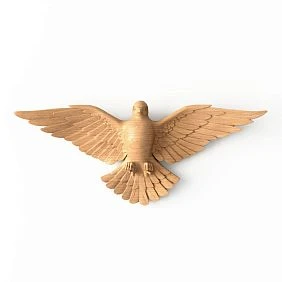
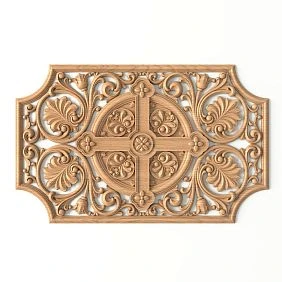
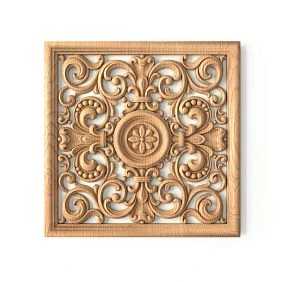
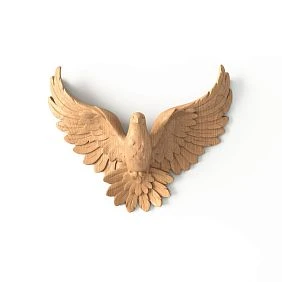
Buy a wooden icon case
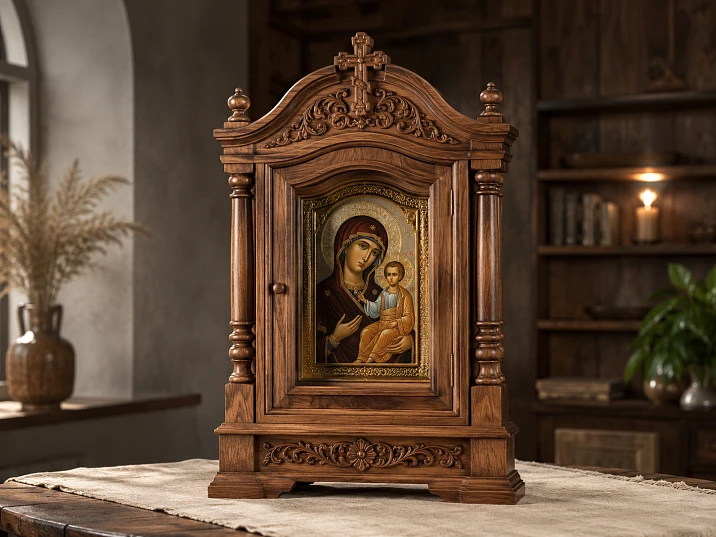
There are objects behind which lies something more than just function. A wooden icon case is one of them. It is not just a frame, not just a box, not just a decorative element. It is a home for an icon. A place where the image lives — protected, framed, presented with dignity.
In a church, the icon case protects the icon from touch and time. At home, it creates a prayer corner, separates the sacred space from the everyday. Buying a wooden icon case means not just making a purchase, but making a decision about how the icon will be presented: as a random object on a shelf or as a shrine in your own home.
This article is for those who want to truly understand the topic: what an icon case is, how it differs from a frame, how to choose the size, what carving is appropriate, what material is durable, and how not to make a mistake when buying. Detailed, knowledgeable, without fluff.




What is a wooden icon case and how to choose it
A kiot is a wooden ark for an icon. Unlike a flat frame, a kiot has depth: it creates a three-dimensional container inside which the icon is placed with a gap around the perimeter and in depth. The front part of the kiot can be open or closed with glass or a door. The side walls, back wall, and decorative outer frame form a single product.
Buying a wooden kiot for an icon means finding a balance between three parameters: size (exactly for the icon), style (harmonizing with the installation location), and material (matching the usage scenario: home or church).
Buying a wooden kiot correctly means having answers to eight questions before ordering: what is the size of the icon, what is its thickness, is glass needed, is a door needed, where will it hang, what decorative style is appropriate, what wood should it be made from, and what finish.
It is this chain of decisions — not each question individually, but all together — that determines the result.
Our factory also produces:
Wooden kiot for an icon: scenarios and formats
There is a fundamental difference between a kiot for a home icon and a kiot for a church image. Not in the item itself, but in scale, material, decor, and installation requirements.
Get Consultation
Kiot for a home icon
A home kiot is intimate, proportionate to a person. It is installed in the red corner of a room, in the bedroom, in the hallway, in the children's room. It serves as a frame for one icon or a small group of images — family, especially revered ones.
Sizes of home kiots: for a small icon 13×17 mm — outer body 25–30 × 30–35 cm. For a medium icon 21×28 cm — body 35–45 × 45–55 cm. For a large image 30×40 cm — body 50–60 × 65–75 cm.
Depth of a home kiot: 40–80 mm. This is enough to place the icon on a wooden or metal stand inside the body, with a gap in front of the glass.
Material: oak, beech, linden. Linden is a traditional material for icon painting and icon cases: soft, light, with a fine texture. Oak is for more monumental home icon cases, where durability and distinctive texture are important.
Icon case for a temple icon
A church icon case made of wood is a completely different scale. Temple icon cases can reach a height of 2–3 meters. They are installed against walls, columns, or in the altar area. They require a sturdy body, reliable installation, and a decorative program coordinated with the iconostasis and the overall church decoration.
Temple icon cases are characterized by:
-
monumental carved pediment or arched crown
-
wide decorative frame with floral or architectural ornament
-
hinged or sliding glass doors
-
stand-shelf for candles or lamp
-
back wall with finishing: fabric, painting, gilding
In the church decor STAVROS products for both home and temple use are presented — crosses, icons, crucifixes, carved gates, and church utensils made of natural wood.
Wall-mounted icon case: design features
A wall-mounted icon case for an icon is the most common format. It is attached to the wall with screws through the back panels or special hinges. Weight matters: a glass door, a massive oak body, and a wide carved frame create a product weighing 3–8 kg. This requires reliable fastening to a load-bearing wall or to a fixed wooden plank.
Requirements for wall mounting:
-
anchor bolt or dowel screw into a load-bearing wall
-
two mounting points horizontally with a distance of at least 150 mm
-
horizontal alignment is checked with a spirit level before final fixation
Icon case for a large icon
For a large icon — special requirements. "Large" in this context means 40×50 cm and larger. Such images are found both at home (wedding icons, parental blessings) and in the church.
An icon case for a large icon has a more massive body, a wider frame, and a deeper compartment. Glass for large icon cases is mandatory: it protects the image from dust, touch, and accidental mechanical impacts.
Icon case with a door
The icon case door is both a protection for the icon and a symbolic solution. In liturgical tradition, opening the icon case door before prayer is a gesture that emphasizes the sacred nature of the moment.
Door construction: hinged (opens 90–180°) or sliding panels (for wide double-leaf icon cases). The glass in the door is transparent float glass 3–4 mm thick or ornamental engraved glass.
Icon case with glass without a door
For small home icon cases, the glass is mounted permanently in the frame groove. The icon is installed from below or through the back wall. This option is simpler to manufacture, cheaper, but less accessible for regular cleaning of the inner surface.
Carved wooden icon case: when decoration becomes prayer
Buying a carved wooden icon case means choosing a living, handcrafted tradition. Wood carving in the context of church art is not decoration for decoration's sake. It is a language of meaning: each motif has symbolic significance, with roots going back a thousand-year tradition.
Buying a carved wooden icon case means getting an item with character. It was created by the hands of a master: every rosette petal, every vine tendril, every angel wing feather—all carved with a chisel.
Ornaments of a carved icon case
Floral ornament is the most common for wooden icon cases. The vine is a symbol of the Eucharist and eternal life. The lily and rose are symbols of the Mother of God. Acanthus leaves and palmettes are motifs inherited from antiquity, reinterpreted by Christian tradition.
Geometric ornament—woven motifs, diamonds, four-pointed crosses, solar signs. Strict, meditative, archaic. Particularly organic for icon cases in the tradition of Old Believer iconography.
Architectural decor — arches, columns, pediment. A kiot with architectural design — a mini-temple for an icon. An arched crown above the entrance to the ark, columns on the sides, a pediment with carving wooden ornamentation — this is an image within an image: an iconostasis in miniature.
Carved frame of the kiot
The frame is the main carrier of decor in the kiot. It frames the opening where the icon is visible and carries the entire ornamental program of the product.
Frame width: for a miniature home kiot — 30–50 mm. For a medium one — 50–80 mm. For a monumental temple kiot — 100–150 mm and more.
A carved solid wood frame is most often a separate part that is attached to the kiot body. This allows it to be made from a hard species (oak, ash) for relief carving and to maintain proportions even with a complex ornament.
Solid wood frame STAVROS — a separate production direction that, if necessary, is integrated into the manufacture of kiots: the frame profile, belt width, decorative relief are coordinated with the body parameters.
Carved cross on the kiot
Wooden Carved cross often becomes an element of the kiot's decor itself — it is installed at the completion of the pediment or crown. This is a traditional solution: the temple is crowned with a cross — and the kiot, as its symbolic reflection, also receives this finishing sign.
In the STAVROS catalog, carved crosses are presented both as standalone products and as elements that can be used as part of icon case decor.
How a wooden icon case differs from an icon frame
This question often arises among those choosing a setting for an image for the first time. The difference is fundamental.
| Element | Function and construction |
|---|---|
| Wooden icon case | A three-dimensional ark with depth, protects the icon from the front (glass, door) and from the sides |
| wooden frame | Flat framing around the perimeter, without depth, without protection |
| Carved cross | Independent church decorative element |
| carved ornament | Decorative pattern on the surface of the frame or body |
| Wooden overlay | Overlay part for enhancing decoration on the surface |
The main difference: a frame is a border that highlights the image but does not protect it. A kiot is an ark that creates its own space for the image.
For an icon on the wall that is regularly wiped, taken out, and touched, a kiot is needed, not a frame. A frame is suitable for images stored in stable conditions without frequent contact.
How to choose the size of a wooden kiot
The correct size of a kiot is the exact size of the icon plus gaps. It sounds simple, but this is where mistakes are most often made.
Step 1. Measure the icon
Measure the width and height of the icon by the wooden base — not by the image, but by the board. These numbers are the basic parameters for calculation.
Step 2. Consider the thickness of the base
The icon board can be from 10 to 40 mm thick. The kovcheg (recess in the center of the icon board where the image is painted) can add relief. Measure the maximum thickness of the board at its thickest point — this determines the minimum depth of the kiot.
Step 3. Calculate the internal dimensions
The internal space of the icon case = icon size + 5–15 mm gap around the perimeter. The gap is needed for free installation and removal of the icon, for ventilation (wood "breathes"), and for ease of adjustment during positioning.
Step 4. Determine the depth
Depth of the ark (internal space) = board thickness + 15–30 mm. The additional 15–30 mm are needed for the gap between the icon and the glass or door. Without this gap, condensation can settle directly on the paint layer.
Step 5. Calculate the external dimensions
External dimensions = internal dimensions + body wall thickness × 2 + decorative frame width × 2.
Body walls: 12–20 mm. Frame: 40–100 mm on each side.
For an icon 21×28 cm (gap 10 mm, walls 15 mm, frame 60 mm): external width = 210 + 20 + 20 + 120 = 370 mm ≈ 37 cm. External height = 280 + 20 + 20 + 120 = 440 mm ≈ 44 cm.
Step 6. Decide on the glass
Glass is necessary to protect the image from dust, moisture, and touch. For icon cases in a home prayer corner, 3 mm float glass is sufficient. For church icon cases that parishioners venerate, tempered or triplex glass 4–6 mm is needed.
Step 7. Check the installation location
The wall-mounted icon case is attached at a level slightly below the gaze of a standing person: the lower edge of the image is at a height of 140–160 cm from the floor. For seated prayer (table, shelf), a different logic applies.
Material of the wooden icon case: what to choose
Linden — a traditional choice
Linden is a traditional material for icon boards and icon cases in Russian tradition. Light, soft, uniform in structure. It cuts well, accepts varnish, oil, and gilding. For home icon cases with moderate decorativeness, it is optimal.
The only downside: softness. A linden icon case is vulnerable to mechanical damage — dents, scratches. For a children's room or places with frequent touching, consider a harder wood species.
Oak — for durability and character
Oak is dense, hard, with expressive texture. A carved wooden icon case made of oak is a product for several generations. Oak solid wood does not deform or dry out when normal room humidity is maintained.
Oak with oil or tinting — expressive natural texture, warm noble tone. For a classic or "antique" design of a prayer corner, oak is organic.
Beech — for painting and gilding
Beech is a dense, fine-grained wood species without pronounced pores. Ideal for painting in dark tones (stained walnut, dark oak), for applying gilding and silver. Furniture-grade beech perfectly accepts gold: the smooth surface without pores gives a clean, deep shine.
For carved icon cases with a gilded frame, beech is preferable to oak. Gilding on oak grain looks less even.
Combination of materials
In professional products, the body (side walls, back wall) can be made of more affordable wood — birch, pine — while the decorative frame is made of oak or beech. This is an economically justified solution, widely used in furniture and church production.
Coating of a wooden icon case: varnish, oil, gilding
An icon case made of solid wood requires proper finishing. Uncoated wood quickly gets dirty, absorbs odors, and darkens unevenly.
Water-based varnish is a modern solution. Light shine, transparency, does not yellow. For natural tones of oak and ash, it is a good coating.
Oil with wax is a traditional, "living" coating. Wood under oil breathes, retains tactile warmth. For home icon cases in the spirit of a natural interior, it is the best choice.
Stain + varnish — allows tinting the wood to the desired shade. Stained oak, dark walnut, mahogany — all achieved with stain followed by varnish.
Gilding (gold leaf, imitation gold leaf) — for ceremonial icon cases. Applied using a special technology: levkas (primer), bole (red-brown pigment), layer of gilding. For carved decor elements with deep relief, gilding works especially expressively: gold on the protrusions, shadow in the recesses.
What affects the price of a wooden icon case
The price range for wooden icon cases is from 3,000 to 150,000 rubles and higher. The difference is real and explainable.
Size. The most obvious factor. A 30×40 cm case uses a small amount of material. A temple icon case 80×120 cm uses 9 times more wood and several times more machine and manual time.
Wood species. Pine is budget-friendly. Beech is mid-range. Oak is more expensive. Exotic species (ash, walnut) are premium. The difference between pine and oak in price per cubic meter is twofold or more.
Case depth. A tray-type case 30 mm deep has one cost. A case with full internal space of 80 mm, a back wall, and interior finishing has another.
Presence of glass. 3 mm glass is inexpensive. Tempered or ornamental glass is more expensive. Installing glass into the frame groove with a safety retainer involves labor.
Presence of a door. A door with hinges is an additional part with its own joinery and metalwork components. Double sliding doors are even more complex.
Complexity of carving. A smooth case with a profiled frame is basic complexity. A frame with a two- to three-tier floral ornament is significantly more complex. Three-dimensional carving with figurative elements (angels, cherubs) is handwork.
Width of the decorative frame. A narrow frame of 40 mm involves one amount of material and time. A wide frame of 120 mm with multi-tiered relief requires three times more work.
Coating and tinting. Bare wood without coating is cheaper. Tinting plus varnish is more expensive. Gilding with gold leaf is a significant surcharge.
Individual parameters. Custom size for a specific icon — made to drawing. Unique ornament — project work.
Delivery. A kiot is a fragile item with relief carving. Packing in a corrugated box with soft inserts, bubble wrap around the frame. Large temple items — delivered by transport companies with mandatory crating.
Mistakes when buying a wooden kiot
Let's list the most common — and, unfortunately, costly — mistakes.
They buy without the exact size of the icon. "Approximately 20 by 30" — and as a result, the icon does not fit into the kiot or dangles with a large gap. Accurate measurement is mandatory.
They do not take into account the thickness of the icon. Especially with icons with a kovcheg and pavoloka — the board can be 25–30 mm thick. If the depth of the kiot is designed for 20 mm — the icon simply will not fit.
They do not check the depth of the body with a gap for the glass. The glass should be 10–15 mm away from the icon. If the icon rests tightly against the glass — condensation destroys the paint layer.
They do not think about the glass and door in advance. "I'll put the glass later" — on a finished kiot without a groove for glass, this is impossible without reworking the frame.
They choose carving without considering the style of the icon. A Baroque gilded frame with lush curls around a strict ancient Russian icon of the 11th century — this is an ornamental dissonance. The style of decoration should match the spirit of the image.
They do not coordinate with other church decor. If there is already in the prayer corner Carved crossThe icon case must be made in the same ornamental tradition. Mismatched carving styles in one space create visual chaos.
They don't check the mounting method. A heavy oak icon case on decorative hooks is a lottery. Proper installation using anchor screws into a load-bearing wall is the only reliable solution.
They confuse an icon case with a regular frame. A frame is flat. An icon case is three-dimensional, with depth. If a seller offers an "icon case without depth," it's a frame. Call things by their names and demand an accurate description of the construction.
Wooden icon case and other elements of church decor: how to create a cohesive design
A wooden icon case is not the final point, but the central element of the decorative system of a prayer space. Everything else is built around it.
Carved cross — above or next to the icon case. It completes the vertical axis of the prayer corner, pointing upward. For a home corner, a small carved cross 200–400 mm. For a church, a monumental one, proportionate to the space.
Solid Wood Frame — for secondary images next to the icon case. Several icons in frames, one in a carved icon case, with a cross above them. This is the traditional Orthodox hierarchy of decoration.
wooden ornament on the walls — carved overlays, moldings, router cuts. For a church space, decorative wall treatment around icon cases is part of the overall program church decor.
Decorative Wooden Patterns in the framing of the prayer corner — overlays with floral ornament at the corners of the wall panel, rosettes in the centers of the fields. They create an architectural frame for the entire group of images.
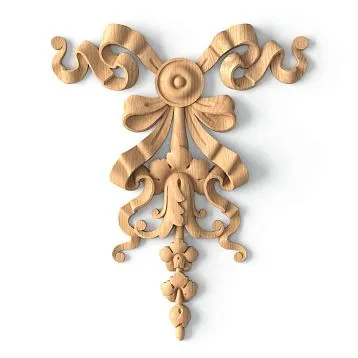
Carved wooden ornament – this is an art that preserves traditions of the past and finds its place in modern interiors. It can decorate any space, adding style, elegance, and individuality. Use wooden ornaments to create expressive accents, decorate facades, furniture, and walls, and you will transform your space, making it unique and irreplaceable! in the tradition of church decor, this is not just decoration, it is a program of symbols. Grapevine, wheat ears, fish, flowering shoots — each motif carries a semantic load rooted in early Christian art.
Where to buy a wooden icon case in Moscow and throughout Russia
Buy a wooden icon case for an icon in Moscow — from the manufacturer with a full catalog of church and decorative wooden decor.
STAVROS specializes in the production solid wood products since 2002. The company is based on artist-restorers with experience working on state-significant sites: the Hermitage, the Konstantinovsky and Alexandrovsky Palaces. This is not just production — it is an understanding of wooden decor at a level that requires real historical experience.
In the church decor — crosses, icons, crucifixes, carved gates, column capitals and bases, church utensils. Related sections — Solid wood frames, Carved Decor, Decorative Inserts — allow you to create a cohesive design for a prayer corner or temple space in a unified decorative program.
Buy a wooden icon case in Moscow — possible with pickup or courier delivery. Buy a wooden icon case in St. Petersburg and other cities of Russia — delivery by transport companies. Packaging: individual corrugated box, soft inserts around the carved frame, bubble wrap on each decorative element.
For non-standard sizes — custom manufacturing to the parameters of a specific icon. Order based on a photo of the icon and exact dimensions. Production time — from 2 to 8 weeks depending on complexity.
FAQ: answers to popular questions about wooden icon cases
Which wooden icon case should I buy for an icon?
The choice is determined by the size of the icon, its thickness, installation location (home, church), required depth, presence of glass and door, as well as the style of carved decor. Start with precise measurements of the icon — and select the icon case based on the internal size.
How is a carved icon case different from a simple frame?
An icon case is a three-dimensional ark with depth, side walls, a back wall, and the possibility of installing glass or a door. wooden frame — a flat frame without depth. An icon case protects the icon, a frame only frames it.
How to choose the size of an icon case for an icon?
Internal dimensions of the icon case = icon dimensions + 5–15 mm gap around the perimeter. Depth of the ark = board thickness + 15–30 mm. External dimensions = internal dimensions + wall thickness × 2 + frame width × 2.
Where are wooden icon cases used?
At home — in the prayer corner, bedroom, hallway, children's room. In the church — near columns, walls, in the altar area. In institutions, schools, educational establishments with Orthodox tradition.
What affects the price of a wooden icon case?
Size, wood species, body depth, presence of glass and door, complexity of carving, frame width, coating, individual parameters, and delivery.
Can a wooden icon case be used at home?
Yes. A home wooden icon case is one of the most popular formats. It creates a dedicated prayer space in the living area, protects the image from dust and touch, and frames the icon in a worthy setting.
Is glass necessary in a home icon case?
It is recommended. Glass protects the icon from dust, accidental touches, and household humidity. For expensive and antique images, it is mandatory. The gap between the glass and the icon should be at least 10 mm for ventilation.
What is a carved cross and how is it related to an icon case?
Carved cross — an independent church decorative element, which is installed next to the icon case, above it, or in the top piece. Together with the icon case, it forms a complete prayer corner in a unified decorative tradition.