
































Article Contents:
- Why total footage does not answer the question of how much baguette to actually buy
- When the total figure is still useful
- Why this is especially important for a mirror
- What to record in the kit card
- Useful typology of panels
- Why a corner sample is more useful than a separate piece
- When a common cutting plan cannot be combined
- Example
- Mathematically identical perimeter can yield different purchase volumes
- The width of the baguette directly affects the outer size of the composition
- When a full-size sample is practically mandatory
- Different SKUs and different finishes cannot be combined into a single purchasing line
- Chain restaurants, stores, and apart-projects benefit from a standard framework specification
- Why wall dimensions still need to be rechecked
- Furniture frames are calculated using the same set logic, but are not mixed with wall frames
- Standard frame
- Large frame
- Overall result
- One large panel set should be cut before dozens of small ones
- Wide baguette and compact profile give different economics for the same frame
- Large baguette around a small mirror
- Too narrow baguette around a large mirror
- One profile for several frame types is better calculated as a shared parts map
- The price of one strip does not show the cost of the finished frame set
- When a wholesale order is better not to launch
- The actual consumption of the first series should be used to improve the next one, not for blind increase
- Inefficient cutting
- Dimensional system error
- Damage
- Project change
- Wholesale kit assembly should link the baguette to frame kits, not just to warehouse linear meters
- Checking the dimensional base before serial cutting prevents the most expensive mistake
- Check “one frame → one row of truth”
- A mirrored room layout does not always mean a mirrored baguette kit
- For 200 furniture fronts, kit-based calculation is especially effective
- Different batches of the same SKU should be combined in the calculation only when they are truly compatible
- A complete-set approach helps you assess the consequences of a project change faster
- Savings from shared cutting only appear after the geometry is approved
- 1. Counting only the total linear meters
- 2. Mixing up mirror size and frame size
- 3. Changing the sizing system within a project
- 4. Not dividing mirrors into types
- 5. Multiplying one number across the entire project
- 6. Not checking the profile width on the wall
- 7. Not making a test corner
- 8. Cut the entire series at once after the drawing
- 9. Build the cutting plan for each frame separately
- 10. Cut short parts before long ones
- 11. Use a fixed 10% allowance
- 12. Combine different SKUs into one total length
- 13. Combine different colors
- 14. Ignore the orientation of the carved ornament
- 15. Store only the remainder in linear meters
- 16. Do not separate non-standard large frames
- 17. Do not analyze the overrun of the first series
- 18. Do not leave a repair reserve
- 19. Choosing a frame only by price per meter
- 20. Do not save the reference map after the project
- What the supplier should not have to guess
- Is there an exact SKU?
- Do all participants use the same sizing principle?
- Is there at least one assembled frame?
- Are all frames of the same type?
- Are there long non-standard frames?
- Are there several colors of the same profile?
- A serial project is conveniently closed in batches of sets, not random meters
- The cutting map should be able to answer the question “what to do with each leftover”
- When changing the mirror size, the entire set must be recalculated, not just one side
- If the SKU changed after the first batch, the old cutting plan cannot be carried over
- Supporting commercial requests should not blur the product meaning
- Bottom line: wholesale baguette should be calculated by frames, parts, and cutting layout
- Can wooden baguette be calculated only by the perimeter of the mirrors?
- What is better to calculate: meters or sets?
- Which size should be used as the basis — outer or inner?
- Should a 10% allowance be added?
- Can the leftover from one frame be used for another?
- Why should large frames be cut first?
- Is it necessary to make a test corner?
- What should be done if the first frame does not match in size?
- What reserve should be left after installation?
- Can mirrors and panels be combined into a single cutting plan?

The project includes 60 identical mirrors in hotel rooms, 20 larger mirrors in public areas, 40 decorative panels, and several custom frames in the lobby. The buyer gets a preliminary figure: "about 700 meters of moulding are needed." That is enough for the budget. For the actual order, it is not.
The same total linear meters can break down into completely different parts. A production frame requires not "3.8 meters in general," but two verticals of a specific length, two horizontals of a specific length, and four corner joints. If frame sizes repeat, it is more efficient to count not individual meters, but sets of parts and the cutting plan for the entire batch at once.
Therefore wooden moulding wholesale for project outfitting, calculations should follow this sequence:
FRAME TYPE → SIZE SYSTEM → FINISHED PARTS → NUMBER OF IDENTICAL SETS → CORNERS → SPECIFIC SKU → SOURCE LENGTH → CUTTING MAP FOR THE ENTIRE BATCH → PURCHASE VOLUME → REPAIR RESERVE.
Main principle:
FRAME SETS ARE CALCULATED FIRST, AND ONLY THEN THE TOTAL WHOLESALE METERS.



Why total meters do not answer the question of how much moulding to actually buy
A rectangular frame is a closed contour. It has four sides and four corners. In the simplest case, the clean perimeter can be calculated with the formula:
2 × width + 2 × height.
For example, the outer frame size is 700 × 1200 mm. Clean perimeter:
2 × 700 + 2 × 1200 = 3800 mm.
But 3.8 m is not yet the purchasing answer. We need to understand which source strips will be used to produce:
- 2 parts of 1200 mm each;
- 2 parts of 700 mm each;
- what remnants will remain after each cut;
- whether these remnants can cover the parts of another frame;
- how many source strips are required for 60 such sets.
If the selected SKU is manufactured in a length of 2000 mm, then theoretically one strip can yield 1200 + 700 mm with a small remnant. In that case, one set can be very efficient. If the source length is different, the consumption structure will change.
That is why molding wholesale you cannot order using the formula “net perimeter of all frames + 10%.” A universal percentage does not know which part lengths and which source strips are actually involved in the cutting plan.
When the total figure is still useful
At an early stage, it helps estimate the budget range, batch weight, and logistics. But before launching into production or purchasing, the pure square footage must be converted into the number of actual products.


The sizing system must be unified for designers, production, and purchasing
One of the most expensive mistakes in serial frames occurs when different participants talk about different dimensions but use the same words "width" and "height."
For the same composition, you can specify:
- mirror panel size;
- internal frame opening size;
- size along the abutment line;
- external overall dimensions of the finished frame;
- finished length of the moulding parts along the accepted measurement line.
These systems must not be mixed within a single specification.
| Parameter | What does it describe | Can it be used as the part length without clarification |
|---|---|---|
| Mirror size | Canvas inside the frame | No |
| Inner frame size | Visible opening | No, the profile geometry has not yet been determined |
| Outer frame size | Overall dimensions of the composition | Yes, if the working drawing counts the parts along this line |
| Finished part length | Specific side of the frame | Yes, this is already a production value |
The best option for a large order is to fix once which dimensional system the working table is based on, and never change it again.
Why this is especially important for a mirror
If a designer writes "mirror 700 × 1200", the purchaser should not automatically order four parts for a 700 × 1200 frame. The mirror panel may be smaller than the outer contour of the finished frame by the width of the baguette and the structural inset.
Therefore wooden baguette wholesale for mirrors, they are calculated only after a specific size system has been approved.
Our factory also produces:



A standard kit turns a repeating frame into a manageable purchasing unit
For 60 identical mirrors, there is no need to repeat the same calculation 60 times. First, a reference kit is created:
FRAME A = 2 VERTICALS + 2 HORIZONTALS + SKU + FINISH + CORNER TYPE.
For example:
| Set | Detail | Finished length | Quantity per 1 frame | Quantity per 60 frames |
|---|---|---|---|---|
| Mirror A | Vertical | 1200 мм | 2 | 120 |
| Mirror A | Horizontal | 700 мм | 2 | 120 |
After that, the purchasing task is formulated much more precisely: 120 parts of 1200 mm and 120 parts of 700 mm are needed in one specific SKU and finish.
The phrase “228 m needed” does not show the structure. The wording “60 sets of type A” shows how many finished frames can be assembled from the actual batch.
for wood baguette wholesale this is especially convenient for hotels, residential projects, chain interiors, and serial furniture.
What to record in the set card
- frame type code;
- external or internal size — according to the accepted system;
- baguette article number;
- the material;
- finish;
- vertical lengths;
- horizontal lengths;
- number of frames;
- test corner approved / not approved;
- reference frame approved / not approved.
Get Consultation
Mirrors from the same project must first be divided into actual types
A plan may contain 72 mirrors, but this rarely means 72 completely identical products. A typical hotel project may include:
- 50 standard vertical mirrors;
- 12 oversized mirrors;
- 6 mirrors in luxes;
- 4 large frames for public areas.
Each type gets a separate set.
| Type | Quantity | Working size | Article | Finish | Status |
|---|---|---|---|---|---|
| Mirror A | 50 | According to the approved drawing | K-___ | Option 1 | Reference approved |
| Mirror B | 12 | Another format | K-___ | Option 1 | Check |
| Mirror C | 6 | Custom | K-___ | Option 2 | Check |
| Mirror D | 4 | Large hallway | K-___ | Option 3 | Separate set |
Several large frames can change the cutting plan for the entire batch: they require the longest sides and possibly a different profile. Therefore, they cannot be absorbed within the average footage.
Before buy wooden baguette wholesale, the object must know not only the total number of mirrors, but also the actual typology of the frames.
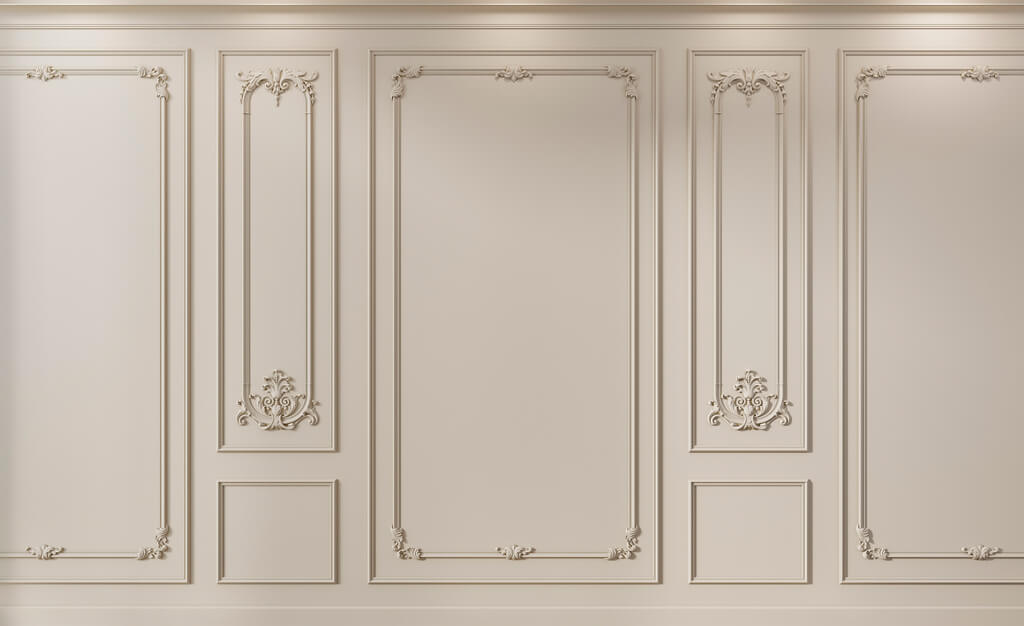
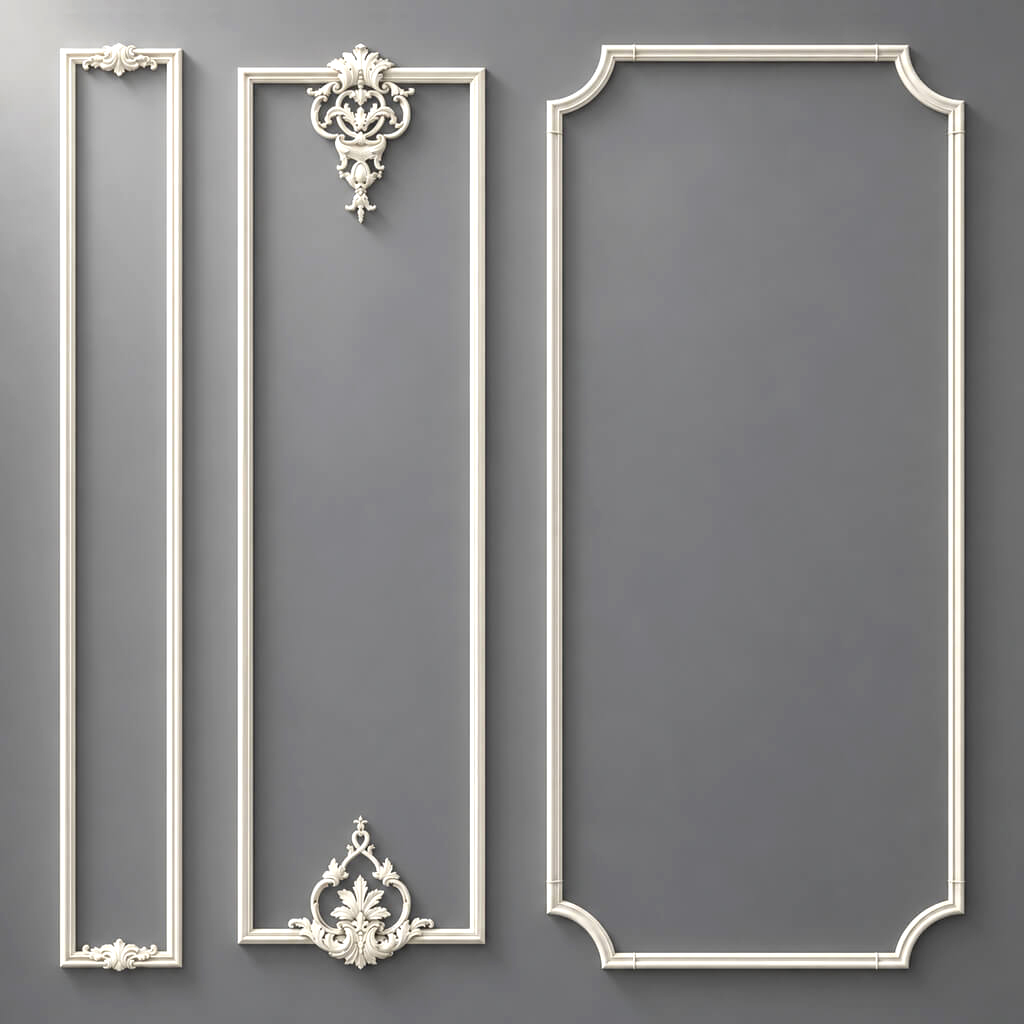
A wall panel is counted as a frame module, but its dimensions are determined by the entire wall composition
For a panel, the principle of sets remains the same: two verticals, two horizontals, four corners. But unlike a mirror, the frame size is often set not only by the insert inside.
The final geometry is influenced by:
- width of the wall section;
- room height;
- the axis of the furniture;
- doorways;
- adjacent moldings;
- baseboard and cornice;
- wall symmetry;
- distance between multiple panels.
Therefore, a panel cannot be calculated based only on the size of the decorative insert.
Useful typology of panels
For the project, it is convenient to distinguish:
- central large;
- side vertical;
- narrow wall-section;
- horizontal above furniture;
- repeating standard.
Each type gets its own set of parts and its own number of repetitions.
This way, baguette for panels wholesale is calculated as a series of specific frames, not as the total decorative linear meters of the wall.
Corner joint — a separate check, especially for wide and carved profiles
A rectangular frame has four corner joints. For 100 identical mirrors, that is already 400 corners. Therefore, an error that seems minor on a single sample scales up in a serial project.
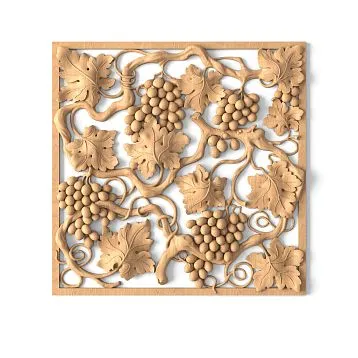
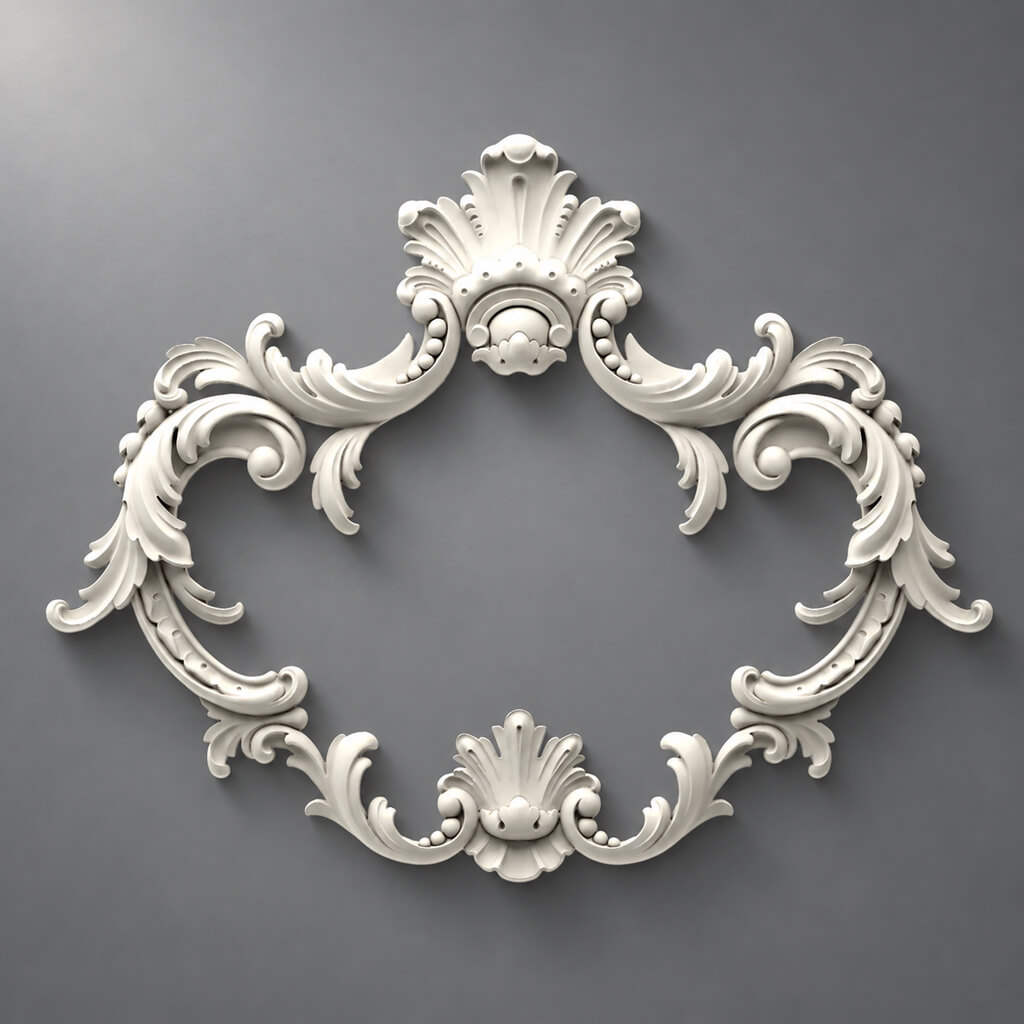
For a simple profile, the main task is geometric precision. For carved baguette, it is additionally important how the relief transitions through the corner.
Check:
- whether the ornament matches;
- whether a gap in the pattern appears;
- whether one corner looks heavier than the other;
- whether the profile width is sufficient for the selected format;
- whether the joint becomes too noticeable after finishing.
Therefore carved wooden baguette wholesale it is better to start after a trial corner or a small trial frame.
Why a corner sample is more useful than a separate piece
On a straight fragment, the quality of the carving and surface is visible. But only a corner sample shows how the profile works in a closed frame.
The first serial set must be assembled before the main batch
After the drawing is approved, it is useful to assemble one complete frame.
Checked:
- outer dimension;
- internal dimension;
- actual length of the sides;
- four corners;
- proportion of the moulding relative to the mirror or panel;
- finishing;
- fit of the mirror glass or insert;
- actual appearance on the wall.
If a discrepancy is found, there is no need to "slightly adjust" each subsequent frame manually. First, find the source:
- a mix of internal and external dimensions;
- the finished length of the sides is determined incorrectly;
- the profile width is not taken into account;
- the corner cut changes the actual overall dimensions;
- the original drawing of the mirror or panel has changed.
The error must be corrected on the first set, not built into the series.
The cutting map is built for the entire batch, not for each frame separately
After calculating the sets, a list of all required parts appears.
For example, the batch includes:
- 120 parts of 1200 mm;
- 120 parts of 700 mm;
- 20 parts of 1800 mm;
- 20 parts of 900 mm;
- 8 parts of 2200 mm;
- 8 parts of 1400 mm.
The next step is to match this array with the product length of the specific SKU.
The longest parts are distributed first because they have fewer placement options. Then the medium and short sides fill the remaining spaces.
This way, the leftover from a large frame can become the horizontal of a small one, and the leftover after a vertical can become the short side of a panel.
That is why Wholesale wooden trim it is more efficient to cut as a single batch if the SKU, material, and finish match.
When a combined cutting plan cannot be merged
If the following differ:
- article number;
- the material;
- finishing;
- batch that cannot be mixed;
- orientation of the carved pattern;
such groups are counted separately.
Why a universal 10% allowance is weaker than a real cutting plan
For 100 identical frames, cutting can be very efficient: the same combination repeats hundreds of times, leftovers are predictable and easily redistributed.
For five frames of different sizes, efficiency may be worse, even with a smaller total linear meterage.
Therefore, the sequence is as follows:
FINISHED PARTS → COMMERCIAL LENGTHS → CUTTING → INEVITABLE LEFTOVERS → TECHNOLOGICAL RESERVE.
Only after this can the purchased volume be compared with the net linear meterage and the actual allowance coefficient be seen.
Example
The net linear meterage of 60 identical frames is 228 m. If the cutting plan shows the need for 120 strips of 2000 mm, the purchased volume is 240 m. The difference is 12 m, or about 5.3% relative to the net linear meterage.
For a different frame structure, this percentage may be higher or lower. It cannot be transferred automatically.
Mathematically, the same perimeter can yield different purchased volume
Let's compare two frames.
| Frame | Size | Net perimeter | Set of sides |
|---|---|---|---|
| А | 600 × 1200 mm | 3600 мм | 2 × 1200 + 2 × 600 |
| Б | 800 × 1000 mm | 3600 мм | 2 × 1000 + 2 × 800 |
The perimeter is the same. But with an original length of 2000 mm, frame B can yield a convenient combination of 1000 + 800, while for frame A the combination 1200 + 600 leaves a different remainder.
If there are 100 such frames, the difference in the structure of remainders becomes significant.
Therefore wholesale mirror moulding is calculated by sides, not only by the perimeter of the finished product.
Real STAVROS profiles show why you can't treat all baguette moulding as one universal strip
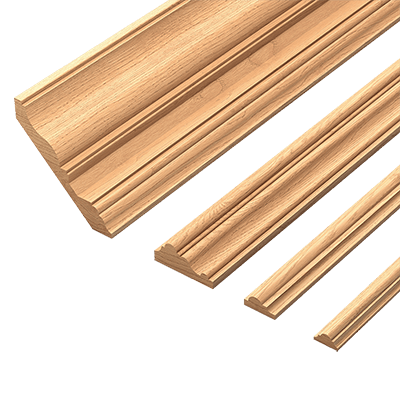
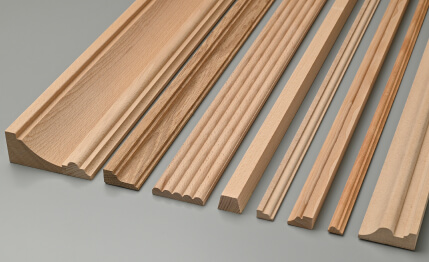
STAVROS's current range includes wooden baguette mouldings with noticeably different scales.
| Article | Example of cross-section | Example length | Practical Meaning |
|---|---|---|---|
| K-013 | 30×7 or 60×14 mm | 300 and 2000 mm | Compact profile |
| K-057 | 70×10 or 90×13 mm | 300 and 2000 mm | Medium expressive profile |
| K-067 | 90×18, 110×22, 130×26 mm | 300 and 2000 mm | Large carved profile |
| K-069 | 130×13 or 160×16 mm | 500 and 2000 mm | Wide frame for statement compositions |
These data show that the width of the moulding can differ severalfold. The same mirror panel size with K-013 and K-069 will create a completely different outer dimension and visual scale.
Therefore wooden moulding from the manufacturer are chosen before the final calculation of the sets, not after calculating an abstract linear meterage.
The width of the moulding directly affects the outer size of the composition
If the project specifies the size of the mirror panel, the outer size of the frame depends on the width of the selected profile and the specific scheme of its fitting.
For example: a mirror 600 × 1000 mm with a profile 30 mm wide and with a profile 130 mm wide will produce two compositions completely different in scale.
It is impossible to determine the outer size with the simple formula “add two widths” without knowing the actual profile and the internal fitting unit. But the general principle is obvious: a wide moulding increases the overall dimensions more and should be checked in the actual interior.
When a full-size sample is practically mandatory
- a small mirror and a very wide profile;
- large mirror in the entrance area;
- carved ornament;
- a series of dozens of identical items;
- close proximity to furniture or a door portal.
Different SKUs and different finishes cannot be combined into one purchasing line
For example, narrow baguette is used in rooms, wide — in the lobby. Even if a total of 500 m is needed, these are two different product items.
Minimum specification:
| Article | Material | Finish | Frame type | Number of sets | Purchase volume |
|---|---|---|---|---|---|
| K-013 | Beech | option A | Numbers | 60 | By cutting |
| K-069 | Oak | Option B | Hall | 10 | By cutting |
Even identical geometry in two colors is considered separate items. Otherwise, the stock of one variant would mistakenly be counted toward another.
Therefore wooden baguette wholesale from the manufacturer must be broken down at least by SKU, material, and finish.
A chain hotel requires a room typology, not the multiplication of a single room
For the room inventory, it is convenient to distinguish:
- standard room;
- standard mirrored;
- corner;
- accessible room;
- suite;
- public areas.
Even if the mirrors are of the same type, their placement can affect the allowable outer frame dimensions and adjacency to furniture.
Before a large series, it is useful to fully check one reference number: the actual mirror size, outer dimensions, profile proportion, angles, and distances to neighboring elements.
Only after that is the standard set scaled.
for finishing material suppliers this structure is more convenient than a single order of “baguette — 700 m,” because it allows you to control the actual number of sets.
Chain restaurants, stores, and apartment projects benefit from a standard frame standard
If the same decorative technique is repeated at several addresses, each new project should not have to start the calculation from scratch.
You can establish a standard:
- baguette article number;
- the material;
- finish;
- working outer or inner size;
- finished lengths of the four parts;
- angle diagram;
- standard cutting map;
- repair reserve.
The next project first checks whether the standard frame fits the specific wall, and only then applies the ready-made set.
This is especially useful for Wholesale building material suppliers, which supply several addresses of one network in stages.
Why wall dimensions still need to be double-checked
Even an identical design concept does not guarantee identical wall sections, door axes, and furniture. A standard kit is a starting point, not a license to ignore the actual geometry of a new site.
Furniture frames are calculated using the same kit logic, but are not mixed with wall frames
For facades, the principle is similar:
2 VERTICALS + 2 HORIZONTALS × NUMBER OF IDENTICAL FACADES.
For example, 200 identical doors allow for a very efficient cutting map. But furniture dimensions cannot be combined with wall frames just because the same moulding is used.
Need to consider:
- different precision;
- different external dimensions;
- possible orientation of the ornament;
- a different finish;
- a different production sequence.
If the item code and finish match and production allows for shared cutting, the groups can be combined at the parts map stage. If not, count them separately.
Carved ornamentation may limit cutting freedom
For a flat profile, the remaining piece of the required length can often be used in any direction. With carved moulding, the pattern may have a pronounced rhythm or orientation.
Before series cutting, you need to check:
- whether the ornament is symmetrical;
- how it appears at the corner;
- whether the remaining piece can be rotated;
- whether a visual gap appears at the joint;
- whether the top and side sides of the frame read the same.
Therefore, decorative wooden baguette wholesale with pronounced carving cannot be considered only arithmetically. A trial corner and the first frame become part of the purchasing check.
End-to-end example: 60 standard and 10 large mirrors
Let the standard frame have an outer size of 700 × 1200 mm, and the large one — 900 × 1600 mm. For the example, we use a profile available in an initial length of 2000 mm.
Standard frame
One set:
- 2 × 1200 mm;
- 2 × 700 mm.
The combination 1200 + 700 = 1900 mm makes it possible to obtain one vertical and one horizontal from a single 2000 mm strip with a small remainder before accounting for the cut.
One frame requires 2 source strips. For 60 frames:
60 × 2 = 120 strips of 2000 mm.
Purchased volume — 240 m with a net perimeter of 228 m.
Large frame
One set:
- 2 × 1600 mm;
- 2 × 900 mm.
The combination 1600 + 900 does not fit into a single 2000 mm strip. This means the long verticals will require separate source pieces, while the horizontals can be grouped together.
For example, two 900 mm horizontals give 1800 mm. Then, for one large frame, the preliminary requirements are:
- 2 strips for the 1600 mm verticals;
- 1 strip for two 900 + 900 mm horizontals.
Total 3 strips per frame, or 30 strips per 10 frames — 60 m of source baguette.
Overall result
Net length:
- 60 standard frames × 3.8 m = 228 m;
- 10 large frames × 5 m = 50 m;
- total net = 278 m.
Purchase volume according to the simplified map:
- 240 m for standard;
- 60 m for large;
- total = 300 m.
The net margin relative to the geometric perimeter is about 7.9%. But this figure is a consequence of the specific frame sizes and the specific source length. For another batch, it will change.
That is why it is more correct to buy baguette in bulk after calculating the sets, rather than through a predetermined 10%.
One large panel set should be cut before dozens of small ones
Let's imagine a project:
- 1 central panel 2200 × 3200 mm;
- 20 side panels 600 × 1000 mm.
If you first cut the short parts of the small frames, the original long strips will be fragmented. Later it may turn out that there are no longer enough whole elements for the long sides of the central panel.
Correct order:
- identify the longest sides of the central frame;
- reserve suitable original products for them;
- distribute the leftovers to the medium parts;
- cover the short sides of the small panels last.
This is the general principle of optimizing linear material: first the parts with the fewest variants, then the more flexible ones.
Accounting by kits makes material dispensing on site more transparent
In the warehouse, the phrase "180 m of K-057 remaining" doesn't help the installer or the kit assembler much. They still don't know how many frames that will cover.
If accounting is done by kits, you can say:
20 FULL KITS OF MIRROR A REMAINING + 4 KITS OF MIRROR B + LOOSE REMAINDERS.
This immediately answers the production question.
| Type | Per project | Issued | Assembled | Full kits remaining |
|---|---|---|---|---|
| Mirror A | 60 | 40 | 36 | 20 |
| Mirror B | 12 | 8 | 7 | 4 |
The total meterage remains useful for financial and material balance, but operational management of a series is more convenient in kits.
The repair reserve should contain useful lengths, not a random sum of meters
After the project is completed, a damaged vertical side of a large frame may require a full-length piece of 1600–2200 mm. A set of short offcuts totaling 5 m will not solve this task.
Therefore, the reserve is determined by:
- the number of identical frames;
- the longest pieces;
- the difficulty of reordering;
- finish;
- the uniqueness of the carved profile;
- the likelihood of local damage.
For a mass-produced series, you can keep several full sets or a set of full-length pieces from which any side of a standard frame can be restored.
If construction materials supplier can consistently reproduce the article number and finish, the reserve can be smaller than for a rare custom profile.
Wide baguette and compact profile give different economics for the same frame
Profile width affects more than just appearance. It can change:
- external overall dimensions of the finished frame;
- the distance to furniture and doors;
- the length of finished parts according to the accepted measurement system;
- the weight of one set;
- the requirements for the test corner;
- the cost per linear meter;
- the cost of an error in a bulk purchase.
For example, K-013 has compact width options of 30 and 60 mm, while K-069 has 130 and 160 mm. These products cannot be compared by price or ornament alone. They create different frame scales.
A large baguette around a small mirror
It can visually dominate the mirror and significantly increase the outer dimensions. If there is little free space on the wall, the conflict will only be discovered after manufacturing.
The frame around a large mirror is too narrow
It may look insufficiently expressive in a large hall. Therefore, the choice of scale must be confirmed before calculating dozens of sets.
One profile for several frame types is better calculated as a shared parts map
Suppose K-057 is used for three types of mirrors:
- type A — 60 frames;
- type B — 20 frames;
- type C — 8 frames.
If the material and finish are the same, the cutting map can be built for all parts at once.
| Part length | Type A | Type B | Type B | Total parts |
|---|---|---|---|---|
| 1200 мм | 120 | 0 | 0 | 120 |
| 1000 мм | 0 | 40 | 0 | 40 |
| 900 мм | 0 | 40 | 16 | 56 |
| 700 мм | 120 | 0 | 0 | 120 |
| 600 мм | 0 | 0 | 16 | 16 |
Now the cutting algorithm can use the remainder from one group in another. For example, a remainder after 1200 mm can cover 700 or 600 mm if its actual length and quality allow it.
This is the advantage of wholesale planning for the entire batch: efficiency emerges between kits, not only within a single frame.
The price of a single strip does not show the cost of a finished frame kit
For commercial comparison, it is more useful to calculate:
COST OF SOURCE STRIPS PER KIT + FINISHING + CUTTING + CORNER ASSEMBLY + INEVITABLE WASTE.
Even without an exact calculation of labor, it is already clear that a wide, expensive profile increases cost not only due to the price per meter. More source strips may be needed, and high-value remainders are harder to use rationally.
On the other hand, a cheap profile that does not fit in scale is also not a saving: you will have to change the entire series or put up with a visually weak result.
Therefore building materials supplier for project procurement, one should receive an exact SKU, not a request like “need a wooden baguette about this width.”
When a wholesale order is better not to launch
A large volume should not be sent to production if key questions remain unresolved.
It is useful to pause if:
- the size system has not been selected;
- the exact SKU has not been approved;
- the mirror panel is still changing;
- the outer frame dimensions have not been checked on the wall;
- a test corner has not been assembled;
- the carved ornament has not been checked in the corner joint;
- the finish has not been approved;
- non-standard large frames have not been separated from the standard series;
- the cutting map is based on the estimated rather than the actual length of the selected product.
An early order at this stage does not save time. It shifts uncertainty into an expensive material batch.
If construction materials wholesale they are purchased in stages, stable standard kits can be launched earlier, while non-standard frames can be left in a separate queue.
The actual consumption of the first series should be used to improve the next one, not for blind increase
After the first 10–20 frames, it is useful to compare:
- the calculated number of initial strips;
- the actual number;
- usable remnants;
- unusable offcuts;
- the reasons for additional cuts;
- the percentage of corner defects;
- changes in dimensions on site.
If consumption is higher than calculated, the cause must first be understood.
Inefficient cutting
Parts may be cut from one frame at a time, and offcuts are not redistributed.
Dimension system error
Finished lengths may differ from the working drawing.
Damage
Some long elements may be lost due to ends or surface.
Project change
Actual dimensions of mirrors or panels may have been changed after the initial calculation.
The next wholesale batch is adjusted only after such diagnostics.
Wholesale assembly should link moulding to frame kits, not just to warehouse meterage
For each purchasing line, it is useful to know:
- article number;
- the material;
- finish;
- commercial length;
- frame types;
- number of sets;
- purchasing quantity of source items;
- reserve.
| Article | Frame types | Sets | Source length | To order | Reserve |
|---|---|---|---|---|---|
| K-057 | A, B | 80 | 2000 мм | According to the cutting map | By critical lengths |
| K-069 | Hall | 10 | 2000 мм | According to the cutting map | Separately |
So wholesale building material suppliers receive an order that can be verified by the number of actual frames, not just by total length.
Checking the dimensional base before serial cutting prevents the most expensive mistake
Before translating dozens of frames into a cutting map, it is useful to perform a separate check of the dimensional basis. Its purpose is to ensure that the designer, the kit assembler, and production are all referring to the same dimension.
Minimum check:
| Check | What must match |
|---|---|
| Frame code | Identical in all statements |
| Dimension system | External or internal — one for the entire type |
| Article number | Exact baguette model |
| Finishing | One approved option |
| Vertical part | Same length in the drawing and the cutting map |
| Horizontal part | Same length in the drawing and the cutting map |
| Number of frames | Matches the room specification |
If at least one value diverges, serial cutting must be paused. On 60 frames, an error in one vertical will be multiplied by 120 parts.
Check “one frame → one source of truth”
For each type, it is useful to have one card where the final data is collected. All other tables should reference it. Then, after a size change, there is no need to search for the old value in several files.
An example of combined cutting for three frame types shows the benefit of a combined batch
Let one SKU with a length of 2000 mm be used for three frame types at once.
| Type | Number of frames | Verticals | Horizontals |
|---|---|---|---|
| А | 40 | 2 × 1200 mm | 2 × 700 mm |
| Б | 20 | 2 × 1000 mm | 2 × 800 mm |
| В | 10 | 2 × 1400 mm | 2 × 500 mm |
If each type is considered independently, for A the obvious combination is 1200 + 700 = 1900 mm. For B — 1000 + 800 = 1800 mm. For C — 1400 + 500 = 1900 mm.
But the overall parts map offers additional options. The remainder of about 600 mm after the 1400 mm part can be allocated to the 500 mm horizontal of type C. The remainder after 1200 mm can cover part of the 700 mm parts if the allowance and actual cut permit. Incompatible short remainders are immediately visible and are not counted as "useful stock" merely because they have meters.
For a large batch, a simple matrix can be built:
| Source length | Combination | Usage | Remainder |
|---|---|---|---|
| 2000 мм | 1200 + 700 | Type A | Minimal |
| 2000 мм | 1000 + 800 | Type B | About 200 mm before accounting for cuts |
| 2000 мм | 1400 + 500 | Type B | Minimal |
| 2000 мм | 1200 + 500 | A + C | About 300 mm before accounting for cuts |
This matrix does not replace the production map, but it quickly shows which frame types combine well in a single batch.
A mirrored room layout does not always mean a mirrored baguette set
If the profile is fully symmetrical and the frames are the same size, the set can be identical. But with carved ornament, an asymmetrical cross-section, or special finishing, direction can matter.
Therefore, for mirrored rooms, check:
- whether verticals can be flipped;
- whether the ornament reads the same;
- whether the profile has a top and bottom;
- whether the grain direction matches;
- whether separate marking of the left and right parts is required.
If direction is not significant, type A and mirrored A can be combined into one set. If it is significant, the two types remain separate even with the same perimeter.
For 200 furniture fronts, set-based calculation is especially efficient
Suppose a furniture project contains 200 identical doors, each with a decorative picture-frame moulding.
One set:
- 2 verticals of 720 mm each;
- 2 horizontals of 420 mm each.
The entire batch:
- 400 verticals of 720 mm each;
- 400 horizontals of 420 mm each.
With an initial length of 2000 mm, the production task already looks like optimizing hundreds of identical parts. You can preselect repeating combinations, for example two verticals of 720 mm and one horizontal of 420 mm:
720 + 720 + 420 = 1860 mm.
Thus, one initial strip potentially covers a significant portion of one frame set. The remaining horizontals are grouped separately.
This is much more accurate than calculating the perimeter of one door, multiplying by 200, and adding 10%.
If the baguette is used both on mirrors and on facades in the same finish, the overall cutting plan can be reviewed together, but only after checking the requirements of the furniture production.
Different batches of the same article should be combined in the calculation only when there is real compatibility
Formally, one article may be identical, but the batch may differ in:
- material;
- tinting;
- color;
- sanding quality;
- production time;
- intended use for another zone.
If the remainder of the first batch cannot be visually mixed with the second, they cannot be combined into one cutting map. Otherwise, the table will show available material that actually cannot be used in a specific frame.
Therefore wholesale purchase of building materials must rely not only on the article, but also on the real compatibility of the execution.
A complete approach helps to assess the consequences of a project change more quickly
If the designer changes type A from 700 × 1200 to 750 × 1250 mm, the object immediately sees what changes:
- 120 verticals;
- 120 horizontals;
- cutting map for 60 sets;
- purchased number of source strips;
- remainders;
- repair reserve.
Without a set structure, the change looks like “plus 100 mm to the perimeter of one frame × 60.” Such a formula shows the change in net linear meters, but does not show the new cutting layout.
Therefore, any serial size after adjustment must be run through the source length map again.
Savings from overall cutting appear only after the geometry is approved
There is no need to optimize cutting too early. If the mirror dimensions continue to change, any perfect map quickly becomes outdated.
Correct order:
- approve frame types;
- approve the dimensions;
- approve the SKUs;
- approve the finishes;
- assemble the reference sample;
- only after that, optimize the cutting.
Otherwise, the purchaser wastes time on precise optimization of imprecise source data.
Checking a batch by the number of complete sets reveals hidden shortages
Let's imagine that after the first phase, 80 m of baguette of one SKU remains in stock. By pure linear meterage, this is enough for approximately 21 standard frames of 3.8 m each.
But the actual remainder consists of:
- 20 strips of 1200–1300 mm;
- 40 pieces of 650–750 mm;
- several short offcuts;
- two full strips of 2000 mm.
A standard frame requires two verticals of 1200 mm and two horizontals of 700 mm.
There are plenty of horizontals from offcuts. Verticals become the limiting component. If suitable lengths
20 typical mistakes when ordering wooden baguette wholesale
1. Counting only the total linear meters
Why it happens: perimeters are easy to add up. Consequence: it is unknown how many complete sets will result. How to prevent: count parts and sets.
2. Mixing up mirror size and frame size
Cause: both are written as width × height. Consequence: all four parts get the wrong length. Prevention: a unified sizing system.
3. Changing the size system within a project
Cause: the designer calculates by outer dimensions, production by inner dimensions. Consequence: a serial error. Prevention: lock in one working system.
4. Do not divide mirrors into types
Cause: in the schedule they are called the same. Consequence: large and non-standard frames distort the cutting layout. Prevention: typology A, B, C.
5. Multiplying one number across the entire property
Cause: the hotel seems standard. Consequence: suites and corner rooms are not taken into account. Prevention: real room types.
6. Not checking the profile width on the wall
Cause: the catalog looks convincing. Consequence: the frame becomes too bulky or too weak. Prevention: a full-size sample.
7. Not making a test corner
Cause: a straight sample looks good. Consequence: the relief does not align well in the frame. Prevention: assemble a corner before the print run.
8. Cutting the entire series immediately after the drawing
Cause: the dimensions seem final. Consequence: the mistake of the first set is repeated dozens of times. Prevention: first make one reference frame.
9. Building the cutting plan for each frame separately
Cause: it is easier to calculate this way. Consequence: leftovers between types are not used. Prevention: a shared parts map for one SKU.
10. Cutting short parts before long ones
Cause: there are more short ones. Consequence: suitable long strips are broken up. Prevention: prioritize the longest sides.
11. Using a fixed 10% allowance
Cause: it is the usual norm. Consequence: the allowance may be excessive or insufficient. Prevention: derive it from the cutting plan.
12. Combining different SKUs into one total length
Cause: all products are called baguette. Consequence: the purchasing line loses its meaning. Prevention: calculate each SKU separately.
13. Combining different colors
Cause: the geometry is identical. Consequence: leftovers cannot be freely redistributed. Prevention: separate batches by finish.
14. Ignoring the orientation of the carved ornament
Cause: the leftover fits by length. Consequence: the pattern does not match. Prevention: check the direction of the specific profile.
15. Storing only the leftover in linear meters
Cause: convenient for the warehouse. Consequence: it is unknown how many frames it will be enough for. Prevention: count full sets and lengths.
16. Not separating non-standard large frames
Cause: there are few of them. Consequence: no long source items remain for them. Prevention: cut large parts first.
17. Not analyzing the overconsumption of the first series
Cause: it is easier to add material. Consequence: the mistake repeats. Prevention: find the cause of the deviation.
18. Not keeping a repair reserve
Reason: all kits are assembled. Consequence: future replacement of a single vertical becomes a separate order. Prevention: reserve of critical lengths.
19. Choosing baguette solely by price per meter
Reason: price is easy to compare. Consequence: external scale and cutting efficiency are ignored. Prevention: calculate the cost of the kit.
20. Not saving the reference map after the project
Reason: the series is already complete. Consequence: the next frame or network site starts from scratch. Prevention: archive of the kit and cutting plan.
Transferring an order to the supplier should begin with the item code and the number of kits
The request “300 meters of baguette for mirrors are needed” is not precise enough. A stronger procurement wording:
K-057, selected finish, 60 kits of frame A, 10 kits of frame B, additional source items for the repair reserve, total volume — according to the approved cutting map.
It is useful to pass on to the supplier:
- exact article number;
- the material;
- the selected finish or execution;
- the finishing option, if it is included in the order;
- frame dimensions according to a unified system;
- the quantity of frames of each type;
- critical long parts;
- delivery phasing;
- reserve volume.
So building materials wholesale from the manufacturer are purchased for a specific serial product of the project, not as an undefined stock of linear meters.
What the supplier should not have to guess
The supplier should not determine on their own which outer frame size the designer intended, whether the mirror can be reduced, how much the baguette width may be changed, or which ornament is better for the hallway. These decisions must be finalized by the project before ordering.
Checklist before releasing a wholesale batch
| Check | Status |
|---|---|
| Exact item code selected | ___ |
| Verified current dimensions and lengths of the selected variant | ___ |
| Established a unified frame size system | ___ |
| Determined mirror and panel types | ___ |
| Vertical parts calculated | ___ |
| Horizontal parts calculated | ___ |
| Large non-standard frames listed separately | ___ |
| Bagette width verified on a physical sample | ___ |
| Test corner assembled | ___ |
| First reference frame assembled | ___ |
| Different SKUs separated | ___ |
| Different finishes are separated | ___ |
| An overall parts map has been compiled | ___ |
| The longest sides are distributed first | ___ |
| Leftovers are redistributed between frame types | ___ |
| The purchase volume is calculated from the original strips | ___ |
| The reserve is determined by critical lengths | ___ |
If most of the items are confirmed, finishing materials wholesale you can start series production. If the sizing system itself or the first frame is not approved, it is too early to produce the entire run.
The decision tree helps you quickly understand whether the project is ready for a mass order
Is there an exact SKU?
No. First select a profile and check its scale.
Yes. Let's move on to the size system.
Do all participants use the same sizing principle?
No. Stop the serial calculation and fix the external or internal dimension as the working basis.
Yes. Create standard kits.
Is there at least one assembled frame?
No. Make a trial kit and corner.
Yes. Check whether the dimensions and proportions matched.
Are all frames of the same type?
Yes. Build a repeating cutting layout.
No. Split into A, B, C and merge the parts map only where the SKU and finish match.
Are there long non-standard frames?
Yes. Reserve the source strips for them first.
No. Optimize the series by recurring sets.
Are there several colors of the same profile?
Yes. The geometry calculation may be similar, but purchasing items and the actual cutting are handled separately.
This is how the decision tree eliminates a typical mistake: starting with the total linear meters before determining what exactly should be manufactured from those meters.
A serial project is conveniently closed in batches of sets, not in random meters
If construction proceeds in phases, delivery can be planned:
- 30 sets of mirror A — first phase;
- 30 mirror sets A + 6 sets B — the second one;
- large hall frames — a separate batch;
- repair reserve — final handover.
With this approach, supply understands what volume of the project each delivery covers.
With standard accounting, “120 m delivered” requires additional recalculation of how many frames that will cover and which sides can still be obtained from the remainder.
Therefore delivery of finishing materials in a serial interior, it is more convenient when linear material is linked to future finished products.
The cutting map must be able to answer the question “what to do with each remainder”
Optimized cutting does not mean that waste is zero. The task is to distinguish:
- a remainder that is immediately used for another part;
- a useful remainder for the next set;
- reserve full length;
- short technological remnant with no real use.
Example:
| Source strip | Part 1 | Part 2 | Remainder | Remnant status |
|---|---|---|---|---|
| 2000 мм | 1200 | 700 | ≈100 mm before cut allowance | Technological |
| 2000 мм | 1000 | 800 | ≈200 mm | Technological / sample |
| 2000 мм | 1400 | — | ≈600 mm | Check for a short part |
This table shows why the overall safety factor is insufficient. Part of the remnant is valuable, part is not, even if both figures are included in one total linear meterage.
When changing the mirror size, the entire set must be recalculated, not just one side
If the mirror was increased in width by 50 mm, two horizontal parts change. If the height was also increased, all four sides change.
But the purchasing adjustment may affect more:
- combinations of parts on the original strip;
- the number of strips needed per frame;
- the usefulness of the leftovers;
- external dimension;
- the position of the frame on the wall;
- the size of the reserve parts.
Therefore, a change in one dimension in a serial frame cannot be considered as "plus 50 mm × quantity." After it, the cutting map is rebuilt.
If the article changed after the first batch, the old cutting layout cannot be carried over
Even if the new moulding is similar in width, it may have a different original length, cross-section, or decorative orientation.
Need to check again:
- frame dimension system;
- finished part lengths;
- corner joint;
- raw lengths;
- cutting efficiency;
- repair reserve.
The old map remains an archive of the first batch, and a new version is created for the new SKU.
Project economics benefit not from the minimum linear meters, but from the minimum number of excess raw items
Let's imagine two scenarios:
Scenario A: net linear meters 280 m, purchased volume 300 m.
Scenario B: after a slight adjustment of frame dimensions, the net linear meters become 282 m, but the cutting layout improves and the purchased volume decreases to 294 m.
Despite the larger net perimeter, scenario B is more economical in terms of raw items.
This effect is possible when the dimensions of a repeating frame align better with the commercial length of the selected profile. Of course, architectural dimensions cannot be changed solely for savings without approval. But at an early stage, this is a useful parameter for comparing options.
That is why wholesale purchasing of building materials benefits from the connection between design, dimensions, and cutting layout, not just from a discount per linear meter.
Supporting commercial queries must not blur the product meaning
The article is specifically about wooden baguette for serial frames. Therefore, general formulations such as materials in bulk or finishing material suppliers are appropriate only as context for a large package.
The main practical question remains a product one:
HOW MANY SETS OF A SPECIFIC FRAME ARE NEEDED AND HOW MANY SOURCE STRIPS OF A SPECIFIC BAGUETTE WILL BE REQUIRED TO MAKE THEM.
This is what distinguishes the page from general articles about choosing decor or buying trim by the meter.
Final algorithm for calculating wooden baguette for serial frames
SELECT THE SKU → APPROVE THE MATERIAL AND FINISH → FIX THE DIMENSION SYSTEM → DIVIDE MIRRORS AND PANELS INTO TYPES → DETERMINE FINISHED VERTICALS AND HORIZONTALS → ASSEMBLE A TEST CORNER → ASSEMBLE THE FIRST REFERENCE FRAME → CHECK THE OUTER AND INNER DIMENSIONS → COUNT THE NUMBER OF SETS → BUILD THE OVERALL PARTS MAP → DISTRIBUTE THE LONGEST ELEMENTS → USE OFF CUTS FOR SHORT ONES → COUNT THE SOURCE STRIPS → SEPARATE TECHNOLOGICAL WASTE → DETERMINE THE RESERVE → DIVIDE THE BATCH BY SKU AND FINISH → LAUNCH THE WHOLESALE ORDER.
- Do not start with the total number of meters.
- Choose a specific baguette.
- Check its current dimensions and lengths.
- Determine which frame sizes are considered working.
- Divide all frames into types.
- Create one set for each type.
- Check the proportion of the profile and the object.
- Assemble a test corner.
- Assemble the first full frame.
- Fix the identified errors before the series.
- Count the number of verticals.
- Count the number of horizontal lines.
- Separate large non-standard frames.
- First distribute the longest sides.
- Then use the leftovers for the short ones.
- Build the cutting plan for the entire compatible batch.
- Do not mix different SKUs.
- Do not mix different finishes.
- Obtain the purchased quantity of source items.
- Compare it with the net linear meters.
- Determine the actual technological reserve.
- Form a reserve of usable lengths.
- Transfer batches in sets.
- After the first series, check the actual consumption.
Bottom line: wholesale baguette must be calculated in frames, parts, and cutting
For a single frame, it is enough to know its four sides. For dozens and hundreds of identical frames, the task changes: serial optimization comes into play.
The correct sequence is:
FRAME → SET → FRAME TYPE → QUANTITY → MASTER PARTS MAP → SOURCE LENGTHS → CUTTING → PURCHASE VOLUME → RESERVE.
So wooden moulding wholesale it is purchased not as a random stock of meters, but as material calculated for a specific number of finished mirrors, panels, or furniture frames.
If finishing materials are purchased wholesale and materials for the entire project are purchased wholesale at the same time, baguette must still remain a separate product group with its own sets, SKUs, and cutting.
Before the final order is sent, it is useful to once again verify the number of frames of each type against the actual list of rooms, mirrors, panels, or facades. If the number of sets has changed even by a few units, the final cutting must be recalculated, because the last strips in the batch are often distributed differently. Such a control check protects against a situation where the geometry has already been calculated correctly, but the purchase volume remains tied to the old number of products.
Frequently asked questions
Can wooden baguette be calculated only by the perimeter of the mirrors?
The perimeter shows the net geometric length, but not the number of source strips. For a wholesale order, cutting by specific side lengths is needed.
What is better to calculate: meters or sets?
For a serial project, both indicators are needed. Meters are convenient for the financial balance, while sets are for understanding how many complete frames can be assembled.
Which size should be used as the basis — outer or inner?
Either approach is possible if it is clearly defined by the working drawing and is the same for all participants. Systems must not be mixed.
Should a 10% allowance be added?
A universal percentage is worse than a cutting plan. First calculate the actual source mouldings, then add a deliberate technological and repair reserve.
Can the leftover from one frame be used for another?
Yes, if the article number, material, finish, and orientation match and the length of the leftover is sufficient for the required part.
Why should large frames be cut first?
Long sides have fewer placement options on the source material. Short parts are easier to obtain from the remaining suitable pieces.
Is it mandatory to make a test corner?
For a simple, familiar profile, the risk is lower. For wide, carved, new, or production-run moulding, a test corner significantly reduces the risk of a serial error.
What should I do if the first frame doesn't match in size?
Stop the run and identify the cause: the sizing system, part lengths, angle, profile, or the original drawing. Do not adjust each subsequent frame manually.
How much reserve should be left after installation?
There is no universal percentage. Keep useful whole lengths or complete sets, taking into account the longest parts and the complexity of reordering.
Can mirrors and panels be combined into a single cutting plan?
Yes, if the same SKU, material, and finish are used, and the offcuts are compatible in length and orientation. This often improves batch efficiency.