Article Contents:
- Why furniture fronts need wooden handles: not hardware, but decor
- When wooden handles are the only right choice
- Types of wooden handles by shape: round, long, knob handles
- Round wooden handles for furniture
- Long wooden handles for furniture
- Wooden knob handles
- Choosing wooden handles by furniture purpose
- Wooden handles for kitchen furniture
- Wooden handles for a cabinet
- Wooden handles for chest of drawers and bedside tables
- Wooden handles for children's furniture
- Wooden handle finishes: unfinished, finished, and ready for finishing
- Unfinished furniture handles
- Finished furniture handles
- Wooden handles for painting with enamel
- How to choose the size of a wooden handle: proportions and calculation
- Handle-to-facade proportion
- Handle placement along the facade height
- Center-to-center distance for long handles
- How to combine wooden handles with other STAVROS decor
- Handles and carved overlays
- Handles and moldings
- Handles and furniture legs
- Handles and Decorative Elements
- Handles and wooden baguette
- Mistakes when choosing wooden handles for furniture
- Where to buy STAVROS wooden handles for furniture: catalog, coating, formats
- Additional solutions: wooden decor in the furniture image system
- Frequently Asked Questions
- About the Company STAVROS
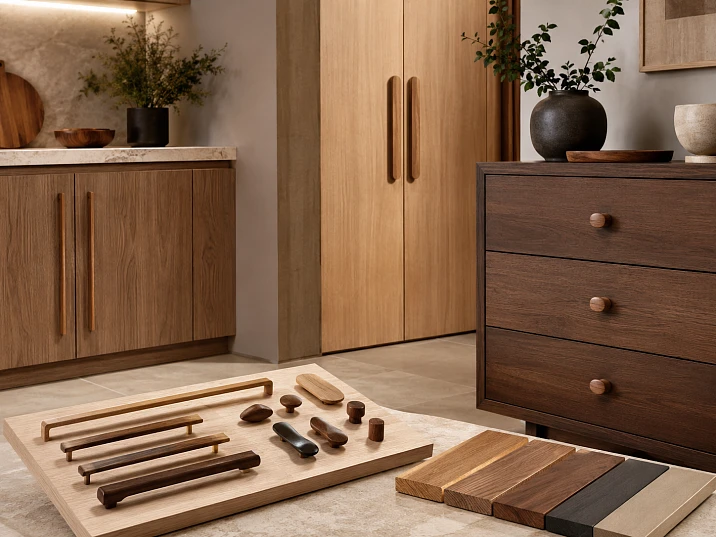
There are details that remain silent — and details that speak. A furniture front handle belongs to the second category. It is the first thing the hand touches when you open a cabinet. The first thing the eye notices on a kitchen front. The final touch that either completes the furniture's look or ruins it. And that is why wooden furniture handles — it is not a routine item in the hardware price list, but a full-fledged design tool.
The problem is different. When it comes to choosing, most people get lost. The catalog offers dozens of models, shapes, sizes, coating options — and it is unclear which one will suit a specific kitchen, cabinet, or chest of drawers. This article is written precisely to figure out: how to choose wooden handles for furniture correctly — by shape, size, coating, and purpose.
Why furniture facades need wooden handles: not hardware, but decor
Wait. Before moving on to choosing specific models, it's worth answering a question that is asked less often than it should be: why wood at all? Why not metal, not ceramics, not polymer?
The answer is not in fashion. The answer is in the logic of the material.
A wooden handle made of solid beech or oak is an element that by its nature belongs to the same world as wooden furniture, wooden overlays on facades, moldings, pilasters. When the handle is made of the same material as the facade decor, unity arises. Not a "matched ensemble," but an organic wholeness that you feel even without understanding why.
A metal handle on a kitchen with wooden moldings is a dialogue between two different languages. Sometimes it's appropriate, sometimes it creates dissonance. A wooden handle in the same tint as the Carved decorative inserts for furniture, is a monologue, unified and convincing.
Beyond aesthetics, there is practicality. Wood is tactilely pleasant — especially in interiors where the feeling of naturalness is valued. It doesn't chill your hand in winter or burn in summer. It accepts any finish — from clear oil to dense enamel — and can be precisely matched to the facade coating.
And finally: buy wooden handles for furniture today means investing in a detail that will last for decades with proper care. Wood doesn't peel like chrome coating. It doesn't crack like cheap polymer. It ages beautifully — if it's high-quality solid wood.




When wooden handles are the only right choice
There are situations where wooden handles for furniture are not just a preference, but an architectural necessity. Let's break them down specifically, without generalities.
Solid wood furniture. If a wardrobe, kitchen set, or chest of drawers is made of natural wood, a handle made of the same material creates completeness. A metal bracket on solid oak furniture is like a ballpoint pen signature on a watercolor painting.
Classic and neoclassical interiors. In these styles, furniture is part of an architectural ensemble. Each element has its role in the ornamental hierarchy. A wooden handle continues the logic of carved decor, of wooden moldings and millwork, stucco cornice. Metal in such a context is a foreign body.
Furniture restoration. If an antique piece or handmade furniture is being restored, a wooden handle is stylistically more appropriate than any metal alternative. It reproduces the historical appearance of the item.
Facades for enamel and tinting. When furniture is painted in a single color — white, gray, greenish — a wooden handle in the same tint creates a monochrome look without visible seams between elements. Buy wooden furniture handles without coating — and paint them yourself to match the facade color — is standard practice among designers.
Kitchen with wooden decor. If the kitchen facades have carved overlays, moldings, or decorative wooden elements — wooden handles complete the system. Without them, the look remains unfinished, like text without a final line.
Our factory also produces:
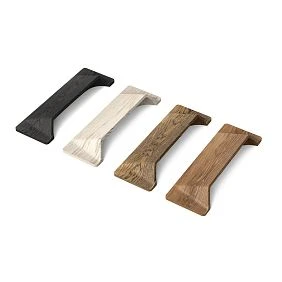
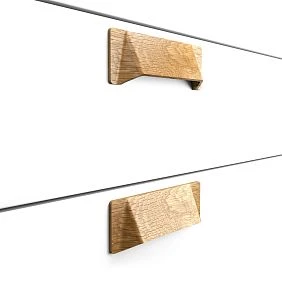
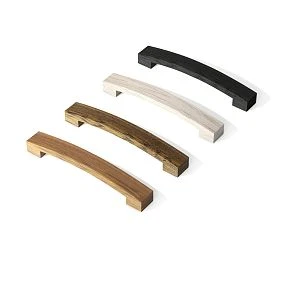
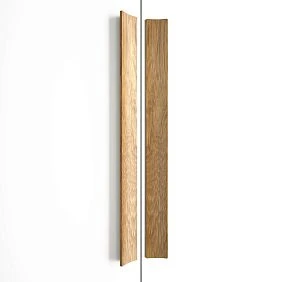
Types of wooden handles by shape: round, long, knob handles
The shape of the handle is not just about aesthetics. It is a functional and proportional characteristic that affects how convenient it is to open the facade and how organically the handle looks on the furniture.
Get Consultation
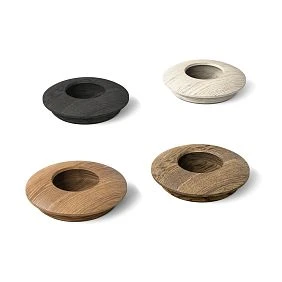
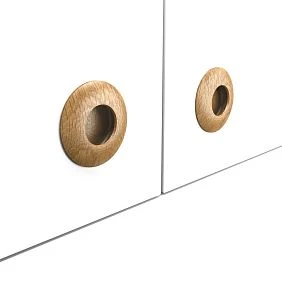
Round wooden furniture handles
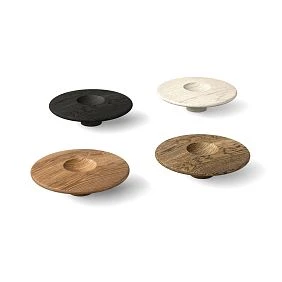
A round handle is a classic "button" or a volumetric ball on a neck. Its laconic shape, compact size, and universal compatibility are why wooden round furniture handles remain the most sought-after format.
Round handles work well on small fronts: dresser drawers, cabinet doors, base kitchen module doors. Their compactness does not overload the surface, and the rounded shape softens the straightness of the facade geometry.
In classical and Baroque styles, round ball handles on a turned neck provide a historically correct appearance. On neoclassical furniture, a smoother, flattened "disc" on a short stem looks more modern. On children's furniture, round handles are especially appropriate: no sharp corners, the shape is soft and intuitive.
Technically: round handles are mounted with a single screw along the axis. No center distance needs to be calculated — only the axis position on the facade. This simplifies installation and allows precise centering of the handle relative to a molding frame or overlay.
Buy wooden round furniture handles means choosing a universal format that suits most classical and neoclassical solutions. If you are unsure about the shape — start with a round one. It won't be a mistake.
Long wooden furniture handles
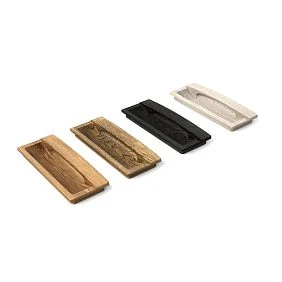
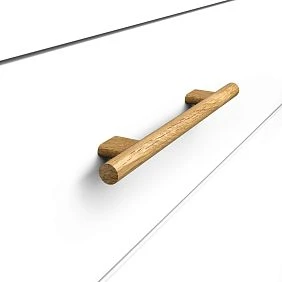
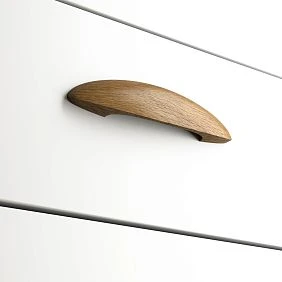
A long handle is a bracket or rail fixed at two points. It has a different scale, a different visual weight, and a different function in the facade space.
Long wooden handles for furniture work perfectly on large facades: cabinets over 180 cm high, kitchen tall units, double-door cabinets, and wardrobe swing doors. A long handle on a tall facade is a vertical accent that structures the plane and makes it "cleaner."
A horizontally placed long handle on a kitchen facade is a different story. It creates a horizontal rhythm, especially when several lower facades are decorated identically. This is a slightly more modern technique that works well in neoclassicism and the "modern classic" style.
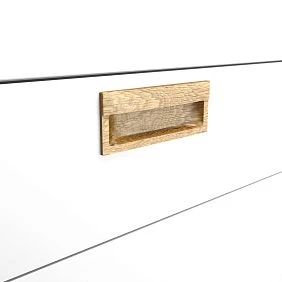
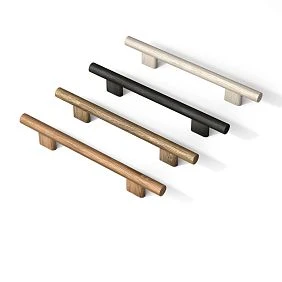
Technically, long handles are attached with two screws at a fixed center distance. Standard values: 96 mm, 128 mm, 160 mm. Before ordering, clarify the center distance of the chosen model and mark the holes on the facade precisely — even a 2 mm error will be noticeable, especially if there are several handles.
Wooden knob handles
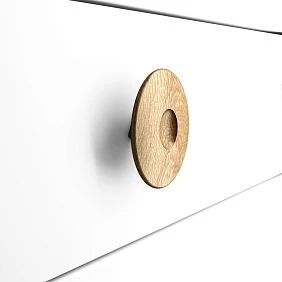
A knob handle is a handle with minimal protrusion. A disc or hemisphere that barely protrudes above the facade surface. The form is ascetic, almost architectural.
Buy wooden knob handles for furniture is worth it when you need a minimalist look without a clear accent on the hardware. The knob handle does not attract the eye — it blends into the surface. This works for modern neoclassicism, for shaker-style furniture, for chests of drawers and nightstands where the facade decor plays a key role, and the handle should be a functional but unobtrusive element.
On dresser drawers, knob handles create an even ornamental row: several identical small elements along the axis of each drawer — a quiet rhythm that reads as a designer detail. In the kitchen, knob handles combined with molding frames create an "integrated decor" effect — as if all the furniture was designed as a single object.
Choosing wooden handles according to furniture purpose
The same handle will look and function differently on different pieces of furniture. The purpose of the furniture determines the requirements for shape, size, coating, and even mounting height.
Wooden handles for kitchen furniture
The kitchen is the most intensively used area. Handles here are opened dozens of times a day. This means requirements for fastening strength, grip comfort, and coating durability.
Buy wooden handles for kitchen furniture means choosing models made of dense wood (beech, oak) with a good coating: varnish or oil-wax, which protect the surface from moisture and dirt. In the kitchen, an unfinished handle will quickly darken from grease and regular touching. Coating is not about aesthetics; here it is a practical necessity.
For lower kitchen modules, long horizontal handles or large-diameter round handles work well — convenient grip when hands are full. For upper wall cabinets, long vertical handles or compact round handles that do not risk being bumped when passing by.
В kitchen decor ideas In classic and neoclassical styles, wooden handles are a key element of the final image. A kitchen with white facades, moldings, and wooden handles in a walnut or white finish looks completely different from the same kitchen with chrome brackets.
A separate point is the combination of a wooden handle with kitchen fittings: hinges, soft-closers, pull-out systems. Make sure the handle does not conflict with the hinges in terms of placement and that its length does not interfere with opening adjacent doors in a compact kitchen layout.
Wooden handles for a cabinet
The cabinet imposes other requirements. Here, the proportion of the handle to the facade height is important. A 220 cm tall cabinet with small round handles looks unbalanced — the handle gets lost. A long vertical bracket on the same facade creates the necessary visual accent.
for cabinet decor In a classic interior, long wooden handles in a vertical arrangement are a standard solution. They create a sense of "door" scale that matches the facade height. A handle 20–30 cm long with a center distance of 160 mm is placed vertically at a distance of 1/3 of the height from the bottom edge of the facade — this is a classic position used in furniture since the 19th century.
For a cabinet with double doors, the handles should be identical in shape and position on both doors. Even a minimal height discrepancy is immediately noticeable. Use a template or painter's tape for marking — do not rely on the eye.
If the cabinet is decorated with pilasters and columns for furniture and moldings, a wooden handle completes the system. Choose a model in the same tint as the pilasters — this creates the feel of a single custom piece.
Wooden handles for a chest of drawers and nightstand
A chest of drawers is about rhythm. Three, four, five drawers, each requiring a handle. Identical handles along the vertical axis of each drawer create an ornamental row that organizes the entire piece.
For a chest of drawers, round handles or knob handles work better: compact, symmetrical, without excessive protrusion. A long handle on a narrow drawer of a chest of drawers creates a disproportion — the handle ends up wider than is logical for that format.
В design of dressers and bedside tables in the interior wooden handles are especially organic when the furniture is decorated with overlays or moldings made of the same solid wood. A round ball handle on a drawer with a thin molding frame is a complete classic detail that requires minimal effort but delivers maximum effect.
For a bedside table — a small item, one or two doors or drawers — the same round handles of small diameter work. Here, the shape is less important than the mounting height: the handle should be comfortable when sitting on the bed.
Wooden handles for children's furniture
Children's furniture is a separate scenario that requires special attention to shape. Here, wooden handles outperform metal ones in every way: they are tactilely softer, have no sharp chrome edges, are warm to the touch, and safe upon accidental contact.
For children's furniture, choose round wooden handles with a smooth surface — without sharp edges or decorative protrusions. Size — small or medium, proportionate to a child's hand. Coating is mandatory: varnish or oil-wax with confirmed food safety.
Vertical placement of the handle — slightly lower than on adult furniture: at a height of 90–100 cm from the floor for lower cabinets, 130–140 cm for upper ones if they are not higher than 160 cm. It should be comfortable to reach without a stool.
Coating of wooden handles: without coating, with coating, and for finishing
This is one of the key practical questions that is almost never asked in time — and then creates problems. The handle coating affects three things: durability, consistency with the facade, and the possibility of self-finishing.
Furniture handles without coating
Uncoated furniture handles — these are products made from bare solid wood, ready for further finishing of your choice. This is the most flexible option: you can apply any coating — stain, tint, oil, wax, acrylic varnish, enamel — and get exactly the color and shade needed for a specific project.
Uncoated handles are the choice of designers and craftsmen who work with a unified color system. The kitchen is painted in color F7F0E6 — the handles are primed and painted in the same color. The cabinet is tinted to "walnut" — the handles are treated with the same stain with the same dilution. The result is a perfect color match that cannot be achieved otherwise.
Important: before applying the final coating, wooden handles need to be sanded with fine sandpaper (grit 220–320) and primed. This ensures even absorption and durability of the coating.
Coated furniture handles
Handles for furniture with coating — these are ready-to-install products with a finished top layer. They are suitable for cases where no additional finishing is planned: you take the handle out of the packaging, mount it — and it already looks like a completed element.
Coated handles are convenient for quick furniture assembly: no need to wait for drying, no need to set up a painting area. This is especially relevant when working with standard series: you buy handles with a "walnut" coating — and they immediately match furniture with similar tinting.
The only condition: the handle coating must exactly match the facade coating. If the shade differs slightly, it will be noticeable — especially in daylight. Therefore, when choosing coated handles, it is advisable to order a sample before placing the main order.
Wooden handles for painting with enamel
A separate scenario: furniture is painted in a solid color with enamel — white, gray, blue, green. In this case, facades, moldings, overlays, and handles are all coated with the same compound. An uncoated wooden handle is ideal here: it is sanded, primed, and painted together with the other wooden elements.
This is a key advantage of wood over metal in fully painted projects: a wooden handle can be included in a single paintable system. A metal handle cannot be painted with enamel without special primers — and it will still peel over time. Wood holds paint reliably.
How to choose the size of a wooden handle: proportions and calculation
Handle size is not about "the bigger, the better" or "the smaller, the more discreet." It's a matter of proportion, and it's solved through specific measurements.
Handle-to-facade proportion
Rule of thumb: the length of the handle (for long models) should be between 1/4 and 1/3 of the facade width. A 60 cm wide facade — handle length 15–20 cm. A 40 cm wide facade — handle length 10–13 cm. Going beyond these limits creates either a "lost" look (too small) or an overloaded look (too large).
For round handles, the same logic applies: the handle diameter should be no more than 5–7% of the facade width. On a 50 cm facade — handle diameter 2.5–3.5 cm. This is a universal ratio, proven in practice.
Handle placement along the facade height
The standard position for a handle on a vertical door is at a height of 1/3 from the bottom (or top) edge of the facade. For a lower kitchen facade, this means the handle is in the upper third — at a height of about 60–70 cm from the floor with a standard facade height of 72 cm. This is a comfortable grip height.
For upper wall-mounted facades, the handle is placed in the lower third — closer to the bottom edge. This is logical: you reach up, grab the bottom of the door.
For drawers — the handle is strictly centered on the drawer, both horizontally and vertically. No offsets. For arranging multiple drawers in a row, use a template made of cardboard or painter's tape with markings — and transfer it from drawer to drawer.
Center distance for long handles
Center distance (CD) is the distance between the centers of two mounting holes on a long handle. Standard values: 32, 64, 96, 128, 160, 192, 224, 256 mm. The manufacturer specifies the CD in the description of each model.
Before marking the holes, make sure the CD of the selected handle matches your markings. An error is unacceptable: a hole in the facade is forever. Better to check three times than to redo it once.
How to combine wooden handles with other STAVROS decor
A handle is the final element in the decorative system of a furniture facade. But it is the final one, not the only one. For a complete look, the handle must work in ensemble with other wooden elements.
Handles and carved overlays
If the facade has Carved Insert for Furniture — an ornamental central motif — the handle should not compete with it. The hierarchy rule applies here: the overlay is the main accent, the handle is a functional element. Choose a compact round handle or a knob handle in the same tint. It will support the look without taking over the role.
The placement of the handle relative to the overlay is also important. If the overlay is in the center of the facade, the handle is placed in the upper or lower third according to standard logic — not next to the overlay and not above it. The space between the handle and the overlay should be proportional.
Handles and moldings
The molding frame on the facade creates structure. The handle is placed inside this structure or on its axis — depending on the model and style.
for of wooden moldings and millwork It is important that the handle does not overlap the frame. If the frame is narrow (molding width 1.5–2 cm), the handle should be positioned strictly along the central axis of the field, not on the molding line. If the frame is wide — the handle has more freedom in positioning.
The molding profile and handle shape should be compatible in style: classic cabochon molding — a round classic handle, modern flat baguette — a minimalist knob handle.
Handles and furniture legs
wooden furniture legs And handles are two ends of the same piece of furniture: legs support from below, handles open from above. If the legs are made of beech wood with a "golden walnut" tint, the handles should be in the same tone. This is the rule of material and color unity, which applies to all wooden elements of a single product.
for Solutions for STAVROS furniture — for chests of drawers, nightstands, cabinets, kitchen sets — the unity of finish of all wooden components is a hallmark of a professional result.
Handles and decorative elements
wooden decorative elements — corner inserts, rosettes, cartouches — work in conjunction with handles according to the same hierarchy principle. The decorative element is an accent. The handle is a function. They should not "compete" for attention.
In a classic chest of drawers with corner rosettes on the molding frames of the drawers — a round handle in the center creates a harmonious three-element system: rosettes at the corners, handle in the center. This is one of the most stable and time-tested decorative schemes for furniture facades.
Handles and wooden baguette
Wooden Picture Frame used as a frame profile on facades in shaker style and modern neoclassicism. In this style, knob handles or compact long handles with a straight profile are a natural extension of minimalist logic. Round classic handles would be out of place here.
Mistakes when choosing wooden handles for furniture
Even experienced specialists sometimes make mistakes at this stage. Knowing them in advance protects you from a result that will require rework.
A handle that is too small on a large facade. On a cabinet door 220 cm high, a handle with a diameter of 3 cm looks like a button on a coat. The scale must be proportionate.
A long handle on a narrow drawer. A handle with a center-to-center distance of 160 mm on a drawer 200 mm wide is a handle that takes up 80% of the drawer's width. This is overkill.
The shape of the handle does not match the style of the furniture. A carved baroque ball handle on a shaker-style kitchen is a stylistic conflict. The shape of the handle is a statement about the style.
The handle finish does not match the facade. A handle in a wenge finish on a milk oak facade is not contrast, it's a mistake. If contrast is needed, it should be intentional and coordinated with the entire color scheme.
The handle interferes with opening the adjacent facade. In a kitchen with a compact layout, a long horizontal handle on the lower facade may hit the adjacent wall cabinet when opening. Always check the trajectory of the facades before installation.
Handles are chosen without considering moldings and overlays. If there is already decor on the facade, the handle is chosen last — taking into account everything on the surface. Not the other way around.
Uneven positioning of handles on different facades. One cabinet, four doors — handles must be strictly at the same height. A discrepancy of 5 mm is visible to the naked eye. Use a single marking template for all facades.
Incorrect quantity calculation. Buying 8 handles for 10 facades means stopping installation at the final stage. Always purchase with a reserve of +2 pieces: in case of drilling errors or hidden defects.
Where to buy wooden furniture handles STAVROS: catalog, finish, formats
Buy wooden furniture handles from STAVROS means getting products made of Russian beech and oak with a full range of shapes and finish options.
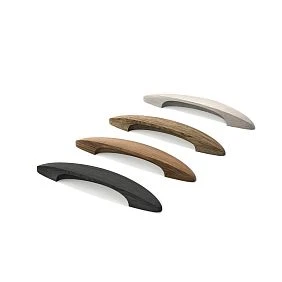
STAVROS handle catalog includes:
-
Round handles — in different diameters and neck heights, for drawers, chests, cabinets, and small doors
-
Long handles — with various center distances (96, 128, 160 mm and others) for wardrobes, kitchen fronts, and tall doors
-
Knob handles — compact, flat, for minimalist and neoclassical solutions
Coating options:
-
Uncoated furniture handles — for self-finishing according to the project
-
Handles for furniture with coating — ready-to-install products with a finish layer
STAVROS works with warehouses in Moscow and St. Petersburg. Delivery across all of Russia. Minimum order — from one item, which is important for targeted tasks: buy one handle, replace a lost part, test a sample before a large order.
To coordinate handles with the rest of the furniture decor: Carved decorative inserts for furniture, Wooden moldings and trim, wooden furniture legs, wooden decorative elements — everything in one catalog, from one manufacturer, made from one material.
Additional solutions: wooden decor in the furniture image system
Wooden handles are one element in a large system. And the more elements of this system you use, the more convincing the final image.
Pilasters and columns for furniture structure the cabinet vertically — create architectural scale. In combination with long wooden handles in the same tint, the cabinet transforms from a "box with doors" into furniture with character.
Decor for Molding — corner inserts and tips for frame systems — allow creating complete molding frames with refined corners. In combination with round ball handles, this forms the classic three-element system mentioned above.
Wooden Picture Frame how a frame profile combined with push-button handles is the formula of modern neoclassicism that works in the kitchen, the bedroom, and the living room.
All these elements are produced by STAVROS from the same material — solid beech and oak. This means that with a uniform finish, they will look like a single cohesive system, not a set of randomly selected parts.
Frequently asked questions
Which wooden handles to choose for the kitchen?
For a classic-style kitchen — round or long wooden handles with a coating (lacquer or oil-wax) resistant to regular use. For a kitchen to be painted with enamel — handles without coating, which are painted together with the facades. More details in the section wooden furniture handles on the STAVROS website.
How do round wooden handles differ from long ones?
Round ones are compact, mounted at a single point, suitable for drawers, chests, cabinets, and small doors. Long ones are brackets with two mounting points, optimal for wardrobes, tall cabinets, and large kitchen facades. The choice depends on the size of the facade and the furniture style.
Can I buy wooden handles without coating?
Yes. In the STAVROS catalog, there is a separate category Uncoated furniture handles — made of solid wood, ready for independent finishing with stain, lacquer, oil, or enamel.
When to choose handles with coating?
Handles for furniture with coating — this is a ready-to-install option that does not require additional finishing. Suitable for quick furniture assembly when painting work cannot be organized.
Are wooden handles suitable for a chest of drawers?
Yes. For a chest of drawers, round handles or knob handles are optimal, symmetrically positioned along the axis of each drawer. The main thing is to maintain a uniform height position on all drawers.
Can wooden handles be combined with moldings and overlays?
Yes, this is standard practice. The handle is the final element of the decorative facade system. Wooden moldings, overlays, and handles made from the same material with the same tint create the feel of a custom piece.
How to calculate the correct handle size?
For long handles: length is 1/4–1/3 of the facade width. For round handles: diameter is 5–7% of the facade width. Mounting height is 1/3 from the bottom edge for vertical doors, centered for drawers.
Are wooden handles suitable for children's furniture?
Yes, especially round models with a smooth surface — no sharp edges, warm to the touch, safe. The coating is varnish or oil-wax without harmful solvents.
How to coordinate handles with the rest of the furniture decor?
Use a single material (beech or oak array) and a single tint for all wooden elements: handles, moldings, overlays, legs. The shape of the handle should match the decor style: Baroque — rounded classic shapes, Neoclassicism — concise straight profiles.
About the company STAVROS
When a furniture piece is made from live wood, it becomes part of the space, not just an object in it. This difference cannot be explained in words — it must be felt.
STAVROS is a Russian manufacturer of wooden furniture decor and fittings made from beech and oak array. Production and warehouses are located in Moscow and St. Petersburg. The company produces a full range of elements for decorating furniture facades: handles, overlays, moldings, pilasters, columns, furniture legs, decorative elements, and polyurethane products.
STAVROS works with private customers, interior designers, furniture manufacturers, and restorers throughout Russia. Minimum order — from one item. The catalog includes hundreds of SKUs with the ability to select by shape, size, material, and finish.
A wooden handle made from solid wood is a detail that is noticed. That is touched. That makes people say: "What is this made of?" Because real wood always speaks for itself.