Article Contents:
- Paw HL-047 or Star HL-044: the main difference is in the character of the shape
- What do the two wooden button handles have in common
- When to buy the paw handle Paw HL-047
- For a room with an animal and nature theme
- For toy storage
- For a single prominent facade
- For multiple children and clear sections
- For a space and fairy tale children's room
- For a long row of identical drawers
- For furniture that should look calmer
- For a matching set of wardrobe, chest of drawers, and table
- Handles for a wardrobe in a children's room
- Handles for a children's chest of drawers
- Handles for a bedside table
- Handles for a desk
- Sections and drawers for toys
- When to choose beech
- When to choose oak
- Why you shouldn't randomly mix beech and oak
- Facade thickness and screw length
- Existing holes
- Clear opening of adjacent facades
- Orientation of shapes
- Finishing before installation
- New custom furniture
- Updating a ready-made cabinet
- Room for a preschooler
- Schoolchild's room
- Shared children's room for two children
- Kindergarten, playroom, or studio
- Choose only by a beautiful photo
- Do not consider the number of repetitions
- Mix shapes without a rule
- Order an unpainted model, expecting a ready color
- Confuse beech and oak
- Do not check the thickness of the facade
- Ignore existing holes
- Do not check adjacent doors
- Paint the handles before fitting
- Forget plugs and spare parts
- Paw is suitable if
- Star is suitable if
- Consider another model if
- Which handle is larger — Paw or Star?
- Which model is better for a cabinet?
- Which handle is more comfortable for a dresser?
- Can Paw and Star be placed on the same piece of furniture?
- What to choose for a room that needs to last a long time?
- What wood are the handles made from?
- Are Paw and Star supplied painted?
- Is the mounting hardware included in the set?
- Are FUR-032 or FUR-033 caps needed?
- Can the handles be installed into old holes?
- How to calculate the quantity?
- Do I need to buy a spare handle?
- How to choose the color?
- Can I paint the handles myself?
- Which model is better for toy boxes?
- Where can I see other shaped knobs?
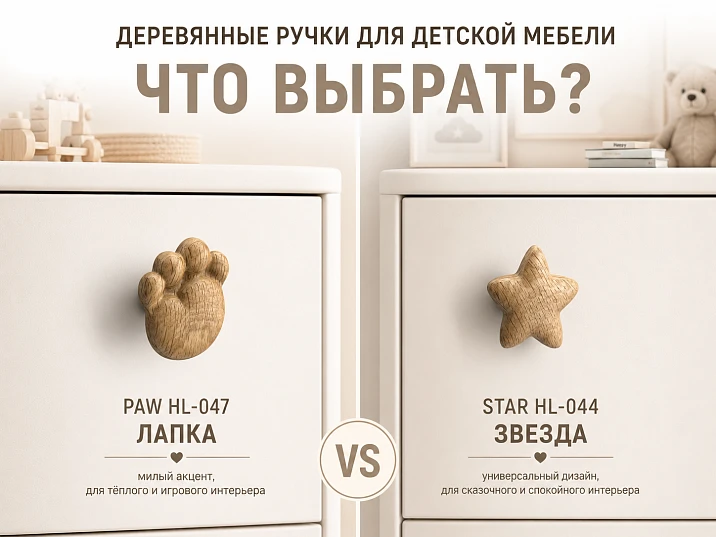
Wooden knobs for children's furniture are often chosen at the very end of the project, when the wardrobe, chest of drawers, or nightstand is already assembled and only a small detail remains to be added. But it is this small detail that is at the child's eye level, repeats on every facade, and participates in opening the furniture daily. Therefore, the shape of the knob affects not only the appearance: it helps set a clear theme for the room, distinguish storage sections, and connect several pieces into one set.
Paw HL-047 and Star HL-044 are two shaped knob handles from STAVROS, similar in size, material, and construction, but different in character. Paw is shaped like a paw and better supports themes of animals, nature, play, and toy storage. Star has the shape of a five-pointed star and works better in space, fairy tale, and more neutral compositions, especially when one symbol needs to be rhythmically repeated along a long row of drawers.
Both models are made from beech and oak, have a 'Prestige' sanding finish, are supplied without a topcoat, and come with mounting hardware. Beech is prepared for enamel, oak for tinting. The size of Paw is 52 × 58 × 27 × 20 mm, Star is 54 × 52 × 27 × 20 mm. The difference in overall size is small: parameters C and D match, and the choice is primarily determined by the silhouette, the children's room theme, and how the knobs will be distributed across the facades.
Below are practical scenarios for a wardrobe, chest of drawers, bedside table, desk, and toy sections. The article will help decide when to buy the Paw paw-shaped knob, when to choose the Star star-shaped knob, whether the two shapes can be mixed, how to calculate the quantity, how beech differs from oak, when the ready-made M series is more convenient, and what to check before installation.
Short answer.
Paw HL-047 is better suited for furniture with an animal, nature, and play theme: the paw looks lively, helps mark toy drawers, and makes an individual facade more noticeable. Star HL-044 is more rational for a space, fairy tale, or calm children's room, as well as for a long row of identical drawers where a symmetrical repeating symbol is needed. In terms of materials and preparation for finishing, the models are identical, so first choose the shape and layout system, then beech for enamel or oak for tinting.
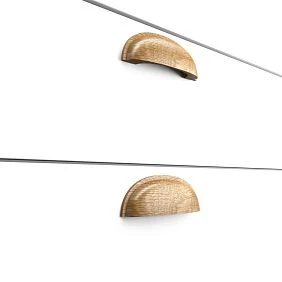
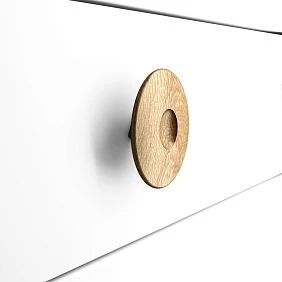
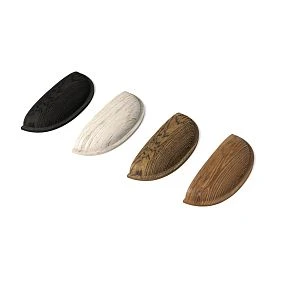
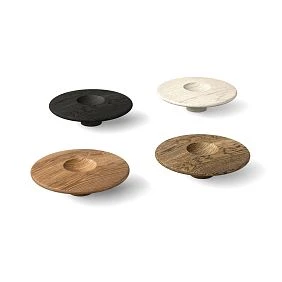
Paw HL-047 or Star HL-044: the main difference is in the shape character
Technically, Paw and Star belong to the same type of hardware — they are solid wood knob handles. They are installed with a single attachment point, so they are suitable for similar furniture tasks: cabinet doors, dresser drawers, nightstands, desk sections, and toy modules. Their almost identical scale allows for comparison without adjusting for one being noticeably larger than the other.
The difference begins with how a child and an adult perceive the silhouette. The paw is asymmetrical and immediately evokes associations with an animal, a walk, a footprint, a pet, or a forest story. It is perceived as an independent symbol and highlights a specific door well. The star is more geometric and balanced. It can be easily repeated on five, six, or eight identical facades without creating a sense of a random set.
If the furniture should have a pronounced playful character, you can buy the Paw HL-047 handle and make the paw the main motif. When a calmer system is needed that suits both a young child and a school-age child, it is convenient to buy the Star HL-044 handle: the star remains childlike but is not tied to a single animal or specific story.
The shape also influences the color strategy. Paws are interesting to paint in several coordinated colors, turning a row of drawers into clear playful markers. Stars look particularly convincing in a single shade, where repetition supports the geometry of the facade. This is not a technical limitation but a practical logic that helps avoid visual overload.
| Criterion | Paw HL-047 | Star HL-044 |
|---|---|---|
| Shape | Paw | Five-pointed star |
| Size A × B × C × D | 52 × 58 × 27 × 20 mm | 54 × 52 × 27 × 20 mm |
| Type | Knob handle | Knob handle |
| Material | Beech or oak | Beech or oak |
| Sanding | «Prestige» | «Prestige» |
| Beech | For enamel | For enamel |
| Oak | For tinting | For tinting |
| Condition | Unfinished | Unfinished |
| Mounting | Included in set | Included in set |
| Visual image | Animals, nature, play | Sky, space, fairy tale |
| Repeat pattern | More lively and asymmetrical | Smoother and more symmetrical |
| Finished version | Paw HL-047M with coating | Star HL-044M with coating |
The table shows that the material, sanding level, and delivery principle are the same for both models. Therefore, there is no point in choosing Star for oak or Paw for enamel: both routes are available for each shape. First, the compositional task is solved, then the finishing one.
Parameters C and D are the same for both models — 27 and 20 mm. Differences in A and B are a few millimeters and are related to the contour of the paw and star. For most projects, this means a similar overall scale, but before ordering, it is still useful to make two full-size paper templates. On a small box, the difference in silhouettes is more noticeable than in numbers.




What two wooden knob handles have in common
Paw HL-047 and Star HL-044 are made from solid beech or oak. Natural material is important not just as a description on the product page. Wood allows the hardware to be integrated into the overall finishing system of the furniture: beech handles can be painted together with the facades, and oak handles can be tinted to enhance the visible wood grain.
Both models are supplied without coating. The buyer receives a prepared part, but the final color and protective layer are not yet determined. This format is convenient for custom projects where a factory shade might not match the furniture. At the same time, it requires deciding in advance who will handle the finishing and in what sequence the handles will be fitted, primed, painted, or tinted.
The "Prestige" sanding is especially suitable for shaped handles. Their contour is constantly examined up close, and fingers touch the edges with every opening. Careful preparation helps preserve the shape after coating and makes working with enamel or tinting easier. But even a well-prepared part should not be painted without checking the chosen technology and material compatibility.
The bracket is included with both models. This does not eliminate the need to check the facade: you need to measure its thickness, evaluate the length of the included screw, ensure it matches the existing hole, and check that the fastener will not protrude inside the drawer or cabinet. The inclusion simplifies the purchase, but the actual furniture assembly always requires a test fit.
| Characteristic | Paw HL-047 | Star HL-044 |
|---|---|---|
| Purpose | Decorative knob handle for children's furniture | Decorative knob handle for children's furniture |
| Materials | Beech, oak | Beech, oak |
| Surface preparation | Prestige sanding | Prestige sanding |
| Finish as supplied | No | No |
| Recommended route for beech | Opaque enamel | Opaque enamel |
| Recommended route for oak | Toning with preserved texture | Toning with preserved texture |
| Mounting | Included in the set | Included in the set |
| Suitable facades | Wardrobes, chests of drawers, bedside tables and other children's room modules | Wardrobes, chests of drawers, bedside tables, tables and other children's room modules |
| What to check before ordering | Size, thickness of the facade, opening, finish | Size, thickness of the facade, opening, finish |
Our factory also produces:
When to buy the Paw HL-047 handle
Get Consultation
For a room with an animal and nature theme
Paw handle for children's furniture immediately sets a recognizable theme. It suits a room that already has animal images, forest shades, natural textures, textiles with paws, or a pet theme. In such an environment, the handle does not look like a separate decoration: it continues the story and connects the furniture with the rest of the interior.
The paw is also useful in a neutral room if you need one playful motif without complex decor. For example, a white wardrobe with simple facades may look too adult. A few wooden paws add a childlike character but do not require drawings on every door. Later, the facades can be repainted, and the handles can be replaced or refinished in a different palette.
To prevent the image from becoming intrusive, it is not necessary to put Paw on all furniture. Paws can be used to highlight only the section with toys or the lower drawers accessible to the child. The upper cabinets are left with calmer hardware or use one shape in a neutral color. This hierarchy helps the child quickly understand where his things are.
For storing toys
On boxes with toys, the paw is perceived as an understandable game marker. It is easier for a child to remember "cubes in the box with the blue paw" or "soft toys behind the green paw" than to navigate only by identical white facades. The shape works together with color and helps create a simple storage system.
It is important not to turn the system into a random set. If each paw is painted in its own color, the shades should be pre-selected and repeated in the room. If the furniture is large, it is better to use a limited palette: for example, two colors for different types of storage. Too many shades in a small area make orientation difficult and quickly tire.
For such a project, you can choose the Paw furniture handle made of beech and paint it with opaque enamel. Beech allows you to not depend on the natural pattern: color becomes the main thing. If you want to preserve the wood and make the drawers calmer, an oak paw for tinting is appropriate.
For a single prominent facade
The asymmetric shape of Paw works well on a single cabinet door or large facade, where the handle is perceived as a separate detail. The Star unfolds more strongly in repetition, while the Paw can be convincing even alone. Therefore, Paw is often suitable for a bedside table, a drawer under the bed, or a small cabinet.
When installing a single handle, the position is especially important. It is better to attach the paw to the facade before drilling and see how it interacts with the panel, edge, and adjacent furniture. A shaped handle has a top and bottom, so it needs to be oriented the same way on paired doors. A careless rotation is more noticeable than with a simple round knob.
If the furniture already has a hole, check whether the required mounting location matches the existing point. Sometimes the old hole is located too close to the edge or decorative frame. In such a case, first assess the possibility of installation, and only then choose the shape.
For multiple children and clear sections
In a shared children's room, paws can be used as conditional section markers. One child gets handles of one color, the other gets a different color. The shape remains the same, so the furniture looks like a unified set, while the color helps distinguish personal drawers. This approach is calmer than mixing a large number of different shapes.
If children like different themes, Paw can be placed only on the shared toy module, while personal cabinets can be decorated with Star or another agreed-upon model. The main thing is to establish a clear rule. When the rule is readable, the mixed set looks designed. When shapes are distributed without a system, the facades start to resemble a sample display.
When it's better to choose the star handle Star HL-044
For a space and fairy-tale children's room
Star handle for children's furniture naturally supports images of the sky, moon, clouds, planets, and fairy-tale themes. It suits both a bright space-themed room and a light bedroom with soft pastel colors. The star is recognizable but does not tie the interior to a single character or age.
This is especially important for furniture bought for the long term. A specific cartoon theme can quickly become boring, while a simple star remains appropriate for both a preschooler and a school-age child. When changing textiles or wall colors, the handles can be repainted while preserving the shape itself.
In a space theme, it is not necessary to use dark blue. White, gray, wood-toned, or softly colored stars support the theme without literal design. The calmer the furniture, the easier it is to change accessories as the child grows.
For a long row of identical drawers
The five-pointed star has a more regular silhouette, so it repeats well on multiple facades. On a wide dresser with six drawers, identical Stars form an even row and emphasize the furniture's geometry. Paws are also possible in this situation, but their more lively contour gives a less strict rhythm.
Repetition helps to assemble different items into a set. Identical stars on a wardrobe, chest of drawers, and nightstand visually connect the furniture, even if the facades differ in width. For this, it is important to maintain the color, material, and orientation. If some handles are painted and some are tinted, a uniform sign no longer guarantees integrity.
When a calm row is needed, you can buy the Star HL-044 handle in the required quantity and order all items simultaneously. This simplifies finishing planning and reduces the risk that some facades will be left without coordinated hardware.
For furniture that should look calmer
The star remains a shaped children's handle, but its geometry is usually perceived as calmer than an animal track. On classic paneled facades, Star can look like a small decorative sign that does not compete with the door profile. In modern furniture, it adds a soft motif to a simple rectangle.
This balance is useful when the room already has many patterns: wallpaper, textiles, carpet, toys on open shelves. Additional paws of different colors can make the picture too busy. Solid-color Stars provide a childlike character but keep the visual background more cohesive.
If doubt remains, attach paper outlines of both models to the facade and step back a few meters. The paw reads more strongly as an image, the star as a repeating element. The real choice is easier to make on furniture than from a separate product photo.
For a unified set of wardrobe, chest of drawers, and table
Star is convenient to transfer from one item to another. On wardrobe doors, it works as a pair; on a chest of drawers, as a row of identical buttons; on a desk, as a small repetition. One sign connects the furniture without needing to copy the shape of the facades.
For a children's chest of drawers, you can choose a wooden handle for a children's dresser, and then repeat it on the nightstand. If the table and wardrobe already have holes of a different type, first check compatibility, rather than buying a set just for visual unity.
A uniform shape is especially useful in a small room where all furniture is in one field of view. In a spacious children's room, it is acceptable to divide zones: Star in the work area, Paw in the play area. But even here, it is advisable to maintain a common material or color.
Which model is best for a wardrobe, dresser, nightstand, and desk
Handles for a wardrobe in a children's room
On the wardrobe, handles are located on large vertical fronts and are visible from any point in the room. For double doors, Star often looks calmer: two symmetrical stars support the central axis. Paw adds more playfulness and is suitable if the wardrobe is associated with an animal theme or should immediately differ from adult furniture.
Before installation, check the distance from the handle to the edge of the door and the adjacent front. The figured contour is wider than the attachment point, so two handles on double doors should not collide when opening. A paper template helps to see the actual distance without drilling.
A wide selection is convenient to start with a category where you can choose handles for children's furniture. A category is needed if Paw and Star seem too thematic or if you need to compare them with other knob handles. But the article decision is best made between specific product cards.
Handles for a children's dresser
A dresser usually has several identical drawers, so repetition is important here. Star emphasizes an even row, especially on geometric facades. Paw makes each drawer more playful and allows for color navigation. Both models are similar in size, so the difference is determined by the task, not by the convenience for a specific drawer.
If the drawers are wide, the design may include two handles on one facade. You cannot automatically transfer the rule from one knob to two: the position depends on the construction and existing holes. First, the opening scheme is determined, then the quantity. For new furniture, this is discussed with the manufacturer; for ready-made furniture, the actual points are checked.
On a tall dresser, the lower handles are accessible to a child earlier than the upper ones. Their finish should be designed for frequent touching. The issue of protective coating is resolved within the chosen enamel or tinting system. An unpainted wooden part should not be installed as a final option without coordinating the finish.
Handles for a bedside table
A bedside table usually has one door or one or two drawers, so the handle appears larger. Paw works well as a single sign and adds a friendly image. Star is suitable if the bedside table matches a wardrobe or dresser and should remain part of a complete set.
Consider the proximity to the bed. The handle should not obstruct passage, catch on textiles, or press against an adjacent object when opening. The models are small in size, but the shaped contour requires checking in the actual position.
If the bedside table is painted the color of the wall or bed, a beech handle can be included in the same enamel. If the furniture has a visible oak surface, it is more logical to consider oak with a coordinated tint.
Handles for a desk
On a desk, the hardware is often perceived as part of the work furniture. Star usually fits more easily into a calm composition and supports the sky theme without excessive playfulness. Paw is appropriate if the desk is part of a bright children's set or one of the drawers is intended for creative materials.
Check the position of the knees, pull-out modules, and adjacent drawers. Fasteners should not protrude inward where paper is stored or where the hand frequently touches the inner surface. The screw length is assessed after measuring the thickness of the facade.
For a workspace, it is useful to use one system: identical handles on all drawers and a separate sign only for a special section. This makes it easier for the child to navigate, and the furniture does not look chaotic.
Sections and drawers for toys
Here, Paw gets the most literal application. The paw turns storage furniture into part of the game and helps indicate the contents by color. Star is also suitable, especially if the room is decorated like the sky or if all sections should look the same.
For heavy or frequently used drawers, not only the shape but also the furniture construction is important. The knob handle must be properly secured, and the facade must be designed for the chosen opening method. The article helps choose a model but does not replace checking the furniture assembly.
If there are many sections, count all doors and drawers in advance. An error in quantity is especially noticeable in a repeating system: one facade with a different handle disrupts the entire logic.
How to distribute shaped handles across facades
Good hardware does not save a random layout. Before ordering, you need to decide whether one shape will be repeated on all furniture or whether Paw and Star will have different functions. A simple diagram on a sheet helps to see the entire set and immediately count the quantity.
The calmest option is one model on all facades. It suits a small room, furniture of one color, and a project that should remain relevant for several years. Paw makes the set more playful, Star makes it more geometric.
The second option is distribution by zones. Paws are placed on toy drawers, stars on clothes, books, or work supplies. Such a system is understandable to a child only when it is consistent. You cannot change the rule from one item to another without reason.
The third option is one handle on the cabinet, another on the dresser. It works if the items are in different parts of the room. To avoid them looking random, maintain a single color or one type of wood. For example, all handles are oak with the same stain, but the shapes differ by function.
| Distribution scheme | What it looks like | When it fits | What to Check |
|---|---|---|---|
| All facades with Paw | Lively play set with a unified paw motif | Room with animals, nature, toy storage | Same orientation, color, and quantity |
| All facades with Star | Even repetition of a symmetrical star | Space-themed, fairy-tale, or neutral children's room | Matching shade on the cabinet, dresser, and nightstand |
| Paw for toys, Star for clothes | Shapes become navigation | Large storage system with clear zones | So the rule repeats on all furniture |
| Paw on the dresser, Star on the wardrobe | Different items get their own sign | Furniture is spread across the room | Uniform material or color |
| One model, different colors | Shape maintains order, color distinguishes sections | Room for several children or color navigation | Limited palette without random shades |
| Different shapes, one color | The set remains connected by trim | Two themes needed without motley | Same painting or tinting technology |
One shape or mixed set of Paw and Star
Two models can be mixed, but not for the sake of variety itself. Each shape must have a clear role. Paw can denote the play area of the room, Star — the sleep or study zone. If the meaning is not readable, the two shapes start competing and make the furniture look like a display stand.
Same color is the simplest way to tie a mixed set together. White Paw and Star on different items are perceived as one collection because the material and finish unify the silhouettes. For oak, the same task is solved by one tint.
Another way is the same shape within one item. On the cabinet only Star, on the dresser only Paw. Do not alternate paw and star on every adjacent drawer if there is no function behind it. Such a pattern quickly becomes too active.
When mixing, consider the child's age and the furniture's service life. If the set is to remain in the room for a long time, Star can be used as a base handle, and Paw can be used selectively on a mobile drawer or cabinet. Later, the playful part is easier to replace without redoing the entire set.
Dimensions, grip, and scale: what to check before ordering
Paw measures 52 × 58 × 27 × 20 mm, Star measures 54 × 52 × 27 × 20 mm. The numbers show that the handles are comparable in depth and mounting part, but the contours are oriented differently. The paw is slightly wider in one dimension, the star in another. On a large cabinet, this difference has almost no effect on scale, but on a narrow drawer, the contour orientation may be noticeable.
Make full-size templates. Cut out rectangles 52 × 58 mm and 54 × 52 mm, draw the silhouette inside, and apply it to the facade. This way, you can check the distance to the edge, panel, adjacent handle, and opening line. The template does not convey volume but helps assess the area.
The depth of 27 mm affects how much the handle protrudes from the facade. This parameter should be considered near a bed, wall, another door, or passageway. The grip of a shaped knob differs from a round one: the hand interacts with the relief contour. Before a large order, it is wise to evaluate one model on an actual facade or carefully study the product card.
On children's furniture, the placement height is important. The child should be able to open accessible sections without awkwardly stretching their arm. However, the handle itself does not determine the height: the position is set by the facade design. When replacing old hardware, the existing hole often fixes the point, so compatibility is checked first.
Beech for enamel or oak for tinting
When to choose beech
Beech is suitable if the handles need an opaque color. Enamel allows linking the hardware with painted facades, walls, beds, or textiles. On beech, the silhouette of Paw or Star becomes the main focus, while the natural wood grain takes a back seat.
Solid enamel makes the set calmer. For example, all stars can be painted in the color of the facade so that they are read through shadow rather than contrast. Paws can be made accent, but the palette is best limited to two or three coordinated shades.
For a project under painting, you can choose Paw handle in beech for enamel or Star HL-044 from beech for painting. The exact composition of primer, enamel and protective coating is determined by the finishing contractor; the product card specifies the material and delivery condition, but does not replace the process sheet.
When to choose oak
Oak is chosen when you need to preserve the woody character of the handle. Tinting emphasizes the texture and helps coordinate the hardware with oak facades, countertops, bed or shelf. Paw in oak looks more natural, Star more graphic, but both forms retain the feel of a natural detail.
You should not choose a shade only by its name. The same tone looks different on a sample, finished furniture and a small handle. Before finishing, it is useful to make a test on the same material and evaluate it under the room's lighting.
For oak furniture, handles can be tinted to a close color or deliberately made more contrasting. Complete matching is not always necessary, but the difference should look intentional. An accidental close shade is often more noticeable than an honest contrast.
Why you should not accidentally mix beech and oak
Formally, Paw and Star are available in both wood species, so a mixed order is possible. But beech for enamel and oak for tinting create different surfaces. If some handles are painted and some show the texture, the furniture gets two visual languages at once.
Such a combination can be appropriate only in a pre-planned scheme, for example oak Star on a wooden cabinet and painted Paw on a separate toy box. For a regular set, one wood species and one finishing technology is more rational.
When calculating the quantity, write down not only the article number but also the material. The phrase 'ten children's handles' is insufficient if five should be from beech and five from oak.
Buy handles without coating or choose the ready-made M series
Unpainted Paw HL-047 and Star HL-044 give freedom of finishing. This is a strong advantage if furniture is made to order, the color of the facades is still being clarified, or an exact match with a sample is required. But freedom means additional steps: fitting, preparation, coating, drying, and result control.
Ready-made versions Paw HL-047M and Star HL-044M are suitable for a buyer who does not plan to do their own finishing. In the cards of ready-made models, you need to check the current material, color, and coating option. The presence of the letter M helps distinguish the ready-made version from the unpainted one, but before ordering, you still need to compare the full name and photos.
For the paw, you can buy Paw HL-047M with coating, for the star — buy Star HL-044M with coating. If you need to compare more ready-made options, it is useful to choose painted children's handles in the Kids collection.
You cannot automatically consider the ready-made series better. If the color does not match the furniture, the ready-made finish limits the project. Conversely, an unpainted handle is not rational when there is no workshop, time, or clear technology. The choice depends on the route after purchase.
| Criterion | Paw HL-047 / Star HL-044 without coating | Paw HL-047M / Star HL-044M with coating |
|---|---|---|
| Condition | Prepared wooden handle without finish coating | Finished version with coating |
| Main advantage | Color and tint can be matched to specific furniture | No need to arrange separate finishing |
| What needs to be decided in advance | Material, technology, color, contractor | Whether the finished color and surface are suitable |
| When to choose | Custom furniture, repainting, individual interior | Quick repair or ready-made furniture |
| Risk of error | Finishing done using unsuitable technology | Ready shade does not match the facade |
| Commercial route | Paw HL-047 or Star HL-044 | Paw HL-047M or Star HL-044M |
How to calculate the number of handles
Calculation starts not from the total number of furniture items, but from each opening facade. Cabinet doors, drawers, cabinet doors, desk sections, under-bed drawers, and mobile containers are counted separately. For each element, one or two handles are recorded according to the actual layout.
The next step is separation by model. If Paw denotes toys and Star denotes clothes, there should be two separate rows in the table. Then the quantity is divided by material and delivery type: beech or oak, without coating or M series. Such detail protects against a situation where the total number is correct, but half of the items are ordered in the wrong finish.
It is useful to provide a spare handle, especially if the furniture is intended to last a long time or is used in a commercial children's setting. A spare allows quick replacement of a part without changing the entire set. The decision about a spare is made based on the project and budget, but it is better to discuss it before placing the order.
Count plugs for fasteners separately if they are needed according to the chosen scheme. The number of plugs is related to the number of attachment points. Do not add them automatically without checking the card and installation: first determine the actual node, then the list of fittings.
| Furniture element | Number of facades | Handles per facade | Selected model | Total |
|---|---|---|---|---|
| Cabinet doors | Fill by project | 1 or by project | Paw or Star | Facades × handles |
| Drawer chest drawers | Fill by project | 1 or 2 by design | One model per row | Drawers × handles |
| Cabinet | Fill by actual | By facade scheme | Paw or Star | Sum of doors and drawers |
| Desk | Fill by actual | One per drawer, if so provided | More often Star or a single headset model | Sum of drawers |
| Sections for toys | Fill by actual | By design | Often Paw | Sum of sections |
| Reserve | At the buyer's discretion | — | Same article, material, and finish | Add separately |
| Caps | By number of required points | By mounting diagram | FUR-032 or FUR-033 | Check before ordering |
What to check before ordering and installation
Facade thickness and screw length
The fastener is included in the kit, but furniture facades vary in thickness. The included screw must be matched to the actual material of the door or drawer. A screw that is too short will not provide the required connection, while one that is too long may protrude from the inside.
Measurements are taken before ordering a large batch. If the furniture is custom-made, data is requested from the manufacturer. When replacing handles, the thickness can be measured on an accessible edge or after removing the old hardware.
Do not compensate for mismatches with random washers or shims without approval. The mounting assembly must be neat and safe for daily use.
Existing holes
The knob handle uses a single mounting point, which makes it convenient to replace with another knob. However, matching the type does not guarantee a successful position. The old hole may be too close to the panel, edge, or decorative cutout.
Place the Paw and Star template over the existing point. Check that the outline does not overlap the facade profile and that there is enough space for fingers. If the hole needs to be moved, the issue of repairing the old point is resolved before purchase.
General design principles can be clarified in the material on how to choose a wooden knob handleThe new article maintains a specific focus on Paw and Star, and the general guide helps understand the mounting type and differences between knob handles.
Free opening of adjacent facades
On paired doors, shaped handles must not touch. The paw and star are wider than the central mounting point, so the distance between holes should be evaluated based on the full outline. Narrow cabinets and doors that open towards each other require special attention.
On corner furniture, the handle may press against an adjacent facade or wall. The paper template shows the width, while the confirmed size of 27 mm is used for depth. The final check is done considering the actual hinge and door trajectory.
The placement must be identical on symmetrical facades. A difference of a few millimeters is more noticeable due to the shaped form. For new furniture, a mounting template is useful.
Orientation of figures
Paw and Star have a readable top part. All handles in one row should be turned the same way, unless the project specifically provides for a free composition. Random tilting of the paws makes the facade look untidy, and stars with different rotations lose rhythm.
Before final fixation, lay out the handles on the facades and take a photo from a distance. In the photo, it is easier to notice a random rotation or color mismatch. This check is especially useful for mixed sets.
If finishing is done separately, mark batches and installation locations. After painting, identical parts are easy to confuse, and different shades or shapes may end up on the wrong facades.
Finishing before installation
It is reasonable to first try on unpainted handles, then remove and finish them in suitable conditions. Painting already on the furniture increases the risk of staining the facade and getting an uneven layer at the base.
After coating, the material must be allowed to dry completely according to the chosen technology. Early installation may damage the surface when tightening the fastener. Specific drying times depend on the finishing materials and should not be determined solely by general advice.
When installing, do not overtighten the connection: wood and coating require care. The exact moment and method depend on the furniture assembly, so complex cases are best left to a professional.
Caps FUR-032 and FUR-033: why they are needed
In the Paw and Star product cards, decorative metal caps FUR-032 and FUR-033 are listed as necessary hardware. They cover the head of the M4 screw and help neatly finish the inner side of the fastening. They differ in coating color: FUR-032 is finished in antique bronze, FUR-033 in nickel.
For warm fittings, you can consider the FUR-032 cap in antique bronze. It blends better with other bronze furniture details. For a cool metallic shade, the FUR-033 cap in nickel is suitable.
The cap color is evaluated not only externally. It is located on the attachment side, so the drawer construction and how often the inner surface is visible matter. In open sections and shallow drawers, a neat detail is more noticeable.
Before purchasing, check how many caps are needed and whether they are compatible with the actual attachment. Do not automatically order them based on the number of handles if the furniture unit differs from the expected one.
What to buy together with Paw and Star
The accompanying purchase depends on whether you choose handles without coating or ready-made models. For unpainted Paw and Star, a pre-planned finishing route is needed. For ready-made M-versions, the main check is the match of color and surface condition with the furniture.
If Paw and Star are not the only candidates, you can buy wooden knob handles after comparing the category. It features different shaped models, so the buyer sees not two isolated cards, but a system of fittings for a wardrobe and a chest of drawers.
For a buyer who does not want to do painting, it is useful to buy ready-made handles for children's furniture from the Kids collection with coating. There you can check ready-made options and decide if individual finishing is justified.
For installation, plugs FUR-032 or FUR-033 may be needed. Their color is chosen based on the metal part of the project and the visible side of the fastening. Other materials and tools are determined by the actual facade and technology, so the article does not replace the installation specification.
| What to add to the purchase | Why this is needed | For which scenario | What to pay attention to |
|---|---|---|---|
| Paw HL-047M with coating | Ready-made alternative to the paw without self-finishing | Quick repair or ready-made furniture | Current color and coating in the card |
| Star HL-044M with coating | Ready-made alternative to the star without self-finishing | A chest of drawers, wardrobe or table with a ready-made color solution | Match with facades |
| Kids collection pens with coating | Allow comparing ready-made children's models | When there is no painting workshop | Shape, color, quantity, and availability |
| Catalog of wooden button pens | Helps compare Paw and Star with other shaped forms | The project is not yet linked to two SKUs | Do not mix too many motifs |
| Cap FUR-032, antique bronze | Covers the M4 screw head | Warm metallic palette | Compatibility and quantity |
| FUR-033 cap, nickel | Covers the M4 screw head | Cold metallic palette | Compatibility and quantity |
| Finishing materials for the selected technology | Needed for enamel or tinting of unpainted handles | Custom color | Compatibility with beech or oak |
| Spare handle of the same article | Simplifies future replacement | Large set or commercial children's | Same material and coating type |
How not to confuse Paw and Star with similar products
The first difference is shape. Paw HL-047 has a paw silhouette, Star HL-044 has a five-pointed star. When ordering a large set, check not only the image but also the full article number. The names are similar in structure, and the sizes are close, so an error in one line of the specification may go unnoticed until unpacking.
The second difference is surface condition. HL-047 and HL-044 are supplied without coating, versions HL-047M and HL-044M are finished models with coating. The letter M in the article number is important: it changes the route after purchase. An unpainted handle cannot be expected as a ready-made colored part, and the M-version is not chosen for free individual finishing without evaluating the existing coating.
The third difference is the button handle and the extended handle. Paw and Star are attached as buttons and have one compact shaped form. If there are two holes from an old bracket on the facade, direct replacement may be impossible without surface repair. First, determine the type of existing hardware.
The fourth difference is material. Beech and oak are available for both unpainted models, but the finishing route differs. You cannot order oak expecting to get a ready-made tint if the card says delivery without coating.
For a general comparison of types, the material is useful wooden furniture handles: types, sizes and selection. It helps to understand the place of shaped buttons among other hardware, and the specific decision of Paw or Star is made based on the children's theme and facade layout.
Practical selection for different scenarios
New custom furniture
For new furniture, it is better to choose the handle before drilling the facades. The manufacturer will receive exact dimensions, the position of one mounting point, and will be able to prepare a template. The material of the handles and future finish are selected simultaneously.
If the facades are painted, beech Paw or Star are conveniently finished in the same system as the furniture. But this does not mean that the part should be painted in the same way without testing: a small relief shape may require a different application technique to avoid losing the contour.
For oak furniture, agree on a tint sample in advance. A small handle may appear darker than a large facade due to relief and shadows, so a test is more important than the verbal name of the shade.
Updating an existing cabinet
When updating a cabinet, the main limitation is the existing hole. If there was a knob handle, Paw or Star can often be installed in the same spot after checking dimensions. If there was a pull handle, a second hole will remain, requiring a separate solution.
The color is chosen according to the new concept. On a white cabinet, a contrasting oak handle emphasizes the natural material, while a painted beech one can almost blend into the facade. Paw will make the update more playful, Star more versatile.
Do not start by buying the entire batch. First, attach the template to one facade and check the opening. This is especially important for a cabinet with paired doors.
Room for a preschooler
For a preschooler, the shape can aid navigation. Paw suits toy drawers, Star suits clothes or books. Color markers work if adults maintain the same system and do not change the purpose of sections every week.
Handles should be installed at an accessible height and securely fastened. Decorative form does not replace safe furniture construction. All decisions regarding cabinet stability, wall mounting, and drawer operation are made separately.
Visually, it is better to limit the number of motifs. Paw and Star already provide two symbols; adding many other shapes without a system can overload the room.
Schoolchild's room
Star often suits a schoolchild: it retains a childlike character but looks calmer next to a desk and bookshelf. Paw can be left on the module for hobbies, sports equipment, or storing pet items.
If furniture is repainted as the child grows, unpainted models allow you to choose a new enamel in advance. Ready-made M-versions are more convenient when the color is already chosen and finishing work is not planned.
For a workspace, a uniform shape and one color are useful. The more small items are on open shelves, the calmer the hardware should be.
Shared children's room for two children
In a shared room, one shape can unify the furniture, and color can mark personal zones. For example, all Star handles, but in two coordinated shades. This is simpler and calmer than different shapes on each drawer.
Another option is Paw for shared toy storage, Star for personal cabinets. This scenario reads functionally. The shapes do not divide children by themes, but separate storage types.
When calculating, be sure to keep separate lines for colors and models. An error in one position will disrupt navigation.
Kindergarten, playroom, or studio
In commercial spaces, shaped handles can help define zones and make furniture more intuitive. Paw suits modules with toys and nature themes, Star suits rows of identical lockers. However, the load and operational requirements here are higher, so the choice of decorative shape must be coordinated with the furniture's construction.
A stock of identical handles is useful. With intensive use, quick replacement without changing the entire system is especially important. The material, coating, and article number of the spare must match the installed batch.
The finish must be designed for the conditions of the specific room. The article does not specify the coating composition: it is chosen by project specialists considering the frequency of cleaning and use.
Mistakes when choosing children's furniture handles
Choosing only based on a beautiful photo
On a separate white background, Paw and Star look equally compact. On a real facade, the paw may turn out too active, and the star too calm. Use the template and evaluate the entire piece of furniture. After checking, return to the product card and clarify the article number, material, quantity, and surface condition.
Not considering the number of repetitions
One paw on a cabinet is perceived as friendly, twelve multi-colored paws on a large cabinet can be overwhelming. The shape should be evaluated in the quantity that will actually be installed. After checking, return to the product card and clarify the article number, material, quantity, and surface condition.
Mixing shapes without a rule
Randomly alternating Paw and Star does not create navigation. First, define the function of each model, then place the order. After checking, return to the product card and specify the article, material, quantity, and surface condition.
Order an unpainted model, expecting a ready color
HL-047 and HL-044 are supplied without coating. For the finished version, look at models with the letter M and check the current card. After checking, return to the product card and specify the article, material, quantity, and surface condition.
Confuse beech and oak
Beech is chosen for enamel, oak for tinting. The wood species affects the finishing route and must be recorded in the specification. After checking, return to the product card and specify the article, material, quantity, and surface condition.
Not checking the facade thickness
The complete mounting must match the actual door or drawer. Measurement is performed before installation. After checking, return to the product card and specify the article, material, quantity, and surface condition.
Ignore existing holes
One point of a knob handle will not automatically cover two holes from an old bracket. Facade repair must be planned in advance. After checking, return to the product card and specify the article, material, quantity, and surface condition.
Not checking adjacent doors
The shaped contour can converge on paired facades. Templates show whether the distance is sufficient. After checking, return to the product card and clarify the article, material, quantity, and surface condition.
Paint the handles before fitting.
After final finishing, adjusting the position and holes is more difficult. First fitting, then coating. After checking, return to the product card and clarify the article, material, quantity, and surface condition.
Don't forget plugs and spare parts.
The installation specification must account for FUR-032 or FUR-033, if needed, as well as a spare handle for a large set. After checking, return to the product card and clarify the article, material, quantity, and surface condition.
Who suits Paw, who suits Star, and who is better off choosing a different handle.
Paw is suitable if
The room is built around the theme of animals, nature, or play; toy furniture should be friendly and easily recognizable; one or more facades need to be highlighted; color navigation is planned; the paw should become an independent sign.
The model is especially appropriate on a cabinet, under-bed drawer, toy module, and dresser with a limited number of facades. On a large set, it is better to repeat it in one clear system.
Star is suitable if
The interior is connected to the sky, space, or a fairy tale; handles should rhythmically repeat along a long row of drawers; furniture is bought for a long time; a childlike but relatively neutral sign is needed; the wardrobe, chest of drawers, and table need to be linked by one form.
Star is convenient for a headset and work area. Its symmetry helps maintain the geometry of the facades, and the color can be changed as the child grows.
Another model should be considered if
Neither the animal theme nor the star motif is related to the interior; the facade is too narrow for the selected contour; the existing holes are designed for a different type of handle; maximally neutral adult hardware is required; the figure interferes with opening the adjacent door.
In that case, it is better to look at handles made of oak and beech in the general category of buttons and choose the shape based on actual constraints. The goal is not necessarily to install Paw or Star, but to get a convenient and cohesive furniture set.
How to buy Paw HL-047 and Star HL-044 on STAVROS
Start with a list of facades. Write down the wardrobe, chest of drawers, bedside table, table, and toy sections. Next to each, indicate the number of attachment points and the chosen shape. After that, distribute the material: beech for enamel or oak for tinting.
For a playful natural motif, open the card and buy a paw handle for children's furniture after checking the size 52 × 58 × 27 × 20 mm. For a symmetrical repeating sign, open children's furniture handles Star HL-044 and check the size 54 × 52 × 27 × 20 mm.
Then decide if you are ready to arrange the finish. If yes, stay with model cards without coating. If you need a ready-made option, compare Paw HL-047M, Star HL-044M and the Kids collection with coating. Do not mix ready-made and unpainted items without a conscious project.
Before placing an order, check the material, quantity, completeness of fasteners, facade thickness and the need for plugs. If handles are selected for existing furniture, prepare photos of the facade, dimensions and hole data. In a complex case, it is better to clarify compatibility with a STAVROS manager.
Broad requests like "handles for a cabinet in a children's room" should reasonably start with the category of knob handles. But the final order must contain exact article numbers. This protects against substitution of shape and surface condition.
Final choice: paw or star
Choose Paw HL-047 when the furniture should speak about animals, play and nature, and the handle is used as an independent friendly sign. The paw is especially convincing on sections for toys, cabinets and individual drawers, as well as in a color storage system.
Choose Star HL-044 when you need a symmetrical motif for several identical facades, a space or fairy-tale theme, a calm set and a shape that remains relevant longer as the child grows.
If you like both models, distribute them by function: Paw for toys, Star for clothing and study; or one shape on the wardrobe, the other on the dresser. Keep a single color, material, or finishing technology.
After choosing the shape, decide on beech or oak, an unpainted model or the M series, the number of handles and plugs. Check the holes, facade thickness, screw length, and free door opening. This order helps you buy specific hardware rather than assembling a set from randomly liked parts.
FAQ: questions about Paw HL-047 and Star HL-044
Which handle is larger — Paw or Star?
Dimensions are close. Paw — 52 × 58 × 27 × 20 mm, Star — 54 × 52 × 27 × 20 mm. Parameters C and D match, while the difference in A and B is related to the contour. It's better to choose based on shape and template on the facade.
Which model is better for a wardrobe?
For paired doors and calm repetition, Star often fits. Paw is chosen for a more playful theme or a wardrobe with natural and animalistic motifs. Be sure to check the distance between handles.
Which handle is more comfortable for a dresser?
Both models are button handles and are close in scale. Star gives an even row, Paw helps make drawers more playful or differentiate them by color.
Can Paw and Star be placed on the same piece of furniture?
It is possible if there is a clear rule. For example, Paw on toy boxes, Star on clothing. Random alternation without a function usually overloads the facade.
What to choose for a room that should last a long time?
Star is often perceived as more neutral and transitions more easily from a preschool room to a school room. Paw can also be kept if the animal theme remains important or the handle is used selectively.
What wood are the handles made of?
Both models are available in beech and oak. Beech is prepared for enamel, oak for tinting. The material must be selected in the product card.
Are Paw and Star supplied painted?
Models HL-047 and HL-044 are supplied without coating. For finished finish, see Paw HL-047M and Star HL-044M and check the current parameters of their cards.
Is the mounting included in the kit?
Yes, according to confirmed data, the mounting is included in the kit of both models. Before installation, check the thickness of the facade and the length of the screw.
Are FUR-032 or FUR-033 plugs needed?
Both cards indicate them as necessary fittings. FUR-032 has an antique bronze color, FUR-033 is nickel. Quantity and compatibility are checked against actual installation.
Can the handles be installed into old holes?
If there was previously a knob handle with a single attachment point, this is possible after checking the position and diameter. Two holes from a bracket will require a separate solution.
How to calculate the quantity?
Count each door and each drawer, then multiply by the number of handles according to the project. Divide the result by article numbers, materials, and coating type. Separately account for spare parts and plugs.
Do I need to buy a spare handle?
This is not a mandatory condition, but for a large set or commercial space, a spare is convenient. It must match in article number, material, and finish.
How to choose the color?
For beech, enamel is planned; for oak, tinting. The color is linked to the facades and the overall palette of the room. A sample is useful before a large batch.
Can I paint the handles myself?
Unpainted models are intended for subsequent finishing, but the technology depends on the material and the chosen coating. For a predictable result, it is better to coordinate preparation and application with a craftsman.
Which model is better for toy boxes?
Paw literally supports a playful and animalistic theme and works well as a color marker. Star is suitable if the room is decorated like the sky or all boxes should look the same.
Where can I see other shaped handles?
Open catalog of wooden handles for cabinets and dressersThere you can compare Paw and Star with other knob handles without changing the type of hardware.
Conclusion
Paw HL-047 and Star HL-044 solve the same furniture task but create different impressions. The paw makes a cabinet, dresser, or nightstand more playful and supports an animal theme. The star creates a calm repetition, suits a space-themed or fairy-tale children's room, and more easily unifies several pieces of furniture.
Technically, the models are similar. Paw measures 52 × 58 × 27 × 20 mm, Star measures 54 × 52 × 27 × 20 mm. Both are made from beech and oak, have a "Prestige" sanding finish, come without coating, and include mounting hardware. Beech is chosen for enamel, oak for tinting.
Before ordering, create a facade layout, decide whether to use one shape or a mixed set, calculate the quantity, and check existing holes. Then choose an unpainted model or a ready-made M series, as well as the need for FUR-032 or FUR-033 plugs.
On the STAVROS website, you can go to the specific Paw and Star product pages, compare ready-made options, and open the knob handle category. An informed choice helps you get not just children's shaped hardware, but a clear system: convenient for furniture, connected to the interior, and calculated for the actual number of facades.