Article Contents:
- How MN-145 differs from MN-233
- Why choosing legs cannot be reduced to a beautiful shape
- When to buy universal legs MN-145
- When exact height is needed
- When the tabletop should remain the main element
- When a set of furniture of different heights is needed
- When compactness under the tabletop is important
- When you need a designer coffee table
- When the interior supports spherical geometry
- When you need a height of 443 or 635 mm
- When the base should be visible
- First, measure the furniture next to it
- Don't forget about the tabletop thickness
- Consider the mounting assembly
- Low central table
- Classic coffee table
- Side or coffee table
- MN-145 takes up less space
- MN-233 forms a dense base
- How to choose the cross-section based on tabletop size
- When vertical installation is rational
- What the tilt changes
- Why tilt cannot be chosen after finishing
- FUR-001
- FUR-012
- FUR-017
- Distance between attachment points
- Height and size of the tabletop
- Weight and load distribution
- Quality of the base
- Check after dry assembly
- Four legs
- Three legs
- More than four supports
- Beech for enamel
- Oak for tinting
- Provence and light country interior
- Eclecticism
- Calm modern interior
- Small living room
- Spacious hall or large living room
- Table in front of a low sofa
- Coffee table next to an armchair
- Round tabletop of small diameter
- Large rectangular tabletop
- Table with thick tabletop
- Table with thin tabletop
- Set of two nested tables
- Bedside table
- Light wall-mounted console
- Table with slanted legs
- White enamel table
- Oak table with dark stain
- Furniture for a small apartment
- Accent table in a spacious living room
- Replacing legs on a ready-made tabletop
- First table DIY assembly
- Project for a showroom or salon
- Table next to an armchair on a rug
- Table on a solid wooden floor
- Furniture of the same color as the wall
- MN-145 is not just any thin leg
- MN-233 is not a set of separate balls
- An unpainted leg is not ready painted furniture
- Mounting is not always included in the expected scenario
- Choose the leg height as the final furniture height
- Compare models only by similar height
- Do not consider four supports simultaneously
- Select tilt without calculating offset
- Select mount after obtaining legs
- Use high supports without stability check
- Mix beech and oak without intent
- Apply too thick coating
- Consider the footplate as a way to fix assembly
- Not checking the current card
- SKU and quantity
- Vertical section
- Bottom side plan
- Finishing schedule
- Use case scenario
- Pre-final assembly check
- Which leg is best for a small coffee table?
- Which model offers more height options?
- Can I replace the MN-145 450 mm with the MN-233 443 mm?
- How do I calculate the final height of the table?
- What sizes of MN-145 are suitable for a coffee table?
- Is the MN-233 only suitable for coffee tables?
- Can both models be installed at an angle?
- Which mount should I choose for vertical installation?
- Is an adjustable foot pad needed?
- What to choose for white enamel?
- What should I choose for a natural wood finish?
- How many legs should I buy for a small table?
- Which model looks lighter?
- Which model is better for a designer accent table?
- Can MN-145 be used for a console table?
- What should you check right before ordering?
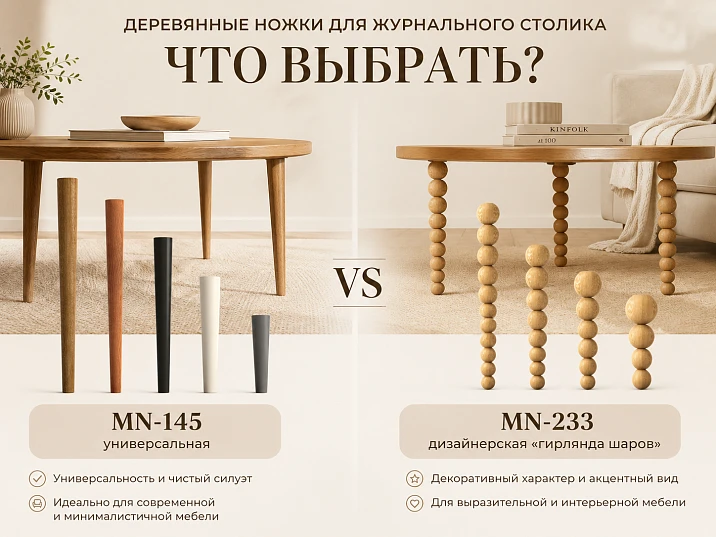
Wooden legs for a coffee table are often chosen based on a single photo: you like the profile, the wood shade matches, the height seems right. For frame-less furniture, this approach is insufficient. The support simultaneously sets the final height, determines the area under the tabletop, affects stability, and decides whether the base remains understated or becomes the main decorative element. That is why two turned models made of beech or oak can lead to completely different results, even though both are suitable for a coffee or side table.
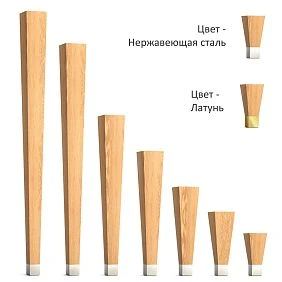
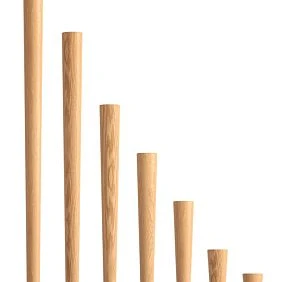
MN-145 is a thin, versatile turned leg with a diameter of 44 mm. Its main practical advantage lies not only in its light silhouette, but in thirteen height options: 100, 150, 200, 250, 300, 350, 400, 450, 500, 600, 650, 700, and 750 mm. This range allows you to select a base for a low coffee table, a taller side table, a cabinet, or a lightweight wall console. The profile remains the same, so several pieces can be assembled into one series.
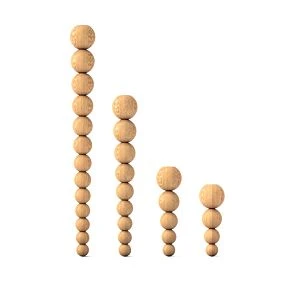
MN-233 is designed differently. Its profile is assembled from successively smaller wooden spheres, and the cross-section is 72 × 72 mm. The support is available in four height options: 198, 247, 443, and 635 mm. This leg does not disappear under the tabletop. It creates a recognizable sculptural image and suits a buyer who wants to turn the base into an independent part of the design.
Both models are made of beech for enamel and oak for tinting, have a "Prestige" sanding, are designed for frame-less structures, and allow for straight or angled installation with properly selected fittings. However, they cannot be considered interchangeable. When choosing, you need to compare the height, tabletop thickness, cross-section, edge offset, number of legs, attachment method, future finish, and actual load. Below, we will break down this route so that after the article, it is clear which item to put in the cart and what to check before assembly.
Short answer. For a lightweight coffee table, precise height selection, and a calm turned silhouette, choose MN-145 with a diameter of 44 mm: the model is available in 13 sizes from 100 to 750 mm. If the legs should become the main decorative element, MN-233 with a profile of decreasing spheres, a cross-section of 72 × 72 mm, and heights of 198, 247, 443, or 635 mm is better suited. Calculate the final furniture height as the leg length plus the tabletop thickness and the actual height of the mounting unit or foot.
MN-145 is more rational for precise proportion adjustment and compact tabletops. MN-233 is chosen for a sculptural base when there is enough space under the table and the shape of the supports should be visible.
Buy MN-145Buy MN-233View all legs for coffee tables
How MN-145 differs from MN-233
Both models belong to wooden furniture supports, but the general category does not make them identical. MN-145 is built on a thin turned profile. It takes up little space under the tabletop, leaves more free space between supports, and allows height adjustment in small increments. MN-233 works as a sequence of voluminous spheres. Its task is not to disappear into the structure, but to form a recognizable silhouette.
The difference in cross-section is especially noticeable next to a small tabletop. The diameter of MN-145 is 44 mm, so four such legs look light even with a relatively small offset from the corners. MN-233 has a cross-section of 72 × 72 mm. Each support takes up more area, has a greater impact on the distance between legs, and requires more careful calculation of the mounting positions. When installed at an angle, the actual footprint becomes even wider.
| Criterion | MN-145 | MN-233 |
|---|---|---|
| Shape | Thin turned profile | Sequence of decreasing spheres |
| Height | 100–750 mm | 198, 247, 443 and 635 mm |
| Number of sizes | 13 | 4 |
| Cross-section | Diameter 44 mm | 72 × 72 mm |
| Character | Lightweight, versatile | Sculptural, accent |
| Material | Beech or oak | Beech or oak |
| Sanding | «Prestige» | «Prestige» |
| Beech | For enamel | For enamel |
| Oak | For tinting | For tinting |
| Furniture construction | Frameless | Frameless |
| Direct mounting | FUR-001 or FUR-012 | FUR-001 or FUR-012 |
| Angled mounting | FUR-017 with confirmed compatibility | FUR-017 with confirmed compatibility |
| Main scenario | Tables, cabinets, and light consoles of various heights | Coffee and side tables, accent cabinets |
The comparison shows that material and sanding quality do not help choose between models: they match. The decision is made based on geometry, height, and base role. The correct order is: first determine the shape and final height, then calculate the space under the tabletop, after that choose beech or oak, finish, and fasteners.




Why choosing legs cannot be reduced to a beautiful shape
A coffee table seems like simple furniture: a tabletop and four supports. In practice, a frameless construction requires coordination of details. It lacks an apron frame that hides fasteners, unites legs into a rigid frame, and visually separates the tabletop from the base. Each support is attached directly to the bottom plane, so an error in marking or mounting hardware immediately affects appearance and stability.
The leg shape must match the scale of the tabletop. Thin MN-145 supports compact round, oval, and rectangular tops when you want to leave a lot of air between supports. MN-233 requires more careful balance. Four sections of 72 × 72 mm can visually fill the space under a small tabletop. This is not a flaw but a characteristic of the model: it is suitable where the base should be noticeable.
Height is also not determined by the single word 'coffee'. A low table near the sofa, a coffee table next to an armchair, a side cabinet, and a decorative table against the wall solve different tasks. MN-145 allows covering almost the entire range in 50 or 100 mm steps. MN-233 offers four specific proportions. Therefore, first set the final height of the item, rather than choosing the leg length separately from the tabletop.
Finally, do not forget about fastening. Direct installation keeps the geometry more compact. Angled installation adds dynamics but increases the leg's overhang relative to the attachment point. For a small tabletop, this may mean that the lower part protrudes beyond the edge or adjacent supports end up too close to each other. Any angled scheme is checked against the drawing and actual markings.
Our factory also produces:
When to buy universal legs MN-145
MN-145 is chosen not because it is simpler, but because its versatility solves specific design tasks. Thirteen height options allow you to assemble furniture from one series: a low coffee table, a taller coffee table, a bedside table, and a lightweight wall console. The profile remains the same, so the pieces are linked without literal repetition of dimensions.
Get Consultation
When exact height is needed
For a coffee table, the relationship with the sofa and armchairs is especially important. A surface that is too low is inconvenient for a cup, book, or remote. One that is too high begins to be perceived as a dining or side table. MN-145 allows you to choose a length of 300, 350, 400, or 450 mm and then account for the tabletop thickness. This range is convenient when the furniture is adapted to an existing seating group.
For example, with a tabletop thickness of 40 mm, a 350 mm leg gives approximately 390 mm before adding the mounting assembly and foot. A 400 mm leg gives about 440 mm. There is only 50 mm between options, but the difference is noticeable in the interior. To evaluate a specific configuration, you can view legs for a table 400 mm high and compare the drawing with your own diagram.
When the tabletop should remain the main element
If the tabletop has an expressive edge, unusual shape, decorative frame, or noticeable texture, the base does not necessarily have to compete with it. The 44 mm diameter allows MN-145 to support the piece without drawing attention. The turned transitions add a classic composure to the furniture but do not turn each support into a separate sculpture.
This approach is useful for tables with a natural oak top, painted round surface, or active pattern. The legs can be made in the color of the tabletop, contrasting, or matched to other furniture. For a buyer who needs thin turned table legsMN-145 gives more freedom in distributing visual roles.
When you need a set of furniture of different heights
The same profile in several sizes helps to assemble a family of items. The low version can be used for a coffee table, the medium one for a cabinet, and the high one for a light console. At the same time, all products maintain a common form. This is more convenient than picking three random legs that are similar only in color.
High options should be used taking into account the card recommendations and the actual construction. For sizes over 450 mm, the manufacturer recommends light wall-mounted consoles and coffee tables. High furniture without a crossbar requires particularly careful checking of stability, tabletop size, and fasteners. Having a leg of 650 or 750 mm does not mean that any high table can be assembled from four supports without calculation.
When compactness under the tabletop is important
Four legs with a diameter of 44 mm leave more free space than four supports with a cross-section of 72 × 72 mm. This is important for a small table, a set of nesting tables, or furniture that needs to be moved close to the sofa. A thin support allows you to increase the distance between the legs without expanding the tabletop.
If you need to precisely select the height and maintain a light silhouette, you can buy the furniture leg MN-145 after checking the selected size and drawing. To compare other profiles, it is better to open the catalog of unpainted furniture supportsand then return to the specific article.
When to choose designer legs MN-233
MN-233 is bought for its shape. The sequence of decreasing balls creates a recognizable profile that remains noticeable even after painting in one color. The leg works well with a simple tabletop because the base takes on the decorative load. If the top and bottom simultaneously have a complex pattern, the furniture may look overloaded.
When you need a designer coffee table
An ordinary round or rectangular tabletop on MN-233 ceases to be neutral. The spherical geometry forms its own image, so the item can be used as the center of a soft seating group. Four identical supports create a repeating motif, and the angled installation enhances the dynamics.
For such a project, it is not necessary to complicate the edge. On the contrary, a calm tabletop allows the "garland of balls" to be read clearly. If the base should become the main decoration, it is worth buying the designer leg MN-233 and first checking its cross-section on a mockup or plan.
When the interior supports spherical geometry
Circles and spheres can be repeated in lighting, mirrors, facade milling, upholstered furniture, and decor. MN-233 helps connect these elements through a furniture leg. In modern classics, it makes traditional turning bolder; in eclecticism, it supports the combination of different eras; and in an organic interior, it echoes rounded shapes.
The model does not necessarily need to be painted brightly. Beech under enamel can be white, milky, gray, deep colored, or match the tabletop. Oak under tinting preserves the texture and makes the spheres warmer in perception. The choice of finish should support the overall concept, not hide the relief with an excessively dense layer.
When a height of 443 or 635 mm is needed
Four confirmed sizes of MN-233 provide different types of furniture. A height of 198 or 247 mm is suitable for very low bases, considering the thickness of the tabletop. The 443 mm size allows for a taller coffee or side table. The 635 mm height can be used in an accent cabinet or other suitable frameless structure, but the final stability must be calculated according to the project.
MN-233 does not offer an intermediate 50 mm step. If the project requires a height that cannot be achieved with the four available sizes and the tabletop, the model should not be adjusted just for the sake of form. In such a situation, MN-145 may be more rational. A designer support is valuable when its available size truly matches the task.
When the base should be visible
MN-233 should not be hidden behind a heavy apron or placed too close to the center, where the profile is barely readable. In a frameless table, the supports can be positioned so that the spherical relief is visible from a normal viewpoint. The specific offset is determined by the size of the tabletop, fasteners, and stability, not just the desire to show the leg.
For a buyer who is looking for decorative furniture supports, it is important to evaluate four elements at once, not just one leg in close-up. It is useful to cut out four rectangles 72 × 72 mm, place them on a paper template of the tabletop, and check the free space.
How to calculate the final height of a coffee table
The main formula is simple: the final table height equals the leg length, tabletop thickness, and the actual height of the mounting assembly or foot. But each term must be taken from the actual project. You cannot assume that the plate always adds the same height, or that the foot is always in one position.
Final height = leg height + tabletop thickness + actual addition of the mounting and foot.
If the mounting plate is recessed or the tabletop has a cutout, the result differs from surface mounting. The adjustable foot can also change height within the allowable range. Therefore, a preliminary table helps select the size, but does not replace a control drawing.
| Selected leg | Tabletop thickness in the example | Approximate height without hardware | What to Check |
|---|---|---|---|
| MN-145, 300 mm | 40 мм | 340 мм | Plate height, foot, convenience next to the sofa |
| MN-145, 350 mm | 40 мм | 390 мм | Match with seat height and edge thickness |
| MN-145, 400 mm | 40 мм | 440 мм | Will the table be too high for the chosen area? |
| MN-145, 450 mm | 40 мм | 490 мм | Is the height suitable for a coffee or side table scenario? |
| MN-233, 247 mm | 40 мм | 287 мм | Will the surface be too low? |
| MN-233, 443 mm | 40 мм | 483 мм | Mounting height and proportions next to furniture |
This is a calculation example, not a specification of the finished product. It shows why the same leg can produce different results with a thin and a thick tabletop. For example, MN-145 with a height of 350 mm and a top of 20 and 60 mm creates two noticeably different items. The thickness of the upper part must be known before ordering.
First, measure the furniture next to it
It is more useful to focus not on an abstract standard height, but on a specific sofa, armchair, or bed. Measure the seat height and armrest height, then decide what the surface is needed for. A table for books and decor can be lower. A coffee or side table used while sitting often requires a different proportion.
Do not forget about the tabletop thickness
Thickness affects not only the height but also the visual balance. A thin top on massive MN-233 may look too light if this is not an intended contrast. A very thick tabletop on MN-145 can overload thin supports. The exact permissible combinations are determined by the design and material, but a visual check can be done on a simple sketch.
Consider the mounting assembly
For a trestleless table, the fastening is part of the geometry. A round plate, a different set, or an angled assembly positions the support differently. Before ordering, it is useful to choose not only the leg but also the intended hardware to understand the distance to the edge and the actual height.
What sizes are suitable for a low coffee table and a taller coffee table
The names 'coffee table' and 'side table' are often used loosely, so you cannot choose the leg length based solely on the product name. It is more reliable to divide scenarios by function. A low item works as the center of a soft seating group, a taller one as a surface next to an armchair, and a side table serves a specific spot.
Low central table
For a very low silhouette, short versions of both models are suitable. MN-233 with a height of 198 or 247 mm gives a particularly sculptural low base. MN-145 offers 200, 250, 300, and 350 mm, allowing for a more precise proportion selection. A low table requires checking comfort: a beautiful item may turn out to be impractical if you have to bend down too much to reach the surface.
Classic coffee table
In the middle range, the MN-145 is particularly flexible. Sizes 350, 400, and 450 mm allow you to change the final height in small increments. The MN-233, with a height of 443 mm, offers a more specific, relatively tall option. If it matches the project, the ball shape becomes a strong advantage. If you need 390 or 430 mm with a specific tabletop, the MN-145 is more convenient.
Side or coffee table
For an item next to an armrest, a higher support is often required. The MN-145 has options of 500, 600, 650, 700, and 750 mm, but a high, apron-free structure cannot be assembled without checking stability. The MN-233 offers 635 mm. In both cases, the tabletop size, number of supports, distance between them, and fastening must be coordinated by a specialist.
To compare other models by application, you can open catalog of legs for coffee tables. The selection is useful when no available size of MN-145 or MN-233 matches the calculated height.
Diameter 44 mm or cross-section 72 × 72 mm: how furniture changes
The cross-section affects not only the appearance. It determines how much space each support takes up under the tabletop, how close it can be placed to the edge, how to position the mounting plate, and how much free space remains between the legs.
MN-145 takes up less space
The round profile with a diameter of 44 mm is easier to place under a small tabletop. This is convenient for compact square and round tables, as well as for nested items where one table should slide under another. Thin legs block less space and allow the eye to pass freely under the furniture.
However, a thin profile cannot automatically be considered more or less stable. Stability depends on the entire structure: the material of the tabletop, the distance between attachment points, installation quality, height, angle, and load. Diameter is just one of the parameters.
MN-233 forms a dense base
The 72 × 72 mm cross-section makes each leg noticeable. Four supports can take up a significant portion of the lower plane of a small tabletop. Therefore, before purchasing, it is worth marking 72 × 72 mm squares on the template and checking whether the fasteners will be too close to the edge or to each other.
The spherical profile expands and narrows in height, but for planning under the tabletop, you should rely on the confirmed cross-section and drawing. When installed at an angle, the lower point shifts outward, so the actual floor area of the furniture increases.
How to choose the cross-section based on tabletop size
For a small top, MN-145 is usually easier to fit into the geometry. MN-233 requires sufficient area so that the shape does not look cramped. There is no universal boundary in millimeters without a drawing. The shape of the tabletop, radii, offsets, plate, and tilt direction are taken into account.
A useful way to check is a scaled layout from below. Draw the contour of the tabletop, attachment points, and dimensions of the supports. For an angled scheme, add the direction of the offset. Such a plan immediately shows whether MN-145 can be replaced with MN-233 at a similar height. Most often, a simple replacement without re-marking is impossible.
Vertical or angled legs
Both models allow different installation options, but the visual effect and marking requirements differ. Vertical supports create a calm, collected silhouette. Angled ones make the table more dynamic, visually widen the base, and can support a modern or retro composition.
When vertical installation is rational
Direct mounting is easier to align with the dimensions of the tabletop. The attachment point and the lower part are closer to the same vertical line, so the furniture occupies a predictable area. This option is suitable for compact spaces, tables that are often moved close to the sofa, and projects with simple geometry.
For vertical mounting, both cards indicate FUR-001 or FUR-012. The specific set is chosen after checking the thread, thickness, and material of the tabletop. It cannot be assumed that any plate is equally suitable for any top.
What the tilt changes
The tilt spreads the lower points and changes the silhouette. MN-145 acquires a lighter retro character, while MN-233 reveals the sequence of balls more strongly. At the same time, the actual dimensions of the furniture increase, raising requirements for symmetry of markings and precision of angles.
For installation at a 10-degree angle, you can consider the angled plate FUR-017. Compatibility must be confirmed for the selected height and design. The same angle for all four legs is important not only visually: deviation changes the position of the supports on the floor and can cause wobbling.
Why the tilt cannot be chosen after finishing
The angle affects the location of holes, edge distance, and direction of the finished item. It is better to decide the scheme before painting and installation. First, make markings and a dry fit, then confirm proportions, and only after that proceed to final assembly.
How to choose FUR-001, FUR-012, or FUR-017
Hardware should not be added to the order accidentally. It connects the leg to the tabletop and determines the mounting method. Three solutions are confirmed in the scheme: FUR-001, FUR-012, and the angled plate FUR-017. They solve different tasks, so choosing a kit only by price or appearance is incorrect.
| Hardware | Main task | When to consider | What to Check |
|---|---|---|---|
| Mounting FUR-001 for furniture leg | Vertical connection of the support to the tabletop | MN-145 or MN-233 for direct installation | Thickness and material of the tabletop, threaded assembly, completeness |
| FUR-012 Set | Round plate with a diameter of 37 mm with M8 thread and M8 × 60 stud | For direct installation when the design matches | Seat and sufficient tabletop thickness |
| Angled plate FUR-017 | Installing legs at a 10-degree angle | Dynamic scheme MN-145 or MN-233 | Overhang beyond the edge, plate orientation, floor position |
| Adjustable foot FUR-019 | Minor leveling and floor protection | Specifically, MN-145 with a suitable fit | Adjustment range and impact on height |
FUR-001
The FUR-001 kit is listed in the cards of both models as one of the vertical mounting options. It suits a buyer who needs a clear, disassemblable assembly. But before ordering, you need to check the kit contents and the connection method with the specific tabletop. Requirements may differ for solid wood, plywood, MDF, and other bases.
FUR-012
FUR-012 includes a round mounting plate with a diameter of 37 mm with M8 thread and an M8 × 60 self-tapping stud. The specified dimensions help to check the mounting location in advance. The plate must be fully positioned on the solid part of the tabletop and not fall too close to the edge, cutout, or weak area.
You can buy FUR-012 kit after the master confirms the thickness and installation method. The presence of M8 thread on the fittings does not exempt from checking the entire system.
FUR-017
The inclined plate sets an angle of 10 degrees. For four legs, it must be oriented symmetrically: each support should diverge in the planned direction. An error in one plate will be noticeable and may change the position of the leg on the floor.
For MN-233, the tilt is especially pronounced because the lower ball helps maintain readability of the shape. For MN-145, the angle emphasizes the lightness of the profile. In both cases, first make a bottom diagram and check whether the lower part exceeds the allowable dimension.
How to check the stability of a frameless structure
MN-145 and MN-233 are designed for frameless products, but this does not mean that four legs automatically form a stable table with any tabletop. The card confirms the application area, while the structural scheme of a specific item is determined by the project.
Distance between attachment points
The wider the supports are placed, the larger the support contour, but fastenings cannot be thoughtlessly moved close to the edge. The tabletop must have enough solid material. For a round top, the radius is considered; for an oval one, different curvatures; for a rectangular one, the position of corners and roundings.
Height and size of the tabletop
A tall narrow structure is more sensitive to lateral forces than a low wide table. Therefore, MN-145 with a height of 700 mm and MN-233 with a height of 635 mm require stricter checking than short versions. The scheme of a low coffee table cannot be transferred to a tall console without recalculation.
Weight and load distribution
In the provided MN-233 scheme, it is recommended for small loads, magazine and coffee tables, bedside tables, and other suitable frameless products. Do not invent precise permissible loads. If a heavy stone countertop, large overhang, or intensive use is planned, the project is coordinated with a specialist.
Base quality
Even a correct leg will not fix a weak countertop. The plate and stud must be attached to material that can hold the assembly. If the underside has voids, thin veneer, or a non-standard structure, a separate solution is required. Before purchasing hardware, the craftsman must see a cross-section or sample.
Check after dry assembly
Before final tightening, place the item on a level surface, check diagonals, equal angles, and contact of all supports with the floor. The adjustable foot helps compensate for minor unevenness but should not mask incorrect marking or different leg lengths.
How many legs are needed for a coffee table
Four supports is the most obvious scenario, but the number cannot be chosen solely out of habit. The shape and size of the countertop, load, fasteners, and design may require a different solution. Below, the logic of selection is discussed, not a universal installation standard.
Four legs
Four points create a familiar geometry and allow showing a repeating profile. For MN-233, this is especially important: four "garlands of balls" form a decorative rhythm. For MN-145, four thin supports maintain lightness. Marking is done relative to the axes of the countertop, not just from the edge.
Three legs
The three-support scheme is sometimes used for round tables, but it should be applied to a specific model only after a structural check. It changes the base pattern and load distribution. The feasibility of such a solution is not confirmed by a single photo of the leg.
More than four supports
For a long tabletop, additional support may be required, but then the coffee table becomes a different structural challenge. You cannot simply add a fifth or sixth leg without checking the plane and positioning. The more supports, the higher the risk of wobbling with the slightest height difference.
For a standard selection, it is easier for the buyer to start with four identical items and confirm the layout with a craftsman. It is better to put the entire set of the same wood species and finish in the cart, rather than buying additional supports later from a different batch unnecessarily.
Beech for enamel or oak for tinting
Both models are made from beech and oak. The choice of material does not change the shape, but determines the finish and character of the finished table. Beech is prepared for enamel, oak for tinting. Mixing these routes accidentally is not advisable.
Beech for enamel
Beech is suitable when the legs need to be painted opaquely. Enamel helps to connect the supports with the tabletop, furniture, or interior palette. White legs make the MN-145 lighter, and the MN-233 resemble a sculptural architectural element. Dark or colored enamel emphasizes the silhouette more strongly.
The dense coating should not flood the turned transitions. For the MN-233, it is especially important to preserve the boundaries between the spheres. The preparation, primer, and application method are chosen by the craftsman considering the material and the selected finishing system.
Oak for tinting
Oak is chosen when the natural texture should remain visible. Tinting can connect the legs with an oak tabletop, floor, frame, or other furniture. On the MN-145, the fibers support the vertical. On the MN-233, the texture passes through the rounded shapes and makes them less graphic than enamel.
For a buyer who needs oak legs for a coffee tableClassic and neoclassical
The MN-145 easily fits into classic furniture thanks to its calm turned profile. It supports panels, cornices, and traditional forms without requiring a complex tabletop. In neoclassicism, it can be painted with light enamel and combined with a laconic round top. The MN-233 also suits modern classics, but makes the piece more noticeable: the spherical sequence resembles traditional turning enlarged to a decorative scale.
Provence and light country interior
MN-145 in painted beech supports light furniture, pastel shades, and simple wooden tabletops. An angled installation can add a less formal character. MN-233 is possible here as a separate accent, but requires caution: large spheres can become too active for a small space.
Eclecticism
MN-233 is especially expressive in an eclectic interior, where classic turning combines with modern forms. The tabletop can be minimalist, while the base is decorative. MN-145 in eclecticism is useful as a neutral connecting element when the room already has enough bright objects.
Calm modern interior
MN-145 works due to its thinness and clear geometry. A monochrome finish, simple edge, and neat offsets create a restrained piece. MN-233 can become a contrast — a sculptural detail against smooth walls and laconic furniture.
Small living room
For a compact space, it is often simpler to use MN-145: it takes up less space and does not visually weigh down the center of the room. MN-233 is also possible if the tabletop is spacious enough and there are few other large accents. Before purchasing, not only the table dimensions but also the passages around it are checked.
Spacious hall or large living room
In a large room, the thin MN-145 can look elegant, especially in a set of several tables. MN-233 better holds the scale and does not get lost at a distance. A height of 443 mm with a suitable tabletop allows for a noticeable coffee table, while 635 mm allows for a taller piece with a confirmed structure.
Practical selection for different buyer tasks
| Task | What to choose | Why | What to Check |
|---|---|---|---|
| Low compact table | MN-145 200–350 mm or MN-233 198/247 mm | Both models have short versions but different base density | Final height, space under the tabletop, convenience |
| Precise selection for the existing sofa | MN-145 | Thirteen heights allow selection with a smaller step | Tabletop thickness and mounting addition |
| Author's accent piece | MN-233 | The garland of balls becomes the main decorative motif | Sufficient tabletop area and free space |
| Set: table + cabinet + console | MN-145 | One profile is available in a wide range of heights | Stability of tall objects and a single material |
| Slanted legs | Any model with confirmed compatibility | FUR-017 sets a 10-degree angle | Overhang, symmetry, and orientation of plates |
| Oak furniture with visible texture | MN-145 or MN-233 made of oak | Both models are available for tinting | Matching the tone with the tabletop and details |
| Solid colored painted furniture | MN-145 or MN-233 made of beech | Beech prepared for enamel | Coating quality and relief preservation |
Detailed selection scenarios
Table in front of a low sofa
Start by measuring the seat height and the distance to the intended surface. If an intermediate size is needed, MN-145 is more convenient due to the 50 mm step in the working range. MN-233 247 mm will create a very low sculptural piece. Before purchasing, make a mockup to ensure the table is comfortable to use, not just beautiful.
Coffee table next to an armchair
Here the surface should be accessible from the side. MN-145 400 or 450 mm allows for more precise adjustment to the armrest. MN-233 443 mm is suitable if its massive profile does not interfere with legs and passage. Calculate the final height together with the tabletop.
Round tabletop of small diameter
MN-145 is easier to place due to its 44 mm diameter. For MN-233, draw four 72 × 72 mm squares and check if sufficient material remains between the plate and the edge. On a round lid, it is especially important to evenly distribute the supports around the corners of the circumference.
Large rectangular tabletop
Both models are possible, but a long lid requires checking for deflection and the support contour. MN-233 better maintains visual scale, while MN-145 preserves lightness. Additional supports cannot be added without calculation because the risk of wobbling increases.
Table with a thick tabletop
A massive lid pairs better with MN-233, but this is not a universal rule. MN-145 can create an expressive contrast between a light base and a heavy top. Check not only the appearance but also the adequacy of the fastening in the chosen material.
Table with a thin tabletop
MN-145 usually looks more natural. MN-233 on a thin lid can create the effect of a heavy base, which needs to be consciously supported. The mounting plate must fit on the solid part, and the stud must not conflict with the thickness.
Set of two nested tables
MN-145 is more convenient due to different heights and a small diameter. One item should fit under the other without the legs colliding. Plan both tables simultaneously. MN-233 is possible, but its cross-section and angle quickly reduce the free space.
Bedside table
MN-145 allows you to choose the height to match the mattress and maintain a calm appearance. MN-233 makes the nightstand decorative. In both cases, consider the cabinet or tabletop, as well as the load distribution from the drawer, door, or stored items.
Light wall-mounted console
Tall MN-145 legs are suitable per the card recommendation for light wall-mounted consoles, but the structure must be protected from tipping and coordinated with the master. MN-233 635 mm can create a strong image, but the cross-section and height require even more careful checking.
Table with angled legs
First determine the angle and direction of the offset, then mark the lower points on the floor. FUR-017 sets 10 degrees, but the actual offset depends on the leg length. The higher the support, the more noticeable the displacement. Do not drill the tabletop until a dry fit.
Table in white enamel
Choose beech. On MN-145, white enamel emphasizes lightness; on MN-233, it turns the spheres into a graphic architectural motif. The coating should be thin and even enough to preserve the turned transitions.
Oak table with dark tint
Both models are available in oak. MN-145 looks stricter, MN-233 more plastic. Do a tone test on a sample and coordinate it with the tabletop. Natural texture varies, so it's better to finish the entire set simultaneously.
Furniture for a small apartment
MN-145 is usually more rational due to its compactness and visual lightness. Choose direct installation if the table needs to be pushed against a sofa or wall. MN-233 is possible as a single striking item, but check the passages and actual dimensions.
Accent table in a spacious living room
MN-233 reads better at a distance and holds its scale. A simple tabletop does not compete with the supports. MN-145 is also possible if an airy set of several pieces is needed. The decision depends on whether the table should be the center or the background.
Replacing legs on a finished tabletop
First, measure the existing holes and a sturdy area underneath. MN-145 cannot be automatically replaced with MN-233 due to different cross-sections and plates. Old markings sometimes have to be covered or relocated. The master makes the decision after inspection.
Self-assembly of the first table
Start with a straight installation and a simple plan. Choose four identical legs, a suitable mounting kit, and make a hole template. The angled pattern is more beautiful but requires precise orientation. Do not use a foot pad to correct a gross error.
Project for a showroom or salon
MN-233 helps create a memorable piece, but the surface must withstand regular use. MN-145 is easier to fit into a furniture series. For commercial spaces, stability, repeatability of finish, and the ability to replace a single support are especially important.
Table next to an armchair on a carpet
A soft base can affect stability. Choose a sufficient support contour and test the item on the actual carpet. Foot pads protect the floor but work differently on pile. Angled legs take up more area and may catch the edge of the carpet.
Table on a solid wooden floor
The foot pad helps protect the surface and compensate for minor unevenness. Check the material of the contact part and the height. For oak legs, the finish of the lower end must be done carefully so that moisture does not get into the wood during cleaning.
Furniture of the same color as the wall
Beech legs under enamel allow you to create a calm, monolithic look. MN-145 will almost disappear, MN-233 will remain noticeable due to its relief. The choice depends on whether you need to hide the base or emphasize the shape without color contrast.
What to buy together with legs
A furniture support does not work separately from the tabletop and fastening. For a complete order, choose a mounting kit in advance, check the foot pads, and plan the finish. This reduces the risk of a situation where the legs are already received, but there is no suitable hardware or installation scheme.
For a general selection, you can open Wooden furniture legs and compare other unpainted models. If the task is strictly related to a coffee table, it is more useful to buy legs for a coffee table through a thematic selection, and then go to the card of MN-145 or MN-233.
| What to add | Why | Scenario | What to Check |
|---|---|---|---|
| FUR-001 Kit | Connect the leg to the tabletop in a direct scheme | MN-145 and MN-233 | Compatibility, thickness and material of the tabletop |
| Round plate FUR-012 | Assemble the collapsible assembly with M8 thread | Vertical legs | Diameter 37 mm, M8 × 60 stud and mounting seat |
| Angled plate FUR-017 | Install supports at an angle of 10 degrees | Dynamic scheme | Same orientation and actual overhang |
| Support pad FUR-019 | Minor adjustment and floor protection | Specifically, MN-145 | Impact on height and compatibility |
| Tabletop | Form a finished item | Any table | Thickness, material, strength of attachment points |
| Finishing system | Paint birch or tint oak | Custom color | Material compatibility and relief preservation |
How not to confuse MN-145 and MN-233 with similar products
MN-145 is not just any thin leg
It features a 44 mm diameter, a specific turned profile, and thirteen heights. A buyer may see a similar support, but a different diameter or size step will change the project. The full article MN-145, selected height, material, and finish option are checked in the product card.
MN-233 is not a set of individual spheres
The profile is made as a single turned furniture leg with a sequence of decreasing spheres. Assembling an analog from random spheres and rods is a different structure requiring a separate calculation of connections. The ready-made MN-233 allows focusing on fastening, finishing, and the tabletop.
An unpainted leg is not a finished painted piece of furniture
Both models are supplied as supports for custom finishing in confirmed materials: beech for enamel, oak for tinting. The buyer must account for the work and materials in advance. It should not be expected that the shade in the photo will be the final finish.
Fastening is not always included in the expected scenario
Hardware is selected separately according to the product card and project. Even if FUR-001 or FUR-012 is listed as a compatible option, the order composition must be checked. It should not be assumed that the leg automatically comes with all plates and glides unless directly confirmed.
Mistakes when buying
Selecting the leg height as the final furniture height
The tabletop and mounting assembly are added to the support length. Due to this mistake, the table ends up higher than calculated. The solution is to prepare a vertical cross-section in advance and include all layers.
Compare models only by similar height
MN-145 450 mm and MN-233 443 mm are close in length, but differ in cross-section and character. Replacement will require new marking and checking proportions.
Do not consider four supports simultaneously
One MN-233 in the photo looks lighter than four supports under a small tabletop. Evaluate the finished base according to the template.
Choose tilt without calculating overhang
The lower part of the angled leg shifts outward. The table may obstruct passage or not slide up to the sofa. Before drilling, mark the position on the floor.
Select fasteners after receiving the legs
Hardware affects marking, final height, and assembly method. It's better to choose legs and a preliminary mounting kit simultaneously.
Use high supports without checking stability
Having a height of 750 or 635 mm does not mean suitability for any tall furniture. A tall, drawerless structure requires calculation.
Mix beech and oak without intent
Materials look different and are intended for different finishing routes. For four identical legs, one species is more rational.
Apply too thick a coating
On MN-233, excess material smooths the boundaries of the balls; on MN-145, it smooths small profile transitions. Finishing is done using the appropriate technology.
Consider the foot as a way to fix the assembly
Adjustment helps compensate for slight unevenness but does not replace equal length, symmetrical marking, and correct angle.
Not checking the current card
Size, material, availability, configuration, and compatible fittings are checked before ordering on the STAVROS website or with a manager.
Who MN-145 suits and who should choose a different model
MN-145 suits a buyer who needs precise height, a light silhouette, and one profile for furniture of different purposes. It is appropriate for compact tabletops, calm classics, neoclassicism, Provence, and modern interiors without an overloaded base. The model is especially useful when legs should support the tabletop rather than compete with it.
MN-145 may not be suitable if the supports are meant to be the main decoration and visible from a distance. In a spacious interior, a diameter of 44 mm can sometimes look too neutral. In that case, consider MN-233 or others. designer wooden legs in the category.
Who is MN-233 suitable for, and who should choose a different model
MN-233 is suitable for a designer coffee or side table, an accent cabinet, and interiors with spherical geometry. It stands out next to a simple tabletop, in a spacious living room, modern classic, eclectic, and organic interiors. This model is chosen when the decorative support is as important as the top part of the furniture.
MN-233 may not be suitable for a very small tabletop, narrow passage, or a project requiring a precise intermediate height. Four sizes limit customization, and the 72 × 72 mm cross-section requires space. If the base should be nearly invisible, MN-145 or another thin support is better.
How to buy MN-145 or MN-233 on STAVROS
Start not with the color, but with the dimensions. Measure the desired final height, tabletop thickness, and available space underneath. Decide whether the legs will be vertical or angled. Then choose the article and specific height.
For MN-145, open the product page and select one of thirteen sizes. If you need a light coffee table, you can buy legs for a coffee table after calculating the final height. For MN-233, check one of four sizes and a cross-section of 72 × 72 mm. For a customer who wants furniture legs "ball garland", it is especially important to evaluate a set of four supports on the plan.
After the article number, choose beech for enamel or oak for tinting. It is better to order all legs for one item in the same material. Then coordinate FUR-001, FUR-012 or FUR-017 and, if necessary, FUR-019. Check specific compatibility in the product card and with the manager.
For a broad query "buy wooden legs for a table" it is more correct to open the catalog of unpainted furniture supports. For a coffee table scenario — choose legs by height and shape in a thematic selection. The article helps narrow the choice to MN-145 and MN-233, but the category remains useful if the calculated height does not match the available options.
Additional materials on choosing legs
If you need to compare more models and understand the general logic of coffee table bases, you can read the material about how which legs are suitable for a coffee table and a side table. For choosing the shape, character, and combination with the tabletop, a guide on how to choose wooden legs for a table. Questions about custom finishing are covered in more detail in the article about unpainted legs for enamel or tinting.
These materials do not replace a product comparison of MN-145 and MN-233. Their purpose is to expand the selection if the buyer has not yet decided on the type of furniture, material, or finishing method.
Project checklist before handing over to the workshop
Even a detailed product selection does not replace a short project specification. It is needed so that the client, designer, tabletop craftsman, and assembler all understand the result the same way. In the document, specify the leg model, exact height, quantity, material, finish, hardware, installation angle, and final furniture height. For MN-145, it is especially important not to lose the chosen size among thirteen options. For MN-233, do not confuse 443 and 635 mm and be sure to indicate the 72 × 72 mm cross-section on the diagram.
Article number and quantity
Write down the full designation MN-145 or MN-233 and the number of supports. If multiple items are being assembled, divide the order by sets. For example, four MN-145 legs 350 mm high for a coffee table and four MN-145 legs 650 mm high for a console. This notation prevents mixing sizes during finishing and installation.
Vertical section
In a simple section, show the leg, plate, tabletop, and foot. Add dimensions. This allows you to see the final height and understand where the mounting element is located. Without a section, project participants may interpret differently whether the plate is included in the calculation.
Bottom side plan
The plan shows the tabletop contour, axes, attachment points, and tilt direction. For MN-233, mark sections 72 × 72 mm; for MN-145, circles with a diameter of 44 mm. If FUR-012 is used, additionally check the round plate of 37 mm. For FUR-017, use arrows to indicate the angle direction.
Finishing schedule
For beech, specify the enamel and agreed color. For oak, specify the tinting system. Do not limit yourself to the words "white" or "oak": the final shade is chosen based on a sample or project. All four legs are finished simultaneously to maintain a uniform result.
Usage scenario
Record what the table is intended for: a decorative centerpiece for the living room, a surface for daily coffee, a side table next to an armchair, or a cabinet. The scenario helps the craftsman assess the expected load and not perceive the furniture as purely decorative if it will be actively used.
Pre-final assembly check
Before tightening the fasteners, check the identical orientation of the legs, diagonals, contact with the floor, and position relative to the edge. For MN-233, ensure that the spherical profiles visually form a set. For MN-145, check that all supports have the same size and are not mixed up with parts from another item.
Final choice: MN-145 or MN-233
Choose MN-145 if the main requirements are precise height, small diameter, and a calm turned profile. Thirteen sizes from 100 to 750 mm allow you to assemble furniture of different heights while maintaining a unified design. The 44 mm diameter is convenient for compact tabletops and a lightweight base.
Choose MN-233 if the legs should be the main decorative element. The profile of decreasing spheres, a cross-section of 72 × 72 mm, and sizes 198, 247, 443, and 635 mm form an expressive sculptural base. The model requires more space and is more closely tied to the tabletop.
In both cases, calculate the final height together with the tabletop and mounting assembly. For vertical installation, consider FUR-001 or FUR-012; for angled installation, FUR-017 with confirmed compatibility. Choose beech for enamel, oak for tinting. Check the stability of the underframe-free structure as a system, not as a property of a single leg.
FAQ: questions about MN-145 and MN-233
Which leg is better for a small coffee table?
For a compact tabletop, it is usually easier to place MN-145 with a diameter of 44 mm. MN-233 with a cross-section of 72 × 72 mm is also possible but requires more space. Make a template of the tabletop and mark the four supports.
Which model offers more height options?
MN-145 is available in 13 heights from 100 to 750 mm. MN-233 has four sizes: 198, 247, 443, and 635 mm. If you need a precise intermediate height, MN-145 is more flexible.
Can I replace MN-145 450 mm with MN-233 443 mm?
Not without a new check. The height is close, but the cross-section differs: 44 mm vs. 72 × 72 mm. The indents, base density, fasteners, and appearance will change.
How to calculate the final table height?
Add the leg length, tabletop thickness, and the actual allowance of the mounting unit or foot. The last value must be taken from the selected scheme, not assigned approximately.
What sizes of MN-145 are suitable for a coffee table?
A range of 300–450 mm is often considered, but the specific size depends on the tabletop and adjacent furniture. The model has options from 100 to 750 mm, so first determine the final height.
Is MN-233 only suitable for coffee tables?
The product scheme also includes coffee tables, bedside tables, and other suitable frameless items for light loads. Any project must be checked against the design.
Can both models be installed at an angle?
Yes, with suitable hardware and confirmed compatibility. FUR-017 sets an angle of 10 degrees. You need to calculate the lower part offset and orient all plates identically.
Which fastener to choose for vertical installation?
Both model cards specify FUR-001 and FUR-012. The choice depends on the tabletop and mounting scheme. FUR-012 includes a round plate with a diameter of 37 mm and an M8 × 60 stud.
Is an adjustable foot needed?
FUR-019 can help with minor leveling and floor protection, particularly for MN-145 with a suitable fit. It affects the final height and does not correct incorrect layout.
What to choose for white enamel?
The beech version of MN-145 or MN-233. Both models are prepared for enamel. The coating must preserve the turned relief and be applied using an appropriate technique.
What to choose for a natural wood finish?
Oak for tinting. It retains visible texture. It is better to order all legs of the set at the same time and finish them in one system.
How many legs to buy for a table?
Four are most often used, but the exact number is determined by the tabletop shape and design. Three or more than four supports require separate verification.
Which model looks lighter?
MN-145. Its diameter of 44 mm and calm profile leave more air. MN-233 with a cross-section of 72 × 72 mm is more noticeable and creates a dense sculptural base.
Which model is best for a custom accent table?
MN-233, if its available height matches the project. The garland of decreasing balls becomes the main decorative motif and pairs well with a simple tabletop.
Can MN-145 be used for a console?
The card allows tall options for lightweight wall consoles and coffee tables. Tall apronless furniture must be checked for stability, fastening, and load.
What should be checked right before ordering?
Article, height, section, material, finish, quantity, installation method, compatible fittings, countertop thickness, marking, and final height. Current parameters are specified in the product card or by a STAVROS manager.
Conclusion
MN-145 and MN-233 solve one common task — they help assemble an apronless coffee or side table — but lead to different results. MN-145 is valued for its range of thirteen heights and light 44 mm diameter. It helps fine-tune proportions and does not overload the tabletop. MN-233 offers four sizes and a sculptural 72 × 72 mm profile that turns the base into the main design element.
Before purchasing, select the final furniture height, add the tabletop thickness and mounting assembly, mark the supports on the plan, decide on straight or angled fastening, and check stability. Then choose beech for enamel or oak for tinting. This order protects against a situation where a beautiful leg does not fit in height, cross-section, or hardware.
On STAVROS, you can go from the general catalog to specific cards for MN-145 and MN-233, select confirmed mounting elements, and assemble an order as a unified system. A conscious choice of ready-made turned supports is simpler and more reliable than trying to fit random parts after the tabletop is made.