














































Article Contents:
- Why wooden overlays and baseboards are a unified system
- Wooden overlays for furniture: where they are used and why it matters
- For Wardrobes and Walk-in Closets
- For dressers, cabinets, and display cases
- For kitchen fronts
- For furniture restoration and custom projects
- Wooden baseboard: its underestimated role in interior design
- Wooden floor baseboard: the lower tier of the interior system
- Wooden ceiling baseboard: the upper tier of architectural decor
- Wooden moldings as a system
- How to connect furniture and floor through wooden decor
- Style coordination
- Color Coordination
- Scale coordination
- How to combine overlays, baseboards, and moldings in a unified system
- Moldings on walls: paneling principle
- Moldings on doors and trims
- Materials and finish: how to choose for a specific interior
- Oak: for a natural look
- Beech: for painting and enamel
- Painting in the color of the facade
- Table: what to choose for different styles
- Which rooms are suitable for a decorative system of overlays and baseboards
- Living Room
- Bedroom
- Office and Library
- Entry Hall
- Kitchen-living room
- Mistakes when combining wooden overlays and baseboards
- Mistake 1: mismatched styles of overlays and baseboards
- Mistake 2: baseboard without connection to furniture
- Mistake 3: floor color not taken into account
- Mistake 4: forgotten doors and architraves
- Mistake 5: too many ornaments at the same time
- Mistake 6: large decor in a small room
- Mistake 7: buying without a sample
- What to buy together with wooden overlays and baseboards
- Wooden decor in the STAVROS catalog: everything for a complete system
- FAQ: answers to popular questions about overlays and baseboards
- About the Company STAVROS
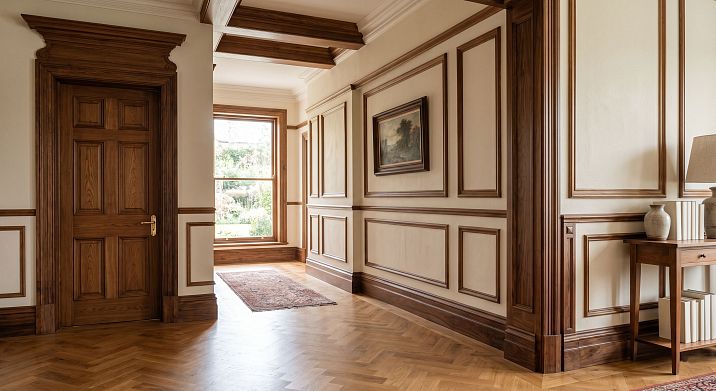
There are interiors where everything is right — and yet something is off. The furniture is good, the walls are neatly painted, the floor is laid evenly. But the eye doesn't linger. There's no captivating force that turns square meters into a space with character. As a rule, the problem isn't the furniture or the wall color — it's in the connections. Or rather, their absence.
Wooden overlays and baseboards — these are precisely the elements that create connections: between furniture and wall, between floor and baseboard, between cabinet facade and the room's overall decor. When these connections are established, the interior gains integrity. When each element is chosen separately, a mismatch arises that is hard to explain but impossible not to feel.
This article provides a detailed discussion of how the "overlays + baseboards + moldings" system works, why wood is irreplaceable in this role, and how to build an interior composition that relies not on luck but on logic.

Why wooden overlays and baseboards form a unified system
Ask yourself a simple question: where does the gaze begin when you enter a room? It doesn't fixate on one point — it moves. First horizontally, taking in the space as a whole, then vertically — down to the floor, up to the ceiling. And it is in this movement that the integrity of the interior either manifests or fails to.
decor for furniture — decorative overlays, carved elements, ornamental inserts on facades — this is the middle level. It works where a person looks straight ahead: at a wardrobe, a chest of drawers, a kitchen set. Wooden baseboard — the lower level, the boundary between floor and wall. The ceiling baseboard is the upper level, the transition from wall to ceiling. Wooden moldings — medium levels on walls, doors, facades. Together they form a vertical axis, read by the eye at once and entirely.
When these three levels are made of the same material, same style, same ornamental language — the interior holds together. This is not magic or a professional secret. It is the principle of architectural consistency that masters have followed for centuries.




Wooden overlays for furniture: where they are used and why it matters
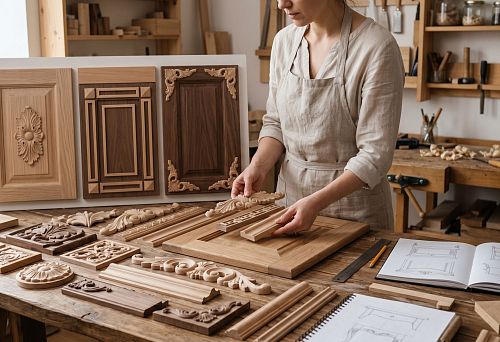
decorative inlays for furniture — these are three-dimensional decorative elements made of solid wood, mounted on facades, doors, side panels, and panels. Their task is to give a flat facade volume, character, and stylistic identity. The overlay is an independent product: it is attached on top of the finished facade and can be replaced without interfering with the structure.
Our factory also produces:


For cabinets and wardrobes
A wardrobe is the largest piece of furniture in a room. Its facades occupy a significant part of the wall and are perceived almost as an architectural element. applied decoration for furniture on wardrobe doors — this is not just decoration. It is a scaling tool: the overlay visually structures a large plane, breaks it into readable parts, and creates a sense of depth.
For built-in wardrobes with multiple door sections, the principle of uniformity is critical. Identical Carved decorative inserts for furniture on all facades create rhythm — one of the strongest visual structures in an interior.
Get Consultation
For chests of drawers, nightstands, and display cabinets
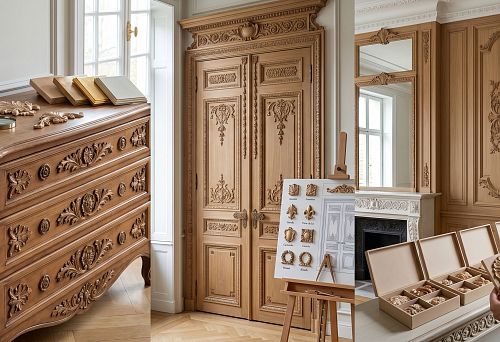
A chest of drawers in the bedroom is an object that catches the eye in the morning and evening. Decorative overlays transform it from a purely functional storage unit into an object with character. A small central overlay on each drawer, corner accents along the perimeter of the facade — and the chest of drawers takes on the appearance of a handmade piece.
Showcases, sideboards, decorative cabinets — here to buy, which will allow you to transform your furniture using carved wooden elements. You can use the C-003-3 decor set to decorate furniture, walls, doors, or any other surface. The C-003-3 decor set is made of oak or beech, known for their strength, durability, and beauty. You can buy the C-003-3 decor set at the Stavros decor store, which specializes in producing and selling decorative elements and hardware for furniture and interiors. At the Stavros decor store, you will find a wide selection of decor sets of various shapes, sizes, and styles. You can choose works as the main artistic element. It is what turns a standard cabinet into a custom piece.
For kitchen fronts
In the kitchen Decor for furniture facades must take into account operating conditions. Humidity, grease vapors, constant touching — all of this imposes requirements on the coating. Oak under oil or varnish, beech under enamel — both options are suitable if properly treated. An overlay without a finish coating is used in the kitchen only if it is painted together with the facade in a single color.
For furniture restoration and custom projects
Carved furniture decor is one of the main tools of a restorer. An old Soviet cabinet, a sideboard that has lost its appearance, a simple MDF cabinet — all of them can be transformed with a few overlay elements without changing the structure. For carpentry workshops and furniture manufacturers, this is also a saving: instead of developing an individual milled pattern, a ready-made catalog element with professional carving quality.
Wooden baseboard: the underestimated role in the interior
A baseboard is perceived as a technical detail. It covers the gap between the floor and the wall — and that's enough. This is a gross mistake that is made even in expensive renovations. In fact, a baseboard is a border. And a border in the interior is an independent architectural element.
Wooden floor baseboard: the lower tier of the interior system
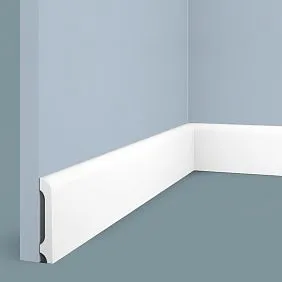
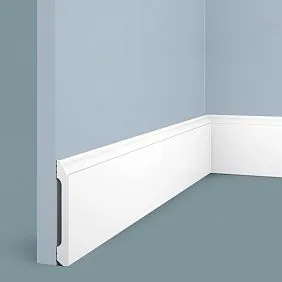
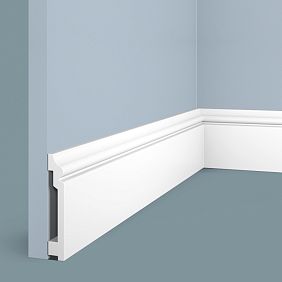
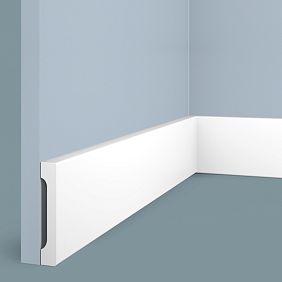
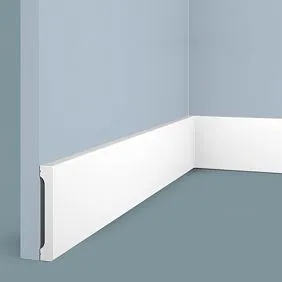
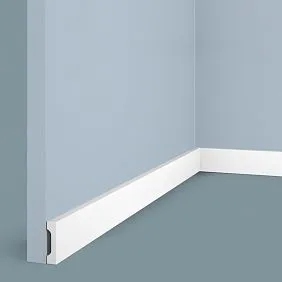
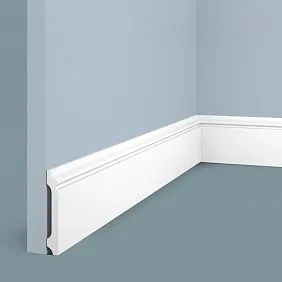
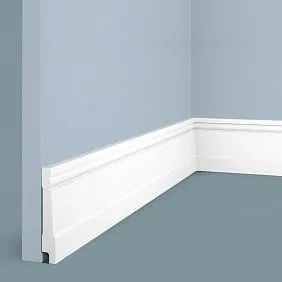
with a classic profile creates a sense of solidity, reliability. is the first thing that catches the eye when looking down. The height, profile, material, and color of the baseboard directly affect the perception of the room. A high baseboard (80–100 mm) makes the room more presentable, emphasizing the ceiling height. A low baseboard (40–50 mm) is a neutral background, appropriate in minimalist interiors.
wooden baseboard made of solid beech or oak is not just beautiful. It is durable, practical, and functional: natural wood does not deform upon impact, accepts paint and oil well, and is easily restored if the surface is damaged. PVC baseboard under the same conditions delaminates, loses color, or pulls away from the wall.
For classic interiors and rooms with wooden furniture wooden skirting boards — is the only choice. They speak the same language as the furniture.
Wooden ceiling plinth: the upper tier of architectural decor
wooden ceiling molding — is a profile element installed at the transition zone from wall to ceiling. In a classic interior, it is called a cornice and is a mandatory element of the room's architectural decoration. Without it, the ceiling "falls," and the room loses its completeness.
Wooden Ceiling skirting board comes in several types: with a straight profile (minimalist, for modern classics and Scandinavian style), with a cove (soft transition, for classics), and with a complex architrave profile (for Baroque and Empire interiors). Height: from 40 to 150 mm — depending on the room height and decor richness.
An important principle: the height of the floor plinth and the height of the ceiling plinth must be proportional. If the floor plinth is 80 mm, the ceiling plinth should not be less than 60 mm. Otherwise, the upper element is perceived as a missing detail.
Wooden moldings as a system
Wooden trim — is a general term for all linear wooden elements: plinths, moldings, cornices, architraves, battens, glazing beads. It is the moldings that form the linear structure of the interior — horizontal and vertical lines that make the space readable, proportionate, and well-groomed.
When all the moldings in a room are made of the same material, in the same palette — the interior works like an orchestra. Each instrument is heard in its place, and together they create something greater than the sum of individual sounds.
How to connect furniture and floor through wooden decor
This is where the real work begins. Not choosing a baseboard — but choosing a system. Furniture with decorative overlays, floor baseboard, ceiling cornice, wall moldings — all of this must be coordinated by three parameters: style, color, and scale.
Style coordination
If the furniture is decorated carved wooden decor with a classic ornament — acanthus leaves, cartouches, rocaille — the baseboard should not be a rectangular profile without a single line. For such furniture, a baseboard with a pronounced profile is needed: scotia, ogee, quarter-round — one of the classic profile elements born in the architecture of Antiquity.
If the cabinet fronts are decorated with geometric overlays in the Art Deco style — the baseboard should be clear, rectilinear, with minimal relief. A complex classic profile here would sound like a dissonance.
Color coordination
Three strategies, each of which works:
The first is monochrome. The baseboard, moldings, furniture decor, and doors are painted in one color. Most often it is white or a very light shade. The relief of the elements is revealed only in light and shadow. The result is aristocratic restraint.
The second is to match the furniture. A wooden baseboard matching the furniture color — a solution for interiors where furniture is the main visual accent. The baseboard picks up its color, "leads" it to the floor, and creates a sense of unity between the furniture and the architectural environment.
The third is contrast. White overlays on a dark facade, dark baseboard on a light wall. This is a more complex strategy requiring a professional eye. But when executed correctly, the result is expressive and memorable.
Scale coordination
This is the parameter that is talked about least often — and violated most often. A powerful wooden baseboard 120 mm high with a pronounced profile next to a facade adorned with a small delicate overlay 80×80 mm is a mismatch of scales. The baseboard "eats" the overlay, and it gets lost.
Rule: the richer the furniture decor, the more restrained the baseboard. The more modest the overlays, the more expressive the baseboard profile can be. They compete for attention, and in this competition, one must win — the one that is the main accent in the interior.
How to combine overlays, baseboards, and moldings into a single system
Wooden molding — a linear element with a profiled cross-section that creates horizontal and vertical lines on walls, facades, and doors. It does not decorate pointwise like an overlay — it structures the plane, divides it into fields, and creates rhythm.
In a classic interior, the system works like this:
-
Lower tier: floor Wooden baseboard — floor/wall boundary.
-
Middle tier of the wall: a horizontal molding or panel layout divides the wall into two parts. The lower part is sheathed with panels or decorated with vertical moldings, the upper part remains for painting or wallpaper.
-
Furniture facades: furniture moldings create frames within which are placed decorative inlays for furniture.
-
Upper tier: wooden ceiling molding — wall/ceiling boundary.
When all four levels work in harmony, the interior acquires that depth which cannot be created by one expensive piece of furniture or one designer light fixture alone.
Moldings on walls: the paneling principle
A wall panel with moldings is one of the most expressive classical techniques. Wooden moldings are mounted on the wall in the form of rectangular frames — panels. The size, proportion, and number of panels depend on the room height and wall width.
Rectangular moldings on the lower part of the wall (at a height of 900–1200 mm) form the "lower belt." Together with the floor baseboard, they create a rich decorative base for the room. If similar moldings are on the furniture, Wooden Inlays — the entire space is united into a single architectural system.
Moldings on doors and architraves
Doors are mobile planes that are in view most of the time. Molding frames on door panels are a classic technique born in the Baroque era. Wooden Casings around the doorway connect the door to the wall. If the casing, door molding, and baseboard are all made of the same material, the door ceases to be a "hole in the wall" and becomes an architectural accent.
Materials and coating: how to choose for a specific interior
The same wooden element in different coatings is a fundamentally different object. The coating changes not only the color — it changes the character, style, and tactile sensation.
Oak: for a natural look
Oak is a species with a large expressive texture, high hardness (700 kg/m³), and exceptional durability. Under a clear varnish or oil, oak fully reveals its character: a warm golden-brown tone, live fibers, a sense of authenticity.
Wooden trim made of oak — floor baseboards, casings, moldings — combined with oak parquet creates a monolithic natural environment. This is the effect sought in hunting studies, libraries, dark classic interiors with leather furniture and copper accessories.
Under enamel, oak is used less often — large pores require priming. But with proper surface preparation, the result is excellent.
Beech: for painting and enamel
Beech is a fine-grained homogeneous species. It is ideal for any projects with a final paint finish. The smooth surface after sanding practically requires no puttying: primer + paint = an even glossy or matte coating without porosity.
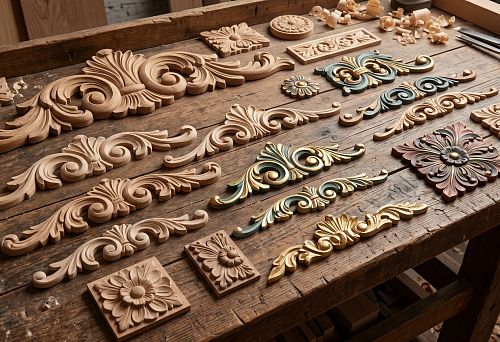
Wooden overlays for enamel Beech is the first choice for white classic kitchens, Provencal dressers, neoclassical bedrooms. White relief overlays on a white facade are a subtle play of light and shadow that cannot be replicated by film or paint without relief.
Painting in the color of the facade
This technique deserves special attention. Wooden decor for furniture for painting It is produced without a finish coating — specifically for subsequent processing. The craftsman installs the overlay, putties the joint, sands it, and paints it together with the facade in a single color.
The same principle works for baseboards and moldings: if all the trim is painted in the color of the walls or furniture, the interior becomes monolithic. The boundary between the wall and floor does not disappear but becomes delicate, architectural, rather than technical.
Table: what to choose for different styles
| Interior style | Material | Finish | Recommended elements |
|---|---|---|---|
| Classic | Beech, oak | White enamel, patina | Overlays, moldings, cornice |
| Neoclassical | Beech | Enamel, tinting | Concise overlays, moldings |
| Rustic, country | Oak | Oil, wax | Baseboard, chamfered trim |
| Provence | Beech | White/colored enamel | Overlays, thin molding |
| Modern Classic | Beech, oak | Matte enamel | Geometric overlays, moldings |
| Art Deco | Oak | Varnish | Geometric decor, baseboard |
What rooms are suitable for a decorative system of overlays and baseboards
It's not a question of "suitable or not" — it's a question of "how to implement." The decorative system of overlays, baseboards, and moldings scales: it is equally appropriate in a spacious living room of 50 m² and in a small study of 12 m².
Living Room
The living room is a formal space. Here, the furniture is wooden decor read from a distance of several meters, and it is here that the decorative system works at full strength. Wall panel moldings + high wooden baseboard + wooden cornice under the ceiling + overlays on cabinets and chest of drawers = a space with architectural character.
Classic Furniture in a living room with such a system does not stand alone — it is integrated into the interior, it is part of its architecture.
Bedroom
The bedroom is an intimate space where the intensity of decor should be slightly lower than in the living room. Here, the decorative system works more softly: overlays on the headboard or cabinet fronts, delicate molding around the ceiling perimeter, a low profile baseboard. A single tone — for example, dusty white or warm ivory — ties all elements together without strain.
Office and library
The most organic place for dark oiled oak. Wall panels with moldings up to shoulder height, high wooden floor baseboard, oak overlays on book cabinets. This image is the most convincing argument in favor of a wooden trim system: it creates a sense of an intellectual environment that cannot be imitated with laminate.
Entryway
The hallway is the first room that greets the guest. Here, the wooden baseboard and overlays on the cabinet or console create the first impression. Important: the hallway often has doors — the entrance door and doors to other rooms. Unified Casings around all doors and a unified baseboard around the perimeter tie the hallway into a cohesive space.
Kitchen-living room
An open kitchen-living room space is the most complex case. Here, two functional zones should read as one decorative system. A common baseboard around the entire perimeter, overlays on kitchen facades and on living room furniture in a unified pattern — this is the solution that ties the space together without physical partitions.
Mistakes when combining wooden overlays and baseboards
Mistakes in this topic are not a catastrophe. But they are costly: redoing baseboards and re-gluing overlays require time and money. It is better to know them in advance.
Error 1: mismatched styles of overlays and baseboards
The most common one. A richly decorated cabinet with acanthus overlays — and next to it a straight PVC baseboard without a single line. Or minimalist Scandinavian furniture — and a massive baroque cornice under the ceiling. The style of the overlays and the style of the moldings should be from the same era.
Error 2: baseboard without connection to furniture
Baseboard for classic furniture — this is not the baseboard that is "just wooden." It should have a profile that matches the style of the furniture. If the furniture is classic, a baseboard with a straight, unpretentious profile is a mistake.
Error 3: floor color not taken into account
The baseboard sits between the wall and the floor. It interacts with two surfaces at once. A dark oak baseboard on light parquet — a striking contrast. The same baseboard on dark parquet — blends in, the boundary disappears. Evaluate the combination in advance.
Error 4: forgotten doors and architraves
Even the most perfect system of "overlays + baseboard + molding" will fall apart if the doors and their framing are made of a different material. Wooden trim, including architraves, should be part of the system — not a leftover from the previous renovation.
Error 5: too many ornaments at once
Acanthus leaf on overlays + rocaille on molding + geometry on baseboard = decorative chaos. Rule: one ornamental motif per space. Other elements are variations on the same theme, not new themes.
Error 6: large decor in a small room
A massive baseboard 120 mm high + powerful wall moldings in an 8 m² room is claustrophobia by decor. In small rooms, everything scales down: baseboard 50–60 mm, thin moldings, delicate small overlays.
Error 7: buying without a sample
The wood color on a monitor screen is an approximation, not accuracy. Order a sample before purchasing. This is especially relevant if overlays and baseboards are bought at different times or from different catalog items.
What to buy together with wooden overlays and baseboards
A complete decorative system is not just overlays and baseboards. For a cohesive wooden interior, the entire ensemble is needed. Here is a list of elements that work in a unified system.
Moldings and cornices
Wooden moldings — for walls, facades, doors, creating panel frames. Cornices — for the top finish of furniture and wall decor.
FURNITURE HANDLES
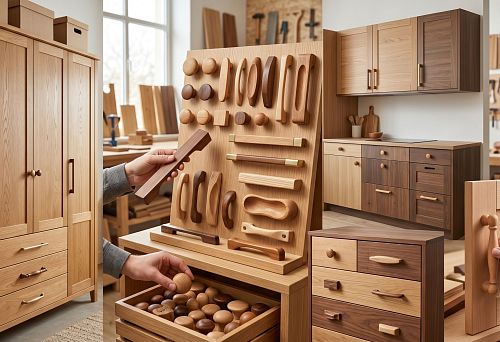
Furniture Handles wooden ones should match the style of the overlays. For classic overlays — curved handle brackets. For modern classic — Wooden handles with a laconic form.
Furniture legs and supports
furniture legs wooden — the lowest point of the furniture composition. furniture leg made from the same solid wood as the overlays, creates vertical unity of the decor.
Pilasters and capitals
Wooden pilaster divides cabinet sections and frames niches. Capital completes the pilaster and connects it to the cornice. For classical compositions, these elements are mandatory.
Trims and moldings
Wooden trims around doorways are part of the molding system. Unified with baseboards and moldings, they connect doors to the space.
Wooden decor in the STAVROS catalog: everything for a complete system
Select applied decoration for furniture, baseboards and moldings from one manufacturer is not just convenience. It is a guarantee of stylistic and material consistency. One wood species, a unified profile system, a cross-cutting range from overlay to baseboard.
The STAVROS catalog includes:
-
wooden furniture appliqués — more than 400 models made of beech and oak, with and without ornament.
-
Wooden baseboard solid wood floor — several profiles and heights.
-
wooden ceiling molding — profile cornices for classic and modern interiors.
-
Wooden moldings — for walls, facades and doors.
-
Wooden trim — trims, layouts, glazing beads, cornices.
to buy wooden baseboard available from 1 linear meter — convenient for trial purchases and final additions. Buy wooden overlays for furniture — from 1 piece. The entire range is available retail and wholesale.
FAQ: answers to popular questions about overlays and baseboards
Can wooden furniture overlays and wooden baseboards be combined?
Yes, and this is one of the best design solutions for classic and neoclassical interiors. applied decoration for furniture decorates the facades, and Wooden baseboard supports the room's style at floor level. The main thing is to match the baseboard profile with the overlay ornament.
How to choose a baseboard for furniture with decorative overlays?
Consider the style of the overlay ornament, the baseboard profile, the floor color, and the overall color scheme. For classic overlays — a baseboard with a pronounced profile. For geometric ones — a laconic straight profile. Color: matching the furniture, matching the walls, or a single monochrome.
Which is better: a baseboard matching the floor color or the furniture color?
Both options are correct — the task is different. A baseboard matching the floor color is a neutral background, fading into invisibility. A baseboard matching the furniture or door color is an active element, connecting the furniture with the room space. For classic interiors, the second option is more often chosen.
Are carved overlays and baseboards suitable for modern classic?
Yes. For modern classics, a moderate relief, calm ornaments, and a uniform matte finish are chosen. Carved furniture decor with a soft botanical motif + a medium-height baseboard with a cove — this is a perfect fit for the style.
What else to buy together with wooden overlays?
It is recommended to pair with the overlays: with a classic profile creates a sense of solidity, reliability., Wooden moldings, Furniture Handles, furniture legs, furniture leg, pilasters и Capitals.
Where to buy a wooden ceiling skirting board?
Wooden ceiling baseboard can be purchased in the STAVROS catalog — several profiles and heights in solid beech and oak, with the option to buy from 1 linear meter.
About the company STAVROS
STAVROS is a Russian manufacturer of solid wood products: wooden overlays, baseboards, moldings, handles, legs, pilasters, capitals, and everything wooden trim for interior and furniture projects. Own production, direct supplies without intermediaries, warehouses in Moscow and St. Petersburg. STAVROS is not an aggregator or an online store with third-party suppliers: each product is manufactured here, in Russia, from selected solid beech and oak, on high-precision equipment. Retail and wholesale orders, delivery throughout Russia, professional consultations on completing decorative systems — from one overlay to a full set wooden products for a classic interior.