Article Contents:
- Why choose the MN-179 furniture leg
- Verified specifications of MN-179
- What furniture is MN-179 suitable for
- Bench
- Pouf
- Commode
- Coffee Table
- Small side table
- Bench
- Pouf
- Commode
- Coffee Table
- Why you cannot cut the leg on site
- Periodic movement
- Direction of movement
- Furniture weight
- Threshold and covering joint
- Impacts and lateral load
- What this means for the bench
- What this means for the ottoman
- What this means for the dresser
- When it's better to choose a fixed leg
- Parquet
- Solid wood plank
- Laminate
- Ceramic tile
- Stone and porcelain stoneware
- Carpet and carpeting
- Vinyl flooring
- How to conduct a safe test
- Beech MN-179 under enamel
- Oak MN-179 under tinting
- Can oak be coated with oil or varnish
- Can oak be painted with enamel
- Why it's better to order a set in one batch
- Exact match not required
- Antique bronze and brass
- Antique bronze and black metal
- Antique bronze and chrome
- Patina on the wooden part
- Four legs
- Six legs
- Five legs
- Eight legs
- Spare leg
- Why you cannot calculate load by simple division
- FUR-001 with insert nut
- FUR-012 with round plate
- How to choose between two sets
- Does the top mount come with the leg
- Rigid mounting plate
- Equal height of points
- Indent from edge
- Space for wheel rotation
- Access for tightening
- Empty item
- Workload
- Load on one edge
- Rotation and movement
- Rechecking fasteners
- Full set of legs
- FUR-001
- FUR-012
- Primer and enamel for beech
- Toning and protective finish for oak
- Mortises in the frame
- Leg with a caster and a regular turned leg
- MN-179 and office caster
- Caster and furniture glide
- Tip with a caster and a separate decorative insert
- Beech and oak
- Need to redo the dresser
- Need a coffee table
- Need to move furniture for cleaning
- Need furniture for a hotel
- Need a vintage dresser with bronze hardware
- Need a white pouf
- Need furniture on a soft carpet
- Need furniture near the stairs
- Choosing Only by Photo
- Do not calculate the finished height
- Consider the caster safe for any floor
- Expect a stopper
- Buy one leg at a time
- Mix beech and oak
- Order FUR-001 without a mounting plate
- Order FUR-012 without plate slot
- Paint assembled small wheel
- Roll heavy dresser with open drawers
- Move over thresholds
- Do not check one plane
- Owner of a bench or pouf that needs occasional shifting
- Furniture craftsman
- Designer of classic or vintage interior
- Owner of a small coffee table
- Commercial project with a test sample
- Furniture must stand absolutely still
- The floor is very sensitive
- Need a very low table
- Furniture is very heavy or long
- Need office or industrial mobility
- Inspection before priming
- Protection of the metal joint
- Priming
- Inter-layer treatment
- Finish enamel
- Test swatch
- Single sequence
- Transparent protective layer
- Matching with the body
- Frame first, then finishing
- Axis control
- Even tightening
- Test on a level floor
- Check quantity and species
- Check the size
- Inspect the tree
- Inspect the wheel
- Check the metal shade
- Clean the tree
- Clean the wheel
- Check tip screws
- Check top mount
- Moving
- Classic Furniture
- Neoclassicism
- Provence
- Vintage interior
- Eclecticism
- Modern Interior
- Remove one old leg
- Compare the height
- Check the center of gravity
- Do not keep random fasteners
- What size is MN-179?
- What furniture is MN-179 suitable for?
- Can MN-179 be used for a bench?
- Is the leg suitable for a pouf?
- Can MN-179 be placed on a dresser?
- Is MN-179 suitable for a coffee table?
- Does the caster have a lock?
- Is the caster suitable for parquet?
- Can MN-179 be used on laminate?
- Is the caster suitable for tile?
- Can the leg be used on carpet?
- Should I choose birch or oak?
- Can the beech MN-179 be painted white?
- What to cover an oak leg with?
- Can oak be left without coating?
- How to combine antique bronze with handles?
- How many legs are needed for a pouf?
- How many legs are needed for a long bench?
- Is a spare leg needed?
- Is the top mount included in the MN-179 kit?
- What is the difference between FUR-001 and FUR-012?
- Which mounting kit should I choose?
- Can legs be installed in particleboard?
- Can MN-179 be trimmed in height?
- Do I need to paint the legs before installation?
- How to protect the caster when painting?
- How to check the stability of the ottoman?
- Can I roll the chest of drawers over a threshold?
- How to care for the caster?
- Where to buy leg MN-179?

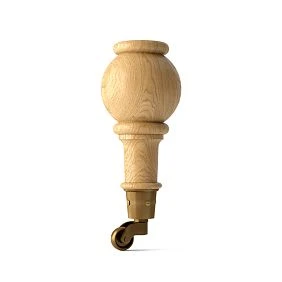
Why choose furniture leg MN-179
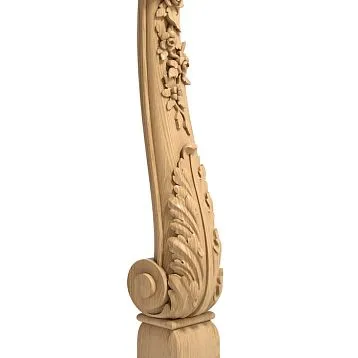
MN-179 is a turned wooden support 220 mm high with a metal tip and a small caster. It is suitable for an ottoman, pouf, chest of drawers, or coffee table that needs to be moved periodically without lifting the entire body. The buyer can choose beech under enamel or oak under tinting, and the antique bronze color helps to match the lower hardware with the handles and other metal furniture parts.
Short answer: MN-179 is worth buying for a bench, pouf, chest of drawers, or coffee table that needs to be moved periodically. The leg measures 220 × 86 × 48 mm, is made of beech for enamel and oak for tinting, and the metal caster is finished in antique bronze. Before ordering, calculate the final furniture height, determine the number of supports, choose the top mounting, and test the caster on the specific flooring.
Buy a wooden furniture leg MN-179 with a caster is not just for decorative effect. This support changes how the furniture is used: a bench can be slightly moved for cleaning, a pouf can be repositioned closer to an armchair, a coffee table can be shifted within the living room, and a chest of drawers can be moved for wall or floor maintenance. At the same time, the caster does not turn the item into a cart and does not negate stability requirements.
The model has four selection points. First is the height of 220 mm and its impact on the finished item. Second is beech or oak. Third is the flooring over which the metal caster will move. Fourth is the top mounting of the leg to the frame. A mistake in even one point can lead to uncomfortable seating, marks on the floor, wobbling of the body, or the inability to securely install the support.
MN-179 differs from a regular wooden leg in that the lower part is already assembled as a functional unit. The antique bronze-colored metal tip is secured with three brass screws 3.5 × 12 DIN 95. Therefore, the buyer does not need to separately find a decorative shoe and wheel, match them by diameter, and drill into the turned part without a template.




Confirmed specifications of MN-179
| Parameter | Confirmed value | What this means for the buyer |
|---|---|---|
| Model | MN-179 | Turned furniture leg with a pre-assembled lower unit |
| Size | 220 × 86 × 48 mm | The height of 220 mm must be added to the frame, base, and soft filling |
| Material | Beech or oak | The choice is related to the future opaque or translucent finish |
| Sanding | «Prestige» | Before the finish, the surface is still inspected and dusted |
| Preparation of beech | For enamel | Suitable for opaque coating that hides lamella differences |
| Oak preparation | For tinting | Allows preserving and emphasizing the wood grain pattern |
| Bottom node | Metal tip with a wheel | Furniture is easier to move, but floor compatibility is checked separately |
| Metal color | Antique bronze | Must be coordinated with handles, hinges, and other visible metal |
| Tip attachment | Three brass screws 3.5 × 12 DIN 95 | The lower fittings already belong to the leg structure |
| Purpose | Chests of drawers, benches, poufs, coffee tables | The model does not replace an office caster or industrial wheel support |
| Upper fittings | FUR-001 or FUR-012 among the options | The mounting is chosen based on the frame and the structure of the installation area |
The characteristics help to understand the model, but do not answer the question about the finished furniture. The leg may be correctly manufactured and still not fit a specific bench due to too high a seat height, weak base, or unsuitable floor. Therefore, it is better to use the article as a verification route, and the product card as a point for selecting material and ordering.
Our factory also produces:


Which furniture is MN-179 suitable for
Get Consultation
Bench
MN-179 is well-suited for a classic or vintage ottoman that sometimes needs to be moved away from the wall. The leg height of 220 mm makes the support a noticeable part of the silhouette. The frame and soft seat should be designed so that the final seating height is not excessively high.
The ottoman experiences dynamic load when a person sits down, stands up, and shifts weight to one edge. A caster without a declared brake requires particularly careful testing on a smooth floor. The item should not roll away when sitting down. If necessary, choose a different base or an additional locking solution coordinated with the design.
Pouf
On the pouf, turned legs with bronze casters create a light classic look. A small item is easier to move, but its low weight increases the risk of spontaneous shifting. Before ordering, evaluate the frame weight, soft filling, and usage location.
For a bedside pouf, quietness and floor safety are important. A metal caster should not be considered universally suitable for parquet or soft wood. It is useful to test contact on a sample of the flooring or in an inconspicuous area.
Chest of drawers
A chest of drawers is usually heavier than a pouf or ottoman. Casters can facilitate small movements, but the body with extended drawers creates a risk of shifting the center of gravity. Movement should only be performed with closed drawers and without heavy items on top.
For a tall chest of drawers, stability is especially important. Legs should not be used as a way to make a heavy body permanently mobile. If the furniture stands on a smooth floor, check whether it moves when opening a drawer.
Coffee table
MN-179 is suitable for a small coffee table that is periodically moved around the living room. The height of the finished item consists of the 220 mm leg, the lower frame, and the tabletop. If the table should be low, such a support may be too high.
Do not lean your full weight on the tabletop when moving. A table with four casters should maintain its geometry and not rotate spontaneously. The shape of the body and the distance between supports affect stability no less than the leg itself.
Small side table
The model can be considered for a decorative side table if its height, weight, and center of gravity are verified. It is not a caster for an office chair and is not designed for constant fast rolling around the room.
Size 220 × 86 × 48 mm: how to calculate the final height
The number 220 mm refers only to the height of the leg. For a bench, add the bottom frame, seat base, foam, other filling layers, and upholstery. For a chest of drawers, add the body and possible lower apron. For a table, add the mounting area and tabletop thickness.
Get Consultation
Bench
First, determine the desired seat height. Then subtract the thickness of the soft block, base, and frame. Compare the remaining value with 220 mm. If the leg is already taller than the available remainder, the product will be uncomfortable regardless of appearance.
Pouf
For a pouf, the soft block can be particularly thick. A tall leg makes the item more like a small bench. Before ordering, create a side drawing to scale and mark all layers.
Chest of drawers
The height of the legs affects access to lower drawers and the overall silhouette. At 220 mm, a noticeable gap appears between the floor and the body. This facilitates cleaning but makes the chest of drawers taller and visually lighter. A heavy upper body requires stability checks.
Coffee table
For a table, the final height is determined by the scenario: next to a sofa, armchair, or bed. Compare the tabletop top with the seat height. MN-179 is not suitable for every low coffee table.
Why you cannot cut the leg on site
The bottom tip with the wheel is already fixed on the turned part. Cutting from below will destroy the assembly, and cutting from above will change the mounting area and may interfere with fastening. If a different height is needed, it is better to choose another model from the category rather than modify MN-179 in a random way.
How the metal wheel works
The wheel reduces resistance when moving furniture short distances. This is convenient when you need to move a bench for cleaning, reposition a pouf to another chair, or shift a table within one zone. However, MN-179 does not turn furniture into a transport platform. The wheel is decorative in scale and designed for items listed in the product card.
Periodic movement
The support is suitable for situations where furniture is moved occasionally and over short distances. Constant rolling over long routes, thresholds, and uneven joints creates a different load. Specialized rollers with confirmed characteristics are needed for such tasks.
Direction of movement
Before ordering, you need to understand how the wheel turns and how much free space it requires. The lower assembly should not touch the baseboard, decorative frame of the body, or an adjacent leg. If positioned too close to the apron, the wheel may not operate freely.
Furniture weight
The heavier the body, the more force is transferred to the contact with the floor. A heavy dresser may be more difficult to move than a light pouf, despite having the same legs. The same level of convenience cannot be guaranteed for furniture of different weights.
Threshold and floor covering joint
The wheel is not automatically designed to cross a threshold. When attempting to go over a noticeable height difference, all the load may fall on the tip and fasteners. It is safer to lift furniture over a threshold with the help of several people.
Impacts and lateral load
The turned leg is designed primarily for vertical support. A sharp push from the side creates torque at the top mount and bottom joint. Furniture should be moved smoothly, without using the leg as a lever.
Does the caster have a lock
The MN-179 card describes a metal caster that makes moving furniture easier. No lock, brake, or blocking mechanism is stated. Therefore, it cannot be guaranteed that a pouf, bench, or chest will automatically stay stationary on a smooth floor.
What does this mean for the bench
A person sits down with a horizontal force. If the floor is slippery, the item may shift. Before manufacturing the set, a test assembly or a finished bench should be tested under real load.
What does this mean for the pouf
A lightweight pouf is especially sensitive to the lack of a brake. On a carpet, it may stay more stable; on smooth laminate, it may move more easily. A conclusion cannot be drawn without testing.
What does this mean for the chest
A heavy body has greater inertia, but opening a drawer creates a horizontal force. If the chest shifts, a different design or additional fixation that does not interfere with the legs is needed.
When is it better to choose a fixed leg
If the furniture must remain strictly in place, children often sit on it, it stands on a slope or near stairs, a caster may be undesirable. In this case, it is wiser to consider a stationary support from the product category.
For which floor coverings can MN-179 be considered
The card confirms the presence of a metal caster, but does not contain a universal list of compatible coverings. Therefore, the decision is based not on the name of the floor, but on actual contact, furniture weight, and usage mode. Safety is checked on a sample or in an inconspicuous area.
Parquet
Lacquered or oiled parquet can be sensitive to point load and metal. Even if the wheel rolls easily, it can leave a streak, dent, or scratch due to a grain of sand. Before installation, clean the wheel and test it on a sample of the same covering.
Solid wood board
Soft wood species are more prone to marks. A hard board also does not guarantee safety. The heavier the furniture and the narrower the contact area, the higher the risk of indentation.
Laminate
Laminate varies in protective layer and joint quality. The wheel should not hit a raised edge or debris. Check if matte streaks remain and if the decorative layer is damaged.
Ceramic tile
Hard tile is more resistant to dents, but joints create unevenness. When crossing a wide joint, the wheel receives an impact. On glossy tile, furniture may move too easily.
Stone and porcelain stoneware
The surface is usually hard, but a polished coating may show marks, and joints can create an impact. The sliding of an object when placed is assessed separately.
Carpet and carpeting
Soft pile can impede movement and change the position of the leg. The caster may catch or sink. High pile also hides the bottom tip and changes the height of the furniture relative to the floor.
Vinyl flooring
Elastic material can get point dents. Even if the mark gradually diminishes, this should be checked in advance. A heavy dresser poses a greater risk than a light table.
How to conduct a safe test
Use one leg or a ready-made test item with comparable load. Clean the wheel and floor, perform several short movements, and leave the support in place for some time. Then check for scratches, indentation, and changes in gloss.
Beech for enamel or oak for tinting
| Criterion | Beech | Oak |
|---|---|---|
| Preparation | For enamel | For tinting |
| Visual result | Even covering color | Pronounced wood texture |
| Combination with the body | Painted MDF, enameled beech, colored furniture | Oak veneer, solid wood and furniture with visible wood |
| Main check | Compatibility of primer and enamel | Test tinting and shade matching |
Beech MN-179 for enamel
Beech is chosen for white, black, gray or colored furniture. The covering coating makes the turned shape the main element and hides the differences of wood lamellas. The antique bronze tip can be left contrasting or supported by handles of the same character.
Oak MN-179 for tinting
Oak reveals a porous texture and is suitable for a transparent or semi-transparent finish. The tint must be tested on a sample. On a turned surface, the color distributes differently than on a flat facade, so matching by catalog name does not guarantee the same appearance.
Can oak be coated with oil or varnish
The choice of system depends on the project and material compatibility. A transparent finish should protect the surface and not interfere with the metal node. Before full finishing, test on similar oak.
Can oak be painted with enamel
Technical feasibility depends on preparation, but if the wood texture is completely covered, the advantage of oak is used less. For opaque painting, it is more rational to consider beech under enamel.
Why is it better to order the set as one batch
Wood has natural differences in shade and grain. Four or six legs purchased at the same time are easier to match in preparation and finishing. For serial furniture, it is especially important to order the entire set and a spare part as one batch.
Before ordering, you can order MN-179 from oak or beech and immediately fix the future finishing system.
How to combine antique bronze with handles and other metal
Full match is not necessary
The tip is near the floor and is perceived in shadow. The handles are located higher and reflect light more strongly. An exact shade match is not always required, but metals should have a similar character: warm, aged, matte, or polished.
Antique bronze and brass
Brass screws are already entering the visible lower node. Handles in a warm brass or bronze shade can support it. Too bright a gold finish will look different.
Antique bronze and black metal
Black handles are acceptable if there are already dark elements in the interior. On oak furniture, the combination looks more graphic. On light enamel, the difference will be more noticeable.
Antique bronze and chrome
Cold shiny chrome often clashes with a warm vintage tip. Such a combination is only possible as an intentional contrast. For classic furniture, it is easier to choose handles of a similar warm shade.
Patina on the wooden part
A slight highlighting of the relief can connect the enamel with the bronze wheel. But the patina must be the same on the entire set. Strong aging on four legs quickly creates a variegated surface.
How many legs MN-179 to order
The number of supports is determined by the furniture design, not just the familiar "four corners" scheme. A small pouf often uses four legs, a long bench may require an additional central support or a different layout, and for a chest of drawers, the number depends on the body length, bottom rigidity, and partition placement.
Four legs
The classic scheme suits a compact pouf, square bench, small table, or short chest of drawers. All four mounting points must be in the same plane. Even a slight height difference creates wobbling, which is more noticeable on casters.
Six legs
For a long bench or chest of drawers, six supports help support the middle of the body. But the additional pair must have its own rigid mounting zone. You cannot screw a leg into a thin bottom without an insert just because the middle seems weak.
Five legs
A central fifth support is sometimes used under a rectangular body, but with a caster, it may contact the floor differently than the corner legs. If the floor is uneven, one point will bear excessive load. The layout must be checked in the drawing and during a trial assembly.
Eight legs
For a very long piece, eight decorative legs can overload the appearance. Sometimes it's better to choose an internal frame or another support system. MN-179 is noticeable, so each additional leg must be justified by both construction and design.
Spare leg
For a commercial project, hotel, restaurant, or series of poufs, it's useful to order spares. Wood and finish have natural variations, so a part from the same batch is easier to replace without noticeable discrepancy.
Why you cannot calculate load by simple division
The body weight is not distributed perfectly evenly. A person sits on the edge, a drawer is pulled out, a table is loaded on one side. A corner leg may receive more than a quarter of the total mass. The structure is checked for the worst-case scenario, not just static weight.
FUR-001 or FUR-012: how to choose the top mounting
The MN-179 card offers several hardware options for connecting the leg to the furniture. In the SEO scheme, FUR-001 and FUR-012 are confirmed. Both kits use an M8 × 60 stud but differ in the second part of the assembly.
| Parameter | FUR-001 | FUR-012 |
|---|---|---|
| Set size | 60 × 8 × 13 mm | 60 × 13 × 13 mm |
| Main elements | M8 × 60 stud and metal insert M8 × 13 | Round mounting plate with a diameter of 37 mm, M8, and M8 × 60 stud |
| Mounting type | Threaded insert inside the furniture base | Installation via a separate round plate |
| What to check | Thickness and density of the material for the insert, mounting hole | Area for the plate, access to fasteners, and base geometry |
FUR-001 with threaded insert
The kit is designed for quick attachment of a leg to a tabletop or furniture structure. The stud has a screw and metric part, and the threaded insert creates an M8 threaded connection in the furniture base. The frame must be thick and dense enough to hold the threaded insert.
On thin plywood or weak particleboard, such a unit cannot be assigned automatically. A solid wood or multi-layer plywood insert may be required. The diameter and depth of the holes are made according to the hardware documentation and project.
For a suitable base, you can buy the FUR-001 mounting kit for MN-179 and include the threaded insert in the frame drawing in advance.
FUR-012 with round plate
FUR-012 includes a round mounting plate with a diameter of 37 mm and an M8 × 60 stud. The plate distributes the connection over a separate area and can be convenient where it is impossible or undesirable to install the threaded insert directly into the body material.
In this case, the plate requires a flat mounting area and its own fastening. It must not intersect with upholstery, staples, apron, or decorative profile.
For an alternative connection, you can view the FUR-012 mounting kit and compare it with the construction of your furniture.
How to choose between two sets
The decision is made by the furniture designer based on the frame material, thickness of the embedded part, access to the reverse side, and maintenance capability. You cannot choose only by price or appearance. Both assemblies must ensure the same axis of the legs and the possibility of precise tightening.
Does the top mounting come with the leg
The top hardware is listed separately among the necessary components. You should not assume that FUR-001 or FUR-012 are automatically included with each leg. The number of sets is calculated based on the number of supports.
How to prepare the furniture frame
Rigid mounting platform
The leg must be attached not to the decorative trim, but to the load-bearing part. For a pouf or bench, this could be the bottom frame or embedded part. For a chest of drawers, it is the reinforced lower belt. For a table, it is the apron or a specially designed platform.
Same height of points
All mounting zones must be in the same plane. Even a difference of a few millimeters leads to wobbling. On casters, the problem may manifest as spontaneous rotation of the body.
Edge offset
Mounting too close to the edge increases the risk of splitting or tearing. The exact offset depends on the material and design. It is specified in the drawing, not chosen by eye.
Space for wheel rotation
The lower tip must not touch the apron, upholstery, or decorative trim. Check the wheel trajectory before securing all legs.
Access for tightening
Fasteners must remain accessible at least during assembly. If upholstery completely covers the joint, install the legs in the correct order. For removable structures, provide service access.
How to check furniture stability
Empty item
First, place the furniture without contents on a level floor. Check for wobbling, verticality, and even contact of all wheels. The body should not move from a light touch if sitting or drawer opening is intended.
Working load
The bench and pouf are tested with gradually increasing load in the center and at the edge. The chest of drawers — with closed and then carefully opened drawers. The table — with items that would normally be on the tabletop.
Load on one edge
The most dangerous scenario often occurs not in the center. A person sits on the side, a heavy drawer is pulled out, a hand leans on the corner of the table. The legs and frame must maintain their position.
Rotation and movement
Move the item a short distance and return it back. The casters should work without jamming or impacts. If one leg turns differently, check the geometry and installation.
Re-checking the fasteners
After several days of use, the connections are inspected. If wobbling appears, you cannot simply tighten the fasteners to the limit without finding the cause. Possibly, the embedded part has loosened, the frame has deformed, or the floor turned out to be uneven.
When it is better to choose fixed furniture legs
A caster is useful only when mobility is truly needed. If the bench stands in one place, the chest of drawers is tall and heavy, and the table is not planned to be moved, a fixed support may be safer and simpler.
For comparison, you can Buy wooden furniture legs without being tied to wheels and choose a turned, carved or geometric model by height.
If independent finishing is important, it is convenient to choose unpainted furniture legs for enamel or tinting and choose a stationary alternative to MN-179.
What to buy together with MN-179
One leg does not solve the furniture problem. The buyer needs a complete set of supports, top mounting, a prepared frame and a finishing system. Sometimes a spare leg from the same batch is also required. It is better to coordinate all elements before starting the body manufacturing.
Complete set of legs
The quantity depends on the design. Four identical legs are suitable for a compact item, six for a long bench or chest after calculation. Ordering different species or different batches for one item is not recommended.
FUR-001
The insert and stud create a threaded removable assembly. The set is only suitable when the furniture base allows proper installation of the insert. A separate set is needed for each leg.
FUR-012
A round mounting plate helps organize the connection on a prepared platform. Its size, holes and fastening method must be taken into account in the frame before upholstery or finishing.
Primer and enamel for beech
The beech kit for enamel requires a compatible system. The primer levels the surface, and the finish color connects the supports to the body. Tips and casters protect against paint ingress.
Tinting and protective finish for oak
Oak legs are first tested with a trial coat. After the shade is approved, all parts are processed in one batch to minimize differences.
Embedded parts in the frame
This is not a separate product from the diagram, but part of the furniture structure. The embedded part must accept a threaded or plate node and transfer the load to the frame, not to the thin cladding.
| What to add to the purchase | Why | For which scenario | What to Check |
|---|---|---|---|
| Kit MN-179 | Assemble all support points in one style | Ottoman, bench, chest, table | Quantity, one wood species, and one batch |
| FUR-001 | Create a connection through a stud and a bushing | Dense embedded plate with a mounting hole | Material thickness and thread fit accuracy |
| FUR-012 | Secure the leg through a round mounting plate | Flat accessible mounting platform | Space for the plate and its fasteners |
| Primer and enamel | Paint the beech legs | White, black, or colored furniture | Layer compatibility and metal protection |
| Tinting and varnish | Preserve oak texture | Furniture with visible wood | Test shade and uniform finish of the set |
| Spare leg | Simplify series repair | Hotel, restaurant, several identical items | Wood species, batch, and finish |
How not to confuse MN-179 with similar products
Leg with caster and regular turned leg
A regular support stands still and requires a separate foot pad. MN-179 has a ready-made metal tip with a caster. If mobility is not needed, the lower assembly may be redundant.
MN-179 and office caster
An office caster is designed for a different mounting method, constant rotation, and chair movement. MN-179 is intended for decorative furniture. It cannot be optimized for computer chairs or used as an industrial support.
Wheel and furniture glider
The glider protects the bottom end and helps furniture stay in place. The wheel reduces resistance to movement. These are opposite functions, so the parts cannot be considered interchangeable.
Tip with wheel and separate decorative insert
For MN-179, the bottom metal is functional. In models with a decorative insert, the metal may only change the appearance. Before purchasing, look not only at the color but also at the purpose.
Beech and oak
Both species look similar only before finishing. Beech under enamel is designed for opaque color, oak under tinting for visible texture. Choice of species
Need to redo the dresser
The body height will increase by 220 mm minus the depth of the mounting unit. Check access to the top drawers and stability. A heavy dresser should not be moved frequently, especially with filled drawers.
Need a coffee table
Match the final height with the sofa. On low upholstered furniture, a table with MN-179 may be too high. The tabletop and apron must be rigid enough for four legs to maintain a single geometry.
Need to move furniture for cleaning
The wheel is useful if the surface is level and safe. Move a test item a short distance and check for marks. A threshold, carpet, or wide tile seam can minimize convenience.
Need furniture for a hotel
A commercial project requires a test sample. Check the fit, daily cleaning, floor condition, fasteners, and finish. Only after testing, order the series and a spare leg.
Need a vintage chest of drawers with bronze hardware
Oak with tinting and antique bronze create a cohesive look. Choose warm-toned handles and check that the degrees of aging used on the metal are not too different.
Need a white pouf
Beech under enamel allows painting the wooden part to match the body color. The metal tip is left contrasting. During painting, it is protected so that enamel does not get into the moving joint.
Need furniture on a soft carpet
The caster may sink into the pile and stop functioning. Do a trial assembly. Perhaps a fixed leg will work better and look just as appropriate.
Need furniture near a staircase
The absence of the stated stopper makes such placement risky. An item with casters should not be placed where accidental movement could lead to a fall. Choose a fixed support or change the location.
Errors when purchasing MN-179
Choosing only by photo
In the image, it is impossible to assess the actual height of 220 mm, the diameter of the turned part, and the scale of the wheel. Use the drawing and full-size template.
Do not calculate the final height
The most common mistake for a bench and pouf is to add legs to an already approved thick soft block. The seat ends up too high.
Consider the wheel safe for any floor
Floor material, varnish, furniture weight, and sand affect marks. Universal compatibility is not claimed.
Expect a stopper
There is no brake confirmation in the card. The buyer must check stability without it.
Buy one leg at a time at different times
Wood batches and shade after finishing may vary. For one item, it is better to order a complete set at once.
Mixing beech and oak
Different species perceive finishing differently. Even under a dark color, the texture may differ. One set is assembled from one material.
Order FUR-001 without a recess
The threaded insert requires appropriate thickness and density. A thin bottom will not hold the assembly.
Order FUR-012 without space for the plate
A round plate with a diameter of 37 mm must be on a flat surface and have access to the fastening.
Paint the assembled caster
Enamel or varnish may get into the moving part. Metal is protected before finishing.
Rolling a heavy dresser with open drawers
The center of gravity shifts, the body may tilt. Before moving, close the drawers and unload the top.
Move over thresholds
A blow to the small wheel is transmitted to the tip and leg. The furniture is lifted over the drop.
Do not check one plane
Four correctly made legs will not fix a crooked frame or uneven floor. Mounting points must match in height.
Who should take a closer look at MN-179
Owner of a bench or ottoman that needs to be moved occasionally
The model is suitable for furniture standing against a wall, bed, or window, when access to the floor is needed during cleaning. The wheel facilitates short movement, and the turned shape preserves the classic character.
Furniture maker
The finished support saves time on turning and selecting lower hardware. The master only needs to design the frame, choose FUR-001 or FUR-012, perform finishing, and check stability.
Designer of classic or vintage interior
Antique bronze, oak texture, or enamel allow connecting the legs with the handles, upholstery, and body. It is important not to overload the furniture with other metal parts.
For the owner of a small coffee table
If the final height suits the sofa, MN-179 helps make the table more mobile. However, the product is not intended for constant rolling around the entire apartment.
For a commercial project with a test sample
A hotel, salon, or showroom can use such legs on a series of poufs and benches. First, assemble one item, test it on the actual floor, and only then repeat the set.
When it is better not to choose MN-179
The furniture must stand absolutely still
If the item is used as a support when standing up, is near a staircase, or on a sloped floor, the absence of the stated stopper becomes a serious limitation.
The floor is very sensitive
On soft wood, delicate varnish, or elastic vinyl, a metal wheel may leave a mark. Without a successful test, it is better to choose a stationary leg with a suitable glider.
Need a very low table
A height of 220 mm may be excessive. Cutting a ready-made support with a caster is not possible without changing the design.
Furniture is very heavy or long
A large chest of drawers, long cabinet, or massive table requires separate calculation of supports. MN-179 cannot be assigned just because chests of drawers are mentioned in the card.
Need office or industrial mobility
For chairs, carts, retail equipment, and furniture that is constantly moved, specialized casters with confirmed load capacity, brake, and mounting type are needed.
How to prepare beech legs for enamel
Inspection before priming
The 'Prestige' quality means detailed sanding, but before painting, each leg is inspected under side lighting. Dust, handprints, and minor defects must be removed before priming.
Protection of the metal component
The tip, brass screws, and wheel are covered with masking material. Paint must not get into the moving part or change the appearance of antique bronze.
Priming
The primer system must be suitable for the wood and the chosen enamel. The turned surface is coated evenly, without creating drips in diameter transitions.
Intercoat treatment
After the primer dries, the surface is carefully matted. All legs are treated identically, otherwise the gloss level and smoothness of the set will differ.
Finish enamel
The color is applied in thin layers. White enamel emphasizes the shape and bronze tip, black makes the metal calmer, colored allows the legs to be tied to the upholstery or facade.
How to finish oak legs
Test paintout
Oak has a pronounced porous texture. Tinting darkens the fibers and recesses of the turned shape. Before processing the entire set, make a sample on the same wood species and with similar preparation.
Uniform sequence
Each leg is tinted in the same order and with the same amount of compound. If one part is left wet longer, the shade may differ.
Transparent protective layer
The finish must match the furniture's usage. For a pouf and bench, resistance to cleaning and accidental shoe contact is important. The metal is protected from varnish in the same way as when working with enamel.
Matching with the body
The legs may match the tone of the oak body or be darker. Exact matching of natural material is not guaranteed, so it is better to approve the combination rather than try to hide natural differences.
How to install legs without dry instructions
Installation begins on the drawing. On the bottom frame, mark the axes of all supports, indents from edges, and the type of fastening. After that, a test assembly is done without upholstery and finish to check the geometry.
First the frame, then the finish
You cannot design holes after the pouf is upholstered with fabric. Staples and filling may block mounting areas. Embedded parts are installed at the frame manufacturing stage.
Axis control
The turned legs should appear evenly splayed. The lower wheel also requires a clear path. Before tightening, mark the direction of each part.
Even tightening
The fastener is tightened without excessive force. Overtightening may damage the insert, plate, or wood. After assembly, check that there is no gap between the top of the leg and the base.
Test on a level floor
Place the item on a verified flat surface. If it wobbles, check the frame, fasteners, and position of all supports. Do not immediately sand one leg or insert random material.
How to accept the set after delivery
Verify the quantity and wood species
Ensure all legs are made of beech or all of oak. Separately count FUR-001 or FUR-012 according to the number of supports.
Check the size
Verify 220 × 86 × 48 mm against the furniture drawing. Before painting and drilling, ensure the height matches the calculation.
Inspect the wood
Check the turned surface, edges, and top seating area. Natural wood variations are acceptable, but mechanical damage must be noted before finishing.
Inspect the caster
The tip must be secured, brass screws must be in place, and the wheel must move without obvious binding. Do not disassemble the assembly unnecessarily.
Check the metal shade
Compare all tips under the same lighting. If bronze handles are nearby, hold a sample before starting wood finishing.
Care for legs and casters
Wood cleaning
Use a soft cloth and a cleaner compatible with enamel, lacquer, or oil. Do not leave water near the lower metal assembly.
Caster cleaning
Sand, hair, and threads impair movement and may scratch the floor. The wheel is regularly inspected and gently cleaned without aggressive tools.
Tip screw control
If play appears, stop using the furniture until inspection. Do not tighten the three brass screws with a random screwdriver using excessive force.
Upper mount inspection
After the first few weeks, inspect FUR-001 or FUR-012. Wobbling may indicate a loose upper assembly, not the wheel.
Moving
Move furniture smoothly and only on a level surface. Lift the item over thresholds or high-pile carpets. Unload the chest of drawers beforehand.
How to buy MN-179 on STAVROS
Open the product page and select the material: beech under enamel or oak under tint. Check the size 220 × 86 × 48 mm against the furniture drawing and determine the number of legs.
Then choose the upper mount. For an assembly with a threaded insert, go to FUR-001; for a version with a round mounting plate, go to FUR-012. The final decision must match the embedded part in the frame.
Before ordering, check the flooring, need for a stopper, and movement mode. If the furniture must remain stationary, compare MN-179 with other wooden supports.
After agreeing on the design, you can view leg MN-179 size 220 mm, select wood species and order a complete set in one batch.
What to Check Before Ordering
- final height of the bench, pouf, chest of drawers, or table;
- body weight and working load;
- number of supports and need for a central pair;
- size and material of the bottom frame;
- location of rigid embedded inserts;
- option FUR-001 or FUR-012;
- beech for enamel or oak for tinting;
- body color and combination with antique bronze;
- floor covering type;
- wheel test result on floor sample;
- absence of the claimed stopper;
- free rotation of the wheel;
- absence of thresholds and high seams on the route;
- stability of the item when sitting or opening drawers;
- need for a spare leg;
- ordering the full set in one batch;
- current price, availability, and delivery time in the product card.
How MN-179 works in different furniture styles
Classic furniture
In a classic chest of drawers or ottoman, the turned leg shape complements paneled fronts, carved handles, and soft body curves. Antique bronze looks natural next to warm metal details. To avoid overwhelming the furniture, it's enough to repeat this shade in the handles or one decorative element.
Neoclassicism
For a neoclassical interior, beech legs can be painted white, gray, blue, or another opaque color. The metal tip will remain a small contrasting accent near the floor. The body is best kept calm, without a lot of carving, so that the wheel and turned silhouette do not compete with the facades.
Provence
Light enamel and bronze metal suit a bench or ottoman with soft fabric and a restrained floral pattern. Patina is applied very sparingly and evenly to the entire set. Heavy artificial aging can hide the neat shape of the leg and make the furniture look motley.
Vintage interior
Oak with a tint finish pairs well with a body that shows wood grain. The dark shade and antique bronze create a sense of antique furniture, but the construction must remain modern and reliable. The decorative look cannot be used as an excuse for weak fastening or an unsuitable floor.
Eclecticism
MN-179 can be placed on a minimalist body to create contrast between the modern form of the furniture and the classic support. To make the solution look intentional, repeat the color of the metal or wood in one adjacent piece. Random mixing of chrome, bronze, and black metal creates a sense of mismatched assembly.
Modern interior
In a modern space, such a leg works as a standalone expressive detail. For example, a white ottoman on turned supports can stand next to a simple bed or chair. But if the entire interior is based on strict geometry and hidden supports, a decorative wheel may be unnecessary.
How to choose MN-179 for repairing old furniture
Replacing legs seems simple until you start measuring the old body. First, you need to determine not only the height of the previous support, but also its seating depth, the condition of the corners, the thickness of the bottom frame, and the distance between fastening points. MN-179 has its own size and requires a new layout, so it cannot be screwed into the old hole without checking.
Remove one old leg
Inspect the threads and the insert. If the wood has crumbled or the hole has widened, a new set will not fix the problem. The frame is repaired and reinforced before installing the hardware.
Compare the height
If the old leg was lower than 220 mm, the chest of drawers, ottoman, or bench will rise noticeably. This affects proportions, access to drawers, and seating comfort. A full-size side drawing helps visualize the change before purchase.
Check the center of gravity
An old heavy chest of drawers on high casters may become less stable. For a tall body, it is especially important to check the opening of the top drawers and possible wall anchoring if it is provided by the design.
Do not keep random fasteners
Old screws may not comply with FUR-001 or FUR-012. The new assembly is designed as a set. This is more reliable than combining a new leg with old worn-out hardware.
How to prepare an order for the workshop
Provide the master with the MN-179 card, the selected wood species, the number of legs, and a link to the fastening. The drawing must include the total height of the item, mounting axes, and the material of the inserts. For a bench, additionally specify the thickness of the upholstered block; for a chest of drawers, the body weight and partition layout.
Separately, record the flooring. The master must understand where the furniture will stand: on parquet, laminate, carpet, or tile. This affects the decision on whether a caster is suitable at all. For a commercial project, add a test sample and a spare leg to the specification.
A good specification does not complicate the order but prevents rework. The buyer understands in advance what height they will get, how the set will be attached, and whether the furniture can be moved safely. It is in this combination that MN-179 reveals itself as a ready-made professional element, not a random decorative detail.
Before finalizing the order, it is useful to compare two layouts: furniture on MN-179 and the same body on fixed legs of similar height. This makes it clear whether periodic movement is truly more important than absolute fixation. If the caster does not provide noticeable benefit in a real scenario, it is better to choose a regular support. If the furniture is regularly moved for cleaning or rearrangement, MN-179 justifies the more complex check of the floor and fastening.
For an accurate solution, it is useful to save the furniture drawing, the selected type of fastening, the wood species, and the results of the caster test on the floor. This data will be useful for reordering, repairs, or manufacturing a second item.
Frequently asked questions
What is the size of MN-179?
The leg size is 220 × 86 × 48 mm. The height of 220 mm applies only to the support and must be added to the frame, soft filling, or tabletop.
What furniture is MN-179 suitable for?
The card indicates dressers, benches, poufs, and coffee tables. For each item, you need to check the weight, height, number of supports, and stability on casters.
Can MN-179 be used for a bench?
Yes, if the final seat height is comfortable, the frame has rigid inserts, and the bench does not shift when sitting. On a smooth floor, a test is mandatory.
Is the leg suitable for a pouf?
It is suitable for a compact pouf after height calculation. A light item may move more easily than a heavy bench, so the absence of a declared stopper must be taken into account.
Can I put MN-179 on a dresser?
The card allows such use. A tall and heavy body requires checking the center of gravity, bottom rigidity, and behavior when opening drawers.
Is MN-179 suitable for a coffee table?
Yes, if the final height matches the sofa, and the tabletop and frame are designed for four or more supports. For a very low table, 220 mm may be too much.
Does the caster have a stopper?
A stopper, brake, or lock is not stated in the card. Immobility of furniture on a smooth floor cannot be promised without testing the finished item.
Is the caster suitable for parquet?
Universal compatibility is not confirmed. Metal, sand, and furniture weight may leave marks. Conduct a test on a parquet sample or in an inconspicuous area.
Can MN-179 be used on laminate?
It can be considered after testing. Laminate varies in protective layer, and joints and debris may be damaged or hinder movement.
Will the wheel fit the tile?
A hard surface is usually less prone to dents, but seams create bumps, and glossy tile may be too slippery. Check the furniture's stability.
Can the leg be used on a carpet?
High or dense pile can block the wheel and change the furniture's position. It's best to test the assembled item on the actual carpet.
Should I choose beech or oak?
Beech is prepared for enamel and is suitable for opaque painting. Oak is prepared for tinting and retains a pronounced wood texture.
Can the beech MN-179 be painted white?
Yes, beech for enamel is suitable for white and other opaque painting. The tip and wheel need to be protected from primer and paint.
What to coat the oak leg with?
You can consider compatible tinting and a clear protective finish. Be sure to test on similar oak before treating the entire set.
Can the oak be left uncoated?
Raw wood gets dirty faster and reacts to moisture. The finish system is chosen based on the furniture's usage conditions.
How to combine antique bronze with handles?
It's better to choose warm bronze or brass shades of a similar character. An exact match is not necessary, but cold chrome can look accidental.
How many legs does an ottoman need?
Four are most often used, but the decision depends on the size and frame construction. All mounting points must be rigid and lie in the same plane.
How many legs does a long bench need?
Six supports or another reinforced scheme may be required. Additional legs cannot be attached to a thin bottom without an embedded insert.
Is a spare leg needed?
For a series, commercial interior, or complex finish, a spare is useful. A part from the same batch is easier to match for wood and color.
Is the top mounting included in the MN-179 kit?
FUR-001 and FUR-012 are listed as separate items among the necessary hardware. Their quantity is calculated based on the number of legs.
How does FUR-001 differ from FUR-012?
FUR-001 includes an M8 × 60 stud and an M8 × 13 insert nut. FUR-012 includes the same stud and a round mounting plate with a diameter of 37 mm.
Which mounting kit should I choose?
The choice depends on the material and structure of the frame. The insert nut requires a suitable embedded part, while the plate needs a flat mounting surface and space for its fasteners.
Can the legs be installed on chipboard?
Thin chipboard cannot automatically be considered a sufficient base. Often a separate embedded part is needed. The assembly should be calculated by a furniture specialist.
Can MN-179 be trimmed in height?
Self-trimming is not recommended: there is a finished tip with a wheel at the bottom and a mounting area at the top. It is better to choose a leg of a different height.
Do the legs need to be painted before installation?
It is often more convenient to finish the finishing before final assembly, keeping the threads and mounting surfaces clean. A test installation is carried out in advance.
How to protect the caster wheel during painting?
Cover the metal tip and moving part with suitable masking material. Paint must not get between the wheel parts.
How to check the stability of a banquette?
Place it on a level floor, gradually load the center and edges, then check the fit and rise. The item should not move on its own.
Can a chest of drawers be rolled over a threshold?
It should not be. The impact on the small wheel is transmitted to the tip and top mount. Unload the chest and carry it.
How to care for the caster wheel?
Remove hair, threads, sand, and dust. If play or binding occurs, stop use and check the lower assembly.
Where to buy leg MN-179?
The model is presented in the STAVROS catalog. In the product card, you can select beech or oak, check the current price, and place an order via the cart or quick order.
Result: MN-179 is chosen for the combination of a turned shape and neat mobility
MN-179 helps assemble a banquette, pouf, chest of drawers, or coffee table with expressive wooden supports and a ready-made antique bronze caster. The 220 mm height makes the leg a noticeable part of the furniture, so it should be considered at the drawing stage, not added to the finished body at the last moment.
Beech under enamel suits solid-colored furniture, oak under tinting suits a project with visible wood texture. The top connection is chosen between FUR-001 and FUR-012 based on the frame design. The caster facilitates periodic movement, but a lock is not specified, and compatibility with a specific floor requires testing.
Before ordering, check the final height, furniture weight, number of legs, inserts, floor covering, and stability during actual use. After that, you can buy a set of turned legs with bronze casters, supplement it with FUR-001 mounting or FUR-012 kit and assemble the furniture without accidentally selecting incompatible parts.