

























Article Contents:
- Why the size of R-001 cannot be chosen from the product photo
- R-001 70×70×13 mm: 55 mm of free space on each side
- When 70 mm should be checked first
- When 70 mm may be too small
- R-001 80×80×15 mm: free space decreases to 50 mm
- What to check on 100 mm
- When 132 mm can work
- When it's worth stopping
- 1. Panel size
- 2. R-001 size
- 3. Material
- 4. Sanding quality
- 5. Preparation for finishing
- 6. Orientation
- 7. Quantity
- Beech for opaque finishing
- Oak for visible wood
- 132 мм
- 160 мм
- Error 8. Selecting the baguette and rosette independently
- Error 9. Centering each rosette by eye
- Error 10. Treating the price of one R-001 as the budget for the solution
- Step 1. Re-measure all 12 panels
- Step 2. Confirm clean decorative field
- Step 3. Make six paper templates
- Step 4. Select two finalists
- Step 5. Test them on several facades
- Step 6. Account for depth
- Step 7. Check handles and opening
- Step 8. Choose beech or oak
- Step 9. Choose Standard/Prestige
- Step 10. Calculate cost for 12 pieces
- Step 11. Fix the finish
- Step 12. Create one specification
- What sizes are wooden rosettes R-001 available in?
- Which R-001 should I choose for a 180×180 mm facade?
- How much space will remain around the R-001 100 mm?
- How much margin will remain around the R-001 132 mm?
- Is the R-001 160 mm too large?
- What is the depth of the R-001 70 mm?
- What is the depth of the R-001 160 mm?
- What size takes up exactly half the width of the panel?
- Can I order 12 identical R-001s?
- What to choose — beech or oak?
- Can the R-001 be painted with enamel?
- How does Standard differ from Prestige?
- Do I need to order one rosette before a batch of 12?
- How to check the size without buying?
- Do I need to measure all 12 panels?
- Can R-001 be used on a pilaster?
- Can one size of R-001 be used on facades of different widths?
- Where to buy wooden rosettes for furniture?
- Where to see other carved rosettes?
- How to combine R-001 with a baguette?
- What decorative overlays can be added to the facade?
- Is a 13th R-001 needed as a spare?
- What to check before payment?
- What to do if 160 mm does not fit into the actual panel?
- Why does 132 mm look much larger than 100 mm visually?
- Where can I see a wider wooden decor for furniture?

On one of the twelve facades, two thin diagonals are drawn, and the exact center of a 180×180 mm panel is obtained. Then six paper squares are placed on this point one by one: 70, 80, 90, 100, 132, and 160 mm. The difference between adjacent numbers seems small until all six options are inside the same field.
For a 70-millimeter rosette, 55 mm of free space remains around it.
For a 100-millimeter one, it's already 40 mm.
For a 132-millimeter one, it's 24 mm.
For a 160-millimeter one, it's only 10 mm.
These are not six almost identical sizes. These are six different compositions: from a small central accent to an ornament that visually occupies almost the entire panel.
For a finished furniture facade, the right question therefore is not 'which R-001 is prettier', but:
what share of the 180×180 mm field should the ornament occupy, how much free plane needs to be preserved around it, and how will the chosen scale repeat across all 12 facades?
The main formula is simple:
(180 − socket size) ÷ 2 = free field on each side.
But this is not enough. You also need to consider the depth of the relief, the actual size of all twelve panels, the position of handles, frames, and moldings, the material — beech or oak, the quality of sanding, the future finish, and the cost of the entire batch.
Therefore, you should buy 12 items only after checking one facade at a 1:1 scale.
For a specific product, you can immediately buy the wooden rosette R-001 after the size is confirmed by a mockup and measurement of the entire batch of facades.

Wooden rosette R-001: which six sizes are actually available
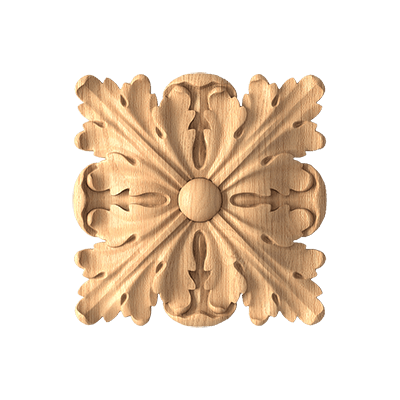
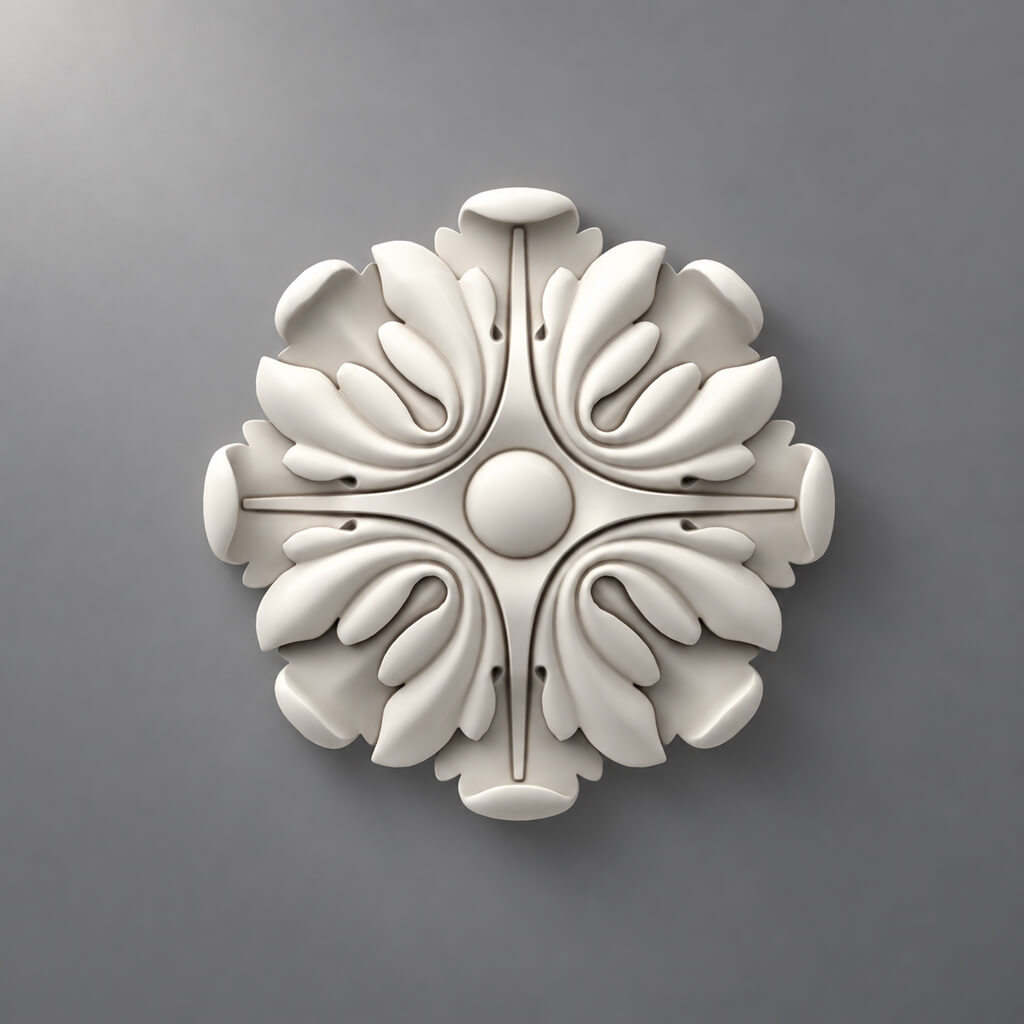
The current R-001 card shows six square sizes.
| R-001 size | Depth C | Beech Standard | Beech Prestige | Oak Standard | Oak Prestige |
|---|---|---|---|---|---|
| 70×70 mm | 13 мм | 520 ₽ | 740 ₽ | 660 ₽ | 870 ₽ |
| 80×80 mm | 15 мм | 610 ₽ | 810 ₽ | 740 ₽ | 1 000 ₽ |
| 90×90 mm | 17 мм | 740 ₽ | 1 020 ₽ | 1 000 ₽ | 1 270 ₽ |
| 100×100 mm | 19 мм | 960 ₽ | 1 250 ₽ | 1 070 ₽ | 1 320 ₽ |
| 132×132 mm | 24 мм | 1 820 ₽ | 2 280 ₽ | 2 540 ₽ | 2 960 ₽ |
| 160×160 mm | 29 мм | 2 860 ₽ | 3 490 ₽ | 4 010 ₽ | 4 750 ₽ |
Prices are indicated at the time of checking. The card reports the average production time for an out-of-stock item as 5–10 business days, and items in stock are shipped after preparation within the timeframes specified by the store.
Materials:
-
beech;
-
Oak.
Grinding quality:
-
Standard;
-
Prestige.
For certain configurations, the card provides for preparation for enamel. The specific material and quality should be chosen together with the future finish, not separately from it.
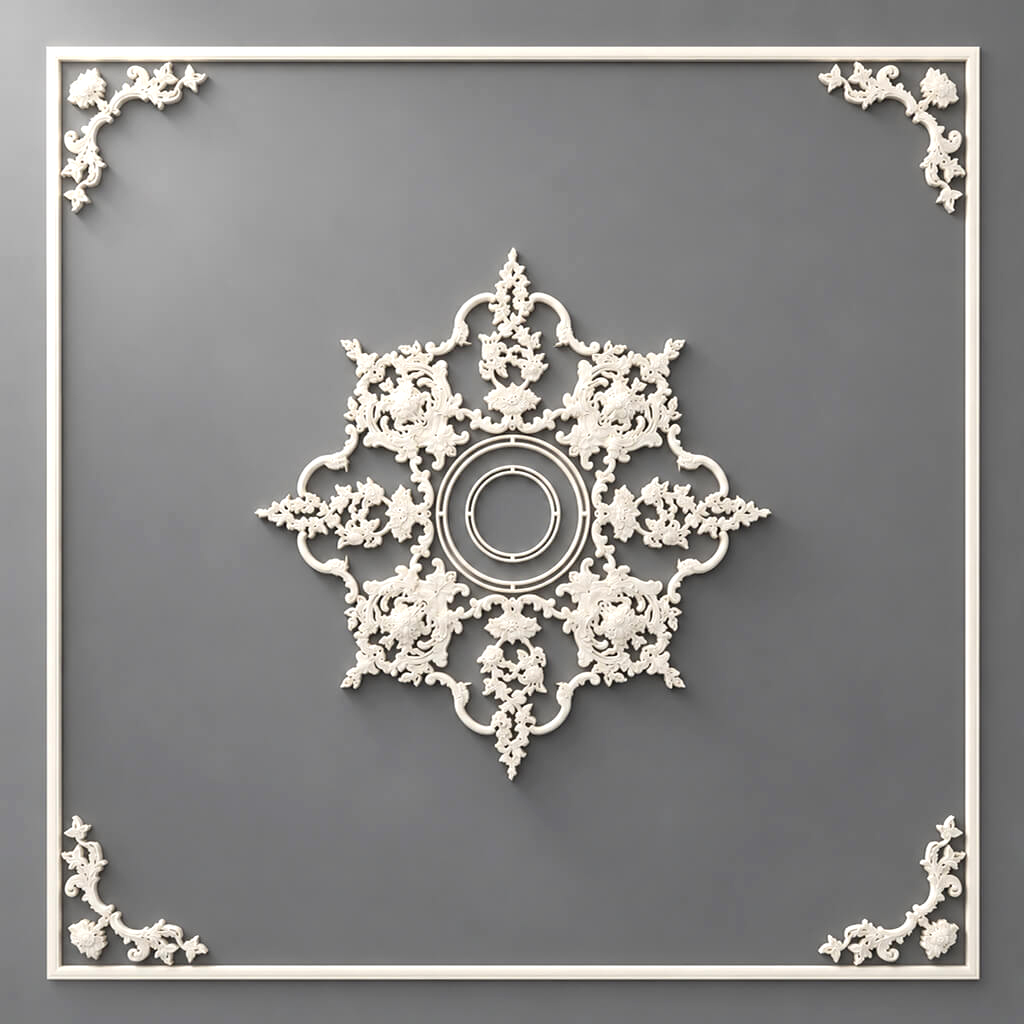
The card also directly describes small R-001 as decor for facades, cabinets, drawers, writing desks, doors, pilasters, and wardrobes. Larger sizes can be used in wall, ceiling, and central compositions.
For our article, this provides an important boundary: all six sizes can physically fit within a 180×180 mm field, but not all will be perceived equally as furniture decor.
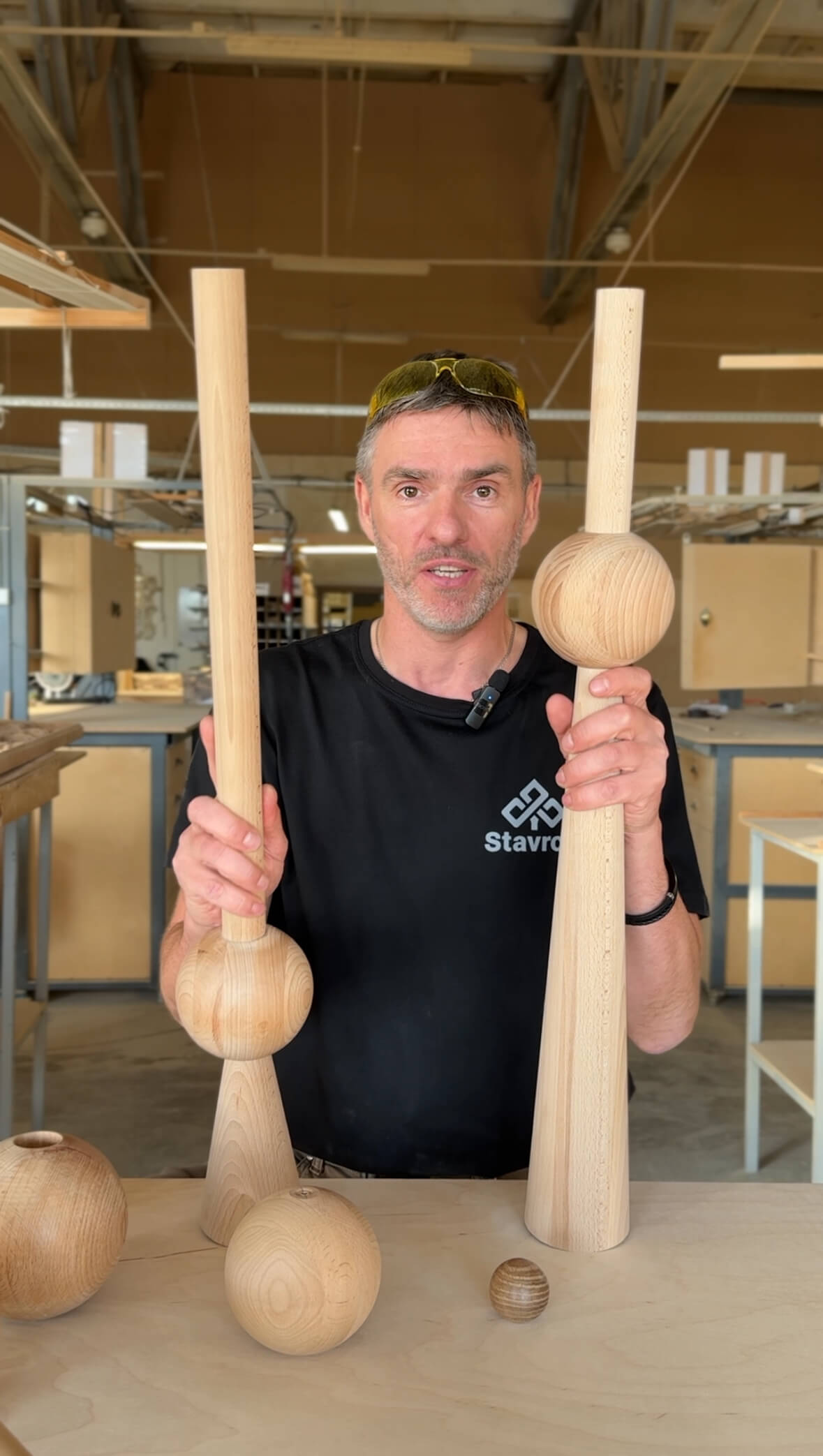
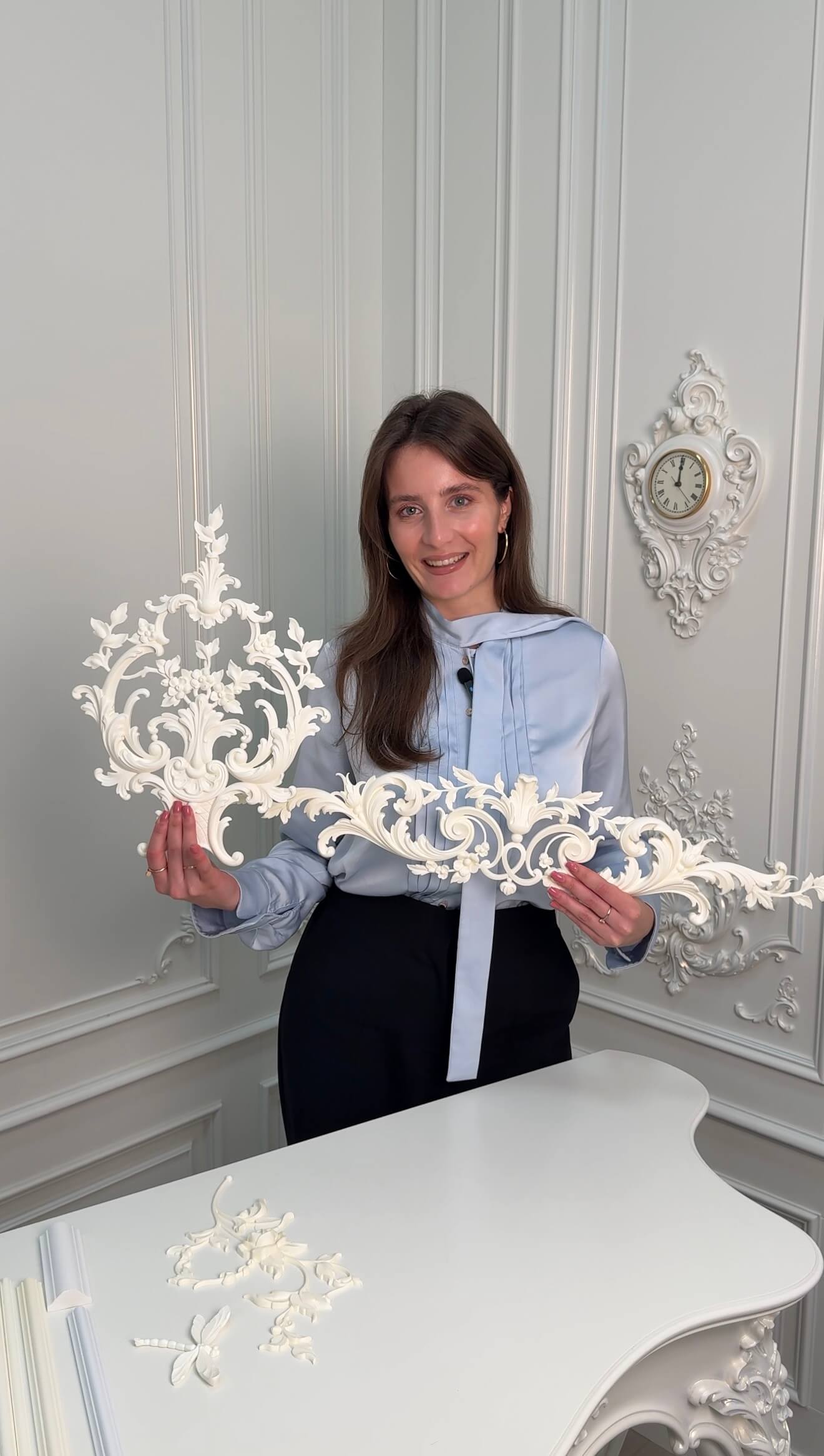
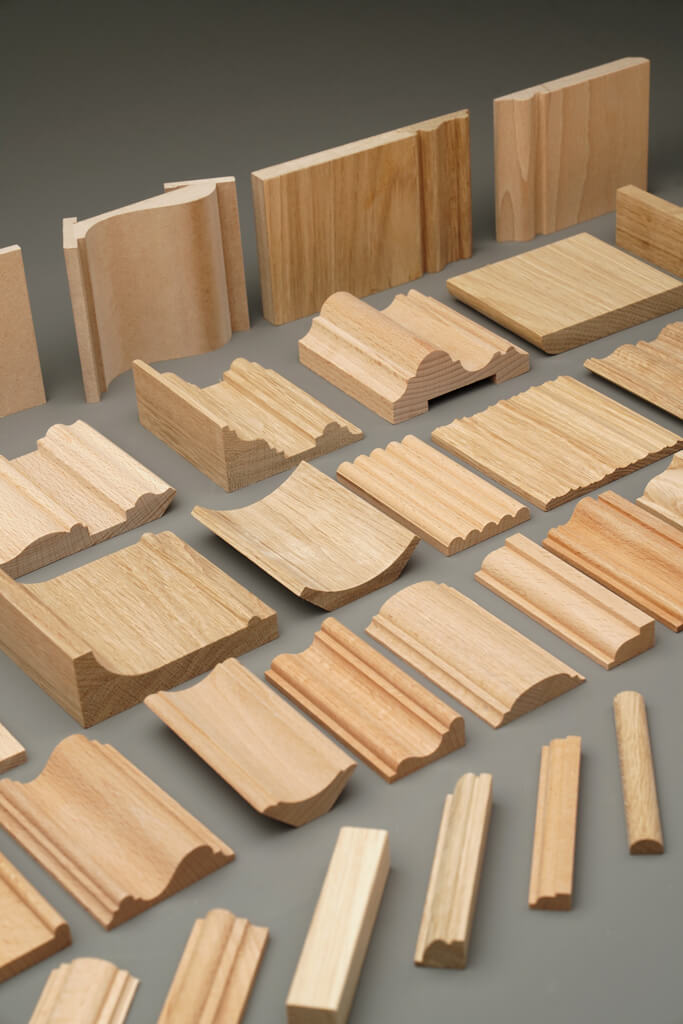
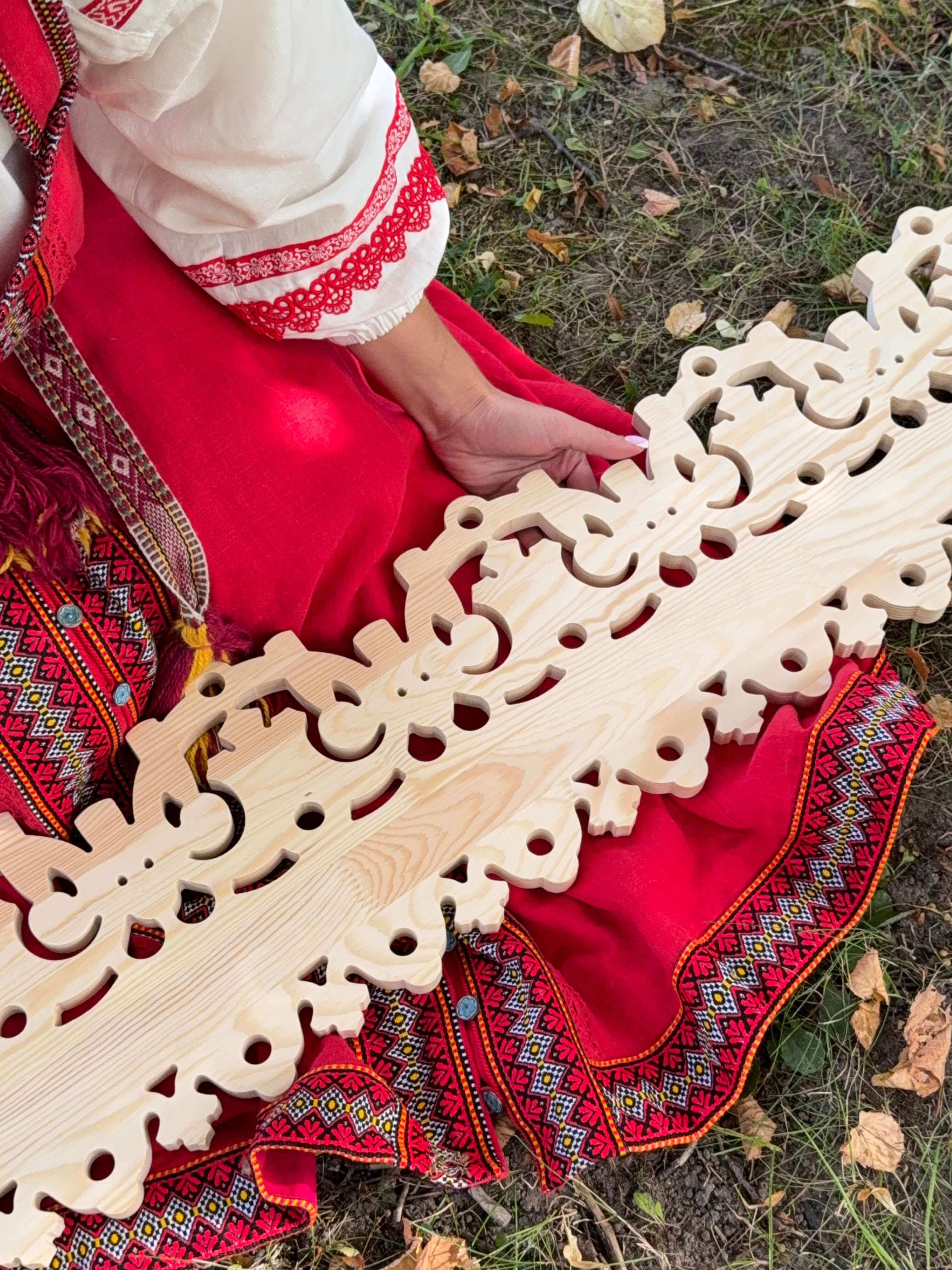
Why size R-001 cannot be chosen based on a product card photo
On screen, a separate 70 mm socket and a separate 160 mm socket may appear similar in scale: the website adjusts images to fit the card, the monitor does not show real millimeters, and there is no furniture paneling around the product.
On a 180×180 mm facade, the picture changes.
Share of paneling width:
-
70 mm — 38.9%;
-
80 mm — 44.4%;
-
90 mm — 50%;
-
100 mm — 55.6%;
-
132 mm — 73.3%;
-
160 mm — 88.9%.
Even more illustrative is the area of the decorative spot relative to the area of a 180×180 mm square.
Panel area:
180 × 180 = 32,400 mm².
Area of square footprint R-001:
-
70×70 = 4,900 mm², i.e., about 15.1% of the panel area;
-
80×80 = 6,400 mm², about 19.8%;
-
90×90 = 8,100 mm², exactly 25%;
-
100×100 = 10,000 mm², about 30.9%;
-
132×132 = 17,424 mm², about 53.8%;
-
160×160 = 25,600 mm², about 79%.
This is not about the actual area of the carved pattern — inside the square footprint there are cutouts, relief, and background. But for comparing scale, these numbers are very useful: they show how dramatically the visual presence of the product changes.
The transition from 100 to 132 mm is not "plus 32 mm." The square footprint of the decorative spot increases from 10,000 to 17,424 mm², that is, by about 74%.
The transition from 132 to 160 mm is another big jump: from 17,424 to 25,600 mm².
Therefore, it is better to choose the size not by a catalog photo, but by a 1:1 mockup.
Our factory also produces:
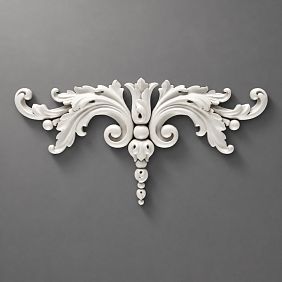
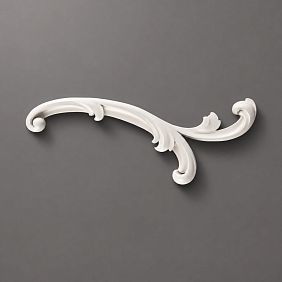
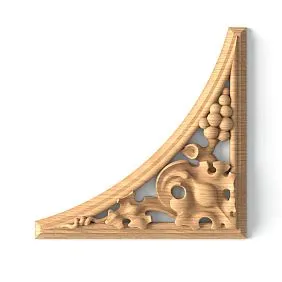
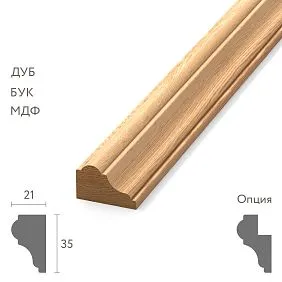


R-001 70×70×13 mm: 55 mm of free space on each side
For the first option, the calculation:
(180 − 70) ÷ 2 = 55 mm.
With ideal centering around the square footprint, there remains:
-
55 mm on the left;
-
55 mm on the right;
-
55 mm from the top;
-
55 mm from the bottom.
In width, R-001 occupies 38.9% of the panel.
By area of the square footprint — about 15.1%.
This is the most "airy" variant of the six.
It suits a scenario where the panel itself should remain clearly readable, and the rosette becomes a focal point.
On twelve facades, this is especially noticeable. One small ornament may look modest, but twelve identical ones create a steady rhythm. Therefore, a small size does not mean a weak overall effect.
Get Consultation
When 70 mm is worth checking first
-
the facade already has an expressive frame;
-
there is a baguette or molding nearby;
-
the central decor should not conflict with the handle;
-
the finish is contrasting;
-
all twelve facades need a calm repetition.
When 70 mm may turn out to be too small
-
the panel is visually empty;
-
the entire facade is large and there is a lot of free space around the central field;
-
the ornament should be the main accent;
-
the color of the rosette almost matches the facade and the relief is read only by light and shadow.
This cannot be solved by a formula. The formula only shows the free field. The visual role is checked with a mockup.
R-001 80×80×15 mm: the free field is reduced to 50 mm
Calculation:
(180 − 80) ÷ 2 = 50 mm.
The difference from the 70-millimeter version is only 10 mm in product size, but the free field is reduced by 5 mm on each side at once.
On one facade, this may look insignificant.
On twelve, it already forms a different rhythm.
80 mm occupies:
-
44.4% of the width;
-
about 19.8% of the area of the square field.
The depth increases from 13 to 15 mm.
That is, not only the area changes, but also the light and shadow.
If the facades are positioned vertically one above the other or assembled into a symmetrical furniture wall, the 80-millimeter ornament starts to read more confidently than the 70-millimeter one, but still leaves half the width of the free field in total on both sides:
50 + 50 = 100 mm.
This is a good size for comparison with 90 and 100 mm when the designer is unsure how active the center should be.
R-001 90×90×17 mm: exactly half the width of the panel
Here a convenient reference point appears:
180 ÷ 2 = 90 mm.
The rosette occupies exactly half the width of the field.
Free field:
(180 − 90) ÷ 2 = 45 mm.
That is:
-
ornament — 90 mm;
-
free side fields together — also 90 mm.
Square footprint area:
8,100 mm², or 25% of the panel area.
This option is easy to visualize even without a photo.
That's why 90 mm is useful as a control midpoint for comparison.
If 70 and 80 look too small, and 100 starts to dominate, 90 mm provides an intermediate scale.
The 17 mm depth is noticeable under side lighting. Therefore, a paper square shows size but not volume. After the paper test, it's useful to evaluate the actual product or at least the depth on a side template.
R-001 100×100×19 mm: when the central decor starts to dominate
Free field:
(180 − 100) ÷ 2 = 40 mm.
In width, the product occupies 55.6% of the panel.
By square footprint, it's about 30.9% of the area.
Visually, this is no longer a small dot in the center. R-001 becomes one of the main elements of the facade.
On twelve identical doors or drawers, such a rosette creates a strong repetition.
This could be exactly what classic furniture with a large rhythm needs. But if the facade simultaneously has an active molding, overlays, a handle, and contrasting coloring, 100 mm may become an unnecessary fourth accent.
To compare other models, you can buy wooden rosettes in the category, but within the R-001 series, 100 mm is a convenient boundary between a moderate and noticeably dominant center.
What to check at 100 mm
-
whether the relief approaches the inner frame;
-
whether 40 mm of margin is enough for a calm contour;
-
whether the 19 mm depth conflicts with the handle;
-
whether the center reads equally on all 12 facades;
-
whether the entire furniture front becomes too rhythmic.
R-001 132×132×24 mm: why it is much larger than it seems after 100 mm
Difference per side:
132 − 100 = 32 mm.
But the free field decreases:
from 40 mm to 24 mm on each side.
This is a reduction of 16 mm per side, i.e., 40% relative to the 40 mm field.
The area of the square footprint increases by about 74% compared to the 100 mm version.
132 mm occupies:
-
73.3% of the width;
-
about 53.8% of the panel area.
That is, more than half of the square field already falls on the footprint of the decorative element.
A depth of 24 mm also significantly increases the chiaroscuro.
Therefore, the 132 mm option should be considered as a separate compositional category, not as "slightly larger than 100."
When 132 mm can work
-
the panel should almost completely turn into a carved medallion;
-
the frame around it is simple;
-
the handle is moved out of the central field;
-
the entire facade is designed for a large classical accent;
-
there is no other relief decor nearby that competes for attention.
When to stop
If after the paper template the remaining 24 mm are perceived as a random thin border, you need to compare 100 mm or another model.
R-001 160×160×29 mm: 10 mm of free margin on each side — almost full coverage
Calculation:
(180 − 160) ÷ 2 = 10 mm.
This is the most radical option.
R-001 occupies:
-
88.9% of the width;
-
about 79% of the square field's area.
Depth — 29 mm.
With this ratio, the panel is no longer perceived as a large free field with a central insert. Rather, the rosette itself begins to define almost the entire composition.
This is not prohibited.
But such a size requires particularly careful verification.
Ten millimeters of margin between the socket's footprint and the panel border is very little compared to other options.
If the actual panel turns out to be not 180 but 177 mm, the margin will already be:
(177 − 160) ÷ 2 = 8.5 mm.
If 175 mm:
7.5 mm.
Therefore, 160 mm cannot be confirmed based on the design dimension without measuring all 12 facades.
All six R-001 dimensions within the 180×180 mm field
Let's summarize the geometry in one table.
| R-001 | Depth | Share of the field width | Free field on each side | Square dimensions | Panel area share | Composition character |
|---|---|---|---|---|---|---|
| 70 мм | 13 мм | 38,9% | 55 мм | 4 900 mm² | 15,1% | A small central accent |
| 80 мм | 15 мм | 44,4% | 50 мм | 6,400 mm² | 19,8% | calm but noticeable center |
| 90 мм | 17 мм | 50% | 45 мм | 8,100 mm² | 25% | exactly half the width |
| 100 мм | 19 мм | 55,6% | 40 мм | 10,000 mm² | 30,9% | pronounced central decor |
| 132 мм | 24 мм | 73,3% | 24 мм | 17,424 mm² | 53,8% | large medallion |
| 160 мм | 29 мм | 88,9% | 10 мм | 25 600 mm² | 79% | almost full filling of the panel |
This table is the basis of the solution.
If you need space around the ornament — compare 70/80/90.
If you need a confident center — 90/100.
If the facade should be built around the rosette itself — 132/160.
But the final choice is confirmed by the actual facade.
Why depth of 13–29 mm changes the impression no less than width
In the plan, it is easy to focus only on A and B.
But C with R-001 grows with size:
-
70 mm → 13 mm;
-
80 → 15 mm;
-
90 → 17 mm;
-
100 → 19 mm;
-
132 → 24 mm;
-
160 → 29 mm.
The difference between the extreme options:
29 − 13 = 16 mm.
This is very noticeable on the facade.
Under frontal lighting, all six paper templates show only the area.
Under side lighting, the large R-001 casts a much deeper shadow.
Therefore, for finished furniture, they check:
-
how far the handle protrudes;
-
whether there is an adjacent facade;
-
whether the relief interferes when opening;
-
how close the molding passes;
-
how light falls on the center.
If a 160-millimeter template looks good frontally, but the 29 mm protrusion interferes with the hand or the adjacent door, flat geometry no longer saves the solution.
Twelve facades: why the minimum actual size matters more than the average
The plan says 180×180 mm.
But the finished products need to be measured.
For example, we got:
-
180×180;
-
179×180;
-
181×179;
-
178×180;
-
180×181;
-
179×179;
-
the rest are about 180 mm.
For 70–100 mm, such deviations have almost no effect on the overall composition.
For 160 mm, the difference becomes more noticeable because the free margin is only 10 mm nominally.
With a minimum width of 178 mm:
(178 − 160) ÷ 2 = 9 mm.
If the actual margin is even smaller, the remainder shrinks further.
Therefore, for a batch of 12 items, you need to record not just “180×180”, but:
-
minimum width;
-
maximum width;
-
minimum height;
-
maximum height;
-
center deviation.
The choice is made based on the worst actual facade if all 12 must look identical.
How to check the center on all 12 facades
Even a perfectly chosen size will look bad if the rosettes are glued with different offsets.
For a square panel, the center is found by intersecting diagonals or measuring half of the sides.
But in a series, what matters more than the method itself is repeatability.
The working template must fix:
-
the center;
-
ornament orientation;
-
distance to the frame;
-
handle position;
-
position of other overlays.
If the R-001 ornament has a visually readable orientation after tinting or patination, all 12 items must be placed identically, unless the designer has provided a different rhythm.
An error of 3–4 mm on one facade may go unnoticed by the eye.
If six facades stand side by side, the difference is already perceived through repetition.
Paper templates 1:1: the cheapest stage of the entire purchase
No complex visualization is needed for selection.
Cut out six squares:
-
70×70;
-
80×80;
-
90×90;
-
100×100;
-
132×132;
-
160×160 mm.
Label them.
Attach them to the center of one facade with masking tape.
Take photos from the same distance.
Then choose the two most suitable sizes and arrange them across several facades.
If the furniture has 12 doors in one plane, it is especially useful to make 12 identical paper templates of the final size and see the entire front at once.
Why?
One R-001 100 mm may look perfect.
Twelve R-001 100 mm may create too dense a rhythm.
Conversely, one 70-millimeter piece seems small, but repeating it across 12 facades turns out to be exactly the level of decorativeness needed.
Real sample after paper: what it adds
Paper shows the area.
The real R-001 shows:
-
depth;
-
thread;
-
shadow;
-
sanding quality;
-
the texture of the wood;
-
reaction to the finish;
-
tactility;
-
the scale when viewed at an angle.
If the party budget is large or the finishing is complex, it is reasonable to first order one socket of the selected size, approve it on the facade, and only then order the remaining 11.
But this is not a universal obligation. If the workshop has already worked with R-001, has a physical reference, and is confident in the size, the entire batch can be ordered at once.
How to choose R-001 for 12 identical furniture facades
Before ordering, seven parameters must match.
1. Panel size
Not the design size, but the actual one.
2. R-001 size
One of six options.
3. Material
Beech or oak.
4. Sanding quality
Standard or Prestige.
5. Preparation for finishing
Coordinated with the future finish.
6. Orientation
All 12 elements are installed according to one rule.
7. Quantity
12 pieces or 12 + deliberate reserve.
Thus, the batch becomes one specification, not twelve separate purchases.
How much do 12 R-001 cost: the batch price changes more than the size seems at a glance
For a batch of twelve facades, you need to calculate not the price of one socket, but the full set.
| R-001 size | 12 pcs. oak Standard | 12 pcs. oak Prestige | 12 pcs. oak Standard | 12 pcs. oak Prestige |
|---|---|---|---|---|
| 70 мм | 6 240 ₽ | 8 880 ₽ | 7 920 ₽ | 10 440 ₽ |
| 80 мм | 7 320 ₽ | 9 720 ₽ | 8 880 ₽ | 12 000 ₽ |
| 90 мм | 8 880 ₽ | 12 240 ₽ | 12 000 ₽ | 15 240 ₽ |
| 100 мм | 11 520 ₽ | 15 000 ₽ | 12 840 ₽ | 15 840 ₽ |
| 132 мм | 21 840 ₽ | 27 360 ₽ | 30 480 ₽ | 35 520 ₽ |
| 160 мм | 34 320 ₽ | 41 880 ₽ | 48 120 ₽ | 57 000 ₽ |
Prices refer to the time of checking the card. Before payment, they need to be reopened and the selected configuration confirmed.
The table gives another important conclusion.
Switching from 100 to 132 mm is not just a larger decorative spot. In Standard beech, the batch becomes more expensive:
21 840 − 11 520 = 10 320 ₽.
In Prestige oak:
35 520 − 15 840 = 19 680 ₽.
Switching from 132 to 160 mm is even stronger:
-
Standard beech: +12,480 ₽;
-
Prestige oak: +21,480 ₽.
That is, a large size changes three things at once:
-
composition;
-
depth of the relief;
-
budget for the entire series of facades.
Therefore, it is economically especially disadvantageous to first buy 12 large sockets and then find out that 132 or 160 mm overload the field.
Beech or oak for R-001: the material is chosen after the scale
Size and material are two different decisions.
One cannot be substituted for the other.
If 100 mm fits compositionally, oak 100 mm does not become "larger" than beech 100 mm. If 160 mm is too large for the panel, more expensive oak will not fix the proportion.
First, the size is approved.
Then the wood species is chosen.
Beech for opaque finishing
Beech is logically considered when the furniture will be painted with opaque enamel and the natural wood grain is not part of the concept.
Then what matters more:
-
thread geometry;
-
quality of preparation;
-
same finish;
-
absence of visually different degrees of gloss;
-
stable color of all 12 parts.
Oak for visible wood
Oak becomes more interesting if the socket should remain woody in perception:
-
clear varnish;
-
oil;
-
stain;
-
tinting;
-
translucent coating.
In this case, the wood's own grain is added to the relief.
But natural texture is variable. Twelve oak items will not be twelve printed copies.
This should be accepted as a property of the material or a preliminary visual selection should be provided.
Standard or Prestige: what changes in a batch of 12 items
Card R-001 offers two qualities of sanding.
In a commercial order of twelve parts, the difference is especially noticeable in cost.
For example, R-001 100 mm in beech:
-
Standard — 11,520 ₽ for 12;
-
Prestige — 15 000 ₽.
The difference:
3 480 ₽.
For oak 160 mm:
-
Standard — 48 120 ₽;
-
Prestige — 57 000 ₽.
The difference:
8 880 ₽.
Standard should not be interpreted as "bad," and Prestige as "correct."
A practical question needs to be asked:
who prepares 12 relief parts before finishing, and to what state?
If a furniture workshop already includes finishing in its technology, Standard can be economically rational.
If the project goes for final painting with strict requirements and additional manual processing on site creates a risk to deadlines, Prestige may be more convenient.
The decision is made together with the finisher, not just based on the price in the product card.
Wooden rosette under enamel: why a test coat should be done on the relief
A flat swatch with a color code does not show how the same finish will look on R-001.
A carved detail has:
-
peaks;
-
recesses;
-
side faces;
-
areas that catch direct light;
-
areas that remain in shadow.
On the same color, the relief visually creates several shades.
The deeper the rosette, the stronger the effect.
Let's compare the extreme options:
-
R-001 70 mm — depth 13 mm;
-
R-001 160 mm — 29 mm.
Difference 16 mm.
If a large rosette is painted with semi-gloss enamel, the peaks may noticeably glare.
If matte — the relief reads more calmly.
Therefore, before launching the entire batch, it is useful to make one approved sample.
The technical specification fixes:
-
primer;
-
preparation;
-
color code;
-
number of layers;
-
gloss level;
-
interlayer treatment;
-
acceptable filling of fine relief.
The article does not assign specific paint and varnish materials: they are chosen by the technologist based on the material and the existing facade.
How to compare 70, 100, and 160 mm not only frontally, but also from the side
Make three simple three-dimensional mockups.
For each size, cut a square from thick cardboard according to the dimensions and glue several layers to achieve a conditional depth:
-
70 mm — 13 mm;
-
100 mm — 19 mm;
-
160 mm — 29 mm.
This is not a copy of the carving.
But such a mockup shows how much the part protrudes relative to the facade plane.
Check:
-
opening of the adjacent door;
-
handle position;
-
finger grip;
-
distance to the molding;
-
shadow under side light.
Sometimes 160 mm is sufficient in area, but 29 mm of relief turns out to be too active.
How the handle changes the selection of size R-001
If the handle is positioned in the center of the same panel, the central rosette may not fit at all.
But more often the handle is located:
-
below;
-
higher;
-
on a separate frame;
-
at the edge of the facade;
-
on an adjacent element.
Before choosing R-001, you need to build two zones:
-
decorative;
-
functional.
The functional zone includes the space where the hand goes when opening.
If R-001 132 or 160 mm falls into this zone, it's not just about appearance.
The relief can interfere with the grip.
You can't make the facade uncomfortable for the sake of a large pattern.
Twelve identical R-001: why order with one specification
Staged purchase looks safer:
"Let's take four now, then eight more."
But for identical facades, this adds risks.
Between orders, the following may change:
-
price;
-
availability;
-
deadline;
-
batch of wood;
-
production cycle;
-
finishing conditions.
If the size and material are already confirmed, it makes more sense to issue all 12 in one specification.
This is especially important for oak under a transparent finish: the entire batch arrives for simultaneous inspection and can be laid out across facades before tinting.
If a reserve is needed, it is allocated separately:
R-001 100×100×19 mm / oak / Prestige / 12 pcs. + 1 pc. reserve.
But the 13th piece is not added automatically.
Is a thirteenth R-001 needed as a spare
A spare makes sense if:
-
the project is located far from production;
-
repeat delivery is expensive;
-
complex finish;
-
a repair piece needs to be kept;
-
oak is selected in one batch;
-
the facades will be used intensively.
Not needed automatically if:
-
the product is easy to reorder;
-
budget is limited;
-
size and installation are simple;
-
the remainder can only be stored in poor conditions;
-
reserve is not provided for in the project.
For R-001 160 mm oak Prestige, the spare part costs 4,750 ₽ at the time of checking.
This is no longer a symbolic reserve.
How to connect the central R-001 with the facade frame
If there is a wooden baguette or molding around the panel, the central size cannot be chosen separately.
The composition is built from the outer contour inward.
Conditional sequence:
-
outer facade dimension;
-
frame width;
-
inner panel dimension;
-
the free margin;
-
central R-001.
Suppose the field itself is already 180×180 mm. Then the frame determined this size earlier.
Now the rosette must 'respect' the boundary.
R-001 70 mm leaves 55 mm of field — the frame and rosette read as two separate layers.
R-001 160 mm leaves 10 mm — visually the central element almost touches the frame.
These are two different furniture languages.
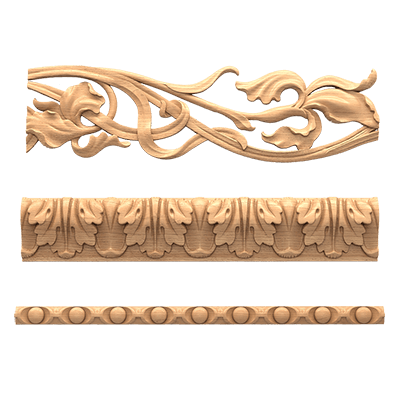
If the project simultaneously requires molding, it is possible Buy wooden picture frame molding and compare its scale with R-001 on one full-size facade.
Carved wooden molding and R-001: when ornaments start to argue
Carved molding already has its own active pattern.
If you add a large R-001 to it, competition may arise.
You need to check not individual products, but the overall facade.
For example:
-
external carved molding;
-
panel 180×180;
-
R-001 132 mm.
The free field is only 24 mm.
If the baguette itself is wide and ornamental, almost no calm surface remains between the two reliefs.
Sometimes this is exactly the required rich classic.
Sometimes it's overload.
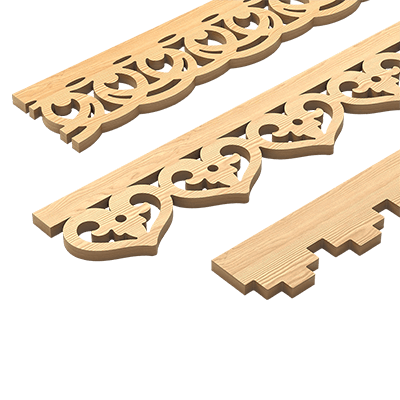
Therefore, if carved molding is chosen, it's better buy carved wooden baguette after a joint mockup with a central rosette.
Decorative overlays and R-001: how many different motifs are acceptable on one facade
In classic furniture, it's easy to add too many details:
-
central rosette;
-
corner overlays;
-
vertical overlays;
-
a baguette;
-
pilasters;
-
Cornice.
Each element is beautiful on its own.
Together, they may stop working as a system.
A good test:
can you explain the role of each decor in one sentence?
For example:
-
the baguette forms the frame;
-
R-001 sets the center;
-
corner overlays support the outer contour.
If two elements perform the same visual job, one of them may be redundant.
To expand the project, you can buy decorative overlays for furniturebut they need to be selected after the central composition is approved.
Wooden decorative elements: how not to turn the purchase of R-001 into a random set
R-001 can be the start of a broader furniture system.
In one project, the following are used:
-
sockets;
-
brackets;
-
overlays;
-
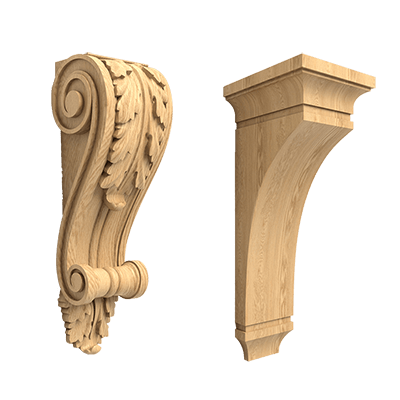
moldings;
-
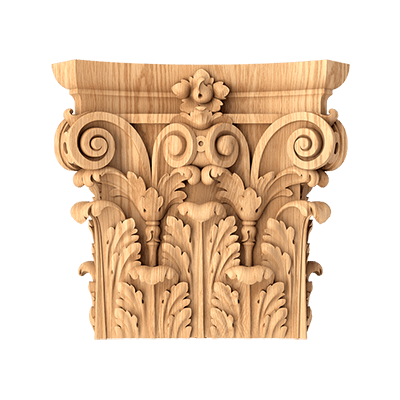
capitals.
But a strong composition is built not by the number of SKUs.
First, repeating rules are chosen:
-
one type of leaf ornament;
-
the same degree of relief;
-
one material;
-
single finish;
-
a repeatable scale.
If a different decor is needed after R-001, it's better buy decorative wooden elements from the general category and compare not names, but compositional role.
R-001 on a pilaster: can the same size be used as on the facade
The R-001 card directly allows the use of small variants on pilasters.
But the pilaster has a different geometry.
The facade panel is a square of 180×180 mm.
The pilaster is an elongated vertical element.
If R-001 100 mm is chosen on the facade, it does not mean that 100 mm is automatically needed on the pilaster as well.
The width of the pilaster needs to be checked.
For example, if its visible width is 140 mm, R-001 132 mm will leave only 4 mm on each side in clean geometry:
(140 − 132) ÷ 2 = 4 mm.
This is already a completely different result.
If the width is 200 mm:
(200 − 132) ÷ 2 = 34 mm.
Therefore, one article can connect furniture and a pilaster with an ornament, but the size is again calculated based on the specific field.
If the project includes such elements, you can Buy wooden pilasters after the general sketch.
One R-001 size on facades of different widths: when uniformity becomes a mistake
Suppose some facades have a panel of 180×180 mm, and others have 220×220 mm.
R-001 100 mm:
In the field of 180 mm leaves:
40 mm on each side.
In the field of 220 mm:
(220 − 100) ÷ 2 = 60 mm.
On the large facade, the socket looks noticeably smaller relative to the field.
If the project requires the same relative scale, perhaps for 220 mm you need to check 132 mm:
(220 − 132) ÷ 2 = 44 mm.
That is, 100 mm in a 180-millimeter panel and 132 mm in a 220-millimeter one give a similar character of the free field.
This is an example of why “one size for all furniture” is not always the best way to create a unified style.
In our main scenario, all 12 panels are identical, so a single size is justified.
What to do if the actual 12 panels have two sizes
Sometimes after production it turns out:
-
8 facades — 180×180 mm;
-
4 facades — 176×176 mm.
If R-001 160 mm is selected:
for the 180 mm field — 10 mm;
for 176 mm:
(176 − 160) ÷ 2 = 8 mm.
The difference is 2 mm on each side.
You need to decide whether it is visible and whether it is allowed by the project.
For R-001 100 mm:
180 mm → 40 mm;
176 mm → 38 mm.
The same absolute difference, but visually it is less critical due to the large free field.
Therefore, the larger the rosette relative to the panel, the more sensitive the composition is to size deviations.
Installation of R-001: why the article does not prescribe a universal adhesive
A wooden rosette has mass, depth, material, and a specific facade substrate.
The facade can be:
-
massive;
-
veneered;
-
MDF under enamel;
-
already painted;
-
laminated;
-
with a different finishing system.
Assigning one adhesive for all options is incorrect.
Before installation, you need to determine:
-
facade material;
-
condition of the finishing coating;
-
material R-001;
-
whether the socket will be painted before or after installation;
-
whether temporary fixation is needed;
-
whether mechanical fastening is acceptable;
-
whether the element can be dismantled without damage.
If the facade is already finished, the test is especially important.
An incorrect composition can damage the finish more than the cost of the socket itself.
Why you cannot trim R-001 just to make it fit
R-001 is a finished carved ornament.
If 160 mm does not fit into the actual field, you cannot automatically decide:
"Cut 3 mm off each side."
Trimming can ruin the pattern.
If the selected size does not fit:
-
take a smaller size;
-
change the composition;
-
choose a different item;
-
reconsider the field.
Any processing of the finished relief requires separate approval.
R-001 132 vs 160 mm: a borderline choice for an almost filled panel
This is a particularly useful pair for comparison.
132 мм
Free field:
24 mm.
Width share:
73,3%.
Depth:
24 mm.
160 мм
Field:
10 mm.
Width share:
88,9%.
Depth:
29 mm.
Side difference is 28 mm.
But visually, 160 mm is significantly stronger.
If the client wants to "almost fill" the panel, you need to make both templates and look at them side by side.
132 mm still leaves a noticeable frame of empty space.
160 mm almost removes it.
R-001 90 vs 100 mm: choosing in the middle of the range
This pair is much thinner.
90 mm:
-
field 45 mm;
-
25% of the square footprint area;
-
depth 17 mm.
100 mm:
-
field 40 mm;
-
30,9%;
-
depth 19 mm.
The difference across the field is only 5 mm on each side.
But on twelve facades, 100 mm creates a denser rhythm.
If the workshop is unsure between them, the paper test is better done on several facades at once.
R-001 70 vs 80 mm: when 10 mm is truly noticeable
On a single facade, the difference may seem minimal.
But the area of a square dimension:
70 mm → 4,900 mm²;
80 mm → 6,400 mm².
Increase:
1,500 mm², or approximately 30.6% relative to the 70-millimeter square.
Therefore, 80 mm is noticeably more than just "10 mm more."
This is a good example of why a linear difference does not equal the visual.
Mistake 8. Selecting the baguette and rosette independently
Reason: items are chosen from separate cards.
Consequence: the facade becomes overloaded.
How to avoid: one layout for the entire composition.
Mistake 9. Centering each rosette "by eye"
Reason: the field is small and seems symmetrical.
Consequence: a floating rhythm appears across 12 facades.
How to avoid: a single center template.
Error 10. Count the price of one R-001 as the solution budget
Reason: the card shows one piece.
Consequence: a batch of 12 pieces turns out to be significantly more expensive.
How to avoid: count the set before choosing the size.
Final algorithm for selecting R-001
Step 1. Measure all 12 panels
Record the minimum and maximum values.
Step 2. Confirm the pure decorative field
180×180 should be exactly the free zone, not the size including the frame or chamfer.
Step 3. Make six paper templates
70, 80, 90, 100, 132 and 160 mm.
Step 4. Choose two finalists
Do not buy immediately.
Step 5. Test them on several facades
View the entire furniture front.
Step 6. Consider the depth
13–29 mm.
Step 7. Check handles and opening
The relief should not interfere with function.
Step 8. Choose beech or oak
After approving the scale.
Step 9. Choose Standard/Prestige
Together with the finisher.
Step 10. Calculate the cost of 12 pieces
Not a single one.
Step 11. Fix the finish
Sample, color, gloss.
Step 12. Prepare one specification
Size, material, quality, quantity.
After that, you can calmly proceed to the order.
One facade and twelve facades: why the size needs to be approved across the entire furniture front
The most insidious mistake in this task occurs after a successful fitting on one facade.
Suppose R-001 100 mm looks convincing in a separate panel of 180×180 mm: 40 mm of free space, the relief is well readable, the handle does not interfere. At this stage, it is easy to decide that the issue is closed.
But when the same rosette is repeated twelve times, a new effect appears — serial rhythm.
If the facades are arranged in two rows of six, the eye no longer sees individual ornaments, but a grid of twelve identical centers. The larger the R-001, the denser this grid.
For comparison, you can do a simple test without buying:
-
print 12 squares of 70 mm;
-
then 12 squares of 100 mm;
-
then 12 squares of 132 mm;
-
temporarily attach them to all facades;
-
photograph the furniture from the same point.
On one facade, 132 mm can look striking. On twelve, it turns the furniture into a too dense ornamental screen.
Conversely, 70 mm alone may seem too modest, but in repetition it gives a neat rhythm that doesn't conflict with frames and handles.
Therefore, the final size is approved in two scales:
the scale of one facade and the scale of the entire furniture composition.
How to choose between two finalists: for example, 90 and 100 mm
After the first mockup, usually two close options remain.
Let's take 90 and 100 mm.
Geometry:
| Parameter | R-001 90 mm | R-001 100 mm |
|---|---|---|
| Free field | 45 мм | 40 мм |
| share of panel width | 50% | 55,6% |
| square dimension | 8,100 mm² | 10,000 mm² |
| Depth | 17 мм | 19 мм |
The free field difference is only 5 mm on each side.
But the area of the dimension increases by:
10,000 − 8,100 = 1,900 mm².
This is approximately 23.5% relative to the 90 mm option.
Therefore, two sizes are compared not with the words “almost the same,” but in the same way:
-
place both templates in the center;
-
take a photo from a fixed distance;
-
repeat on several facades;
-
check the overall front;
-
evaluate the relief under side lighting;
-
choose the option that works best in the entire system.
If the decision is still debatable, it is better to order one physical R-001 of the final size than to buy twelve at once.
How to choose between 100 and 132 mm: here the type of composition changes
This pair has a much stronger difference.
100 mm leaves:
40 mm of field.
132 mm:
24 mm.
The free field decreases by:
16 mm on each side.
In total, the quiet zone narrows from 80 to 48 mm across the width.
At the same time, the depth increases from 19 to 24 mm.
This is no longer just "larger."
100 mm still keeps the central ornament within a well-readable panel.
132 mm starts turning the panel itself into a frame around the rosette.
If the designer wants exactly this effect — great.
If not, choosing 132 mm will be a mistake even with perfect product quality.
How much does it cost to get the size wrong on all twelve facades
The cost of a mistake is a good argument for a mockup.
Let's imagine we ordered R-001 132 mm in Prestige oak:
12 × 2 960 = 35 520 ₽.
After trying on the finished furniture, it turned out that 100 mm is needed.
New set of oak Prestige 100 mm:
12 × 1 320 = 15 840 ₽.
Only the cost of two batches:
35 520 + 15 840 = 51 360 ₽
without delivery, finishing, and labor.
Even if the large batch can be used in another project, the money and time are already diverted.
For R-001 160 mm oak Prestige, the initial batch costs 57,000 ₽. Therefore, checking with a paper template 160×160 mm is not a "designer overcaution" but an element of normal procurement.
Checking in light: why a depth of 29 mm can change the choice between 132 and 160 mm
Under frontal soft light, large R-001 may seem similar in character.
With raking light, the difference intensifies.
132 mm has a depth of 24 mm.
160 mm — 29 mm.
The relief of the 160-mm part gives longer shadows and more contrasting peaks.
If the furniture is placed near a window, a wall sconce, or linear lighting, be sure to check the direction of the light.
A useful test:
-
in the morning;
-
during the day;
-
in the evening under main lighting;
-
with decorative lighting turned on.
A size that looks noble in diffused daylight may become too graphic in the evening.
This is especially important for dark enamel, semi-gloss, and contrasting tinting.
Control chart for the workshop for all 12 facades
Before installation, it is convenient to make a simple list.
| Facade | Field, mm | Center confirmed | R-001 | Orientation | Finish |
|---|---|---|---|---|---|
| 1 | × | Yes/No | ___ mm | ___ | ___ |
| 2 | × | Yes/No | ___ mm | ___ | ___ |
| 3 | × | Yes/No | ___ mm | ___ | ___ |
| … | … | … | … | … | … |
| 12 | × | Yes/No | ___ mm | ___ | ___ |
If all twelve rows are identical in size R-001 and finish, the workshop receives a clear serial order.
If one facade differs, it is detected before gluing and painting, not after installing the entire furniture.
Result: which R-001 to choose for a panel 180×180 mm
R-001 has no single "correct" size for a field of 180×180 mm.
There are six different compositions:
-
70 mm → 55 mm fields on each side;
-
80 mm → 50 mm;
-
90 mm → 45 mm;
-
100 mm → 40 mm;
-
132 mm → 24 mm;
-
160 mm → 10 mm.
If you need a small central accent — first compare 70/80/90 mm.
If you need a confident center — 90/100 mm.
If the rosette should almost define the entire panel — 132/160 mm.
But the main choice is made not by these words, but on a full-size mockup.
For a batch of 12 facades, it is especially important to see the repetition: one large ornament and twelve large ornaments are different visual situations.
After the size, check the depth, then the material, sanding, and finish.
At current prices, a batch can cost from 6,240 ₽ for 12 beech R-001 70 mm Standard to 57,000 ₽ for 12 oak R-001 160 mm Prestige.
The difference is almost tenfold — another reason not to buy the maximum size "for solidity."
The correct specification does not look like this:
12 carved rosettes.
But like this:
R-001 / ___×___×___ mm / beech or oak / Standard or Prestige / preparation ___ / 12 pcs. / facade field 180×180 mm / approved finish sample ___.
And only after that the selected Wooden socket R-001 becomes part of the calculated furniture facade, not a random decoration.
FAQ
What sizes do wooden rosettes R-001 come in?
The card shows 70×70×13, 80×80×15, 90×90×17, 100×100×19, 132×132×24, and 160×160×29 mm.
Which R-001 should I choose for a 180×180 mm facade?
First, determine how much free field you want to leave. For six sizes, it ranges from 55 to 10 mm on each side.
How much space will remain around R-001 100 mm?
40 mm on each side when precisely centered in a 180×180 mm field.
How much field will remain around R-001 132 mm?
By 24 mm.
Isn't R-001 160 mm too large?
It physically fits into 180×180 mm and leaves 10 mm margins. Visually, it's almost a full fill, so a 1:1 mockup is needed.
What is the depth of R-001 70 mm?
13 mm.
What is the depth of R-001 160 mm?
29 mm.
What size takes up exactly half the width of the panel?
R-001 90 mm, because 180÷2=90.
Can I order 12 identical R-001?
Yes, after confirming the size, material, quality, and finish. For a series, it's better to create one precise specification.
What to choose — beech or oak?
If a covering color is needed, beech is often considered. If natural wood should be visible, oak is used. The decision is confirmed with the finishing system and a sample.
Can R-001 be painted with enamel?
The card provides for preparation under enamel for the corresponding configurations. The specific coating system is agreed with the technologist.
How does Standard differ from Prestige?
These are different levels of sanding. The choice should be made considering how much preparation the finisher still performs.
Do I need to order one socket before a batch of 12?
Not always, but it is reasonable if the size, depth, or finish has not yet been verified on a real facade.
How to check the size without purchasing?
Cut out a paper template at 1:1 scale and apply it to the finished panel.
Do I need to measure all 12 panels?
Yes, especially if 132 or 160 mm with a small residual field are being considered.
Can R-001 be used on a pilaster?
The card allows small sizes R-001 on pilasters, but the specific size needs to be calculated based on the pilaster width.
Can one size R-001 be used on facades of different widths?
Yes, but the relative scale will be different. For different fields, it is sometimes better to use different sizes of the same article.
Where can I buy wooden rosettes for furniture?
In the STAVROS category of wooden carved rosettes.
Where can I see other carved rosettes?
In the general rosettes category, if R-001 does not fit by ornament or size.
How to combine R-001 with a baguette?
First approve the frame and the clear field, then the size of the central rosette. Both reliefs need to be viewed on the same mockup.
What decorative overlays can be added to the facade?
Only those with a separate compositional role. Do not add overlays if they duplicate the work of the central rosette or baguette.
Is a 13th R-001 needed as a spare?
Not automatically. The reserve depends on logistics, budget, finishing, and operational risk.
What should I check before payment?
SKU, size, depth, beech/oak, Standard/Prestige, preparation for finish, quantity 12 pcs., current price, availability or production time.
What to do if 160 mm does not fit into the actual panel?
Do not trim the ornament automatically. Check 132 or a smaller size, or choose another product.
Why is 132 mm visually much larger than 100 mm?
Because the square dimension increases from 10,000 to 17,424 mm² — by about 74%, and the free field shrinks from 40 to 24 mm.
Where can I see a wider range of wooden decor for furniture?
You can go to the category that collects various decorative wooden elements.