









































































Article Contents:
- What is a wooden decorative rosette
- History of the wooden rosette as a decorative element
- Where wooden rosettes are used: all application scenarios
- Furniture facades: chest of drawers, wardrobe, sideboard
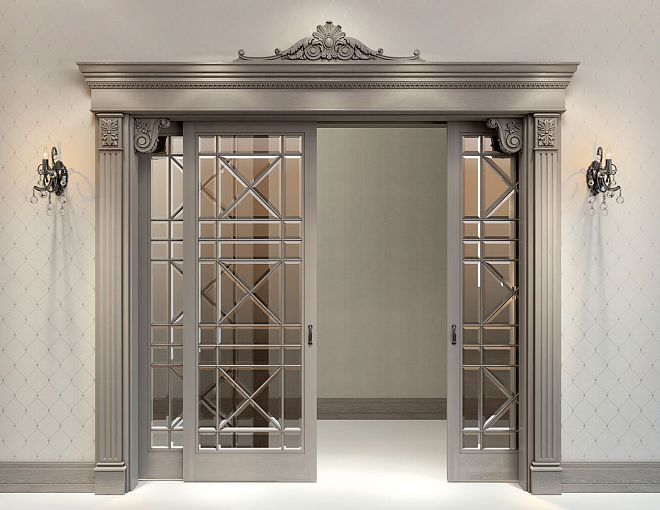
- Doors: panel, overlays, casing
- Fireplace Portal Frames
- Wall decorative compositions
- Decorative frames and mirrors
- Restoration of old furniture
- Kitchen fronts
- Decorative panels and niches
- How a wooden rosette differs from an overlay and molding
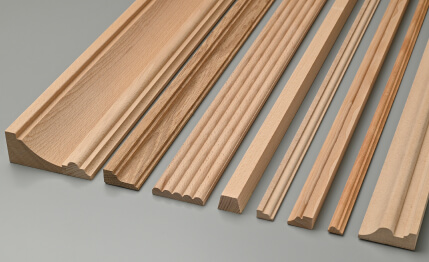
- Molding
- Overlay
- Carved decor in the form of a cartouche or medallion
- How to choose the shape of a wooden rosette
- Round rosette
- Square rosette
- Oval rosette
- Figural carved rosette
- Ornament: what is depicted on the rosette
- How to choose the size of a wooden decorative rosette
- Scaling principle
- Corner rosettes: alignment with molding
- Paired installation
- Single rosette in the center
- Wooden rosette for furniture: a commercial guide
- Chest of drawers: rosettes on drawers
- Sideboard: multi-level decorative system
- Display case: accent without overload
- Wardrobe: vertical facades
- Kitchen fronts
- Wooden rosette for door and portal
- Door in a classic interior
- Fireplace portal: the main decorative accent
- Door casing
- Wooden rosette in wall decor
- Molding frames on the wall
- Wooden wall panels
- Decorative niche
- Material and coating of the wooden rosette
- Wood species
- Finishing options
- How to choose a coating for the interior
- Installation of a wooden rosette: technique and details
- Marking
- Mounting methods
- Painting: before or after installation
- Symmetry in paired installation
- How to combine a wooden rosette with moldings and overlays
- Rosette + molding frame
- Rosette + wooden overlays
- Rosette + wooden handles
- Rosette in a wooden trim system
- Mistakes when choosing and using wooden rosettes
- Where to buy a wooden decorative rosette
- FAQ: Answers to Popular Questions
- About the manufacturer
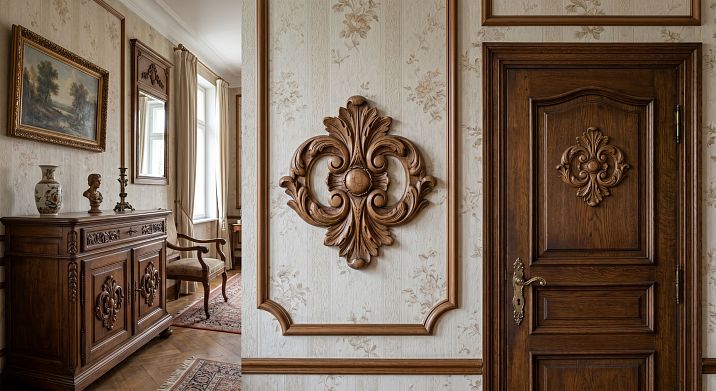
There are details that don't immediately catch the eye — but they create the feeling that the interior is made with soul. A small carved element in the center of a furniture facade. An elegant wooden insert on a door panel. A round ornamental accent at the intersection of moldings. All of this is a wooden decorative rosette. A small detail with a big personality.
Carved wooden decoration In the form of a rosette — one of the oldest decorative techniques in the history of furniture and architecture. It was used by masters of the Baroque, Classicism, and Empire styles. The carved rosette adorned fireplace portals, palace doors, and aristocratic furniture. Today, this element is in demand again — and not only in classic interiors. It works in neoclassicism, Provence style, modern classicism, restoration of old furniture, and any space where you want to add a point of expressiveness without overload.
But how to choose correctly? What size is needed for your facade? What shape is appropriate for your style? How to combine a rosette with moldings, overlays, and handles? This article is a comprehensive practical guide. Read and choose with knowledge.

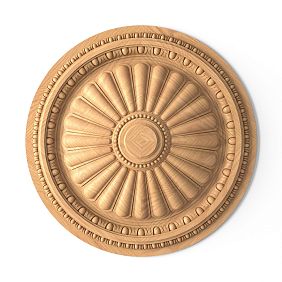
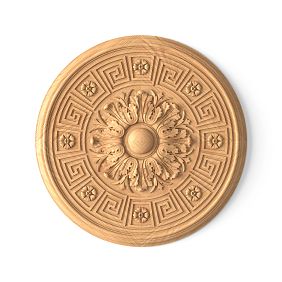

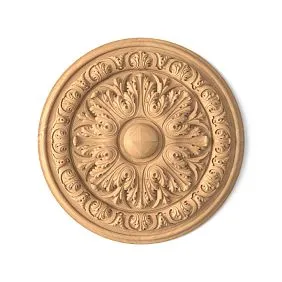
What is a wooden decorative rosette
First of all — a definition. Because confusion arises regularly here: a rosette is confused with an overlay, a medallion, or a ceiling rosette. These are all different items.
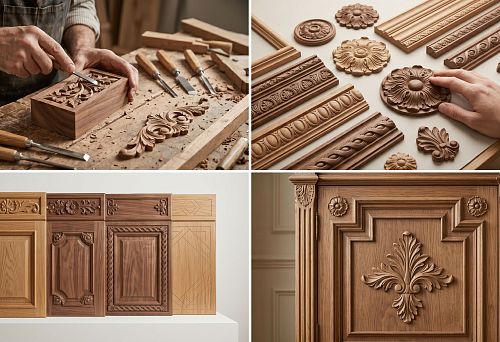
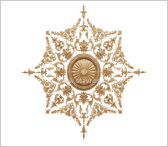
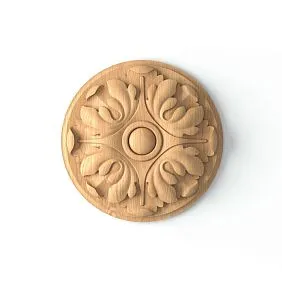
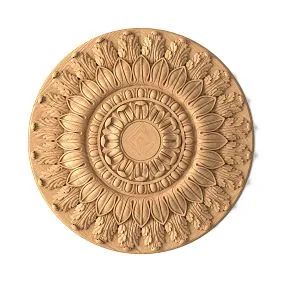
A wooden decorative rosette is a small carved element of round, square, oval, or shaped form made from solid wood. It is created specifically for a point decorative accent: on a furniture facade, door, portal, at the intersection of moldings, in the center of a decorative composition, or at the corner of a frame surround.
Unlike a general overlay, wooden rose outlet it is a complete object with a finished ornament. Its cross-section is relief: petals, geometry, leaf ornaments, floral motifs, solar symbols. The relief depth is from 5 to 20 mm. The diameter is from 30 mm to 200 mm and larger.
The function of a rosette is dual: it both decorates and accentuates. Where a molding creates a line and an overlay builds a plane, the rosette places a point. A visual point in the right place.




History of the wooden rosette as a decorative element
The rosette is one of the oldest ornamental motifs. It was used in Ancient Greece, Rome, and medieval Europe. The rosette symbolized the sun, a flower, a point of reference. In Renaissance and Baroque furniture, it became a mandatory element of facade, door, and portal decoration.
In Russian classicism and Empire style, the wooden rosette made of solid wood adorned library cabinets, desks, sideboards, and door panels. It is this tradition that makes the carved wooden rosette an organic element in classical and neoclassical interiors today.
Our factory also produces:



Where wooden rosettes are used: all application scenarios
The scope of application is wider than commonly thought. A rosette is not just a furniture detail.
Get Consultation
Furniture facades: chest of drawers, wardrobe, sideboard
This is the main and most popular application. Decorative rosette for furniture is installed:
-
in the center of the chest drawer front — as an independent accent;
-
in the center of the frame molding on the wardrobe door — as a frame completion;
-
at the intersection of moldings on a sideboard or display cabinet — as a nodal element;
-
on the top crossbar of the facade — as a decorative insert.
A rosette on a furniture facade is minimal intervention with maximum visual impact. One small carved element changes the character of the entire piece.
Doors: panel, overlays, architrave
Wooden rosette for a door used on the door leaf in several places:
-
in the center of the door panel — as a central accent;
-
in the corners of the frame — four corner rosettes create a classic frame composition;
-
on the upper horizontal crossbar of the door — as an ornamental element;
-
on the architrave — as a small decoration.
A door with carved rosettes in a classic interior is an object perceived as antique or custom-made. This impression is created by several small details.
Fireplace Entrances
A fireplace portal is an architectural frame around the fireplace. It has a horizontal lintel, vertical pilasters, and a top cornice. In classic portals, wooden rosettes are placed:
-
in the center of the horizontal shelf of the portal;
-
in the corners of the frame surround of the fireplace;
-
at the intersection of the horizontal and vertical elements.
This is a tradition that is several centuries old — and it still works flawlessly.
Wall decorative compositions
A wall with molding frames is a popular design technique for living rooms, bedrooms, and studies. In each corner of the molding frame or in the center of the panel, a wooden rosette. This turns the geometric frame into a decorative object with an artistic character.
When using of wooden moldings and wooden rosettes in a unified system, the wall gains depth and architectural quality — it ceases to be just a painted surface.
Decorative frames and mirrors
Corner and central rosettes on a wooden frame for a mirror or painting is a technique that turns the frame into a jewelry object. Four corner rosettes of the same size set the rhythm of the frame. The central rosette along the top edge creates an accent.
Restoration of old furniture
This is a separate and very relevant scenario. An old chest of drawers or sideboard with worn or missing decorative elements is restored using ready-made carved wooden rosettes. Choose the right ornament, tint, and size — and the furniture regains its original character.
wooden furniture appliqués and rosettes are the main tools of a restorer when restoring the decorative layer of furniture.
Kitchen fronts
In the kitchen, rosettes are used delicately: small 30–50 mm elements on the facades of wall cabinets or on decorative inserts above the hood. This is appropriate in classic and Provencal kitchens — as a detail that adds handcrafted work to a machine-made interior.
Decorative panels and niches
In a decorative niche — a wooden rosette in the center of the back panel. In a wall with molding frames — at the intersections. In a hallway with wooden paneling — as an accent on key planes.
How a wooden rosette differs from an overlay and molding
This question requires a clear answer. Many people get confused, calling a rosette an overlay — and this leads to mistakes when choosing.
Molding
Molding — a linear element. It creates an extended decorative line: a frame, a belt, a border. Molding builds form, not an accent. It works in motion — along the perimeter, diagonally, in a system of frames.
A rosette is a point element. It fixes a place, creates a center, sets a visual point. A rosette has no length — it exists at one point and from there controls the perception of the entire plane.
Overlay
wooden furniture appliqués — a broader concept. An overlay can be of any shape: elongated, asymmetrical, an ornamental strip. An overlay is a decorative element without strict geometry of application.
A rosette is a specific form of overlay: symmetrical, round or square, with a central ornament. Its feature lies in symmetry and completeness. It is not part of a longer decoration — it is an independent object.
Carved decor in the form of a cartouche or medallion
A cartouche is a decorative element with an oval frame, often including text or a symbol. A medallion is a stricter, geometrically regular element. A rosette is an ornamental, petal-shaped, radially symmetrical form.
Difference in practice: a cartouche — above the front door or on the facade of a sideboard as a ceremonial element. A medallion — in the center of a frame composition or on a lintel. A rosette — at the intersection of moldings, in corner points of a frame, in the center of a small facade.
How to choose the shape of a wooden rosette
The shape of a rosette determines its character and appropriateness in a particular style.
Round rosette
Universal shape. Round carved wooden rosette is organic in any style: classic, neoclassical, Provence, Russian style. It pairs well with rectangular molding frames — the contrast of circle and rectangle creates expressiveness.
The round rosette is the most popular choice for furniture, doors, and fireplace portals.
Square rosette
Works well in strict framed compositions. The square rosette is installed in the corners of rectangular molding frames — where you need to "close the corner" with a decorative accent. This is a classic of 18th–19th century furniture and interior decor.
The square rosette is appropriate in neoclassicism, Empire style, and modern classicism with clear geometric lines.
Oval rosette
The oval shape is for classicism and baroque. It is slightly more dynamic than a circle and fits well into vertical or horizontal accents. An oval wooden rosette on a vertical facade of a chest of drawers or sideboard is an organic, proportionate solution.
Figural carved rosette
A complex figural shape — star, rounded rhombus, ornamented polygon — for expressive custom decor. This is an element that attracts the eye first. It is suitable as a single central accent on a large facade or on a fireplace mantel.
Ornament: what is depicted on the rosette
In addition to the shape — the nature of the ornament:
Petal floral — the most classic. Petals radiate from the center, like in a real flower. This is a soft, organic ornament for classicism and Provence style.
Foliage — acanthus, oak, and laurel leaves around the perimeter. More solemn and formal. For Empire, Classicism, and cabinet furniture.
Geometric — rays, rhombuses, division of a circle into equal sectors. Strict, graphic character. For Neoclassicism, Art Deco, and modern classics.
Solar — rosette as a sun symbol. Rays radiate from the center. An archaic yet relevant ornament — for interiors with a nod to tradition.
Mixed — combination of leaves, flowers, and geometry. The most common type in classical furniture.
How to choose the size of a wooden decorative rosette
Size is perhaps the most important practical issue. A mistake in size makes the rosette either unnoticeable or overloaded.
Scaling principle
The diameter of the rosette should be 15–25% of the smaller side of the facade or panel on which it is installed.
Drawer front 200×100 mm — rosette diameter 30–40 mm. Cabinet door front 500×800 mm — rosette 80–120 mm. Fireplace portal with lintel 1200 mm long — central rosette 150–200 mm.
| Facade / Surface | Recommended rosette diameter |
|---|---|
| Small box up to 150×200 mm | 25–40 mm |
| Medium box 200–300 mm | 40–60 mm |
| Cabinet door 400–600 mm | 60–100 mm |
| Door leaf 800–900 mm | 80–150 mm |
| Large buffet front | 120–200 mm |
| Fireplace portal, wall | 150–250 mm |
Corner rosettes: matching with molding
If rosettes are installed in the corners of a molding frame, their size must match the width of the molding. Molding 25 mm — corner rosette 25×25 mm or diameter 25–30 mm. This creates the impression that the rosette and molding are one system, not a random combination.
Paired installation
Two symmetrical rosettes on one front — this is paired decor. They are installed symmetrically relative to the central axis and must be absolutely identical: diameter, ornament, tint. A deviation in position of even 2–3 mm is visually perceived as an error.
Single rosette in the center
One rosette in the center of the facade is a standalone accent without a frame. It works on small facades where a frame is excessive. A rosette with a diameter of 40–60 mm in the center of a 200×150 mm drawer is sufficient and precise.
Wooden rosette for furniture: a commercial guide
The furniture scenario is the most detailed. Here, size, ornament, and installation method are all important.
Chest of drawers: rosettes on drawers
Classic scenario for a chest of drawers: one rosette per drawer. They create a vertical rhythm, making the chest of drawers a decorative object. If the chest has six drawers, six identical rosettes form a visual column.
Option with different sizes: large rosettes on the top drawers, smaller ones on the bottom. This creates a sense of diminishing scale—an ancient decorative technique.
Rosettes on a chest of drawers pair organically with wooden furniture handles —in the same style and same tint. Handles are function, rosettes are decor. They work as a pair.
Sideboard: multi-level decorative system
A sideboard is a large piece of furniture with several facades of different character. Here, the rosettes work in a system:
-
central rosettes on the doors of the lower part;
-
corner rosettes in molding frames;
-
a central decorative accent on the horizontal crosspiece between the upper and lower parts of the sideboard;
-
possibly — carved decor in the upper part under the cornice.
Carved wooden decoration for a sideboard, it is always a system, not a chaotic placement. Each element must be part of a planned composition.
Display cabinet: accent without overload
A display cabinet with glass doors requires a delicate approach. A rosette is appropriate here at the corner points of the wooden door frame or on the upper crosspiece. A large central rosette on a glass door is a mistake: it obscures the contents of the display cabinet.
Wardrobe: vertical facades
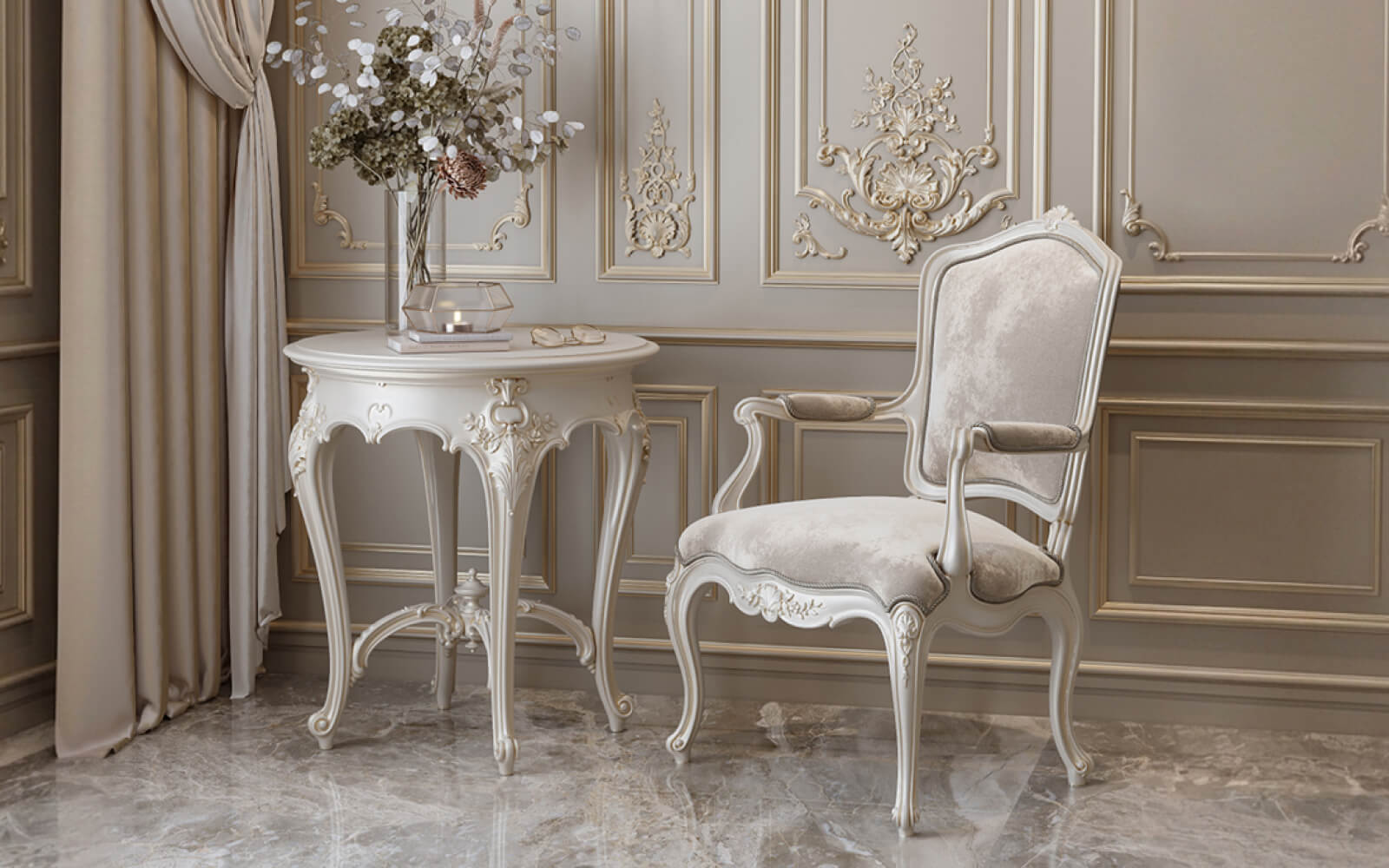
On a tall wardrobe with flat doors, a rosette in the center of each door is the simplest and most effective technique. When adding of wooden moldings Along the perimeter of the door and a rosette in the center — the cabinet acquires a framed character of classic furniture.
Kitchen fronts
In the kitchen, rosettes are used selectively: small elements 30–50 mm on corner wall cabinets, on decorative inserts, on island elements. Not on every facade — otherwise the kitchen becomes overloaded. A rosette in the kitchen is a selective accent, not a rule.
Wooden rosette for door and portal
Door in a classic interior
A door with wooden rosettes is a door with history. Four corner rosettes in the frame moldings of the door leaf are a classic technique. This turns a budget MDF product into a full-fledged decorative object.
Size of a corner rosette on a door: 40–60 mm. This is enough to be noticeable and delicate enough not to overload the leaf.
Installing a rosette on a door: PVA-based glue or wood mounting adhesive. Preliminary — surface treatment with sanding. After installation — painting or varnishing together with the door.
Fireplace portal: the main decorative accent
A fireplace portal is where a wooden rosette truly shines. A central rosette with a diameter of 150–200 mm on the horizontal shelf of the portal is an architectural gesture. It fixes the center of the fireplace wall, attracts the eye, and creates the feeling of a custom-made piece.
in combination with wooden molding, with pilasters and cornices of the fireplace portal, the rosette completes the ensemble.
Door casing
A wooden casing with decorative rosettes in the corners is a traditional technique of Russian wooden architecture. Small rosettes 30–50 mm in the upper corners of the casing create a folk or classical character depending on the ornament.
Wooden rosette in wall decor
Wall decorative compositions are a combination of molding frames, wooden panels, and accent points. Rosettes play the role of 'notes' in a musical phrase within this system.
Molding frames on the wall
Wooden moldings on the walls form rectangular frames — decorative 'pictures' without an image. In the corners of each frame are corner rosettes. This turns a geometric scheme into an interior object with a handcrafted character.
Corner rosette size = molding width ± 5 mm. This creates a precise match that looks like a unified system.
Wooden wall panels
Wooden cladding or slatted wall with a rosette in the central part is a focal point. One accent element on a large wooden plane attracts the eye and sets the reference point for the entire composition.
Decorative niche
In the niche, there is a wooden rosette on the back wall, in the center. It can be large — 120–150 mm — if the niche is spacious enough. A rosette in the niche illuminated by spot lighting creates a theatrical effect.
Material and coating of the wooden rosette
Wood species
Beech. Dense, uniform structure, easy to carve. Carved patterns from beech turn out clear, with sharp edges. Good for detailed ornaments.
Oak. A hard wood with expressive texture. An oak rosette under clear varnish looks luxurious — the wood texture is visible in every petal of the ornament.
Pine. An affordable soft wood. Carving is slightly less clear than beech, but it is the optimal choice for painting. A rosette for painting from pine is the most economical option.
Linden. A traditional material for carving. Soft, easy to cut, gives a clear relief. Linden rosettes for restoring historical furniture.
Finishing options
Without coating (for painting). Sanded surface. Wooden rosette for painting — the most popular option. Allows you to paint the rosette to match the furniture or wall — it will look like part of the product, not a glued-on element.
Clear varnish. Preserves the texture and color of the wood. Good for oak and beech rosettes with expressive texture.
Stain + varnish. Tinting to match the desired wood species or color. A pine rosette tinted to dark walnut is visually indistinguishable from oak.
White enamel. For Scandinavian and Provencal interiors. A white carved rosette on a white door — a delicate relief that is only noticeable with side lighting.
Gilding. Tinting to look like old gold — for classic and baroque interiors. A gold rosette on a dark buffet facade is a theatrical, celebratory accent.
How to choose a coating for the interior
The rule is simple: the rosette should match the tone of the element on which it is installed. A rosette on a door matches the door color. A rosette on furniture matches the facade color or the tone of the decorative elements of that same furniture.
Contrast (a dark rosette on a light facade) is a deliberate design technique. It only works when the contrast is applied systematically — everywhere, not just in one place.
Installing a wooden rosette: technique and details
Installing a rosette is a simple operation, but it requires precision in several key aspects.
Marking
Before installation, place the rosette on the surface dry and mark the center point. For a central rosette on a facade, find the center mathematically: the intersection of the rectangle's diagonals. This guarantees perfect centering.
For corner rosettes, mark the corner of the molding and determine the center of the square formed by the intersection of the two moldings.
Methods of mounting
PVA or wood glue. For wood-to-wood bonding — the optimal choice. Apply glue to the back side of the rosette, press, and secure with painter's tape for 20–30 minutes.
Construction adhesive. For bonding to MDF, chipboard, plywood. Sets faster, holds on smooth surfaces.
Self-tapping screws. For large rosettes (100 mm and larger) in combination with glue. A thin screw through the center of the back side, the head is countersunk and covered with putty.
Painting: before or after installation
If the surface will be painted in one color — install first, then paint. Paint hides glue joints and makes the rosette part of the surface.
If the rosette is in a different tone than the facade — paint it before installation (except the back side). After installation, touch up the joints.
Symmetry in paired installation
Two rosettes — always with measurement. Mark the central axis of the facade. Both rosettes must be at the same distance from the axis and from the top/bottom edge. Use a level and tape measure. A 2 mm error is visible to the naked eye on a symmetrical surface.
How to combine a wooden rosette with moldings and overlays
The rosette works in a system — this is its strongest quality. One rosette is a point. A rosette in a system of moldings and overlays is architecture.
Socket + molding frame
Classic combination: molding around the perimeter, socket in the center or corners. Wooden moldings form a frame — the socket completes it. The style of the socket ornament should match the style of the molding profile: classic molding — classic socket with petals; geometric molding — geometric socket.
Socket + wooden overlays
wooden furniture appliqués create planar decor — ornamental overlay elements on the facade. The socket in this system is the central accent around which the overlays are arranged. First determine the location of the socket, then place the overlays.
Socket + wooden handles
wooden furniture handles and sockets should be in a unified style. Classic shaped handle — classic petal socket. Strict rectangular handle — geometric angular socket. Mismatch of handle and socket styles is one of the most common mistakes.
Socket in the wooden trim system
Wooden trim — baseboards, cornices, moldings — creates a wooden interior ensemble. Sockets in this ensemble are point accents. They should be made of the same wood species or have the same tint as the main trim.
Mistakes when choosing and using wooden sockets
Let's list typical mistakes. After this article, you won't repeat them.
Choosing too large a rosette for a small facade. A 120 mm rosette on a 200×150 mm drawer is not an accent, it's overload. The rosette should occupy no more than 25% of the smaller side of the facade.
Mixing different patterns. Floral pattern on one door, geometric on another. The pattern style should be uniform for the entire piece of furniture or the entire room.
Not considering the element's thickness. A rosette relief depth of 15 mm on a door that opens in a narrow passage — the rosette will catch the door frame. Check the clearances.
Choosing a rosette without connection to moldings and handles. The rosette is part of the system. Without connection to other decorative elements, it looks random.
Forgetting about painting before installation. If you plan to paint only the rosette, do it before installation. After installation, it's difficult to cover glue joints without traces.
Placing decor without an overall composition. A rosette in an arbitrary spot on a large facade is chaos. Always determine the position mathematically: center, corner, intersection of moldings.
Not checking symmetry when installing in pairs. Two rosettes installed "by eye" are always asymmetry. Measure. Always.
Using different stains in the same room. A rosette on a door in dark walnut, rosettes on furniture in light oak — inconsistency. A uniform stain for all wooden decorative elements is a sign of a professional approach.
Where to buy a wooden decorative rosette
Buy a wooden decorative rosette it is important to choose a manufacturer with a real assortment — with different diameters, ornaments, wood species, and coating options.
In the Stavros catalog — Carved wooden decoration и wooden furniture appliqués of various shapes and sizes. Next in the catalog — Wooden moldings for creating frame systems, Wooden trim for a unified interior ensemble and wooden furniture handles for stylistic consistency. Full catalog wooden products for interiors — in a unified system of material and style.
FAQ: Answers to popular questions
What is a wooden decorative rosette?
It is a small carved element of round, square, or figured shape made from solid wood. It is used as a point decorative accent on furniture, doors, portals, walls, and decorative panels.
Where are carved wooden rosettes used?
On furniture facades, chests of drawers, sideboards, display cabinets, cabinets, door panels, fireplace portals, in molding frames on walls, in niches, and when restoring old furniture.
How is a rosette different from a regular overlay?
A rosette is a symmetrical point element with a radial ornament. An overlay is a broader concept, any decorative element. A rosette places a "point" in a specific location, while an overlay can cover an extended surface.
Is a wooden rosette suitable for furniture?
Yes, that is its primary use. Rosettes are installed in the center of drawer fronts, at corner points of molding frames, and on horizontal furniture crosspieces.
Can a rosette be used on a door?
Yes. Four corner rosettes in the molding frames of a door panel or one central rosette are classic techniques for doors.
How to choose the size of a decorative rosette?
Diameter = 15–25% of the smaller side of the facade. For a small drawer — 25–40 mm, for a cabinet door — 60–100 mm, for a fireplace portal — 150–200 mm.
Can a wooden rosette be painted?
Yes. An uncoated rosette can be painted in any color with acrylic enamel, stain, or varnish. It is better to paint before installation.
How to combine sockets with moldings?
Socket size = molding width ± 5 mm. The ornament style of the socket should match the style of the molding. Uniform tinting.
Is a carved socket suitable for furniture restoration?
Yes, it is one of the key tools of a restorer. Ready-made wooden sockets restore the decorative layer of furniture where original elements are lost or damaged.
Where to buy a wooden decorative socket?
In the STAVROS catalog: Carved wooden decoration и Wooden Inlays with delivery across Russia.
About the manufacturer
STAVROS is a Russian manufacturer of wooden products for interiors and furniture. The company's catalog includes Carved wooden decoration и Wooden Inlays, Moldings, Wooden trim и wooden furniture handles a complete system of wooden decor for furniture and interiors. If you are looking for a wooden decorative socket — in the catalog STAVROS you will find the right size, ornament, and finish with the quality guarantee of natural wood.