




























Article Contents:
- What Are Faux Wood Ceiling Beams?
- Structural Beams vs. Decorative Beams
- Why the Distinction Matters
- Visual Rhythm
- Direction
- Depth and Shadow
- Architectural Character
- 1. Parallel Faux Wood Ceiling Beams
- 2. Coffered Ceiling With Decorative Beams
- 3. Narrow Decorative Ceiling Slats
- 4. A Single Feature Beam
- 5. Beams Combined With Crown Molding and Ceiling Ornament
- The Painted MDF Version
- The Oak-Veneered Version
- What the BL-001 Beam Does Not Do
- Why Its Stock Length Matters
- Wood Slats as Decorative Accents
- Wood Trim on Decorative Beams
- Natural Wood and Painted Polyurethane
- STAVROS MLDPU-001
- STAVROS MLDPU-004
- STAVROS MLDPU-002
- STAVROS MLDPU-003
- Profile Comparison
- Center-to-Center Spacing
- Clear Space Between Beams
- Symmetrical Beam Placement
- Example: Three Parallel Beams in a 16 × 13-Foot Room
- Clear Space With Four-Inch Beams
- Why the Layout Works
- BL-001 Stock Length
- Cutting One Beam Run
- Three Beam Runs
- Purchased Length
- Nominal Unused Length
- Important Installation Detail
- Eight-Foot Ceilings
- Nine-Foot Ceilings
- Ten-Foot Ceilings
- Ceiling Height Reference
- First Establish the Main Grid
- Decide Whether Every Field Needs Molding
- Coordinate the Perimeter
- Step 1: Convert the Room Dimensions
- Step 2: Position the Longitudinal Beams
- Step 3: Position the Transverse Beams
- Step 4: Determine the Number of Ceiling Fields
- Step 5: Account for Beam Width
- Longitudinal Beams
- Transverse Beams
- Transverse Cutting Plan
- Total Beam Quantity
- Check the Purchased Length
- Total Installed Decorative Beam Length
- Nominal Unused Material
- Establish a Consistent Inset
- Nine Frame Dimensions
- Calculate the Installed Molding Length
- Cutting Pattern A
- Cutting Pattern B
- Combined Cutting Schedule
- Purchased Molding Length
- Installed Molding Length
- Nominal Unused Length
- Nominal Waste Percentage
- Why the Cut List Matters
- STAVROS HIWOOD Crown Molding
- Perimeter of a 16 × 12-Foot Room
- Crown Molding Strip Quantity
- Feasible Wall-by-Wall Allocation
- Nominal Material Difference
- Use a Central Focal Point
- Coordinate With Lighting Fixtures
- Consider Smaller Accents
- Modern Farmhouse Living Room
- Traditional Dining Room
- Transitional Bedroom
- Open-Plan Kitchen and Living Room
- Home Office
- Rustic Cottage or Cabin
- Contemporary Living Room
- White-on-White Ceiling
- Dark Beams on a Light Ceiling
- Natural Oak Finish
- Painted Dark Ceiling
- Combining Wood and Polyurethane
- Choose the Correct Scale
- Keep the Layout Consistent
- Plan the End Conditions
- Design the Section Joints
- Match the Surface Finish
- Identify the Ceiling Structure
- Do Not Use Generic Fastener Spacing
- Check Concealed Utilities
- Suspended Ceilings
- Stretch Ceilings
- Support the Fan Independently
- Check Blade Clearance
- Avoid Creating a Conflict
- Recessed Lighting Between Beams
- Linear LED Lighting
- Concealed Lighting
- Electrical Code Considerations
- Heat
- Check Flatness
- Check the Existing Finish
- Locate Fixtures and Services
- Transfer the Layout
- Confirm the Finished Appearance
- Step 1: Approve the Ceiling Plan
- Step 2: Inspect the Existing Construction
- Step 3: Specify the Beam Attachment System
- Step 4: Complete Relevant Electrical Preparation
- Step 5: Prepare the Supporting Ceiling
- Step 6: Install the Main Beam Assembly
- Step 7: Establish the Coffered Field Geometry
- Step 8: Cut the Polyurethane Molding
- Step 9: Install the Decorative Molding
- Step 10: Install Optional Decorative Details
- Step 11: Finish the Surfaces
- Step 12: Inspect the Complete Assembly
- Paint-Grade MDF
- Polyurethane Molding
- High-Density Polystyrene Crown
- Match Color and Sheen
- Paint Before or After Installation?
- First Layer: Main Beam Grid
- Second Layer: Decorative Panel Frames
- Third Layer: Ceiling Perimeter
- Fourth Layer: Ornamental Accents
- Final Layer: Lighting
- Choosing Beams Before Measuring the Room
- Ignoring the Beam's Projection
- Using Arbitrary Beam Spacing
- Forgetting the Room Perimeter
- Confusing MDF Beams With Polyurethane Beams
- Treating Polyurethane Molding as a Support
- Mounting Beams Into Drywall Alone
- Forgetting Ceiling Fan Clearances
- Overcomplicating the Coffers
- Ordering From Linear Footage Alone
- Assuming All Crown Moldings Are Polyurethane
- Mixing Incompatible Finishes
- Ignoring Shipping and Packaging
- Decorative Beam Cost
- Polyurethane Molding Cost
- Optional Crown Molding
- Supporting Construction
- Installation Labor
- Finishing
- Electrical Work
- Freight and Import Costs
- Project Cost Formula
- Decorative Beam Specification
- Polyurethane Molding Specification
- Crown Molding Specification
- Corner and Ornament Compatibility
- Samples
- What Are Faux Wood Ceiling Beams?
- Are Faux Ceiling Beams Structural?
- Can Polyurethane Molding Be Combined With Wood Ceiling Beams?
- Is STAVROS BL-001 Made From Polyurethane?
- What Is the Length of STAVROS BL-001?
- How Do You Calculate Faux Beam Spacing?
- How Far Apart Should Faux Wood Ceiling Beams Be?
- Can You Install Faux Beams on an 8-Foot Ceiling?
- What Is a Faux Coffered Ceiling?
- How Many Coffers Can Two Beams in Each Direction Create?
- What Is the Best Polyurethane Molding for a Coffered Ceiling?
- Does a Faux Beam Ceiling Need Crown Molding?
- Can You Use Polyurethane Crown Molding With MDF Faux Beams?
- Can Faux Beams Support a Ceiling Fan?
- Can You Hide LED Lighting Inside Faux Beams?
- Can Faux Beams Be Installed Directly on Drywall?
- Can Faux Beams Be Installed on a Stretch Ceiling?
- Is Oak-Veneered MDF the Same as Solid Oak?
- Can You Paint MDF Beams and Polyurethane Molding the Same Color?
- How Much Polyurethane Molding Do You Need for Nine Coffers?
- Where Can I Buy Decorative Ceiling Beams and Polyurethane Trim?
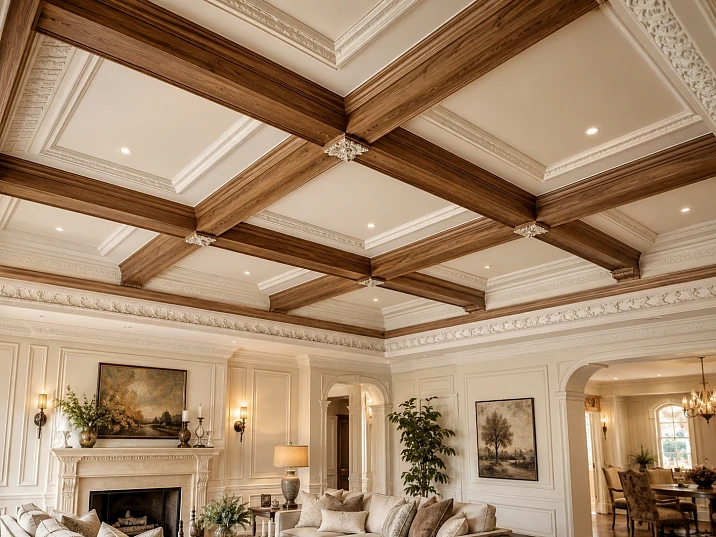
A ceiling can change the character of an entire room without altering its walls, furniture, or floor plan.
A flat white ceiling is often a sensible choice. It provides visual simplicity and allows other elements to dominate. But in a room that needs stronger architectural identity, an unbroken ceiling plane can also represent a missed design opportunity.
Decorative ceiling beams offer a way to introduce structure, depth, and visual rhythm.
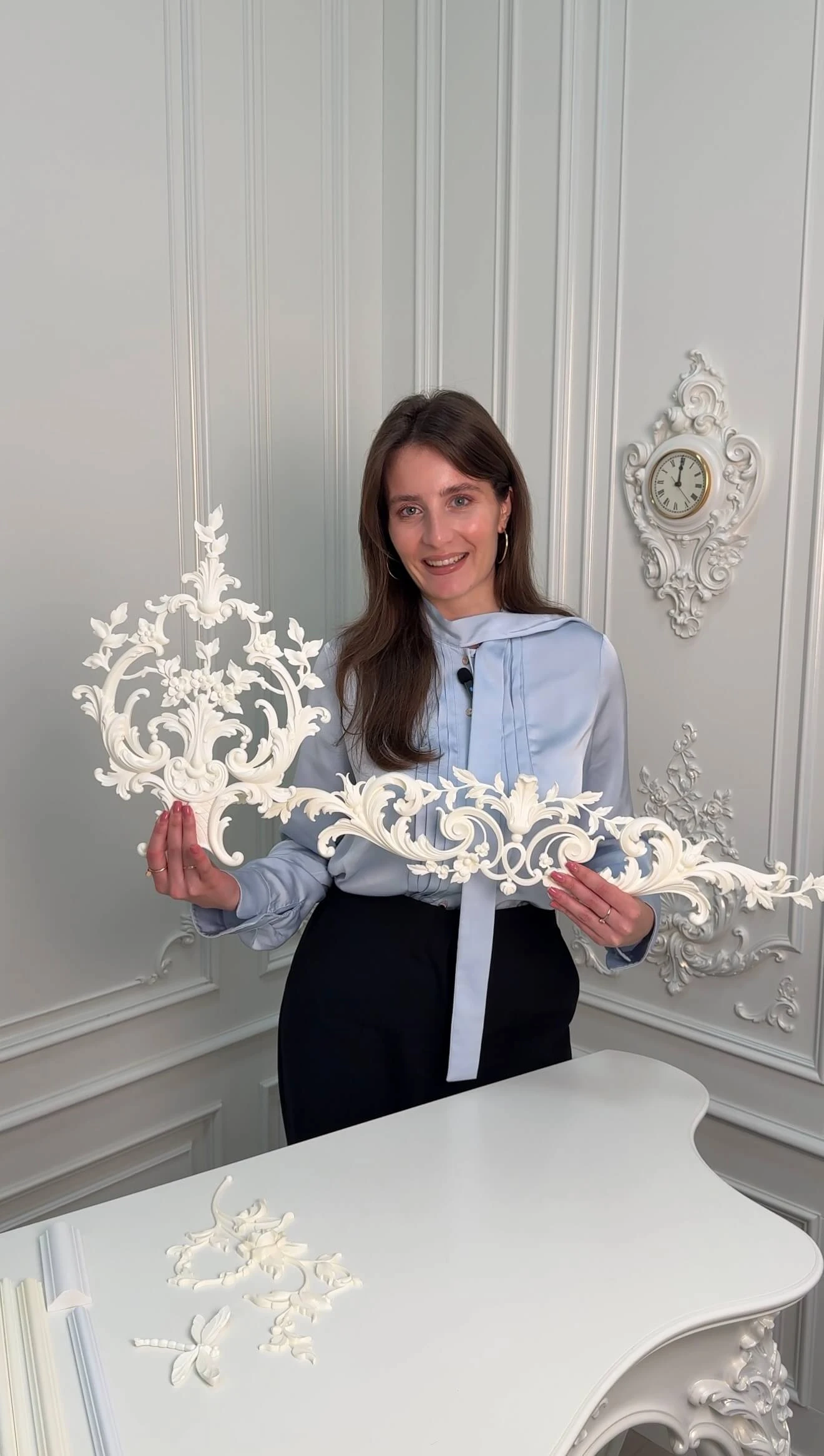
In a modern farmhouse living room, warm oak-look beams can bring character to an otherwise simple space. In a traditional dining room, a geometric arrangement of ceiling beams and decorative molding can create the appearance of a carefully designed coffered ceiling. In a transitional bedroom, shallow painted beams can introduce architectural detail without overwhelming the space.
The effect comes from the relationship between the elements.
The beams establish direction and scale.
Architectural molding defines selected borders and recessed-looking fields.
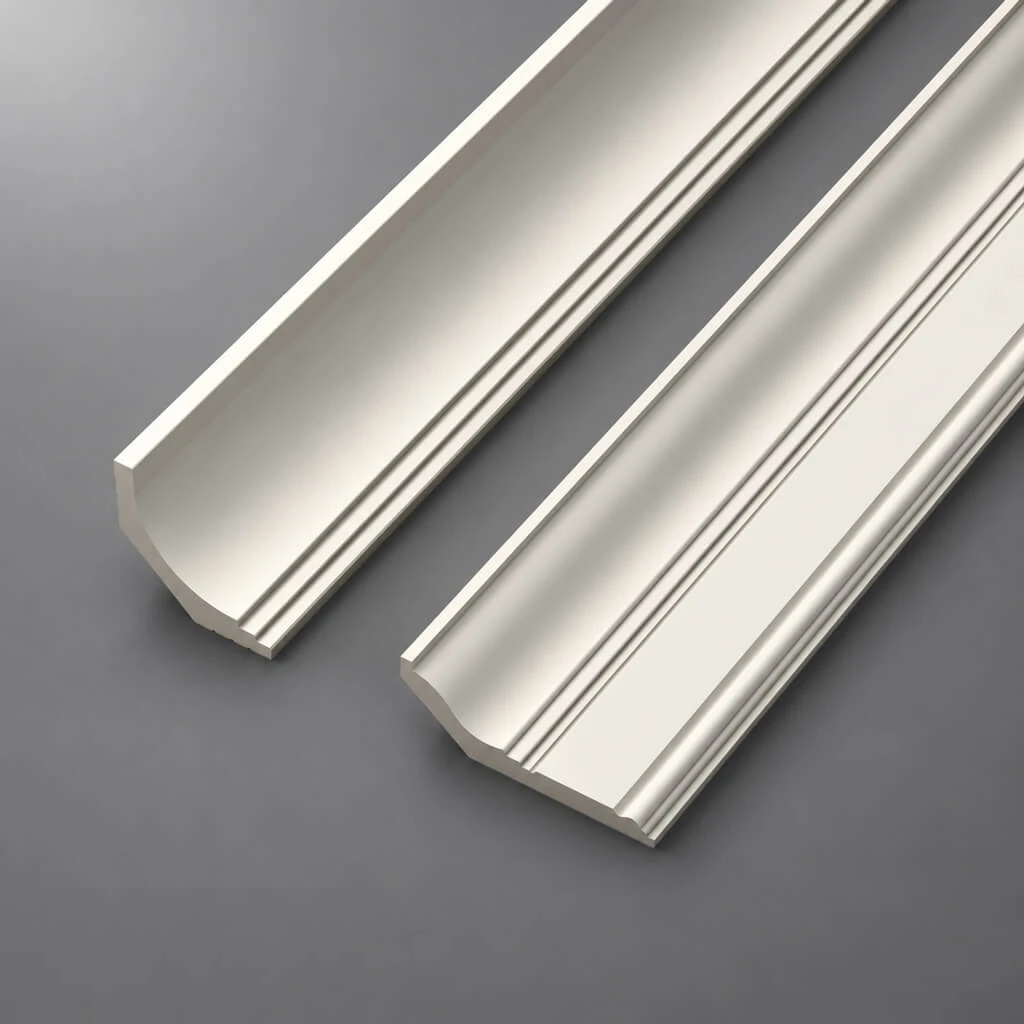
Crown molding may establish a transition between the ceiling and walls.
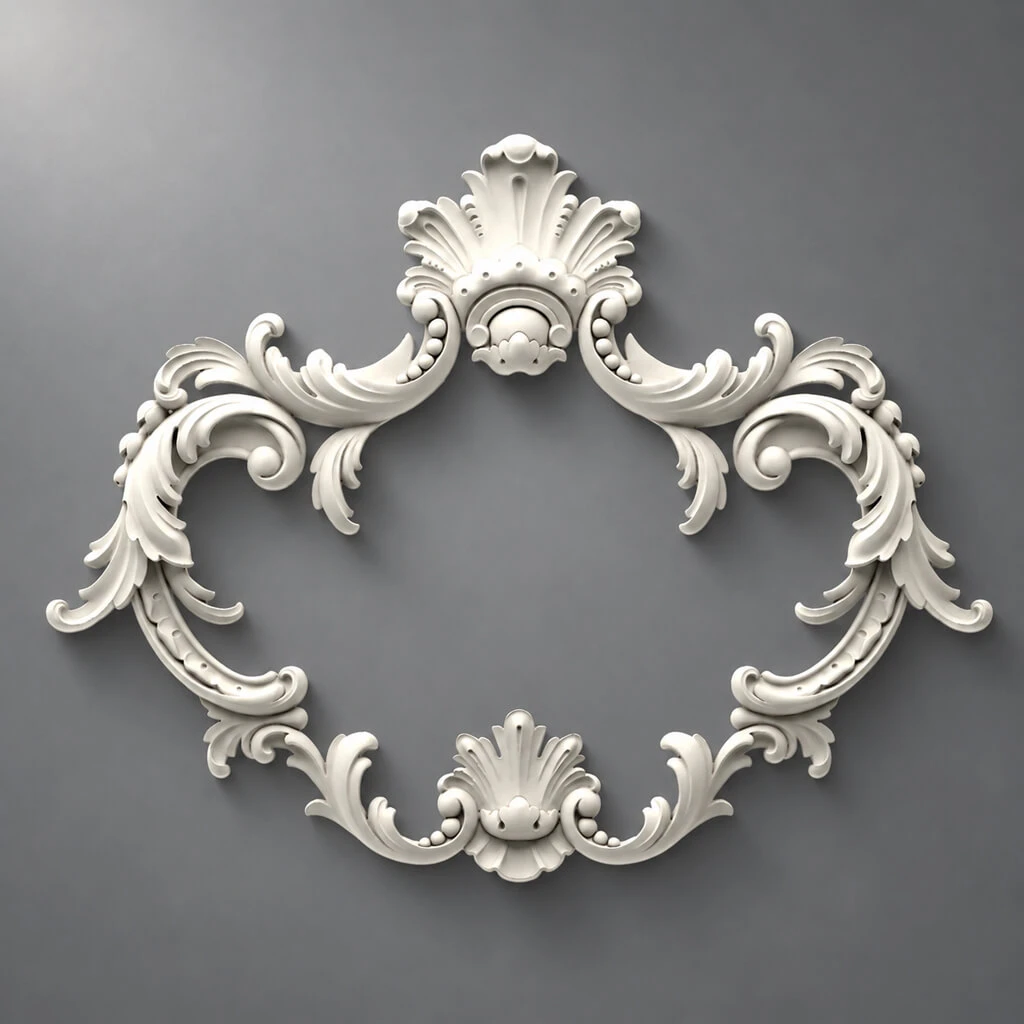
Decorative ornaments can introduce focal points where the design requires them.
When these components are coordinated, the result feels like a deliberate architectural composition rather than a collection of materials attached to the ceiling.
Faux wood ceiling beams and polyurethane molding can work together to create a distinctive ceiling design, provided the decorative products, supporting construction, and attachment methods are specified separately.
This distinction matters for American homeowners, contractors, and interior designers.
A faux beam is not necessarily structural. A polyurethane molding is not a ceiling joist. A decorative bracket should not be assumed capable of supporting a beam. The ceiling assembly must be securely installed using methods appropriate to its weight, substrate, and location.
STAVROS offers several categories of products that can be considered for these designs.
Its BL-001 decorative false beam is available in MDF and oak-veneered MDF configurations.
The STAVROS polyurethane molding collection includes architectural profiles suitable for selected decorative ceiling frames.
The company also supplies polyurethane molding accents, decorative ceiling medallions, and HIWOOD polystyrene crown molding.
These are different products made from different materials. They should not be combined into one generic category of “polyurethane beams and crown molding.”
This guide explains how to select and coordinate them for U.S. residential interiors.
We will examine faux wood ceiling beam ideas, beam spacing, coffered ceiling layouts, material choices, lighting, installation requirements, and practical purchasing calculations.
A detailed example for a 16 × 12-foot room demonstrates how to calculate an entire ceiling system using real STAVROS stock lengths.
The objective is simple: build a ceiling that looks intentional, respects the room's proportions, and can be specified and installed correctly.
What Are Faux Wood Ceiling Beams?
Faux wood ceiling beams are decorative elements designed to create the appearance of exposed architectural beams.
They are commonly installed in rooms where the original structure does not contain visible beams or where the designer wants a different visual arrangement.
The term can describe several types of products.
Some faux beams are manufactured from polyurethane foam and have a molded wood-grain texture.
Others are made from MDF, veneered wood products, engineered wood, or lightweight hollow assemblies.
Some are site-built from timber framing and panel materials.
These constructions differ in weight, appearance, finish, and installation requirements.


Structural Beams vs. Decorative Beams
A structural beam carries loads within a building.
Its dimensions, material, and connections are determined by engineering and construction requirements.
A decorative faux beam creates a visual effect.
It generally does not carry the building's structural loads.
A hollow ceiling beam may conceal an existing structural member or other appropriately installed components, but that does not make the decorative enclosure itself load-bearing.
Наша фабрика также производит:
Смотреть весь Каталог продукции
Why the Distinction Matters
A homeowner may see a large decorative ceiling beam and assume it can support a pendant light or ceiling fan.
That assumption can be dangerous.
The fixture needs its own approved support and electrical installation.
Similarly, decorative polyurethane molding installed beside a beam does not strengthen the beam attachment.
Every component needs a defined function.
Получить консультацию
Why Decorative Ceiling Beams Change the Appearance of a Room
The effect of ceiling beams is primarily geometric.
A plain ceiling has relatively few visual reference points.
Beams introduce a sequence of raised lines that organizes the overhead surface.
This can make the room feel more architectural.
Visual Rhythm
Parallel beams create a repeated pattern.
The distance between them establishes the rhythm.
A few widely spaced beams create a restrained composition.
A larger number of closely spaced beams produces a denser pattern.
Neither is universally better.
The correct choice depends on ceiling height, room dimensions, and intended style.
Direction
Beams can emphasize one axis of a room.
When beams run along the room's length, they reinforce that direction.
When installed across the width, they create a different visual rhythm.
These effects are contextual. They are not reliable guarantees that a room will appear wider or longer.
Depth and Shadow
A beam projects below the ceiling surface.
Its edges cast shadows.
Under directional lighting, those shadows become more pronounced.
This produces a sense of physical depth that a painted ceiling alone may not provide.
Architectural Character
A natural wood finish can suggest a rustic or farmhouse interior.
White painted beams may suit a transitional or coastal room.
Dark beams combined with decorative molding can create a more formal classical atmosphere.
The same basic ceiling geometry can support very different design styles.
Five Ceiling Design Approaches for American Homes
Faux beams can be arranged in several ways.
The best layout depends on the room and the desired visual character.
1. Parallel Faux Wood Ceiling Beams
This is one of the most recognizable arrangements.
Several beams run in the same direction.
Their spacing is consistent or follows a deliberate symmetrical pattern.
The ceiling surface between the beams remains relatively simple.
This works well in modern farmhouse living rooms, kitchens, family rooms, and transitional interiors.
The beams can be finished in natural oak tones, darker stained wood, or paint.
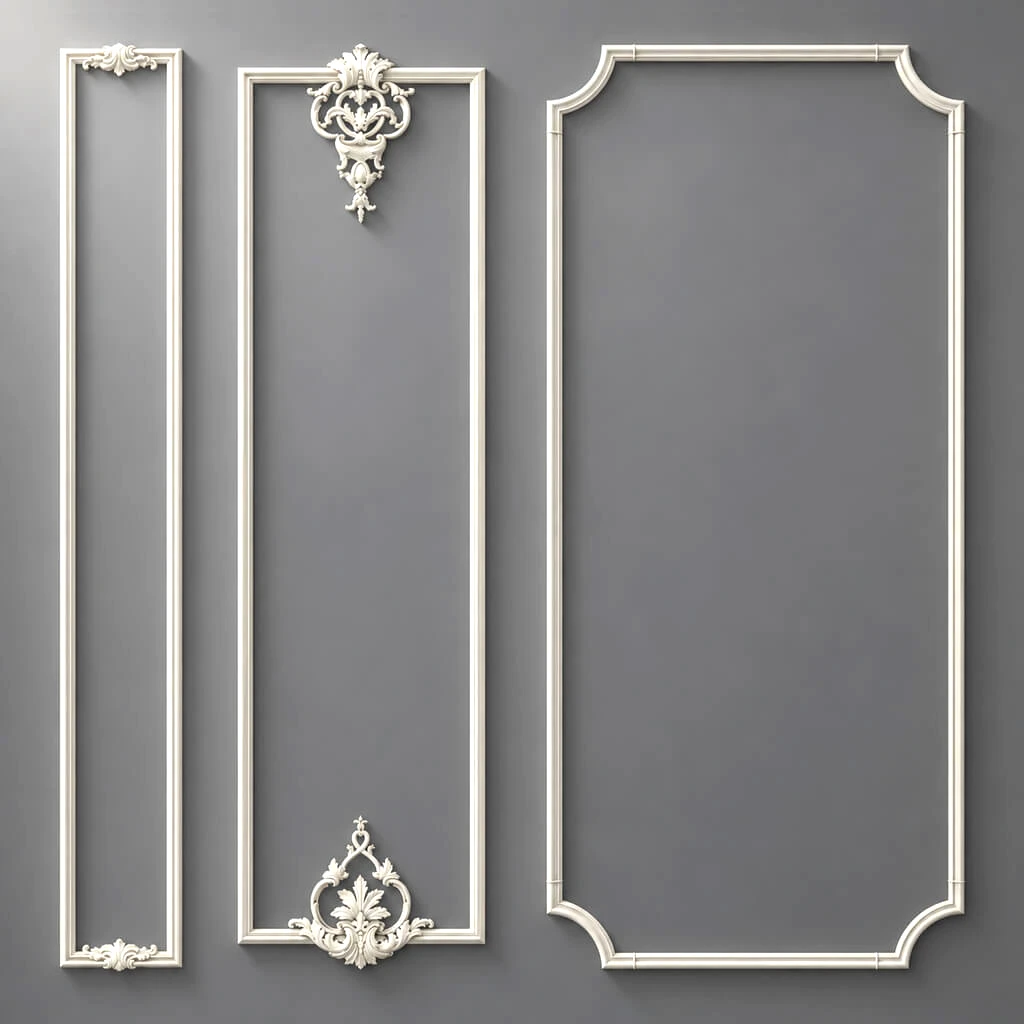
A restrained polyurethane molding may be added elsewhere on the ceiling or surrounding walls, but it is not mandatory.
2. Coffered Ceiling With Decorative Beams
A coffered ceiling uses a geometric arrangement of crossing beams, panels, or architectural divisions to create recessed-looking fields.
Traditional coffered ceilings may contain actual recessed construction.
A decorative applied-beam version can imitate that appearance on an existing ceiling.
The distinction should be understood when specifying the project.
A flat ceiling with applied beams can create a convincing faux coffered ceiling, but it is not necessarily the same construction as a structurally recessed ceiling.
Polyurethane molding can emphasize the individual fields.
3. Narrow Decorative Ceiling Slats
Shallow wood slats create a lighter visual treatment than full-sized beams.
They can establish parallel lines across a ceiling without the same projection.
This approach may suit contemporary bedrooms, home offices, and interiors with relatively low ceilings.
Slat systems still require appropriate attachment.
Thin decorative wood should not be assumed suitable for overhead installation using adhesive alone.
4. A Single Feature Beam
One decorative beam can identify a particular architectural axis.
It may align with a kitchen island, dining table, or transition between an open kitchen and living room.
This is often more restrained than covering the entire ceiling with beams.
The beam should relate to the layout below it.
A feature placed without reference to the room's geometry can appear arbitrary.
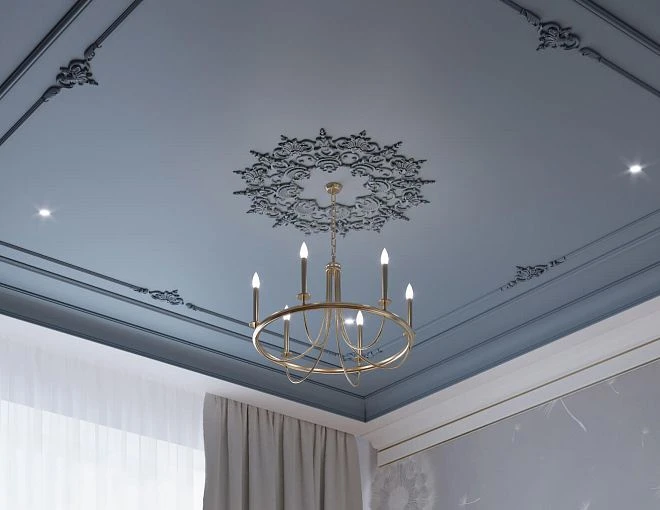
5. Beams Combined With Crown Molding and Ceiling Ornament
In more formal interiors, the beam arrangement may form part of a larger decorative system.
A crown molding establishes the perimeter.
The beams create the principal overhead divisions.
Polyurethane moldings define selected rectangular fields.
Decorative ornaments introduce focal points.
This approach requires careful proportioning.
Using every available decorative element will not necessarily improve the result.
A good composition establishes a hierarchy.
Faux Ceiling Beam Materials Compared
Different materials serve different aesthetic and practical purposes.
| Material | Typical appearance | Main consideration |
|---|---|---|
| Solid wood | Authentic natural timber | Weight, movement and secure attachment |
| MDF | Smooth paint-grade decorative beam | Moisture conditions, weight and finishing |
| Oak-veneered MDF | Real wood-grain appearance over engineered substrate | Veneer finish and installation suitability |
| Manufactured polyurethane faux beam | Often molded to imitate wood | Product-specific fire, attachment and heat requirements |
| Site-built engineered assembly | Custom dimensions and finish | Engineering, fabrication and installation quality |
| Polyurethane decorative molding | Raised architectural lines and ornament | Nonstructural decorative use |
| High-density polystyrene crown molding | Wall-to-ceiling transition | Product-specific installation and coating compatibility |
A faux wood ceiling beam does not have to be made from polyurethane.
For example, the STAVROS BL-001 beam discussed below is an MDF-based product.
The polyurethane elements are separate architectural decorations that may complement it.
STAVROS BL-001: MDF Faux Beam for Decorative Ceilings
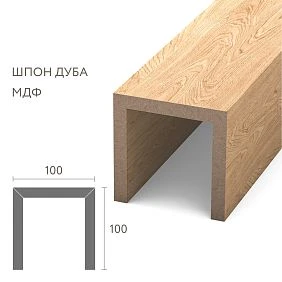
The STAVROS False Beam BL-001 is designed for decorative architectural applications.
It has a U-shaped cross-section.
The product is offered in two main material configurations:
MDF intended for a painted finish
MDF with oak veneer for a natural wood-grain appearance
The listed product dimensions are approximately:
| Parameter | Dimension |
|---|---|
| External width | 3.94 in |
| External depth | 3.94 in |
| Wall thickness | 0.51 in |
| Stock length | 108.27 in |
| Base material | MDF |
| Optional facing | Oak veneer |
The length is approximately 9.02 feet.
The Painted MDF Version
The MDF version can be considered for a painted ceiling design.
For example, it may be finished in white, warm cream, charcoal, or another color compatible with the overall ceiling composition.
This is useful when the designer wants the beams and surrounding ceiling to appear as one architectural surface.
The Oak-Veneered Version
The oak-veneered version offers a real wood-grain appearance over an MDF-based assembly.
It can be considered for a warm natural-wood ceiling treatment.
A suitable stain, lacquer, or other approved finish may emphasize the oak veneer.
However, the product should not be described as a solid oak beam.
It is an engineered decorative product.
What the BL-001 Beam Does Not Do
BL-001 is not presented as a structural floor or roof beam.
Its decorative U-shaped body should not be used as an independent support for ceiling fans, chandeliers, heavy objects, or building loads.
The required overhead attachment must be developed for the actual installation.
Why Its Stock Length Matters
At 108.27 inches, a single BL-001 beam is shorter than a typical 12- or 16-foot room dimension.
Longer runs therefore require a planned arrangement of sections, a different product length if available, or another construction approach.
The joints must be considered before ordering.
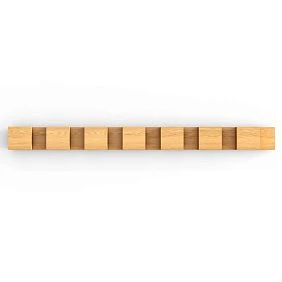
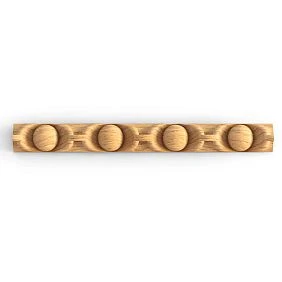
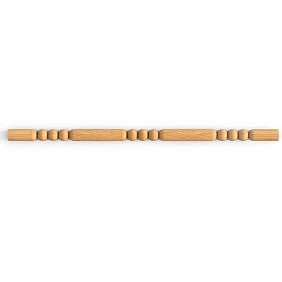
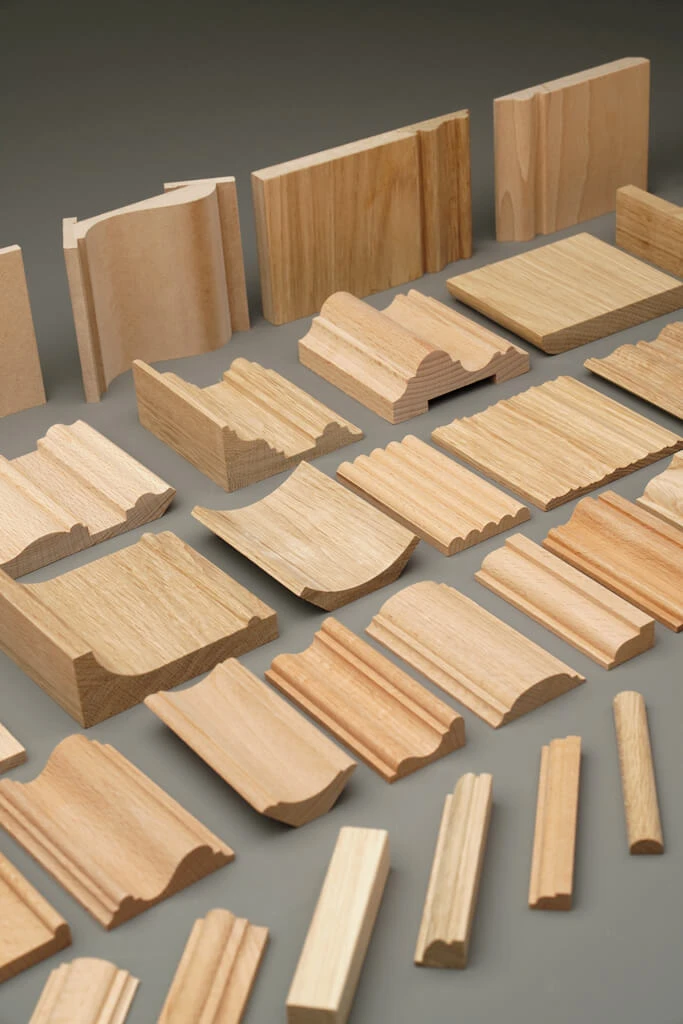
Using Solid Wood Slats and Trim Around Faux Beams
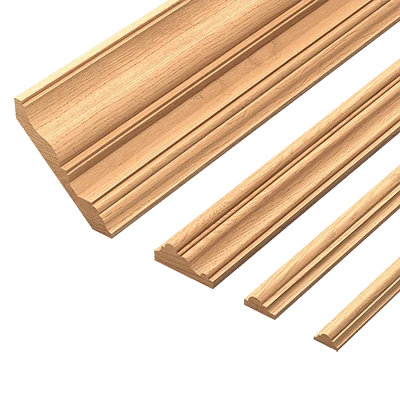
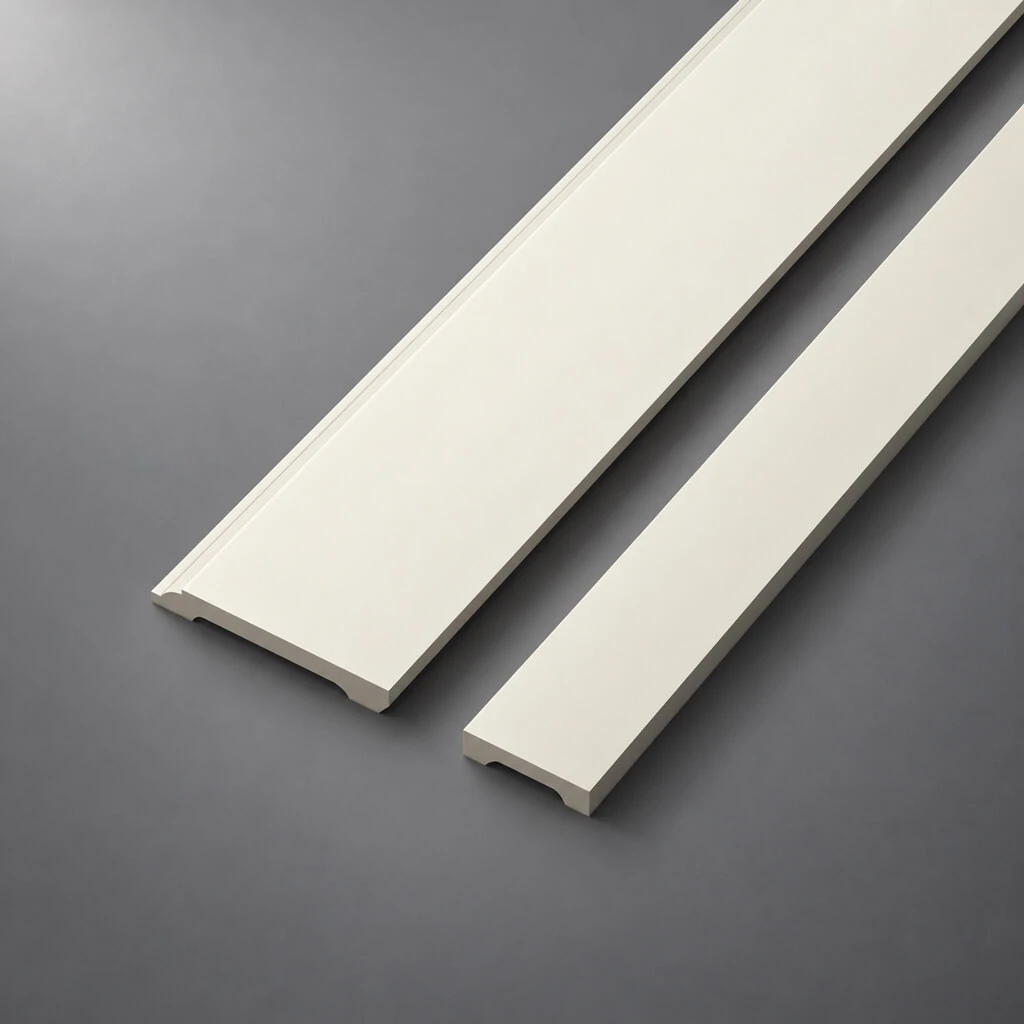
STAVROS also offers wood and MDF trimming products.
These may be considered for decorative lines, transitions, or other appropriate millwork details.
Wood can create a warm contrast with a painted ceiling.
However, wood profiles used as decorative elements should not be confused with properly graded structural framing materials.
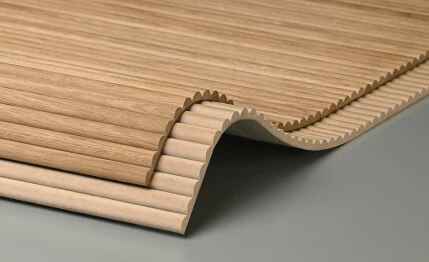
Wood Slats as Decorative Accents
A series of narrow wooden slats can create a repeating ceiling pattern.
The result may be lighter in appearance than large box beams.
This approach works particularly well where a contemporary or Scandinavian-inspired design is intended.
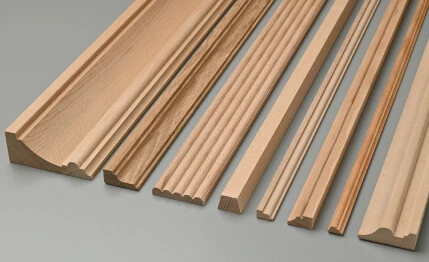
Wood Trim on Decorative Beams
Profiled wood trim can introduce additional detail to the edges of a beam.
A small molding may establish a shadow line along the lower edge.
A stepped trim can create a more formal profile.
The design should consider whether the added molding enhances the beam or simply makes it unnecessarily complicated.
Natural Wood and Painted Polyurethane
A ceiling can combine wood-toned faux beams with painted polyurethane architectural molding.
The materials do not need to match.
A dark wood beam with white decorative molding can create an intentional contrast.
But their scale and visual character should still be compatible.
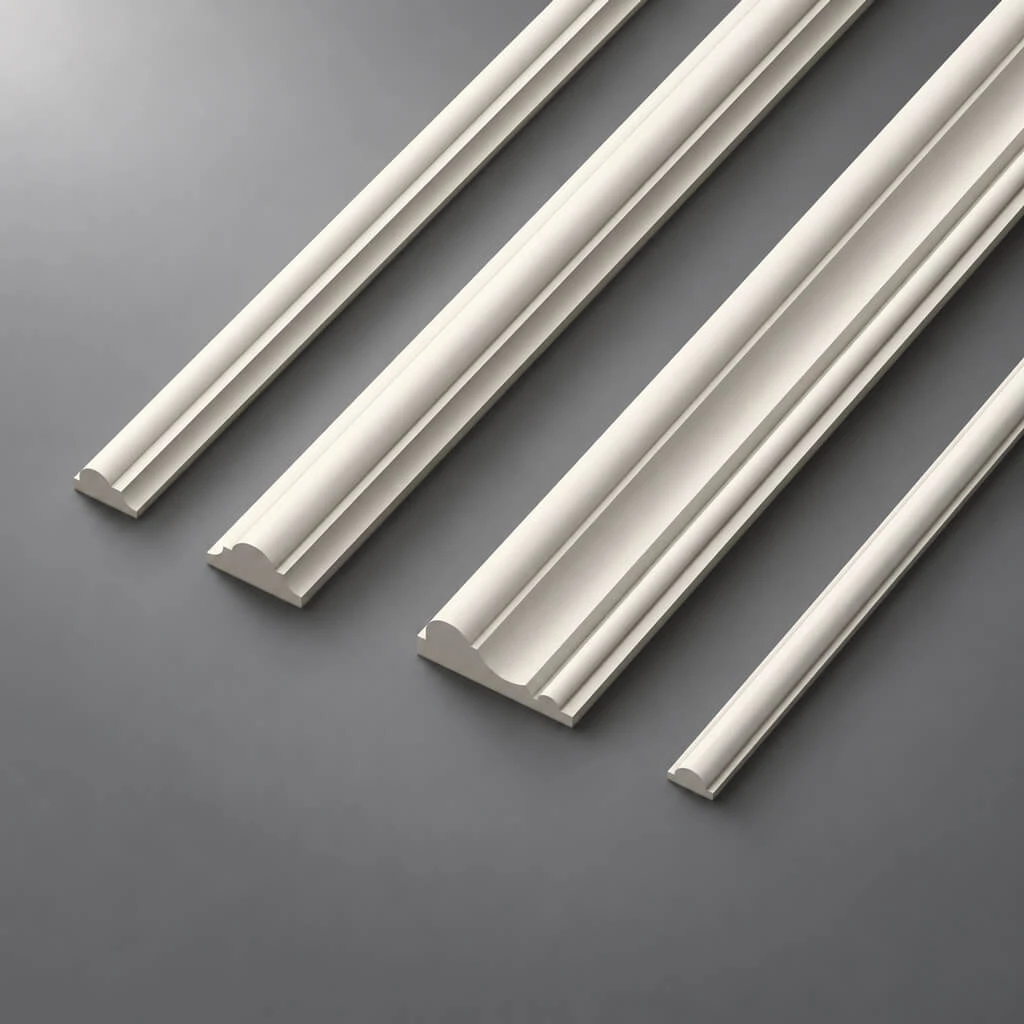
Polyurethane Molding Between Decorative Ceiling Beams
The space between beams provides an opportunity for additional architectural detail.
This is particularly relevant to coffered ceiling designs.
A beam grid creates the main geometric divisions.
A decorative molding frame within each field can add a secondary layer.
The molding should be selected according to the size of the ceiling field.
A small profile may look appropriate in a restrained composition.
A larger profile may be more effective in a formal room.
STAVROS MLDPU-001
The STAVROS MLDPU-001 polyurethane molding measures approximately:
Face width: 0.39 inches
Projection: 0.24 inches
Length: 102.36 inches
It creates a fine architectural line.
This can be useful for understated decorative frames within a ceiling field.
STAVROS MLDPU-004
The STAVROS MLDPU-004 polyurethane molding measures approximately:
Face width: 0.59 inches
Projection: 0.31 inches
Length: 102.36 inches
The slightly larger profile creates more noticeable relief.
It may be appropriate when the ceiling fields are moderately sized.
STAVROS MLDPU-002
The STAVROS MLDPU-002 polyurethane molding measures approximately:
Face width: 0.87 inches
Projection: 0.43 inches
Length: 102.36 inches
This is a more defined architectural profile.
It can create decorative frames within a classical or transitional faux coffered ceiling.
STAVROS MLDPU-003
The STAVROS MLDPU-003 polyurethane molding measures approximately:
Face width: 1.38 inches
Projection: 0.47 inches
Length: 102.36 inches
Its wider profile creates stronger visual presence.
This may be appropriate for a large formal ceiling.
However, it can overwhelm smaller ceiling fields.
Profile Comparison
| Product | Face width | Projection | Stock length |
|---|---|---|---|
| MLDPU-001 | 0.39 in | 0.24 in | 102.36 in |
| MLDPU-004 | 0.59 in | 0.31 in | 102.36 in |
| MLDPU-002 | 0.87 in | 0.43 in | 102.36 in |
| MLDPU-003 | 1.38 in | 0.47 in | 102.36 in |
These are decorative molding profiles.
They are not structural beams or purpose-designed ceiling joists.
Their use overhead requires suitable installation methods and product compatibility.
Faux Wood Ceiling Beam Spacing: How to Calculate a Balanced Layout
The spacing between beams strongly affects the final appearance.
However, there is no universal rule requiring every gap to be three, four, or five times the beam width.
That relationship may work for a dense decorative treatment, but it is not appropriate for every ceiling.
A large modern farmhouse room may use only three beams with comparatively wide spacing.
A traditional coffered ceiling may use a more closely organized grid.
Spacing should be derived from the room geometry and design objective.
Center-to-Center Spacing
The most useful preliminary measurement is the distance between beam centerlines.
This is commonly called on-center spacing.
It helps establish a consistent layout.
Clear Space Between Beams
The visible opening between two beams differs from their center-to-center spacing.
For equal-width beams:
Clear spacing = center-to-center spacing − beam width
For example, beams measuring approximately 4 inches wide and installed 48 inches on center create a clear gap of approximately 44 inches.
Symmetrical Beam Placement
For a simple parallel-beam design, symmetrical placement often creates a more deliberate result.
The first and last beam can be positioned equally relative to the side walls.
The remaining beams are then distributed consistently.
However, ceiling fixtures, doorways, and architectural focal points may require a different arrangement.
Example: Three Parallel Beams in a 16 × 13-Foot Room
Consider a room with:
Length: 16 feet
Width: 13 feet
Ceiling height: 9 feet
The beams run along the 16-foot direction.
Three beams are distributed across the 13-foot width.
Convert the width:
13 × 12 = 156 inches.
Suppose the beam centerlines are positioned at:
26 inches from the first wall
78 inches from the first wall
130 inches from the first wall
The center-to-center distance is:
78 − 26 = 52 inches.
And:
130 − 78 = 52 inches.
The outer beam centerlines are equally spaced from the walls:
156 − 130 = 26 inches.
This creates a symmetrical layout.
Clear Space With Four-Inch Beams
Using a nominal 4-inch beam width:
52 − 4 = 48 inches of clear space between adjacent beams.
At each side wall, the clear space is approximately:
26 − 2 = 24 inches.
The composition therefore contains narrower side fields and wider internal fields.
This can look balanced because the outer spaces are approximately half the internal on-center spacing.
However, the final design should be reviewed using the actual 3.94-inch BL-001 width.
Why the Layout Works
The center beam is aligned with the room's central axis.
The remaining beams are symmetrical.
The spacing creates three strong longitudinal lines without filling the entire ceiling with closely packed detail.
The design can be adjusted for lighting fixtures and furniture placement.
How Many STAVROS BL-001 Faux Beams Are Needed for That Room?
The previous room requires three decorative beam runs.
Each run is 16 feet long.
Convert one run to inches:
16 × 12 = 192 inches.
Total installed beam length:
3 × 192 = 576 inches.
That equals:
48 linear feet.
BL-001 Stock Length
One STAVROS BL-001 is 108.27 inches long.
A single unit cannot span the 192-inch room length.
Cutting One Beam Run
A preliminary arrangement could use:
108.27 + 83.73 = 192 inches.
This requires two stock sections.
The section joint must be detailed for the chosen installation.
The actual cut lengths may require adjustment for wall clearances, end treatment, and joining details.
Three Beam Runs
Two pieces per run multiplied by three runs gives:
6 BL-001 stock beams.
Purchased Length
6 × 108.27 = 649.62 inches.
Nominal Unused Length
649.62 − 576 = 73.62 inches.
That is approximately 6.14 linear feet of unused material across the project.
The nominal unused length does not include saw kerf, section-joint allowances, or cutting mistakes.
Important Installation Detail
A decorative section joint should not be treated as a structural connection.
The complete beam arrangement needs an appropriate overhead attachment system.
The U-shaped decorative beam does not become load-bearing merely because it spans a long distance.
Ceiling Height: Do Faux Beams Work With 8-Foot Ceilings?
Yes, decorative beams can work in rooms with standard American ceiling heights.
But the amount of projection matters.
A beam reduces the physical clearance directly beneath it.
It also changes the way the ceiling is perceived.
Eight-Foot Ceilings
An 8-foot ceiling measures 96 inches.
A decorative beam projecting 4 inches below the ceiling creates a nominal underside height of:
96 − 4 = 92 inches.
That is:
7 feet 8 inches.
This may be appropriate for certain residential interiors, subject to the applicable requirements.
However, the designer must also consider ceiling fans, light fixtures, sprinkler equipment where present, door and cabinet clearances, and the room's visual scale.
A shallow slat treatment may be preferable where overhead space feels limited.
Nine-Foot Ceilings
A 9-foot ceiling provides 108 inches of height.
A 4-inch projection leaves:
108 − 4 = 104 inches.
That equals:
8 feet 8 inches.
This often allows more flexibility in creating decorative beam patterns.
However, the actual room dimensions and furniture still affect the design.
Ten-Foot Ceilings
A 10-foot ceiling provides 120 inches of height.
A decorative beam projecting 6 inches leaves:
120 − 6 = 114 inches, or 9 feet 6 inches.
A taller ceiling may accommodate more substantial decorative elements.
But additional size should be introduced only where it improves the composition.
Ceiling Height Reference
| Existing ceiling | Illustrative beam drop | Nominal underside height |
|---|---|---|
| 8 ft | 2 in | 7 ft 10 in |
| 8 ft | 4 in | 7 ft 8 in |
| 9 ft | 4 in | 8 ft 8 in |
| 10 ft | 6 in | 9 ft 6 in |
These are geometry calculations, not blanket code approvals.
Minimum ceiling heights and allowable projections depend on applicable building requirements and the specific room.
Also, ceiling fans and other fixtures may impose their own clearance requirements.
How to Design a Faux Coffered Ceiling
A coffered ceiling creates a pattern of enclosed fields.
In a decorative applied-beam system, this typically involves perpendicular beam runs or another suitable architectural grid.
The design may also include a perimeter treatment.
First Establish the Main Grid
Determine the number of fields across the width and length.
A simple grid may have two internal beams in one direction and two in the other.
When the walls define the outside boundaries, this creates three divisions in each direction.
The result is:
3 × 3 = 9 ceiling fields.
This is an important distinction.
Two beams crossing two other beams do not automatically create only four coffers.
The outer spaces between the beams and walls also contribute to the total pattern.
Decide Whether Every Field Needs Molding
A coffered ceiling can look complete with only the principal beam grid.
Additional molding may provide more detail.
But it also increases the number of cuts, joints, materials, and finishing operations.
A restrained transitional ceiling may not require ornament within every field.
A formal classical ceiling may benefit from more elaborate framing.
Coordinate the Perimeter
The beam grid should have a deliberate relationship to the walls.
This may be achieved through a suitable perimeter header, crown molding, or another detailed edge treatment.
Crown molding is not mandatory for every design.
In contemporary interiors, a clean termination may be preferable.
Complete Project Example: A 16 × 12-Foot Faux Coffered Ceiling
Let's develop a more detailed ceiling design using actual STAVROS stock lengths.
The room measures:
Length: 16 feet
Width: 12 feet
Ceiling height: 9 feet
The design includes:
Two longitudinal decorative beams
Two transverse decorative beams
Nine decorative ceiling fields
Polyurethane molding frames within the fields
Optional crown molding at the room perimeter
This is an illustrative material takeoff.
It does not specify the structural attachment hardware, which must be determined separately.
Step 1: Convert the Room Dimensions
Length:
16 × 12 = 192 inches.
Width:
12 × 12 = 144 inches.
Step 2: Position the Longitudinal Beams
Two longitudinal beams run in the 192-inch direction.
Their centerlines are placed at:
48 inches from the first side wall
96 inches from the first side wall
The ceiling is divided into three nominal 48-inch-wide bands.
Step 3: Position the Transverse Beams
Two transverse beams cross the room width.
Their centerlines are placed at:
64 inches from one end wall
128 inches from the same wall
This creates three nominal 64-inch-long divisions.
Step 4: Determine the Number of Ceiling Fields
There are three bands across the width.
There are three divisions along the length.
Total:
3 × 3 = 9 fields.
Step 5: Account for Beam Width
For a preliminary drawing, round the BL-001 beam width to 4 inches.
The exact product is approximately 3.94 inches wide.
The visible clear dimensions vary depending on whether the field is beside a wall or between two beams.
Across the width:
First field: approximately 46 inches
Middle field: approximately 44 inches
Last field: approximately 46 inches
Along the length:
First field: approximately 62 inches
Middle field: approximately 60 inches
Last field: approximately 62 inches
These are preliminary clear field dimensions.
Final shop drawings should use the actual beam profile and installation geometry.
BL-001 Beam Quantity for the Nine-Field Ceiling
The beam system contains two long continuous runs and two transverse runs.
The transverse decorative sections terminate against the sides of the longitudinal beams.
Therefore, their material length should not be calculated as though they pass through the longitudinal beams.
Longitudinal Beams
Two runs, each 192 inches:
2 × 192 = 384 inches.
Each 192-inch run requires two BL-001 stock sections.
The two longitudinal runs therefore require:
4 full BL-001 stock beams.
Transverse Beams
Each transverse run is divided into three visible segments.
Using nominal 4-inch beam widths:
46 + 44 + 46 = 136 inches.
There are two transverse runs.
Total transverse beam length:
2 × 136 = 272 inches.
Required pieces:
Four pieces measuring 46 inches
Two pieces measuring 44 inches
Transverse Cutting Plan
One 108.27-inch BL-001 can provide two of these shorter pieces.
A feasible plan is:
| Stock beam | Cuts |
|---|---|
| Beam 1 | 46 + 46 in |
| Beam 2 | 46 + 44 in |
| Beam 3 | 46 + 44 in |
This requires:
3 additional BL-001 stock beams.
Total Beam Quantity
Four stock beams for the longitudinal runs.
Three for the transverse segments.
Total: 7 full BL-001 stock beams.
Check the Purchased Length
7 × 108.27 = 757.89 inches.
Total Installed Decorative Beam Length
384 + 272 = 656 inches.
This equals approximately:
54.67 linear feet.
Nominal Unused Material
757.89 − 656 = 101.89 inches.
That equals approximately 8.49 linear feet of nominal unused material.
This calculation assumes that the specified pieces can be cut and assembled using an approved joint and attachment arrangement.
The final quantities may change after the connection details are designed.
How to Add Polyurethane Molding Frames Inside the Nine Coffers
The main beam system creates the ceiling grid.
Now consider adding a decorative polyurethane frame inside each field.
For the example, choose STAVROS MLDPU-002.
Its stock length is 102.36 inches.
Establish a Consistent Inset
Assume the decorative molding frames are positioned approximately 5 inches inside the visible field boundaries.
This inset is measured from the clear field edges for the preliminary layout.
A field measuring 62 × 46 inches would contain a molding frame measuring:
62 − 10 = 52 inches.
46 − 10 = 36 inches.
The result is a 52 × 36-inch decorative frame.
The inset should be evaluated visually before approval.
It is not a universal requirement.
Nine Frame Dimensions
The ceiling fields create the following frame dimensions:
| Ceiling position | Frame dimensions |
|---|---|
| Top-left | 52 × 36 in |
| Top-center | 50 × 36 in |
| Top-right | 52 × 36 in |
| Middle-left | 52 × 34 in |
| Center | 50 × 34 in |
| Middle-right | 52 × 34 in |
| Bottom-left | 52 × 36 in |
| Bottom-center | 50 × 36 in |
| Bottom-right | 52 × 36 in |
The labels are illustrative positions within the three-by-three layout.
Calculate the Installed Molding Length
For the first row:
2 × (52 + 36) = 176 inches for each outer frame.
2 × (50 + 36) = 172 inches for the center frame.
Row total:
176 + 172 + 176 = 524 inches.
For the middle row:
2 × (52 + 34) = 172 inches for each outer frame.
2 × (50 + 34) = 168 inches for the center frame.
Row total:
172 + 168 + 172 = 512 inches.
The bottom row matches the first:
524 inches.
Grand total:
524 + 512 + 524 = 1,560 inches.
In linear feet:
1,560 ÷ 12 = 130 linear feet.
The nine ceiling frames require 130 installed linear feet of decorative polyurethane molding.
Cutting Plan for the Nine Polyurethane Ceiling Frames
The installed footage alone does not establish the number of full strips.
The project needs four groups of finished lengths:
| Piece length | Quantity |
|---|---|
| 52 in | 12 |
| 50 in | 6 |
| 36 in | 12 |
| 34 in | 6 |
The selected MLDPU-002 stock length is 102.36 inches.
Cutting Pattern A
Cut:
52 + 36 = 88 inches.
This pattern provides one 52-inch piece and one 36-inch piece.
Use it on 12 stock strips.
That produces:
Twelve 52-inch pieces
Twelve 36-inch pieces
Cutting Pattern B
Cut:
50 + 34 = 84 inches.
Use it on six stock strips.
That produces:
Six 50-inch pieces
Six 34-inch pieces
Combined Cutting Schedule
| Pattern | Strips | Pieces |
|---|---|---|
| 52 + 36 in | 12 | 24 finished pieces |
| 50 + 34 in | 6 | 12 finished pieces |
| Total | 18 strips | 36 finished pieces |
All required molding pieces fit within:
18 full MLDPU-002 strips.
Purchased Molding Length
18 × 102.36 = 1,842.48 inches.
This equals:
153.54 linear feet.
Installed Molding Length
130 linear feet.
Nominal Unused Length
1,842.48 − 1,560 = 282.48 inches.
That equals:
23.54 linear feet.
Nominal Waste Percentage
282.48 ÷ 1,842.48 × 100 = approximately 15.33%.
This is the nominal cutting-plan result.
The final shop schedule must account for blade kerf, miter reference dimensions, end trimming, and any changes to the ceiling geometry.
Why the Cut List Matters
Dividing 130 installed feet by the stock length of 8.53 feet would suggest a theoretical minimum of approximately 15.24 strips.
Rounded upward, that gives 16 strips.
But 16 strips are not sufficient under the stated practical cutting arrangement.
The finished piece lengths determine how efficiently stock can be used.
This is why a detailed ceiling design should be accompanied by a cut list rather than a simple linear-foot estimate.
Crown Molding for a Faux Beam Ceiling
Crown molding can help establish a consistent perimeter around the beam design.
However, it should be chosen according to the intended architectural style.
A rustic farmhouse ceiling may look better without elaborate crown molding.
A traditional coffered ceiling may benefit from a defined wall-to-ceiling transition.
A transitional ceiling may use a restrained profile.
STAVROS HIWOOD Crown Molding
The STAVROS crown molding collection includes HIWOOD high-density polystyrene profiles.
They are not polyurethane products.
For example, HIWOOD A70V1 crown molding is listed with dimensions of approximately:
Profile dimensions: 2.76 × 0.83 inches
Stock length: 78.74 inches
Material: high-density polystyrene
The product's actual cross-section should be reviewed before specifying its installed wall drop or ceiling projection.
Perimeter of a 16 × 12-Foot Room
The room perimeter is:
2 × (16 + 12) = 56 linear feet.
In inches:
56 × 12 = 672 inches.
Crown Molding Strip Quantity
One HIWOOD A70V1 strip is 78.74 inches long.
The theoretical minimum is:
672 ÷ 78.74 = approximately 8.53 strips.
Rounded upward:
9 strips.
Feasible Wall-by-Wall Allocation
The two 16-foot walls each measure 192 inches.
They can be assembled from sections measuring:
78.74 + 78.74 + 34.52 = 192 inches.
The two 12-foot walls each measure 144 inches.
They can be assembled from:
78.74 + 65.26 = 144 inches.
This can be allocated across nine stock strips:
Six full-length 78.74-inch pieces
Two 65.26-inch pieces
Two 34.52-inch pieces cut from one strip
The plan is feasible in nominal length terms.
However, actual miter and corner geometry must be accounted for in the shop cutting schedule.
Nominal Material Difference
Purchased length:
9 × 78.74 = 708.66 inches.
Installed room perimeter:
672 inches.
Nominal unused material:
708.66 − 672 = 36.66 inches.
This does not include any required allowances for miter cuts or defective pieces.
Full Material Schedule for the 16 × 12-Foot Ceiling
The calculations can now be combined into one preliminary specification.
| Component | Product | Base quantity |
|---|---|---|
| Decorative beam grid | STAVROS BL-001 MDF Faux Beam | 7 stock beams |
| Decorative frames in nine ceiling fields | STAVROS MLDPU-002 Polyurethane Molding | 18 strips |
| Optional ceiling perimeter | HIWOOD A70V1 Polystyrene Crown | 9 strips |
| Optional ornamental corners | STAVROS Molding Decor | Determine from design |
| Optional ceiling accent | STAVROS Ceiling Medallions | Determine from design |
| Structural attachment system | Appropriate approved hardware | Engineer or installer to specify |
| Decorative adhesives and finishing | Compatible materials | Determine from product instructions |
| Electrical components | Listed equipment and appropriate wiring | Electrical design to specify |
The listed base quantities describe the geometric material schedule under the stated assumptions.
They are not a complete installation purchase order.
A reserve may be appropriate based on site conditions, cutting complexity, replacement lead time, and supplier availability.
Should Every Coffered Ceiling Field Have a Decorative Ornament?
No.
A decorative molding frame may already provide enough architectural detail.
Adding a central ornament to every field can make the ceiling visually crowded.
For some traditional interiors, repeating ornaments may be appropriate.
For other rooms, the beam grid itself should remain the dominant feature.
Use a Central Focal Point
A single central ornamental composition can establish a focal point.
This may be appropriate in a dining room or formal living room.
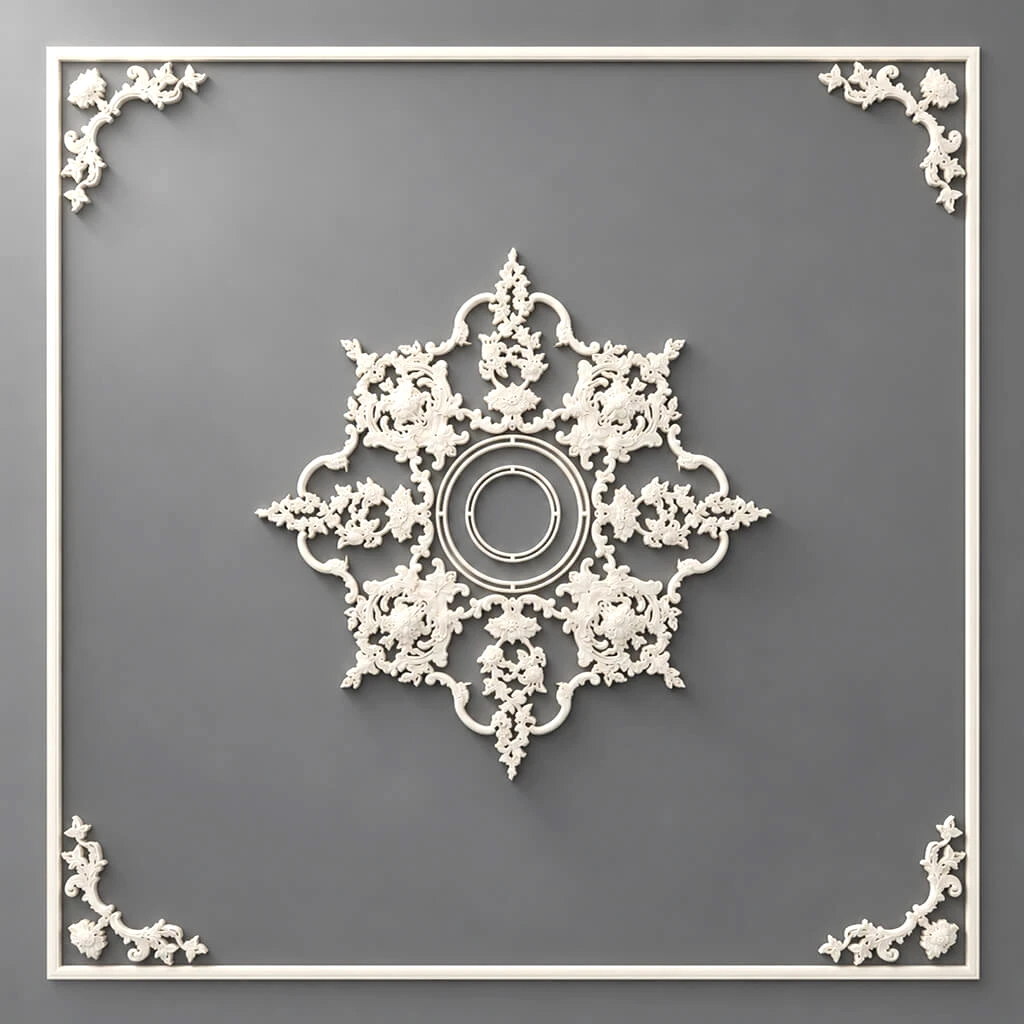
For example, STAVROS offers a CRPU-070 polyurethane ceiling medallion with an overall decorative dimension of approximately 30.12 × 30.12 inches and a relief depth of 0.71 inches.
This is a substantial modular ornament.
It should not be assumed to fit every coffer.
Its dimensions must be compared with the actual available field area.
Coordinate With Lighting Fixtures
A medallion may be positioned around a chandelier when the arrangement permits.
But the chandelier requires independent approved structural and electrical support.
The medallion is decorative.
It must not obstruct the electrical box or other required access.
Consider Smaller Accents
Small polyurethane molding corner details may be appropriate at selected frame corners.
For example, the STAVROS MLDPU-002U decorative corner measures approximately 6.77 × 6.77 inches with a 0.51-inch relief depth.
It is designed for selected molding-frame applications.
However, introducing such corners changes the cutting schedule.
The linear molding lengths must be recalculated to account for the corner components and their exact geometry.
Room-by-Room Faux Ceiling Beam Ideas
The best ceiling composition depends on how the room is used.
Modern Farmhouse Living Room
A modern farmhouse living room can use several parallel faux wood beams.
Natural oak tones create warmth.
White or warm-neutral ceiling paint provides contrast.
The arrangement should relate to the seating area and room geometry.
A heavily ornamented classical molding may not be necessary.
A restrained decorative line may be sufficient.
Traditional Dining Room
A dining room can accommodate a more formal coffered ceiling.
The beam grid may be painted white or warm ivory.
Polyurethane molding frames can create a secondary level of detail.
A central light fixture establishes the focal point.
The ceiling composition should be symmetrical where the room design supports that approach.
Transitional Bedroom
An 8- or 9-foot bedroom may benefit from shallow painted beams rather than a dense coffered grid.
A few understated lines create character without excessive visual weight.
If the room already contains decorative wall frames, a restrained ceiling treatment can reinforce the architecture.
Open-Plan Kitchen and Living Room
One or more ceiling beams may mark the transition between functional zones.
For example, a beam can align with the boundary between the kitchen and living area.
The design can introduce a visual division without constructing a wall.
However, the beam should be positioned according to the overall architectural plan.
It should not interfere with ventilation, lighting, sprinklers where applicable, or access to building services.
Home Office
A home office can use a darker decorative ceiling treatment.
Wood-toned beams or a painted grid may add visual character.
For a traditional study, ornamental molding can provide more detail.
For a contemporary office, simple lines are generally more appropriate.
Rustic Cottage or Cabin
A rustic interior often benefits from an emphasis on wood texture.
Oak-veneered MDF decorative beams may provide an engineered wood-grain option.
However, the finish should be coordinated with the surrounding floors, doors, and furniture.
A very elaborate classical polyurethane ornament may not suit the intended rustic character.
Contemporary Living Room
A modern room may use beams painted the same color as the ceiling.
The resulting texture is subtle.
The beams create shadow lines rather than strong color contrast.
A narrow polyurethane molding may add secondary geometry, but it should not distract from the restrained design.
White Faux Beams vs. Natural Wood Beams
Color influences how strongly the beam grid is perceived.
White-on-White Ceiling
White beams against a white ceiling create relief through shadow.
This can look restrained and architectural.
It works well in transitional and selected coastal interiors.
Dark Beams on a Light Ceiling
Dark wood tones create strong contrast.
The individual beams become prominent.
This is common in rustic, farmhouse, and lodge-inspired interiors.
Natural Oak Finish
Oak veneer can introduce visible wood grain.
The finish may be clear, tinted, or otherwise treated using an appropriate coating system.
Its appearance depends on the actual veneer and finish.
Painted Dark Ceiling
A dark ceiling with beams in a similar color can create an intimate atmosphere.
This may be appropriate for a home office, media room, or formal study.
However, lighting becomes especially important.
Combining Wood and Polyurethane
The finish does not need to be identical across the two materials.
A wood-toned beam may be combined with white polyurethane decorative molding.
The contrast can be intentional.
A monochromatic design is another option, but MDF, oak veneer, polyurethane, and polystyrene may require different surface preparation.
The same paint color does not mean the same coating process is appropriate for every material.
How to Make Faux Wood Beams Look Convincing
A faux beam can look inexpensive when its proportions, joints, or finish are poorly resolved.
The objective is not always to imitate a rough structural timber.
A clean painted decorative beam may be entirely appropriate.
But the intended appearance should be clear from the beginning.
Choose the Correct Scale
A large beam in a small low-ceiling room can dominate the space.
A very narrow beam on a large ceiling may appear insignificant.
Evaluate the dimensions using full-scale markings or a three-dimensional design model.
Keep the Layout Consistent
Parallel beams should generally follow a coherent spacing scheme.
The pattern can be symmetrical or deliberately asymmetrical.
Unintentional spacing differences often appear as installation mistakes.
Plan the End Conditions
Consider where the beam meets a wall.
Some designs use a clean butt termination.
Others may include a decorative end treatment or a concealed transition.
The correct choice depends on the style and product geometry.
Design the Section Joints
Long beam runs may require multiple pieces.
The joint should be visually and mechanically resolved.
A decorative filler is not a substitute for an approved connection or attachment system.
Match the Surface Finish
The finish should suit the desired material impression.
Oak veneer should be treated differently from paint-grade MDF.
A faux timber finish may require additional artistic work.
Can Faux Wood Beams Be Installed on a Drywall Ceiling?
Potentially, yes, but the attachment must transfer the appropriate loads to suitable supporting construction.
The drywall panel alone should not be assumed capable of supporting a decorative beam system.
The mounting method depends on the beam weight, substrate, structural framing, fastening requirements, and local conditions.
Identify the Ceiling Structure
A finished ceiling may conceal wood joists, engineered trusses, steel framing, concrete, or other supporting systems.
Each requires an appropriate attachment method.
Do Not Use Generic Fastener Spacing
A statement such as “install one anchor every 16 inches” is not a complete safe installation specification.
The required anchor type and spacing depend on actual loads, member geometry, substrate strength, and other factors.
The manufacturer and qualified installer should establish the correct system.
Check Concealed Utilities
Before drilling, identify relevant electrical wiring, plumbing, HVAC components, and other concealed services.
Do not assume that the ceiling cavity is empty.
Suspended Ceilings
An ordinary suspended ceiling panel or grid may not be designed to carry decorative beams.
Use a support arrangement approved for the actual ceiling system.
Stretch Ceilings
A stretch ceiling membrane is not a structural substrate.
Decorative beams should not be mounted directly to the membrane as if it were a solid support.
Any beam installation must be coordinated with suitable supporting construction.
Faux Beams and Ceiling Fans: A Critical Clearance Issue
Decorative beams can interfere with ceiling fans.
A fan needs appropriate support and clearance.
The beam may reduce the available space between the blades and surrounding surfaces.
This can affect safe operation.
Support the Fan Independently
The ceiling fan requires an approved fan-rated mounting system.
A decorative U-shaped MDF beam should not be assumed capable of supporting the fan.
Check Blade Clearance
The fan manufacturer's specified clearances must be respected.
These may include minimum blade height above the floor and minimum distances from adjacent walls or other obstructions.
Decorative beam locations should be evaluated before installation.
Avoid Creating a Conflict
A beam grid may place a decorative member directly where the fan blades need clearance.
If so, revise the decorative layout or fixture selection.
Do not try to solve the conflict by treating the decorative beam as a structural support.
LED Lighting With Faux Wood Ceiling Beams
Lighting can make the beam geometry more expressive.
But electrical planning should occur before decorative components are installed.
Recessed Lighting Between Beams
Recessed lights can be positioned within selected ceiling fields.
Their placement should support the room's lighting needs.
The beam grid should not create unintended shadow patterns or interfere with the fixtures.
Linear LED Lighting
Suitable LED systems can create continuous lines of light near or between decorative beams.
The light may emphasize the architectural rhythm.
However, the LEDs should be installed using a compatible mounting system.
Ordinary decorative molding should not automatically be treated as a listed LED channel.
Concealed Lighting
A properly designed ceiling pocket or recess may conceal linear lighting.
The construction must address ventilation, wiring, access, and any required equipment clearances.
Electrical Code Considerations
Electrical equipment and wiring must be installed according to applicable requirements.
Do not conceal ordinary extension cords or unsupported conductors inside a faux beam.
Use properly specified electrical components and installation methods.
Heat
LED systems still produce heat.
A polymer decorative element or MDF beam should not be placed against a heat-producing component unless the complete installation is suitable for the temperature and clearances involved.
Preparing the Ceiling for Decorative Molding
A well-designed layout can still look poor when installed over an unsuitable substrate.
Check Flatness
Ceilings are not always perfectly level.
Substantial irregularities can produce visible gaps between the decorative molding and the ceiling surface.
The installation plan should account for those conditions.
Check the Existing Finish
Loose paint, contamination, and unstable coatings may undermine adhesion.
The substrate should be prepared according to the selected molding and adhesive instructions.
Locate Fixtures and Services
Identify light fixtures, smoke alarms, sprinkler heads where present, vents, and other ceiling components.
The decorative layout must maintain their required clearances and accessibility.
Transfer the Layout
Mark the beam centerlines and molding frame boundaries.
Check that the geometry is square and consistent.
For a coffered ceiling, small accumulated errors can become noticeable when the grid reaches the opposite wall.
Confirm the Finished Appearance
Before installation, review the proposed lines from the normal room viewing positions.
The ceiling may look different from a seated position than it does on a floor plan.
Installation Sequence for a Combined Beam and Molding Ceiling
A coordinated sequence reduces interference between trades and decorative components.
Step 1: Approve the Ceiling Plan
Finalize the number, dimensions, and positions of beams.
Determine which fields receive molding frames.
Coordinate lighting and other ceiling equipment.
Step 2: Inspect the Existing Construction
Identify suitable support locations.
Confirm the ceiling assembly can accept the proposed installation.
Obtain professional design or review where required.
Step 3: Specify the Beam Attachment System
Select mounting materials and methods appropriate to the actual construction.
Do not substitute an arbitrary adhesive or anchor arrangement.
Step 4: Complete Relevant Electrical Preparation
Coordinate the location and installation of lighting, fans, and other fixtures.
Preserve required service access.
Step 5: Prepare the Supporting Ceiling
Repair unsuitable areas.
Prepare surfaces for any adhesive-applied decorative components.
Step 6: Install the Main Beam Assembly
Install the approved supports and decorative beams.
Check the alignment and secure retention.
Resolve section joints using the specified method.
Step 7: Establish the Coffered Field Geometry
Measure the completed clear dimensions between the beams.
Adjust the decorative frame cutting schedule where necessary.
Step 8: Cut the Polyurethane Molding
Prepare the required molding pieces.
Verify corner dimensions and miter orientation.
Dry-fit representative sections.
Step 9: Install the Decorative Molding
Use the installation system specified for the product and substrate.
Follow the adhesive manufacturer's instructions.
Overhead installation may require temporary support during curing or additional measures specified by the design.
Step 10: Install Optional Decorative Details
Add approved corner accents or ceiling ornaments.
Check that they do not interfere with lighting, electrical boxes, or necessary access.
Step 11: Finish the Surfaces
Complete compatible joint treatment, priming where required, and finish coating.
Different materials may require different preparation.
Step 12: Inspect the Complete Assembly
Verify the beam attachment, decorative component retention, joint condition, and fixture clearances.
Resolve defects before the room is returned to normal use.
How to Paint MDF Beams and Polyurethane Molding the Same Color
A monochromatic ceiling can be particularly attractive in transitional and neoclassical interiors.
The objective is to create one visual surface from several different materials.
However, MDF, polyurethane, and high-density polystyrene may need different preparation.
Paint-Grade MDF
MDF often requires suitable sealing or priming, particularly on machined surfaces and edges.
The finish system should be selected for the specific MDF product.
Polyurethane Molding
Some polyurethane moldings are supplied with a prepared or primed surface.
Others may require additional preparation.
Follow the molding and coating manufacturers' recommendations.
High-Density Polystyrene Crown
A HIWOOD polystyrene cornice has different chemical compatibility requirements from MDF or polyurethane.
Avoid coatings containing solvents that are incompatible with the specific product.
Match Color and Sheen
Using the same paint color does not guarantee an identical appearance.
Different materials may absorb or reflect light differently.
A finish sample can reveal those differences.
Paint Before or After Installation?
The correct sequence depends on the product and project.
Some components may benefit from preliminary finishing before installation.
Others should be finished after the joints are completed.
A coordinated plan is usually preferable to deciding separately at each stage.
How to Create a Traditional Coffered Ceiling Without Overdecorating It
A traditional ceiling may use several layers of architectural detail.
But the strongest design is not always the one with the most ornament.
A balanced composition has a clear hierarchy.
First Layer: Main Beam Grid
The beams establish the geometry.
This is the largest architectural element.
Second Layer: Decorative Panel Frames
Polyurethane moldings may define the individual fields.
The molding profile should remain subordinate to the main beams.
Third Layer: Ceiling Perimeter
A compatible crown molding may establish the transition to the walls.
It should not visually compete with the beam grid unless the design intentionally calls for a more elaborate ceiling.
Fourth Layer: Ornamental Accents
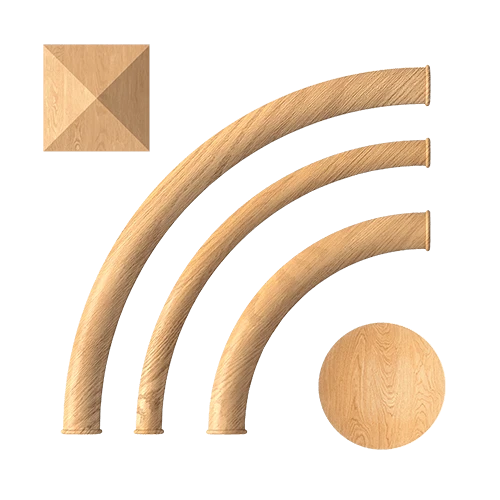
A central medallion, corner element, or another decorative applique may create a focal point.
Not every field requires one.
Final Layer: Lighting
The lighting should reveal the intended architectural character.
It should not produce uncontrolled glare or excessive shadow contrast.
The final result should feel cohesive from the normal viewing distance.
Common Faux Ceiling Beam Mistakes
Choosing Beams Before Measuring the Room
The beam size and number should respond to the actual ceiling geometry.
An unsuitable profile can overwhelm the room.
Ignoring the Beam's Projection
A 4-inch beam reduces the physical clearance directly beneath it by approximately 4 inches.
This matters particularly in rooms with 8-foot ceilings.
Using Arbitrary Beam Spacing
Spacing should follow a defined layout.
A grid that looks symmetrical on paper may require adjustment around lighting or other existing conditions.
Forgetting the Room Perimeter
The outer fields are part of the composition.
A coffered ceiling layout should account for the spaces between the outer beams and the walls.
Confusing MDF Beams With Polyurethane Beams
The STAVROS BL-001 is an MDF-based decorative beam.
Its oak-veneered option remains an engineered MDF product.
It should not be described as molded polyurethane.
Treating Polyurethane Molding as a Support
Decorative molding does not replace approved beam attachment, ceiling framing, or fixture support.
Mounting Beams Into Drywall Alone
The attachment must be appropriate to the supporting construction.
A drywall surface does not automatically provide adequate capacity.
Forgetting Ceiling Fan Clearances
Beam positions should be coordinated with the actual fan specifications.
Overcomplicating the Coffers
A large number of decorative frames, corner ornaments, and central appliques may create a crowded appearance.
A simpler composition can be more effective.
Ordering From Linear Footage Alone
The stock lengths and required cut pieces determine the actual purchase quantity.
A detailed cut list is essential.
Assuming All Crown Moldings Are Polyurethane
STAVROS HIWOOD crown moldings are polystyrene products.
Their material and installation requirements should be identified correctly.
Mixing Incompatible Finishes
A single ceiling may combine several substrates.
Use a compatible finishing system for each.
Ignoring Shipping and Packaging
Long decorative products may require special packaging and freight arrangements.
For imported materials, those costs may affect the overall project budget.
What Does a Faux Wood Beam Ceiling Cost?
The total cost depends on the design.
A simple parallel-beam ceiling may require fewer components than a detailed coffered ceiling.
The material price is only one part of the estimate.
Decorative Beam Cost
Determine the required BL-001 quantity and selected material finish.
An MDF beam and an oak-veneered MDF beam may have different prices.
Polyurethane Molding Cost
Calculate the exact stock-strip quantity.
Do not estimate solely from installed footage.
Optional Crown Molding
If the design includes a perimeter crown, calculate it separately.
The product may use a different material and stock length.
Supporting Construction
Beam attachment, backing, framing, and any required engineering are separate cost items.
Installation Labor
Labor depends on the substrate, number of beam sections, intersections, joints, and decorative details.
Finishing
Painting, staining, glazing, and joint treatment may materially affect the final price.
Electrical Work
Lighting installation, wiring, and fixture relocation are additional considerations.
Freight and Import Costs
For U.S. buyers, confirmed shipping and import-related charges should be included in the final estimate.
Project Cost Formula
A practical estimate can be structured as:
Total ceiling project cost = decorative materials + supporting construction + installation labor + finishing + electrical work + delivery and applicable import costs + contingency
No fixed percentage saving can be guaranteed by choosing MDF beams or polyurethane molding.
The correct comparison depends on fully specified alternatives.
Buying Faux Wood Ceiling Beams and Polyurethane Trim From STAVROS
For American designers and contractors, the purchasing process should begin with exact product specifications.
The STAVROS English-language catalog provides dimensions in inches and displays prices in U.S. dollars.
However, published delivery information primarily describes Russia and certain neighboring markets.
Customers purchasing for the United States should confirm international delivery availability, freight costs, customs responsibilities, lead times, and payment terms directly before ordering.
A USD price does not establish domestic U.S. inventory.
Decorative Beam Specification
For BL-001, verify:
Exact SKU
MDF or MDF with oak veneer
Cross-sectional dimensions
Stock length
Required quantity
Surface finish
Technical installation information
Polyurethane Molding Specification
For the MLDPU profiles, record:
Exact SKU
Face width
Projection
Stock length
Required cut pieces
Full-strip quantity
Approved installation and finish system
Crown Molding Specification
For HIWOOD products, confirm the actual profile section and stock length.
Do not rely only on the catalog's nominal profile width.
Review the cross-sectional drawing.
Corner and Ornament Compatibility
Decorative corner pieces may be designed for particular molding series.
Verify compatibility before ordering.
Samples
For a substantial ceiling renovation, physical samples can help establish scale and finishing requirements.
This is especially valuable when combining wood veneer, polyurethane, and polystyrene.
Frequently Asked Questions About Faux Wood Ceiling Beams
What Are Faux Wood Ceiling Beams?
Faux wood ceiling beams are decorative elements designed to resemble exposed architectural beams. They may be made from polyurethane, MDF, veneered wood products, or other suitable materials.
Are Faux Ceiling Beams Structural?
Generally, decorative faux beams are not intended to carry structural building loads. Their supporting installation must still be appropriately designed.
Can Polyurethane Molding Be Combined With Wood Ceiling Beams?
Yes. Polyurethane molding may be used as a nonstructural decorative element in a suitable ceiling composition that includes wood or MDF beams.
Is STAVROS BL-001 Made From Polyurethane?
No. STAVROS BL-001 is an MDF-based decorative faux beam. It is available in MDF and MDF with oak veneer.
What Is the Length of STAVROS BL-001?
The listed stock length is approximately 108.27 inches, or about 9.02 feet.
How Do You Calculate Faux Beam Spacing?
Establish a layout based on room dimensions, beam width, desired number of beams, and required fixture clearances. Use centerlines to create a consistent arrangement.
How Far Apart Should Faux Wood Ceiling Beams Be?
There is no universal spacing. The correct distance depends on the room and design. A large room may benefit from a few widely spaced beams, while a coffered ceiling uses a more structured grid.
Can You Install Faux Beams on an 8-Foot Ceiling?
Yes, in suitable applications. However, beam projection reduces overhead clearance and should be evaluated against room proportions, lighting, fans, and applicable requirements.
What Is a Faux Coffered Ceiling?
A faux coffered ceiling uses applied decorative beams, panels, or moldings to create the appearance of recessed architectural fields.
How Many Coffers Can Two Beams in Each Direction Create?
If the two beams in each direction divide a rectangular ceiling into three fields per axis, the arrangement creates nine fields in total.
What Is the Best Polyurethane Molding for a Coffered Ceiling?
The choice depends on scale and style. Narrow profiles such as STAVROS MLDPU-001 or MLDPU-004 may suit restrained designs, while MLDPU-002 or MLDPU-003 can create more pronounced architectural relief.
Does a Faux Beam Ceiling Need Crown Molding?
No. Crown molding is optional. Some traditional ceilings benefit from a defined perimeter, while modern and rustic interiors may look better without it.
Can You Use Polyurethane Crown Molding With MDF Faux Beams?
Potentially, yes, if the products and installation are compatible. However, the STAVROS HIWOOD crown moldings discussed in this guide are made from polystyrene, not polyurethane.
Can Faux Beams Support a Ceiling Fan?
Do not assume so. A ceiling fan requires an approved mounting and electrical support system. Decorative beams should not be used as substitutes.
Can You Hide LED Lighting Inside Faux Beams?
Certain decorative beam systems may accommodate appropriately designed concealed lighting. Wiring, fixtures, heat, and service access must comply with the selected system and applicable requirements.
Can Faux Beams Be Installed Directly on Drywall?
Not without verifying a suitable attachment system. The decorative beam loads must be transferred to appropriate supporting construction.
Can Faux Beams Be Installed on a Stretch Ceiling?
A stretch ceiling membrane is not a structural support. Any beam installation must be coordinated with approved underlying supporting construction.
Is Oak-Veneered MDF the Same as Solid Oak?
No. Oak-veneered MDF uses a decorative oak facing over an engineered MDF base. It is not a solid oak timber.
Can You Paint MDF Beams and Polyurethane Molding the Same Color?
Yes, with compatible preparation and coating systems for each material. Samples are useful for evaluating color and sheen consistency.
How Much Polyurethane Molding Do You Need for Nine Coffers?
It depends on the field dimensions and molding layout. In the illustrated 16 × 12-foot room, nine interior frames require 130 installed linear feet and a feasible base cut schedule of 18 STAVROS MLDPU-002 stock strips.
Where Can I Buy Decorative Ceiling Beams and Polyurethane Trim?
Explore the STAVROS BL-001 MDF false beam, polyurethane molding catalog, decorative molding accents, and crown molding collection.
Confirm the exact materials, technical information, availability, and delivery terms before ordering.
Final Thoughts: Design the Ceiling as One Architectural System
A successful decorative beam ceiling begins with proportion.
The beams establish the principal geometry.
Their width and spacing should relate to the dimensions of the room.
The ceiling height determines the available projection and influences the perceived scale.
Polyurethane molding can add secondary architectural lines between beams.
Crown molding may define the perimeter.
Selected ornaments can introduce focal points.
The finish brings the separate materials into a coherent composition.
But the design must also be practical.
A faux beam is not automatically structural.
A decorative polyurethane molding is not an overhead support.
Electrical fixtures require approved installation.
And the material quantity should be determined from a real cutting schedule rather than a rough estimate.
The 16 × 12-foot project demonstrates how these principles come together.
A nine-field decorative ceiling can be planned using seven BL-001 stock beams for the illustrated beam layout and eighteen MLDPU-002 strips for the corresponding decorative frames.
An optional HIWOOD polystyrene crown molding creates a separate perimeter specification.
Each quantity comes from the actual layout and stock lengths.
That is the difference between a general decorative idea and a usable project specification.
STAVROS offers MDF decorative false beams, polyurethane architectural molding, ornamental molding details, and ceiling decoration products for creating coordinated interior compositions.
For an American home, the best approach is to select the architectural concept first.
Measure the ceiling.
Establish the beam grid.
Review the overhead support and fixture clearances.
Choose the decorative profiles.
Prepare the complete material takeoff.
Confirm product and installation compatibility.
Then finish the ceiling as one deliberate design.
The most convincing faux wood ceiling is not the one with the most beams or ornament. It is the one in which geometry, materials, light, and construction work together to create an architectural result that belongs in the room.