









































































Article Contents:
- What is decorating doors with ready-made elements: defining the concepts
- What is included in decorating doors with ready-made elements
- When you don't need to replace the door: five scenarios for decor
- Scenario 1. The door is in good condition but boring
- Scenario 2. The interior has changed, but the door hasn't
- Scenario 3. Need to visually "raise" the door
- Scenario 4. A portal without architectural framing
- Scenario 5. Restoring an old door
- Which elements are suitable for door decor: a complete overview
- Wooden overlays: relief where there was none
- Moldings: geometry as decor
- Carved decor: when expressiveness is needed
- Capitals for a door portal
- Pilasters: an architectural portal at the door
- Door leaf decor: strategy for selection and arrangement
- Frame composition
- Vertical division
- Horizontal division
- Central vertical axis
- Corner accent scheme
- Door moldings: how to work with them correctly
- Profile principle
- Angle cut principle
- Offset principle
- Sequence principle
- Profile unity principle
- Carved door overlays: when and how it works
- Classic Interior
- Office and Library
- Country house
- Solid wood interior doors
- What not to decorate with carving
- Door portal decor: the space around the door as part of the design
- Trim with profile
- Pilasters on the sides of an opening
- Keystone
- Horizontal cornice above the opening
- How to choose door decor to match your interior style
- Classicism and Baroque
- Neoclassicism
- Modern classicism
- Art Deco
- Art of installation: installing trims
- Country classic
- Compatibility of door decor with other interior elements
- Door decor and furniture
- Door decor and staircase
- Door decor and wall moldings
- Door handles and decor
- Door decor material: what to choose and why
- Oak
- Linden
- Oak
- MDF with or without veneer
- Errors when choosing and installing door decor
- Installing decor on a door: basic principles
- FAQ: answers to main questions about door decor
- STAVROS: decor that transforms a door

A door is a boundary. It separates one space from another, one rhythm of life from another. And that is why a door in an interior carries a double load: functional and visual. It is impossible to pass by a beautiful door — the gaze lingers, registers details, reads the level.
The problem is that most interior doors in residential interiors are flat panels without character. A smooth surface, neutral color, standard architraves. Such a door is not bad — it is simply nondescript. And when the interior around it begins to acquire a classic, neoclassical, or any other distinct character, the door falls out of the image.
The solution is not always replacement. Often, competent door decor with ready-made elements is enough: overlays, moldings, carved details, rosettes, portal decor. That is what this article is about.

What is door decor with ready-made elements: defining the concepts
Door decor is a broad concept. It includes painting, film wrapping, and replacing the panel. But here we are talking about something else — about ready-made decorative wooden elements that are attached to an existing door and change its appearance.
This is a commercial, not a DIY approach. Not "take a strip from a hardware store and glue it on." But "choose a ready-made decorative element of the desired profile, size, and style — and install it so that the door becomes part of a well-thought-out interior."




What is included in door decor with ready-made elements
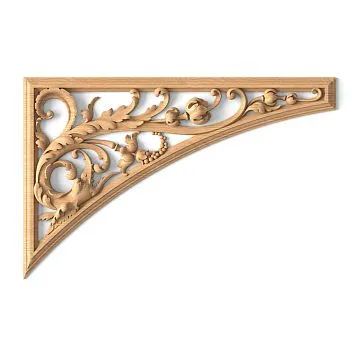
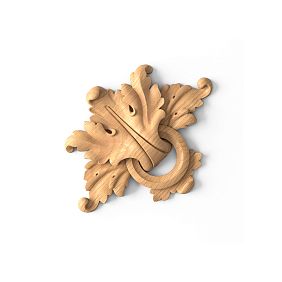
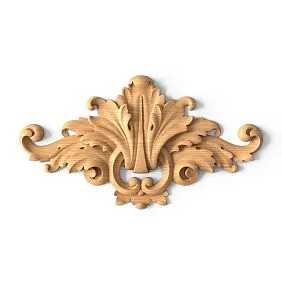
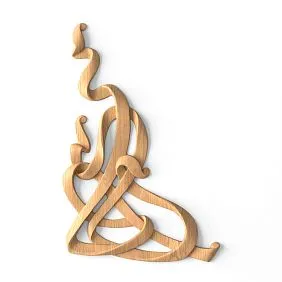
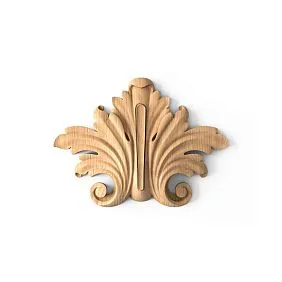
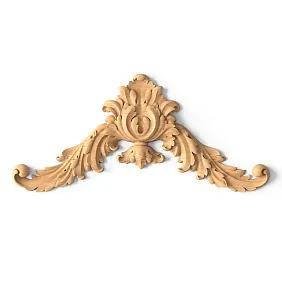
Wooden overlays. Ready-made three-dimensional elements that are glued or attached to the surface of the door leaf: corner decors, central rosettes, ornamental inserts. They create relief and visual depth on a flat surface.
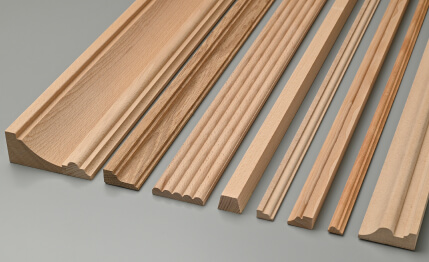
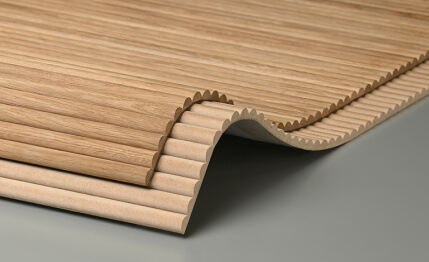
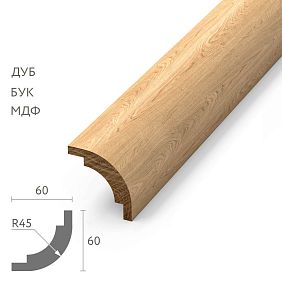
Wooden moldings. Profile wooden strips that form frames, divide the leaf into zones, and create geometric structures. Molding is the most versatile and affordable tool for decorating a door.
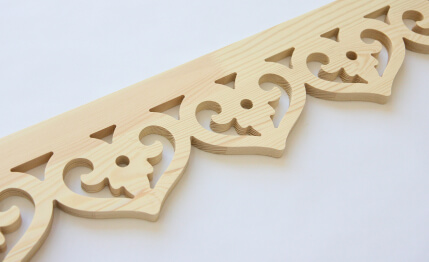
Carved wooden decoration. More complex ornamental elements: rosettes with leaf or floral motifs, rocailles, acanthus leaves, friezes with repeating patterns. For classic and baroque interiors in the high price segment.
Capitals. Decorative crowning elements for pilasters or columns on the sides of the door portal. Used when designing the entrance to formal rooms, offices, living rooms.
pilasters and columns. Flat or three-dimensional architectural elements for designing the door portal: side posts with a decorative profile, creating an architectural image of the entrance opening.
Corner and center compositions. Ready-made sets of decorative elements that form a symmetrical composition on the door leaf.
Our factory also produces:


When you don't need to replace the door: five scenarios for decor
Replacing interior doors involves dismantling the frame, puttying the slopes, new architraves, and painting. This costs money, time, and creates mess. In many cases, this can be avoided.
Get Consultation
Scenario 1. The door is in good condition but boring
The leaf is intact, hinges work, geometry is not compromised — the door is just unexpressive. A flat surface without character. Moldings in the form of rectangular frames glued to the leaf completely change its appearance in a few hours of work.
Scenario 2. The interior has changed, but the door hasn't
You renovated in a classic style: stucco, parquet, classic furniture. But the doors remained from the previous renovation — smooth, neutral. Classic-style overlay door decor brings it back into the context of the interior without replacing the leaf.
Scenario 3. You need to visually 'raise' the door
In rooms with high ceilings (3+ meters), a standard door 2 meters high looks squat. A vertical composition of moldings and overlays on the leaf visually stretches the door upward — without physically changing its size.
Scenario 4. Portal without architectural framing
There is a doorway, the architraves are in place — but the entrance area to the living room, study, or grand hall looks like just a "hole in the wall." Portal decor — pilasters, Capitals, a keystone, a cornice above the opening — creates an architectural accent without construction work.
Scenario 5. Restoration of an old door
Old wooden doors are often a good base: solid wood, thickness, quality. But the decor is worn, the profile is erased, the appearance is untidy. New overlay elements applied to the prepared surface give the old door a new life.
Which elements are suitable for door decor: a complete overview
Wooden overlays: relief where there was none
Wooden Inlays — это объёмные элементы, которые крепятся непосредственно на поверхность дверного полотна. Их задача: создать рельеф, акцент, декоративную ось на плоской поверхности.
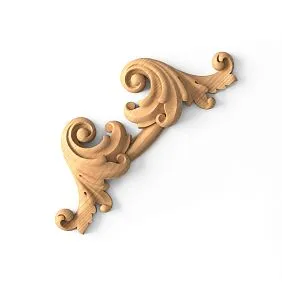
Corner overlays. Symmetrical elements for the four corners of the door leaf or the area inside a molding frame. Most often — leaf ornament, rocaille, geometric pattern. They create a frame effect, visually highlight areas of the leaf.
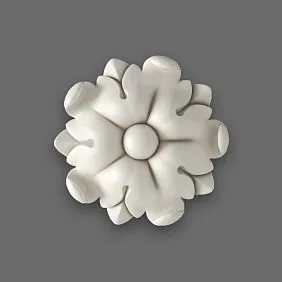
Central rosettes. Round or oval decorative elements for the center of the door leaf. They work as an independent accent or in combination with a molding frame. Diameter: from 60 to 200 mm depending on the door size.
Horizontal inserts (friezes). Decorative strips for horizontal division of the panel: between the upper and lower zones of the door. They create a visual "belt" across the width of the panel.
Vertical overlay elements. For decorating the vertical axes of the panel: "columns" of overlay elements on both sides of the central zone.
Moldings: geometry as decor
Moldings — is the basis of any frame composition on a door. A profile strip glued along the perimeter of the zone instantly creates a classic frame with shadow and relief.
Types of molding profiles for doors:
-
Ogee (cyma): S-shaped profile, classic architectural. For doors in a classic style.
-
Quarter round: convex semicircle. Soft, neutral. For neoclassical and modern classic.
-
Straight with chamfer: strict angular profile. For geometric decors, art deco, modern classic.
-
Double chamfer: enhanced accent — for frames that should be clearly readable from a distance.
-
Reverse ogee (heel): for lower horizontal frame elements.
Carved decor: when expressiveness is needed
Carved Decor — these are milled or hand-finished elements with ornamental patterns. Acanthus, leaf garlands, floral rosettes, woven ornament, rocaille. Used as accent overlays on the upper part of the door, at the corners, or in the central area of the panel.
Carved decor on a door is a level. It is something that is instantly "read" as handwork, as an expensive solution, as a conscious choice. Even on a painted door, a small carved rosette at the top of the panel changes the perception of the entire door.
Capitals for a door portal
Wooden capitals — crowning elements for the side pilasters of a door portal. In classical architecture, the capital completes the column, creating a transition to the horizontal ceiling. In the interior, a capital above the side pilaster at the door creates an architectural image of the entrance to the room.
Capital styles: Ionic (volutes), Corinthian (acanthus), Tuscan (simple abacus), decorative (neoclassical interpretations without strict order).
Pilasters: architectural portal at the door
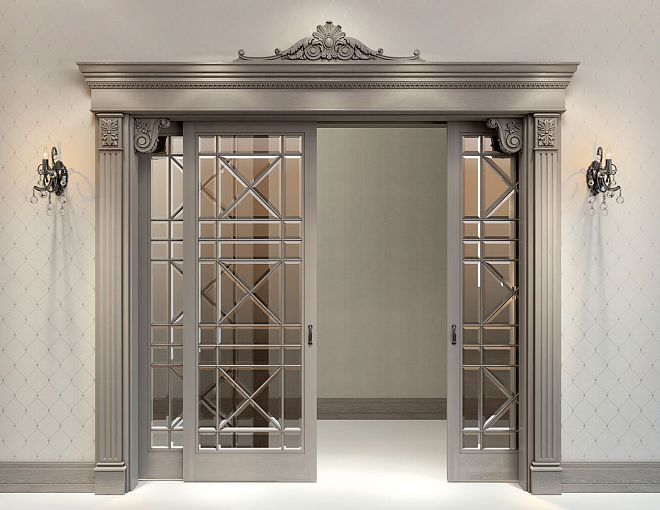
pilasters and columns — flat or three-dimensional vertical elements on the sides of the doorway. They create an architectural "portal": the door ceases to be just an opening in the wall and becomes a designed entrance.
Application: entrances to the living room, study, library, formal hall. Pilaster + capital + horizontal cornice above the opening = a full-fledged door portal in a classic style.
Door panel decor: strategy for selection and arrangement
A flat door leaf is a blank canvas. The key strategy here is not to "add something beautiful," but to build a visual system.
Frame composition
The most common and foolproof technique. Molding is laid along the perimeter of the leaf (indented 50–80 mm from the edge) — and a frame with shadow and relief appears on the flat door. Inside the frame, the leaf looks like a "field" — it can be empty or have added central decor.
Double frame: two rows of molding with a 20–30 mm gap between them. Creates a richer relief and reads as a "double frame" — a characteristic technique for neoclassicism.
Vertical division
The leaf is divided into two or three vertical "fields" by moldings or applied stiles. Each field is its own frame. This technique makes the door "multi-panel" — like a classic solid wood door with real panels. The effect is achieved without changing the leaf.
Horizontal division
The leaf is divided by a horizontal molding into upper and lower zones. The upper zone is smaller (usually 30–35% of the height), the lower zone is larger. In the upper zone — a frame with a decorative central element. In the lower zone — a frame without ornament or a simple molding. This is the classic scheme of a paneled door.
Central vertical axis
One large decorative element along the vertical axis of the leaf: at the top — a carved rosette or corner decor, in the center — a vertical ornamental frieze, at the bottom — an element mirroring the top one. Creates a symmetrical vertical composition without frames.
Corner accent scheme
Four corner decorations of the same size and pattern, installed symmetrically at the corners of the panel (indentation from each corner 80–120 mm). A minimalist but expressive technique. Works well without additional moldings.
Moldings for doors: how to work with them correctly
Molding is a tool. You can create a masterpiece with it, or you can pile up chaos. The difference lies in understanding a few principles.
Profile principle
The molding profile should match the scale of the door and the character of the interior. For a standard door 2 m high — molding width 20–40 mm. For a door 2.5 m high and above — 40–60 mm. Too thin molding on a high door gets lost. Too wide on a narrow panel — overloads.
Angle cut principle
Molding at the corners of the frame is cut at 45°. This is a basic requirement. Having a miter box or miter saw is a must for a neat result. A gap in the corner or a crookedly cut joint is what is noticed first.
Indentation principle
The indentation of the molding from the edge of the panel should be uniform on all four sides. Measurement is mandatory. Visual "fitting" without a ruler creates asymmetry that the eye catches instantly.
Sequence principle
First horizontal moldings, then vertical ones — or vice versa, but always sequentially. Random installation without a system creates misaligned corners.
Principle of profile unity
All moldings on one door must be of the same profile. Mixing "ogee" with "straight chamfer" on a single panel is a mistake. Exception: a deliberate two-profile frame where the outer and inner strips have different profiles — but this requires precise calculation and verified compatibility.
Carved overlays for doors: when and how it works
Carved Decor on a door — it's not for all interiors and not for all doors. But where it is appropriate, it works flawlessly.
Classic interior
Doors in a classic interior — with stucco, parquet, classic furniture — must match the level. A carved rosette in the upper part of the door leaf, corner overlays with leaf ornament, a frame made of profile molding — and the door becomes a full-fledged part of the interior, not a neutral "background."
Office and library
A study is a room decorated with special attention to detail. A door to a study with carved decor on the upper part of the panel and a portal with pilasters and capitals is an architectural statement. This is the seriousness and character of the room expressed in material.
Country house
In a country house with wooden interiors, carved decor on doors is organic. It doesn't look "superfluous" because wood is everywhere: in beams, in the floor, in the staircase. Here it is a continuation of the theme.
Solid wood interior doors
A solid wood door leaf with added carved elements is no longer "just a door," but an item made with care. Especially if the decor is coordinated with carved stair balusters or furniture overlays in adjacent rooms.
What should not be decorated with carving
Doors in bathrooms (humidity), minimalist or high-tech doors, doors with leather or fabric upholstery (mixing materials), very narrow doors (less than 60 cm wide) — carved decor overloads the space there.
Decor of the door portal: the space around the door as part of the concept
A door portal is not just the leaf. It is the area around the door: slopes, architraves, the space between the opening and the ceiling, side walls near the entrance.
Architraves with profile
Standard flat architraves are replaced or supplemented with profiled ones. An architrave with a molding profile like "goose neck" or "quarter round" already creates a classic look, even without additional decor on the leaf.
Pilasters on the sides of the opening
pilasters — flat vertical elements 80–150 mm wide, attached to the wall on the sides of the doorway. They create the feeling of an architectural "frame" — as if the entrance is framed by columns.
A pilaster consists of: a base (lower element), a shaft (vertical part with a profile) and Capitals (upper crowning element). The entire system is attached to the wall using liquid nails and dowels.
Keystone
Decorative element at the top of a door arched or straight opening — keystone or central insert above the horizontal casing. Creates an architectural accent above the entrance.
Horizontal cornice above the opening
Wooden cornice made of profile molding, installed horizontally above the door opening — connects pilasters and creates an "entablature" (horizontal completion of an architectural portal).
The "pilasters + capitals + horizontal cornice" system is a full-fledged classical portal that can be created in one day of installation without construction work.
How to choose door decor to match interior style
Door decor should be part of the interior — not a separate "decoration." If chosen out of context, it will look random.
Classical and Baroque
Carved rosettes, corner overlays with leaf ornament, moldings with a "goose neck" profile, Capitals Corinthian or Ionic style, pilasters with developed relief. Toning: dark walnut, patina, white enamel with gilding.
Neoclassicism
Geometric frames made of molding with a "straight with chamfer" profile, small central rosettes without complex ornament, pilasters with Tuscan capital. Coating: white enamel or neutral toning.
Modern classic
Single or double frame made of molding. No carved ornaments — only geometry. Coating: white or cream matte enamel.
Art Deco
Geometric overlays with angular accents, double-beveled moldings, strict symmetry. Tinting: dark wood contrasting with the wall color.
Country and Provence
Turned overlay elements with soft ornamentation, moldings with a quarter-round profile, natural tinting or white enamel with a slight aged effect.
Country classic
Carved Decor with a floral motif, wooden architraves with a profile, natural tinting or oil. The decor is embedded in the overall wooden theme of the interior.
Compatibility of door decor with other interior elements
Door decor does not exist in isolation. It must be coordinated with everything around it.
Door decor and furniture
If the room has classic furniture with decorative inlays on the facades, the door decor should be in the same ornamental language. Leaf ornament on furniture + leaf ornament on door decor = system. Furniture ornament + geometric door decor = mismatch.
Door decor and staircase
If the house has a staircase with carved balusters or decorative details, the tone of the door decor should match the staircase. The same carved motif, the same tinting — and the house begins to "sound" as a single piece.
Door decor and wall moldings
If the interior has ceiling stucco, cornices, wall moldings — the door decor should correspond to them. Door moldings and wall moldings — from the same profile, in the same tinting.
Handles and door decor
Wooden door handles — another part of the system. A wooden handle matching the tint of the door decor = completeness of the image. A chrome metal handle + dark wooden decor = stylistic break (unless it's a deliberate contrast).
Door decor material: what to choose and why
Ready-made wooden door decor is made from several types of wood. Each has its own logic of application.
Beech
Dense, fine-porous, accepts any coating evenly. Best choice for decor under enamel or stain. Carved beech ornament yields good detail clarity. Price: average.
Linden
Softer than beech, but easy to cut. Linden carved decor has a more "handcrafted" character. For complex ornamental motifs with fine details: floral garlands, thin leaves. Price: below beech.
Oak
Expressive texture, high hardness. For decor under clear varnish or light tinting, where the "living" wood grain is important.
MDF with or without veneer
A cheaper option. For overlays under white paint — acceptable. For carved decor with fine details — less preferable: sharp edges of the ornament chip faster upon impact than solid wood.
Mistakes when choosing and installing door decor
Most mistakes are made at the selection stage — before purchase. Fixing them after installation is much more difficult.
Too large decor for a narrow door panel. A central rosette with a diameter of 200 mm on a door 700 mm wide — overloads. Proportion: the decorative element should not occupy more than 25–30% of the width or height of the area where it is installed.
Mixing different ornaments. Corner overlays with leaf ornament + central rosette with geometric motif + frieze with rocaille — three different "languages" on one door. Result: decorative chaos.
Decor without considering the door color. Warm-toned wooden decor on a cold gray door — dissonance. Before purchase: apply the desired coating to a decor sample, compare with the panel.
They forget about the handle. The handle is part of the door's image. After installing decor, the old metal handle may clash with the new look. Consider replacing it with wooden handle one in the same tint.
They overload the door with carving. Carved decor works as an accent—it should 'breathe.' Three to four ornamental elements on one panel is the maximum for a standard door 2×0.8 m.
They don't account for the panel thickness. The molding is attached to the surface—its thickness adds to the overall panel thickness in the area of the casing and hinge. Ensure the decor protrusion does not interfere with the operation of hinges and lock.
They install without primer. Liquid nails on bare wood is worse than on a primed surface. Before installation: lightly sand both sides (the panel and the back of the overlay) with P120 and prime. Adhesion is significantly better.
They don't secure the molding until the glue dries. Molding on glue 'drifts'—it shifts from vertical load until the glue sets. Temporary fixation is needed: painter's tape, clamp, or pins.
They buy decor 'by eye.' Without measurements, without a layout diagram, without considering distances—the result is unpredictable. First, make a sketch on paper to scale, then purchase.
They ignore the casings. Panel decor and old standard casings are like a new dress and worn-out shoes. The door decor and casings should be in the same style system.
Installing decor on a door: basic principles
This is not a construction article, but the basic installation principles are important for understanding the scope of work and surface requirements.
Surface preparation. The door leaf must be clean and degreased. If the leaf has a lacquer coating, the attachment area is sanded with P120–P180 sandpaper to create adhesive roughness.
Adhesive. Liquid nails (acrylic or polyurethane) — the primary fastener for overlay wooden elements. Apply in a zigzag pattern on the back side of the overlay. After pressing, temporarily fix for 20–30 minutes.
Additional fastening. For moldings longer than 500 mm and carved overlays weighing more than 300 g — additional finishing nails with a diameter of 1.6–1.8 mm. The head is countersunk, and the hole is filled with wood putty.
Coating. After installation, all elements are coated in a single cycle with the leaf: sanding joints, priming, finishing coat (enamel, varnish, stain + varnish).
FAQ: answers to the main questions about door decor
What can be used to decorate an interior door?
Ready-made wooden elements: overlay panels, moldings, carved decoration. Also — pilasters и capitals for portal design.
What is better for door decor: moldings or overlays?
Different tasks. Moldings create geometric frames and divisions. Overlays create point decorative accents: rosettes, corner elements, ornamental inserts. The best result is a combination of both.
Can a door be updated without replacing the panel?
Yes. Decorative overlay elements are mounted on the existing panel. Door replacement is not necessary provided the panel geometry is not compromised and the surface is in good condition.
Which decorative elements are suitable for a classic door?
Moldings with an ogee or quarter-round profile, carved rosettes and corner overlays with leaf ornamentation, pilasters with Corinthian or Ionic capitals.
Is wooden decor suitable for a door to be painted?
Yes. Beech is the best material for decor under enamel: it accepts the coating evenly, without pores. Scheme: sanding P180 → primer → finish enamel in 2 coats.
How to choose the size of an overlay for a door panel?
The decorative element should not occupy more than 25–30% of the width of the corresponding panel zone. For a standard door 2.0×0.8 m: central rosette — no more than 200 mm, corner elements — no more than 120×120 mm.
Can door decor be combined with architraves?
Not just possible — necessary. Casing with profile molding + door leaf decor + Wooden Handle in tone = a complete door look.
How not to overload a door with carved decor?
Rule: one main accent + supporting elements. For example, a central carved rosette in the upper zone + four corner overlays. Everything else — moldings, without additional ornament.
What to choose for door portal decor?
pilasters on the sides of the opening + Capitals on them + a horizontal cornice above the opening. This creates an architectural portal without construction work.
Where to buy ready-made door decor?
In the Stavros catalog — applique, Moldings, Carved Decor, Capitals, pilasters. Delivery across Russia.
STAVROS: decor that transforms the door
A door is not just a passage from one room to another. It is a point where the interior is tested for consistency: how well each element is thought out, how details are coordinated, how the space looks like a cohesive piece, not a collection of randomly purchased items.
Ready-made door decor is a tool of this sequence. A properly chosen molding, a carved rosette in the right scale, pilasters at the portal coordinated with the furniture and staircase — and the door ceases to be a background and becomes an accent.
STAVROS offers a full range wooden decorative elements for doors: overlays and carved decor, Moldings, Capitals, pilasters и Wooden handles — made of solid wood, with and without coating, for any style and any project scale.
STAVROS — because a good door starts with the right details.