

























Article Contents:
- First, let's separate the visual image from the construction
- What you get when ordering MN-105
- Why MN-105 can look "metallic" while remaining wood
- Black color enhances the geometry
- A matte surface is calmer than a glossy one
- Graphite is softer than pure black
- Enamel hides the grain, but not the origin
- The table is built on four separate supports
- Need a single material matching other furniture
- The ability to change color is important
- Need a more 'furniture-like', not industrial character
- The tabletop is wooden
- Thin steel profile is part of the design
- The underframe must be unified
- The tabletop is heavy and the project is designed for metal
- The metal texture is specifically needed
- Furniture is designed for demanding conditions
- Beech: practical logic for opaque finishes
- Oak: when texture matters
- All legs of one table — same specification
- Why 30 mm cannot be substituted automatically
- What to measure before ordering
- Square tabletop
- Rectangular
- Round
- Oval
- Shaped
- Should you buy a spare leg
- FUR-001: stud and threaded insert
- FUR-012: mounting plate and stud
- Why you shouldn't put both sets in the cart "just in case"
- Modern minimalism
- Soft neoclassicism
- Art Deco
- Jatoba
- Loft
- Why one wood species is not enough
- Why it's better to paint the entire set with one system
- Black next to white
- Black next to natural oak
- Graphite next to gray stone
- For a compact table next to an armchair
- For a central coffee table
- For a long narrow table
- For a heavy decorative countertop
- Look not only at the color of the photo
- Read the category name
- Check the product unit
- Verify the mounting diagram
- Do not use the word "metal" in order MN-105
- Mistake 1. Considering MN-105 metal because of the search query
- Mistake 2. Confusing black color with material
- Mistake 3. Considering 430 mm as the height of the finished table
- Mistake 4. Buying four legs without checking the tabletop
- Mistake 5. Putting FUR-001 and FUR-012 in the cart as a mandatory pair
- Error 6. Not accounting for the foot plate
- Error 7. Buying oak and then completely hiding the texture without understanding why
- Error 8. Choosing "Standard" without assessing the cost of finishing
- Error 9. Painting without a test sample
- Error 10. Ignoring the top mounting platform
- Error 11. Placing legs too close to the edge
- Error 12. Placing too deep
- Error 13. Not checking the diagonals
- Scenario 1. Light oak tabletop and black legs
- Scenario 2. Round glass top
- Scenario 3. Heavy stone
- Scenario 4. Table with a lower shelf
- Scenario 5. Want a maximally industrial look
- Scenario 6. Need graphite, not black
- Scenario 7. Part of the furniture is already oak
- Scenario 8. Want to assemble the table yourself
- Scenario 9. Need ten identical tables
- Scenario 10. Unsure about proportions
- Scenario 11. Black legs should match the cabinet handles
- Scenario 12. The table will be moved frequently
- SKU
- Size
- Material
- Sanding
- Finish for enamel
- Hardware
- Is MN-105 metal or wooden?
- Why does MN-105 show up for the query "metal legs for a coffee table"?
- Can I get a fully black MN-105?
- Would graphite enamel also work?
- What is the size of MN-105?
- Is 430 mm the height of the finished table?
- How many MN-105 legs are needed for a coffee table?
- Is beech or oak better under black enamel?
- How is "Standard" different from "Prestige"?
- Does "under enamel" mean the leg is already painted?
- Is mounting hardware included with the MN-105 leg?
- What should I choose: FUR-001 or FUR-012?
- What is included in FUR-001?
- What is included in FUR-012?
- What is FUR-023 for?
- Can MN-105 be used without a foot?
- Can MN-105 be installed under a stone countertop?
- Will MN-105 fit under glass?
- Can a table be made without aprons?
- Can a lower shelf be installed between MN-105?
- Can one MN-105 be ordered as a sample?
- Do I need to buy a spare leg?
- Can the legs be repainted later?
- Will black enamel completely hide the oak texture?
- How is MN-105 different from MN-148?
- Where can I see other legs for the coffee table?
- How do I know if the MN-105 is too tall?
- Which black color should I choose?
- Do I need to paint all the legs at the same time?
- Can I call the MN-105 a "metal leg" in my project card?
- What should I do if I already ordered the MN-105, thinking it was metal?
- Can I use four MN-105s with a very large tabletop?
- How do I know which mounting hardware will fit underneath?
- Why might the FUR-012 not fit a tabletop with a bevel?
- Can MN-105 be placed on a carpet?
- What should be sent to a designer or manager for review?

A buyer enters "coffee table legs" into the search, imagines thin black supports, and mentally already sees the finished table: a light tabletop, a strict dark base, laconic geometry. Then MN-105 opens — and a natural question arises. Is this the very black metal leg for a coffee table, or a completely different product?
The answer needs to be known before placing an order. MN-105 is a wooden geometric furniture leg with a height of 430 mm. The product page offers beech and oak, two sanding qualities — "Standard" and "Prestige", as well as an "Under enamel" finish. An opaque black or graphite coating can make such a support visually strict and graphic, but the material does not change: under the paint remains wood, not a steel tube, welded underframe, or metal frame.
Therefore buying a wooden leg MN-105 makes sense if from the "metallic" look you primarily need black color, straight lines, a assembled silhouette, and a modern presentation. If the project is specifically designed for a steel structure, thin profile, welded joint, or a single U-shaped or X-shaped underframe, the wooden support should not pretend to be a technical analogue of metal.
This boundary determines the right purchase. The color can be changed. The texture can be almost completely covered with opaque enamel. The proportions can be tied to the tabletop. But the material, mounting scheme, and structural function of the leg remain wooden.

First, let's separate the visual image from the construction.
The query "metal legs for a coffee table" often describes not so much the material as the picture: dark supports, minimalism, graphic quality, contrast with a light top. The user searches for "metal" because they are used to associating such an image with steel. This is where MN-105 may be relevant—but only partially.
It has a geometric silhouette without twisted carving, floral ornament, or massive classical plasticity. After opaque painting, the wood stops showing its usual grain and is perceived primarily as form. If the table stands on four identical supports, the black verticals create that assembled rhythm for which many start their search with metal models.
But "similar in mood" does not mean "equal in construction."
A metal underframe can be welded, consist of frames, crossbars, and thin-walled tubes, distributing load through a single frame. MN-105 is a separate wooden leg. It requires its own attachment scheme to the tabletop or furniture base. Four legs do not become a welded underframe just because they are all painted black.
Therefore, the correct wording is: MN-105 can replace a metal leg in color and graphic quality if the table's construction is designed for separate wooden supports. It does not replace metal as a material or a single metal underframe.
What you get when ordering MN-105
Before any discussions about style, it's worth opening the product card and checking the specifics. This protects against the most expensive mistake—buying an "image" instead of the product.
| Characteristic | Confirmed value | Practical significance |
|---|---|---|
| Article number | MN-105 | It needs to be fixed in the specification and invoice |
| Type | Geometric furniture leg | This is a separate support, not a ready-made underframe |
| Height | 430 мм | The final height of the table will be more than 430 mm |
| Other dimensions | 61 × 56 × 44 mm | They define the geometry of the upper and lower parts of the profile |
| Material | Beech or oak | The leg remains wooden even after black painting |
| Sanding | "Standard" or "Prestige" | The choice affects the degree of surface preparation |
| Regluing quality | Option "Under enamel" | Suitable for opaque covering finish |
| Finish coating | Not included in the unpainted leg itself | Color and finish need to be considered separately |
| Mounting | Selected separately | The scheme is chosen for the tabletop and base |
| Associated hardware | FUR-001-1, FUR-001, FUR-012, FUR-023 | These positions should be checked as node variants, not automatically buying everything at once |
One of the key points is the height of 430 mm. The buyer sees the number and often decides that the finished table will be 430 mm high. This is incorrect. The leg is only part of the structure.
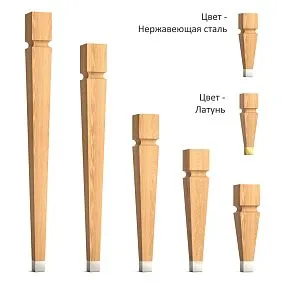
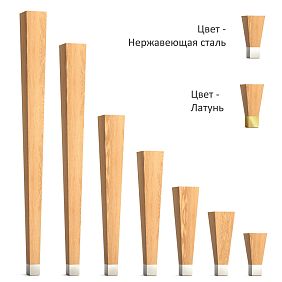
Our factory also produces:




Why MN-105 can look "metallic" while remaining wood
Color greatly influences the perception of the material. Light wood immediately shows fibers, tonal transitions, and natural patterns. Opaque black enamel, on the contrary, shifts attention from texture to contour.
Get Consultation
Black color enhances geometry
On a light background, a dark support reads as a clear vertical stroke. If the leg has smooth planes and a calm taper, the eye perceives primarily the silhouette. That is why black wooden legs for a coffee table can support a modern interior without a feeling of "carved classic."
Matte surface is calmer than glossy
A matte or near-matte finish usually emphasizes micro-irregularities less and works as a solid dark plane. Gloss reflects light more strongly, so it requires more careful preparation. The specific coating system should be chosen for the project, not assigning a predetermined gloss to the product card.
Graphite is softer than pure black
The graphite shade provides similar graphic quality, but the contrast with the light countertop becomes somewhat calmer. It is convenient when the interior already has dark handles, lamps, or window profiles, but there are no absolutely black surfaces.
Enamel hides the grain, but not the origin
Under the opaque coating, the natural texture visually recedes into the background. However, the behavior of the wooden part, the method of attachment, and the preparation requirements remain tied to wood. There is no need to promise the user a "metal effect" as a full imitation of the material. It is more honest to talk about a black geometric wooden support.
What black enamel will not be able to do
Paint changes the color, but not the construction. This is especially important for a person who came from a search for metal legs.
Enamel will not create:
-
a welded U-shaped frame;
-
an X-shaped metal underframe;
-
a thin-walled steel tube;
-
a cold metallic shine;
-
polished brass surface;
-
characteristic edge of a rolled profile;
-
a frame joined into a single whole;
-
properties calculated in a specific project specifically for the metal.
If a designer drew two thin rectangular steel frames at the ends of the tabletop, four MN-105s will not be a structural replacement for them. If the visual task sounds like "four black geometric supports without threads," wood may well be more appropriate.
When a wooden MN-105 fits better than the idea with metal
Sometimes the initial request for metal turns out to be a habit rather than a real necessity. After clarifying the task, it becomes clear that the buyer needs not a steel frame, but a certain image.
The table is built on four separate supports
If the tabletop is designed for four corner legs, MN-105 logically fits into the structure. In this scenario, it doesn't need to be forced to imitate a frame — it works precisely as a separate support.
A single material is needed to match other furniture
The room may already have wooden legs of chairs, a dresser, or a console. Black enamel allows you to assemble a modern palette while maintaining a material connection between the items.
The ability to change color is important
A wooden blank for enamel allows you to fit the supports into a specific project palette. Today it is deep black, in another interior — dark gray, milky, or a complex wall panel color. Specific finishing options depend on the chosen technology.
A more "furniture-like" rather than industrial character is needed
A steel frame often makes the table technical, loft-style, and structural. Wood, even under an opaque coating, retains a more object-like, interior character due to the shape and scale of the detail.
The tabletop is wooden
A wooden support naturally combines with solid wood, veneered, and painted tabletops. In the catalog, you can separately buy a tabletop for a coffee table and calculate the final height based on its thickness and shape.
When a real metal structure is still needed
There are projects where replacing the material destroys not only the image but also the calculation.
Thin steel profile — part of the design
If the visual effect relies on a very thin frame, wood will not provide the same proportion. Attempting to reduce the cross-section of a wooden part for visual similarity may alter its structural performance.
The underframe must be unified
U-shaped, X-shaped, and trapezoidal supports are perceived as a complete structure. Four independent legs work differently.
The tabletop is heavy and the project is designed for metal
Stone, porcelain tile, thick glass, or large solid wood require calculation of the entire assembly. You cannot transfer a solution from a metal frame to wooden legs based solely on visual similarity.
The texture of metal is specifically needed
Brass, stainless steel, raw rolled metal, powder coating on metal — these are a distinct aesthetic. Black enamel on wood does not have to imitate it.
Furniture is intended for demanding conditions
Street, constant humidity, sharp temperature changes — a separate engineering challenge. For MN-105, suitability for such conditions cannot be promised without confirmation of a specific configuration.
MN-105 and MN-148: wood without metal or wood with metal decor
The catalog has a neighboring scenario that helps draw the line even more precisely. Buy legs with metal decor MN-148 possible when you want to combine wood and a visible metal element.
MN-148, however, is also not an all-metal leg. It is a turned wooden support with metal decor. It solves a different aesthetic task: the wood material remains part of the image, while metal works as an accent.
MN-105, on the contrary, is built on pure geometry and can be fully painted opaque. If you need a minimalist black silhouette — MN-105 is more logical. If a metal touch as a visible detail is important — it is worth comparing neighboring models.
Beech or oak under black enamel
The MN-105 card features beech and oak. The choice of wood species should be linked not to an abstract "what is better" rating, but to the finish and what result should remain visible.
Beech: practical logic for opaque finishes
Beech has a calmer, non-porous texture. For a project where the entire surface will be covered with opaque enamel, this is a clear choice. The quality of surface preparation becomes more important than the natural grain.
Oak: when texture matters
Oak is valued for its pronounced structure. If a semi-transparent tint, oil, varnish, or finish is planned where the wood grain remains part of the design, oak becomes an obvious choice.
With fully opaque black enamel, part of the decorative value of oak texture is hidden. This does not mean oak cannot be painted. It means you need to honestly understand what you are paying for and what effect will remain after the finish.
All legs of one table — one specification
Do not assemble a set from randomly mixed wood species and preparation levels. For one table, fix one model, one size, one wood species, the same sanding quality, one gluing execution, and one finishing system. This makes it easier to achieve a repeatable color and uniform surface on all supports.
"Standard" or "Prestige": what changes before painting
Card MN-105 offers two sanding qualities. These are not two different leg designs, but different levels of surface preparation.
"Standard" is a variant with basic machine sanding. It can be rational when further finishing is done in your own workshop and the craftsman plans a full preparation cycle anyway.
"Prestige" is more detailed hand sanding. This option reduces the amount of finishing work before coating, especially when the surface must be smooth under an opaque covering.
It is useful for the buyer to evaluate not only the price per leg, but also the cost of subsequent work. A cheaper blank may require more of the craftsman's time. Conversely, a carefully prepared surface can shorten the finishing stage.
For a project under black enamel, this choice is especially noticeable: a dark finish and directional light can emphasize surface defects.
What 'For enamel' means
In the MN-105 card, there is a gluing quality called "Under enamel". This is not a color name or a ready-made coating.
This option is designed for subsequent opaque finishing. When gluing lamellas, it is not necessary to select the natural pattern as carefully as for transparent tinting, because the finish will cover the color differences of the wood.
Therefore, "under enamel" is the logic of the blank, not a promise that the leg will arrive already black.
If the task sounds like "order MN-105 under black enamel", in the estimate you need to separate two items: the wooden leg itself in the appropriate version and the subsequent finishing system.
Height 430 mm: why the finished coffee table will be higher
Size A of MN-105 is 430 mm. This is the height of the leg itself, not the entire table.
The result can be expressed by the formula:
Hfinished table = Hleg + Hmounting unit + Ttabletop
Where:
-
Hleg = 430 mm;
-
Hmounting unit depends on the mounting method;
-
Ttabletop is the actual thickness of the selected top.
If the tabletop has a thickness of 30 mm and the mounting does not add noticeable height, the approximate level of the upper surface will be about 460 mm. But this is just an example of the principle, not a ready-made size for any project.
Why 30 mm cannot be substituted automatically
A specific tabletop may have a different thickness, a subframe, a mounting platform, or a milled seat. Therefore, calculations must be based on the drawing of the selected parts.
What to measure before ordering
-
desired total height of the table;
-
The thickness of the tabletop;
-
the height of the mounting plate or another component;
-
possible recessing;
-
the thickness of the base plate;
-
the floor and carpet level, if it affects perception.
When the result is composed of several parts, a single figure of “430 mm” is insufficient.
Proportions of a coffee table: the leg does not exist separately from the tabletop
MN-105 is tall enough for the coffee table format, so it is especially important to check the scale of the top.
A small square tabletop on four tall narrow supports can look light and graphic. A long heavy slab will require a different relationship between the overhang, the distance between the legs, and the rigidity of the structure.
Square tabletop
Four supports form a calm symmetrical volume. Here, equal indents from the edges and precise diagonal are important.
Rectangular
Need to check if the distance between legs along the long side is too large. The solution may require aprons, a stretcher frame, or other reinforcement.
Round
Square in plan, the geometry of the supports creates an interesting contrast with the circle. But the position of the legs needs to be marked by radius so that all four are equidistant from the center.
Oval
Requires a separate layout. You cannot simply transfer the four corner points of a rectangle.
Shaped
Without a drawing, the number and placement of supports cannot be assigned. Here it is more useful to first choose the tabletop and then design the base for it.
How many MN-105 to order
For an ordinary small square or rectangular coffee table, a clear scheme is four separate legs. But the word "ordinary" should not turn into a universal norm.
The quantity is determined by the drawing:
Q = number of supports per project + R
where R is the reserve, if provided by the customer.
Additional supports may be needed for a long tabletop, complex shape, heavy material, lower shelf, or frame. Sometimes, on the contrary, the project is based not on four legs but on two frames or a central support — then MN-105 does not match the original design concept at all.
Should you buy a spare leg
For a single table, a spare is not always necessary. But in a serial project, cafe, hotel, or large batch of furniture, an extra part can simplify future repairs. The decision is made by the customer based on budget and production volume.
Fasteners: FUR-001 and FUR-012 are not the same
The MN-105 card shows several options for the required hardware. This is a useful hint, but it does not mean that all items need to be purchased at once.
FUR-001: stud and insert nut
buy the FUR-001 mounting kit possible for a scheme where the connection is made via an M8 × 60 stud and a metal insert nut M8 × 13.
The upper part of the leg is connected to the furniture base with a threaded assembly. Before ordering, check the base material, its thickness, the place for the insert nut, the diameter of the mounting hole, the possibility of precise drilling, tool access, and load direction.
FUR-012: mounting plate and stud
Order FUR-012 kit with mounting plate makes sense if the design is intended for a separate round plate with a diameter of 37 mm and an M8 × 60 stud.
The plate requires free space on the underside of the tabletop or frame. You need to check in advance whether it will interfere with the edge, apron, bevel, or other fasteners.
Why you shouldn't put both kits in the cart "just in case"
Usually FUR-001 and FUR-012 describe alternative installation methods. Buying both without a design decision increases the estimate and does not resolve the main question: which specific joint will attach the leg to the table.
If the project is non-standard, it's better to first Buy hardware for furniture legs after checking the drawing and choose a specific scheme.
FUR-023: floor glide — a small part that changes contact with the floor
The MN-105 card also indicates the square floor glide FUR-023. Its size is 25 × 25 × 5 mm. The kit includes a universal self-tapping screw with the glide itself.
buy a square glide FUR-023 should be considered not as a decorative accessory, but as a separate contact part between the leg and the floor covering.
It helps protect the lower end of the support, reduce direct contact of the wood with the floor, make furniture movement more predictable, and reduce hard friction on some floor coverings. But the glider adds its own thickness to the total height and must be installed equally on all supports.
What to buy together with MN-105
One leg does not turn into a ready-made coffee table. For a real project, you need a set.
| Position | Why it's needed | Which question to resolve before purchasing |
| MN-105 | Main wooden support | Beech or oak, "Standard" or "Prestige", for which finish |
| Tabletop | Forms the top of the table | Size, shape, thickness, weight |
| FUR-001 | Attachment via a stud and a threaded insert | Is the base suitable for threaded mounting |
| FUR-012 | Mounting via mounting plate | Is there space for the plate |
| FUR-023 | Contact with the floor | Is this type of foot pad needed |
| Finishing materials | Preparation and finish | Which system is compatible with wood |
| Stretcher frame or aprons | Rigidity, if specified by the design | Are they needed for the selected tabletop |
| Tabletop fastening | Connection of top and base | Compatibility with thickness and material |
| Spare leg | Replacement in batch | Is it needed for a serial project |
For a painting project, it's useful to order right away order materials for painting wooden legs and agree on the preparation technology, rather than trying to pick random compounds after assembly.
Black MN-105 with a light wooden tabletop
One of the most obvious images is a natural top and dark legs.
Light wood attracts attention with its grain pattern, while black supports set the frame. In such a composition, MN-105 does not have to "pretend to be steel." On the contrary, the contrast of materials makes the object more interesting: on top, the wood remains open, while on the bottom, the same natural origin is hidden by enamel.
For visual coherence, you can repeat the black in cabinet handles, chair legs, lamp housings, or a thin mirror frame. But there is no need to mechanically repeat the color in every item. Two or three points are enough to make the palette cohesive.
MN-105 for a stone or ceramic tabletop
A dark base and a stone top look convincing, but here aesthetics should not outpace calculations.
Stone and porcelain stoneware can have significant mass and a different mounting scheme than a wooden slab. Four MN-105 legs cannot be assumed to be automatically sufficient support. Data on the tabletop's size and weight, load distribution, presence of an underframe, and permissible attachment points are needed.
If the designer calculates the structure for four wooden legs with a corresponding frame, the black finish will work visually. If the calculation is done for a metal underframe, replacing it with wood without revising the scheme is not allowed.
Glass tabletop and wooden legs
Glass makes the supports especially noticeable because they are visible from above. This increases the importance of the quality of the top mounting assembly.
The mounting plate, apron, or connecting frame becomes part of the visual field. Therefore, the mounting is designed first, and then the finish is chosen. Four beautiful legs with a sloppy top assembly will not yield a clean result.
Bottom shelf: a useful feature that complicates the design
A coffee table often gets an additional shelf. With it, MN-105 ceases to be just four vertical supports.
It is necessary to determine how the shelf is attached, at what height it runs, whether it connects the legs, whether stretchers are needed, whether the fasteners weaken the cross-section, how the joint will be painted, and whether access to the hardware remains.
If the shelf is part of the structural scheme, the project must account for it.
Four legs without stretchers: when visual lightness requires engineering verification
A modern table is often desired to be as "clean" as possible: a tabletop and four supports, no crosspieces. Such a look is possible, but stability depends on dimensions and the method of connection.
The higher the leg and the larger the tabletop, the more noticeable the horizontal forces from an accidental push. Threaded fastening must withstand not only vertical weight but also rocking.
Therefore, the "no stretchers" solution cannot be chosen just for the sake of a photo. The rigidity of the finished joint must be checked.
Black legs in different styles
Modern minimalism
MN-105 supports a clear form without ornament. An opaque dark color makes it even stricter. An even tabletop, clean lines, and minimal surrounding decor are important.
Soft neoclassicism
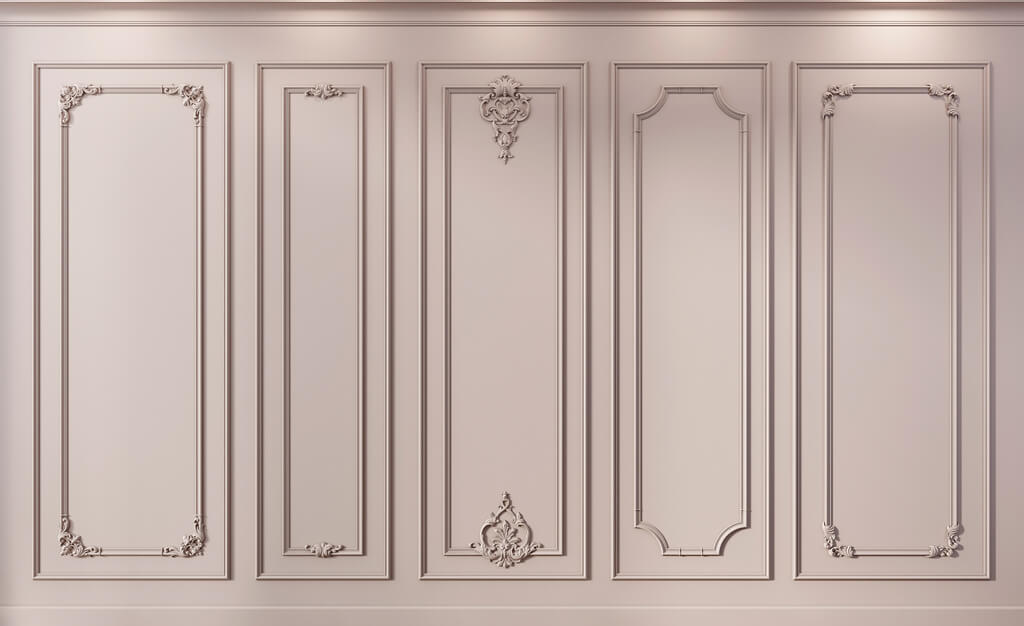
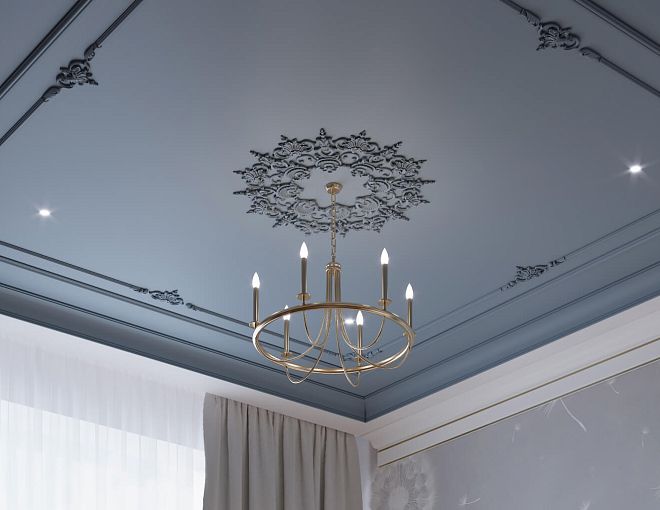
A geometric leg can work as a modern counterbalance to classic moldings on the wall. The table does not repeat the stucco, but ties the interior together through color.
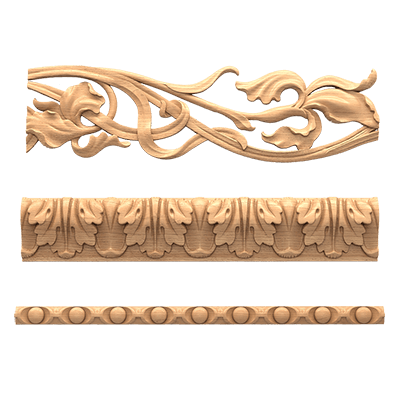
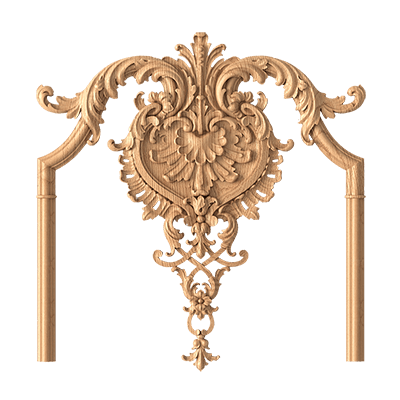
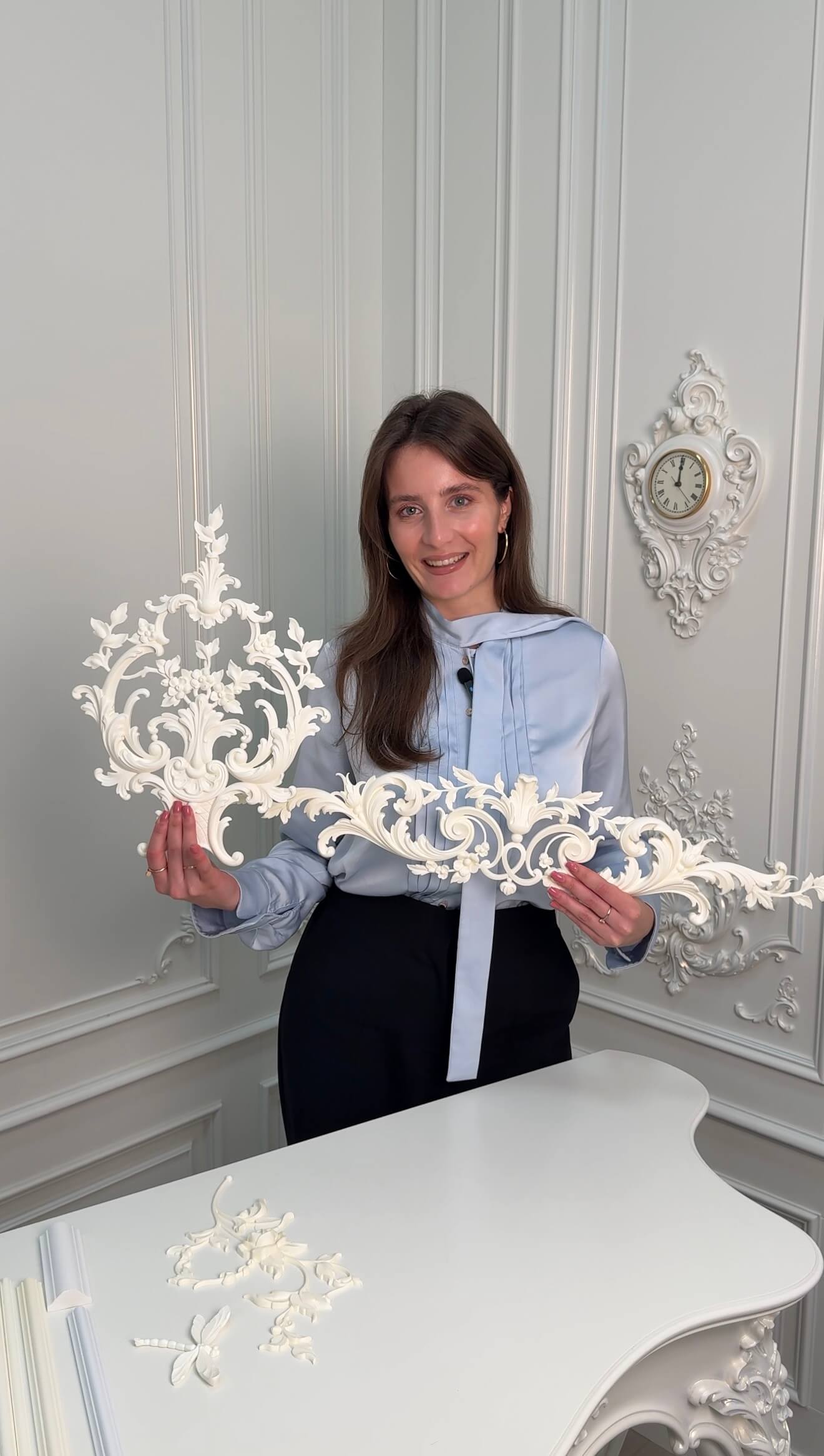
Art Deco style is renowned for its love of ornamentation, symmetry, and refined details. The molded decoration NPU-422 can become an excellent complement to geometric motifs and contrasting color combinations characteristic of this style. Try highlighting it with metallic paint or patina — and you’ll get an eye-catching detail that’s hard to look away from.
The black base can be paired with a glossy tabletop, glass, or brass accents. Here it is especially important not to overload the piece: the MN-105 itself is quite calm.
Japandi
Instead of pure black, you can consider soft graphite or a deep dark brown shade. The geometry remains minimalist, and the material natural.
Loft
If you need a true industrial look of welded steel, the MN-105 may be too furniture-like. But if the interior only uses black contrasts, it is quite appropriate.
What to compare MN-105 with in the catalog
A buyer rarely needs just one card. It is much more useful to see a range.
For a general selection, you can choose legs and supports made of solid wood and compare geometric, turned, and carved models.
If the coffee table format is important, it is better to buy legs for a coffee table from a specialized selection on application.
If you want to do the finishing yourself, a section where you can order wooden furniture legs without coating.
If self-painting is not part of your plans, it is useful to buy furniture legs with a ready-made coating and compare ready-made options with MN-105 as a blank for your own color.
How to order four identical black legs, not four "almost identical" ones
In a furniture project, repeatability matters more than a single beautiful detail. All four supports are perceived simultaneously, and a difference in shade, sanding, or preparation is immediately noticeable.
Before ordering, specify in one line of the specification:
MN-105 — quantity per project — one wood species — one sanding quality — one finish option — a unified enamel system.
If the order is large, add the numbers of rooms or items. For example:
-
table A — 4 pcs.;
-
table B — 4 pcs.;
-
table C — 4 pcs.;
-
reserve — 1 pc., if it is provided for by the project.
This order seems overly pedantic only until the first case when two supports are prepared for one finish, and two for another. For a black monochrome item, the differences are especially noticeable: the eye instantly compares identical vertical parts.
Why one species is not enough
Even within one material, the quality of preparation affects the result. If two legs are "Standard" and two are "Prestige", the craftsman gets a different amount of finishing. After opaque enamel, the natural color of the wood is almost invisible, but surface flaws are visible in reflected light.
Why it is better to paint the entire set with one system
Different primers, batches of enamel, application methods, and degrees of sanding between layers can produce different gloss. Therefore, it is wiser to treat four legs as a single set from preparation to finish.
How to check the table geometry before drilling
The most unpleasant mistake is to discover a misalignment after the holes have already been made. The MN-105 itself may be accurate, but incorrect marking of the tabletop will turn four identical legs into a visually crooked table.
Before final fastening:
-
turn the tabletop face down on a protected flat surface;
-
mark the central axes;
-
mark equal indents from the edges;
-
place the legs without drilling;
-
measure the distances between them;
-
check the diagonals;
-
make sure the top platforms do not extend beyond the edge;
-
check the free space under the selected FUR-001 or FUR-012;
-
mark the direction of each leg if the profile is visually asymmetrical;
-
only then mark the fasteners.
For a round tabletop, it is more convenient to work not from the "corners," which do not exist, but from the central point and four radial axes. For an oval one, work from the main and transverse axes. For a shaped one, use a full-size template.
How the base color changes the visual mass of the table
The same silhouette in natural beech and in black is perceived differently.
A natural light support looks softer and lighter. A black one looks denser and more graphic. On a light floor, it emphasizes every vertical; on a dark floor, it partially dissolves. On a carpet, a dark leg may visually become shorter because the lower part is lost in the pile.
This is useful to consider if the table seems too massive. Sometimes the problem is solved not by changing dimensions, but by a different finish tone. Conversely, a composition that is too thin visually becomes more cohesive after a dark finish.
Black next to white
The contrast is maximum. Any misalignment, height difference, or mismatch in offsets is more visible. Such an interior forgives fewer installation errors.
Black next to natural oak
The contrast is not only in color, but also in texture. The oak tabletop shows a live texture, while the opaque enamel on the legs makes the bottom calm and monolithic.
Graphite next to gray stone
The contrast is softer, but the shade is especially important. Cold graphite and warm gray can argue, although both appear "gray-black" on screen.
Do I need to paint the tabletop in the same black
Not necessarily. A fully black table can look monolithic, but it loses the contrast between the top and the base.
Three simple schemes:
-
black legs + natural tabletop — contrast of material and color;
-
black legs + light painted tabletop — a graphic two-color piece;
-
everything in one color — a monolithic volume where geometry works primarily.
There is also a fourth option: a tabletop in a deep color close to black, and legs one or two shades darker or lighter. This scheme is more complex because a small difference can look not like a deliberate nuance, but like a tinting error. Here, a control paint-out is mandatory.
How to choose a tabletop for MN-105 not by picture, but by task
First, the function of the table is determined. Will it hold a cup and a book? Will it become a central piece in front of the sofa? Will it get a heavy decorative stone? Will it be moved around the room? The answer affects not only the size of the top, but also the base construction.
For a compact table next to an armchair
A small square or round tabletop reduces the requirements for the span between supports. Four MN-105 can create a light vertical silhouette if the overall height is comfortable next to the seat.
For a central coffee table
Width and length are usually larger, so rigidity needs to be checked. The farther the legs are from each other, the more important the work of the tabletop or the subframe.
For a long narrow table
A long surface can sag even if the supports themselves are correctly calculated. You cannot discuss legs separately from the top material.
For a heavy decorative tabletop
A calculation is needed. The number "four" guarantees nothing here.
What to check in the countertop before choosing fasteners
It is impossible to choose hardware based only on the leg. Parameters of the second part—the one it attaches to—are needed.
Check:
-
countertop or subframe material;
-
actual thickness;
-
presence of reinforcement;
-
distance from the fastening point to the edge;
-
possibility of drilling;
-
grain direction, if it is solid wood;
-
location of the chamfer;
-
presence of metal inserts;
-
finishing of the underside;
-
access to fasteners after assembly.
If the underside of the tabletop has a deep chamfer, the mounting plate FUR-012 may simply not fit where it was drawn on the sketch. If the base is too thin for the insert, FUR-001 will require a different solution.
How not to confuse a wooden leg with a metal underframe when ordering
Look not only at the color of the photo
A black object on a white background can easily be mistaken for metal. The material is always checked in the specifications.
Read the category name
MN-105 is among wooden furniture legs. This is already an important reference point.
Check the unit of the product
The card sells one leg, not a set of four, and not a table base.
Check the mounting diagram
A separate leg requires a separate mounting assembly. A welded frame has different logic.
Do not use the word "metal" in order MN-105
In the request, it is better to write "wooden geometric leg MN-105 in black enamel." This reduces the risk of mutual misunderstanding between the buyer, manager, finisher, and assembler.
Why the anchor "buy metal legs MN-105" would be a mistake
SEO should not contradict the product. Even if the search engine shows MN-105 for a query about metal legs, turning that query into an affirmative commercial anchor is not allowed.
Such text would promise the user a material that does not exist. In the short term, the phrase could increase relevance for the word "metal," but in real buyer behavior it creates disappointment: a person comes for steel and sees beech or oak.
An honest construction works much better: "Looking for metal legs? Compare whether you need metal specifically or whether a black geometric wooden support is enough." The user gets an answer to their query and understands why MN-105 appeared in the search results.
Twenty mistakes when choosing MN-105
Error 1. Considering MN-105 metallic because of the search query
Search shows relevant options, but the material is determined by the product card.
Error 2. Confusing black color with material
A black leg can be wooden, metallic, or composite. Color proves nothing.
Error 3. Considering 430 mm as the height of the finished table
You need to add the thickness of the tabletop and the height of the mounting assembly.
Error 4. Buying four legs without checking the tabletop
The quantity and arrangement depend on the shape, mass, and construction.
Error 5. Adding FUR-001 and FUR-012 to the cart as a mandatory pair
These are different mounting options. First, choose the scheme.
Error 6. Not accounting for the foot plate
Size FUR-023 25 × 25 × 5 mm affects contact with the floor and adds its own thickness.
Error 7. Buying oak and then completely hiding the texture without understanding why
With opaque enamel, the natural pattern ceases to be the main visual advantage.
Error 8. Choosing "Standard" without assessing the cost of finishing
Savings on the blank can turn into expenses for preparation.
Error 9. Painting without a test sample
The black shade and gloss need to be seen next to the countertop and interior.
Error 10. Ignoring the top mounting platform
The fastener must fit on the base and not extend beyond the edge.
Error 11. Placing legs too close to the edge
The risk of base damage and visual imbalance increases.
Error 12. Placing too deep
The tabletop starts to "hang" around the perimeter, and the space between supports decreases.
Error 13. Not checking diagonals
Four beautiful legs
Who MN-105 suits
MN-105 is especially interesting for those who want a modern coffee table on four separate legs, appreciate clear geometry, and plan an opaque finish.
It suits wooden and painted tabletops, projects where black is used as an accent, modern furniture without carved ornamentation, and sets where wood is preferred over cold metal. It can be considered when the ability to change the shade to match the interior is important and when the table is structurally designed specifically for individual legs.
A suitable user scenario sounds like: "Stainless steel isn't essential to me. I need a strict black base that will match a wooden or painted tabletop." In this case, MN-105 fits the task perfectly.
Who would be better off looking for another base
MN-105 is not worth choosing if the project requires a single welded underframe, thin steel tube, exposed metal texture, brass or stainless steel surface, engineering calculation for a metal frame, U-shape, X-shape, or trapezoid as a single structural element.
The logic of "let's buy the legs first, then somehow attach them" doesn't work either. If the tabletop is non-standard, heavy, or very long, the fasteners and rigidity must be resolved before ordering.
Practical selection across twelve scenarios
Scenario 1. Light oak tabletop and black legs
MN-105 suits a dark covering finish aesthetically. The natural top retains the grain, and the black bottom makes the piece graphic. Check the fasteners and final height.
Scenario 2. Round glass top
First decide how the glass will connect to the wooden supports. Without a mounting design, it's too early to buy the legs, because the top mounting point will be visible through the transparent surface.
Scenario 3. Heavy stone
A base calculation is needed. Don't replace a metal underframe with four wooden supports without checking the mass, spans, and subframe.
Scenario 4. Table with lower shelf
Plan the connection of the shelf to MN-105 before painting and drilling. Adding a shelf later may require new holes and ruin the finish.
Scenario 5. Want a maximally industrial look
If the steel itself matters, MN-105 won't solve the task. If only the black color and straight lines matter, it may work.
Scenario 6. Need graphite, not black
The enamel finish option gives freedom of finish, but the exact shade is agreed separately. Make a color sample next to the tabletop.
Scenario 7. Part of the furniture is already oak
Oak MN-105 can support the material if the texture is left visible. With a fully opaque coating, consider whether oak is really needed.
Scenario 8. Want to assemble the table yourself
Create a specification of legs, tabletop, one selected mounting option, floor glides, and finishing materials. Don't order mounting hardware 'just in case' before choosing the scheme.
Scenario 9. Need ten identical tables
Order with a single specification, add an agreed reserve, make a control color sample and an installation template.
Scenario 10. Not sure about proportions
Order a design project for a coffee table more rational than buying a set by eye and reworking the finished product.
Scenario 11. Black legs should match the cabinet handles
Compare real color samples. Two shades, both called "black," may differ in undertone and gloss.
Scenario 12. The table will be moved frequently
Separately consider contact with the floor. FUR-023 should be included deliberately, understanding its size and impact on the surface.
Procedure before placing an order
A strong purchase starts not with the "add to cart" button, but with a sequence.
-
Determine the shape of the tabletop.
-
Record its dimensions and thickness.
-
Calculate the required total height.
-
Check whether the MN-105 430 mm height is suitable.
-
Decide whether a wooden support or a metal underframe is needed.
-
choose beech or oak
-
Determine the quality of sanding.
-
Specify the execution for opaque finishing if enamel is planned.
-
Choose one mounting scheme: FUR-001, FUR-012, or another calculated assembly.
-
Resolve the issue with the foot cap.
-
Make a swatch of black or graphite shade.
-
Check the leg layout on the tabletop.
-
Verify the diagonals and offsets.
-
Check that the fasteners do not interfere with the chamfer or the underframe.
-
After that, prepare the full set.
This order saves not minutes, but rework. The main value of preliminary checking is that it turns the search for "beautiful black legs" into a specific furniture assembly.
How to order MN-105 on STAVROS without missing parts
The cart should not just contain "4 legs." A good specification answers what will happen to the parts after receipt.
For a basic table, it might look like this:
-
MN-105 — quantity per project;
-
wood species — one for the entire set;
-
grinding quality — identical;
-
finish — according to the selected trim;
-
FUR-001 or FUR-012 — per the diagram;
-
FUR-023 — based on the number of legs, if this glider is selected;
-
countertop;
-
materials for final preparation;
-
reserve — if necessary.
If the order is shipped to another city, calculate in advance the delivery of the furniture leg set useful together with the tabletop: the dimensions of the top plate can affect packaging and logistics more than the legs themselves.
How to read the MN-105 card before payment
Don't limit yourself to the photo. In the card, you need to check sequentially:
SKU
MN-105. One digit in the furniture catalog can mean a completely different geometry.
Size
430 × 61 × 56 × 44 mm. If the designer used a different size in the drawing, you need to find out where it came from.
Material
Beech or oak. The invoice must specify the exact selected wood species.
Sanding
"Standard" or "Prestige". Don't leave this parameter to random configuration if preparation depends on it.
Enamel finish option
Check it for the selected combination of characteristics. Don't confuse it with the final paint.
Hardware
Select a specific mounting path, not all items from the "required hardware" block.
Why an article about MN-105 should sell not a leg, but the right solution
A person rarely wakes up in the morning with the thought "I need part number MN-105." They want a table of a certain height, color, and character. The part number appears only after the search engine links it to the task.
Therefore, useful commercial text should not endlessly repeat "buy MN-105." It should answer more complex questions:
-
will the wood look strict enough;
-
how does it differ from metal;
-
which material to choose for black;
-
why is the finished table higher than 430 mm;
-
how many supports are needed;
-
how to attach them;
-
which countertop to choose;
-
what to do with the support plate;
-
at what point a designer is needed.
If the article covers these questions, the transition to the product card becomes natural rather than promotional.
FAQ: answers to questions about MN-105 and black legs for a coffee table
Is MN-105 metal or wooden?
Wooden. The MN-105 card specifies beech and oak. Black enamel changes the color, but not the material.
Why does MN-105 show up for the query "metal legs for a coffee table"?
The search engine may associate the card with a similar user intent: a person is looking for black graphic supports. But the card does not become metal because of search relevance.
Can I get a fully black MN-105?
You can plan an opaque black finish for execution under enamel. The specific coating system, shade, and application method need to be agreed upon separately.
Would graphite enamel also work?
Yes, if the selected finishing system is compatible with the wood and the leg preparation. The article itself is not tied to a single black shade.
What is the size of MN-105?
The confirmed size is 430 × 61 × 56 × 44 mm.
Is 430 mm the height of the finished table?
No. To 430 mm, you need to add the thickness of the tabletop and the height of the mounting assembly. If a floor glide is used, its influence is also taken into account in the overall geometry.
How many MN-105 are needed for a coffee table?
Most often four for a standard layout on separate supports, but the final quantity is determined by the drawing. For a long, heavy, or shaped tabletop, the layout may be different.
Is beech or oak better under black enamel?
For covering surfaces, beech has clear practical logic because the natural texture is covered anyway. Oak makes more sense when the wood grain is to be preserved. This is a recommendation based on the task, not a prohibition on staining oak.
How does 'Standard' differ from 'Prestige'?
These are sanding levels. "Prestige" implies more detailed surface preparation, "Standard" is basic machine sanding.
Does "under enamel" mean the leg is already painted?
No. This is a characteristic of preparing the workpiece for subsequent opaque finishing.
Is fastening included with leg MN-105?
Fastening should not be considered automatically included. In the product card, it is listed as separate accompanying items.
What to choose: FUR-001 or FUR-012?
The choice depends on the base. FUR-001 uses a stud and a threaded insert, FUR-012 uses a mounting plate and a stud. One calculated assembly is needed, not both sets without reason.
M8×60 stud and M8×13 metal insert.
The set contains a M8 × 60 stud and a metal threaded insert M8 × 13.
What is included in FUR-012?
The kit includes a round mounting plate with a diameter of 37 mm and an M8 × 60 stud.
What is FUR-023 used for?
This is a square foot pad measuring 25 × 25 × 5 mm for the bottom part of the leg. It creates a contact area between the support and the floor.
Can MN-105 be used without a foot pad?
The specific method of floor contact is determined by the project. If FUR-023 is selected, it is installed identically on all supports.
Can MN-105 be placed under a stone countertop?
Only after calculating the weight, subframe, and mounting. You cannot automatically transfer the scheme from a light wooden countertop.
Will MN-105 fit under glass?
Visually — possibly, but structurally, the attachment of the glass countertop needs to be resolved separately. Through the transparent top, the mounting assembly will be more visible.
Can a table be made without aprons?
Sometimes yes, but the rigidity of the connection needs to be checked. Tall individual legs receive horizontal loads when rocking.
Can the lower shelf be installed between MN-105?
Such a design can be planned, but the shelf joint needs to be resolved before drilling and finishing the legs.
Can I order one MN-105 as a sample?
The current possibility of ordering a specific quantity needs to be checked in the product card and with the STAVROS manager.
Do I need to buy a spare leg?
Not always for a single table. For a serial project, a spare may be reasonable.
Can the legs be repainted later?
The possibility depends on the existing coating and the new finishing system. Before repainting, the compatibility of layers and surface preparation need to be assessed.
Will black enamel completely hide the oak texture?
An opaque coating significantly hides the natural grain. That is why choosing oak for a fully opaque finish should be done consciously.
How is MN-105 different from MN-148?
MN-105 is a geometric wooden leg without declared metal decor. MN-148 is a turned wooden leg with a metal decorative element. Neither of them is an all-metal welded underframe.
Where can I see other legs for a coffee table?
In the specialized category of unpainted supports for coffee tables, you can compare geometric, turned, and carved models. For a wider selection, open the general section of furniture legs.
How do I know if MN-105 is too tall?
Add 430 mm, the tabletop thickness, and the mounting assembly, then compare the result with the sofa, armchairs, and the table's purpose. Do not rely only on the word "coffee."
Which black color should I choose?
Not by the name on the screen. Make a real color swatch next to the tabletop, floor, and other black interior details.
Do I need to paint all legs at the same time?
It is advisable to process the set with one technology and one batch of material to reduce the risk of differences in shade and texture.
Can MN-105 be called a "metal leg" in your project card?
No. It is more correct to write "wooden geometric leg MN-105 for black enamel." This maintains specification accuracy.
What to do if you have already ordered MN-105, thinking it was metal?
First, assess whether the wooden structure fits your drawing. If you specifically need metal, do not try to resolve the discrepancy with paint alone. Conditions for order changes, returns, or replacements should be clarified with the seller.
Can four MN-105 legs be used with a very large tabletop?
It cannot be stated without calculation. Size, weight, material, and the presence of a support frame determine the allowable configuration.
How to determine which fasteners will fit underneath?
You need to measure the area at the leg installation point, the base thickness, and the distance to the edge. Then compare these dimensions with FUR-001 or FUR-012.
Why might FUR-012 not fit a tabletop with a bevel?
Because the mounting plate requires a flat surface. If the bottom bevel eats up space, the plate may partially extend beyond the base.
Can MN-105 be placed on a carpet?
Yes, but visual and actual stability depends on the carpet. Soft, high pile changes the feel of contact with the floor, so it's better to test the table in real conditions.
What should be sent to the designer or manager for verification?
Tabletop size, material, thickness, desired overall height, number of legs, sketch of the bottom part, interior photos, and intended color. The more specific the initial data, the fewer decisions will need to be made after delivery.
Final check before payment
Before placing the order, go through a quick check:
-
MN-105 is chosen specifically as a wooden leg;
-
size 430 × 61 × 56 × 44 mm is suitable;
-
the overall height of the table is calculated with the tabletop;
-
the number of legs is determined according to the drawing;
-
the wood species is fixed;
-
grinding level selected;
-
finish matches future cladding;
-
black or graphite color checked on sample;
-
FUR-001 and FUR-012 not purchased simultaneously without need;
-
area for selected fasteners checked;
-
support feet accounted for;
-
tabletop agreed on size and weight;
-
scheme without crossbars checked for rigidity;
-
delivery calculated for the entire set;
-
nowhere in the request does it state that MN-105 is metal.
If at least one item remains unanswered, it is better to close it before payment. Furniture assembly rarely forgives decisions to "figure it out on site," especially if the parts are already painted.
Acceptance of MN-105: what to check before painting
Even an accurate specification does not cancel acceptance. Before the legs reach the painting workshop, they need to be inspected as a set. After applying opaque enamel, it is too late to return to the initial sorting: the finish will already add cost and complicate resolving a disputed situation.
Lay out all the supports nearby on a flat surface. First compare the article number and dimensions, then the wood species and sanding quality. Place the legs vertically and look at the silhouette from a few meters away. The geometric model is especially sensitive to visual comparison: four identical parts should form a single rhythm.
Separately check the top part where the fasteners will be. There should be no random decisions by the craftsman before the mounting scheme is approved. If FUR-001 is planned, the marking for the threaded insert differs from the option with FUR-012. Drilling "out of habit" is not allowed.
Before painting, it is useful to mark the legs on the inside: A, B, C, D or 1, 2, 3, 4. The same marking is transferred to the tabletop diagram. After the finish, the assembler will not rearrange parts in search of a suitable place.
How to make a black coffee table expressive rather than faceless
Black enamel by itself does not make furniture modern. If all decisions are reduced to one color, the table can turn out heavy or similar to a mass-produced office item. Expressiveness comes from proportions.
The MN-105 has a height of 430 mm, so the tabletop must have a convincing connection with the supports. A too thick massive top will visually press down on the legs. A too thin large slab, on the contrary, may look structurally questionable and require hidden reinforcement.
The second tool is the offset of the legs from the edge. A small offset makes the base look assembled and emphasizes the perimeter, but requires sufficient strength in the mounting area. A large offset creates a noticeable overhang of the tabletop and changes the silhouette. The correct distance cannot be assigned with one universal number: it depends on the dimensions of the top and the construction.
The third tool is the texture of adjacent surfaces. A matte black support reads especially well next to the live grain of wood, stone, glass, or a calm painted plane. If the legs, the tabletop, and the floor all have the same dark matte tone, the boundaries of the object partially disappear. Sometimes this is a desired effect, sometimes it is a reason to reconsider the palette.
And finally, there is no need to prove that wood "looks like metal." An honest contrast looks stronger: the geometric shape recalls the strictness of metal supports, but the material remains wooden. Such a table does not copy an industrial underframe but uses its visual discipline in its own way.
Black color — yes, material substitution — no
The MN-105 has a strong side that does not need to be masked. It is a wooden geometric leg 430 mm high with a clear modern shape, options in beech and oak, and the ability to choose preparation for opaque finishing. That is why it can cover part of the requests where a person initially thinks about black metal.
If what you need from metal legs is an image — strict lines, dark color, contrast with the tabletop — the MN-105 deserves comparison. If you need metal as a structure — a welded frame, thin steel profile, specific texture, or calculation for a heavy top — you need to look for a different base.
Before ordering, combine four things in one specification: the actual size of the tabletop, the final height, the mounting scheme, and the future finish. Then choose the wood species, sanding quality, fasteners, and floor glides. This order eliminates the situation where beautiful black legs arrive separately, and there is nothing to assemble the table from.
STAVROS allows you to go from one detail to a whole furniture project: choose the MN-105, compare other wooden supports, select a tabletop, hardware, and finishing materials, and for a complex structure — use design services. As a result, a black coffee table turns out not to be an imitation of someone else's idea, but a conscious product where wood works as wood, color works as color, and every detail knows its place in advance.