






























































Article Contents:
- What we keep in the dining group — and why we buy two new frames
- Chair-armchair frame STU-004: what the buyer gets, and what is agreed separately
- Two end seats: checking the table together with four existing chairs
- The "4 + 2" scheme starts with a full plan
- Room calculation: why you can't just add two frame depths
- Two identical ends may have different constraints
- Sitting comfortably and fully pushing in — not the same requirement
- Can four regular chairs and two STU-004 be combined at one table?
- What table dimensions will be needed before ordering?
- How to check armrests relative to the apron?
- Is painting included in the frame price?
- Is upholstery needed to be ordered for STU-004?
- Can the color be matched with the existing chairs?
- How much do two frames cost without additional work?
- What to do if a pair does not fit at the ends?
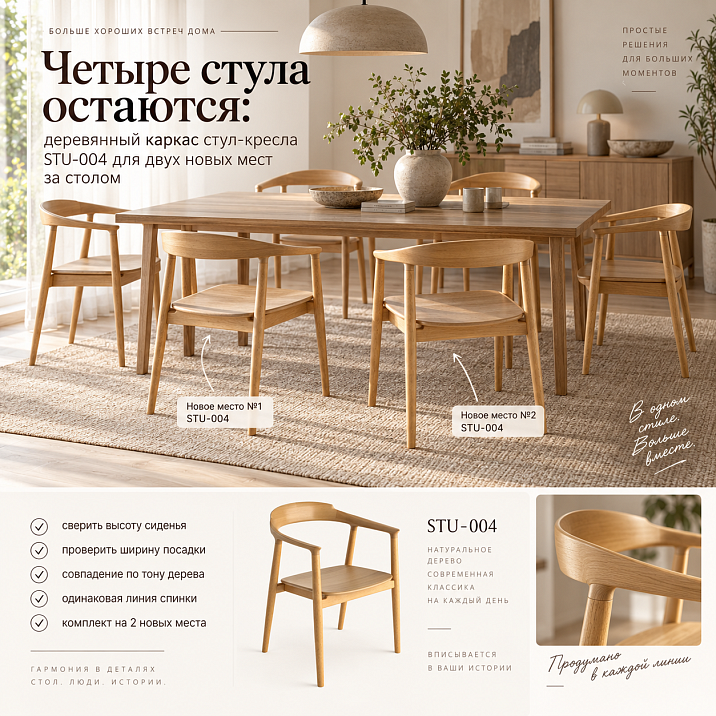
Adding two seats with armrests to an existing table is possible without replacing the entire dining set. But buying a pair of STU-004 is worth doing after checking the overall layout: the new items need space for seating, room to push back, and space next to the four retained chairs. A free end of the tabletop does not necessarily mean that a person can sit there comfortably.
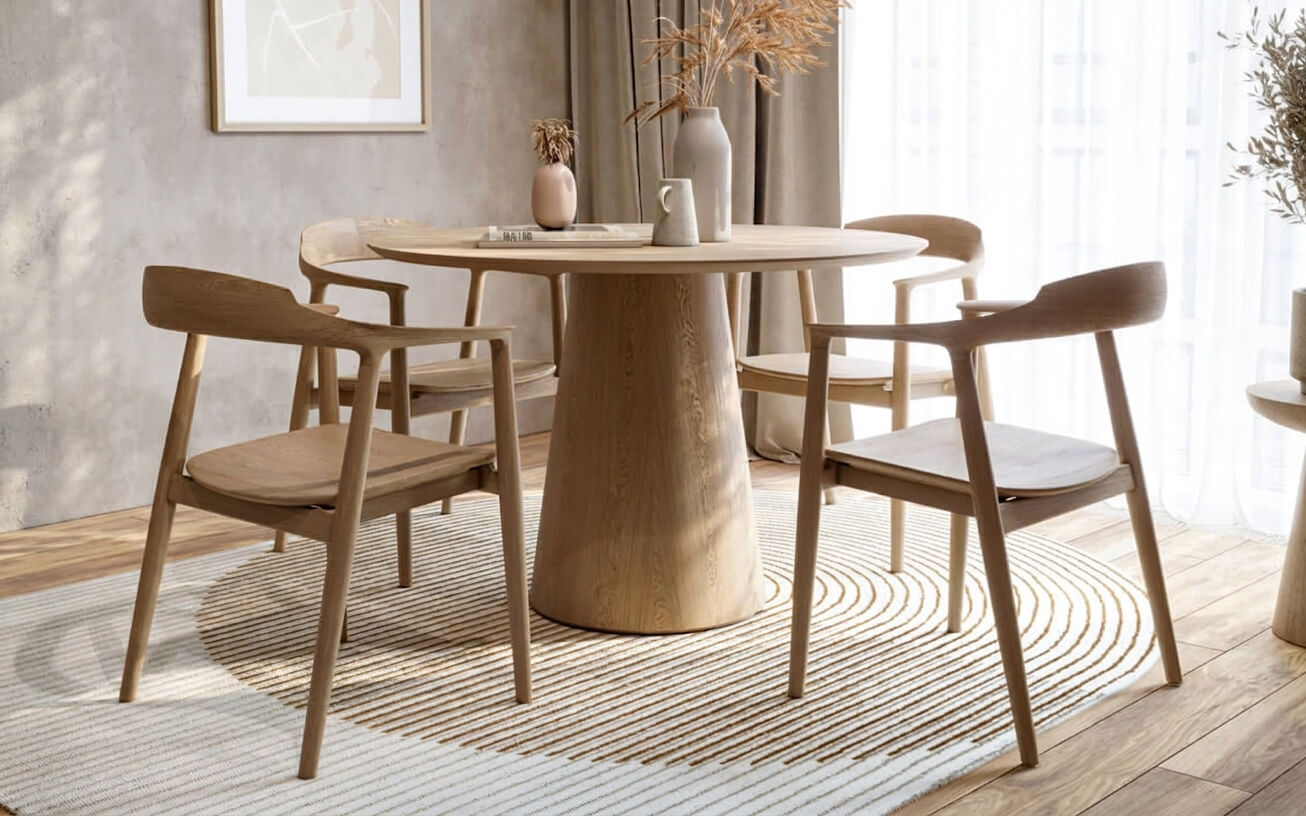
Let's consider a hypothetical situation: the table suits the owners in size and appearance, four chairs are in good condition, and now they want to gather six people for meals. The original seats remain along the long sides, and two wooden armchairs are planned at the ends. We need to determine whether STU-004 fits this layout, coordinate the finish of the pair, and calculate the final result. Buying a new set is not part of the original task.
It is better to start with dimensions and fitting, rather than choosing between beech and oak. Color can be discussed after understanding seating and movement around the table. If the armrests hit the apron or the new item blocks access to the adjacent seat, a beautiful finish will not solve that problem.

What we keep in the dining set — and why we buy two new frames
First, determine who the additional seats are for. Two daily seats for family members and a pair for rare festive dinners impose different requirements on room organization. In the first case, the furniture must always be positioned conveniently. In the second, a pre-planned rearrangement is acceptable, but an answer is needed on where the armchairs will be stored on other days.
It is useful for owners to describe the expected usage pattern: whether the table is used only for eating or for staying to talk after dinner, whether free turning to a neighbor is needed, and who usually occupies the end seats. Armrests may be a reason for choosing the pair, but the comfort of their position is checked by the user themselves. End seats should not be assigned to a person just because they look more impressive in the sketch.
Do not assume that two new purchases automatically add two full seats. If one of the side chairs must be removed to accommodate the end items, the layout already differs from the intended one. You should count the people who can use the table simultaneously, not the amount of furniture around it.
| What is already there | What is being acquired | What needs to be coordinated |
|---|---|---|
| Dining table | The table does not change | Accessibility of both ends, position of supports, space under the tabletop |
| Four regular chairs | All four are preserved | Their final positions and the ability to move back when the ends are occupied |
| Two proposed new seats | Two STU-004 frames | Seating, finishing, compatibility with the table and neighbors |
| Furnished room | Additional furniture is optional | Walkways, door opening, and access to existing cabinets |
Set the project boundaries: the tabletop, under-table, and four old chairs remain unchanged. This is useful both for the estimate and for communication with the contractor. Otherwise, the proposal may gradually turn into a full dining room renovation, although the owners only need two new seats.
After checking, different solutions are possible. Order two STU-004 frames if they fit. Choose another format while keeping the idea of a pair. Or keep four seats if expanding makes the existing group uncomfortable. The last option does not mean a failed selection: it allows avoiding purchases of items that have no suitable place.




STU-004 chair-frame: what the buyer gets and what is agreed separately
Before buy STU-004 chair-frame, check the selected version in the product card. For the task at hand, the following characteristics are essential, re-verified on September 5, 2026.
| Parameter | STU-004 data |
|---|---|
| Product type | Chair-armchair frame |
| Size A × B × C | 558 × 779 × 537 mm |
| Wood | Beech or oak |
| Sanding | «Prestige» |
| Seat | Wooden, concave |
| Backrest and armrests | Armrests transition into a semicircular backrest |
| Packaging | Rigid box |
The wooden seat is a fundamental part of the configuration. The word "frame" here does not justify automatically adding fabric, padding, and upholstery work. In the current description, STU-004 is not stated as a set with a standard upholstered backrest. The buyer selects a specific wooden structure, not any version of a half-chair that could be imagined from the name.
The size designation preserves the manufacturer's order A × B × C. These three numbers describe the overall dimension but do not indicate the armrest height, seat surface position, or internal width between side elements. They cannot be substituted for missing seating dimensions. Checking against a table will require a detailed drawing or measurements of a specific unit.
Execution names should also be read carefully. "Prestige" refers to the quality of sanding. In the open beech configuration, regluing "under enamel" is separately specified. This is not a chosen color or confirmation of already applied enamel. Delivery conditions with a finish coating should be fixed as a separate order line.
For two end seats, the buyer needs an identical agreed result: material, preparation, coating, and appearance of the pair. Matching item numbers alone is insufficient if one item is ordered for transparent finishing and the second for opaque painting. Compare both positions before payment, even when they are placed in a single order.
Our factory also produces:


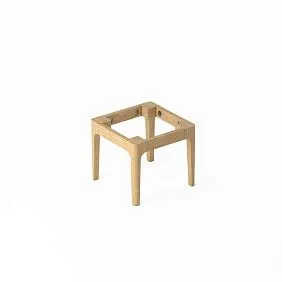


Two end seats: checking the table together with four existing chairs
Get Consultation
The "4 + 2" scheme starts with a complete plan
Draw the table from above and mark all six seats. Place the four existing chairs in their actual positions: two along each long side. Label the new seats separately — left and right ends. On the same plan, mark the table legs, central support if present, nearby walls, cabinets, and doorways.
Each chair needs at least two positions: during use and when a person exits. The storage position, when the furniture is pushed in as far as possible, can be shown with a third outline. It helps assess the free room but does not replace checking the occupied dining group.
On the plan, it is easy to miss corner adjacency. A person at the end and the nearest participant along the long side share the same area near the corner of the tabletop. Their chairs may not touch, but knees, elbows, or dishes can interfere with each other. Therefore, check not only furniture outlines but also the habitual seating of people.
It is useful to temporarily arrange the existing four chairs as they will be after purchasing the pair. Ask future users to take their seats and set up a typical table setting. In the absence of STU-004, the mock-up shows only the assumed volume of the new item; it does not confirm the comfort of a specific wooden seat. For a final decision, a trial of the product or comparison of detailed dimensions with user requirements is needed.
Room calculation: why you cannot simply add two frame depths
Let's take a conditional example, not a placement standard or a description of STU-004 seating dimensions. Between two obstacles along the table axis, there is 3800 mm. The tabletop length is 1800 mm. The project assumes that when the seat is occupied, the extreme rear point of each end item will be 650 mm from the corresponding edge of the table.
The occupied length of the group will be:
1800 + 650 + 650 = 3100 mm.
Remaining space:
3800 − 3100 = 700 mm.
With symmetrical placement, there will be 350 mm behind each end seat. If, in this conditional test, the chair needs to be moved back another 250 mm for exit, only 100 mm will remain behind it. Arithmetically, the furniture fits, but the ability to exit and walk behind the person is not yet confirmed.
The value of 650 mm here is the distance from the edge of the tabletop to the rear point of the item in its assumed position, not its rated depth. Part of the chair-armchair may go under the table, or, conversely, it may need to be placed further from the edge. Therefore, the formula "table length plus two external dimensions" does not automatically describe the arrangement.
Separately check the attempt to free up the corners by shifting the four old chairs toward the middle of the long sides. In the drawing, it looks simple, but it brings two neighbors closer together on each side. In this variant, assess the placement of their plates and the movement of their arms. Keeping the number of items is not enough if the usual side positions become cramped for the sake of new end positions.
For your own space, replace each conditional value with a measured one. Determine the required pulling-back distance by trial, not by copying from the example. The remaining space should also not be called a sufficient passage without checking actual movement and the requirements of the specific room.
Two identical ends may have different constraints
On the wall side, the distance to the backrest is an issue, while on the side of the sideboard, the opening door is. Near one corner, there is a table leg; near the other, there may be an extension mechanism. Checking only one end and mirroring the result is not enough.
Walk through a typical household route: sit down, pull in, take a dish, get out from the table, open the nearest cabinet. The other seats should remain occupied or marked according to an agreed scheme during this time. Checking in an empty room without the four old chairs creates a false sense of freedom.
On the floor plan, mark the edge of the carpet if it passes under the end seat. During pulling back, the position of the legs relative to it changes. Test the movement on the actual flooring: a comfortable arrangement on bare floor does not describe the situation when part of the supports is on the carpet and part is beyond it. This issue is best resolved by positioning the furniture and carpet before ordering.
If moving the table is required for the sake of a couple, transfer all related constraints to the plan. Additional space at the end may disappear at the side passage. For an extendable tabletop, separately check both the normal and extended positions: the ability to gather six people for a holiday does not prove the convenience of the daily arrangement.
Armrests and table apron: what to check before ordering STU-004
The apron is an element under the tabletop that connects parts of the base. It is this, not the upper surface of the table, that may first encounter the armrest. Under the table, there may also be fasteners, crossbars, and mechanisms, so you need to measure the actually free space along the intended movement path.
| What to measure | What is the size for | Where to get it from |
|---|---|---|
| Height of the tabletop top from the floor | Assess the ratio of table and seating | Measure an existing table |
| Height of the lower point of the apron and other obstacles | Check armrest clearance | Measure in the work area of each end |
| Distances between table supports | Check space for legs and frame | Foundation plan and measurements |
| Height and profile of STU-004 armrests | Match them with the table at the required depth | Drawing or measurement of the product |
| Surface height and useful seat dimensions | Check the seating of a specific user | Drawing, measurement, fitting |
| Desired depth of insertion | Determine the position of the frame relative to the edge | Fitting and layout project |
In the specification, leave unconfirmed dimensions blank. Writing "check with manufacturer" is better than a number taken from a similar chair. An error here affects the purchase decision, not just the appearance of the sketch.
Let's consider another conditional calculation for a table. The top of the tabletop is at a height of 750 mm, its thickness is 30 mm, and the apron extends 80 mm below the lower surface. Then the bottom point of the apron is at the mark:
750 − 30 − 80 = 640 mm.
The armrest should be compared with this mark in the corresponding zone, not with the height of 750 mm. However, the armrest height of STU-004 is not specified in the text table considered, so a conclusion about compatibility based on this example cannot be made.
After obtaining the dimension, the vertical clearance is calculated as the difference between the height of the obstacle and the height of the corresponding section of the armrest. A negative result indicates a geometric conflict when attempting to cross that place. A positive clearance allows continuing the check but does not automatically assign sufficient margin: actual surfaces, the position of the item, and possible contact during movement must be taken into account.
Sitting comfortably and fully pushing in — not the same requirement
Sometimes a chair-armchair is comfortable for dining, even though a semicircular back or armrests do not allow it to be tucked deeply under the table. Such an option can be considered if the owners are satisfied with a constant protrusion and it does not block the passage. Record this as an agreed storage position, not as a surprise after delivery.
The reverse situation is also possible: the frame passes under the tabletop, but the person ends up too far from the edge or hits their knees against the support. Check access to the plate without forced leaning, leg position, and the ability to use armrests in a normal posture. A suitable external dimension does not replace a personal tryout.
If four old chairs have soft seats, do not require matching only by the height of their unloaded surface. For comparison, it is useful to assess the actual seating on each item. Do not add a cushion to a new seat solely for an identical line: it changes the person's position relative to the table and armrests, so it requires a new check.
In case of a conflict, do not start by sawing off legs or altering the apron. In the original design, the table is preserved. Therefore, first change the position of the new item or choose a different design, rather than reworking functional furniture for unconfirmed compatibility.
New wooden chair-armchairs and old chairs: matching or deliberate contrast
A mixed dining group has no mandatory requirement to look like a factory set. It is more useful to choose a pairing principle in advance: bring the end pair closer to the existing finish or make it intentionally different. A vague "almost the same wood" is harder to evaluate than a specific decision.
Matching with existing furniture is suitable when owners want to maintain a calm overall look. For a sample, choose the most significant visible surface: for example, the tabletop or the backs of four chairs. If they already differ in shade, do not set the finisher the task of simultaneously reproducing both colors. Determine what the new pair should relate to and how much difference is acceptable.
Deliberate contrast allows highlighting the end seats. You can discuss an opaque finish for the pair next to furniture where visible wood grain is preserved. Here, the check is not the similarity of each detail, but the overall look of six seats. The contrast must be accepted at the room level, not just on a small fragment of a palette.
For both options, the shade, visibility of wood grain, and degree of gloss are important. Two close colors with different gloss may be perceived differently under evening lighting. Therefore, coordinate a physical sample on the chosen wood and examine it next to the table during the day and under usual artificial light. A photo is suitable for preliminary discussion but should not become the sole reference.
In the section materials and quality of wooden frames The manufacturer separates regluing and surface treatment. For the "under enamel" option, lamellas are not matched by color and grain; for the "under tinting" option, matching is performed, although natural differences may remain. "Prestige" sanding describes surface preparation and does not replace the choice of coating.
In practice, this means that the wood and finish must be coordinated with the future topcoat. For opaque painting, beech can be considered; if you want to keep a noticeable oak texture, oak with appropriate preparation is suitable. These are selection directions, not a prohibition of other combinations. Check the availability of the required re-gluing specifically for the selected STU-004 configuration.
Keep the approved color sample until acceptance. On its back or in the accompanying note, indicate the wood, preparation option, coating designation, and approval date. The phrase "as in the last photo in the correspondence" is unreliable, especially when several options were discussed. When changing the contractor, pass on the actual sample, not just a household color name like "dark walnut."
Do not require two natural wooden items to have an identical grain pattern on each lamella. In the request, it is more useful to define a unified color concept, an approved sample, and acceptable differences. During acceptance, compare the pair together, rather than evaluating one item today and the other under different lighting a week later.
If it is difficult to assess a mixed group on your own, you can Order a design project. When contacting, clarify whether the offered service includes specifically selecting two chair-armchairs to match the existing furniture, checking the layout, and preparing a specification. The availability of the service does not mean that any scope of design work is included in the product price.
Price of two STU-004 frames and the full estimate for completing the group
As of the card check on September 5, 2026, the price of one STU-004 was 78,510 ₽ for beech and 91,390 ₽ for oak. For a pair, the cost of the items themselves is as follows.
| Material | One frame | Two frames |
|---|---|---|
| Beech | 78 510 ₽ | 157 020 ₽ |
| Oak | 91 390 ₽ | 182 780 ₽ |
The amounts for two items are calculated by multiplication, without any assumed discount. The difference between an oak pair and a beech pair is 25,760 ₽. This money relates to the choice of frame finish, not showing the cost difference between fully finished options with different coatings.
The full budget is convenient to write as follows:
Two frames + coordinated finishing + samples and additional works per estimate + delivery.
| Expense item | How to account |
|---|---|
| Two STU-004 | At the confirmed price of the selected configuration |
| Preparation of a finishing sample | Separately, if it is not included in the contractor's proposal |
| Finishing of two items | Per estimate with the same description of the result for the pair |
| Additional agreed works | Only when actually necessary, without re-charging operations already included |
| Delivery | According to the selected route and delivery conditions |
Purchase of a new countertop, table base, and four regular chairs is not included in this estimate. If it turns out that the existing furniture requires repair, that is a separate decision of the owner. Do not quietly include restoration of the entire set in the cost of adding two seats.
The STAVROS product card indicates the possibility of painting when ordering products worth 150,000 RUB or more. Both calculated pairs exceed this threshold: the beech one by 7,020 RUB, and the oak one by 32,780 RUB. Therefore, along with the request for two frames, it makes sense to ask for a painting quote. The threshold does not mean a free service, a fixed coating price, or automatic acceptance of any color sample.
Agree on what amount is considered for this condition in a specific order, what finishing options are available, and how they affect the timeline. If two different workshops are involved, separately determine transportation between them. The delivery cost to the customer does not necessarily cover the intermediate route to the finishing contractor.
It is useful to check the remaining own budget even before approving an expensive coating. For example, with a conditional limit of 210,000 RUB for the entire project, after purchasing the beech pair, 52,980 RUB will remain, after the oak pair — 27,220 RUB. These are balances for all still unpaid work and delivery, not market prices for finishing. When the contractor presents an estimate, it can be compared with these amounts without guesswork.
If the balance is insufficient, discuss an available coating option or reconsider the purchase. Do not consider money already spent on samples as disappeared from the budget. Also, do not treat an unfilled delivery line as zero: until the calculation is received, the total amount remains preliminary.
Proposals should be compared by the same degree of readiness. An unpainted pair with delivery and two finished items according to an approved sample are different proposals. Adding STU-004 also cannot be declared in advance cheaper than any finished set. Its purpose is to preserve suitable furniture and obtain the needed end positions; the economic result is determined by specific amounts.
Before placing an order, re-check current prices and the full scope of work. The date in the article fixes the initial calculation data but does not reserve the cost for the future.
When to buy exactly the STU-004 pair, and when to choose other frames
A pair makes sense when the four existing seats remain comfortable, both ends are checked, the wooden seat suits users, and the finish and total cost are agreed upon. It is desirable that the solution maintains an acceptable arrangement both at an occupied table and in the normal state of the room.
It is worth rejecting the chosen model if the armrests force sitting far from the edge, the frame does not fit between the supports, or exiting from the end requires lifting neighbors each time. Another reason is the need for a different seat design. You should not buy STU-004 counting on an unconfirmed conversion into an upholstered chair.
When the problem specifically relates to the format of the new seat, you can Buy a chair frame of a different design. For selection, there is already a useful task: permissible external dimensions, requirements for armrests, necessary seating parameters, and position relative to the table. Thus, the search continues based on measured constraints, not on another attractive photo.
A broader section allows buy solid wood furniture frames, but there is no need to expand the purchase without reason. If the table itself does not accommodate six seats, replacing only two items may not solve the problem. Then one chooses between a different arrangement, using the extension position if available, and keeping the four-seat group.
For a festive scenario, it is acceptable to consider temporarily placing the pair in another part of the room. However, this must be a real place for storage and use, not a promise of "we will put it somewhere later." Otherwise, two new items will be in the way most of the time for the sake of a few dinners a year.
How to order two wooden frames of the same configuration
Attach to the request a general view of the table with four chairs, photos of both ends, and the base from below. Mark dimensions on the diagram so that the manager does not have to reconstruct them from the perspective of the photo. Separately note unchangeable conditions: the table is not modified, old chairs are kept, new seats are needed at the ends.
Before payment, it is useful to obtain information about missing seating dimensions and agree on the chosen finish. If there is an opportunity for a fitting, clarify whether STU-004 is available at the required display location. Demonstrating another chair-armchair does not replace checking this model.
For ordering, the following specification can be used:
STU-004 — 2 pieces. Size A × B × C — 558 × 779 × 537 mm. Material — ___. Sanding — "Prestige". Gluing quality — ___. Required finish — ___. Approved sample, its designation and date — ___. The table and four existing chairs are kept; two new seats are placed at the ends. Photos, layout diagram and measurements are attached. Please confirm the seating dimensions, identical configuration of both items, scope of work, final cost and delivery procedure.
The official STAVROS order processing rules require specifying the article number, material, size, quality, quantity and contact details. Before payment, check payment and delivery terms and supplement the request with the city, delivery method and any necessary packaging clarifications.
Clarify the final dimensions of the shipping units: the external size of the product is not equal to the size of the rigid box. For complex delivery, inform about doors, turns and elevator. Do not plan to disassemble the frame as a way to pass through a narrow area without manufacturer confirmation.
In the order confirmation, the parameters of both items must match. If one common article number with quantity "2" is used, make sure that the coating sample and approved works apply to both pieces. Separately check whether the pair is delivered in one shipment and who hands over the items for finishing if it is done by a third-party workshop.
Link the readiness date to the complete result. The availability of frames in stock, surface preparation, sample production and completion of coating are different stages. For a pair for a specific family event, agree not only on shipment but also on the moment when the items will be ready for normal use after all planned works. The raw frame deadline cannot be automatically transferred to the finished order.
Upon receipt, inspect both items, compare material, workmanship and appearance with the order. After completing the agreed finishing, check the layout on site: movement of each door, access from the ends and comfort of the four existing chairs. Do not try to compensate for detected contact with the table by forcing them in.
When these conditions are defined, you can order wooden frames STU-004 for two new seats. The completed result is a dining group where the existing furniture remains convenient to use, and the pair complements it without forced modifications.
Questions before purchasing a pair of chair-armchairs
Can four regular chairs and two STU-004 be combined at one table?
Yes, such an option can be considered without replacing the other items. The entire group should be checked simultaneously: end seats should not deprive side neighbors of comfort. The same color for all six chairs is not mandatory; the combination principle is chosen separately from geometric compatibility.
What table dimensions will be required before ordering?
In addition to the length, width, and height of the tabletop, free dimensions underneath are needed: the lower mark of the apron, the location of supports, and the distances between them. Specify both ends separately. For an extendable table, add data for the configuration in which seating for six people is planned.
How to check armrests relative to the apron?
Obtain the height and profile of the STU-004 armrests specifically and compare them with obstacles at the required insertion depth. Checking one vertical difference is insufficient if a support or protruding fastener interferes from the side. Without detailed dimensions, compatibility remains unconfirmed.
Is painting included in the frame price?
It cannot be considered included without confirmation. "Prestige" denotes sanding, and "under enamel" means the blank's execution. The possibility of painting with a certain order amount does not replace separate agreement on the coating, its price, and completion time.
Is it necessary to order upholstery for STU-004?
No, mandatory upholstery work for the described configuration does not follow from the card: the model features a wooden concave seat. If a soft seat is essential, discuss a suitable format before purchasing, without factoring in an unknown modification of an already ordered pair.
Can the color be coordinated with existing chairs?
You can assign this task to the finishing contractor and approve the result based on a physical sample. Exact matching based only on a photo cannot be promised. If the table and old chairs already differ, choose in advance which surface to use as the main reference.
How much do two frames cost without additional work?
Based on prices verified on September 5, 2026, two beech STU-004 frames cost 157,020 ₽, and two oak ones cost 182,780 ₽. This is the arithmetic cost of the items without any assumed discount. The final total with finishing, samples, and delivery is determined separately.
What to do if the pair does not fit at the ends?
First, determine the cause: external dimensions, table legs, armrests, or insufficient space for exiting. Then check the permissible rearrangement or another frame based on this constraint. Removing one of the four preserved chairs without noticing is not advisable: that would be a different project, not the planned "4 + 2" addition.