






























































Article Contents:
- A glass door is already expressive enough: why move the carved decor lower
- Glass works through transparency
- A blind panel works differently
- The overlay needs space around it
- Therefore, measure the clear field
- Panel 130 mm high
- Panel 170 mm high
- Panel 220 mm high
- Handle
- Adjacent leaf
- Pull-out drawer
- Decorative cornice or belt
- A square overlay would work differently
- A vertical overlay would conflict with the design
- Linear decor would pose a different challenge
- Look straight ahead
- Look from a distance
- Look from the side
- Open all doors
- Take a photo
- One central overlay
- Two overlays
- One NPU-250 in the center
- Three identical ones
- Two on the sides, center without decor
- Central panel plus moldings
- Under the glass
- Above the glass
- Do not center the overlay through the handle
- Do not place relief under the fingers
- Check the hand, not just the ruler
- Advantage of a single piece
- Why this is useful for a display case with dishes
- First check the compatibility of the finish
- Leave one
- Use two
- Add a molding field
- View other overlays
- Template is mandatory
- On the common blind panel above the drawers
- On each drawer
- Only on the central front
- One central belt
- Two separate panels
- Three sections
- Several identical sideboards
- Choose an overlay just because it looked good separately
- Measure the full width of the furniture
- Consider 280 mm a sufficient width for the panel. NPU-250 is especially suitable for
- Light from above
- Side lighting
- Frontal diffused light
- What is NPU-250?
- Is NPU-250 suitable for furniture?
- Why install NPU-250 under a glass door rather than on it?
- Is it still possible to use molding on the glass door itself?
- What is the width of the NPU-250?
- What is the height?
- What is the relief depth?
- Is a panel 280 mm wide sufficient?
- How to calculate the side margins?
- What will be the result on a 400 mm panel?
- And on a 500 mm panel?
- Do I need to consider the panel height?
- Can the NPU-250 be installed on a panel 100 mm high?
- How to create a mockup?
- Do I need to account for 12 mm on the paper template?
- How many NPU-250 are needed for a two-door sideboard?
- Which is better — one or two?
- Can three NPU-250 be used on a three-section sideboard?
- Where to center one NPU-250?
- Can the plate be shifted due to the handle?
- Can the relief interfere with the handle?
- Is a molding around the NPU-250 needed?
- When is a molding frame useful?
- Where to look for furniture moldings?
- Can the plate be finished in the color of the cabinet?
- Should NPU-250 be made contrastive?
- Can NPU-250 be installed above a glass door?
- Will the trim fit for the bottom drawer?
- Can one trim be installed on each drawer?
- Is a quantity reserve needed?
- Where can I see other decorative overlays?
- Can NPU-250 be used on an old sideboard?
- Do the doors need to be removed before trying it on?
- What to do if the panel is too narrow?
- What to do if the panel is too wide?
- Where to order NPU-250?
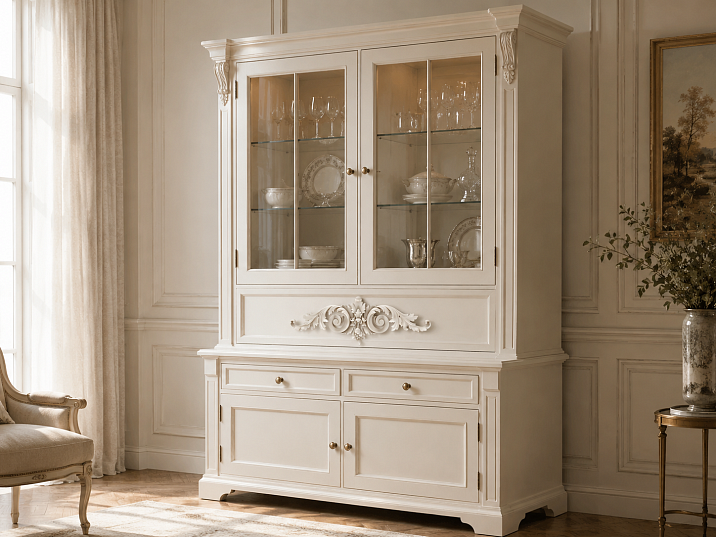
A cabinet with glass doors has one feature that is easy to forget when you want to add furniture decor: the glass itself already creates a complex and quite active surface. Behind it, you can see shelves, dishes, books, or decorative items, a frame runs along the perimeter of the facade, and handles are nearby. If you add large carved molding on top of this, the upper part of the furniture may lose the visual lightness for which glass doors were used in the first place.
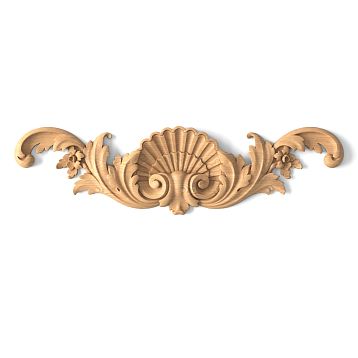
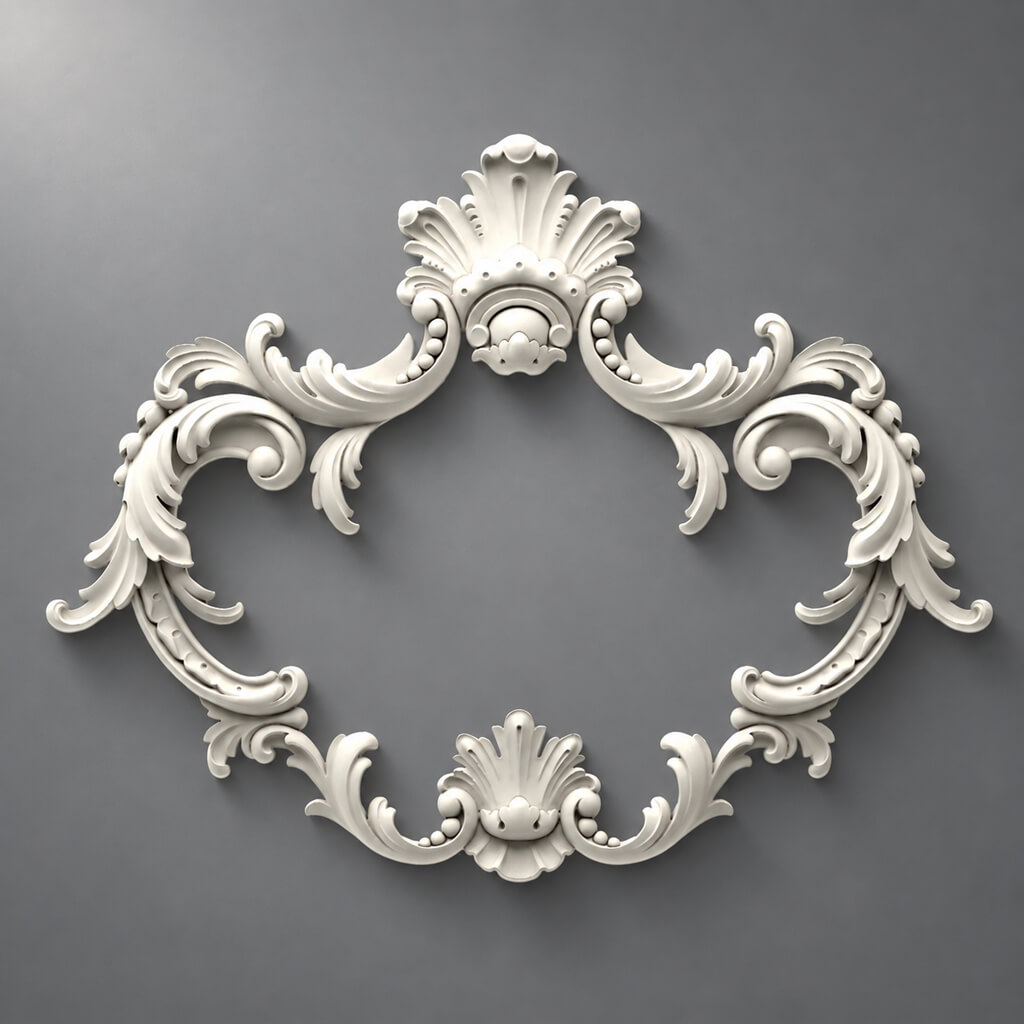
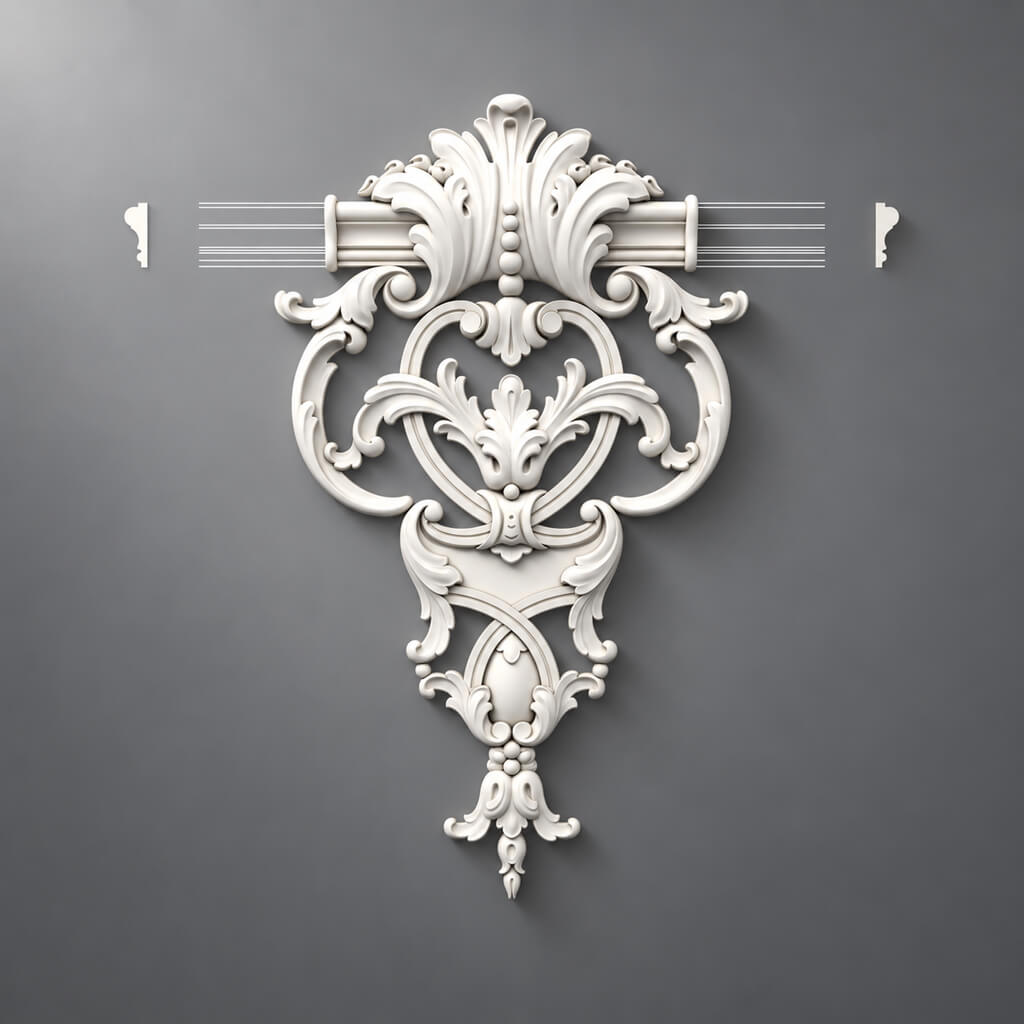
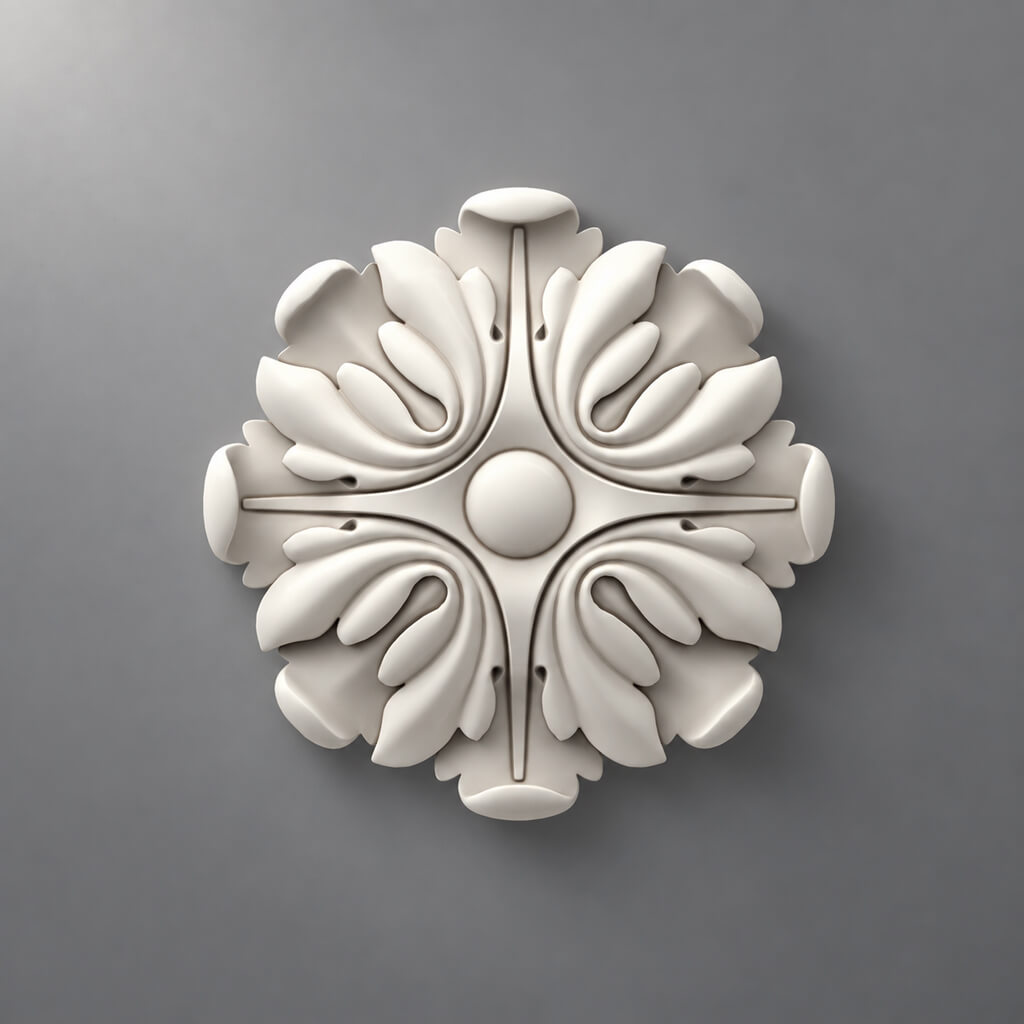
Therefore, molding for furniture does not necessarily have to be placed directly on the door. Sometimes it is much more accurate to leave the glass free and move the expressive ornament lower—onto the solid horizontal panel. It is for this scenario that the carved overlay NPU-250 made of polyurethane, measuring 280 × 90 × 12 mm, is interesting. Its horizontal proportion matches the very character of the furniture belt under the glass top: the width is significantly greater than the height, so the decor can support the horizontal line of the cabinet without encroaching on the transparent part.
But 280 × 90 × 12 mm is not just three numbers from the product card. Before ordering, you need to check whether the specific cabinet has 280 mm of free width, whether there is enough vertical space for 90 mm, what is next to the overlay, and whether the 12 mm relief will interfere with handles, adjacent doors, or other protruding parts. A separate question is how many overlays are needed: one in the center of the entire cabinet, one under each glass section, or only on the central solid part.
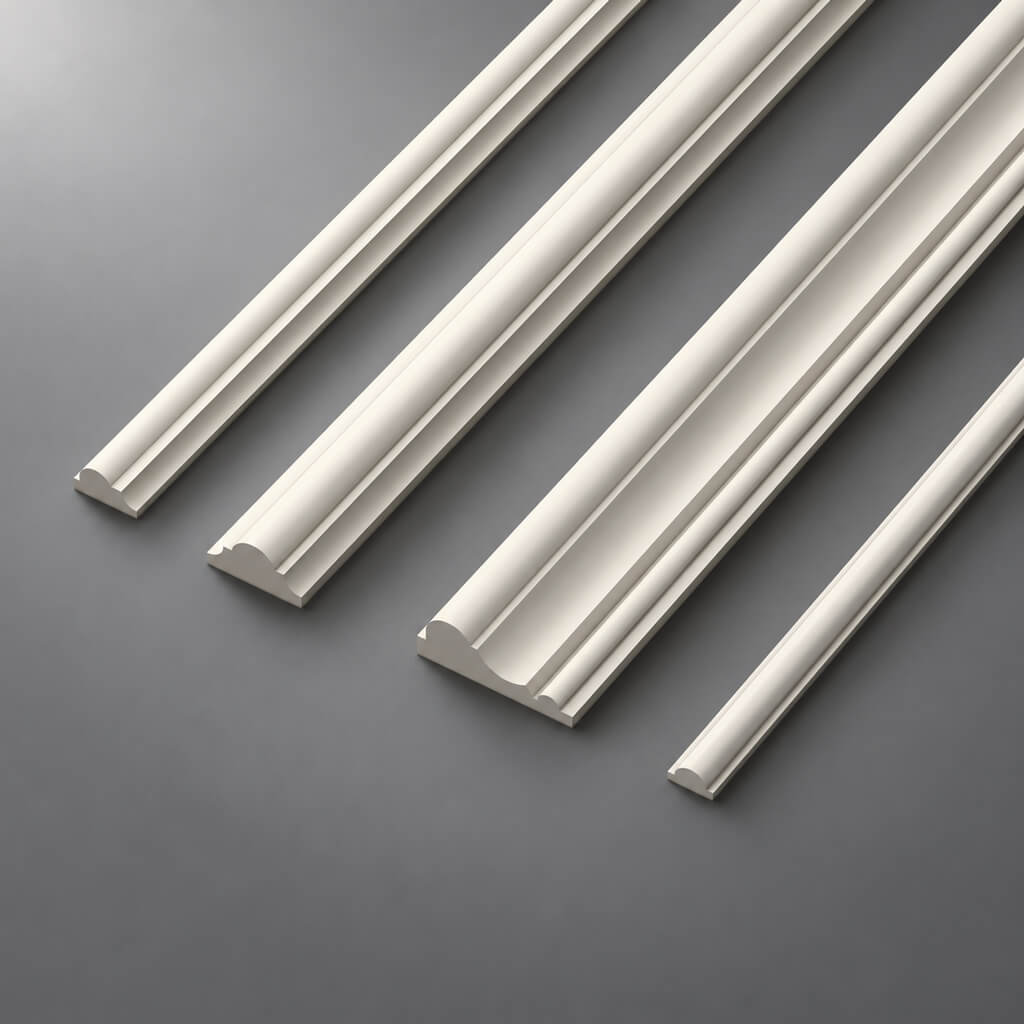
Therefore, it is better to choose NPU-250 not as an abstract "beautiful molded decor," but as a horizontal decorative overlay for a specific furniture field. If the cabinet design is only being planned and you want to compare different types of polyurethane decor, you can first You can buy ready-made stucco matching the Baroque style. Calculate the quantity: linear meters of cornices and moldings, number of rosettes, pilasters, consoles, corner elements. Add a ten to fifteen percent allowance for trimming. after studying suitable product groups. If it is clear that a local relief element on the facade is needed, it is more logical to Buy decorative polyurethane overlays and within this category, evaluate NPU-250 based on the actual size of the furniture.
When the installation location is determined, the path becomes even shorter: take measurements of the solid panel, make a template of 280 × 90 mm, check it on the facade, and buy the carved overlay NPU-250 only after the proportions have been confirmed on the cabinet itself.

The glass door is already expressive enough: why move the carved decor lower
If you look at a classic sideboard or display cabinet not as a single item, but as several horizontal levels, the task becomes clearer.
The upper part often handles displaying the contents. There are transparent doors, shelves, and items behind glass. The middle or lower part can be denser: solid panels, drawers, panels, horizontal bands.
These zones do not have to have the same intensity.




Glass works through transparency
When there is glass in the door, the gaze goes inside the furniture. Even a completely transparent field is visually filled with what is behind it.
Add:
-
a wooden or other front frame;
-
handle;
-
the hinge side;
-
the shelf lines;
-
silhouettes of objects inside.
This results in a fairly complex image.
A carved overlay directly on such a door can conflict with several elements at once.
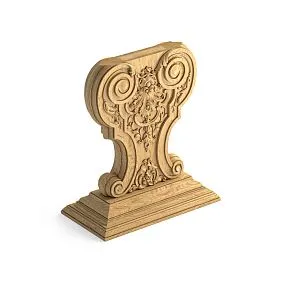
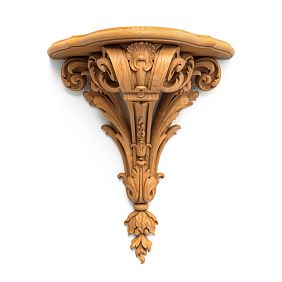
Our factory also produces:


A solid panel works differently
An opaque field under the glass does not show the contents of the cabinet.
If it is large and flat, this is exactly where a lack of decor may be felt.
The NPU-250 can give this area a central relief without covering or fragmenting the transparent part.
As a result, a clear distribution of roles emerges:
glass — lightness and visibility; solid panel — decorative center.
For a sideboard, this is often more convincing than trying to repeat the same ornament on every available surface.
Get Consultation
NPU-250: dimensions that need to be tried on specifically for furniture
NPU-250 — carved polyurethane overlay. Confirmed size — 280 × 90 × 12 mm.
The card provides for the use of a decorative overlay on furniture, doors, walls, and facades, so using it on the blank facade field of a sideboard corresponds to the very group of possible tasks for the product.
| Parameter | NPU-250 | What this means for the sideboard |
|---|---|---|
| Type | Carved decorative overlay | Used as a separate relief element |
| Article number | NPU-250 | Allows you to choose the model precisely |
| Material | Polyurethane | The material must be taken into account during installation and further finishing |
| Width | 280 мм | A sufficient horizontal platform is needed |
| Height | 90 мм | Need to check the height of the blank furniture belt |
| Depth | 12 мм | The relief protrudes relative to the facade |
| Proportion | Horizontal | Convenient for an elongated field under a glass door |
| Application | Furniture, doors, walls, facades | For the article topic, the furniture scenario is used specifically |
| Quantity | Depends on the number of fields being styled | One or more overlays can be used |
| Specific model | buy the carved overlay NPU-250 | Before ordering, the furniture facade must be checked |
The most important feature for our scenario is the 280 by 90 mm ratio.
This is not a square ornament or a long linear profile. NPU-250 occupies a specific horizontal field and has its own complete pattern. Therefore, on a sideboard it should be perceived as the center of the panel, not as part of a randomly cut decorative strip.
Why a width of 280 mm does not mean that a 280 mm panel is sufficient
Perhaps this is the first check to do before ordering.
If the overlay itself is 280 mm wide, placing it on a blank field of the same width means almost completely filling the surface from edge to edge.
Even if the part physically fits, compositionally it may lack free background space.
The overlay needs space around it
Imagine a panel 300 mm wide.
The NPU-250 takes up 280 mm.
Only 20 mm remains, that is, 10 mm on each side with precise centering.
The relief almost touches the vertical borders.
Now a panel 400 mm wide.
After centering:
(400 − 280) ÷ 2 = 60 mm.
60 mm of free field remains.
With a width of 500 mm:
(500 − 280) ÷ 2 = 110 mm.
The difference is huge.
The overlay itself is the same, but its character changes from almost full filling to a calm central ornament.
Therefore, measure the clear field
Not the entire sideboard.
Not the external width of the section.
Not the distance between the cabinet sides.
You need to measure exactly the surface on which the NPU-250 is intended to be installed.
If the blind panel is framed with a profile or molding, count the inner free space.
Preliminary estimation table by panel width
| Net panel width | Free space after NPU-250 | Field on one side when centering | What to Check |
|---|---|---|---|
| 300 мм | 20 мм | 10 мм | Ornament almost touches the edges |
| 340 мм | 60 мм | 30 мм | Composition remains dense |
| 400 мм | 120 мм | 60 мм | Noticeable background appears |
| 450 мм | 170 мм | 85 мм | Overlay reads as a separate center |
| 500 мм | 220 мм | 110 мм | Lots of free field |
| 600 мм | 320 мм | 160 мм | Need to check if the NPU-250 seems too small |
| 700 мм | 420 мм | 210 мм | A different scheme or additional elements may be needed |
This is not a table of "allowed facade sizes."
It shows why one figure of 280 mm does not give a ready answer.
Height 90 mm: sometimes it is this that first excludes the NPU-250
The buyer often looks at the horizontal size and forgets about the second one.
But the blind strip under the glass can be quite low.
If its clear height is 100 mm, an overlay of 90 mm will leave only 10 mm of free space, that is, about 5 mm at the top and bottom when centered.
Physically, the part fits.
Visually, it almost fills the entire band.
Panel 130 mm high
Free 40 mm.
When centered — about 20 mm on top and bottom.
Panel 170 mm high
Free 80 mm.
We get approximately 40 mm each.
Panel 220 mm high
130 mm remains.
The NPU-250 takes up less than half the height, and the question arises: doesn't the ornament seem too low relative to the entire panel.
Therefore, it is necessary to compare not only the width of the NPU-250 with the facade, but also the 90 mm with the height of the blind belt.
The platform for NPU-250 must be blank not formally, but visually.
Sometimes there is indeed an opaque panel under the glass, but it is already occupied:
-
with handles;
-
by lock hardware;
-
the panel;
-
by a recessed field;
-
by a decorative frame;
-
by a connecting profile.
Then the free area under NPU-250 may turn out to be smaller than it seems.
Before purchasing, it is useful to imagine the facade without the words "blank panel" and simply answer: where is the clean rectangle at least 280 mm wide and 90 mm high, plus the necessary background around it?
If there is no such rectangle, you should not try to squeeze in the overlay.
Depth 12 mm: the decor does not end with the frontal drawing.
NPU-250 has a relief of 12 mm.
For a facade, this is more important than for a stationary wall.
The sideboard opens.
The flaps operate nearby.
A person grabs the handles.
Drawers can be pulled out.
Therefore, it is necessary to check not only where the overlay looks beautiful in the closed state.
Handle
If the handle is on the same blank panel, the relief may end up near the hand.
The overlay should not impair access to the hardware.
Adjacent leaf
If the fronts pass close to each other when opening, the additional protrusion requires checking.
Pull-out drawer
If the NPU-250 is installed on a drawer front or on a panel next to it, check whether the relief falls into the working area.
Decorative cornice or belt
The depth of adjacent parts also affects the overall silhouette.
Therefore, it is useful to make the template not only flat.
You can add a conditional 12 mm spacer to the cardboard rectangle and look at the furniture from the side.
Why a horizontal panel under glass so naturally accepts the NPU-250
The shape of the part itself helps.
280 mm horizontally and 90 mm vertically give an aspect ratio of approximately 3.1:1.
That is, the overlay is clearly elongated.
A blind belt under the upper display case is also usually perceived horizontally.
These directions coincide.
A square overlay would work differently
It would create a local point.
NPU-250 is more like a horizontal ornamental center.
A vertical overlay would conflict with the construction
If there is one long belt under two glass doors, the vertical direction would break it up.
NPU-250 supports its width.
Linear decor would give a different task
Molding or carved trim runs along the entire length.
NPU-250 does not have to run from edge to edge.
It leaves a free field and becomes a separate accent.
Decor on a glass door or on the panel below it: a comparison without abstractions
| Criterion | Decor directly on the glass door | NPU-250 on a blank panel under glass |
|---|---|---|
| Impact on transparency | May visually overlap part of the glass field | Glass remains free |
| Background for the ornament | Shelves and contents are visible behind the detail | There is a blank surface behind the overlay |
| Perception of relief | Competes with items behind glass | Reads separately |
| Installation check | Depends on the door and glass construction | Depends on the blank panel |
| Connection with handles | May end up in the active zone of the leaf | Can be moved to a separate furniture belt |
| Character of furniture | More saturated glass top | Calm top and decorated bottom |
| Size selection | Depends on the glass panel frame | Depends on a blank panel 280 × 90 mm or larger |
For the scenario in question, the advantage of the lower placement is not that the glass “cannot be decorated.” There is no such universal prohibition.
The point is different: the buyer deliberately wants to keep the transparent part light.
Then moving the relief to the blank panel is consistent.
A paper template 280 × 90 mm needs to be made before ordering
For NPU-250 this is especially simple.
Cut out a rectangle:
280 × 90 mm.
Attach it to the intended panel.
Do not try to reproduce the ornament first. The first solution requires scale.
Look straight ahead
Is there sufficient background on the right and left?
Look from a distance
Does the rectangle get lost on wide furniture?
Look from the side
Remember the depth of 12 mm.
Open all doors
Has the perception changed and is there a potential conflict with moving elements?
Take a photo
The photo clearly shows the overall hierarchy:
glass top;
horizontal decor;
lower part of the sideboard.
Sideboard with two glass doors: one NPU-250 or two
This is one of the main practical forks.
Suppose there are two identical glass doors on top.
Below them runs one solid blank panel.
You can install:
-
one NPU-250 in the center of the entire buffet;
-
two NPU-250 — one under each door.
These layouts give completely different results.
One central overlay
Emphasizes the buffet as a single piece.
The seam between the glass doors at the top is not automatically carried over to the lower section.
This creates one large central focus.
Two overlays
Support the division of the upper part.
Each decorative element ends up connected to its own glass section.
This option requires a significantly larger overall facade width.
How to calculate two NPU-250 on one belt
Let the free width of the blank panel be 900 mm.
Two overlays will take:
280 × 2 = 560 mm.
remains:
900 − 560 = 340 mm.
But these 340 mm need to be distributed not only between the two parts, but also along the outer edges.
If an equal interval is needed in three places:
-
from the left;
-
between the overlays;
-
on the right,
it will be approximately:
340 ÷ 3 ≈ 113 mm.
This is already a quite readable scheme for the layout.
Now let's take a 700 mm panel.
After two overlays, what remains is:
700 − 560 = 140 mm.
With three equal intervals — less than 47 mm.
The composition becomes much denser.
That is, the quantity cannot be chosen separately from the width of the furniture.
A sideboard with two doors and a narrow central partition
Glass doors can be divided by a vertical post.
There is a temptation to place two NPU-250 units exactly under the centers of the doors.
This can work.
But first, check the bottom structure.
If there is one solid panel under the glass, two overlays break it up more.
If there are already two separate panels at the bottom, one NPU-250 per section looks more logical.
Do not repeat the top division mechanically. Look at the facade as a whole.
A sideboard with three sections: three NPU-250s might be too busy.
Three glass doors on top are not a reason to automatically buy three overlays.
Three NPU-250 pieces take up horizontally:
280 × 3 = 840 mm.
To keep proper intervals, the sideboard must have a corresponding width.
One NPU-250 in the center
Gives a calm central motif.
Three identical ones
Support the sectional layout.
Two on the sides, center without decor
Non-standard scheme that can only be considered on a mockup and with appropriate furniture construction.
Central panel plus moldings
Sometimes one NPU-250 and a thin frame are more convincing than three repeats.
Tall furniture display case: do not automatically raise the overlay to the glass
In a tall display case, the glass part can occupy a large share of the facade.
The blind belt below it appears relatively small.
That is why a horizontal ornament can serve as a useful transition point.
But it doesn't have to be placed directly under the bottom edge of the glass.
Sometimes it's better to leave a free strip of the facade between the glass door frame and the NPU-250.
It will separate:
-
the transparent level;
-
Carved decor.
This way, the details won't visually stick together.
Why the NPU-250 shouldn't "prop up" the glass
If the top edge of the relief almost touches the frame of the glass door, two different elements start to be perceived as one complex unit.
This can look cramped.
Especially if the sash frame itself is profiled.
If there is free height available, it is better to show that the NPU-250 is a separate ornamental center.
There is no universal mandatory distance.
It is determined by the actual height of the panel and the layout.
NPU-250 above the glass door: a possible but different scenario
Since the overlay has a horizontal shape, the question arises: why not place it above the display case?
This arrangement can also be considered if the furniture construction has a suitable blank upper zone.
But the effect is different.
Under the glass
The NPU-250 connects the transparent top with the blank lower part.
Above the glass
It approaches the cornice and the top finish of the furniture.
Then you need to look especially carefully at the existing cornice and other decorative details.
If the top is already saturated, adding NPU-250 may be unnecessary.
For a sideboard theme with light glass doors, the lower blind panel usually provides a calmer route.
Handles on a blind panel: function first, then ornament
If the handles are on the frames of glass doors, NPU-250 below barely interacts with them.
If the hardware is installed directly on the blind panel, everything changes.
Do not center the overlay through the handle
The handle should remain comfortable.
Do not place relief under the fingers
A depth of 12 mm means real volume.
Check the hand, not just the ruler.
Sometimes there are formally a few centimeters left between the handle and the NPU-250, but using the door is inconvenient.
Make a cardboard volumetric template and open the furniture several times.
The central handle and the central NPU-250 may compete for the same axis.
Suppose on a wide door the handle is located exactly in the middle.
If you place an NPU-250 directly under it, a strong vertical chain appears:
handle;
ornament;
the lower facade.
This may be intentional.
But it may look too mechanical.
Sometimes it is better to use the NPU-250 on a separate bottom panel that is structurally not connected to the handle of the glass door.
When the NPU-250 is sufficient without moldings
If the blank panel has a clear shape and its own boundaries, a single overlay can fully solve the decorative task.
For example:
-
a rectangular belt under two glass doors;
-
a free field in the center;
-
the edges of the panel are already defined by the cabinet construction.
Then an additional molding frame may be redundant.
Advantage of a single piece
The top remains light.
The bottom receives ornamentation.
The number of lines is minimal.
When a molding frame around the NPU-250 helps
If the panel is large and completely smooth, a single overlay can sometimes seem lost.
Then the frame can define the field.
First, the molding creates a rectangular border.
The NPU-250 occupies the center.
If such a structure is needed, you can buy polyurethane moldings after checking the dimensions of the specific furniture field.
But the frame should be added not out of habit, but after comparing two layouts:
NPU-250 without a frame;
NPU-250 inside the frame.
When the frame makes the facade worse
On a small panel, four sides of molding plus NPU-250 may be too much.
Especially if there is already a glass door with its own profiled frame above.
This results in several nested contours:
glass frame;
furniture belt;
molding;
a carved overlay.
Sometimes a simple scheme looks much stronger: glass on top, one horizontal carved element at the bottom.
Not every NPU-250 needs decoration for moldings
If a furniture frame already exists, it can be developed with corner or other decorative elements.
For such projects, a category is provided where you can buying polyurethane molding decor.
But that is the next level of design.
First, answer the question: is one NPU-250 enough or not?
If it is enough, do not complicate the composition.
Furniture decor in the color of the cabinet: relief without color noise
For a buffet with glass, this is a particularly interesting strategy.
If the NPU-250 strongly contrasts with the cabinet body, it immediately becomes one of the main elements of the facade.
If the overlay is finished in the color of the furniture, the pattern is read through the relief.
The glass retains transparency, and the blind part gets a plastic, not a color, accent.
Why this is useful for a display case with dishes
There may already be many different shades behind the glass.
Contrasting facade decor adds another one.
A solid-color NPU-250 allows making the cabinet body more complex in shape without increasing the number of colors.
First check the compatibility of the finish
You cannot assign a specific paint, primer, or application method without knowing the existing furniture finish.
You need to check the compatibility of the selected system with polyurethane and the facade material.
If the sideboard is already painted
Then the task is not just about choosing the NPU-250.
You need to decide how the new part will relate to the existing finish.
Different approaches are possible:
-
a color as close as possible;
-
a deliberate contrast;
-
a subsequent full repaint of the furniture surface;
-
another decorative solution.
The exact method of surface preparation depends on the actual coating.
It should not be assumed that any paint is equally suitable for both the body and the polyurethane pad.
If the furniture is only being manufactured
This is a more flexible situation.
The place for NPU-250 can be taken into account in advance.
For example, immediately plan for:
-
sufficient panel width;
-
the required height;
-
a free zone without handles;
-
positioning relative to glass doors.
But even here, you shouldn't design the entire facade around a single overlay without seeing the natural template.
Wide buffet: NPU-250 may be too small alone, but that's no reason to immediately install three.
Let's imagine a blank panel 1200 mm wide.
One NPU-250 takes up less than a quarter of the total width.
In the center, it can look like a small ornament.
What to do?
There are several ways.
Leave one
If the interior is restrained, this might be exactly the right degree of decoration.
Use two
A symmetrical system appears.
Add molding field
One NPU-250 gets an architectural boundary.
View other overlays
If a wider local ornament is needed, it is not necessary to multiply NPU-250.
You can Buy decorative polyurethane overlays after comparing other formats.
Narrow sideboard: here the 280 mm size becomes critical
A panel 320–350 mm wide leaves little side space.
NPU-250 will be perceived almost as full-width decor.
This is not always bad.
On a small object, such an effect can be convincing.
But it cannot be chosen randomly.
Template is mandatory
Without it, the 280 mm figure seems compact.
On real furniture, this is a fairly noticeable width.
Low sideboard with a display case on top
Sometimes the glass part is mounted on a low cabinet.
The blind panel between them is small.
The height of NPU-250 at 90 mm becomes the main constraint.
If the clear vertical space is only slightly more than 90 mm, the decor will take up almost the entire strip.
Perhaps this is exactly the desired effect.
But if there is no background around the ornament, the furniture may seem overloaded.
Sideboard with two drawers under glass
A very common logic: display case on top, drawers below.
The question is where to place the NPU-250?
On the common blind panel above the drawers
If it exists, this is one of the most understandable options.
On each drawer
That's a different scheme.
Two horizontal overlays will be repeated.
Need to check the width of each facade and the position of the handles.
Only on the central facade
If the sideboard has a mixed structure, one NPU-250 can highlight the main element.
Sideboard with three lower facades
Here it is especially dangerous to repeat the overlay mechanically.
Three NPU-250s create a strong rhythm.
If the upper display case is also divided into three parts, you get a very rigid grid.
Sometimes this matches the style.
Sometimes it makes furniture too fragmented.
Therefore, before ordering three parts, attach three paper rectangles at the same time.
One NPU-250 for the entire center of the furniture: when this is the strongest option
Imagine a sideboard 1000 mm wide with two glass doors.
Below them is one long solid panel.
One NPU-250 centered takes up 28% of its width.
A lot of free facade remains around it.
The ornament is readable but does not divide the furniture into two halves.
If the structure itself is already quite rich, this option may be preferable to two overlays.
Two NPU-250 under two glass doors: when pairing is more convincing
If the lower part structurally repeats the upper:
-
two glass doors;
-
two solid panels below them,
Two identical overlays support this rhythm.
Each should be centered on its own front panel, not approximately on half of the total body width.
Measure the left and right panels separately.
If the sections are of different widths
Do not try to automatically place the same NPU-250 in both parts.
On a wide section, it may look calm.
On a narrow one, it may look cramped.
If the furniture architecture is asymmetrical, the decorative scheme does not have to be absolutely identical either.
Perhaps the NPU-250 is only needed on the main field.
A glass door with a mullion already has its own ornament
The glass may not be solid.
The frame divides it into several parts.
Then the top of the sideboard becomes even more active.
In such furniture, it is especially useful to leave the door itself without additional molding.
NPU-250 on a blank panel continues the classic character, but does not impose carving on top of the existing grid.
A fully transparent minimalist display case and NPU-250
Here is a different risk.
If the cabinet is very modern and extremely minimalist, a carved overlay may feel stylistically foreign.
Technically, the size fits.
Compositionally, it's not.
You cannot choose molding only based on available space.
The ornament should match the overall idea of the furniture.
Classic sideboard: NPU-250 can replace a more complex carved composition
It's easy to get carried away with a classic piece.
Add:
-
door overlays;
-
drawer overlays;
-
moldings;
-
cornice;
-
decorative corners.
But if the glass top already has an elaborate frame, a single NPU-250 on the blind belt can provide enough carved pattern.
This is one of the main arguments of the scenario: not to decorate everything, but to choose the right field.
Dish display cabinet in the dining room
Behind the glass there is dishware that itself forms a decorative background.
If the doors are left clean, the contents are easy to read.
The NPU-250 below becomes part of the furniture, not a barrier in front of the collection.
It is especially useful to check the color of the cabinet body and the trim together.
Display cabinet in the living room
Books, art objects, and collections can stand here behind the glass.
The furniture fits into a more richly furnished room.
If there are already many details around, one horizontal NPU-250 can be more precise than complex facade decor.
Display cabinet in the study
Glass doors are often used for books.
The carved overlay below adds a classic character without covering the spines or complicating the glass fields.
But the panel dimensions are still checked individually.
Commercial display case
In a showroom or another interior with repeating cabinets, NPU-250 can be used as a repeating motif.
Here it is especially important not to order the entire batch based on a single image.
First:
-
one facade;
-
one template;
-
view from working distance;
-
checking repetition.
How not to confuse NPU-250 with molding
NPU-250 is a ready-made fixed-size overlay.
Molding is a linear profile.
If a strip across the entire width of the sideboard is needed, NPU-250 does not replace a linear profile.
If you need a single finished central ornament, a molding solves a different task.
How not to confuse NPU-250 with a furniture socket
A rosette is usually perceived as more centered.
NPU-250 is elongated horizontally.
That is why it aligns well with the furniture belt.
Do not choose a product only by the general category "carved molding."
Look at the proportion.
How not to confuse an overlay with a decorative panel
The panel occupies a large field.
NPU-250 is a local element.
It is not intended to completely cover a facade measuring 500 × 200 mm.
The free surface around the ornament is part of the composition.
How not to confuse a solid furniture panel with a panel insert
A paneled facade already has its own geometry.
If NPU-250 is placed inside a recessed or framed field, measure only the clean installation area.
Do not count the entire door size.
What to buy together with NPU-250
Additional decor is not always needed. For a glass-fronted sideboard, a restrained set is often valued.
| What to consider | For which task | When needed | Link |
|---|---|---|---|
| NPU-250 | Central horizontal decor | When the panel fits 280 × 90 × 12 mm | buy the carved overlay NPU-250 |
| Decorative overlays | Find another format | If NPU-250 does not match the field | Buy decorative polyurethane overlays |
| Overlays for furniture facades | Assemble decor for multiple sections | If more than one panel is being styled | Buy decorative overlays for furniture facades |
| Moldings | Form a frame around a blank field | If one overlay is visually insufficient | buy polyurethane moldings |
| Decor for moldings | Extend an existing frame | Only for a richer composition | buying polyurethane molding decor |
| Polyurethane molding | Match the buffet with the other decor | for a comprehensive project | You can buy ready-made stucco matching the Baroque style. Calculate the quantity: linear meters of cornices and moldings, number of rosettes, pilasters, consoles, corner elements. Add a ten to fifteen percent allowance for trimming. |
The point of the table is not to add as many products as possible to the NPU-250.
On the contrary.
The buyer must understand at what point the set is already complete.
How many NPU-250 to order: calculation is based on facade fields
For a ready-made overlay, there is no need to calculate linear meters.
The number of installation locations is counted.
One central belt
One NPU-250.
Two separate panels
If each uses one, then two NPU-250.
Three sections
After the layout, three parts may be required, but not necessarily.
Several identical sideboards
The quantity is multiplied by the number of approved facades.
If the interior has four identical display cases, each with one overlay:
4 × 1 = 4 pcs.
Is a reserve needed
There is no need to automatically add an extra NPU-250 based on the linear molding logic.
The molding gets a trim.
A finished overlay has a different principle.
But for a large project, you can separately decide whether an additional unit is needed for organizational reasons.
This is a matter of a specific order, not a universal consumption standard.
A paper specification protects against confusion.
For a complex buffet, it is useful to write down each section.
For example:
| Field | Panel size | NPU-250 | Quantity |
|---|---|---|---|
| Central blank panel | 620 × 180 mm | Yes | 1 |
| Left side | 250 × 180 mm | No, too narrow | 0 |
| Right side | 250 × 180 mm | No, too narrow | 0 |
| Lower drawer | 500 × 160 mm | Check template | After solving |
This is much more reliable than writing "two overlays are needed for the buffet."
Errors when choosing NPU-250 for a buffet
Choosing an overlay just because it looked good on its own
The ornament does not exist by itself.
It needs a suitable panel.
Measure the entire width of the furniture
NPU-250 is not installed on the entire cabinet.
The size of a specific field is needed.
Consider 280 mm a sufficient width for the panel.Who the NPU-250 is especially suitable for
This model is interesting to a buyer who has a horizontal free field and a desire to add carved decor without decorating the glass door itself.
Such cases are especially clear:
- a classic sideboard with two glass doors;
- a display cabinet with a solid belt;
- a credenza with a central horizontal panel;
- a display cabinet with a decorative lower part;
- a piece of furniture that one wants to update without changing the glass part;
- a new sideboard where the space for the overlay can be checked before final finishing.
Who should better consider another option
Other decor should be considered if:
- the free width is noticeably less than 280 mm;
- a vertical composition is needed;
- a square central element is needed;
- continuous decor along the entire length is required;
- the blank field is very large and one NPU-250 looks random;
- a different ornament character is required.
Then it is more reasonable Buy decorative polyurethane overlays after comparing sizes and shapes.
Updating an old sideboard: first remove visual noise
Old furniture may have many existing details.
Before adding NPU-250, evaluate:
- old handles;
- panels;
- cornice;
- legs;
- Decorative inserts.
If each element is already complex, a new overlay will not necessarily improve the facade.
Sometimes you first need to understand which decor remains the main one.
New sideboard: NPU-250 can be considered in the project, but do not design furniture only around it.
The size 280 × 90 × 12 mm can be pre-set into a blind field.
For example, choose a panel that leaves enough background.
But you shouldn't make the facade width exactly to fit NPU-250.
The overlay should support the furniture, not dictate the entire structure.
If the facade already has a panel
Need to measure the inner part where the NPU-250 will sit.
Let's say the outer width of the facade is 500 mm.
But the panel frame leaves only 300 mm inside.
It is these 300 mm that need to be compared with 280 mm.
The margins will be very narrow.
Perhaps such an installation is unsuccessful.
If the blank panel is absolutely smooth
Here, the NPU-250 has more freedom.
Allowed:
- center it;
- compare with the frame;
- use single decor;
- evaluate painting in the color of the housing.
A smooth field provides the cleanest background for carved patterns.
If a wide decorative band runs under the glass
NPU-250 may turn out to be the natural center.
But check if there is already a profile along the top and bottom edges.
If the band is saturated, an additional frame around the overlay is likely to be redundant.
How to finish the NPU-250 in the body color without losing the relief
With a single color, the form is read through shadows.
A depth of 12 mm is noticeable enough to account for lighting.
Light from above
Shadows appear under the lower edges of the relief.
Side light
It brings out the carved pattern more strongly.
Frontal diffused light
Makes the ornament softer.
Therefore, it is useful to evaluate color and size at the actual installation site.
Contrast NPU-250: when it becomes the main accent
If the overlay differs from the body in color, attention switches to it faster.
On a small sideboard, this can be too active.
On a large display case, on the contrary, it provides the needed focal point.
But this is already a different designer scenario.
To preserve the lightness of the glass top, a calm finish related to the body is often checked first.
Do not automatically copy the color of metal hardware
A gold, bronze, or other metal handle does not mean that the NPU-250 must necessarily match its shade.
Then the ornament begins to be perceived as additional hardware.
If the task is part of the facade architecture, the body color often looks calmer.
Furniture and the wall should be considered together
The sideboard does not stand in a vacuum.
On the wall there may be:
- Moldings;
- wallpaper;
- paintings;
- Wall decor.
If the background is very active, it's better not to overload the furniture facade.
If the wall is calm, the sideboard can feature a more pronounced carved detail.
NPU-250 in the dining room with wall molding
A good scenario is when the room already uses molded decor, and the furniture supports it through a single overlay.
There's no need to repeat the entire wall pattern on the facade.
A general decorative logic is enough.
When furniture decor should be calmer than wall decor
If the wall has large molding panels, the sideboard in front of it doesn't have to have as much relief.
One NPU-250 can create a connection without competing with the wall architecture.
When NPU-250 becomes part of a set rather than a separate purchase
If the entire piece of furniture is being updated, you can first determine:
- cornice;
- molding frames;
- central overlays;
- handle placement.
But links in the project are best directed only to confirmed categories.
For extended decoration, you can buy polyurethane moldings and compare them with a single overlay.
Practical check before ordering
Before , it is useful to record five parameters:, it's useful to write down five parameters:
- clean height;
- clear height;
- distance to the glass door frame;
- distance to the glass door frame;
- If at least one item remains unknown, the purchase is premature for now.
If at least one item remains unknown, the purchase is premature for now.
Blank field:
Blind field:
820 × 180 mm.
NPU-250:
280 × 90 mm.
Remaining width:
820 − 280 = 540 mm.
When centering:
270 mm on each side.
By height:
180 − 90 = 90 mm.
That is, approximately 45 mm at the top and bottom.
Such an overlay will occupy about a third of the width and half the height of the panel.
This is already a fairly clear layout.
Example: two panels of 360 mm each
Each has a width of 360 mm.
After installing the NPU-250:
360 − 280 = 80 mm.
40 mm on each side.
The composition becomes dense.
Two identical pieces together will make the bottom of the sideboard quite rich.
Here it is especially useful to compare two schemes:
- one NPU-250 per panel;
- one NPU-250 in the central common area, if the design allows it.
Example: panel 500 × 140 mm
By width:
500 − 280 = 220 mm.
110 mm on each side.
By height:
140 − 90 = 50 mm.
25 mm each.
The width looks loose, the height is significantly tighter.
This example shows why you cannot check only one dimension.
Example: panel 700 × 250 mm
NPU-250 occupies:
40% of the width;
36% of the height.
There is a lot of free background around it.
On such a field, a single patch may seem small.
You need to look at the entire sideboard.
Where to buy furniture decor if NPU-250 is not the only option
If multiple items or different facade fields are being styled, it is reasonable to first Buy decorative overlays for furniture facades after comparing the sizes of the entire category.
If a horizontal ornament NPU-250 is specifically required, the card of the particular model becomes the point of final order.
If the facade additionally requires a frame, a category is used where you can buy polyurethane moldings.
Thus, the purchase develops from the furniture structure, not from a random set of liked details.
How to buy NPU-250 on STAVROS without making a mistake in the task
The first question is not "where to glue the molding," but "which part of the sideboard do I want to keep visually light."
If the answer is glass doors, do not automatically fill them with decor.
The second question is whether there is a suitable blank panel underneath them.
The third is whether its field matches the size of 280 × 90 mm with a margin of free background.
The fourth is whether the 12 mm relief interferes with the furniture's use.
After that, you can buy the carved overlay NPU-250 in the calculated quantity.
FAQ: NPU-250 for sideboards and furniture display cases
What is NPU-250?
NPU-250 is a carved decorative polyurethane overlay measuring 280 × 90 × 12 mm.
Is NPU-250 suitable for furniture?
Yes, furniture is among the intended use cases for this overlay. Before installation, you need to check the specific front panel area.
Why place NPU-250 under a glass door rather than on it?
This way, the glass part can remain visually clear, while the carved decor is moved to the solid furniture panel.
Is it still possible to use molding on the glass door itself?
The specific possibility depends on the door's construction and the project. The scenario in question deliberately leaves the glass without an additional overlay.
What is the width of the NPU-250?
The width is 280 mm.
What is the height?
The height is 90 mm.
What is the relief depth?
The depth is 12 mm.
Is a panel 280 mm wide sufficient?
Matching dimensions only means physical compatibility in width. For proper perception, it is advisable to first check the free space around the overlay.
How to calculate side margins?
When centering, the formula used is: (panel width − 280 mm) ÷ 2.
What will fit on a 400 mm panel?
There will be 60 mm of free space left on each side.
And on a 500 mm panel?
There will be approximately 110 mm left on each side.
Do we need to consider the panel height?
Yes. The NPU-250 has a height of 90 mm, so you need to check the free space above and below.
Can the NPU-250 be installed on a panel with a height of 100 mm?
Physically, the size almost matches, but there will be very little free space. This option must definitely be evaluated with a full-size template.
How do I make a mock-up?
Cut out a rectangle 280 × 90 mm and attach it to the facade without permanent fixation.
Should 12 mm be taken into account on the paper template?
For a frontal assessment, a flat template is sufficient. To check handles and door movement, it is useful to also model the depth.
How many NPU-250 are needed for a two-door sideboard?
This depends on the design. A single central overlay on a common belt is possible, or two — one under each section.
Which is better — one or two?
One unifies the furniture more strongly, two emphasize the division into sections. The decision needs to be verified with a full-size mockup.
Can three NPU-250 be used on a three-section sideboard?
Such a scheme can be considered if the width of each panel allows maintaining sufficient intervals and the decor does not overload the facade.
Where to center one NPU-250?
Usually, the first option is the center of a clean blank field, rather than approximately the center of the entire cabinet body.
Can the overlay be shifted due to the handle?
Yes, if the design requires it, but the offset should look intentional. Sometimes it's better to choose a different zone than to break the symmetry.
Can the relief interfere with the handle?
Yes, if the handle is positioned too close. Before installation, you need to check the hand and the movement of the facade.
Is a molding frame needed around the NPU-250?
Not necessarily. On a small or already structured panel, a single overlay may be sufficient.
When is a molding frame useful?
When the blank field is large and one NPU-250 is not enough for an architectural boundary.
Where can I see moldings for furniture?
For the project, you can buy polyurethane moldings after measuring the facade field.
Can the overlay be finished in the color of the cabinet body?
Such a designer scenario is possible. The specific coating system needs to be selected considering the polyurethane and the existing furniture finish.
Should the NPU-250 be made contrasting?
No. Contrast is just one option. If you want to keep the glass top looking light, a calm finish in line with the cabinet body may be more appropriate.
Can the NPU-250 be placed above a glass door?
This option can be considered if there is a suitable solid top panel, but the cornice and existing decor need to be taken into account.
Will the overlay fit the bottom drawer?
Only after checking its clear area, handle, and facade movement. The size 280 × 90 × 12 mm must match the specific drawer.
Can one overlay be placed on each drawer?
Yes, but repeated repetition can make the furniture overly saturated. First, lay out paper templates on all fronts.
Is a quantity reserve needed?
For finished overlays, there is no mandatory cutting allowance as for linear profiles. The quantity is determined by approved installation locations.
Where can I see other decorative overlays?
If NPU-250 does not fit in width or proportions, you can Buy decorative polyurethane overlays after comparing other products in the category.
Can NPU-250 be used on an old sideboard?
This option can be considered if the blank field fits in size, the base allows installation, and the pattern matches the existing furniture.
Do I need to remove the doors before fitting?
For a preliminary assessment, this is not necessary. But you need to open the doors and check how the overlay interacts with the working furniture.
What to do if the panel is too narrow?
It is better to choose a different decorative overlay of a smaller scale than to try to fit the NPU-250 to an unsuitable field.
What to do if the panel is too wide?
Compare one NPU-250, several repeats, and a version with a molding frame. Do not multiply the decor automatically.
Where to order NPU-250?
After checking the facade, you can , it is useful to record five parameters: in the required quantity.
Glass does not need to be decorated just because it takes up most of the facade.
In a good sideboard, the decorative work does not have to be distributed evenly.
The transparent top can remain light.
That is exactly its purpose.
Behind the glass, shelves and items are visible. The door frame already forms a contour. Handles add another level of detail. If a large stucco ornament is transferred onto the same surface, it starts to compete with the contents of the display case.
The solid panel under the glass works differently.
It does not show the internal space.
It has a background.
And the NPU-250, measuring 280 × 90 × 12 mm, can use this background much more confidently.
Before ordering, you don't need to resolve dozens of questions. A few precise checks are needed.
Measure the clear width of the panel.
Compare it with 280 mm.
See how much will remain on the right and left.
Measure the height.
Compare it with 90 mm.
Check the handles, frames, and door movement taking into account the 12 mm depth.
Then cut out the paper template and look at the sideboard as a whole — with doors closed and open, from the usual room viewpoint, not just up close.
After that, decide whether you need one NPU-250 or several.
If the overall solid band is perceived as a single piece of furniture, one central ornament may be stronger than two or three repeats.
If the lower zone is structurally divided into separate sections, paired decor may be more convincing.
If the size 280 × 90 mm is not suitable, there is no need to rework the furniture to fit the chosen overlay. Better Buy decorative polyurethane overlays of a different scale.
If the NPU-250 looks too lonely on a large panel, you can check additional framing and, if necessary, buy polyurethane moldings. But the frame should appear because it is truly needed for the composition, not because “classic furniture must necessarily be complex.”
In STAVROS, the carved overlay NPU-250 is interesting precisely as a ready-made horizontal decorative element for a specific field. It allows you not to interfere with the glass part of the sideboard and to transfer the stucco accent to where it gets a calm opaque background.
This is exactly what should be checked before purchasing: whether there is enough space for 280 × 90 mm, whether the 12 mm relief interferes with the furniture's operation, whether one ornament matches the panel width, and whether the glass top is truly better left free.
If all four answers are confirmed by a real mockup, NPU-250 ceases to be just another decorative overlay. It becomes the element that connects the transparent and blind parts of the sideboard, without weighing down the display case and without forcing you to decorate every centimeter of the facade.