



































Article Contents:
- Why a "similar" baseboard may not fit
- First, find the SKU of the old wooden trim
- If the SKU is found, what to check before buying
- What to do if the SKU is unknown
- How to take measurements from an old baseboard
- Why a direct joint matters more than comparing two pieces separately
- Wooden molding: a few millimeters change the frame
- How to check molding in a corner
- Wooden cornice: a local insert is not always the best repair
- Building materials warehouse: we check availability before dismantling
- What “in stock” means
- What to do if the exact SKU is available but only in a different length
- Building warehouses: compare geometry, not photos
- When a physical sample matters more than a photo
- Wholesale building materials warehouse: when a small repair turns into a project
- How to compile a damage report
- When to repair and when to replace the profile
- Is the geometry intact?
- Is the damage localized?
- Will the joint with the old profile be visible?
- No suitable profile available?
- Find the same finish
- Reproduce the profile
- Replace the entire architectural line
- What to do first — find the product or remove the old profile?
- Can a skirting board be matched from a photo alone?
- What to check for availability?
- If 2.7 m is damaged, how much should you buy?
- When is it worth reproducing the old profile?
- When is it better to replace the entire run?
- Do you need a repair reserve?
- Where to find STAVROS wooden mouldings?

In a hotel, three metres of wooden skirting board are damaged. In a restaurant, after rearranging the furniture, chips were found on the moulding. In an apartment, part of the cornice had to be removed when replacing a built-in wardrobe. In all three cases, the task seems simple: find an "approximately the same" profile and replace the damaged section. In practice, it is precisely this attempt that most often creates a noticeable joint.
For local repairs, it is more important not to find a similar product, but to restore the exact product or geometric identification of the existing moulding. Therefore building materials database is useful primarily when the buyer can quickly follow the chain:
old SKU → material → size → length → finish → actual availability → comparison with the old element → section calculation → reserve → order.
If the old SKU is unknown, the order changes:
undamaged fragment → exact cross-section → drawing/measurement → comparison with the catalog → sample → decision: exact standard profile, custom reproduction, or replacement of the entire architectural line.
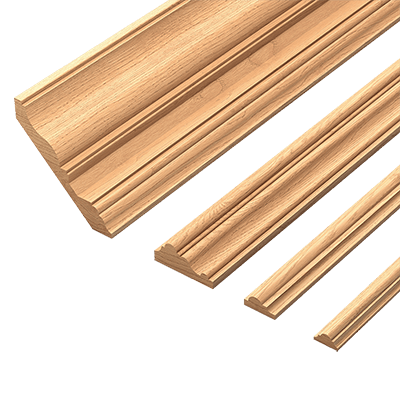
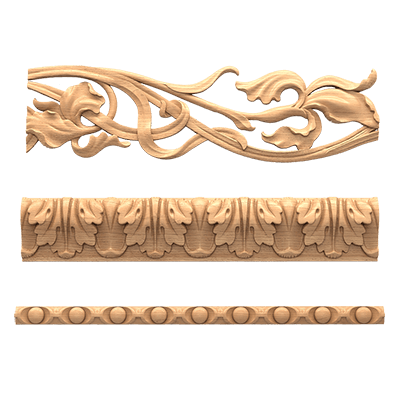
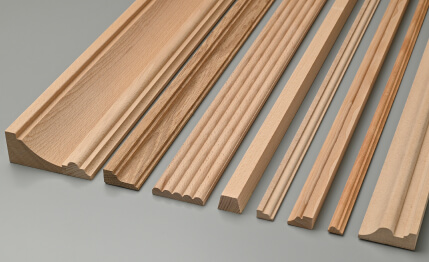
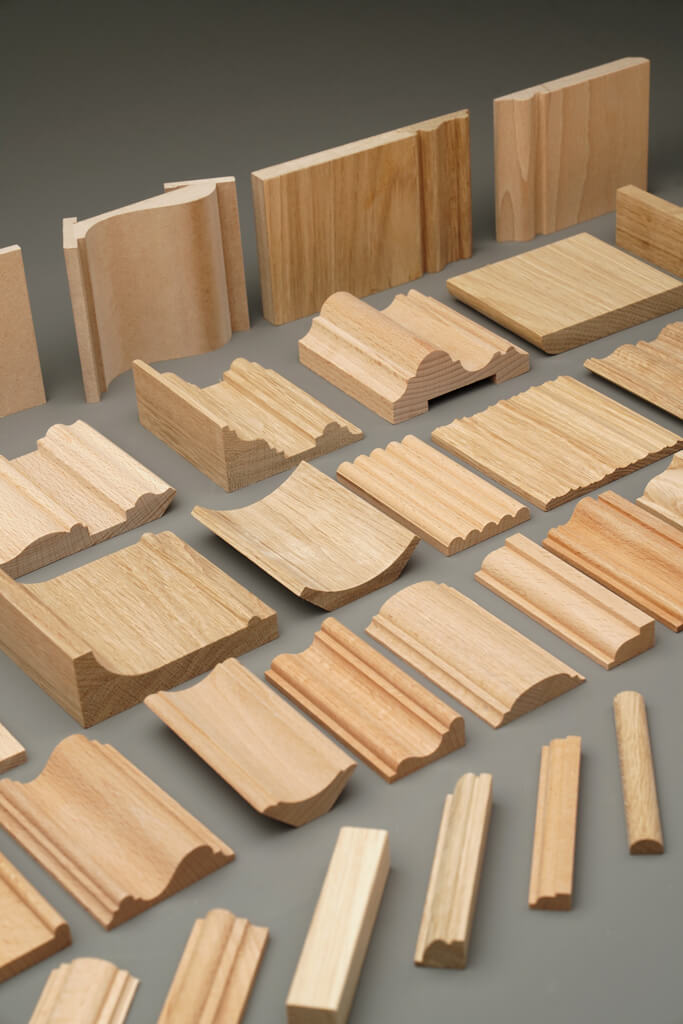
STAVROS has a current catalog of wooden mouldings, individual product samples, and the ability to manufacture custom profiles from individual drawings for production runs. This makes it possible to handle not only new interiors but also repairs to existing finishes without automatically replacing the entire room.


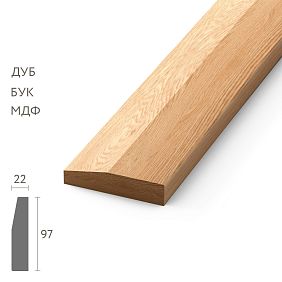


Why a “similar” skirting board may not fit
3 m of skirting board is damaged. It seems enough to choose a “tall oak one with approximately the same pattern.”
But the following may differ:
- full height;
- thickness;
- shape of the upper part;
- radius;
- relief of the front surface;
- the material;
- product length;
- nature of the preparation for finishing.
If the new profile is several millimeters higher than the old one, the transition will be immediately visible.
If the height matches but the top edge differs, the joint can still create a step.
If the geometry matches but the wood remains under a clear finish, the difference in material or texture may already become noticeable.
Therefore, local replacement begins not with the color of the photo in the catalog, but with a technical match.


First, find the article number of the old wooden molding
This is the fastest way.
The article number should be looked for in:
- old order;
- designer's specification;
- invoice;
- delivery note;
- correspondence with the supplier;
- box or preserved label;
- property passport;
- contractor's estimate;
- project archive card.
If the exact SKU is found, there is no need to re-select the profile by appearance.
Need to check:
whether it is the same material, the same size, the same length, and the same finish as originally installed.
The article number alone does not yet guarantee a complete match of the configuration if one product exists in several materials or lengths.
Our factory also produces:




If the article number is found, what to check before purchasing
The working line should not look like this:
PLT-___
But like this:
PLT-___ / oak / size ___ / length ___ / finish ___ / required ___ pcs.
For repairs, it is especially important to preserve the original finish.
If the old interior had oak, and the product found today of the same profile is selected in beech, it may match geometrically, but under a transparent coating the result will be different.
If the product is fully painted with opaque enamel, the visual role of the wood may be smaller, but the material still remains part of the specification.
Get Consultation
What to do if the article number is unknown
Then you need the most informative set of source data.
The best option is an undamaged fragment of the old product.
If it can be safely removed from a hidden or already dismantled area, keep it as a reference.
Additionally required:
- photo of the front surface;
- photo of the end face;
- exact width;
- exact thickness;
- overall cross-section contour;
- photos of the joints;
- material, if reliably identified;
- type of old finish;
- length of sections to be replaced.
The more complex the profile, the weaker a photograph is as the sole source.
For a shaped molding, an end section is usually more useful than a frontal photo.
How to take measurements from an old baseboard
For a baseboard, you need to measure more than just the "height."
Fix:
- full vertical dimension;
- full thickness;
- geometry of the top edge;
- the lower part;
- protruding and recessed elements;
- flat sections;
- the material;
- Surface condition.
If a product is covered with several layers of paint, the visible cross-section may differ from the original wooden profile.
Therefore, old paint cannot automatically be taken as part of the geometry.
In complex reconstruction, it is useful to compare two or three surviving sections rather than build a new profile from a single damaged end.
Why a direct joint is more important than comparing two parts separately
Two profiles may appear identical when viewed separately.
Place them end to end — and the difference becomes more obvious.
Check:
- matching overall height;
- matching thickness;
- continuation of the top line;
- continuation of the relief;
- absence of a step;
- behavior of the joint after future finishing.
For partial replacement, this is the main test.
If the new skirting board only joins the old one after noticeable adjustment of the entire adjacent line, it may be more rational to replace the section from a natural boundary to a boundary.
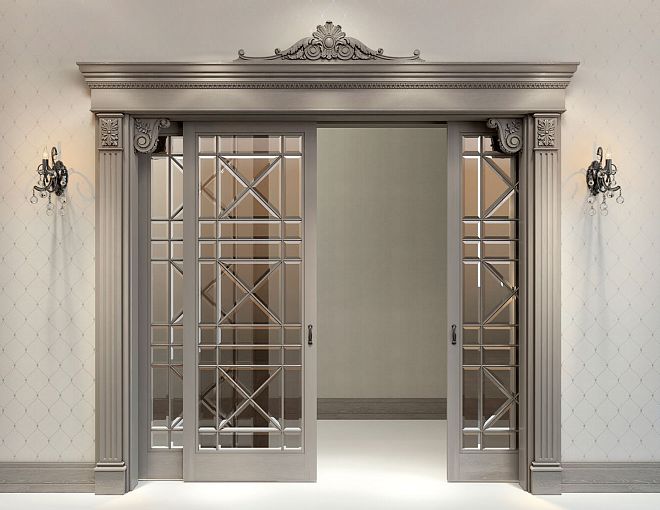
Wooden molding: a few millimeters change the frame
Molding works within a geometric composition.
A slight difference in profile can lead to the following:
- 45° angles do not continue the pattern;
- the old and new sides of the frame look different;
- the light and shadow change;
- the joint becomes noticeable;
- the width of the frame visually "breaks".
Therefore, for local molding repair, an exact profile is especially important.
A similar pattern is not sufficient.
If the old MLD-___ exists in the catalog, it is better to start with the exact article number.
If not, take the cross-section and resolve the issue of custom reproduction.
How to check the molding in the corner
For molding, not only a straight joint is useful, but also a corner test.
Make a small mockup from the old and new fragment.
Check:
- whether the width matches;
- whether the relief depth matches;
- whether the pattern continues;
- whether a step appears;
- whether the profile reads the same under side light.
If the profile is complex, the error is more noticeable at the corner than on a straight section.
Therefore, one successful straight joint does not yet guarantee a quality frame.
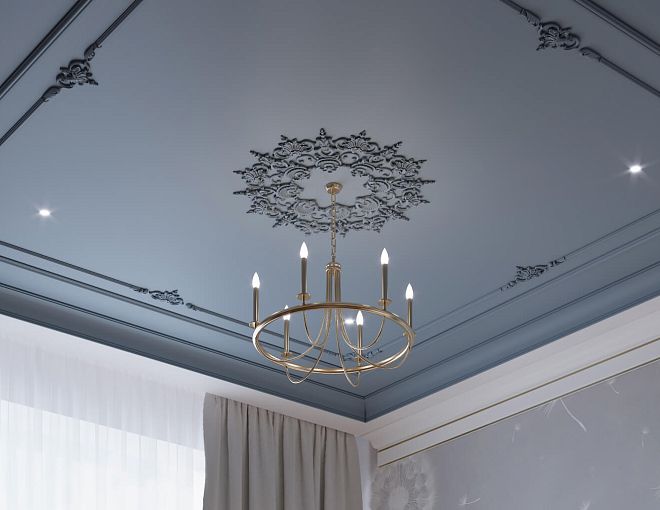
Wooden cornice: a local insert is not always the best repair
The cornice forms a long upper line.
If a profile with a different geometry is installed in the middle of this line, the difference may be noticeable even from the floor.
The following may differ:
- scale;
- relief;
- cross-section;
- position relative to the wall and ceiling;
- shadow pattern.
Therefore, for a cornice, you especially often have to choose between three options:
exact reorder → reproduction of the old profile → replacement from a natural boundary to a boundary.
A natural boundary can be a corner of the room, a portal, a column, a projection, or another architectural point where changing the element does not look accidental.
Building materials database: we check availability before dismantling
If you need building materials database for urgent repairs, the sequence is essential:
find the profile → confirm the configuration → confirm actual availability → determine the quantity → only then dismantle the damaged section.
Bad scenario:
the old skirting board was removed today, and tomorrow it turned out that the required version is not available and cannot be obtained by the renovation deadline.
For an operating hotel, restaurant, or office, this means an open, unfinished area.
Before dismantling, you need to understand at least one workable replacement path.
What “in stock” means
A green marker in the catalog by itself does not answer the question of a local repair.
Need to check:
- exact article number;
- the material;
- size;
- length;
- execution;
- the quantity actually available;
- city of receipt;
- the ability to obtain the required volume by the required date.
If 2.7 m is damaged, and the product is sold in 2.4 m strips, one piece is physically insufficient:
2,7 / 2,4 = 1,125.
The minimum is 2 whole strips, that is, 4.8 m of product length before accounting for cutting.
That is why a repair cannot be calculated based on the phrase “three meters are damaged.”
What to do if the exact product code is available, but only in a different length
This is a separate edge case.
Suppose the old profile was installed in 2400 mm strips, but currently only the same cross-section and material are in stock, in a different commercial length.
Such an item cannot automatically be considered fully equivalent for repair.
Need to check again:
- whether the required cut fits within the new length;
- whether the number of joints will change;
- whether the offcuts can be used on other damaged areas;
- whether the repair will become more expensive due to extra full strips;
- whether the new length is suitable for transportation and bringing onto the site.
For example, three solid pieces of 2.2 m are required. A 2400 mm strip covers each piece with a single unit. A 2000 mm strip no longer allows obtaining 2.2 m as a solid piece.
The product code may be the same, but the cutting layout is already different. For local repair, this is a fundamental difference.
Building profiles: comparing geometry, not photographs
When building profiles offer several visually similar options; the comparison must be based on a single reference chart.
| Parameter | Old profile | Candidate | | --- | --- | --- | | Product code | ___ | ___ | | Material | ___ | ___ | | Overall width | ___ | ___ | | Thickness/second dimension | ___ | ___ | | Cross-section shape | reference | drawing | | Length | ___ | ___ | | Surface | ___ | ___ | | Straight joint | — | check | | Corner joint | — | check |
Letters A, B, C, or other designations cannot be assigned a universal physical meaning without an official drawing for the specific product.
For repair, what matters is the fact that the geometry matches, not the name of the size letter.
When a physical sample matters more than a photograph
A sample is especially useful if:
- the old product code is unknown;
- the interior is old;
- shaped profile;
- partial replacement;
- complex relief;
- the wood remains visible;
- the adjacent old line is preserved;
- a mistake will require repeated dismantling.
STAVROS has separate samples of mouldings and moulding sample sets.
For repairs, this allows you to first compare the physical geometry, and only then buy the main volume.
A sample does not replace an exact drawing, but it does a good job of revealing an error in scale and shape.
Wholesale building materials base: when a small repair turns into a project
Sometimes wholesale building materials warehouse is no longer needed just for three meters.
After the inspection, it may turn out:
- 80 m of skirting boards are damaged along the corridors;
- 40 m of cornice require replacement;
- several dozen moldings have chips;
- the same profile is used on several floors;
- part of the repair is better carried out in a single sequence.
Then a local purchase turns into a full-fledged project specification.
It's no longer a matter of "buying a couple more strips" but rather:
survey → classify damage → decide what is retained → calculate linear footage → create a cutting plan → determine reserve → divide repairs into zones.
How to compile a damage report
Example:
| Zone | SKU | Condition | Action | Required | | --- | --- | --- | --- | ---: | | 2nd floor corridor | PLT-___ | chips | replace sections | 18 m | | Room 204 | MLD-___ | damaged | replace | 6 m | | Lobby | KZ-___ | local defect | survey | 8 m | | Restaurant | PLT-___ | coating wear | repaint | 0 m |
The last row is especially important.
Not every damage requires purchasing new linear stock.
Sometimes the geometry is intact, and the problem is only in the coating.
When to repair and when to replace the profile
For each section, it is useful to go through four questions.
Is the geometry intact?
If so, surface restoration without replacement may be possible.
Is the damage localized?
If so, check the possibility of a short insert.
Will the joint with the old profile be visible?
If so, geometric precision is critical.
No suitable profile available?
Then compare custom reproduction and replacement of the entire architectural line.
This way, purchasing only happens where it is truly needed.
Why you cannot order exactly as many meters as are damaged
2.7 m is damaged — that does not mean you need to buy 2.7 linear meters.
Whole products of a specific length are supplied.
For example, the product length is 2.4 m.
For 2.7 m, the minimum required is:
ceil(2.7 / 2.4) = 2 planks.
Purchased:
2 × 2.4 = 4.8 m.
But even these 4.8 m do not yet guarantee a completed repair.
If the area being replaced consists of two independent zones of 1.35 m each, two planks may be sufficient with a good remainder.
If there are complex joints or the damage turns out to be longer after removal, a different calculation is needed.
Therefore, the linear meterage is converted into a map of actual cut lengths.
How to calculate multiple damaged areas of the same SKU
Let's imagine three sections:
- 1.8 m;
- 1.1 m;
- 0.9 m.
Total:
1.8 + 1.1 + 0.9 = 3.8 m.
With a 2.4 m strip, mathematically two pieces are needed:
2 × 2.4 = 4.8 m.
You can cut:
- first strip → 1.8 m + 0.6 m remainder;
- second → 1.1 m + 0.9 m + 0.4 m remainder.
Two strips do indeed cover the task.
But if there are three sections of 1.7 m each:
Total requirement:
1.7 × 3 = 5.1 m.
Simple division:
5.1 / 2.4 = 2.125, formally giving three strips.
And in this case, each strip yields one piece of 1.7 m, with leftovers of 0.7 m each.
This way, the cutting map immediately shows the real quantity.
What to do if the required SKU is no longer available
There are three main scenarios.
Find the same finish
Sometimes the SKU is still active, but it is not in the first search results or region.
Replicate the profile
If the existing geometry is critical and the volume justifies custom production, an accurate drawing can be prepared.
STAVROS indicates the possibility of manufacturing custom linear profiles according to drawings for production runs. Specific terms must be clarified for a real order.
Replace the entire architectural line
If exact reproduction is not feasible, you can replace the baseboard or cornice from corner to corner, from portal to portal, or along another natural boundary.
This is usually better than inserting a noticeably different short fragment into the middle of the old line.
When profile reproduction is more advantageous than full replacement
Let's imagine an interior with 600 m of existing molding.
40 m is damaged.
Replacing the entire volume means:
600 / 40 = 15.
That is, fifteen times more new material will be required than the damaged linear meters themselves, even before accounting for dismantling, wall preparation, and installation.
If the profile is unique and the remaining 560 m are in good condition, individual reproduction of the damaged sections may be more rational.
But if only 20 m of the old molding has been preserved, and 580 m needs to be replaced, the logic may be the opposite: it is easier to switch entirely to a new standard profile.
How to check a control sample before custom manufacturing
The old and new fragment need to be:
- butt-joined;
- compare overall dimensions;
- check the relief;
- assemble a straight joint;
- perform a corner test, if needed;
- inspect under side lighting;
- perform a test finish if visual coating match is critical.
Only after that should a production volume be approved.
The format and cost of the control sample must be agreed upon separately. It should not be considered an automatic free service from the manufacturer.
What to do if the geometry matches but the color doesn't
Old wood and its finish change over time.
Even a new profile made of the same species may look different due to:
- fading of the old finish;
- darkening;
- repair layers;
- differences in sheen;
- new tinting.
There are three practical solutions:
local color matching;
repainting the entire line within the room;
replacing the section between natural boundaries with a new unified finish.
It is impossible to promise a perfect match between the old and new coating without a test paint.
Wholesale building materials warehouse: when to take a repair reserve right away
If wholesale building materials warehouse used for a rare, individual, or critical profile; after repair, it is reasonable to decide on a future reserve.
Especially if:
- the profile is used throughout the entire facility;
- it is complex in geometry;
- the facility is operated intensively;
- reproduction will take time;
- the material should visually continue the existing line.
The reserve should not be calculated as a universal percentage.
For a specific project, you can keep several whole items of the most critical SKUs.
Why the repair reserve should consist of whole elements
A 200 mm offcut rarely helps if, three years later, a 1.8 m section of skirting board is damaged.
Therefore, it is better to build the operational stock as follows:
several whole planks + article number + material + size + order number.
Short offcuts can be useful as color and geometry samples, but they do not replace a long repair reserve.
For a rare profile, the value of a single whole plank may only become apparent years later.
Wholesale building material depots: when to check several locations at the same time
If wholesale building materials depots used to find the old SKU; you should not limit yourself to the first matching card.
It is worth checking:
- exact SKU match;
- the material;
- length;
- card status;
- available volume;
- lead times;
- possibility of reordering.
But comparing multiple sellers only makes sense for the same product configuration.
A similar profile in a different size is not "the same product for less."
Building material depots: how not to turn urgency into a mistake
When damage prevents a room, restaurant, or office from opening, you want to buy the first similar solution.
It is here construction material databases should be used as a precise search tool, not as a reason to speed up the choice.
Urgent repairs still go through at least four checks:
SKU → geometry → availability → quantity.
If the SKU is unknown:
sample → measurement → candidate → physical comparison.
It is better to spend one extra day checking than to redo a noticeable joint a week later.
Where to store information about trim after renovation
After completing the work, save:
- exact article number;
- manufacturer;
- the material;
- size;
- commercial length;
- photo;
- link to the product card;
- order number;
- date;
- remaining stock;
- reserve storage location.
It is useful to create a short passport:
| Field | Value | | --- | --- | | Zone | 2nd floor corridor | | Profile | PLT-___ | | Material | oak | | Size | ___ | | Length | ___ | | Order | No.___ | | Reserve | 2 pcs. | | Storage location | operations warehouse |
The next repair crew receives accurate data, not a photograph of the wall from five years ago.
Ready-made algorithm for urgent additional purchase
- Do not dismantle everything at once.
- Find the old SKU.
- Set the material and finish.
- If there is no SKU, take a cross-section and keep a sample.
- Find the exact profile or a technically justified option.
- Check actual availability.
- Compare the old and new fragment.
- Decide: local insert, custom reproduction, or line replacement.
- Create a map of the sections to be replaced.
- Convert the linear meters into whole units.
- Add only a justified installation allowance.
- For a rare profile, create an operational reserve.
- Save the procurement passport after repair.
When it is better not to do a local additional purchase
You should not try to preserve the old line at any cost if:
- the profile is severely damaged almost throughout the entire room;
- the old cross-section no longer matches the new concept;
- only a small percentage of the material has been preserved;
- individual reproduction is economically unjustified;
- an exact joint is still impossible;
- the old finish is so uneven that a local insert will stand out;
- A new standard profile allows you to logically replace the entire line between natural boundaries.
Sometimes a complete switch to a new profile is not an "unnecessary expense," but a way to avoid endless fitting.
Mistakes when urgently buying additional wooden trim
Mistake: looking for a "similar oak skirting board."
The reason is that the old article number is unknown. The consequence is a visible transition. The solution is to restore the cross-section and compare physically.
Mistake: dismantling before confirming the replacement.
The reason is that the repair needs to start urgently. The consequence is that the open area remains without material. The solution is availability first, then dismantling.
Mistake: ordering exactly the damaged linear meters.
The reason is that they count linear meters, not planks. The consequence is that there is not enough material after cutting. The solution is to convert to whole units.
Mistake: comparing only the width.
Cause — the profile looks identical from the front. Consequence — the relief or thickness does not match. Solution — compare the full cross-section.
Mistake: treating any leftover as a reserve.
Cause — “there’s wood left.” Consequence — during the next renovation, the length is useless. Solution — an operational reserve made of whole elements.
Mistake: starting custom production without a sample.
Cause — the drawing seems sufficient. Consequence — the error is repeated across the entire batch. Solution — a control comparison first.
Questions before buying more
What should be done first — look for the product or remove the old profile?
First look for the article number in the documents. If it is not there, move on to measuring and a sample.
Can a skirting board be matched from a photo alone?
For a partial replacement, this is unreliable. Dimensions are needed, and preferably a physical comparison.
What should be checked for availability?
Product code, material, size, length, finish, and the quantity actually available.
If 2.7 m is damaged, how much should be purchased?
It depends on the commercial length and cutting plan. With a 2.4 m strip, the mathematical minimum is two full strips.
When is it worth reproducing an old profile?
When a significant part of the existing line is preserved, an exact joint is critical, and custom production is economically justified.
When is it better to replace the entire line?
When little of the old profile remains, exact reproduction is impractical, or the new section will still be noticeably different.
Is a repair reserve needed?
For rare and critical profiles, it is useful, but the quantity is determined by the project, not by a universal percentage.
Where to find STAVROS wooden mouldings?
In the catalogue of moulded products; if a standard profile does not meet the requirement, you can separately enquire about manufacturing to a custom drawing.