Article Contents:
- Sample of slat panel OPAN-001 196×8×310 mm: what exactly we buy for testing the counter
- OPAN-001 made of MDF
- Beech sample OPAN-001
- Oak OPAN-001
- Why the size 196×8×310 mm is sufficient for local radius check
- What the small OPAN-001 fundamentally does not show
- What to check on the actual radius
- Why you can't promise "PAN-001 is guaranteed to fit R=120"
- Check on a manufactured stand
- Check several heights
- Check the start of the radius
- Check the apex
- Check the exit to the straight line
- Take photos from the side and from above
- MDF OPAN-001 for painting
- Oak OPAN-001 for clear finish
- Beech OPAN-001
- Mathematical minimum
- What seven gives
- Nominal excess
- Why this is a good start
- Why this percentage alone doesn't decide anything
- Phase of the slat pattern
- Position of the first cut
- Position of the last cut
- Two radius transitions
- Damaged or uncomfortable edge
- Need to keep a whole edge rail
- Actual body geometry
- Step 1. Fix the clean flat pattern
- Step 2. Apply two R=120 mm
- Step 3. Apply visible zones
- Step 4. Apply desired joints
- Step 5. Check edge endings
- Step 6. Calculate remainders for each original module
- From the central axis of the post
- From the most visible end
- From the central straight section with symmetrical transition to the radii
- Bad location: the top of the most visible radius
- Bad location: bright side light
- Bad location: central frontal point
- Bad location: constant contact zone
- More convenient location: straight part
- More convenient location: less visible end face
- Radius with a single piece
- Joint on the radius
- Joint on the invisible side
- If the finished height is 920 mm
- If the height is 930 mm
- If the height is 945 mm
- If at one point 955 mm
- Why you need to measure more than once
- Check during the day
- Check under ceiling light
- Check with LED backlighting
- Look from the visitor's side
- Look from the staff's side
- MDF
- Primed MDF
- Oak
- Oak
- The main PAN-001 can be ordered right away if
- First OPAN-001, if
- Oak: a particularly sensitive choice
- Oak
- MDF
- The eighth PAN-001 is justified if the map of seven doesn't add up
- The eighth can be a useful service reserve
- The eighth is an overpayment if seven are already laid out
- What should match at the bottom of the table
- Why the table should not automatically have seven parts of 971–972 mm
- Why you need to label the radius/straight line
- What can be done better
- Main conclusion
- What not to do
- Why the radius complicates the ruler
- If 6800 mm are already obtained by the sweep
- MDF for covering paint
- Oak for transparent finish
- Oak
- Check 1. Color
- Check 2. Gloss
- Check 3. Tactility
- Check 4. Cleaning
- What not to do
- Why this is needed
- General section of samples
- Cost of three samples
- If the rack faces the hall frontally
- If one end is visible from the entrance
- If both ends are equally noticeable
- Option 1. Shift adjacent joints
- Option 2. Change the layout start
- Option 3. Buy an eighth one
- Why you can't keep the old one
- MDF
- Oak
- Oak
- What this means
- Why the application should state "finishing deployment"
- Why specify OPAN-001
- Why specify the function of the eighth module
- R=120 exists only in the drawing
- The rack is still being puttied
- OPAN-001 is not attached
- Material is not selected
- 6800 mm approximate
- Joints not marked
- Cladding height not measured
- Finish not approved
- Bottom/top edge not resolved
- Error 1. Ordering seven just because 6800/1010=6.73
- Error 2. Automatically order eight "with a reserve"
- Error 3. Check R=120 only with an MDF sample, then buy oak
- Error 4. Consider overall flexibility a guarantee of a specific minimum radius
- Error 5. Check OPAN-001 only at one point of the arc
- Error 6. Check only one of the two R=120
- Error 7. Measure 6800 mm in a straight line, not along the surface
- Error 8. Assume the arc shape based on one R=120
- Error 9. Leave a joint at the top of the most visible radius without a reason
- Error 10. Remove all 270 mm from one end
- Error 11. Divide 270/2 and consider 875+…+875 as the finished cutting layout
- Error 12. Not measuring the rack height by length
- Error 13. Painting the entire batch before testing the radius
- Error 14. Considering OPAN-001 a full check of all joints
- Error 15. Not storing the approved sample
- Error 16. Ordering oak based on the current 6 pieces without confirming the seventh
- Error 17. Considering 270 mm as one useful remainder
- Error 18. Using the repair eighth module as compensation for poor installation
- Scenario A. Main view — long front
- Scenario B. One end is the main one
- Scenario C. Both ends are equally important
- Useful remainder
- Technological waste
- Installation reserve
- Why 270 mm in total can turn into almost zero useful stock
- Keep a large remainder of seven modules
- Buy the eighth PAN-001 entirely
- What to choose
- What this helps detect
- What it does not help with
- Transitions
- Vertices of the two ends
- Joints
- Bottom edge
- Top edge
- Light
- Why the table has two separate rows for the eighth PAN-001
- Why the sample material and the main panel are listed in separate rows
- MDF: sample + seven PAN-001
- Oak
- Oak
- If after the test it turns out the material is not suitable
- Option 1. Redistribute the joints
- Option 2. Change the position of one joint on a straight line
- Option 3. Buy an eighth PAN-001
- If no reserve is needed
- If needed
- What is the size of OPAN-001?
- What materials is OPAN-001 made from?
- How much does OPAN-001 cost?
- What is OPAN-001 used for?
- Can OPAN-001 be tested at R=120 mm?
- Does the sample guarantee the suitability of the entire counter?
- Do I need to take a sample in the same material as PAN-001?
- What is the size of the short PAN-001?
- How many PAN-001 are needed for 6800 mm?
- How much do seven modules give?
- What is the nominal remainder?
- Why might seven not be enough in practice?
- When is the eighth PAN-001 needed?
- Where is it better to place the joints?
- Can a joint be made on a radius?
- How to check the height of 950 mm?
- What is better for a stand — MDF, beech, or oak?
- How much do seven short PAN-001 made of MDF cost?
- And eight?
- How much do seven oak PAN-001 cost?
- Eight oak ones?
- What to do if only six oak panels are shown in stock?
- Can 6800 mm be counted along the straight facade?
- Can the arc length be calculated using only R=120?
- Where to buy OPAN-001?
- Where to buy PAN-001?
- Where to compare different slat panels?
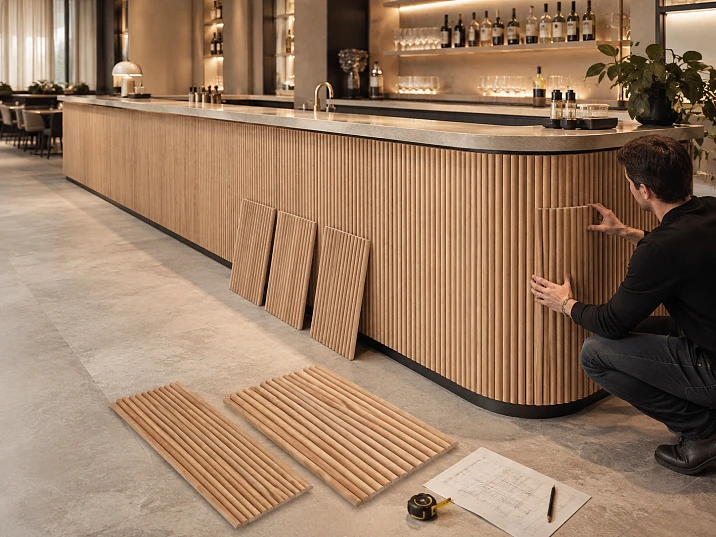
Seven PAN-001 mathematically cover the 6800 mm sweep. This does not yet mean that exactly seven should be ordered.
The calculation looks almost flawless:
6800 / 1010 = 6,73.
We round up — we get 7 modules.
Seven PAN-001 give:
7 × 1010 = 7070 mm.
Nominal excess:
7070 − 6800 = 270 mm.
If you look only at the calculator, the eighth panel seems obviously redundant. But a bar counter differs from a straight wall by two actual ends with R=120 mm. And here 270 mm cease to be just a "cutting allowance."
Before payment, four things need to be checked:
-
whether the selected material PAN-001 actually passes the specific R=120 mm without undesirable changes;
-
where the joints will be relative to the two radius ends and the main frontal zone of the counter;
-
do 270 mm allow maintaining a correct rhythm and both extreme endings after actual cutting;
-
is 6800 mm the clean unfolded surface length along the facing, not the approximate straight-line length of the body.
That is why in this article the first product is not the full-size PAN-001, but a sample OPAN-001 196×8×310 mm.
The manufacturer describes OPAN-001 as a compact demonstration module for evaluating texture, pattern, profile depth, and material. At the time of verification, the following are available:
| OPAN-001 | Size | Price |
|---|---|---|
| MDF | 196×8×310 mm | 540 ₽ |
| Beech | 196×8×310 mm | 940 ₽ |
| Oak | 196×8×310 mm | 1 490 ₽ |
The full-size PAN-001 has a flexible fabric base; the card directly indicates the ability to face straight and curved surfaces. But there is no separate published technical standard like "minimum guaranteed radius = 120 mm" in the card. Therefore, R=120 mm in our project cannot be considered automatically confirmed only by the general word "flexible."
The cheapest way to eliminate this risk is to physically buying a sample OPAN-001 use exactly the material planned for the stand and apply it to the already manufactured end.
After a successful radius check, a layout of seven full-size PAN-001 1010×8×950 mm is built. And only if this layout does not fit the actual parts, joints, and two beautiful endings into 7070 mm of original width, an argument for an eighth module appears.
Thus, the article answers two related but different questions:
-
OPAN-001 confirms that the selected material is generally suitable for the specific R=120 mm.
-
The cutting map confirms whether seven PAN-001 units are enough or an eighth is really needed.
If both checks pass, you can buy wall slat panels no longer 'with a margin percentage', but with a clear specification of the specific rack.
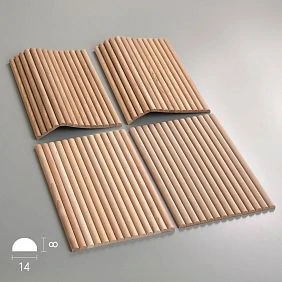
Sample of the slat panel OPAN-001 196×8×310 mm: what exactly we buy for the rack test
OPAN-001 does not replace the full-size PAN-001. Its task is much narrower: to provide a physical piece of the same geometric idea that can be brought to the manufactured body and checked where the drawing no longer answers all questions.




OPAN-001 made of MDF
Size — 196×8×310 mm.
Price at the time of check — 540 ₽.
An MDF sample is logical if the main batch of PAN-001 will also be made of MDF and will be painted with an opaque coating.
On the sample you can check:
-
real thickness and relief;
-
behavior of the flexible base on the radius;
-
how much the visual pitch of the slats changes when bending;
-
what the transition “straight → R=120 → straight” looks like;
-
surface quality for future finishing.
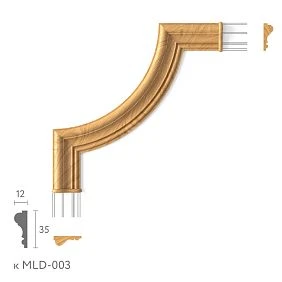
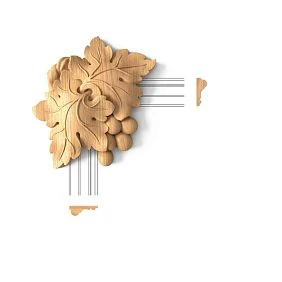
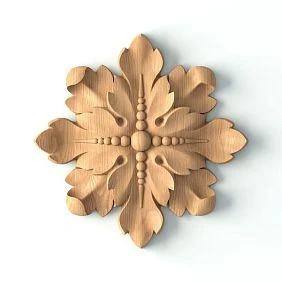
Our factory also produces:


Beech sample OPAN-001
Price — 940 ₽.
Beech is needed not as a more expensive version of the MDF test, but as a physical sample of a different material.
If the full-size batch is planned to be made of beech, it is advisable to test beech specifically. The flexibility of the entire panel is created by the fabric base and spaced apart slats, but the solid part of the slats remains natural wood. It is impossible to prove the behavior of beech on a tight actual radius just by the fact that the MDF sample visually fit on the same body.
Get Consultation
Oak OPAN-001
Price — 1,490 ₽.
For an oak bar counter, this is a particularly rational purchase. Seven short oak PAN-001 1010×8×950 mm at the current price cost:
7 × 26 930 = 188 510 ₽.
Eight:
8 × 26 930 = 215 440 ₽.
Against this backdrop, the oak sample for 1,490 ₽ costs less than one percent of the seven-module batch and allows you to check the critical R=120 mm before the main payment.
Why the size 196×8×310 mm is sufficient for a local radius check
It is sufficient not for “certifying the entire counter,” but for a local answer:
-
whether the selected material fits the actual arc;
-
how the fabric base behaves;
-
how the gaps open up;
-
whether there is a visually unpleasant kink;
-
how the surface looks at the top of the tightest section.
The sample can be applied sequentially:
-
at the beginning of the radius;
-
closer to the top of the arc;
-
at the very top;
-
at the end of the radius;
-
at the transition back to the straight line.
Thus, one compact module checks several characteristic zones.
What the small OPAN-001 fundamentally does not show
It does not prove:
-
that seven full-size modules will perfectly fit into 6800 mm;
-
that the joints will be invisible;
-
that both sides of the rack have the same actual geometry;
-
that the entire batch of oak will match in pattern;
-
that the specific adhesive and fasteners work throughout the entire site;
-
that 950 mm is exactly sufficient in height at every point;
-
that the edge cut will turn out beautiful at both ends.
That is, OPAN-001 is a control of material and local geometry, not a reduced copy of the entire project.
Flexible slat panel PAN-001 and radius R=120 mm: what cannot be decided based only on the product description
The PAN-001 card does indeed confirm the flexible fabric base and the ability to work on curved surfaces. The semicircular beads are attached to the fabric; individual modules can be joined into a single decorative covering.
This is good initial information.
But the phrase "suitable for curved surfaces" does not automatically answer the question:
"How will a specific oak, beech, or MDF module behave on the finished end with R=120 mm of this particular post?"
What to check on the actual radius
Fit of the base.
The fabric should follow the surface without unwanted creases or local detachment in the layout.
Changes in gaps between slats.
On the outer surface of the bend, visual intervals may be perceived differently.
Outer edge.
You need to see how the outermost slat looks at the transition from the straight section to the arc.
Behavior of the selected material.
MDF, beech, and oak should be considered different product variants.
chiaroscuro.
At R=120, each slat changes orientation relative to the luminaire faster than at a larger radius.
Transition back to the straight line.
Sometimes it's not the arc's apex, but specifically the exit from it that looks weaker.
Why we can't promise "PAN-001 is guaranteed to fit R=120"
Because the specific minimum radius is not published in the product card.
Expert text should not turn general flexibility into a fabricated engineering guarantee.
The correct wording is:
PAN-001 is designed for curved surfaces; the specific R=120 mm for the chosen material is confirmed by physically fitting OPAN-001 on a manufactured stand.
How to apply OPAN-001 to a finished end with R=120 mm before the main purchase
The main advantage of our scenario is that the stand is already manufactured.
No need to check the radius on a paper template if a real surface exists.
Check on the manufactured stand
The design R=120 mm could have changed slightly after:
-
manufacturing of the body;
-
puttying;
-
leveling;
-
final preparation.
Therefore, the control object is a finished or as close to finished surface as possible, not just CAD.
Check several heights
The bar stand may have a slight variation in radius or flatness along its height.
Apply the sample:
-
at the bottom;
-
in the middle;
-
Closer to the top.
If the behavior is the same, confidence is higher.
Check the start of the radius
This is where the straight surface begins to change direction.
Need to see if there is a visual step.
Check the top
This is the tightest zone in terms of curvature.
Check the exit to the straight
The second transition should look as smooth as the first.
Take photos from the side and from above
A frontal shot often hides the reveal of gaps.
From above, it's better visible:
-
the actual arc;
-
fit;
-
the line of battens;
-
Symmetry.
OPAN-001 from MDF or wood: why the radius should be checked in the exact material you will order
The most dangerous saving is to buy the cheapest MDF sample for 540 ₽, see that it fits R=120 mm, and then order an oak batch for almost 190 thousand ₽ without an oak test.
These are different product variants.
MDF OPAN-001 for painting
If the main batch is MDF, the logic is consistent:
OPAN-001 MDF → check R=120 → full-size PAN-001 MDF.
If after the test a decision is made buy MDF slat panelsit can already be considered 7/8 modules.
Oak OPAN-001 for transparent finish
If the rack must retain its natural texture, a physical oak sample simultaneously checks:
-
radius;
-
drawing;
-
tone;
-
reaction to side light;
-
future transparent finish.
After that, it is logical buy wooden slat panels already in oak.
Beech OPAN-001
Beech is a separate natural version.
If the project will be tinted or painted over wood, the sample helps evaluate not only the geometry, but also the real material.
Slat panel PAN-001 1010×8×950 mm: how many modules to order for a 6800 mm layout
Now we move on to the main purchase.
The article assumes that 6800 mm is the already unfolded length of the decorative surface, including both radius sections.
This is an important condition.
If 6800 mm is just the linear length of the stand according to the plan, and the arcs are not yet included, the calculation of 7 modules cannot be used.
Mathematical minimum
6800 / 1010 ≈ 6,73.
Therefore:
a minimum of 7 original PAN-001.
What seven give
7 × 1010 = 7070 mm.
Nominal excess
7070 − 6800 = 270 mm.
Why this is a good start
The excess is approximately:
270 / 6800 × 100 ≈ 3.97% of the net unfolded length.
But this ~4% is not a "margin per standard." It is simply the arithmetic difference between seven modules and the length of the object.
Why this percentage by itself doesn't decide anything
Because you can't glue all 270 mm into one convenient place.
In a real map, part will be lost:
-
at the beginning;
-
at the end;
-
for the pattern phase;
-
for precise seams;
-
for possible trimming of the damaged factory edge.
And only the map shows whether there is a real surplus after all operations.
Why 270 mm of remainder doesn't yet prove that the eighth PAN-001 is not needed
Seven modules is the mathematical minimum. A work order is confirmed only after specific parts for a specific rack can be assembled from 7070 mm.
Rack pattern phase
PAN-001 consists of repeating semi-circular glazing beads on a flexible fabric base.
When trimming longitudinally, the edge should not look accidentally torn.
If the mathematical cutting line passes through a visually inconvenient part of the rhythm, it may need to be shifted.
Each such shift consumes part of the 270 mm.
Location of the first cut
One edge of the rack may be more visible to the visitor than the other.
Then you cannot automatically use the entire allowance on the "technical" side if it breaks the main visible edge.
Location of the last cut
A mistake at the start shows up at the end.
If the first six modules are laid out without a common map, the seventh may end up with a too narrow or visually poor piece.
Two radius transitions
At each R=120 mm, you need not only to cover the length but also to maintain a readable rhythm.
If the joint falls on the tightest part of the arc, it may need to be moved to a straight section.
Damaged or inconvenient edge
In real production, the edge may require technological trimming.
The article does not prescribe universal 3, 5, or 10 mm. This is decided based on the actual part.
But the very fact of possible adjustment means that the "270 mm of margin" cannot be considered completely free.
The need to preserve a whole outer rail
If the designer requires finishing both sides of the post with a single visual element, the cutting layout may become more rigid.
Geometry of the actual body
Two ends with the same design R=120 mm may have slight actual differences after manufacturing.
Therefore, seven PAN-001 units are sufficient only when the actual seven modules are laid out on the actual post, not when the calculator shows 6.73.
How to understand whether an eighth PAN-001 is needed without a safety margin percentage
Instead of "let's add another 10%," you need to create a 6800 mm layout and place seven original strips of 1010 mm on it.
Step 1. Fix the clean layout
Measurement should be taken along the surface of the cladding.
Not along the axis of the post.
Not along the straight chord of the radius.
Not by the length of the countertop, if its overhang differs.
Step 2. Apply two R=120 mm
On the development, the following are marked:
-
the start of the first radius;
-
its apex/central zone;
-
the end;
-
the second radius similarly.
Step 3. Mark visible zones
Where is the visitor located?
Which end is most visible?
Is there a technical side?
Step 4. Apply desired joints
It is not necessary on every 1010 mm boundary.
Panels can be trimmed and redistributed if the actual structure allows it.
Step 5. Check edge endings
Both edges should be visually acceptable.
Step 6. Calculate leftovers for each original module
Only after this can you see if seven are enough.
Slat panel PAN-001 on two radius ends: where to start the layout
There are three strong approaches. Each has its own logic.
From the central axis of the post
Suitable if the front part is the main view.
The layout is built symmetrically to the left and right.
Pros:
-
The main facade gets controlled symmetry;
-
Both ends become a consequence of one central system.
Cons:
-
The extreme remainders may turn out unequal in convenience;
-
Both R=120 mm can "catch" different phases of the pattern.
From the most visible end
If one radius faces directly into the hall or entrance, it can be made the starting control point.
Pros:
-
The best edge and transition get priority.
Cons:
-
The opposite end gets everything left after the long sweep.
This scheme cannot be applied without preliminary verification of the end.
From the central straight section with a symmetrical transition to the radii
Often the calmest option for a bar counter.
The main rhythm is formed on the long straight zone.
Then both radii are checked against it.
If minor adjustments are required for the two ends, they are distributed along less noticeable straight sections.
Where the PAN-001 joint should be located on the bar counter
A joint is not a defect. PAN-001 is modular.
But the joint has good and bad locations.
Bad location: the top of the most visible radius
On the arc, the plane constantly changes direction.
Any vertical joint line receives additional shading and may read more strongly.
Bad location: bright side light
LED or directional light emphasizes the transition.
Bad location: central frontal point
If a visitor looks directly at the joint from several meters away, it becomes part of the composition.
Sometimes this is acceptable, but it must be intentional.
Bad location: high-contact zone
Staff or guests may regularly brush against the area.
The joint does not have to be weak, but for a high-traffic zone, a seamless visual surface is more convenient.
More convenient location: straight section
On a straight line it's easier to control:
-
rhythm alignment;
-
verticality;
-
clamp;
-
Light.
More convenient location: less visible end face
If the stand has a technical side, some joints can be moved there.
Can the PAN-001 joint be placed on the straight section instead of the radius
Yes, and for R=120 mm this is often more logical as a design priority.
But you need to check whether the length of the individual part is sufficient for the radius and adjacent transitions to run as one continuous strip.
Radius as a single part
Pros:
-
no joint in the zone of maximum curvature;
-
the drawing passes the arc continuously.
Cons:
-
the requirement for segment length grows;
-
the map of seven modules becomes less flexible.
Joint on the radius
May be acceptable if:
-
it falls into a calm phase;
-
the sample confirms the fit;
-
the light does not emphasize the line;
-
the installer is confident in repeatability.
But "can" does not equal "better".
Joint on the invisible side
A very strong solution if the rack geometry really has a back side.
But there is no need to move all joints into one small area and create a chaotic grid there.
PAN-001 1010×8×950 mm and rack body: check the vertical dimension before ordering
The short 950 mm format is convenient for a bar counter if the finished cladding height is less than this value.
The plan gives a guideline of 900–930 mm.
If the finished height is 920 mm
Nominal allowance:
950 − 920 = 30 mm.
This is convenient for fitting.
If the height is 930 mm
remains:
20 mm.
If the height is 945 mm
Only remains:
5 mm.
If at one point it is 955 mm
A short PAN-001 as a single piece is no longer sufficient in height.
Why measuring more than once is necessary
For a long post of 6.8 m, the following are possible:
-
floor slope;
-
tabletop deviation;
-
different height of the plinth/body;
-
local adjustment of the bottom.
Several control heights need to be taken across the entire layout.
What to consider the correct height of PAN-001 on the rack
It is not necessary to close the gap from the floor to the lower plane of the tabletop if the project provides for:
-
base;
-
metal bottom strip;
-
top belt;
-
shadow gap.
So, 950 mm is compared with the actual decorative zone, not with the total height of the rack.
Sample OPAN-001 and side light: why the profile looks different on the radius
On the straight section, all slats face the light fixture approximately the same way.
At R=120 mm, their local orientation changes quickly.
As a result, on one arc a sequence may occur:
-
light edge;
-
the average tone;
-
dark zone;
-
light again.
For MDF under enamel, this is created by shape.
For oak/beech, natural texture is added.
Check during the day
Natural light shows the overall relief.
Check under ceiling light
You can see how the slats read in the normal mode of the establishment.
Check with LED backlight
If light passes along the countertop or plinth, it can strongly emphasize the radius.
View from the visitor's side
Main commercial facade.
View from the staff side
Technical joints, access, and wear may be more important there.
MDF PAN-001 or oak wood slat panel: which material to check with sample OPAN-001
The choice of material affects both the price of 7/8 modules and the meaning of the sample.
The current card PAN-001 1010×8×950 mm shows:
| Execution | Price per unit | 7 modules | 8 modules |
|---|---|---|---|
| MDF "Prestige" | 9 700 ₽ | 67 900 ₽ | 77 600 ₽ |
| Primed MDF | 15 810 ₽ | 110 670 ₽ | 126 480 ₽ |
| Beech | 16 800 ₽ | 117 600 ₽ | 134 400 ₽ |
| Oak | 26 930 ₽ | 188 510 ₽ | 215 440 ₽ |
Prices are indicated at the time of verification.
MDF (740–760 kg/m³, emission class E1/E0) provides ideal geometry, uniformity, and better base for enamel: high adhesion, smooth surface, absence of knots and cracks.
A strong option if the rack is painted in a single corporate/interior color.
The manufacturer's card separately describes the preparation of MDF for enamel and recommends priming before painting.
Primed MDF
More expensive, but part of the preparation is already included in the product configuration.
The difference on seven modules:
110 670 − 67 900 = 42 770 ₽.
This amount should be compared with the actual painting process.
Beech
Natural wood with a different texture character.
Tinting, transparent finish, or painting according to the project is possible.
Oak
The most expensive of the short options in the current card.
On seven panels, the surcharge for the eighth is 26,930 ₽.
Therefore, the oak OPAN-001 for 1,490 ₽ is a particularly reasonable preliminary check.
Why the rack material and the sample material must match
The MDF check answers the question:
"how the MDF version behaves."
It does not turn oak into MDF.
Even if the geometry of the glazing beads matches, natural wood:
-
has a different structure;
-
reacts to finishing differently;
-
may visually perceive a tight radius differently.
For an expensive main batch, saving on the correct sample is not justified.
Buy slat panels right away or first spend one order on OPAN-001
On a finished rack, the cost of a mistake is tens of times higher than the price of a sample.
Therefore, it is convenient to split the solution into two scenarios.
The main PAN-001 can be ordered right away if
-
the same material has already been used on a real R=120 mm;
-
the contractor has worked with PAN-001 in similar geometry;
-
the actual rack has been measured;
-
the joint locations are marked;
-
the map of seven modules already exists;
-
the finish has been approved on a physical sample.
In that case, OPAN-001 may not be a separate "test for the sake of testing," but only a control color reference.
First, OPAN-001, if
-
R=120 mm is new for the project;
-
the material PAN-001 has not yet been used on such a tight end face;
-
the stand is already manufactured and reworking it is expensive;
-
oak or beech is being ordered;
-
the main order is expensive;
-
the side light is strong;
-
the contractor doubts the visual phase of the relief.
Then Order a sample of slatted panel OPAN-001 — this is not a project delay, but a way to remove uncertainty before purchasing the main batch.
How much does the “seven or eight” mistake cost on different materials
The price of the eighth module equals the price of one short PAN-001:
-
MDF — 9,700 ₽;
-
primed MDF — 15,810 ₽;
-
beech — 16,800 ₽;
-
oak — 26,930 ₽.
If the eighth panel later remains intact and is useful elsewhere, it is not a complete waste.
If it is needed only as insurance against poorly planned cutting, it is an expensive way to replace a drawing.
Oak: a particularly sensitive choice
Seven — 188,510 ₽.
Eight — 215,440 ₽.
Difference — 26,930 ₽.
Oak OPAN-001 — 1,490 ₽.
That is, a physical preliminary check costs about 18 times less than one extra full-size oak module.
Beech
Seven — 117,600 ₽.
Eight — 134,400 ₽.
Difference — 16,800 ₽.
Beech sample — 940 ₽.
MDF (740–760 kg/m³, emission class E1/E0) provides ideal geometry, uniformity, and better base for enamel: high adhesion, smooth surface, absence of knots and cracks.
Seven — 67,900 ₽.
Eight — 77,600 ₽.
The difference is 9,700 ₽.
MDF sample — 540 ₽.
In all three cases, the sample is significantly cheaper than the eighth module, but its function is different: it checks the radius and material, not solving the cutting layout for the installer.
Cost of slat panels: when the eighth module is a useful reserve, and when it's an unnecessary overpayment
Requests about the cost of slat panels often lead to a simple comparison of "7 is cheaper than 8." For a bar counter, this is not enough.
The eighth PAN-001 is justified if the map of seven doesn't add up
For example:
-
both beautiful endings require additional cuts;
-
the joint needs to be moved away from R=120 mm;
-
one module must pass the radius continuously;
-
the actual unfolded length after the final measurement exceeds 6800 mm;
-
part of the original edge is unsuitable.
The eighth may be a useful service reserve.
For a commercial property, this is separate logic.
The bar counter receives:
-
shoe kicks;
-
staff contact;
-
cleaning;
-
equipment movement.
If PAN-001 is installed so that the local module can be replaced, a full spare from the same finishing batch may be valuable.
But this should be called a repair reserve, not a "cutting allowance."
The eighth is an overpayment if seven are already laid out.
If all finishing parts fit within 7070 mm, the joints are approved, the edges are good, and a service reserve is not needed, an additional PAN-001 adds no value.
How to create a cutting map for seven PAN-001 before order payment
Need a simple list.
| Source PAN | Section | Net length | Radius/straight | We cut off | Remainder |
|---|---|---|---|---|---|
| №1 | left end | ___ | R=120 | ___ | ___ |
| №2 | left transition | ___ | radius/straight | ___ | ___ |
| №3 | Facade | ___ | Straight | ___ | ___ |
| №4 | facade center | ___ | Straight | ___ | ___ |
| №5 | Facade | ___ | Straight | ___ | ___ |
| №6 | right transition | ___ | straight/radius | ___ | ___ |
| №7 | right end | ___ | R=120 | ___ | ___ |
What should match at the bottom of the table
Sum of clean parts:
6800 mm.
Sum of original width:
7070 mm.
Sum of all trims and leftovers:
270 mm.
If the arithmetic doesn't add up, the map is incomplete.
Why the table should not automatically have seven parts of 971–972 mm
PAN-001 is the source module, not a mandatory finished section.
Finished parts may have different widths if needed for joints and radii.
Why you need to label radius/straight
Because two pieces of the same length are not equivalent.
One may be perfect for a straight line, but inconvenient at R=120 due to the joint line or edge orientation.
Example of a map that looks mathematically correct but is bad in practice
Suppose the installer decides:
-
leave the first six panels at 1010 mm;
-
cut the seventh to 740 mm.
Sum:
6 × 10¹⁰ + 740 = 6800 mm.
The arithmetic is perfect.
But the last piece gets the entire remaining 270 mm on one end.
If the right end is the main visible radius, that's where the extreme trim appears and, possibly, an awkward pattern phase.
What can be done better
Distribute the trims across two or several less noticeable zones.
For example, conditionally remove part from the left and part from the right.
But the specific numbers should be determined by the actual rhythm, not by a beautiful symmetry of "135 mm each."
Why the scheme "135 mm from both ends" is also not a ready-made recipe
Pure arithmetic:
270 / 2 = 135 mm.
It seems that what can be done is:
875 + 1010×5 + 875 = 6800 mm.
Let's check:
875×2 = 1750;
1010×5 = 5050;
1750+5050 = 6800.
Geometrically, the scheme is beautiful.
But the 875 mm lines can:
-
fall into different phases of the pattern;
-
give a bad ending;
-
turn out to be inconvenient on two R=120.
Therefore, 875+…+875 is a good layout sketch, not a final cut.
How to use 270 mm not as random waste, but as a phasing resource
It is these 270 mm that allow you to slightly move the joints.
Allowed:
-
trim the first module;
-
change the length of the second;
-
move the joint away from the radius vertex;
-
keep the last edge more intact.
The more accurately the rack is marked, the more useful this small resource is.
Why the percentage of allowance does not replace a map of specific parts
7 panels give about 4% nominal excess.
8 — already:
8080 − 6800 = 1280 mm of excess.
In percentage:
1280 / 6800 × 100 ≈ 18,8%.
That is, the transition from 7 to 8 sharply increases the purchase allowance.
This doesn't mean 8 is bad. It means the eighth module must have a specific function:
-
cover an impossible cut;
-
become a repair reserve;
-
go to another object/facade.
If the actual layout turns out to be 6870 mm
Seven PAN-001 give 7070.
Remainder:
7070 − 6870 = 200 mm.
The margin decreases.
If the layout is 6950 mm
remains:
120 mm.
If 7020 mm
remains:
50 mm.
If 7080 mm
Seven is already physically insufficient.
Key takeaway
The phrase "rack 6.8 m" is not enough.
Before payment, a final unfolded layout with accuracy corresponding to the actual installation is needed.
How to measure the unfolded length of a rack with two R=120 mm
If the rack is already manufactured, the most practical way is to measure along the surface of the future cladding, following both radii.
Depending on the condition of the body, a flexible measuring tape or a prepared template can be used.
What not to do
Do not add up:
-
straight facade;
-
"approximate width of two ends";
-
visually estimated arcs.
Why the radius complicates the ruler
A straight tape measure between two points measures the chord, but the cladding goes along the arc.
If 6800 mm has already been obtained from the development
Re-check after final preparation of the hull.
Can the arc length be calculated using R=120 mm
Only if the central angle of each arc is known.
Formula:
L_arc = R × θ, where θ is the angle in radians.
But in the article's plan, the angle is not specified.
One cannot assume that each end is a quarter circle, semicircle, or any other arc.
Therefore, R=120 alone is insufficient for recalculating the total length.
This is an important example of why actual unfolding is stronger than a beautiful geometric guess.
Radius counter and daily contact: material is chosen not only by bending
A bar counter is not a decorative column that no one touches.
The lower cladding works in the zone:
-
visitors' footwear;
-
cleaning equipment;
-
carts;
-
accidental bag impacts;
-
legs of bar stools;
-
regular wet cleaning.
Therefore, a successful OPAN-001 test at R=120 mm is only the first filter.
After that, the material is evaluated based on its performance.
MDF for opaque painting
Plus, you can get a single corporate or interior color.
If the rack housing, adjacent panels, and furniture are painted the same, PAN-001 looks like part of the architecture.
But the finish must match the area of constant contact.
The manufacturer specifies polyurethane and acrylic enamels as wear-resistant options for furniture applications, and acrylic/latex water-based compositions for interiors. The specific system is chosen by the finisher based on actual use.
Oak under a transparent finish
The strong point is the natural texture.
On the fiber radius, light and shadow change together, so the stand can look particularly expressive.
But in the bar area, the natural surface must have a consistent protective finish.
Beech
A calmer texture, natural wood, the possibility of tinting or painting.
It can be a rational intermediate option between MDF and oak.
What to check OPAN-001 not only at R=120, but also in the impact-contact zone
The sample can be used as a mini-test of the finish.
Check 1. Color
Under daylight and artificial light.
Check 2. Gloss
Matte and semi-matte relief look different.
Check 3. Tactility
The visitor can touch the counter with their foot or hand.
Check 4. Cleaning
It is convenient to check the compatibility of the agreed finish with the cleaning method that will actually be used on a separate sample.
What not to do
Do not invent a "household chemical test" without recommendations from the coating manufacturer.
First, the finish system and acceptable care are approved.
Do not discard OPAN-001 after the check: make it the project's reference standard.
After the sample has passed R=120 mm and the material is approved, it ceases to be just a demonstration piece.
It can be turned into a physical passport of the counter.
On the back side or on the label, record:
-
OPAN-001;
-
material;
-
project;
-
bar counter;
-
R=120 checked;
-
date;
-
color/stain;
-
varnish/oil/enamel;
-
shine;
-
responsible for approval.
Why this is needed
The project goes through several people:
-
designer;
-
customer;
-
carpenter;
-
finisher;
-
installer;
-
operation.
Everyone may have their own idea of the phrase "that very oak."
A physical sample removes ambiguity.
General sample section
If the project compares several materials before the final choice, you can order STAVROS product samples and form a small physical library of the project.
When one OPAN-001 is not enough
If the client is really choosing between MDF, beech, and oak, one sample only covers one material.
Then it makes sense to take several OPAN-001.
Cost of three samples
540 + 940 + 1 490 = 2 970 ₽.
Against the backdrop of seven full-size panels even made of MDF:
67 900 ₽,
that's about:
2970 / 67900 × 100 ≈ 4,4%.
Against the backdrop of oak
How to decide where the first module should stand
A bar counter may not have a physical "beginning" for the visitor.
But there is a main viewpoint.
If the counter faces the hall frontally
The main facade gets priority.
If one end is visible from the entrance
Its edge can be made exemplary.
If both ends are equally noticeable
It is logical to build the layout symmetrically relative to the front.
How to use a paper layout at 1:10 scale
With a length of 6800 mm, the 1:10 scale gives:
680 mm.
One PAN-001 module:
101 mm.
The remainder of seven:
27 mm.
On the sheet, it is easy to move seven strips and see:
-
joints;
-
radii;
-
edges;
-
Light.
This is faster than discussing the layout only with numbers.
Why 1:10 is not enough for the final edge
It is needed for the composition.
The line of the specific cut is checked at a 1:1 scale on real PAN/OPAN.
What to do if the map of seven modules converges only with one ugly joint
There are three options.
Option 1. Shift the adjacent joints
Use the 270 mm part differently.
Option 2. Change the layout start
Sometimes moving the zero point solves the problem.
Option 3. Buy an eighth one
If the first two do not give a good result.
The eighth one here already has a proven function.
What to do if the card seven fits with a 40 mm margin
Mathematically, it is sufficient.
In practice, the margin is very small.
Need to check:
-
accuracy of the actual layout;
-
quality of factory edges;
-
installation trims.
If everything is confirmed, seven are possible.
If 6800 mm were rounded, the risk is high.
What to do if after the final measurement the length is 6815 mm
Seven give:
7070 − 6815 = 255 mm.
The difference is small.
But the map is recalculated.
Why can't we keep the old one
The position of the joints relative to the radii shifts.
If the post height is 900 mm
PAN-001 950 gives 50 mm of nominal allowance.
If 930 mm
20 mm.
If the height varies 915–928 mm
The short version still nominally covers all points, but the bottom/top trim line must account for the difference.
When the short PAN-001 950 mm is more convenient than the long 2400/2670
For a stand height of about 900–930 mm, the short SKU is close to the finished size.
Advantages:
-
less waste in height;
-
easier transportation;
-
lower risk of damage;
-
clearer map.
When a long panel can be more advantageous
If from one length you can get two or more full-fledged elements at different objects/zones.
But that is already a separate general cutting plan.
Why you cannot simply cut a long PAN-001 into two 950 pieces and count the savings
Need to compare:
-
the current price of the long SKU;
-
actual length;
-
relief orientation;
-
quality of both obtained ends;
-
remainder;
-
labor.
For one rack, the short 950 mm remains the most straightforward option.
Current availability: why material affects not only price
At the time of checking, the short PAN-001 1010×8×950 mm shows as follows:
-
MDF — 26 pcs. in St. Petersburg;
-
beech — 11 pcs.;
-
oak — 6 pcs.;
-
primed MDF — made to order.
For seven modules:
MDF (740–760 kg/m³, emission class E1/E0) provides ideal geometry, uniformity, and better base for enamel: high adhesion, smooth surface, absence of knots and cracks.
The displayed balance is sufficient.
26 − 7 = 19 pcs. remains nominally.
Beech
11 − 7 = 4 pcs.
For eight:
11 − 8 = 3 pcs.
Oak
The card shows only 6 pcs.
For seven, at least one is missing according to the current display.
For eight, two are missing.
What does this mean
The oak project needs to be approved before payment as a combination:
-
current free balance;
-
possible production;
-
deadline;
-
finishing of the entire batch.
The card indicates an average production time for custom orders of 5–10 days, but the specific readiness date for the required quantity must be confirmed by a manager.
Why the availability of OPAN-001 needs to be checked separately from PAN-001
Samples are now noticeably more available:
-
MDF OPAN-001 — 252 pcs in St. Petersburg;
-
oak — 49;
-
beech — 13.
This makes the testing stage organizationally simple.
But the availability of a sample does not mean the availability of seven/eight full-size panels.
What to send to the STAVROS manager to order PAN-001 after testing OPAN-001
A good request should not sound like:
"You need about seven panels per stand."
It should convey already made decisions.
Example:
PAN-001 / 1010×8×950 mm / material ___ / bar counter / finished sweep 6800 mm / two actual R=120 mm / OPAN-001 of the same material verified on a finished body / 7 working modules per cutting map / eighth module: yes/no, function ___ / cladding height ___ / joint scheme ___ / finish ___.
After such a check, you can order PAN-001 1010×8×950 mm in the confirmed quantity.
Why write "finished sweep" in the request
So that 6800 mm is not mistaken for an approximate tabletop length.
Why specify OPAN-001
The manager understands that R=120 has already been physically tested.
Why specify the function of the eighth module
If it is needed, it should be clear why:
-
cutting;
-
reserve;
-
another zone.
When the full-size PAN-001 is NOT yet needed to be ordered
R=120 exists only in the drawing
The housing is still being refined.
Physical testing is premature.
The stand is still being puttied
The actual surface of the radius is changing.
OPAN-001 is not attached
For the new material, an unconfirmed risk remains.
Material not selected
Cannot calculate price and finish.
6800 mm is approximate
Seven/eight are not defined.
Joints not marked
Nominal 270 mm proves nothing yet.
Cladding height not measured
950 mm may be insufficient at one point.
Finish not approved
Especially for oak and beech.
Bottom/top edge not resolved
Trim or metal belt can change the finished height.
When you can buy seven PAN-001
Seven is a strong option if the following conditions are met simultaneously:
-
the finished sweep is indeed about 6800 mm and is fixed;
-
OPAN-001 of the required material passes both R=120;
-
the 950 mm height covers all control points;
-
the map of seven modules is built;
-
both extreme endings look normal;
-
the joints are moved away from undesirable zones;
-
after real trimming, a positive technological remainder remains;
-
a full repair module is not needed.
When the eighth PAN-001 is justified
-
the map of seven does not match;
-
the actual layout has become larger;
-
for beautiful endings, one has to sacrifice too much width;
-
one joint needs to be moved away from the critical radius, and there is no other way;
-
the object wants to keep the full repair module;
-
the remainder of the eighth panel is planned for another real zone.
When the eighth PAN-001 is not needed
If it appears only because someone is used to adding "10%."
In our case:
7 → 8 is an increase in quantity by approximately:
1 / 7 × 100 ≈ 14.3% relative to the seven-module order.
According to the original layout, the excess increases from 270 to 1280 mm.
This is too noticeable a surcharge to make it without a map.
Errors when linking OPAN-001 → PAN-001 on a rack with R=120
Error 1. Ordering seven just because 6800/1010=6.73
Why it occurs: the calculator gives an obvious answer.
Consequence: joints and edges do not fit into the real rhythm.
How to prevent: map of details before payment.
Mistake 2. Automatically order eight "with a reserve"
Why it occurs: fear of cutting.
Consequence: an extra full-size panel for 9,700–26,930 ₽.
Mistake 3. Check R=120 only with an MDF sample, then buy oak
Why it occurs: MDF is cheaper.
Consequence: behavior of the final material is not verified.
Mistake 4. Consider overall flexibility a guarantee of a specific minimum radius
Why it occurs: the card mentions curved surfaces.
Consequence: unconfirmed engineering confidence.
Error 5. Check OPAN-001 at only one point of the arc
Why it occurs: the sample is small.
Consequence: a bad transition to the straight line is skipped.
Error 6. Check only one of the two R=120
Why it occurs: according to the drawing, they are identical.
Consequence: actual asymmetry is detected during installation.
Error 7. Measure 6800 mm in a straight line, not along the surface
Why it occurs: a tape measure is simpler.
Consequence: the actual facing length is greater.
Error 8. Assume the shape of the arc based on one R=120
Why it occurs: you want to calculate the circumference.
Consequence: an unknown angle turns into a made-up number.
Error 9. Leave a joint at the top of the most visible radius without a reason
Why it occurs: the module ended exactly there.
Consequence: light highlights the seam.
Error 10. Remove all 270 mm from one end
Why it occurs: it is arithmetically simpler.
Consequence: one end gets a random edge.
Error 11. Divide 270/2 and consider 875+…+875 as a ready cut
Why it occurs: symmetry seems ideal.
Consequence: cut lines may not align with the pattern phase.
Error 12. Not measuring the post height by length
Why it occurs: the body “should be 920 mm.”
Consequence: at one point of the short panel, there is not enough.
Error 13. Painting the entire batch before testing the radius
Why it occurs: they want to speed up finishing.
Consequence: unsuitable material already has an expensive finish.
Error 14. Considering OPAN-001 a full check of all joints
Why it occurs: the sample passed the arc.
Consequence: problems with long layout remain.
Error 15. Do not store the approved sample
Why it occurs: after ordering, it seems unnecessary.
Consequence: the finisher and installer lose the physical reference.
Error 16. Order oak based on the current 6 pieces without confirming the seventh
Why it occurs: the card shows "in stock."
Consequence: the batch stops due to one panel.
Error 17. Consider 270 mm as one useful remainder
Why it occurs: total arithmetic.
Consequence: in the real map, it is distributed across several cuts.
Error 18. Use the repair eighth module as compensation for poor installation
Why does it occur: "there is a reserve."
Consequence: the reserve disappears before the object opens.
How to check the seven-module map for common sense
After the table, ask five questions:
-
Where is the most visible joint?
-
How does the left end finish?
-
How does the right one finish?
-
How many millimeters actually remain after all finishing parts?
-
Can one cutting error be fixed without the eighth panel?
If the last answer is "no," the eighth module may be justified as an installation risk, but this decision is already made consciously.
Three practical layouts for the same 6800 mm sweep
The same total of 6800 mm can be assembled in different ways.
Scenario A. Main view — long front
Then the central straight part gets priority.
Logic:
-
several most integral modules go to the front;
-
joints are moved closer to transitions;
-
both radii pass as continuous sections where possible.
Plus — a calm facade.
Minus — radius parts may require more complex trimming.
Scenario B. One end — main
For example, it is visible from the entrance.
Then the first R=120 is made as cleanly as possible.
The rest of the cutting layout is built from it.
In this scenario, one must not forget to model the right edge in advance. Otherwise, the "ideal" first end consumes the entire 270 mm resource.
Scenario B. Both ends are equally important
Then a symmetrical idea is useful:
-
identical extreme sections;
-
central straight part;
-
equivalent radius transitions.
This is the most demanding option for the seven modules. If the rhythm of the two edges does not align, the eighth module may become a real necessity.
What remainder of seven PAN-001 should be considered normal after cutting
There is no universal number.
It's important not to "leave a minimum of X mm", but to understand the quality of the remaining material.
Useful remainder
May come in handy:
-
for finish testing;
-
for local repairs;
-
for a small furniture insert;
-
as a rhythm reference.
Technological waste
A short or inconvenient piece that cannot be used.
Installation reserve
A whole or sufficiently large fragment that can replace a real part.
Why 270 mm in total can turn into almost zero useful reserve
If they are distributed:
-
35 mm;
-
40 mm;
-
60 mm;
-
55 mm;
-
80 mm,
no single piece may have practical value.
The sum remains 270 mm.
Usefulness — no.
If the object needs a repair reserve
There are two ways.
Save a large remainder of seven modules
Cheaper.
But it only works if the card allows obtaining a truly usable part.
Buy the eighth PAN-001 entirely
More expensive.
However, the full module is preserved:
1010×8×950 mm.
For a commercial facility, such a reserve is easier to label and store.
What to choose
Depends on:
-
service life;
-
the availability of future reordering;
-
material prices;
-
maintainability of the mounting system.
How to store the eighth panel if it was purchased as a spare
Do not leave unsigned.
Marking:
PAN-001 / 1010×8×950 / material ___ / bar counter ___ / finish ___ / batch ___ / spare.
If the panel is already finished, the packaging must protect the front surface.
If stored unfinished, a finishing specification should be nearby.
Why an oak spare is visually more valuable than an MDF spare
MDF for enamel can be painted later in an approved color.
Oak has a natural texture.
A reorder after years may differ more in pattern.
This does not mean that the eighth oak PAN-001 is mandatory. But the argument for a spare for a natural material is stronger.
How to make OPAN-001 part of finished rack acceptance
After installation, the reference sample can be applied to the straight section and compared:
-
color;
-
shine;
-
texture;
-
relief quality.
What this helps detect
-
incorrect shade;
-
different degree of matteness;
-
finish deviation.
What it does not help with
The sample is not a metrological instrument for the geometry of the entire rack.
What to check after installing PAN-001 on R=120
Transitions
Both zones "straight → radius" must be smooth.
Vertices of the two ends
Is there any local opening or fold.
Joints
Does the rhythm match.
Lower edge
Does the line wander in height.
Top edge
Are there any random gaps under the countertop.
Light
Check under the working lighting of the establishment.
Why acceptance should be done before the opening of the facility
After launch:
-
the rack is occupied by equipment;
-
operation is in progress;
-
access is more difficult;
-
local modification interferes with work.
What to do if after installation one R=120 visually differs from the second
First, determine the cause.
Do not automatically attribute it to a "wood feature."
Check:
-
the actual shape of the housing;
-
panel direction;
-
joint;
-
lighting;
-
finish.
How to order seven PAN-001 without an extra module
The final specification may look like this:
PAN-001 / 1010×8×950 mm / material ___ / 7 pcs. / finishing reamer 6800 mm / two R=120 mm / OPAN-001 of the same material verified / cutting map approved / joints ___ / cladding height ___ / finish ___ / eighth module not required per map.
This is much stronger than:
"7 panels, seems enough."
How to order eight PAN-001
If the eighth is needed:
PAN-001 / 1010×8×950 mm / 8 pcs. / 7 working + 1 repair reserve
Or:
8 pcs. / eighth module needed for cutting section ___.
The purpose must be written directly in the order.
Why the late CTA should lead to a specific product card
After all the checks, the user already knows:
-
model;
-
size;
-
material;
-
Quantity.
So, buy wall slatted panels as a category are useful for comparison, but the final action is a specific PAN-001.
Control matrix before payment of the main batch
To prevent the solution from falling apart into separate verbal agreements, it is useful to consolidate everything into one sheet before ordering.
| Checkpoint | Result |
|---|---|
| Finishing sweep of the rack | ___ mm |
| Design radius of the left end | R=120 mm |
| Actual left end checked by OPAN-001 | Yes/No |
| Design radius of the right end | R=120 mm |
| Actual right end face checked by OPAN-001 | Yes/No |
| Sample material | MDF / beech / oak |
| Main PAN-001 material | same / different |
| Cladding height min | ___ mm |
| Cladding height max | ___ mm |
| Seven PAN-001 give | 7070 мм |
| Nominal excess at 6800 | 270 мм |
| Map of seven modules converges | Yes/No |
| Joint at main radius | Yes/No |
| Extreme endings approved | Yes/No |
| The eighth is needed for cutting | Yes/No |
| The eighth is needed as a reserve | Yes/No |
| Finish approved | Yes/No |
| OPAN-001 saved as reference | Yes/No |
Why are there two separate rows about the eighth PAN-001 in the table
Because these are two different procurement reasons.
The eighth for cutting is consumed in production.
The eighth as a reserve remains intact after installation.
If these functions are mixed, the project may order eight, use all eight, and then mistakenly assume that a repair reserve exists at the site.
Why the sample material and main panel are recorded on separate lines
This immediately reveals the most unpleasant substitution: the MDF sample passed R=120, but unexpectedly oak was sent in the order.
If the materials differ, a separate justification or a repeated test is required.
Total price of preliminary verification and main procurement
Sometimes OPAN-001 is perceived as an additional small purchase that can be removed from the budget.
Let's compare the full path.
MDF: sample + seven PAN-001
540 + 67 900 = 68 440 ₽.
Beech
940 + 117 600 = 118 540 ₽.
Oak
1,490 + 188,510 = 190,000 ₽ exactly at current prices.
For the oak project, the physical verification of the critical radius increases the merchandise budget from 188,510 to 190,000 ₽, i.e., by less than one percent.
If after the test it turns out that the material is not suitable
The loss is limited to the sample and inspection time, not the entire full-size batch.
This is the economic rationale behind the sequence OPAN-001 → PAN-001.
What to do if OPAN-001 shows a beautiful radius, but the seven-module map still doesn't align
This is a normal result.
The sample only answered its own question: the material is visually capable of passing the actual end face during a test fitting.
What remains is a procurement question.
Option 1. Redistribute the joints
Shift the zero point and reuse the 270 mm.
Option 2. Change the position of one joint on a straight line
Sometimes that is enough.
Option 3. Buy an eighth PAN-001
If the first two paths worsen edges or radii.
It is important that the eighth module appears after proven necessity, not before the calculation.
What to do if seven modules converge, but the remainders are very small
This is not necessarily a problem.
If all finished parts are obtained, edges are good, and assembly risk is accepted, a useful repair remainder does not have to exist.
But for a commercial rack, you need to separately decide whether a service reserve is needed.
If a reserve is not needed
The order remains 7.
If needed
The order becomes 8, but the eighth module is marked as repair and does not participate in cutting without a separate decision.
Why a 6.8 m bar counter is a good example where the “reserve percentage” is misleading
With seven modules, the nominal excess is about 4%.
With eight, it is almost 19%.
No number by itself indicates which option is correct.
Correctness is determined by:
-
radii;
-
joints;
-
edges;
-
height;
-
operational policy.
Therefore, after checking, you can Buy slatted panels specifically by the map, not by the rule “add 10%”.
If two ends have one R=120 mm, but different arc lengths
The same radius does not mean the same unfolded length of the radius sections. The arc depends not only on R, but also on the rotation angle. Therefore, the left and right ends cannot be automatically considered mirror images just by the R=120 marking. On the finished post, each section is measured along the surface, and these actual lengths are transferred to the PAN-001 map. This is especially important if one end transitions into a short side panel, and the other into a longer one.
FAQ
What is the size of OPAN-001?
196×8×310 mm.
What materials is OPAN-001 produced from?
MDF, beech and oak.
How much does OPAN-001 cost?
At the time of checking: MDF 540 ₽, beech 940 ₽, oak 1,490 ₽.
What is OPAN-001 for?
For physical verification of texture, relief, material, finish, and local behavior on a real surface before the main order.
Can OPAN-001 be tested on R=120 mm?
Yes, specifically as a physical fitting of the specific material on the finished end. But this does not turn R=120 mm into a published factory minimum radius.
Does the sample guarantee the suitability of the entire post?
No. It checks the local section. Joints, total length, and height are checked separately.
Is it necessary to take a sample in the same material as PAN-001?
For the final decision, preferably yes. An MDF sample should not be the sole basis for an expensive oak batch.
What size is the short PAN-001?
1010×8×950 mm.
How many PAN-001 are needed for 6800 mm?
The mathematical minimum is 7.
How much do seven modules give?
7070 mm of original width.
What is the nominal remainder?
270 mm.
Why might seven not be enough in practice?
Due to the actual layout, relief phasing, trims, two radii, and requirements for beautiful edges.
When is the eighth PAN-001 needed?
When the map of seven does not align, or a separate full repair reserve is needed.
Where is it best to place the joints?
Usually it's easier on straight or less visible sections, but the final layout depends on the viewpoint and rhythm.
Can a joint be made on a radius?
This is not universally prohibited, but at R=120 it needs to be especially carefully checked for light, geometry, and installation.
How to check the height of 950 mm?
Measure the actual height of the decorative zone at several points along the entire stand.
What is better for the stand — MDF, beech, or oak?
It depends on the design, finish, budget, and usage. The material needs to be checked with physical OPAN-001.
How much do seven short PAN-001 MDF panels cost?
67,900 ₽ at the time of checking.
And eight?
77 600 ₽.
How much do seven oak PAN-001 cost?
188 510 ₽.
Eight oak ones?
215 440 ₽.
What to do if only six oak panels are shown in stock?
Coordinate the free balance with the manager and produce the missing quantity before starting the finishing.
Can 6800 mm be counted along the straight facade?
Only if it is already the actual surface development. Arcs cannot be replaced by chords.
Can the arc length be calculated using only R=120?
No. The central angle or the actual development is needed.
Where to buy OPAN-001?
In the OPAN-001 sample card.
Where to buy PAN-001?
After the test — in the PAN-001 card.
Where to compare different slat panels?
In the general category of flexible slat panels.
Final algorithm OPAN-001 → PAN-001
-
Ensure that the rack already has an actual R=120 mm.
-
Determine the final material: MDF, beech, or oak.
-
Buy OPAN-001 of the same material.
-
Apply to the first radius at several points.
-
Check the start of the arc.
-
Check the apex.
-
Check the exit to the straight line.
-
Repeat on the second end.
-
Check under working lighting.
-
Approve the finish.
-
Remove the finishing reamer from the surface.
-
Confirm that it is indeed 6800 mm.
-
Measure the height at several points.
-
Mark the joints.
-
Lay out seven initial modules at 1010 mm.
-
Check the two extreme ends.
-
Check where the 270 mm are distributed.
-
Determine whether there is a useful remainder.
-
Decide whether an eighth module is needed for cutting.
-
Separately decide whether the eighth is needed as a service reserve.
-
Check current prices.
-
Check availability.
-
For oak, coordinate the missing module if the warehouse remainder is insufficient.
-
Hand over the full specification to the manager.
-
After installation, save OPAN-001 as a reference.
Conclusion
For the bar counter with a clean layout of 6800 mm, seven PAN-001 1010×8×950 mm are indeed the mathematical minimum:
7 × 1010 = 7070 mm.
Nominally, 270 mm remains.
But the decision of "seven or eight" cannot be made by a single division. Two ends with R=120 mm require checking the relief phase, joint locations, the start and end of arcs, both extreme endings, and the actual geometry of the body.
Therefore, the first step is not a full-size batch, but an OPAN-001 196×8×310 mm in the same material. The manufacturer confirms the flexible base of PAN-001 and its work on curved surfaces, but there is no separate guaranteed minimum R=120 mm in the specification. Physical fitting closes exactly this gap.
If OPAN-001 from the selected material easily passes both actual radii, then a map of seven full-size modules is built. Seven can be ordered when all real parts fit within 7070 mm, joints are in acceptable places, edges are neat, and a positive technological margin remains after trimming.
The eighth PAN-001 is not needed "just to take 10%". It is justified only if:
-
the map of seven does not match;
-
the finishing reamer has grown;
-
the joint needs to be moved away from the radius;
-
a beautiful ending requires additional material;
-
the object deliberately wants a full repair reserve.
At current prices, the cost of such a solution varies greatly: the eighth MDF module adds 9,700 ₽, beech — 16,800 ₽, oak — 26,930 ₽. Therefore, for expensive wood, a physical sample and a proper cutting map are especially beneficial.
The height needs to be checked separately. If the decorative zone is 900–930 mm, a PAN-001 with a length of 950 mm has a working nominal allowance. If at any point the cabinet exceeds 950 mm in height, the short format no longer solves the problem automatically.
Final sequence:
OPAN-001 of the required material → both R=120 → light and finish → finishing reamer 6800 → map of seven PAN-001 → joints → edges → leftovers → decision on the eighth → order.
After such a check, you can buy slatted panel PAN-001 in a quantity confirmed by the actual cabinet, not by a percentage of allowance.