Article Contents:
- Short answer: when to choose beech balusters
- What are beech balusters
- Why beech is often chosen for stair elements
- Beech, pine, oak or ash: what to choose for balusters
- Beech balusters for painting
- Beech balusters for varnish or stain
- What shapes of beech balusters are available
- How to match beech balusters with handrails and posts
- How to calculate the number of balusters
- Where is it better to use beech balusters
- In private houses
- In classic interior
- In neoclassicism
- In a country house
- Mistakes when choosing beech balusters
- What to buy together with beech balusters
- FAQ: questions about beech balusters
- About the Company STAVROS
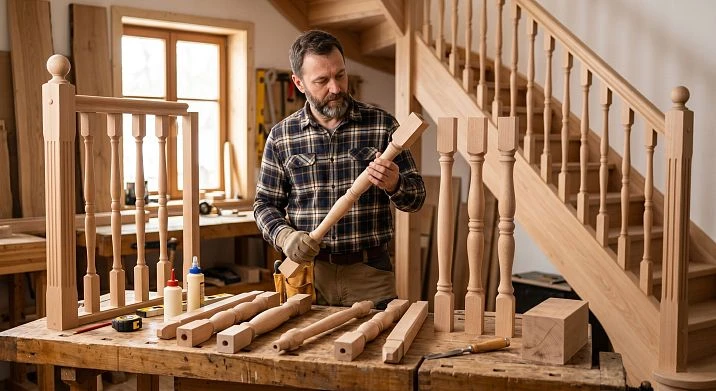
Choosing the material for stair balusters is not purely a technical question. It is a decision that determines how the staircase will serve you in a year, five, twenty years. Pine is soft and responsive to work, but quickly loses its appearance. Oak is monumental, but expensive. Ash is expressive, with a characteristic pattern. And beech? Beech is a species that is often underestimated, overshadowed by more "prominent" species. Meanwhile, it is beech balusters that often turn out to be the most accurate and practical choice for a staircase in a private house.
This article is an honest discussion about beech as a material for stair railings. Without marketing clichés, with specific comparisons, practical recommendations, and answers to questions asked by people building or renovating a staircase in their home.
Short answer: when to choose beech balusters
If you need a quick reference — here it is. letter balusters — the right choice in the following situations:
-
You need durable wooden balusters with high density that do not dent, scratch during installation, or deform during use.
-
It is planned to paint with enamel — beech provides a perfectly smooth, uniform surface without pronounced pores or resin pockets.
-
Neat elements for a classic interior are needed — turned beech balusters look organic with profiled handrails and carved posts.
-
Compatibility with other wood finishes is important — beech elements easily fit into a wooden interior with baseboards, moldings, and door trims.
-
A neoclassical or modern classic staircase is being built — beech is versatile in style and does not impose strict limitations.
-
An optimal balance of price, strength, and processing quality among hardwoods is needed.
If at least three out of six points suit you — beech deserves serious consideration.




What are beech balusters
Let's start with the basics. A baluster is a vertical element of a staircase railing, located between the support post and the step (or sub-baluster board) on one side, and the handrail on the other. A row of balusters forms the railing lattice of a staircase flight.
Wooden balusters They are made from different wood species — each with its own characteristics, price, and application. Beech (Fagus sylvatica) is a deciduous tree that grows in the temperate climate of Europe and is widely used in the production of furniture, parquet, and joinery.
What makes beech attractive for staircase elements? First of all — the wood structure. Beech has a uniformly dense, fine-porous structure without resin canals. This means: the surface after processing is smooth, uniform, without 'protruding' annual rings. It is this smoothness that is the main technological advantage of beech balusters when painting.
wooden balusters for staircases Beech is produced by turning on a lathe from a solid workpiece. The standard height of a finished baluster is 900–1000 mm, with a cross-section at the widest point of 45–70 mm. The lower tenon for attachment to a step or sub-baluster board is 20–22 mm in diameter. The upper tenon for attachment to the handrail is similar.
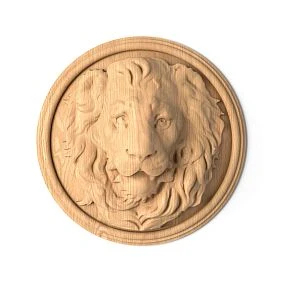
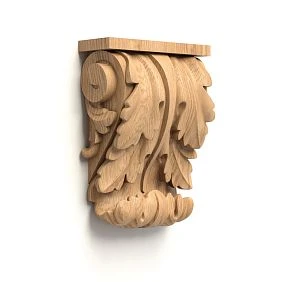
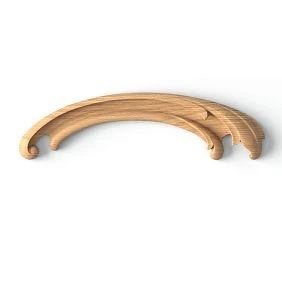
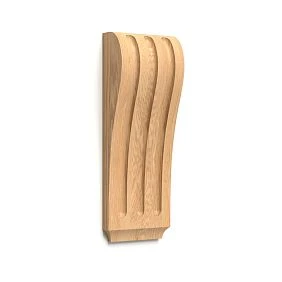
Our factory also produces:
Why beech is often chosen for staircase elements
This is not a matter of fashion. Behind the choice of beech lies a specific technical logic.
Density. The density of beech wood is about 680–720 kg/m³. This is significantly higher than pine (480–520 kg/m³) and comparable to oak (680–750 kg/m³). High density means that a beech baluster does not deform from point loads, does not dent during installation, and does not crack from tightening a fastening bolt.
Workability. Beech is a "compliant" material. It cuts well, turns on a lathe, and sands without forming fuzz. Turned profiles on beech balusters come out clear, with neat edges—without the blurriness characteristic of soft woods.
Surface for coating. Here is the main argument for those planning to paint the staircase. Beech has a fine, closed pore. This means: a sanded beech baluster, after applying primer, gives a surface almost indistinguishable from furniture-grade MDF in smoothness. White or pastel enamel applies without orange peel, without revealing texture. The result is an elegant, neat staircase.
Stability. Beech is not too prone to cracking when properly stored and installed under conditions of stable indoor humidity. For staircases in residential homes with a normal microclimate, this is a suitable material.
Noble appearance under varnish. Natural beech is light brown, with a soft pinkish tint, and a fine, even grain. Under clear varnish, it looks warm and expensive. For a classic interior with natural wood, this is a worthy aesthetic.
Compatibility. Handrails and balusters Beech easily combines with other wooden interior elements—baseboards, trim, doors, furniture. Beech is neutral: it does not dominate in color and does not conflict with warm or cool interior shades.
Get Consultation
Beech, pine, oak or ash: what to choose for balusters
The most pressing question is comparing materials. We answer honestly and objectively.
| Material | Density | Finishing | For painting | For varnishing | Price | When to choose |
|---|---|---|---|---|---|---|
| Beech | High | Good | Ideally | Good | Medium | Classic and neoclassical, enamel painting |
| Spruce | Low | Good | Satisfactory | Difficult | Below average | Simple and budget-friendly solutions |
| Oak | High | Good | Allowed | Excellent | High | Premium staircase with expressive texture |
| Ash | High | Good | Allowed | Excellent | Medium-high | Durable elements with a beautiful, expressive pattern |
Now in more detail — because a table doesn't replace understanding.
Beech vs. pine. Pine is the most affordable wood. Soft, easy to work with, familiar. But its softness is its weak point in staircase elements. A pine baluster dents during careless installation. The surface for painting is porous, and resin pockets may appear months after painting. For staircases in country houses with a low budget, pine is acceptable. But if you need a neat, durable baluster, beech wins in all parameters except price.
Beech vs. oak. Oak is the king among hardwoods in Russia. It is strong, durable, has an expressive grain and rich color. Under varnish, oak looks monumental and expensive. But oak has its own specifics: open large pores. For painting with enamel, oak requires a special pore filler, otherwise the pores show through the paint layer. Beech is simpler and more technologically advanced in this regard. Another factor is price: oak balusters are more expensive than beech ones. If the budget is limited and quality is important, beech is more reasonable.
Beech vs. ash. Ash is a worthy, strong species with a beautiful, clearly defined grain. In terms of strength, it is comparable to beech. Under varnish, ash looks impressive — the striped grain gives an active rhythm. But this very expressive grain is a double-edged property. In a laconic modern interior, ash can be excessive. Beech is more modest in grain and therefore more versatile.
MDF and composite balusters. They exist. They are cheap. But they are not wood. For a full-fledged wooden staircase, do not consider them.
The conclusion is simple: beech occupies the middle of the market — in terms of price, strength, and versatility. For a classic or neoclassical staircase with enamel painting, it is often the best choice.
Beech balusters for painting
If you plan to paint the staircase, beech is the first on the list of candidates. Why? Let's break it down technically.
Enamel is a coating that hides the texture of the wood and creates a monolithic colored surface. For this surface to be smooth and beautiful, the wood underneath must be dense, fine-pored, and free of resin inclusions. Beech meets all three conditions.
Technology for painting beech balusters:
-
Sanding with P150 grit sandpaper, then P220 — to a perfectly smooth surface;
-
Applying wood primer (preferably water-based) in one coat;
-
Repeated light sanding of primer — P320;
-
Application of enamel in two coats with interlayer drying.
The result on beech is a surface almost indistinguishable from painted MDF. No protruding pores, no resin spots. That is why Balusters for staircase beech is so in demand for creating stairs painted in white, cream, gray, or pastel colors.
Important: posts and handrails should be selected in the same logic. If the balusters are painted beech, carved wooden balusters they should also be painted in the same color. The handrail too. The entire railing structure is created in a single color, creating a sense of monolithic, expensive work.
Color solutions for painted stairs:
-
White and cream — universal classics, ideally suited to white doors and light walls;
-
Gray (light, warm, or cool) — modern neoclassicism, restrained and elegant;
-
Dark (anthracite, graphite) — a bold solution, requires a corresponding interior;
-
Pastel shades — pale blue, pink-beige, olive — for intimate classic interiors.
Painting the balusters also helps tie the staircase to the doors, wooden skirting boards and door trims. A uniform color for all wooden interior elements is a technique that creates the feel of a professionally designed space.
Beech balusters under varnish or stain
Not everyone wants to paint the staircase. Sometimes the goal is to preserve the wood and showcase its natural beauty. In this case — varnish or stain.
Beech under clear varnish. The natural color of beech wood is light brown with a warm pinkish tint. The grain is uniform and unobtrusive. Under glossy or semi-matte varnish, beech looks warm and neat. It is not the "loud" beauty of ash or the monumentality of oak — it is a calm, homey aesthetic.
Beech under stain. Stain changes the shade but preserves the wood structure. Beech balusters can be tinted to look like walnut, oak, teak, wenge, or darker shades. This allows adapting the staircase to the floor or furniture color. An important nuance: beech takes stain evenly — without the blotchiness characteristic of pine. The result is predictable and neat.
What to choose: varnish or stain?
If the natural color of beech is satisfactory — varnish. If you need to match the color to the floor or furniture — stain + varnish. If the staircase will be painted — see the previous section.
Practical tip: before making a decision, apply a test coating to a small section of the baluster. Look at it in the interior under daylight and artificial lighting. Only then — make the final decision.
Coverage unity is critically important. All wooden balusters, posts and handrail must have the same coating. A mismatch in tone and type of coating on a single structure is a sign of incompleteness.
What shapes of beech balusters are there
The shape of a baluster is the character of the staircase. It determines how active the railing decor is, how the rhythm of verticals is perceived, and in what style the staircase 'speaks'.
Simple smooth balusters. Minimalist profile — cylindrical or slightly conical shape without relief. For a modern interior with clean geometry. Here, the wood speaks for itself — without decor, the emphasis is on the material.
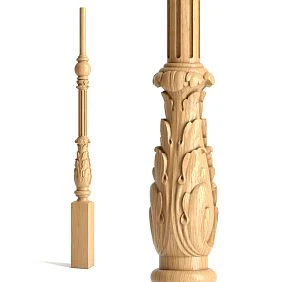
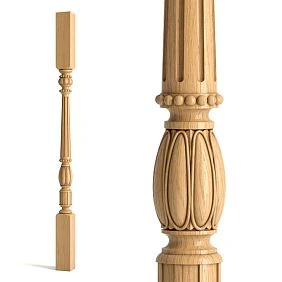
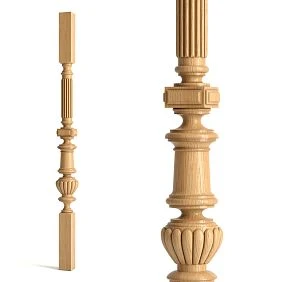
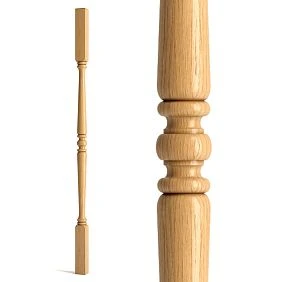
Turned beech balusters. The most common type. Classic turned profile — vase-like expansions, grips, spherical elements — repeats in each baluster of the row. turned balusters are good in classic and neoclassical interiors: they create a recognizable 'staircase' rhythm, work in a system with handrails, posts, and overlays.
Figural balusters. A more complex profile with additional details — rings, capitals, shafts. Such a baluster is no longer just a load-bearing element, but a decorative one. It is appropriate in a rich classic interior with stucco, cornices, and classic furniture.
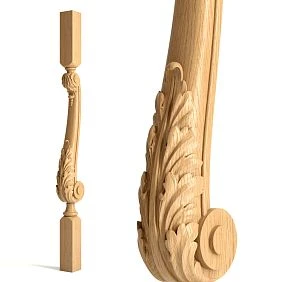
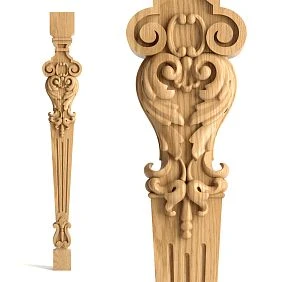
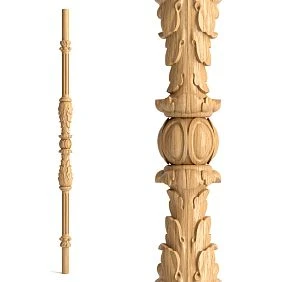
Carved beech balusters. Manual or machine carving on the baluster body — floral or geometric ornament. This is the decorative maximum: each baluster is an element of a relief ornament. For grand staircases in country houses and historical interiors.
Balusters for modern classic. Simplified turned profile — one or two grips, soft tapering towards the tenons. Fewer details, cleaner form. Works in a modern classic interior where order and restraint are valued.
Balusters for a light interior. Thin profile, small diameter — 35–40 mm in the wide part. For stairs in small houses and apartments where visual lightness of the railing is important.
How to choose the shape? Answer one question: how decoratively rich is your interior? If the house has many details — stucco, moldings, paneled doors, rich furniture — balusters with an expressive turned profile will be organic. If the interior is calm and minimalist — choose simple or minimally detailed balusters.
How to match beech balusters to handrails and newel posts
A staircase is a system. A baluster in a system with a handrail and a newel post — these are three elements that must speak the same language. If at least one "speaks" differently — the structure looks inconsistent.
The principle of a unified style. If Wooden balusters with a turned profile — the handrail should be profiled, with chamfers or rounded edges, wide enough (at least 50 mm in cross-section). If the balusters are smooth cylindrical — the handrail is smooth round or rectangular.
Newel posts as an architectural accent. carved wooden balusters at the base and top point of the stairs — load-bearing and decorative simultaneously. The newel post should be noticeably larger than the baluster: if the baluster is 50 mm in diameter, the post is at least 80–100 mm. This is a structural logic that is both correct and visual.
The handrail is not thinner than the body of the baluster. A common mistake: a thin handrail is chosen for large turned balusters. Result: "a rope over a fence." The handrail should visually be no narrower than the wide part of the baluster.
Finish — uniform. Beech balusters, beech newel posts, beech handrail — the same finish. Either all painted with enamel, or all with varnish of the same shade.
Flat balusters as an alternative. If turned balusters are too "classic" for your interior, consider Flat balusters — silhouette ones, made from boards. They create a different aesthetic — more graphic, two-dimensional. For them, choose posts of a calmer character and a handrail of a simple profile.
Do not buy balusters without a handrail and posts in the cart. First, decide on the style of the entire structure, make sure all elements are from the same "collection" in terms of proportions — and only then place your order. This will save money, time, and disappointment.
How to calculate the number of balusters
This is a practical task that many put off until the moment of installation — and then they are short by two or three elements or have an extra dozen and a half. Here is an algorithm that works.
Step 1. Measure the length of the flight of stairs. If the balusters are attached to the stringer — measure the length of the stringer. If to the baluster board — measure the length of the board. Important: measure along the slope, not the horizontal projection.
Step 2. Determine the installation locations of the posts. The lower support post — at the first step. The upper one — at the exit to the landing. At each turn and intermediate landing — one post each. Mark them on the plan. The total length "occupied" by the posts is subtracted from the length of the flight.
Step 3. Choose the spacing between balusters. The recommended spacing is 100–120 mm from center to center. The minimum allowable gap between balusters (clear) is about 100 mm. For homes with small children — no more than 100 mm clear.
Step 4. Calculate the balusters for the flight. Divide the length of the flight (without posts) by the spacing between balusters. Get the quantity. Round up.
Step 5. Account for horizontal landings. On each landing — a separate calculation using the same scheme. Do not forget: on the landing, the spacing is the same as on the flight.
Step 6. Account for the railing of the second light. If the house has an open span of the second floor with a railing — this is a separate zone with a separate calculation.
Step 7. Add a margin of 10–15%. A few "extra" balusters are needed for fitting, possible defects during installation, and future repairs. Keep in mind: in a few years, it may be impossible to buy the same model of baluster. A small stock in storage is insurance.
Where is it better to use beech balusters
In a private house
A private house is an ideal environment for beech balusters. Stable microclimate, enclosed space, constant humidity without sharp fluctuations. It is under such conditions that beech works best.
Buy wooden balusters made of beech for the main staircase connecting the first and second floors is a standard solution. Beech turned balusters with a handrail and carved posts are a full-fledged classic design for a living space.
In a classical interior
Classics require discipline in details. Here, the combination works: turned beech balusters + carved wooden balusters + profiled handrail + Moldings from solid wood along the string + Wooden baseboard along the perimeter.
Everything is coated with a single white or cream enamel. Result: a staircase that organically fits into a classic interior with paneled doors and classic furniture.
In neoclassicism
A neoclassical interior is a classic with modern editing. Less decor, more pure form. Balusters are turned, but with a simple profile: one or two grips. Posts are neat, without excessive carving. The handrail is profiled but not overloaded.
Coating: white or light gray enamel. Emphasis is on clean lines, not decorative richness. wooden balusters for staircases In beech, they work exactly like this: they give the desired shape without excessive 'classicality'.
In a country house
A country house is a space where stairs have increased strength requirements. It operates under higher load conditions — more users, sometimes humidity fluctuations when heating the house.
Beech balusters for a country cottage are a reasonable choice: durable, stable, and accept coating well. With proper treatment and installation, they last for decades without losing their appearance.
Mistakes when choosing beech balusters
Let's be honest: knowing mistakes saves money better than any advice about advantages.
Buying balusters without handrails and posts. Balusters are purchased, the handrail is ordered separately and turns out to be too thin or of an incompatible profile. Result: the railing looks like a random set of elements. Always complete them together.
Not considering the railing height. The standard is at least 900 mm from the step surface to the handrail. Many measure the baluster and do not account for the height of the mounting assembly. Result: the railing is below standard.
Choosing a shape only from a catalog photo. A catalog photo shows one baluster in good lighting. On a real staircase with twenty balusters, the pattern can be completely different. If possible, view samples in person or request photos of completed projects.
Don't count the number of elements in advance. "I'll order as many as needed" — without calculation. Result: several balusters are missing, installation stops, delivery delays the timeline. Count in advance, add a reserve.
Mixing different materials without a unified concept. Beech balusters + oak handrail with natural varnish + painted white post. Everything differs in tone and finish — the staircase looks disjointed.
Not planning painting before installation. Installation is done, then attempts to paint already installed balusters. Inconvenient, paint gets on the steps, result is worse. Paint before installation or immediately after, protecting steps with painter's tape.
Too large spacing between balusters. Spacing over 150 mm violates standards for homes with children, and visually creates a "holey" railing.
Choosing too thin balusters for a massive staircase. On a wide, high flight, thin balusters look unreliable — both aesthetically and structurally.
What to buy together with beech balusters
The right approach is to get everything in one go. Here's the full list:
Beech balusters — the base of the staircase railing.
Balusters for staircase — full catalog of all shapes and profiles, including alternatives from other wood species.
Flat balusters — for a silhouette, graphic version of the railing.
carved wooden balusters — support elements at the base, top point, and turns.
staircase components — complete system: balusters, posts, handrails, and trim elements.
with a classic profile creates a sense of solidity, reliability. — for finishing the lower junction of the stair space.
Moldings from solid wood — for decorative finishing of the stringer, transitions, and wall junctions.
Wooden decoration — tread end caps, decorative details for posts and stringers.
Classic Furniture — if you are decorating the stair hall and adjacent areas in a unified classical style.
Wooden staircase components for sale — the entire system in one order.
FAQ: questions about beech balusters
What are the advantages of beech balusters?
letter balusters — dense, durable material with a fine closed pore. They are easy to work with, do not dent during installation, and provide a perfectly smooth surface for painting. An optimal choice for classic and neoclassical stairs, especially for painting with enamel.
What is better for balusters: beech or pine?
In terms of strength and processing quality, beech significantly surpasses pine. Pine is softer, wears out faster, and holds coating worse — especially in high-load areas. Buy wooden balusters choosing beech means choosing a more durable solution.
Can beech balusters be painted?
Yes, this is one of the main advantages of beech. The smooth, fine-porous surface perfectly accepts enamel without orange peel or protruding pores. Important: sanding + primer before painting are mandatory.
Are beech balusters suitable for a classic staircase?
Absolutely. Turned or shaped wooden balusters for staircases beech balusters fit organically into classic and neoclassical styles. Pair them with a profiled handrail and carved wooden balusters — you will get a complete system.
Is it necessary to buy balusters, handrails, and posts together?
Highly recommended. Handrails and balusters They are selected as a system: consistent style, coordinated proportions, uniform coating. When purchased separately, they rarely create a cohesive impression.
What is the difference between beech and oak balusters?
Oak is stronger and has a more pronounced grain. But it has large pores, which complicates painting with enamel. Beech is more precise in processing, accepts enamel better, and costs less. For stairs to be painted, beech is preferable. For a natural, expensive staircase under varnish, oak is more convincing.
How to avoid mistakes with the number of balusters?
Measure the length of the flight, choose a step of 100–120 mm, divide and round up. Add 10–15% spare. Count landings and horizontal railings separately.
About the company STAVROS
A staircase is a structure that is built once and must serve flawlessly for decades. Every element, every wooden baluster detail matters. STAVROS produces a full line staircase components of solid wood: turned and flat balusters, support Carved posts, Moldings, Baseboards и Wooden decoration for designing the entire staircase area.
STAVROS is a production where every part is precisely processed: spikes are standardized, profiles are reproduced without deviations, the surface is sanded for coating. This is not just a set of wooden elements — it is a system designed to make your staircase look like a single, professionally designed product. From the first baluster to the last molding.