























Article Contents:
- How a spiral staircase differs from a regular one
- Geometry that changes everything
- Compactness as the main condition
- The load is distributed differently
- What elements are needed for a spiral staircase railing
- Balusters
- Central support post
- Handrails and railing
- Support posts around the perimeter
- Fasteners and additional components
- Which balusters are suitable for a spiral staircase
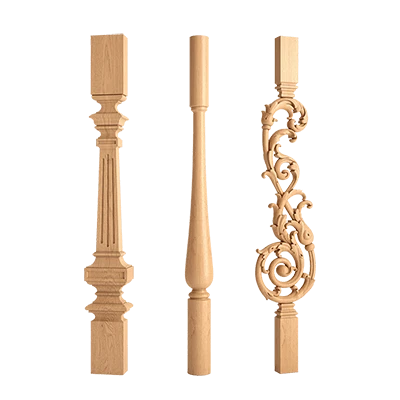
- Turned balusters: a classic choice
- Square balusters: modern minimalism
- Carved balusters: a decorative accent
- What definitely does not fit
- How to choose railings and handrails for a spiral staircase
- Height of Handrails
- Handrail Profile
- Methods for solving curved handrails
- How to choose wood for a spiral staircase railing
- Beech: Precision and Uniformity
- Oak: Durability and Character
- Spruce: accessibility and lightness
- Ash: elasticity and light tone
- How to match balusters to steps
- How to calculate the number of balusters for a spiral staircase
- Installation step: safety and aesthetics
- Arc length of the railing
- Number of balusters
- Balusters on steps vs balusters on stringer
- What to buy along with balusters: complete order composition
- Balusters are the basis of the railing
- Central post and support pillars
- Handrail
- Risers, overlays, baseboards
- Fasteners
- Railing installation: logic and sequence
- Step 1: installation of support posts
- Step 2: installation of the lower support
- Step 3: installation of balusters
- Step 4: Installing the Handrail
- Price of the spiral staircase railing kit
- What forms the budget
- Estimated calculation for a typical spiral staircase
- Mistakes when buying balusters and components for a spiral staircase
- Mistake 1: buying standard balusters without considering geometry
- Mistake 2: forgetting about the handrail
- Mistake 3: not checking component compatibility
- Mistake 4: saving on fasteners
- Mistake 5: not accounting for the upper landing
- Mistake 6: buying without a reserve
- Style and design: how to integrate a spiral staircase into the interior
- Classic Interior
- Modern minimalism
- Loft and Industrial Style
- Scandinavian Style
- Caring for wooden railings inside the house
- Wet cleaning — carefully
- Every few years — coating renewal
- Checking fasteners
- Frequently Asked Questions (FAQ)
- Which balusters are suitable for a spiral staircase?
- Can you buy regular balusters for a spiral staircase?
- What to buy along with balusters for a spiral staircase?
- How to calculate the number of balusters for a spiral staircase?
- Where to buy components for a spiral staircase?
- What type of wood is best for a spiral staircase railing?
- Are special balusters needed specifically for a spiral staircase?
- How long does it take to manufacture a curved handrail?
- Where to buy balusters and components for a spiral staircase
A spiral staircase is not just a way to get to the second floor. It is an architectural statement, a sculptural object inside the house that is visible immediately — from the doorstep, from the living room, from any point in the room. It spirals through space, saves every square meter, and at the same time requires completely special attention. Especially when it comes to the railing.
It would seem: a baluster is a baluster. Install it — and you're done. But a person who has ever been involved in selecting staircase componentsknows: for a spiral staircase, standard logic does not work. There is a different geometry, a different radius, a different handrail angle, and completely different requirements for component compatibility. To make a mistake means to waste money and start all over again.
This article is written for those who want to understand the topic once and do everything right: choose the right balusters, properly equip the railing, calculate the quantity, and avoid the pitfalls of typical buyer mistakes.
How a spiral staircase differs from a regular one
Before talking about balusters and components, you need to understand the nature of the structure itself. Because it dictates the rules of the game.
Geometry that changes everything
A regular straight staircase is a line. The railing runs strictly along the flight, the handrail is straight, the balusters stand in a single row with equal spacing. Everything is predictable.
A spiral staircase is a spiral. The steps radiate from the central post like flower petals. The handrail is not straight—it curves around the axis of rotation in an arc. Each step is wider at the outer edge and narrows toward the center. This means:
-
The handrail must bend—either physically (bent handrail from solid wood or laminated) or be composite with connectors
-
Balusters have different lengths on the same step—higher at the outer edge, lower at the inner edge, if the staircase has a slope
-
The installation spacing of balusters along the arc differs from the spacing on a straight flight
-
The fasteners must allow fixation at an angle
This is not scary. You just need to know it in advance—and buy accordingly components for wooden staircases with an understanding of these features.
Our factory also produces:
Compactness as the main condition
A spiral staircase is most often chosen for space-saving reasons. The diameter of the structure is usually from 1.2 to 2 meters. This means the railing is also compact — and overloading it with massive, heavy balusters would ruin the entire look.
A different aesthetic is at play here: lightness, rhythm, airiness. Balusters should not 'eat up' space — they should structure it, hint at volume, and create an ornament along the spiral.
Get Consultation
The load is distributed differently
On a straight flight, the load on the railing is applied primarily in one plane. On a spiral staircase, a person holding the handrail creates force both along and across the spiral. This requires a more careful approach to choosing the method of attaching balusters and to the rigidity of the entire structure.
What elements are needed for a spiral staircase railing
A complete railing is a system. Each element in it performs its function, and the absence of any one makes the structure either unreliable or unfinished.
Balusters
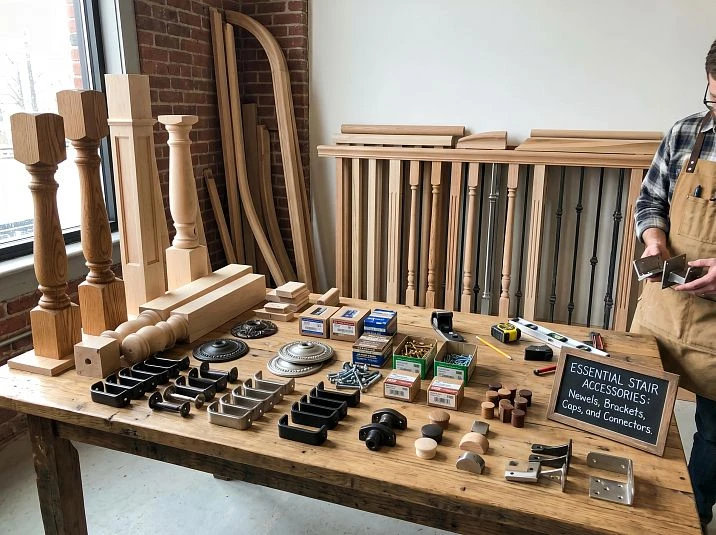
The main 'actors' of the railing. They create visual rhythm, ensure safety (prevent falling through the gap) and bear the lateral load from the handrail. Buy wooden balusters for a spiral staircase, it needs to be calculated considering the step height, railing angle, and required spacing.
Central support pillar
Most spiral staircases have a central post — an axis around which the steps spiral. This is a powerful load-bearing element that takes most of the weight of the entire structure. It is made from hardwoods with an oversized cross-section.
Railings and handrail
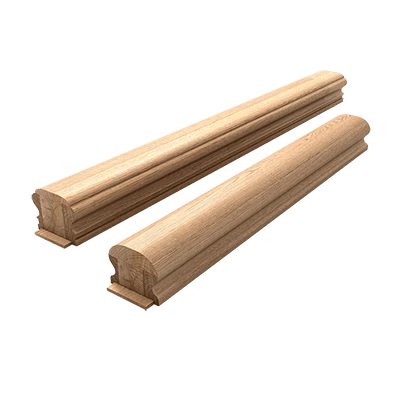
The handrail for a spiral staircase is technically the most complex element. It must smoothly curve around the axis of rotation while maintaining a constant height above the steps. Several solutions are used:
-
Curved solid wood handrail — made to the specific radius of the staircase, expensive, but aesthetically flawless
-
Glued curved handrail — more affordable, holds its shape well
-
Sectional handrail with connectors — assembled from straight sections with corner connectors, a budget option with visible joints
Support posts around the perimeter
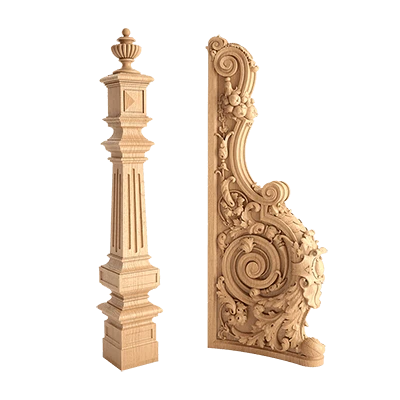
In addition to the central post, vertical ones are installed along the outer edge of the railing Wooden stair posts. Their role is to secure the ends of the handrail runs, mark the beginning and end of the railing, and add rigidity to the structure.
Fasteners and additional components
-
Studs for attaching balusters to steps
-
Anchor bolts for posts
-
Metal angle connectors
-
Decorative rosettes and covers for joints
-
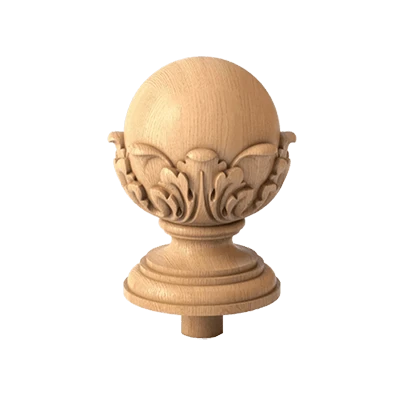
End caps for posts
Which balusters are suitable for a spiral staircase
This is the most frequently asked question. And the answer here is not straightforward — it depends on the style of the staircase, the interior of the house, and the design features of the specific model.
Turned balusters: a classic choice
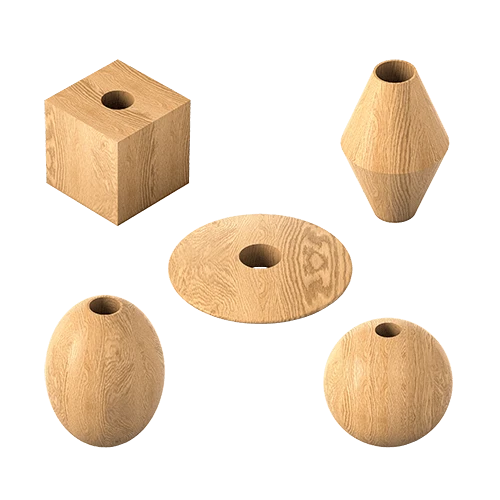
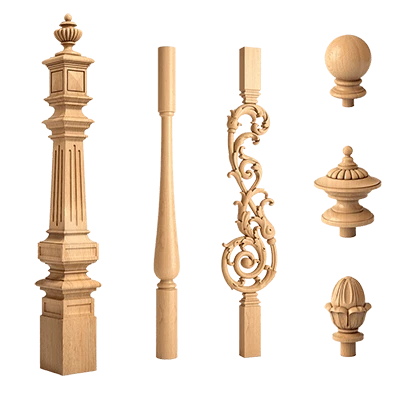
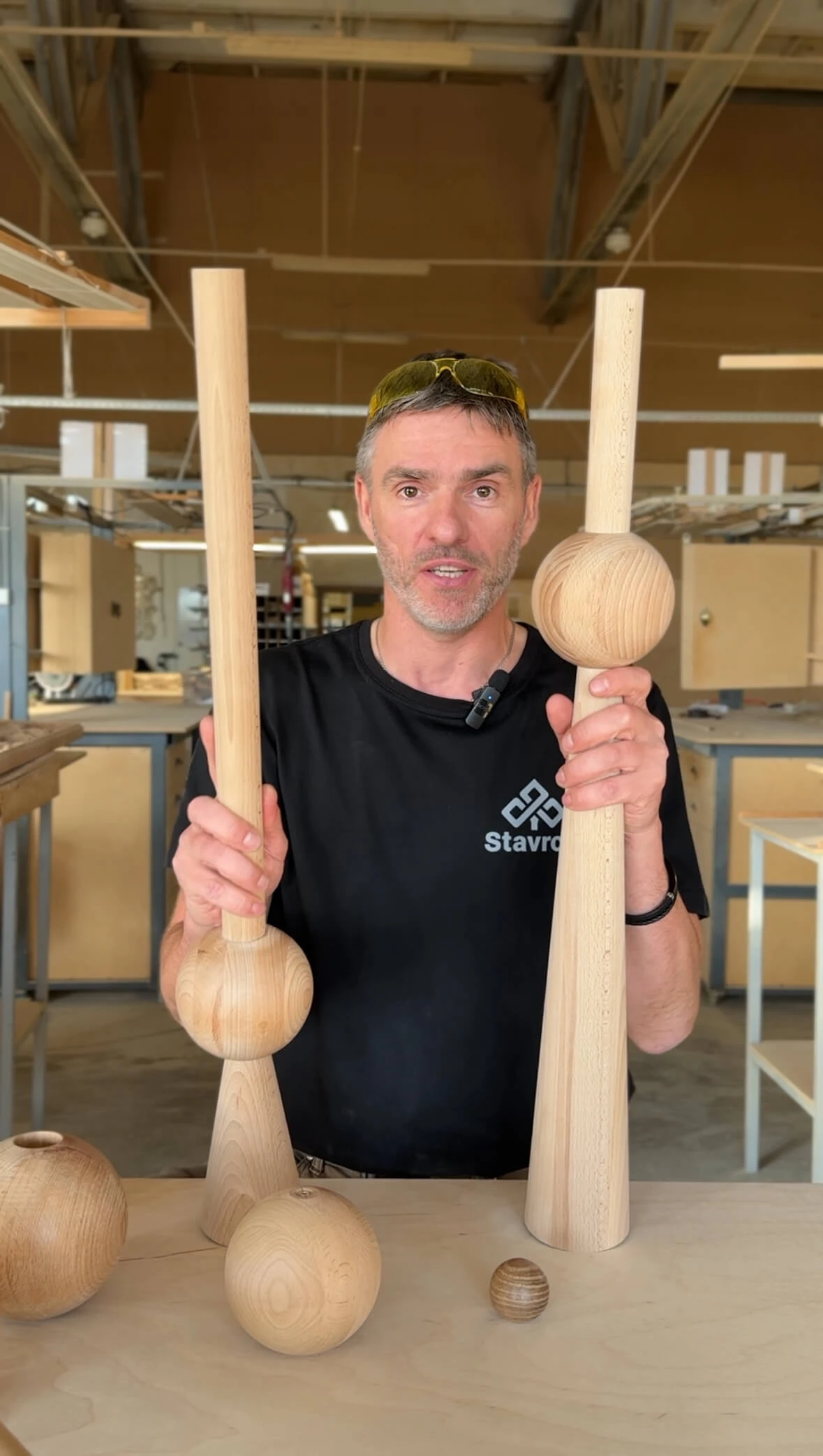
Turned wooden balusters are the most common and organic option for spiral staircases in classic or traditional style. Their silhouette — smooth tapers and expansions along the axis — is well "read" in space and creates a recognizable rhythm of the railing.
For a compact design, it is better to choose turned balusters with a cross-section of 40×40 or 45×45 mm — they do not overload the visual space and are strong enough for proper fastening.
Square balusters: modern minimalism
square balusters for stairs — an excellent choice for houses in modern style, minimalism, or Scandinavian design. Clean geometry, no extra details, a smooth silhouette along the arc of the railing.
The square shape is convenient for installation on a spiral staircase: there is no need to orient the product along the axis of rotation — any side is the same. When the balusters are positioned at an angle, square-section ones are easy to cut to the required angle.
Carved balusters: a decorative accent
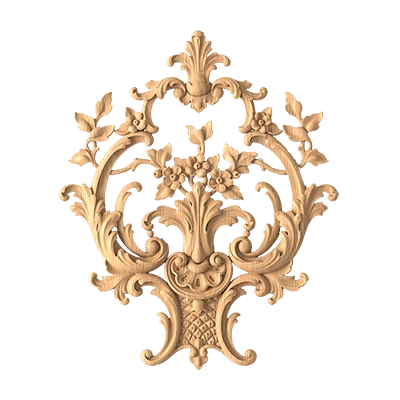
Carved wooden balusters — this is the choice for those who do not seek compromise in beauty. Flutes, ornamental belts, figured transitions — all this turns the staircase into a genuine decorative object.
On a spiral staircase, carved balusters look especially expressive: twisting into a spiral, they create an almost sculptural effect. However, it is important not to overdo it here: for a compact staircase with a small diameter, it is better to choose more restrained carved models without excessive decoration.
What definitely does not fit
-
Very wide and massive balusters with a cross-section of 70 mm or more — they "close" the railing, depriving it of airiness
-
Balusters of non-standard height without the possibility of trimming
-
Models without a tenon at the end — attaching such products to the steps on a spiral staircase is significantly more difficult
How to choose handrails and railings for a spiral staircase
The handrail is the first thing a person touches on the stairs. It is tactile contact, support, a feeling of reliability. And it is with the handrail that you should start designing the railing.
Height of railings
The standard height of railings for residential premises is 900 mm from the surface of the step. This is the minimum. For houses with children and for high staircases, 950–1000 mm is recommended. On intermediate landings — at least 1100 mm.
These figures determine the height of the balusters, taking into account their attachment to the step and the angle of inclination.
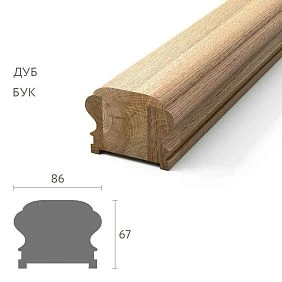
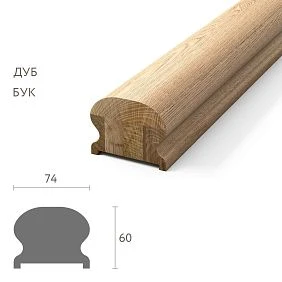
Handrail profile
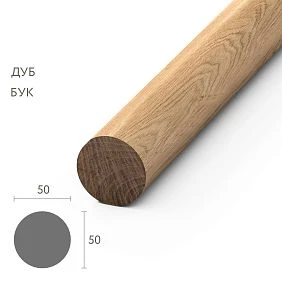
The handrail should be comfortable to grip — and this is not just a matter of aesthetics. A handrail that is too thin is uncomfortable to hold, while one that is too wide is difficult to grasp. The optimal diameter or width is 40–50 mm horizontally.
for railings and balusters made from a single type of wood — this ensures both aesthetic unity and consistent material behavior when humidity changes: they expand and contract synchronously.
Methods for solving curved handrails
The most common question: how to make a handrail that smoothly follows the entire spiral?
Option 1 — bent solid handrail. Made to a specific radius on order. Beautiful, expensive, monolithic. Requires precise measurements before ordering.
Option 2 — glued bent handrail. Assembled from thin lamellas that are bent and glued on a template. More affordable, durable, holds its shape well.
Option 3 — straight sections with corner connectors. The handrail is assembled from short straight segments with metal connectors at turning points. This is visible at the joints, but installation is quick and requires no special equipment.
How to choose wood for a spiral staircase railing
The railing material is not just about strength. It's about color, texture, tone, feel under the hand, and durability under specific operating conditions.
Beech: precision and uniformity
Beech is one of the most popular wood species for wooden balusters for staircases. It is dense, uniform, and responds well to turning and milling — parts come out crisp with smooth edges. The color is light beige with a fine texture. Under varnish or stain, it looks expensive and neutral.
The only nuance: beech does not like high humidity. For living spaces with normal climate, it is ideal.
Oak is the undisputed leader for baseboards in residential spaces. Density 650–750 kg/m³, Brinell hardness 3.7 units (this means: even a stiletto heel won't leave a dent), natural tannin content — substances that protect the wood from fungus, insects, and rot without any additional treatment. Service life with normal care — 50 years or more.
Oak is a choice for a lifetime. Hard, durable, with a pronounced texture and a warm golden-brown color. Oak Buy balusters and posts for a wooden staircase means betting on a material that will not lose its appearance after 20 years.
Oak bends well when steamed, making it suitable for making curved handrails. Under clear varnish, the texture "plays," creating a lively, warm surface.
Pine: accessibility and lightness
Pine is the most budget-friendly option. Soft, easy to work with, takes paint and varnish well. For an interior staircase in a residential house, with proper treatment, it lasts a long time. The main limitation is softness: on steps and in high-traffic areas, pine wears and scratches faster.
For balusters and railings of an internal spiral staircase, pine is quite suitable. Pine steps are best protected with overlays.
Ash: elasticity and light tone
Ash occupies an intermediate position between pine and oak in price and between beech and oak in appearance. Light, almost white wood with soft brown texture stripes. Elastic, durable, bends well. Popular for making curved handrails.
How to align balusters with steps
The rule that is most often violated: balusters and steps must be either from the same wood species or have the same tone of coating. If the steps are made of dark oak, the railing should also be dark oak. If the steps are light, natural — the handrails and balusters should be in the same tone.
Mismatched wood species create a visual break that makes even an expensive staircase look cheap.
How to calculate the number of balusters for a spiral staircase
The calculation for a spiral staircase is a bit more complex than for a straight one. But once you understand the logic, everything falls into place.
Installation spacing: safety and aesthetics
The standard clear spacing between balusters (distance between adjacent items) is 100–150 mm. This is primarily dictated by safety regulations: a child's head should not be able to pass through the gap. The standard norm is no more than 150 mm in the clear.
On a spiral staircase, the clear spacing is measured along the arc of the outer edge of the railing — where the gap is largest.
Length of the railing arc
For the calculation, you need to know:
-
Stair diameter (outer) — D
-
Stair rotation angle — α (in degrees)
-
Arc length L = π × D × α / 360
Example: outer stair diameter 2 m, rotation angle 360° (full turn).
L = 3.14 × 2 × 360 / 360 = 6.28 m
This is the arc length along which balusters are placed.
Number of balusters
Number of balusters = L / (baluster width + clear spacing)
With baluster width 45 mm and spacing 120 mm:
6.28 m / (0.045 + 0.120) = 6280 / 165 ≈ 38 balusters
Add 5–10% extra for trimming and possible defects during installation.
Balusters on steps vs. balusters on stringer
On spiral staircases, balusters are often installed directly on the steps (via a tenon or pin) rather than on the stringer. This determines the length of the products: on each step, the height of the baluster is measured from the step surface to the bottom edge of the handrail.
If the steps are at different heights relative to the handrail axis, balusters may have different lengths within a single run. This should be considered when ordering.
What to buy together with balusters: complete order composition
There are no small details here. Every missed element is a potential installation delay or visual flaw in the finished product.
Balusters — the foundation of the railing
balusters for staircase to buy needed in the calculated quantity plus a reserve. For spiral staircases — only solid wood, with a tenon at the ends for attachment to the step.
Central post and support posts
Buy balusters and posts for a wooden staircase need to be together — this ensures compatibility in wood species, tone, and style. Posts for the start and end of the span are mandatory. Intermediate posts are installed when the span length exceeds 1.5 m.
Handrail
The handrail for curved installation must be ordered in advance — its production takes time. Straight sections can be purchased with a small margin and trimmed on site.
Risers, overlays, baseboards
If the staircase is wooden and a full finish is planned, don't forget about risers and decorative baseboards around the perimeter of the steps.
Fasteners
Proper fasteners for wooden balusters include:
-
Studs or dowels for screwing into the step (diameter 10–12 mm, length 70–100 mm)
-
Screws or bolts for attaching the upper end of the baluster to the handrail
-
Metal connectors for linking railing elements
-
Anchor bolts for posts
All of this is stainless steel or galvanized metal. Regular steel inside wooden elements leaves rust stains that will appear on the surface after a year or two.
More about proper attaching balusters and railings can be found in the special STAVROS section — it describes a professional approach to installation in detail.
Fence installation: logic and sequence
Before taking out the tool, it is important to understand the order of actions. Incorrect installation sequence is one of the main causes of misalignments and on-site adjustments.
Step 1: installation of support posts
First — always the posts. They set the vertical line from which everything else is built. The posts are installed on anchor bolts strictly vertically, checked with a level in two planes.
Step 2: installation of the lower support
On horizontal platforms, install the bottom rail or support handrail to which the balusters are attached from below. On steps, mark the installation points for the studs.
Step 3: installation of balusters
Balusters are placed on studs, glued with epoxy compound, or secured with self-tapping screws. On a spiral staircase, it is important to ensure each baluster remains vertical — their angle does not change despite the slope of the steps.
Step 4: Installing the Handrail
The handrail is placed on the balusters and fixed to the posts. On a curved handrail, joints are coated with wood glue and reinforced with metal brackets. After installation — puttying joints, sanding, final coating.
Step-by-step instructions for installation of wooden railings and balusters provides a comprehensive guide for those who want to understand the details.
Price of a spiral staircase railing kit
The issue of cost is always at the forefront. And it's important not to make a mistake with the benchmarks.
What shapes the budget
Wood species. The most significant factor. Pine Buy wooden balusters can be from 1,990 rubles per piece. Oak and beech — from 3,500 to 7,000+ rubles.
Baluster shape. Square — cheaper, turned — more expensive, carved — the highest price.
Baluster height. Standard height is 900–1000 mm. Non-standard sizes are made to order and cost more.
Handrail. Straight handrail — the most affordable. Curved to a radius — significantly more expensive due to production complexity.
Posts. The price depends on the cross-section, height, and complexity of the shape.
Order volume. When Buy balusters price from the manufacturer wholesale — lower per unit.
Preliminary calculation for a typical spiral staircase
Let's take a staircase with a 360° rotation angle, an outer diameter of 2 m, a height of 3 m, and 16 steps.
| Element | Quantity | Price per unit | Total |
|---|---|---|---|
| Turned balusters (beech) | 42 pcs. | from 2,500 rub. | from 105,000 RUB |
| Support posts | 2 pcs. | from 13,000 RUB | from 26,000 RUB |
| Curved handrail (l.m.) | 7 м | from 4,500 RUB/m | from 31,500 RUB |
| Studs, anchors, connectors | — | — | from 8,000 RUB |
| Decorative overlays | — | — | from 5,000 RUB |
| TOTAL | from 175,500 RUB |
These are approximate figures. An accurate calculation is always made for a specific project, taking into account all measurements.
Mistakes when buying balusters and components for a spiral staircase
Mistakes on this topic are costly. Let's break them down directly, without unnecessary words.
Error 1: buying standard balusters without considering geometry
The most common. A person sees a beautiful baluster in a catalog, orders the required quantity — and discovers that the standard height of 900 mm doesn't fit: on some steps the baluster protrudes above the handrail, on others it falls short.
Solution: before ordering, take working measurements from each step or calculate the baluster height considering the staircase angle and step height.
Error 2: forgetting the handrail
Balusters ordered. Posts ordered. But the handrail — forgotten. Or ordered a straight handrail for a curved railing. Result: installation stalled.
The handrail for a spiral staircase is ordered first — because its manufacturing takes the most time.
Error 3: not checking element compatibility
Balusters from one manufacturer, posts from another, handrail from a third. On paper, the dimensions match. In practice — the handrail seat doesn't fit the baluster, the connector is wrong, the fasteners don't fit.
Solution: buy balusters and handrails from one manufacturer that designs the railing system as a single unit.
Error 4: skimping on fasteners
Cheap black steel self-tapping screws leave rusty streaks on wood after 1–2 years. Loose balusters are not just an aesthetic issue but also a safety concern. Fasteners must be stainless steel or galvanized — no compromises.
Mistake 5: not accounting for the top landing
A spiral staircase ends with a landing — and that also needs railing. It's often forgotten when calculating the number of elements. As a result, there aren't enough balusters for the final section.
Mistake 6: buying without a reserve
Always buy 5–10% extra. During installation, a baluster may crack when cut, a defect may be discovered, or a measurement may be taken incorrectly. Reordering later means time and possibly a different batch with a different shade.
Style and design: how to integrate a spiral staircase into the interior
The railing is the last thing to be installed but the first thing to be seen. Therefore, the stylistic decision should be made in advance.
Classic interior
Turned wooden balusters for stairs buy made of oak or beech, with a golden walnut or dark cognac finish. The handrail is round or semi-round in profile. Posts with capitals and decorative bases. This is a railing you can admire.
Modern minimalism
Square balusters made of beech or ash, matte finish in bleached oak or light ash color. The handrail is rectangular in profile, without decoration. Posts are minimalist and square. Everything is in the same tone as the floor and walls.
Loft and industrial style
Here, wood is often combined with metal. A wooden handrail on metal posts or a metal handrail with wooden balusters is a popular solution. The wood is dark, brushed, or distressed oak.
Scandinavian style
Light wood, simple shapes, no unnecessary decor. Balusters are square or with soft turning, in the color of natural beech or pine. Coating is clear matte varnish. Handrail is thin, comfortable, light.
Caring for a wooden railing inside the house
A wooden railing inside the house requires less attention than an outdoor one. But a few rules are still worth following.
Wet cleaning — carefully
The handrail is constantly touched by hands. It gets dirty. It should be wiped with a slightly damp cloth, not wet — excess moisture damages the varnish and wood. The same applies to balusters and posts.
Coating renewal every few years
The varnish on the handrail wears off over time, especially at points of maximum contact. When matte spots or scratches appear — local sanding and applying a new layer of varnish. Complete coating renewal is recommended every 5–7 years.
Checking fasteners
Annually — before forgetting about the stairs for the next season — it is worth checking the balusters for loosening: a slight wobble by hand. A loose baluster should be reinforced immediately, without delay.
Frequently Asked Questions (FAQ)
Which balusters are suitable for a spiral staircase?
For a spiral staircase, neat wooden balusters with a cross-section of 40×40 or 45×45 mm are best — they don't overload the compact structure and create a light, airy silhouette. The optimal shape choices are turned or square. Carved ones suit classic interiors. The main thing is to correctly calculate the height considering the staircase's angle of ascent.
Can I buy regular balusters for a spiral staircase?
Yes. Standard balusters are quite suitable — if you correctly calculate their height for the specific step. On straight horizontal sections (landings), the height is standard. On flight sections with a slope, the top end of the baluster is cut at the angle of the handrail's incline. Tools needed include a miter saw or a saw with an adjustable angle.
What should I buy together with balusters for a spiral staircase?
Optimal set: balusters + support posts + handrail (curved or segmented) + fasteners (studs, anchors, connectors) + decorative joint covers. If the staircase is open, add risers. It's best to order everything from one manufacturer — compatibility is guaranteed.
How to calculate the number of balusters for a spiral staircase?
Basic calculation: the length of the outer guardrail arc is divided by the sum of the baluster width and the clear spacing. The arc length is calculated using the formula L = π × D × α / 360. Add 5–10% margin to the result. It's better to do the exact calculation together with the manufacturer's manager — they know the nuances of specific models.
Where to buy components for a spiral staircase?
All elements — buy staircase railing components, posts, balusters, fasteners — can be selected in the STAVROS catalog. Here you can also get advice on calculating and selecting elements for a specific structure.
What wood is best for making a spiral staircase railing?
The optimal choice is oak or beech. Oak — for those who value durability and pronounced texture. Beech — for those who want a neutral tone and high precision of details. Pine — a budget option for stairs with moderate load. Oak and ash are well suited for curved handrails.
Are special balusters needed specifically for a spiral staircase?
There are no specialized balusters "only for spiral staircases". But when choosing, it is important to consider: the compact size of the structure dictates a moderate cross-section of products, the correct height is calculated for a specific angle of ascent, and the fastening should allow installation with end trimming at an angle.
How long does it take to manufacture a radius handrail?
Manufacturing a curved handrail for a specific radius usually takes from 2 to 4 weeks, depending on the complexity, wood species, and production workload. That is why the handrail should be ordered first, while the preparation of other work is underway.
Where to buy balusters and components for a spiral staircase
The question 'where' is no less important than the question 'what'. Here, not only the price matters, but also the quality of the material, manufacturing precision, availability of a full range, and the possibility of professional consultation.
STAVROS is a manufacturing company with many years of experience in producing wooden components for stairs to the second floorbalconies and terraces. The catalog features over 50 models of balusters, a wide selection of posts, railings, handrails, and all fasteners for complete installation.
What sets STAVROS apart:
-
Full-cycle production — all products are made in-house, without intermediaries and price markups
-
Unified compatibility system — balusters, posts, handrails, and fasteners are designed as a complete set.
-
Wide selection of wood species — pine, beech, oak, ash in one catalog.
-
Professional calculation — managers will help calculate the number of elements for your specific staircase.
-
Contact us to confirm shipping to your destination. — Moscow, St. Petersburg, regions, and CIS countries.
Here you can purchase wooden staircase components in one order — from the first baluster to the last decorative overlay. No need to search for each element from different sellers and check compatibility: everything is already systematically thought out.
A spiral staircase is only complicated until the first right step. And the first right step is to contact a manufacturer who knows their product inside out and is ready to guide you from measurement to finished railing.