Article Contents:
- Geometric furniture leg MN-206: what options the product card actually offers
- MN-206, 120 mm high
- MN-206, 180 mm high
- Heights 250, 350, 450, 650, and 740 mm
- MN-206 made of beech
- MN-206 made of oak
- Brass tip
- Stainless steel tip
- MN-206 120 mm and MN-206 180 mm are already two different orders
- Beech and oak cannot be mixed within one item
- Brass and stainless steel change the appearance of the series
- Why the word "MN-206" is not enough for the purchasing list
- 96 working supports
- Count the reserve separately
- Why it is better to discuss the reserve in sets of four
- Why you cannot automatically add 10%
- First, the final height of the furniture is set
- Then the cabinet body is subtracted
- The tabletop is taken into account
- Mounting elements that actually add height are taken into account
- Only then is 120 or 180 mm chosen
- Height of the top surface
- Cabinet body proportion
- Visible clearance under the cabinet
- Cleaning equipment
- Position of handles relative to the bed
- Beech MN-206
- Oak MN-206
- Why the wood species is chosen before starting the finish
- When visible texture becomes part of the project
- Why you cannot order the first 60 legs in beech and the rest in oak just because of availability
- Furniture handles
- Luminaires
- Other brass parts
- Why the tip should be included in the specification as a separate line
- Chrome-plated fittings
- Stainless steel parts
- Contemporary furniture
- Why changing the metal after manufacturing the first switches is not allowed without checking the entire series
- Check one specific SKU
- Do not combine leftovers of different versions
- What to do if there are fewer than 96 in stock
- When it is more rational to approve a production batch
- Why one series is easier for finishing and acceptance
- Check an alternative if the height of MN-206 is not suitable
- Compare another geometric profile
- Do not force MN-206 to work in an unsuitable project
- One foot per support — only after confirming the assembly
- For 96 legs, hardware must be counted simultaneously
- Reserve of feet
- Why hardware should have a separate line
- Checking the proportion
- Checking the metal
- Finishing check
- Checking the operation
- Test swatch
- Same technology
- First batch control
- Why you cannot change the coating formula in the middle of an order
- Assemble four supports of one item into a set
- Do not sort by individual leg only
- Compare cabinets side by side
- Toning control
- Geometry
- Surface
- Tip
- Preparation
- Finish repeatability
- Serial hotel property
- Possible future renovation
- Complex custom finishing
- Remote object
- When the reserve is not justified
- Level 1 — quantity
- Level 2 — specification
- Level 3 — geometry
- Level 4 — surface
- Level 5 — tips
- Level 6 — hardware completeness
- Level 7 — reference standard
- Why you can't paint everything first and then accept
- Different heights
- Different wood species
- Different metal
- Different wood texture
- Different shade after finishing
- Zone "Accepted, not processed"
- Zone "Finishing"
- Zone "Sets 01–24"
- Zone "Reserve"
- What to attach to the request
- What heights are available for MN-206?
- Is there an MN-206 with a height of 120 mm?
- Is there an MN-206 with a height of 180 mm?
- What furniture is suitable for MN-206?
- Can I buy MN-206 for a cabinet?
- What to choose — beech or oak?
- What metal tips does MN-206 have?
- Can I order MN-206 with a brass tip?
- Can I order MN-206 with a stainless steel tip?
- How many legs are needed for 24 cabinets?
- Do I need to buy spare legs?
- Why is it convenient to count spare parts in sets?
- Can I just add 10%?
- How to order 96 identical MN-206?
- Do I need to make one reference cabinet?
- Which floor glide is recommended for MN-206?
- What size is FUR-023?
- Do I need to buy 96 FUR-023?
- Where to Buy Furniture Legs?
- Where to buy wooden furniture legs?
- How do 120 mm differ from 180 mm in a finished cabinet?
- Can I mix 120 and 180 mm in one batch?
- Can part of the batch be ordered in beech and part in oak?
- Can I change brass to stainless steel mid-series?
- What to do if there are fewer than 96 identical legs in stock?
- How to accept oak legs with natural texture?
- How to store finished legs before assembly?
- How to check the current price of MN-206?
- What matters more for a large order — price or identical specification?
- When is it too early to buy the entire batch?
- When can 96 MN-206 already be ordered?
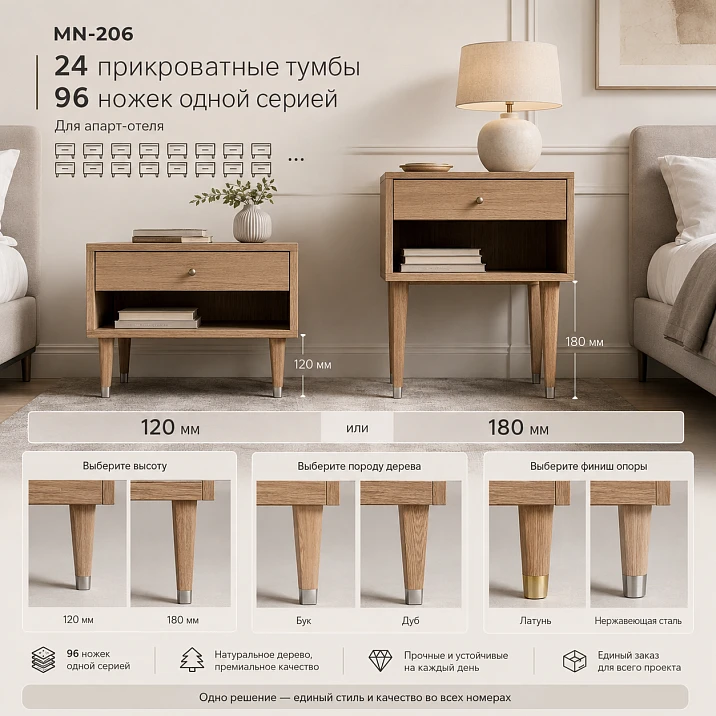
How to order 96 identical wooden furniture legs MN-206 for 24 nightstands: choose 120 or 180 mm, beech or oak, brass or stainless steel, calculate reserve, FUR-023, and properly accept a serial batch.
For one nightstand, making a mistake with the legs is unpleasant. For a series of 24 identical nightstands, the same mistake multiplies by 24: incorrect height changes the level of the entire furniture, an accidental mix of beech and oak disrupts the finish, different metal tips break the visual rhythm, and unchecked hardware surfaces during assembly. Therefore, the specification "MN-206 — 96 pcs." is insufficient for a serial order.
In the project under consideration, four supports are provided for each cabinet. Therefore, the working quantity is:
24 cabinets × 4 legs = 96 MN-206 legs.
Four supports here are a condition of the specific project, not a universal standard for any cabinet. Another cabinet may have a different structure, central support, or a different base layout. But if the project has already been approved with four legs, the buyer needs to turn the number 96 into a full specification.
At a minimum, it must include:
MN-206 / height / beech or oak / tip: brass or stainless steel / finish / 96 working pcs. / reserve / associated hardware / acceptance rules.
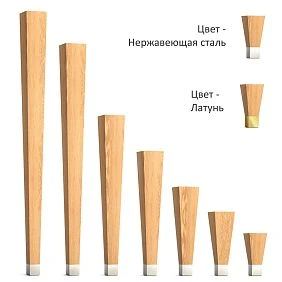
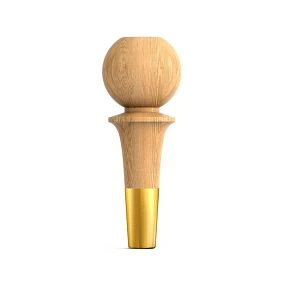
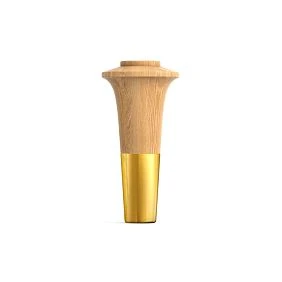
The MN-206 card confirms seven heights — 120, 180, 250, 350, 450, 650, and 740 mm. For the 120 mm version, a cross-section of 52×30 mm is specified; for the others, 60×30 mm. Beech and oak are available, and the metal tip is offered in brass and stainless steel options. For MN-206, a square floor glide FUR-023 25×25×5 mm is recommended.
The main question of the article is not where to find furniture legs. It is different: how to buy 96 identical MN-206 legs so that all 24 cabinets are truly one series, not a set of similar parts.
Geometric furniture leg MN-206: what options the card actually offers
Before a serial order, it is necessary to separate the MN-206 family from a specific purchasing item. The article number is the same, but within the card there are several heights, two wood species, and two metal options. Therefore, MN-206 by itself is not yet a complete specification.
If the project has already been approved, the specific option can be buy furniture legs MN-206 in the product card. Before ordering a series, you need to select all parameters at once.
| Parameter | Confirmed options |
|---|---|
| Height | 120, 180, 250, 350, 450, 650, 740 mm |
| Cross-section of the 120 mm version | 52×30 mm |
| Cross-section of other heights | 60×30 mm |
| Wood | Beech, oak |
| Metal tip | brass, stainless steel |
| Recommended footrest | FUR-023, 25×25×5 mm |




MN-206 with a height of 120 mm
The 120 mm version is the lowest confirmed by the card. In a bedside table project, such a height may be appropriate if the body itself is tall enough and the designer needs a moderate clearance from the floor.
But 120 mm cannot be turned into a "standard for a table." Tables have different body heights, tabletop thicknesses, bottom construction, and visual proportions. The right choice starts with the final furniture height, not a familiar number.
The 120 mm version has a separate cross-section — 52×30 mm. This needs to be recorded in the drawing and mounting template, especially if both 120 and 180 mm are considered simultaneously in production.
Our factory also produces:
MN-206 with a height of 180 mm
180 mm provides a 60 mm greater lift compared to the 120 mm version. In a single table, the difference seems small, but in a series of 24 items, it changes the entire level of the top surface, the visual lightness of the body, and the clearance under the furniture.
If the table body does not change, switching from 120 to 180 mm increases the final furniture height by the same 60 mm, provided additional mounting elements do not introduce other changes.
Get Consultation
Heights of 250, 350, 450, 650, and 740 mm
These options show that MN-206 is not a "leg only for a table," but a family of supports for different furniture tasks. The manufacturer lists among applications dressers, benches, poufs, coffee tables, dining and writing tables, and consoles.
For our article, they are important as confirmation of a wide size range, but not as a reason to expand the intent to tables. If the project is 24 bedside tables, the choice is made between those heights that truly suit the project. In this scenario, the main comparison is 120 and 180 mm.
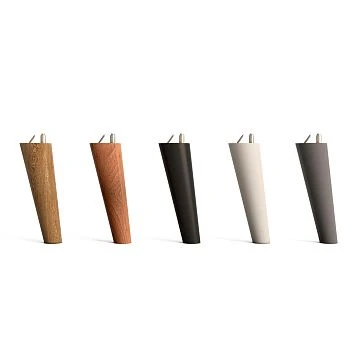
MN-206 made of beech
Beech makes sense to consider for a series where controlled finishing and a uniform appearance are important. The specific decision — whether to leave the wood visible, tint it, or paint it with an opaque coating — is determined by the design project and production technology.
The wood species must be approved before the final finishing starts. Ordering "some beech now, oak later, if it's not enough" for a single serial item is bad practice.
MN-206 made of oak
Oak is chosen when its visible texture and character of the wood are part of the design. For 96 supports, the task becomes more complex: you need to think not only about each leg individually, but also about how four supports of one product look as a set and how 24 cabinets look next to each other.
Natural wood does not have to be absolutely identical in grain pattern. But a serial project requires defining in advance the acceptable degree of variability and the sorting method after finishing.
Brass tip
Brass becomes a noticeable part of the furniture's image. If the cabinet has brass handles, nearby brass lamps, or there are other warm metallic accents in the interior, such a tip can support the overall system.
In the order, the word "brass" must be a separate parameter. It cannot be left as a verbal wish.
Stainless steel tip
Stainless steel is visually closer to cold modern hardware, chrome-plated and steel parts. It can be more neutral in a project where the metallic accent should not dominate.
But the main rule is the same for both options: the tip metal is chosen for the entire series before launching 24 toggles.
Buying furniture legs for a series: why first fix one SKU, and then count 96 pieces
When a person wants buy furniture legs, in a retail scenario, you can first choose the model, and clarify details later. In a serial project, this order is risky.
Here, a specific purchasing item is first created, for example:
MN-206 / 120 mm / beech / brass tip / finish per approved sample.
And only after that, the quantity is set:
96 working pcs. + agreed reserve.
MN-206 120 mm and MN-206 180 mm are already two different orders
Even with one article, the height changes the finished furniture. If a batch accidentally contains 90 legs of 120 mm and 6 of 180 mm, these six parts cannot be considered a normal "addition" to the order. For production, this is a sort error.
Beech and oak cannot be mixed within one item
Mixing wood species creates problems in finishing and visual consistency. Even under the same stain, beech and oak do not become the same material.
If the project deliberately uses both species, they should be two separate specification lines, not one vague item like "MN-206 wooden."
Brass and stainless steel change the appearance of the series
For a single cabinet, a mixed-up tip is noticeable. For an apartment hotel corridor where furniture repeats, the inconsistency becomes a serial defect.
During acceptance, metal is checked the same way as height and wood species.
Why the word "MN-206" is not enough for a procurement list
The article number defines the product family but does not fully describe the selected combination. The purchase list should be such that another employee, not involved in the discussion, can receive the goods and unambiguously understand whether they match the order.
If this is impossible without verbal comments, the specification is weak.
24 cabinets and 96 furniture legs MN-206: how to count the quantity correctly
Number of slats = rounding up (net frieze length ÷ length of one slat).
24 × 4 = 96 working supports.
But the number 96 only answers the question of how many legs will be physically installed in the furniture according to the approved scheme. It does not answer the question about the reserve.
96 working supports
For each cabinet, the set: 4 legs. Total: 24 sets × 4 = 96.
Count the reserve separately
The reserve is not part of 96. It is entered as a separate line: 96 working + ___ reserve.
This is important for accounting, warehouse, and receiving. Otherwise, extra parts get lost within the total number and it is unclear how many of them should be installed.
Why it is better to discuss the reserve in sets of four
For serial furniture, it is often more practical to think not in percentages, but in terms of readiness to restore one item. For example: 1 reserve set = 4 legs.
Such a reserve allows in the future to replace a full set of one nightstand if the finish or batch of wood requires a group replacement. But this does not mean that you should always take four extra. The specific reserve is approved by the project.
Why you cannot automatically add 10%
10% of 96 is 9.6, which rounds to 10 pieces. But ten legs do not form a whole number of four-leg sets.
Mathematically, the percentage looks neat, but logistically it is not necessarily so. Better to ask: what scenario should the reserve cover?
MN-206 120 or 180 mm: how to choose the height for a nightstand
The leg height is chosen based on the final furniture height.
The simplest model:
final nightstand height = body + elements that actually add height + leg.
If the tabletop is already included in the body dimension, you cannot add it a second time.
First, the final furniture height is set
In the apart-hotel, the bedside table works together with the bed, mattress, outlets, lamp, and user scenario. The top surface should be convenient specifically in this composition.
Then the body is subtracted
Conditional example:
-
target height of the nightstand — 600 mm;
-
body with tabletop — 480 mm;
-
additional elements do not add height.
Then: 600 − 480 = 120 mm.
In this model, MN-206 120 mm fits. If the same cabinet is placed on 180 mm, the top surface will be at 660 mm.
The countertop is taken into account
You need to understand whether the countertop is included in the cabinet size. At the factory, one team may call a "480 mm cabinet" without the top panel, another may include it. Before choosing a leg, the dimensions are brought to a single system.
Mounting elements that actually add height are taken into account
A base plate, mounting platform, or structural insert can affect the final level if they actually sit in the dimensional chain. The magnitude of this contribution cannot be assumed without a drawing.
Only then is 120 or 180 mm selected
The choice becomes a result of calculation, not taste.
Why the 60 mm difference between MN-206 120 and 180 mm significantly changes the series
60 mm is 6 cm. For 24 identical cabinets, this is not a cosmetic adjustment.
Height of the top surface
If the cabinet body is the same, the entire top surface rises by 60 mm. This changes the interaction with the bed and the lamp.
Body proportion
Low legs visually connect the cabinet body to the floor more strongly. Higher legs provide a larger gap and make the piece appear lighter.
Visible gap under the cabinet
The gap affects perception and usability. It should be evaluated on a reference product.
Cleaning equipment
If the object uses robotic or other cleaning equipment, the geometry under the cabinet must be checked with a real device or its exact dimensions. Compatibility cannot be promised based only on leg height: the bottom of the cabinet, crossbars, and fasteners also matter.
Position of handles relative to the bed
When the height of the entire cabinet changes, the coordinates of handles, drawers, and outlets relative to the user also change.
Buy wooden furniture legs made of beech or oak for 24 identical cabinets
When you need Buy wooden furniture legsthe species becomes part of the serial specification.
Beech MN-206
Beech can be a rational choice for a project with an opaque finish, where a stable color of the entire furniture set matters more than highlighting the open texture of a specific species. The specific coating technology is agreed upon with the contractor.
Oak MN-206
Oak is especially appropriate if the project showcases natural wood and wants to use its grain as part of the design. Then acceptance includes not only dimensions but also visual sorting.
Why the species is chosen before starting the finish
The test coating must be done on the species that will go into the series. You cannot approve the color on beech and then replace part of the batch with oak and expect an identical result.
When visible texture becomes part of the project
If the legs remain semi-transparent, the four supports of one item should look like a set.
Why you cannot order the first 60 legs in beech and the rest in oak just because of availability
If the supply of the selected wood species does not cover 96 workpieces, the right question is whether a production batch can be approved or the project changed entirely, rather than mixing materials within a single series.
Brass tip MN-206: when metal becomes part of the nightstand design
Brass must be coordinated with other metal elements.
Furniture handles
If the handles are brass, it is useful to place a sample of the tip and an actual handle nearby. The name of the metal does not yet guarantee an identical shade or degree of gloss.
Lighting fixtures
In the bedside area, the leg can visually work with the light fixture. This looks close in the render, but actual metal compatibility is better confirmed with samples.
Other brass parts
Mirror frames, switches, decorative profiles, and hardware can influence the choice.
Why the tip should be included in the specification as a separate line
Because "MN-206, beech" does not answer the question of which metal should arrive. The procurement document should state: tip = brass.
MN-206 with stainless steel tip: when the series looks calmer
Stainless steel can support a modern, more neutral scheme.
Chrome hardware
Stainless steel is not automatically the same as chrome, but visually the cool metal group can work more consistently than brass.
Stainless steel parts
If stainless steel is already present in the furniture or interior, the logic becomes more straightforward.
Modern furniture
In laconic geometry, cool metal sometimes emphasizes the shape of MN-206 without drawing too much attention.
Why changing the metal after the first cabinets are made is impossible without checking the entire series
After the standard is approved, the metal is part of the design. If the first six cabinets are made with brass, and the remaining eighteen are proposed to be made with stainless steel only because of availability, that is already two series, not one.
Buy furniture legs from stock or order the entire MN-206 series as one batch
In a large purchase, availability needs to be checked not by the model card in general, but by the specific combination.
For example: MN-206 / 120 mm / oak / brass.
Another variant of the same item number does not cover the need.
Check one specific SKU
The manager must be asked for availability of exactly the selected specification in the quantity of 96 working pieces plus the agreed reserve.
Do not combine balances of different versions
You cannot sum 40 beech with brass, 30 oak with brass, and 26 beech with stainless steel and declare that "there are 96 MN-206 in total." For one serial furniture line, these are three different items.
What to do if there are fewer than 96 in stock
Correct scenarios:
-
agree on the production of the missing quantity;
-
order the entire series as one production batch;
-
change the project deadline;
-
choose a different combination entirely;
-
choose a different model before starting furniture production.
Which option is better depends on the supplier's timelines and conditions.
When it is more rational to approve a production batch
If the warehouse stock is insufficient or a uniform finish is needed, a production batch may be more convenient from a control standpoint. But absolute identity of wood cannot be promised without confirmed technology: natural material has variability.
Why one series is simpler for finishing and acceptance
One approved combination reduces the number of variables. The inspector has one checklist, the painter has one sample, the assembler has one type of joint.
Buy legs for the dresser and nightstand: why the category is useful even after choosing MN-206
If after the reference nightstand it turns out that MN-206 does not fit in height or proportion, there is no need to force the selected item to work at any cost.
You can open a profile category buy legs for a dresser and cabinet and compare alternatives.
Check an alternative if the height of MN-206 is not suitable
For example, 120 mm is too low, and 180 mm is too high for a specific dimensional chain. Then the problem is not solved by a nice description of MN-206.
Compare another geometric profile
Even with a suitable height, the visual mass of the leg may not match the body.
Do not force MN-206 to work in an unsuitable project
If the reference shows that the model is not suitable, it is cheaper to replace the support before launching the series.
Base plate FUR-023 for MN-206: consider it together with the series, not after delivery
The MN-206 card recommends FUR-023. The FUR-023 card itself confirms the size 25×25×5 mm.
If this base plate is accepted in the project, it can be buying the FUR-023 foot simultaneously with the supports.
One foot pad per support — only after the assembly node is confirmed
The logic of "one leg — one foot pad" seems obvious, but the final quantity should follow the actual assembly scheme. If the project indeed includes FUR-023 on each of the 96 legs, the working quantity will be 96 pcs.
For 96 legs, the hardware should be counted simultaneously
If the legs have arrived but the foot pads are forgotten, serial assembly stops due to an inexpensive accompanying item.
Foot pad reserve
The foot pad reserve should also be listed as a separate line, not as a random quantity.
Why hardware should have a separate line item
In the order: FUR-023 / 25×25×5 mm / working quantity ___ / reserve ___.
If the project requires other components, it's convenient to gather them via the section Furniture hardware.
96 wooden furniture legs: first assemble one reference cabinet
For serial production, the reference is more important than the render.
Before ordering or at least before starting the finishing of the entire batch, one cabinet should be assembled as close to the final as possible. It includes the actual carcass, the chosen MN-206 height, the chosen wood species, the tip, the accepted foot pad, the finish, the actual handle, the tabletop, and other visible elements.
Proportion check
Place the cabinet next to the bed or its full-size mockup. Evaluate the top height, clearance, and visual mass of the legs.
Metal check
Compare the tip with the handle and interior metals.
Finish test
The color is checked under real lighting, not just in the paint room.
Operational check
Open drawers, simulate cleaning, check whether new conflicts arise with the baseboard, wall, or flooring.
The reference must be approved before production repeats it 23 times.
Reference passport: what to document before serial production
The phrase "sample approved" is too vague. A passport is needed.
| Field | Value |
|---|---|
| Article number | MN-206 |
| Height | ___ mm |
| Cross-section | according to the selected version |
| Species | Beech / Oak |
| Tip | brass / stainless steel |
| Finish | code / sample / technology |
| Mounting location | According to the drawing |
| Indent from cabinet edge | ___ |
| Thrust bearing | FUR-023 / other |
| Quantity per cabinet | 4 |
| Reference approved | Date |
| Photo | Attached |
| Responsible person | ___ |
The date is needed so that during adjustments it is clear which option is current. A photo does not replace a physical sample, but helps the warehouse and assembly quickly verify the appearance. A responsible person is needed because serial changes should not exist as two contradictory verbal instructions.
Unpainted wooden furniture legs: how to approve the finish of the entire batch
If the project plans finishing after purchase, it is useful to compare options in the section buy unpainted wooden furniture legs.
For MN-206, the main task is not just to choose a color, but to ensure a repeatable technology for 96 parts.
Test paintout
A test finish is done on the wood species and preparation that will go into production.
Identical technology
The finishing passport records the material, primer, stain or enamel, number of coats, varnish, gloss level, application method, and a reference sample. Specific chemical products and modes are determined by the finisher.
First batch control
Before processing all 96 supports, it is useful to accept a small set according to the standard.
Why you cannot change the coating formula in the middle of an order
Even a small change in material or application method can alter the visual result. If the technology changes, a new control sample and a decision on already finished parts are needed.
For general requirements for wooden products, you can open materials and quality of wooden products.
Oak furniture legs MN-206: how to distribute the natural grain across 24 cabinets
If oak with visible texture is chosen, sorting becomes part of production.
Assemble four legs of one item into a set
Legs should be evaluated not individually, but in groups of four. This way, you can see if one part stands out too much in tone or grain.
Do not sort by a single leg only
Pieces that look nice individually do not necessarily make a harmonious set.
Compare cabinets side by side
If several switches are visible simultaneously in an apart-hotel, it is useful to place two or three finished units side by side before mass shipment.
Tint control
During tinting, natural variability may increase. Therefore, the control sample should set a range of expectations, not promise absolute wood identity.
Beech furniture legs MN-206 for enamel: what to check upon acceptance
If beech is intended for an opaque coating, acceptance is still not limited to color.
Geometry
The height of the selected version is checked, and the entire batch must match one specification.
Surface
Before painting, identify damage that may appear after finishing.
Tip
The selected metal and its condition are being checked.
Preparation
The finisher must accept the surface according to their technology.
Finish repeatability
After painting, sets are selectively compared under the same lighting.
How to distribute 96 MN-206 among 24 furniture sets
Storing 96 finished legs in one pile is inconvenient.
After acceptance and, if necessary, finishing, they can be distributed among sets:
Cabinet 01 — legs 01.1–01.4
Cabinet 02 — legs 02.1–02.4
...
Cabinet 24 — legs 24.1–24.4.
This reduces grade mixing, preserves sets matched by grain, and simplifies installation.
When additional MN-206 is really worth ordering as a spare
A spare is justified not by a number, but by risk.
Serial hotel property
The property will be used for a long time, and repeat repairs are more likely than for a single home nightstand.
Possible future repair
If one leg is damaged in a few years, finding the exact same finish may be harder.
Complex custom finish
The harder it is to replicate the finish, the more useful it is to have a ready spare part or set.
Remote site
Re-delivery of a single leg can be disproportionately expensive.
When a spare is not justified
If the project is easily reproducible, the batch is standard, storage is limited, and delivery is available, a large stock can simply freeze the budget.
The reserve must be justified before ordering.
Price of 96 furniture legs MN-206: why you need to calculate a specific combination
You cannot write "MN-206 costs X" and multiply X by 96 without checking the specific variant. The model has several heights, two wood types, and two metal tips, and the current price may change.
A correct commercial table looks like this:
| Option | Height | Material | Tip | Quantity |
|---|---|---|---|---|
| A | 120 мм | Beech | Stainless steel | 96 |
| B | 120 мм | Oak | Stainless steel | 96 |
| C | 120 мм | Beech | Brass | 96 |
| D | 180 мм | Beech | Stainless steel | 96 |
After that, for each row, the current price of the specific combination is taken, not the old value from an article or screenshot.
The full estimate includes MN-206, reserve, FUR-023 if approved, finishing, transportation, packaging, assembly, possible wood sorting, and installation.
Acceptance of a large batch of MN-206: what to check before launching 24 cabinets
It is convenient to accept a serial batch by levels.
Level 1 — quantity
Verify 96 working pieces and reserve separately.
Level 2 — specification
All parts must correspond to the selected height, species, and metal.
Level 3 — geometry
According to the accepted control system, the dimensions of the selected version are checked. It is important not to mix 120 mm with other heights and not to forget that the 120-millimeter version has a different cross-section from the others.
Level 4 — surface
Look for visible damage before finishing.
Level 5 — tips
Check the metal type, integrity, and repeatability.
Level 6 — hardware completeness
FUR-023 or other parts are counted separately.
Level 7 — reference standard
Several legs are applied to the approved physical sample.
Why you can't paint everything first and then accept
After finishing, it's harder to separate the original supply defect from the finishing defect. Therefore, initial acceptance must precede mass finishing.
What to do if the batch arrives non-uniform
First, determine the type of non-uniformity.
Different heights
This is a critical grade mix. Parts cannot be mixed in the same cabinet.
Different wood species
If the project requires one species, this is also a grade mix.
Different metal
For one series, this is a visual inconsistency.
Different wood grain texture
For natural material, variability is possible. It needs to be compared with the agreed quality level and project expectation.
Different shade after finishing
First, check whether the technology was performed identically. Do not automatically link the issue only to the wood without process analysis.
How to organize storage before assembly
For 96 legs and 24 sets, a simple system is needed.
Zone "accepted, not processed"
Parts go here after incoming inspection.
Zone "finishing"
The batch undergoes finishing according to the approved technology.
Zone "sets 01–24"
Ready groups of four.
Zone "reserve"
The reserve is stored separately and is not used for current assembly without the decision of the responsible person.
Serial defects often appear not in the product, but in the workshop logistics: mixed up metal, mixed groups, took the reserve, lost the sample. Simple labeling is cheaper than fixing finished furniture.
When MN-206 does NOT yet need to be ordered as a full batch
A full order for 96 working supports is better postponed if:
-
the final height of the cabinet is not approved;
-
the choice between 120 and 180 mm is still ongoing;
-
the wood species is not selected;
-
the tip metal is being changed;
-
there is no reference cabinet;
-
the mounting platform is not verified;
-
FUR-023 is not included or excluded deliberately;
-
the finish is not approved;
-
the number of toggles may change;
-
the reserve is not justified;
-
the presence of a specific combination is not confirmed;
-
the project is assembled only from the render.
In such a situation, early purchasing creates a risk of freezing money in an unsuitable batch.
When 96 wooden legs MN-206 can already be ordered
Control check:
-
24 cabinets are approved;
-
four supports for each cabinet are confirmed;
-
96 working legs are calculated;
-
the height MN-206 is selected;
-
breed selected;
-
tip metal selected;
-
reference sample assembled;
-
finish confirmed by sample;
-
reserve determined;
-
FUR-023 or other hardware counted;
-
availability or production confirmed;
-
entire specification issued as one document;
-
person responsible for acceptance appointed;
-
delivery terms approved.
After this, a large purchase turns from a risk into a manageable production operation.
How to place an order for 96 MN-206 furniture legs
The ready-made template can be used as the basis for a request:
MN-206 / height ___ mm / cross-section according to the selected version / wood: beech or oak / tip: brass or stainless steel / finish ___ / 96 working pcs. + ___ reserve / project: 24 bedside tables / FUR-023 ___ working pcs. + ___ reserve / reference approved ___ / delivery terms ___.
If the parameters are confirmed, you can order wooden legs MN-206 according to one fixed specification.
What to attach to the request
-
drawing of the cabinet;
-
target final height;
-
selected MN-206 option;
-
photo or finish code;
-
selected metal;
-
mounting scheme;
-
FUR-023, if it is part of the project;
-
quantity;
-
reserve;
-
desired delivery date.
Where to buy furniture legs for a serial project
The specific MN-206 is in the card buy furniture legs MN-206.
If you need to compare models, it is reasonable to open the general category buy furniture legs.
If the project fundamentally uses natural wood, you can compare Buy wooden furniture legs within the same category.
For unpainted options for your own finish — buy unpainted wooden furniture legs.
For nightstands and dressers — buy legs for a dresser and cabinet.
Related items can be checked in the section Furniture hardware.
Before a large delivery, it is useful to check the delivery conditions for furniture legs.
Result: for 24 nightstands, they buy not "96 MN-206", but one repeatable specification
In a project of 24 nightstands, the number 96 is obtained simply:
24 × 4 = 96.
The complex part begins after arithmetic.
You need to decide:
-
120 or 180 mm;
-
beech or oak;
-
brass or stainless steel;
-
what finish;
-
what reserve;
-
whether FUR-023 is used;
-
how the reference is assembled;
-
how the batch is accepted;
-
how four legs are configured for each nightstand.
The most useful purchasing formula looks like this:
first one reference sample → then one specification → then 96 working legs → reserve separately → hardware separately → incoming inspection → finishing → kitting of 24 sets.
If at least one parameter is still changing, it's too early to order the entire batch.
If the reference sample is approved, the specific MN-206 variant is confirmed by the supplier, the finish is agreed upon, and the purchasing list is unambiguous, the serial order becomes controllable. Then 96 legs really turn into 24 identical cabinets, not 24 attempts to replicate the first sample.
FAQ
What heights are available for MN-206?
The card confirms 120, 180, 250, 350, 450, 650, and 740 mm.
Is there an MN-206 with a height of 120 mm?
Yes. For the 120 mm version, the card indicates a cross-section of 52×30 mm.
Is there an MN-206 with a height of 180 mm?
Yes. For versions other than 120 mm, the source data specifies a cross-section of 60×30 mm.
Which furniture is suitable for MN-206?
The manufacturer lists dressers, benches, poufs, coffee tables, dining tables, writing desks, and consoles. Specific compatibility is determined by the furniture's design.
Can I buy MN-206 for a cabinet?
Yes, if the model fits the height, geometry, and design of the specific cabinet.
What to choose — beech or oak?
The choice depends on the finish and design. If natural oak texture is important, oak has its own value. For a covering finish, beech may be a rational option, but the project technologist confirms the decision.
What metal tips does MN-206 have?
Brass and stainless steel.
Can I order MN-206 with a brass tip?
Yes, this option is confirmed by the card.
Can I order MN-206 with a stainless steel tip?
Yes.
How many legs are needed for 24 cabinets?
If the project provides four supports per cabinet: 24 × 4 = 96 working legs.
Do I need to buy spare legs?
Not necessarily automatically. The reserve is determined by risk, re-supply lead times, complexity of finishing, and operation of the facility.
Why is it convenient to calculate the reserve in sets?
For a four-legged cabinet, a set of four parts can fully restore one item. But the specific reserve is approved by the project.
Can I simply add 10%?
A percentage can be used as an internal guideline, but it is not always logical. 10% of 96 gives ten parts after rounding, which is not a whole number of four-legged sets. It is better to tie the reserve to a real scenario.
How to order 96 identical MN-206?
Record the height, wood species, tip metal, finish, 96 working pieces, reserve, and associated hardware in one specification line.
Do we need to make one reference cabinet?
For a serial project, this is very useful. The reference allows checking height, proportion, metal, finish, and performance before mass production.
Which floor glide is recommended for MN-206?
FUR-023.
What size is FUR-023?
25×25×5 mm.
Do we need to buy 96 FUR-023?
Only if the project confirms one FUR-023 per working leg. The quantity should follow from the actual assembly scheme.
Where to buy furniture legs?
In the general STAVROS furniture legs category or on the specific MN-206 product page.
Where to buy wooden furniture legs?
In the furniture legs category, where wooden models and design options are presented.
How do 120 mm differ from 180 mm in the finished cabinet?
With the same body, the 180 mm version raises the furniture by 60 mm relative to the 120 mm version, if the other elements of the dimensional chain are unchanged.
Can 120 and 180 mm be mixed in one batch?
Not for one serial specification. These are two different height options.
Can part of the batch be ordered in beech and part in oak?
Only if the project is deliberately divided into two different items. For 24 identical cabinets, random mixing of wood species is undesirable.
Can brass be changed to stainless steel in the middle of the series?
Only after a separate design decision. Otherwise, the series will visually fall apart.
What to do if there are fewer than 96 identical legs in stock?
Clarify the possibility of producing the missing quantity or the entire batch, timelines, and conditions. Do not cover the shortage with other finishes without approval.
How to accept oak legs with natural texture?
Evaluate not only an individual part, but also a set of four legs, as well as several cabinets side by side after finishing.
How to store finished legs before assembly?
It is better to sort them into sets like "Cabinet 01", "Cabinet 02", and so on, and keep the reserve separately.
How to check the current price of MN-206?
Open the card of the selected combination before placing a large order and confirm the price with the seller. The article does not fix one universal price for all MN-206 variants.
What is more important for a large order — price or identical specification?
First, compatibility and repeatability of the specification. A low price for an unsuitable or mixed batch does not compensate for reworking 24 items.
When is it too early to buy the entire batch?
If the height, wood species, metal, finish, reference sample, hardware, or number of drawers have not been approved.
When can 96 MN-206 already be ordered?
When the reference sample is approved, the specification is unambiguous, the quantity is fixed, the reserve is calculated, the hardware is determined, and the supplier has confirmed the selected combination.