









































































Article Contents:
- What is a polyurethane keystone
- Where to install a keystone
- On the arch
- Above the door
- Above the window
- On a fireplace or mirror portal
- On the facade
- Keystone, cartouche, or overlay: how not to get confused in the choice
- Types of keystones by shape and relief
- Trapezoidal keystones
- Wedge-shaped keystones
- Sculptural keystones
- Concise neoclassical forms
- How to choose the size of a keystone
- How to choose the style of a keystone
- What to pair with a keystone
- How to assemble a set: step-by-step algorithm
- Installing a keystone: how to do it right
- Mistakes in selection and installation
- About the Company STAVROS
- Answers to popular questions
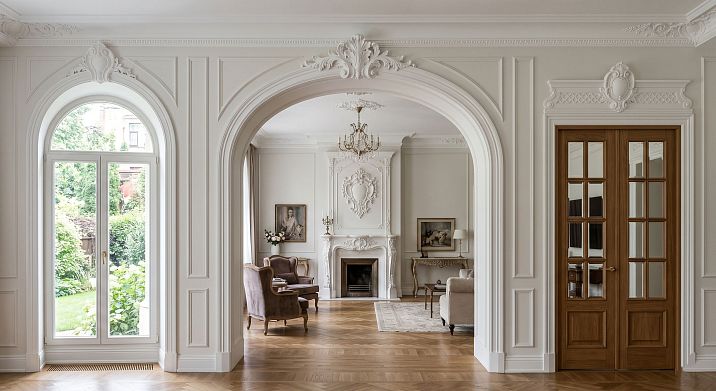
Sometimes you look at an arch — and something about it feels off. The molding is laid evenly, the pilasters stand on both sides, the paint is flawless. But the opening isn't "closed" — it hangs without completion, without a focal point, without a center. Something is missing. And what's missing is one thing: polyurethane keystone at the apex.
This is the central decorative element that literally completes the architectural composition. It is installed at the highest point of an arch or in the center of the top frame of a door, window, fireplace portal, or niche. Moldings create the outline, pilasters define the verticals, capitals finish the side elements — and the keystone makes the opening architecturally complete. Without it, even the most precise molding system looks like an unframed window without its central pane.
STAVROS offers a wide range PU overlays of polyurethane decorative elements, including keystones of various shapes, sizes, and styles: from minimalist trapezoidal forms to voluminous sculptural ones. This article is a complete guide to choosing the central decorative element for an arch, door, window, and portal.


What is a polyurethane keystone
The historical context here is not mere lyricism but a semantic foundation. In stone arch masonry, the keystone (Schlussstein, clé de voûte) was indeed a load-bearing element. It was placed last: it occupied the apex of the arch and, with its wedge-shaped cross-section, wedged the adjacent stones apart, locking the vault into a single self-supporting structure. Remove the keystone — the arch would collapse. That is why in architecture it became a symbol of strength, completion, the point where all forces converge.
In decorative architecture, the function changed, but the symbolism remained. Modern arches made of drywall or brick bear the load themselves — they do not structurally need a keystone. But visually and symbolically, it still 'closes' the composition: it gathers the molding system into a unified whole, fixes the central axis, and creates a point where the eye rests.
A polyurethane keystone is a modern reproduction of this architectural archetype. It is manufactured using cold casting from European two-component polyurethane. The density of the working elements is 320–380 kg/m³. It is a lightweight, durable, moisture-resistant material with precise relief reproduction down to 0.5 mm. The white matte surface accepts acrylic paint without priming. Installation is done with adhesive without mechanical fasteners (for elements weighing up to 1.5–2 kg), with additional self-tapping screws for heavy sculptural forms.




Where is a keystone installed
Our factory also produces:




On the arch
This is the main, classic area of application. The keystone is installed at the apex of the arch — at the point where the arch contour reaches its maximum height. The lower edge of the stone touches the molding or slightly overlaps it, and the central axis of the stone coincides with the vertical axis of symmetry of the opening.
for arches made of polyurethane stucco The keystone is a mandatory element of any classic or neoclassical solution. It covers the joint of molding sections at the apex of the arch — technically, this simplifies installation, and aesthetically, it creates an accent. Even if the joint of the moldings at the apex is perfectly executed, the keystone adds architectural completeness that a single molding line cannot provide.
For an arched opening up to 1.5 m wide, a keystone with a height of 100–150 mm is sufficient. For wide arches from 2 m — 160–250 mm. For monumental portals — sculptural forms up to 300–400 mm high.
Get Consultation
Above the door
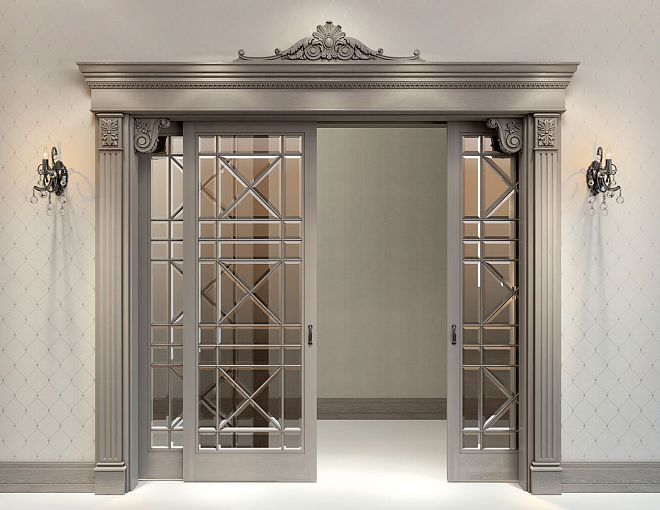
A door opening with a molding frame is a frame. A good frame requires a center. The keystone is installed in the center of the upper horizontal molding — the horizontal section of the portal above the door. It emphasizes the axis of the door opening, creating a hierarchy: side moldings — horizontal belt — central accent.
This technique is characteristic of classical architecture of the 18th–19th centuries: door portals in estates, grand halls, and foyers always had a central element above the door — a cartouche, mascaron, garland, or trapezoidal keystone. In modern classical and neoclassical interiors, this technique works just as flawlessly.
Choosing the size for a door opening: the width of the keystone should be 10–15% of the opening width. For a door 900 mm wide — a stone 90–130 mm wide at the base. Height — 100–180 mm depending on the height of the molding frame.
Above the window
In interiors, the keystone above the window works the same as above the door. In facade architecture, it is one of the main decorative elements of window framing: sandriks, architraves, rustications, and a keystone in the center of the upper part — a classic facade set.
More about framing windows with polyurethane stucco — is a separate big topic. The key principle here is: the keystone above the window should be proportionate to the width of the casing molding. A thin 40 mm molding — a stone 80–100 mm at the base. A wide 80–100 mm casing — a stone 120–160 mm at the base.
On a fireplace or mirror portal
A fireplace portal is one of the richest decorative objects in a classic interior. Its architectural structure fully reproduces the order system: side pilasters or columns, a horizontal entablature, a central accent. The keystone in the center of the horizontal band above the fireplace opening is a classic and appropriate solution.
For a mirror portal — the same: a mirror framed with moldings and a keystone on the upper central axis looks like an architectural element, not just a mirror on the wall. This is the difference between "furniture" and "interior architecture."
On the facade
In facade polyurethane relief keystones are used together with rustication, casings, and window frames. A facade keystone is larger and more relief than an interior one: it is seen from a distance of 3–15 meters, so the relief must be readable at that distance. The optimal height of a facade stone is 150–300 mm depending on the scale of the building and the height of window openings.
For facade use, the moisture resistance of polyurethane is important — the material does not absorb water and does not deform in frost. When painted with facade acrylic paints with UV filters, the service life is 15–20 years without loss of shape.
Keystone, cartouche, or overlay: how not to get confused in your choice
The decor market uses these terms interchangeably, and the buyer often gets lost. Let's sort it out once and for all.
| Task | What to choose |
|---|---|
| Arch apex — trapezoidal classic accent | Keystone |
| Door portal top — rectangular central accent | Keystone or cartouche |
| Window frame — center of top molding | Keystone |
| Center of molding frame on wall | Cartouche or decor for moldings |
| Fireplace portal — center of horizontal band | Keystone or central overlay |
| Corner frame elements | Decor for moldings |
| Classic arch — system completion | Keystone + moldings + pilasters |
| Neoclassicism — delicate central accent | Laconic keystone or overlay |
Keystone — historically trapezoidal, wedge-shaped or sculptural element for the top of an arch or center of the upper frame. Specific architectural role.
Cartouche — decorative frame of oval or rectangular shape with ornamental border, inside which there may be a monogram, coat of arms or ornament. Cartouche is a "medallion", not a "stone". It can be used in the same positions but has a different shape and visual character.
Decor for Molding — corner rosettes, central inserts, side accents for molding frame systems. This is a system of additions to the molding, not an independent central element.
PU overlays — broad category of three-dimensional decorative elements: leaves, rosettes, garlands, ornamental overlays. Some of them can be used as a keystone, but not all have the classic "keystone" shape.
Types of keystones by shape and relief
Trapezoidal keystones
Classic shape. The top part is narrower (50–80 mm), the bottom is wider (100–160 mm), height 100–200 mm. Reproduces the shape of a real wedge stone in brick arch masonry. The relief can be smooth (with rustication — imitation of stone texture) or ornamental (rosette, cartouche, leaves).
Trapezoidal stones are a universal choice for neoclassicism and classicism. They read as an architectural detail, not as a "decoration" — this is a fundamental difference in perception.
Wedge-shaped keystones
Sharp triangular shape with a vertical at the top. Characteristic of Gothic and Neo-Gothic styles. Height 120–220 mm. Relief: Gothic leaves (trefoil, quatrefoil), crosses, geometric ornaments. Suitable for libraries, studies with Gothic touches, Neo-Gothic interiors.
Sculptural keystones
Three-dimensional images: lion or eagle head, mascaron (face of an ancient god or spirit), garland, angel, cartouche with ornament. Sizes — from 150 × 200 mm to 300 × 400 mm, relief deep (30–50 mm), shape three-dimensional. This is Baroque, Rococo, 19th-century Eclecticism. Such a stone itself is a piece of small sculpture, the center of visual attraction in any room.
The price of sculptural forms is higher: 3500–6500 rubles. But the result is worth it — an interior with a mascaron above the arch cannot be confused with anything else.
Laconic neoclassical forms
Rectangular or slightly trapezoidal overlays with moderate relief: rosette, simple ornamental band, rustication without ornament. This is a choice for modern classicism and neoclassicism, where architectural purity without Baroque splendor is important.
How to choose the size of a keystone
Size is not a matter of taste. It's a matter of proportions that either work or don't. Here is a specific selection system.
Width of the arch opening. A basic parameter. The width of the keystone at the base should be 8–15% of the opening width. For an arch 1000 mm wide — a stone 80–150 mm at the base. For an arch 2000 mm wide — 160–300 mm.
Height of the keystone. It should be proportional to the width of the trim molding. Guideline: stone height = 1.5–2.5 × molding width. Molding 60 mm → stone 90–150 mm high. Molding 100 mm → stone 150–250 mm high.
Arc radius. For arches with a small arc radius (narrow opening, high arch), the stone should be taller and narrower. For arches with a large radius (wide opening, shallow arch), it should be wider and lower.
Relief depth. It should match the relief of the molding. If the molding is 15 mm deep, a keystone with 8 mm relief will look flat. The stone's relief equals or slightly exceeds the molding's relief.
Ceiling height and space scale. In a room 5 × 5 m with a ceiling of 2.7 m — a sculptural stone 300 × 400 mm will create a feeling of pressure. In a grand hall with a ceiling of 4 m — it will be in its place. The larger the space, the larger the permissible stone scale.
Visibility from a distance. For interior use, the viewing distance is 2–5 m. At this distance, relief details from 3–5 mm are well readable. For facade use — 5–15 m. At such a distance, a large relief of 15–20 mm is needed.
Overlap of the molding joint. One of the technical functions of the keystone is to hide the joint of molding sections at the top of the arch. The stone size should overlap the joint with a margin of 15–20 mm on each side.
How to choose the style of a keystone
The style of ornament is not about 'like / dislike'. It is about alignment with the architectural context.
Renaissance and Classicism — strict trapezoidal forms with moderate relief. Rosette, meander, rustication. White coloring or imitation of stone. Cold, rational elegance.
Baroque — sculptural mascaron, garlands, shells, cartouches with swirling ornament. Deep relief, gold accents on protruding parts. This is a style of theatrical gesture, loud architectural intonation.
Neoclassicism — laconic forms with delicate relief. Emphasis on form, not ornament. Often painted to match the wall — working with shadow relief. Suitable for living rooms, studies, halls in modern classical homes.
Neo-Gothic — wedge-shaped stones with Gothic foliage or crosses. Dark or stone coloring. A special style for special spaces: libraries, studies, corridors with Gothic arches.
Modern Classic — rectangular overlays with minimal profile. No floral Baroque. Geometry, proportions, purity. Painted to match the moldings or contrasting.
What to combine the keystone with
The keystone is the apex of the system, not an isolated element. Its strength is revealed in the context of architectural decor.
Keystone + flexible molding. Stucco decor for arches and radius walls is built precisely on this duet. A flexible molding creates the contour of the arch, and the keystone completes its top. This is the minimally necessary and already architecturally convincing set.
Keystone + straight moldings. Moldings made of polyurethane decorate the side and horizontal sections of the portal. The keystone completes the horizontal band above the opening. System: vertical moldings → horizontal molding → central keystone.
Keystone + pilasters + capitals. This is already a full-fledged portal. Pilasters set the vertical axes on the sides of the opening, capitals complete them and visually "support" the arch, the keystone fixes the center. Article about pilasters and capitals made of polyurethane reveals how to choose vertical elements to match the keystone.
Keystone + consoles (brackets). Consoles are installed at the springing points of the arch — where the curve transitions into the vertical part of the opening. They visually "support" the arch from below. In combination with the keystone at the top, the system gains a double decorative accent: a pair of consoles below, and a keystone above. Polyurethane brackets is a separate topic that deserves careful selection.
Keystone + rustication. Facade rustication imitates block masonry. A keystone in the center of a rusticated architrave is a historically accurate and visually expressive technique. Together they create the image of real stone construction.
Keystone + decor for moldings. Decor for Molding — corner rosettes, central accent inserts. In the molding frame system, the keystone is installed in the center of the upper horizontal, molding decor — in the corners. A harmonious, consistent system.
How to assemble a kit: step-by-step algorithm
One of the main practical questions is where to start and how to avoid buying incompatible elements.
-
Determine the type of opening. Arch with a semicircular arc, pointed arch, rectangular doorway, window frame, fireplace portal, niche — each type has its own kit.
-
Measure the opening. Width, height, arc radius (for arches). For an arch: run the tape measure along the surface of the arc from heel to heel — this is the length of the molding.
-
Choose the molding for the frame. The width of the molding is the basis of proportions. Everything else is selected to match it.
-
Determine if a flexible molding is needed. For arched arcs — yes. For straight portals — no, standard straight molding.
-
Select the keystone based on the molding width and opening size. Stone height = 1.5–2.5× molding width. Stone width at base = 8–15% of opening width.
-
Check the ornament style. The pattern of the molding, keystone, and consoles must belong to the same stylistic system.
-
Decide on vertical elements. Are pilasters needed or only moldings on the sides of the opening.
-
Add consoles if a classic portal is needed. For a simple minimalist solution — without consoles. For a classic look — with consoles at the arch's heels.
-
Check the depth of the relief. All elements should be proportionate in volume and relief detail.
-
Order everything in one batch. Stylistic unity is guaranteed, surface color and texture are identical.
Installing the keystone: how to do it correctly
Installing the keystone is the final chord in assembling a decorative arch or portal system. Despite its apparent simplicity, precision is crucial here.
Step 1. Find the central axis of the opening. Use a laser level or plumb line to draw a vertical line through the center of the opening. Mark it on the wall above the molding.
Step 2. Test fit the keystone. Place it against the wall, ensure the stone's central axis aligns with the opening's axis, and the stone's bottom edge correctly relates to the molding — touching it or overlapping by 10–15 mm. Trace the stone's outline with a soft pencil.
Step 3. Apply adhesive. On the back of the stone — polyurethane mounting adhesive around the perimeter plus a cross through the center. For heavy sculptural elements weighing over 1.5 kg — adhesive plus two self-tapping screws through the stone body into the wall. Countersink the heads, fill with putty, and paint over.
Step 4. Install and secure. Place the stone according to the markings, press with force for 3–5 seconds. Hold for 3–5 minutes. Secure with painter's tape for 24 hours.
Step 5. Seal the joints. After the adhesive dries — fill the gaps around the stone's contour with white acrylic sealant. Smooth with a damp finger. After drying — paint over.
Errors in Selection and Installation
Practice shows: most mistakes are made before the purchase, not during installation.
They buy a keystone without choosing a molding. Then it turns out that a 40 mm molding and a 250 mm high stone are disproportionate. Always start with the molding.
They don't check the width of the opening. A keystone that seems "average" in hand turns out to be small on an arch 1200 mm wide. Always calculate the proportion: the width of the stone at the base is 8–15% of the opening width.
They take too large an element for a small arch. A sculptural mascaron 300 × 400 mm on an arch 800 mm wide is a "head" larger than the arch itself. The proportion is broken, the decor overwhelms.
They don't account for the central axis of the opening. A stone shifted from the axis by 5–10 mm is immediately visible — it creates a feeling of curvature in the entire opening. Always mark the axis.
They mix a keystone with moldings of a different style. A baroque mascaron and a geometric minimalist molding — a stylistic conflict.
They paint before final fitting. First — complete installation and joint sealing. Then — painting.
They buy one element without a system. A keystone alone, without a framing molding, without vertical elements, looks like a "sticker" — it's unclear what it is and why. Decor works in a system.
They don't check the thickness and relief projection. A keystone with a relief of 40–50 mm creates significant volume. Make sure it doesn't conflict with the door leaf when opening.
About the company STAVROS
STAVROS has been operating since 2002 as a manufacturer and supplier of architectural decor from polyurethane and wood. Founded by artists Andrey Ragozin and Evgeny Tsapko. Already in 2003 — the Konstantinovsky Palace in Strelna. Then — the Hermitage, the Alexander Palace, the Trinity-Izmailovsky Cathedral, the Sheremetev Mansion.
Today STAVROS — full range polyurethane molding decoration: PU overlays including keystones from 850 to 6500 rubles, Moldings, flexible arch moldings, Decor for Moldingbrackets and capitals, cornices, baseboards, ceiling rosettes, decor for ceilings and walls. Showrooms in Saint Petersburg and Moscow. Delivery across Russia and CIS. Shipment from warehouse from 3 business days. 264 reviews with a rating of 5.0.
Answers to Popular Questions
What is a polyurethane keystone?
A central decorative element installed at the apex of an arch or at the center of the top frame of a door, window, or portal. Historically — a load-bearing element of a stone vault, in decor — an architectural accent that completes the composition.
Where is a keystone installed?
At the apex of an arched opening, at the center of the top horizontal of a door or window portal, on fireplace and mirror portals, in facade architraves above windows.
Is a keystone needed for an arch?
Technically — no. Architecturally — yes. Without it, an arch with a molding frame remains unfinished: the moldings create a contour, but the center is "empty."
How is a keystone different from a cartouche?
A keystone is a trapezoidal or wedge-shaped element for the top of an arch, a direct quote from architectural construction. A cartouche is a decorative frame of oval or rectangular shape, a medallion. Both forms can be used in the central position, but have a different character.
Can a keystone be used above a door?
Yes. A keystone is installed in the center of the horizontal molding above the doorway — this is a classic technique of 18th–19th century architecture.
Is a keystone suitable for window framing?
Yes, both in the interior and on the facade. A facade keystone should be larger and more relief — it is seen from a distance of 5–15 meters.
How to choose the size of a keystone?
Width at the base — 8–15% of the opening width. Height — 1.5–2.5× the width of the frame molding. Relief — equal to or slightly deeper than the relief of the molding.
Can I paint a polyurethane keystone?
Yes. The white matte surface accepts acrylic paints without priming. Painting in the color of the wall, contrasting painting, gold patination, or stone imitation is possible.
How to combine a keystone with moldings and pilasters?
The ornament style of all elements must match. The molding sets the width — the keystone is chosen proportionally to it. Pilasters set the verticals, capitals complete them — the keystone fixes the top of the system.
Where to buy a polyurethane keystone?
In the Stavros catalog — PU overlays with a wide range of shapes and sizes. Phone: +7 (800) 555-46-75. Showrooms in Saint Petersburg and Moscow. Delivery across all of Russia.