Article Contents:
- MLD-004 for a dresser: what exactly we are buying
- First, we choose a rule for all drawers
- Identical indents produce frames of different heights
- The short top drawer is checked separately
- Verticals, handles, and profile direction need to be coordinated before cutting
- We convert three frames into twelve parts
- Why 5.7 linear meters still do not determine the cheapest order
- Beech, oak, or MDF: we do not mix different finishes in one frame without a reason
- The price of the molding and the cost of the finished update are different amounts
- Three mistakes that most often appear after purchase
- Acceptance of slats before irreversible cutting
- When it is better not to order MLD-004 for this dresser
- We order MLD-004 according to the list, not "three frames"
- Questions before buying molding for a dresser
- Is it necessary to make identical frames on drawers of different heights?
- Can I leave the short top drawer without a frame?
- How does the outer size of the frame differ from the inner free field?
- Why is painter's tape not enough for a final check?
- How many individual parts are needed for three rectangular frames?
- Why don't 5700 mm of parts mean ordering exactly 5.7 linear meters?
- Does "Primed Prestige" mean ready-to-paint finish?
- Who should perform cutting, finishing, and installation?
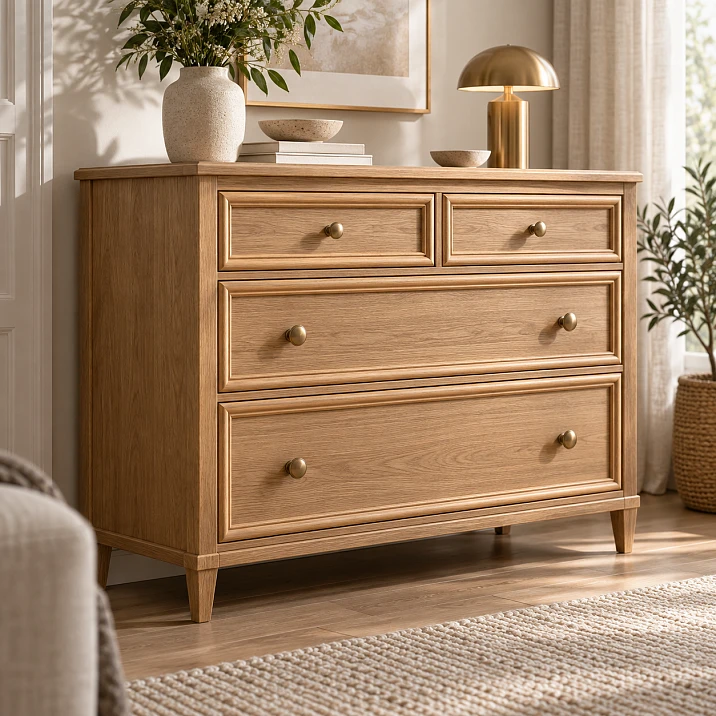
The dresser has three flat pull-out fronts, but the top one is noticeably lower than the other two. If you simply draw a nice frame on one drawer and copy it to the others, the composition may fall apart: the same rectangle will give different margins at the top and bottom. The opposite approach — keeping equal indents from the edges — will preserve the rhythm of the margins, but the frames themselves will be of different heights.
Therefore, before purchasing, what is needed is not the total length of molding, but a full layout of the entire dresser. It records the dimensions of the three fronts, gaps between fronts, handle positions, profile direction, and the chosen design rule. Only after this is the sketch translated into twelve specific parts and into the number of whole product strips.
For such a task, a thin wooden MLD-004 is suitable. But to buy wooden molding MLD-004 it is reasonable after the outer contours of the frames have been determined and the cutting map has been checked. The price of one strip by itself does not yet answer the question of how much material is actually needed and whether the top drawer will be overloaded with decor.
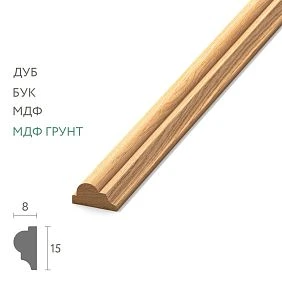
MLD-004 for a dresser: what exactly we are buying
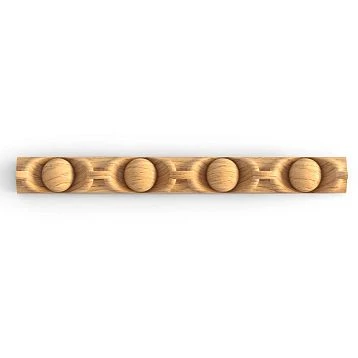
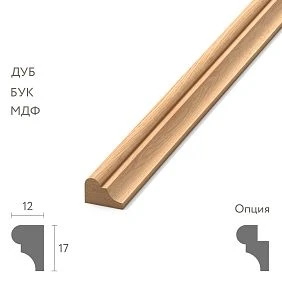
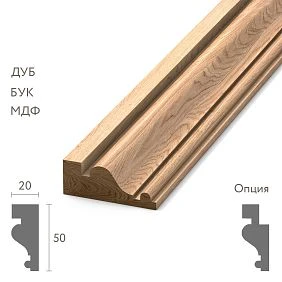
MLD-004 is a linear furniture molding with a cross-section dimension specified in the card as A × C = 15 × 8 mm. At the time of checking, several materials and lengths are available.
| Material | Size A × C × L, mm | Preparation | Price per whole plank |
|---|---|---|---|
| Beech | 15 × 8 × 1000 | «Prestige» | 350 ₽ |
| Oak | 15 × 8 × 1000 | «Prestige» | 440 ₽ |
| Beech | 15 × 8 × 2400 | «Prestige» | 700 ₽ |
| Oak | 15 × 8 × 2400 | «Prestige» | 890 ₽ |
| MDF | 15 × 8 × 2600 | «Prestige» | 490 ₽ |
| MDF | 15 × 8 × 2600 | Prestige primed | 940 ₽ |
For the calculation example below, beech or oak strips of 2400 mm are used. This does not mean that meter-long options are useless: they also need to be considered in the cutting map if they reduce waste and cost. But first, it is necessary to determine the list of parts, and only then optimize the cart.
It is important to distinguish four things. Molding is a commercial blank. The frame is the result of cutting and assembly. The mounting is selected for a specific facade and coating. Final painting or tinting is a separate technological stage. The note "three frames needed" is insufficient for an order, because the seller ships linear material, not ready-made rectangles to box dimensions.
Card MLD-004 also indicates a rigid packaging frame costing 390 ₽ and product stacking standards. For a specific purchase, the number of shipping units and final packaging should be confirmed in the invoice rather than automatically multiplying this amount.




First, choose a rule for all boxes
Start with the overall front elevation. Not only the width and height of each facade are needed, but also the working area around it: gaps between boxes, handles, locks, protruding parts, the cabinet edge, and places where fingers approach the facade when opening.
For boxes of different heights, there are two basic compositional principles.
Identical outer frames. One rectangle is repeated on all facades. Horizontal and vertical elements have the same length. This is convenient for production, but the margins to the edges differ on tall and short boxes.
Identical offsets. The outer border of the frame is positioned at the same distance from the edges of each facade. Then the side lines are easy to align, and the frame height changes along with the box height.
Neither principle can be declared correct in advance. For a classic dresser, a uniform rhythm of margins is sometimes more convincing, while in another composition, repeating a single rectangular motif is more important. The decision is tested on the entire piece of furniture, not on a single large box.
When marking up, it is convenient to assign designations D1, D2, and D3 to the facades and record for each: width, height, handle position, outer size of the future frame, and offsets. Then a change to the top box will not get lost among the dimensions of the others.
Our factory also produces:
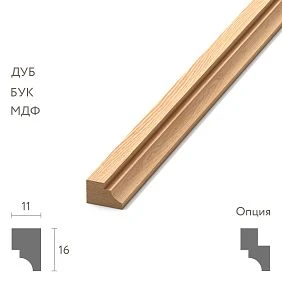
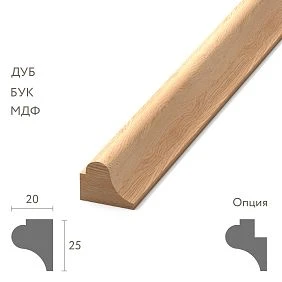
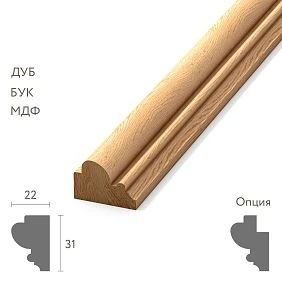
Identical indents produce frames of different heights
Let's take a training dresser with three fronts 800 mm wide and 150, 250, and 350 mm high. Let the outer border of the frame be 25 mm from each edge. This is a condition of the example, not a furniture manufacturing standard.
The width of the outer contour is the same:
800 − 25 − 25 = 750 mm.
The height for each drawer is calculated separately:
- D1: 150 − 25 − 25 = 100 mm;
- D2: 250 − 25 − 25 = 200 mm;
- D3: 350 − 25 − 25 = 300 mm.
| Facade | Outer frame with 25 mm indents | If you put a 750 × 100 mm frame everywhere |
|---|---|---|
| 800 × 150 mm | 750 × 100 mm | top/bottom margins 25 / 25 mm |
| 800 × 250 mm | 750 × 200 mm | top/bottom margins 75 / 75 mm |
| 800 × 350 mm | 750 × 300 mm | top/bottom margins 125 / 125 mm |
This table shows the fork itself. With equal indents, vertical elements will be 100, 200, and 300 mm. With an equal frame, vertical margins change from 25 to 125 mm. The choice should be based on the overall dresser design.
The outer dimension of the frame cannot be automatically converted into the inner clear opening by simply subtracting 15 mm twice. The card reports the section dimension, but without a readable installation drawing, one cannot arbitrarily assign which part of the profile lies on the facade, where the relief is oriented, and what the actual visible inner edge is. For ordering linear parts, an external list is sufficient; for precise visualization, a real sample or a confirmed profile drawing is needed.
Get Consultation
Check the short upper drawer separately
A facade 150 mm high is a borderline case. With 25 mm offsets, the outer frame is only 100 mm high. On paper, the calculation works out, but that is not enough: inside this zone there may still be a handle, mounting holes, finger grip area, and technological margins.
First, the outline of the future molding is applied to the facade at a 1:1 scale. For a quick check, a paper strip or masking tape along the outer boundary will do, but the final decision is better made with a real profile fragment: a flat strip does not show the relief and the protrusion of the wooden part.
If the top frame looks too tight, there are several proper solutions. You can increase its offsets by reducing the contour itself. You can leave the upper drawer without a frame and turn that into a deliberate facade hierarchy. You can choose a calmer profile. You cannot simply reduce one offset "by eye" and end up with skewed verticals relative to the two lower drawers.
If MLD-004 does not fit compositionally or conflicts with the hardware, it is better to switch to a selection and buy wooden moldings for furniture with a different geometry than to force one article to work in an unsuitable place.
Verticals, handles, and profile direction must be coordinated before cutting
Even when three frames have different heights, their side lines can form one strict vertical. In our example, the width of all facades is the same, so with 25 mm offsets, the side boundaries of the frames will coincide. This creates order: the height changes, but the position of the decor across the width does not "wander."
If the facades have different widths, a common vertical does not arise automatically. Then, on the layout, you need to choose what is more important: the same offset from the side edge of each facade or the visual axis of the entire dresser.
The orientation of the MLD-004 itself is recorded separately. For each part, it must be clear where the front side is and which edge faces inward toward the frame. This is especially important for miter joints: an error in the direction of one workpiece is detected only after cutting, when the length can no longer be restored.
Handles are checked not only at the center. The entire trajectory of the hand when opening must be visible. The frame may not intersect the handle's mounting hardware and still obstruct the grip. If the hardware is already installed and convenient, changing it solely for the sake of the initial decorative sketch is unreasonable.
Each drawer remains an independent moving facade. Therefore, the molding must not form a common continuous strip glued across the inter-facade gap. Frames D1–D3 end on their own facades and do not interfere with their movement.
We convert three frames into twelve parts
After approving identical 25-millimeter margins, the list becomes specific. For three frames, the following are required:
- 6 horizontal parts of 750 mm each;
- 2 vertical parts of 100 mm each;
- 2 vertical parts of 200 mm each;
- 2 vertical parts of 300 mm each.
If the corners are assembled with miter joints and the frame dimensions are specified by the outer contour, the part lengths are fixed by the long points. For another joining method, the list must be recalculated, not automatically carried over with these numbers.
Net total length:
6 × 750 + 2 × 100 + 2 × 200 + 2 × 300 = 5700 mm.
The clearest preliminary cut is one 2400 mm plank per frame:
| Workpiece | Parts | Net total | Nominal remainder |
|---|---|---|---|
| № 1 | 750 + 750 + 100 + 100 | 1700 мм | 700 мм |
| № 2 | 750 + 750 + 200 + 200 | 1900 мм | 500 мм |
| № 3 | 750 + 750 + 300 + 300 | 2100 мм | 300 мм |
Three planks give 7200 mm of nominal length, and the sum of parts is 5700 mm. The difference is 1500 mm. But not all 1500 mm can be called full-fledged offcuts: part will go to saw cuts, end trimming, fixing defective ends, and technological allowance, and short pieces may be unsuitable for the next product.
Why 5.7 linear meters do not yet determine the cheapest order
The card includes not only 2400 mm planks, but also wooden MLD-004 pieces 1000 mm long. Therefore, after approving the parts, a more interesting task arises — not just to buy “more than 5.7 m”, but to check the layout by product lengths.
Mathematically, twelve finished parts can be distributed across two 2400 mm planks and one 1000 mm plank. For example:
- first 2400: 750 + 750 + 750 + 100 = 2350 mm;
- second 2400: 750 + 750 + 750 + 100 = 2350 mm;
- bar 1000: 300 + 300 + 200 + 200 = 1000 mm.
The total purchased length then is 5800 mm, only 100 mm more than the finished requirement. In terms of price, this would be 1750 ₽ for beech (700 + 700 + 350) and 2220 ₽ for oak (890 + 890 + 440).
But this is exactly where arithmetic can deceive. On each long bar, only 50 mm remains before accounting for the actual cut, trimming, and possible technological allowance; the meter-long blank is completely filled with finished parts. Without a machining plan, it cannot be promised that such a basket is feasible in practice.
Therefore, three 2400 mm bars are not a proven minimum or a mandatory recommendation, but a calm preliminary option. A mixed order of 2400 + 2400 + 1000 is potentially cheaper, but it must be confirmed by a craftsman after assigning the cut width, cutting sequence, and end requirements.
This is a good example of a situation where the total footage says "there is enough material," but production may still answer "a larger allowance is needed."
Beech, oak, or MDF: do not mix different finishes in one frame without a reason
For the calculation under consideration, the wooden options have the same cross-section of 15 × 8 mm and two lengths — 1000 and 2400 mm. But the material affects not only the price. It is related to the finishing task, selection of the blank, and the appearance of the finished frame.
"Prestige" is the quality of surface treatment: detailed sanding, not a ready color. For opaque painting of wood, suitable re-gluing is separately agreed upon; for semi-transparent coating, the selection of lamellas and natural texture are important. Before ordering, it is useful to check preparation of wood for painting and only after that, fix in the specification not only "beech" or "oak," but also the required condition of the blank.
MDF 2600 mm long requires a separate recalculation of the cutting layout. It cannot be substituted for wooden 2400 mm just because the profile has the same nominal size of 15 × 8 mm. A different length will have a different parts yield map, and the primed version will have a different retail price and degree of surface preparation.
It is better to view the coating sample on a combination of facade + MLD-004, rather than on a separate strip detached from the furniture. On a thin profile, color, gloss, and shadow read differently than on a large drawer surface.
The price of the molding and the cost of the finished renovation are different amounts
If the craftsman confirmed the simple option with three wooden strips of 2400 mm, the product portion is calculated as follows:
| Material | Price of one 2400 mm strip | Three strips |
|---|---|---|
| Beech | 700 ₽ | 2100 ₽ |
| Oak | 890 ₽ | 2670 ₽ |
The difference between three beech and three oak blanks is 570 ₽. This is only the cost of the MLD-004 itself at the time of verification.
Packaging, delivery, cutting, end preparation, corner assembly, finishing coating, consumables, and installation on facades may be added to it. If the attachment technology is not yet determined, first agree on the base and finish, and then choose Materials for installing furniture decor. Do not promise a specific adhesive or mechanical fastener in advance without checking the facade surface.
For the same reason, the price of three strips is not equal to the price of "three finished frames." The store sells linear molding; the workshop work begins after receiving the material. Delivery terms and batch processing are convenient to check separately on the page the payment and delivery terms for the molding.
If the goal is the minimum raw material price, mixed cutting with a meter strip may be more profitable. If the goal is to reduce the risk of shortage after the first erroneous cut, the craftsman may prefer more allowance. This is not a contradiction: the two baskets have different optimization criteria.
Three mistakes that most often appear after purchase
The first mistake is to calculate based on a single facade. If the lower drawer is used as a sample and its frame is then simply copied to the middle and upper ones, the margins change along with the height of the facades. On the lower drawer, the result may be calm, on the upper one — too tight. Prevention is simple: before ordering, all three facades must be on the same layout with the same scale.
The second mistake is to count only the total 5700 mm. Such a figure looks like a ready-made requirement, but it says nothing about how twelve parts are placed in commercial blanks. The mixed variant of 2400 + 2400 + 1000 mm shows this especially well: by net length it is almost ideal, but the allowance to the nominal is minimal. If the craftsman includes end trimming, a control cut, or edge correction, a mathematically sufficient basket may become insufficient. Therefore, what is transferred to the order is not the total footage, but the approved quantity of whole strips.
The third mistake is to cut before checking the actual profile. In the sketch, MLD-004 is represented by a line, but the obtained part has a real cross-section, relief, and face orientation. If the craftsman first cuts all twelve elements and then discovers that the profile should be turned with the other side or the handle is too close to the frame, the correction will affect several parts at once. It is safer to first accept the strips, select one facade, assemble or apply a test contour without irreversible fixation, and only then start the rest of the cutting.
There is also a less obvious risk — mixing executions. Suppose part of the order was taken from beech with a length of 2400 mm, and the missing piece was decided to be replaced with MDF 2600 mm only because the cross-section size is also 15 × 8 mm. Geometrically, the parts may look related, but the material, surface preparation, and reaction to finishing are already different. If combining is truly intended, it must be checked as a separate design and technological solution, not used as an emergency replacement.
Such control takes less time than reworking already painted frames. Before cutting, four things must match: the approved dresser drawing, the actual MLD-004 profile, the length list, and the finishing technology.
Acceptance of strips before irreversible cutting
Molding should be checked before it turns into short parts. First, the article, material, length, quality of preparation, and quantity are verified. Then the strips are laid face up and assessed for any section that the craftsman would exclude in advance from a critical corner or long horizontal.
After that, it is useful to lay out the future groups D1, D2, and D3 on the table. Such a "dry" layout without a saw shows from which strip it is more reasonable to obtain each horizontal and where to leave allowance. If a mixed basket of 2400 + 2400 + 1000 mm is used, it is at this stage that it becomes visible whether there are enough technological fields for a real saw.
Only after acceptance is the final cutting map fixed. It must match the marking of the parts so that two 100 mm verticals do not get mixed up with the 200 and 300 mm pairs, and the horizontals maintain the correct face orientation. This is especially useful when frames are painted before installation: after finishing, differences in lengths are small, and a mixed-up part is only discovered on the facade.
When it is better not to order MLD-004 for this dresser
The purchase should not be mandatory just because the profile was liked on the product card.
MLD-004 should be set aside if on the top drawer the frame conflicts with the handle or makes the field visually cramped, and changing the composition is not acceptable. The same applies when the facades have complex routing, protruding panels, or unstable old coating, and a reliable base for mounting has not yet been determined.
There is no need to order the molding either when the design of the entire dresser has not yet been approved. Three rectangles on separate sheets of paper do not replace the overall layout: after assembly, it may turn out that the side lines of the frames do not match, and the top drawer looks random.
If the choice between identical frames and identical offsets is still open, first make two simple mockups. Only after the visual decision does it make sense to count the parts. For another profile, you can separately buy wooden furniture molding, but the new model will also require its own check.
We order MLD-004 according to the list, not "three frames"
The final product line for the preliminary version may look like this:
MLD-004 / 15 × 8 × 2400 mm / beech / "Prestige" / agreed gluing quality / 3 pcs.
If the master has confirmed mixed cutting, the specification is changed to two strips of 2400 mm and one of 1000 mm of the same material and quality. Two options cannot be kept in the order simultaneously as if they were the same calculation.
Separately, the master receives a parts list:
| Designation | Horizontals | Verticals | Outer contour |
|---|---|---|---|
| D1 | 2 × 750 mm | 2 × 100 mm | 750 × 100 mm |
| D2 | 2 × 750 mm | 2 × 200 mm | 750 × 200 mm |
| D3 | 2 × 750 mm | 2 × 300 mm | 750 × 300 mm |
Attached to the parts list are a front elevation, profile direction, corner diagram, handle positions, and a coating sample. Before irreversible cutting, it is useful to attach the obtained MLD-004 to each facade and check the actual relief, rather than relying only on the conditional lines of the sketch.
For questions regarding preparation, connections, and sequence of work, you can cross-check tips for finishing and installing wooden decor, but the specific installation method is still chosen based on the material and finish of the dresser itself.
After checking dimensions, cutting, and finishing, you can reopen the card and to buy wooden molding MLD-004 already in the confirmed quantity.
Questions before buying molding for a dresser
Is it necessary to make identical frames on drawers of different heights?
No. An identical frame is one of the compositional options. With different facade heights, it will create different margins at the top and bottom. If the goal is to maintain a consistent rhythm of offsets, the frame height should change along with the drawer height.
Can I leave the short top drawer without a frame?
Yes, if it has been consciously verified on the overall layout. The top facade can become a calmer element of the composition. But the decision is better made before purchasing, because it changes the parts list and cutting map.
How does the outer frame size differ from the inner free space?
The outer size defines the contour along the long points of the parts. The inner opening depends on how the profile is oriented on the facade and which part of its cross-section faces inward. Without a readable drawing or sample, the inner size cannot be calculated by simply subtracting 15 mm from each side.
Why is painter's tape not enough for the final check?
The tape shows the outer rectangle and margins well, but it does not convey the relief, thickness, shadow, or actual proximity to the handle. Before cutting, it is useful to apply a real profile or an accurate cross-section template.
How many individual parts are needed for three rectangular frames?
Four for each: two horizontal and two vertical. For three frames — 12 parts. In the training example, this is six elements of 750 mm each and two parts each of lengths 100, 200, and 300 mm.
Why does 5700 mm of parts not mean ordering exactly 5.7 linear meters?
Because whole commercial blanks of specific lengths are sold. In addition to finished dimensions, the layout across planks, saw kerf, end trimming, and technological allowance are considered. The minimum total length does not guarantee a feasible machine cutting plan.
Does "Prestige primed" mean ready-to-paint finish?
No. This is the degree of surface preparation, not the final decorative color. The finished coating and its compatibility with the facade need to be specified separately.
Who should perform cutting, finishing, and installation?
Card MLD-004 describes the commercial blank. Specific operations for cutting, corner joints, coating, and installation need to be included in a separate workshop task and agreed upon before irreversible work begins.