Article Contents:
- What are SV-004 and SV-005
- General characteristics of the stands
- Why the same size doesn't mean the same set
- How to check the composition of SV-004 before ordering
- How to check the composition of SV-005 before ordering
- SV-004 or SV-005: selection table
- Who needs the stand and what for
- Furniture showroom
- Kitchen showroom
- Wardrobe and dressing room showroom
- Design studio
- Furniture manufacturing
- Architectural bureau and supplier
- STAVROS dealer
- Sales Office
- Exhibition or temporary presentation
- Private buyer
- Real scale
- Tactility
- Protrusion above the plane
- Texture under oil
- Side-by-side comparison
- Exact article number
- Trust
- Reducing rework
- Next to facades
- At an accessible height
- Under even lighting
- Near the consultation area
- Not in the aisle
- With space for two panels
- In the mobile zone
- Stand and catalog
- Stand and display case
- Stand and set of individual handles
- Stand for handles and stand for moldings
- Information stand and product stand
- Oiled sample and finished color of the entire collection
- Stand article number and handle article number
- Need to open a new furniture showroom
- Need to update the existing display
- Need to show kitchen handles
- Need to assemble wardrobes and dressing rooms
- Need to coordinate handles for dressers
- Need to work with classic interiors
- Need to work with modern interiors
- Need to conduct on-site presentations
- Need to participate in an exhibition
- Need to standardize branch operations
- Need to show handles for custom painting
- Need to show finished natural finish
- Need to connect handles with facades
- Need to reduce consultation time
- Need to reduce order errors
- Need to supplement the stand with profiles
- Need to choose a stand for a small office
- Need to design a large showroom
- Need to present products to an architect
- Need to choose a stand as a gift for a partner
- Select only by SKU
- Consider sets identical due to size
- Invent specific models
- Buying without demand analysis
- Placing too high
- Hide separately from facades
- Consider oil a universal color standard
- Do not check the handle card
- Remove handles for furniture
- Buy two stands without comparison
- Use for linear molding
- Do not include transportation
- Do not update sales script
- Limit catalog to display stand
- Do not train managers
- Show all samples at once
- Next to kitchen fronts
- Next to the wardrobe and dressing room
- Next to a chest of drawers and nightstand
- Next to children's furniture
- Next to the study and library
- Next to hotel or restaurant furniture
- What is the difference between SV-004 and SV-005?
- What size are the stands?
- What is the base made of?
- Do I need to assemble the stand myself?
- Are handles included in the set?
- Are there article numbers near the handles?
- What coating are the samples treated with?
- Which handles are included in SV-004?
- Which handles are included in SV-005?
- Which stand should a kitchen showroom choose?
- Which stand is suitable for a design studio?
- Can I order two stands together?
- Can the stand be used at an exhibition?
- Can I buy a separate handle from the stand?
- Can I remove the handles from the stand?
- Where should I place the stand?
- How do I link a sample to an order?
- Can I show unpainted handles on the stand?
- How is SV-006 different from SV-004 and SV-005?
- Is the stand suitable for a private buyer?
- Do I need to update the stand?
- Where can I see other product samples?
- Can I determine the set by price alone?
- What to do if the photo does not allow reading the article numbers?
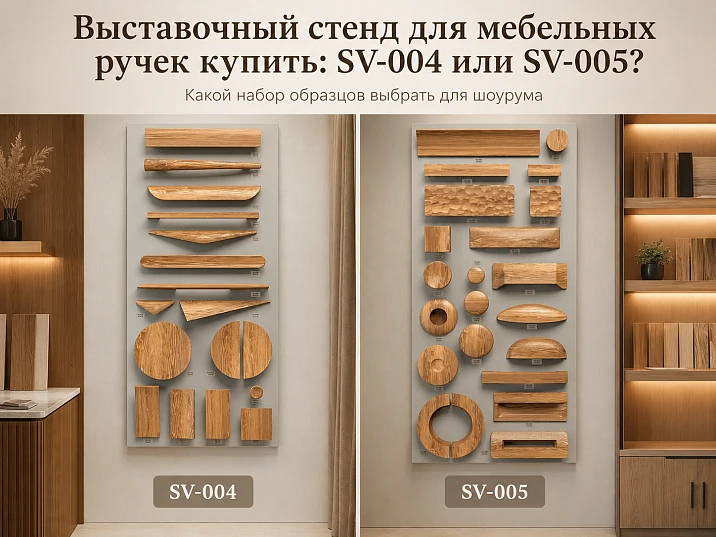
Buying a display stand for furniture handles is worth it not as a decorative addition to the showroom, but as a permanent consultation tool. A photo in the catalog shows the general silhouette of the product, but does not convey the actual length, thickness, curve, ease of grip, and character of natural wood. When a client chooses handles for a kitchen, cabinet, chest of drawers, nightstand, or wardrobe, it is important for them to see the product in real scale, run their hand over the surface, and immediately match the liked sample with the exact article number. This is exactly the task that the SV-004 and SV-005 stands solve.
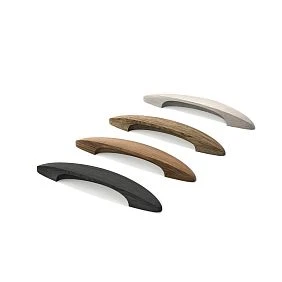
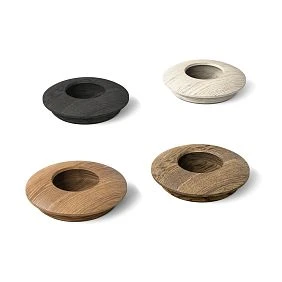
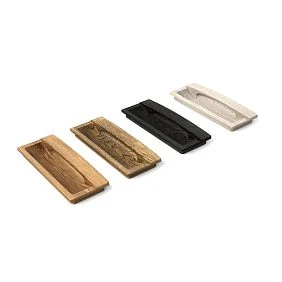
Both stands have the same basic format: 730 × 350 × 16 mm, a base made of laminated chipboard, delivery assembled, and information plates with the article number of each installed handle. The samples are coated with oil, so the natural wood texture is already prepared for display. The buyer does not need to independently mark the panel, install each handle, come up with labeling, or order separate processing of the display elements.
The main difficulty is that identical dimensions do not make SV-004 and SV-005 identical sets. These are two separate product cards with different article numbers. The choice between them should be based on the actual composition of the installed handles: the shapes, presented sizes, style, and the furniture projects most often ordered by clients of a particular showroom. The exact models on each stand cannot be determined by assumption. They should be verified against current photos and the card specification before ordering.
For a kitchen showroom, some samples are important; for a manufacturer of classic furniture, others; for a design studio, the ability to show the client a wide range of proportions and finishes. Sometimes one stand is enough, sometimes it is more rational to order SV-004 and SV-005 together to avoid narrowing the consultation to one group of shapes. Below, we break down how to compare the two sets without invented characteristics, how to place the stand in the showroom, link the physical sample to the product card, and understand when instead of a stand for handles, an SV-006 with linear molding samples is needed.
Short answer.
SV-004 and SV-005 have the same size of 730 × 350 × 16 mm, a laminated chipboard base, are supplied assembled, and come with tags indicating handle article numbers. Therefore, the choice is made not by dimensions, but by the current composition of samples. Open both cards, compare the shapes and sizes of the installed handles, and select the set that is closest to the furniture assortment of your showroom. If the showroom works with different styles and regularly coordinates fittings with clients, the two stands can complement each other.
What are SV-004 and SV-005
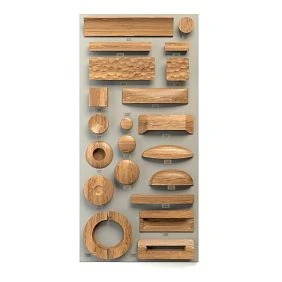
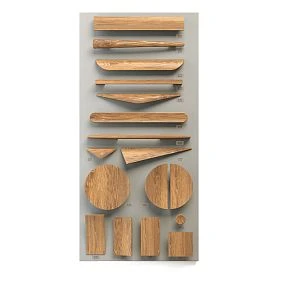
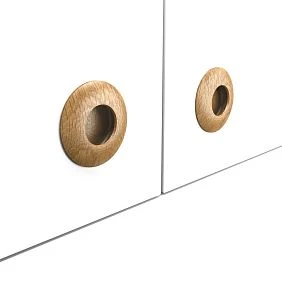
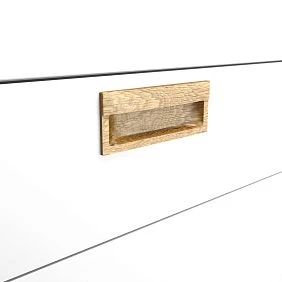
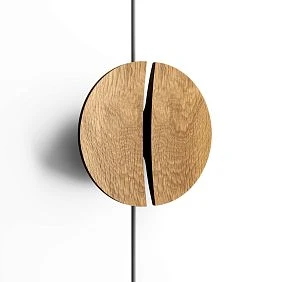
SV-004 and SV-005 are ready-made demonstration panels with installed samples of wooden furniture handles. Their purpose is to move the selection from a flat catalog to a real consultation. The client sees not a conventional drawing, but a real object: they understand how much the handle protrudes above the facade, whether it is comfortable to grip, how the oil reveals the texture, and how the shape changes when viewed from the side.
The base measuring 730 × 350 × 16 mm is compact enough for a consultation area, yet allows placing several samples so they do not blend into one mass. The panel can be used in a furniture showroom, design studio, manufacturer's office, during negotiations with a client, or at an exhibition. The format does not require complex self-assembly: the stand is delivered ready-made.
An information plate next to each handle turns the physical sample into an order point. The manager does not need to recall the article number by shape or search for a similar model among dozens of cards. The client points to the preferred option, the salesperson records the designation and proceeds to check the available sizes, coating, and current order conditions.
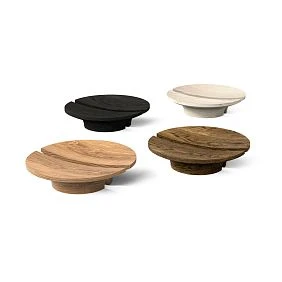
The oil coating of the samples is important for the perception of wood. It shows the real texture and makes tactile contact more convincing. However, the stand should not be perceived as a universal standard for all possible shades. Natural wood has variability, and the current finishing options for a specific handle should be checked in its card.
The two article numbers exist not for choosing the panel color. Their commercial meaning lies in different sets of samples. Therefore, comparing SV-004 and SV-005 should answer not the question of which panel is more beautiful, but which set better reflects the real demands of the showroom audience.




General stand characteristics
| Parameter | SV-004 | SV-005 | Benefits for the showroom |
|---|---|---|---|
| Size | 730 × 350 × 16 mm | 730 × 350 × 16 mm | Same placement logic in the exhibition. |
| Base | Laminated chipboard | Laminated chipboard | Ready-made flat panel for demonstration. |
| Delivery | Assembled | Assembled | No need to install samples yourself. |
| Marking | Plates with article numbers | Plates with article numbers | Quick transition from sample to order. |
| Handle coating | Oil | Oil | You can evaluate the texture and tactility. |
| Purpose | Handle display | Handle display | Selection, approval, and sale. |
| Main difference | Current composition of handles | Current composition of handles | Selection by shapes, sizes, and audience. |
Almost all basic characteristics match. In a regular comparison, the buyer chooses size, material, or coating. Here, these parameters do not provide an answer. The solution lies within the display — in which specific handles are attached to each stand.
Before ordering, you need to open both cards and carefully examine the current photos. If the text specification does not list the models, you should request clarification from the STAVROS manager. You cannot invent the composition based on the general appearance or transfer the set from one stand to another.
Our factory also produces:



Why the same size does not mean the same set
Two stands can occupy the same space on a wall or table, but solve different consultation tasks. One set may be closer to a kitchen showroom, another to a manufacturer of cabinets and dressers. The difference is determined by which shapes and scales are actually presented.
A long handle and a compact knob show the client different scenarios. The first helps to imagine a vertical cabinet facade or a wide drawer, the second — a small door or a nightstand. But it cannot be stated that a specific shape is on SV-004 or SV-005 without checking the current photo.
The same applies to style. A showroom selling modern furniture looks for laconic forms and clean geometry. A workshop of classic interiors may pay more attention to voluminous or traditional solutions. If the stand does not reflect the main assortment of the showroom, it turns into a beautiful panel that rarely participates in sales.
Size representativeness is also important. It is useful for the client to see different scales. On a small facade, a massive handle looks different than on a tall cabinet. A good set helps explain this before furniture production and avoid replacing fittings after the facades are made.
Get Consultation
How to check the composition of SV-004 before ordering
The first step is to open the card and view the composition of SV-004 samples based on current photos. Don't limit yourself to the overall picture. Zoom in on the image, pay attention to the length, height, grip style, and proportions of each handle.
The second step is to write down the article numbers from the information plates or request a list from the manager. Such a list allows you to match samples with individual handle cards, check size options, and understand which models can actually be offered to the client after the demonstration.
The third step is to distribute the samples across product scenarios. Which ones are suitable for the kitchen, which for the cabinet, which for the dresser, nightstand, children's room, or study? If most handles can be easily integrated into the salon's current projects, the stand is commercially useful.
The fourth step is to check whether the set duplicates existing samples. If the salon already has individual handles of the same shapes, the new stand should expand the selection, not repeat it. The exception is when the same display is required in two sales offices.
The fifth step is to assess whether the manager can use the stand in a consultation. Samples should be accessible for touching, and article numbers should be clearly visible. If the stand is planned to be placed too high or behind glass, its value decreases.
How to check the composition of SV-005 before ordering
The same principle applies to the second set. Open the card and view the handle set SV-005 in current photos. Do not transfer the description of SV-004 to SV-005 just because the base dimensions match.
The composition should be evaluated alongside the furniture assortment. If the showroom specializes in kitchens, it's useful to understand whether the samples help discuss wall cabinets, base drawers, tall cabinets, and islands. If it's a door and furniture salon, the ability to show the difference between a compact and a long handle on different fronts is important.
A design studio should evaluate the range of visual characters. One stand may cover the main consultation, while the second may provide alternatives for unusual projects. Such a conclusion is only possible after viewing the actual composition.
If the photos are not detailed enough, request the specification before placing an order. This is especially important for a dealer who buys a stand not for a general introduction to the brand, but as a tool for generating orders.
SV-004 or SV-005: selection table
| Criterion | SV-004 | SV-005 | How to make a decision |
|---|---|---|---|
| Handle shapes | Check against photos and article numbers | Check against photos and article numbers | Select a set closer to the salon furniture. |
| Size range | Check actual sample dimensions | Check actual sample dimensions | The set should explain the scale to the client. |
| Styles | Match with projects | Match with projects | Avoid sets far from the target audience. |
| Duplication | Compare with existing samples | Compare with existing samples | The second stand should expand the exhibition. |
| Main furniture | Kitchens, cabinets, chests of drawers — by composition | Kitchens, cabinets, chests of drawers — by composition | Focus on the order flow. |
| Business format | Showroom, office, exhibition | Showroom, office, exhibition | For two venues, you can order both. |
Who needs a stand and for what purpose
Furniture salon
The stand speeds up the selection of handles for facades and helps move away from abstract words. The client sees the real size, the manager records the article number, and the commercial offer becomes more accurate. The set should be chosen based on the furniture that makes up the majority of sales.
Kitchen showroom
The kitchen combines upper cabinets, lower drawers, tall cabinets, and an island. Physical samples help explain why the same shape can look good on a wide drawer and be excessive on a small door. The set is chosen based on the current kitchen assortment.
Wardrobe and dressing room salon
For tall facades, the proportions of long and compact handles are important. The stand allows showing vertical and horizontal perception, but the specific availability of such samples on SV-004 or SV-005 is checked by photo.
Design studio
The designer uses the stand to coordinate the character of the furniture, texture, and scale. Studios with a wide portfolio may need both sets if they truly complement each other.
Furniture production
The stand standardizes communication between the manager, designer, technologist, and client. The order records the article number, not a description like "long wooden handle." This reduces the risk of errors during assembly.
Architectural bureau and supplier
Physical samples help quickly coordinate fittings during client meetings and convey precise solutions to the furniture supplier. Labeling and connection to the product card are especially important.
STAVROS dealer
A dealer needs a set that reflects the demand of their region and the format of their partners. One stand can be basic, while the second can expand the assortment or be used at exhibitions.
Sales office
The compact format allows the panel to be integrated next to the desk. However, samples must remain accessible to the client, otherwise the stand becomes just a background.
Exhibition or temporary presentation
The assembled panel reduces the preparation time for the exhibition. Before transportation, the handles, base, and plates need to be protected, and at the site, the stand must be installed stably and at a convenient height.
Private buyer
For a single dresser or kitchen, a full stand is often excessive. It is more rational for a private client to choose individual handles, guided by samples in the showroom and catalog cards.
How to use the stand in a consultation
A good consultation does not start with listing all handles. First, the manager clarifies the type of furniture, style, facade size, and desired grip method. After that, they show a limited group of suitable samples. This order helps the client compare meaningfully, rather than getting lost among many shapes.
The next step is checking the scale. The handle is examined next to a facade sample or drawing. If possible, the actual dimensions of the door are marked on paper and the position of the hardware is shown. This is especially important for long handles and small drawers.
Then the finish and wood are discussed. The stand samples are oiled and show the natural texture. If the project involves enamel or another finish, the manager explains that the final look will differ and directs the client to the appropriate category.
At the end, the article number, size, quantity, and the facade for which the handle is chosen are recorded. The phrase 'option from the stand' is not suitable for a production sheet. Accurate labeling is the main advantage of the finished panel.
Why physical samples are stronger than photos alone
Real scale
A photo depends on screen size and angle. On the stand, a long handle does not look artificially reduced, and a compact knob does not look enlarged.
Tactility
Wood is chosen not only by sight. The client feels the smoothness, edge rounding, and ease of grip.
Protrusion above the plane
From the side, you can see how far the handle is from the facade and whether it is convenient to insert fingers.
Oil-finished texture
The coating shows the wood grain and surface character in real light.
Side-by-side comparison
Multiple forms can be compared without switching between cards and tabs.
Exact article number
Marking shortens the path from selection to commercial offer.
Trust
A real sample helps the client understand what they are ordering and reduces fear of unusual wooden fittings.
Reduction of rework
Incorrect scale or uncomfortable grip is identified before furniture production, not after installation.
How to link a sample to a product card
Each sample has a tag with an article number. The manager records the designation or enters it into the catalog search. Then opens the card and checks all available options. The size of the display sample cannot be transferred to the entire model line without verification.
It is useful for the client to send a link to the selected handle along with the commercial offer. This way they can return to the decision after the meeting and compare the appearance. Inside the CRM or project sheet, the article number, size, quantity, coating, and the facade on which the handle is installed are recorded.
If the selected model exists with and without coating, the customer must understand the difference. An oiled sample shows the natural surface, but the version for enamel or tinting may look different. The manager should not promise full color matching without a finish sample.
Can I buy a separate handle from the stand
The stand is intended for displaying the set, and individual handles are ordered by article numbers in the catalog. The availability of a specific model, sizes, and finish should be checked in the product card.
To go to the assortment, you can Buy wooden furniture handles after selecting by sample. The category allows you to compare other models that may not be on a specific display.
If a finished finish is needed, open the section where you can buy wooden handles with coatingFor painting together with the facade, the category where you can buy unpainted wooden handles is suitable. buy unpainted wooden handles.
Do not remove the demonstration sample and install it on furniture unless this is provided for by the design and conditions of using the stand. The showroom will lose part of the display and labeling, and it will become more difficult for clients to compare the set.
Do you need one stand or both
One stand is suitable for a small sales office, a salon with a narrow specialization, or a company that wants to start a physical presentation of handles. They choose the set closest to current orders. This approach does not overload the consultation area and allows managers to study each sample well.
Two stands are useful for a wide showroom, a design studio, and a dealer who works with different styles. But both should be purchased after comparing the composition. If the sets heavily duplicate each other, the second stand may not provide the expected expansion.
Two stands of the same size can be conveniently placed side by side symmetrically. They can be divided by style, purpose, or types of furniture — but only if the actual composition allows such classification. An artificial label like "classic" or "modern" without confirmation misleads the client.
Another scenario is that one stand remains in the permanent showroom, while the second is used at exhibitions and off-site meetings. Then the choice depends on the consulting tasks of each venue. For a branch network, identical stands can be useful for uniform sales standards.
Where to place the stand in the showroom
Near facades
The best place is an area where the client compares furniture materials. This way, the handle is immediately perceived together with the color, texture, and size of the facade.
At an accessible height
The client should easily reach the samples and read the article numbers. Placing it too high turns a tactile tool into a picture.
With uniform light
Strong shadows and colored lighting distort the wood. Lighting should allow comparison of shapes and textures.
Near the consultation area
The manager won't have to leave for samples. The stand becomes part of the conversation, not a separate display.
Not in the aisle
Protruding handles should not catch on clothes and bags. Safe space must be left.
With space for two panels
If SV-004 and SV-005 are planned, check the wall width and distance between stands in advance.
In the mobile zone
For an exhibition or off-site presentation, provide protective packaging and stable installation.
How to care for display samples
Handles are touched regularly, so they accumulate fingerprints and dust. Clean them gently with a method compatible with the oil coating. Harsh solvents and abrasives can alter the surface and create a false impression of the product.
Information plates must remain legible. If the marking is damaged, restore it according to the current specification, without guessing the article number by shape. An error on one plate could lead to ordering a different model.
Inspect the stand periodically: check the handle attachment, base integrity, and assortment compliance with the current catalog. If a model has changed or become unavailable, update the consultation script.
During transport, protect the panel from impacts and friction. Even a small scratch on a demonstration sample reduces customer trust, as they perceive the stand as an indicator of overall product quality.
When SV-004 and SV-005 are not suitable
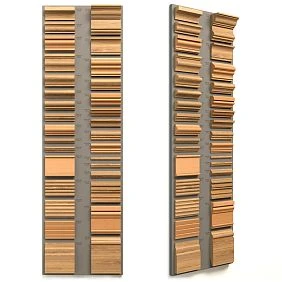
These stands are designed for furniture handles. If the showroom sells moldings, baseboards, cornices, and architraves, a different demonstration tool is needed. In this case, you can choose SV-006 for wooden trim.
SV-006 shows profiles, not face furniture hardware. Its audience is a finishing materials showroom, door center, architectural firm, or studio where trim is coordinated. One stand cannot be replaced by another just because of the similar word "display."
If a portable case, rotating stand, vertical tower, or custom design is required, confirmed stands may not suit the task. Do not attribute functions to them that are not in the card.
A private buyer choosing handles for a single project usually does not need a full stand. They can view samples in the showroom and order individual items by article numbers.
How not to confuse a stand with similar solutions
Stand and catalog
The catalog shows the full range, the stand shows a limited set of real samples. They complement each other.
Stand and display case
The display case protects products with glass but reduces tactile contact. SV-004 and SV-005 are designed for visual demonstration.
Stand and set of individual handles
Individual samples are more mobile, but harder to label and store. The panel organizes the assortment in one system.
Stand for handles and stand for moldings
SV-004 and SV-005 show handles. SV-006 is for moldings, baseboards, cornices, and architraves.
Information stand and product stand
The information panel contains text and images. Here the client interacts with real products.
Oiled sample and finished color of the entire collection
The sample shows a specific surface, but does not replace checking all available finishes in the card.
Stand SKU and handle SKU
SV-004 and SV-005 denote sets. Each installed handle has its own label.
Practical choice for different tasks
Need to open a new furniture showroom
Start by analyzing the future furniture assortment and customer profile. Compare photos SV-004 and SV-005, list the models that will be most useful, and choose one basic set. The second stand can be added after the first months of sales, when real demand becomes clear.
Need to update an existing display
Make a list of existing samples. The new stand should fill gaps: different shapes, scales, or styles. If SV-004 or SV-005 mostly repeats the current panel, the purchase will not have a noticeable effect.
Need to show handles for kitchen
Check if the set helps discuss different facades: small doors, wide drawers, tall cabinets. Confirm the specific availability of shapes by the card, not by the stand name.
Need to outfit cabinets and wardrobes
Pay special attention to the length and vertical perception of samples. The client should see how the handle will look on a tall facade. If a suitable size is missing, move to the full catalog.
Need to coordinate handles for dressers
Compact and medium shapes that do not overload drawers are useful. Compare the current composition of the two sets and choose the more relevant one.
Need to work with classic interiors
Do not label a stand as classic based on article number. Evaluate the actual shapes in the photo and match them with frame facades, carved decor, and salon furniture.
Need to work with modern interiors
Look for laconic forms, clean geometry, and different scales in the current composition. Do not confirm the presence of specific models without a specification.
Need to conduct on-site presentations
Choose one set with maximum utility for typical clients. Prepare protective packaging, and duplicate the article numbers in an electronic spreadsheet.
Need to participate in an exhibition
Two stands can create a full wall of samples. Place them at an accessible height, ensure even lighting, and provide quick access to the catalog by article numbers.
Need to standardize branch operations
You can use the same set in each office so that managers offer a unified basic assortment. If regions differ in demand, different stand configurations are allowed.
Need to show handles for custom painting
The oiled sample shows the shape and wood, but not the final enamel. After selection, move the client to the unpainted handles category and coordinate a separate paint sample.
Need to show finished natural finish
Use the stand as a tactile reference, then check the availability of the specific handle in the coated products section.
Need to link handles with facades
Place furniture material samples nearby. This way the client evaluates not an isolated handle, but a combination of color, texture, and scale.
Need to reduce consultation time
Prepare a script: style — front — size — grip — article number. The stand works faster when the manager does not show all samples in a row.
Need to reduce order errors
Record the full handle designation, size, quantity, and finish. A photo or verbal description does not replace the article number.
Need to supplement the stand with profiles
SV-004 and SV-005 are not intended for matching. Add SV-006 as a separate tool, rather than mixing product groups on the same panel.
Need to select a stand for a small office
The same format allows you to choose either of the two sets by composition. Check if the panel fits next to the consultation table and if the handles do not obstruct the passage.
Need to design a large showroom
Consider both stands, but compare duplication. Supplement them with facades, finish samples, and an electronic catalog.
Need to present products to an architect
Focus on exact article numbers, sizes, and finish options. It is important for the architect to be able to transfer the selection into the project specification.
Need to choose a stand as a gift for a partner
First, clarify the partner's assortment. The useful set should match their clients, not just look nice.
What to buy together with the stand
The main addition is the range of individual handles. The stand helps with selection, but for furniture, the required quantity of a specific model is needed. The manager should immediately go from the article on the panel to the card and calculate the set.
It is useful for a showroom to have facade samples to show the combination of wood, color, and shape. There is no confirmed URL for such materials in the scheme, so a separate link is not placed. The principle itself is important: the handle should be displayed next to the furniture material.
If the client wants a ready-made coating, they are directed to the category of handles with finish. If the handle is to be painted together with the furniture, an unpainted version is selected. The availability of the required model in both categories is checked separately.
| What to add | Why | Who it suits | What to Check |
|---|---|---|---|
| View the full catalog of furniture handles | Find products by article numbers and expand the selection. | Any showroom. | Sizes, material, coating. |
| Select ready-made oiled handles | Offer a finished finish. | Ready-made furniture salons. | Does the model match the stand. |
| Select handles for custom finish | Paint together with the facade. | Production and studios. | Wood species and model availability. |
| Buy a sample stand | Add other samples to the showroom. | Dealers with multiple directions. | Purpose of each stand. |
| Stand for molding and baseboard samples SV-006 | Show wooden linear moldings. | Door and finishing salons. | Not to be confused with handles. |
Mistakes when choosing a display stand
Select only by article number
SV-004 and SV-005 do not explain the composition by themselves. You need to open the cards and compare the photos and specifications.
Considering sets identical due to size
The base matches, but the commercial value is determined by the installed handles.
Making up specific models
Article numbers need to be read on the plates or obtained from the current specification.
Buying without demand analysis
The set may be beautiful, but of little use for the salon's assortment.
Placing too high
The client will not be able to touch the handles and read the marking.
Hiding separately from the facades
The choice of handle should be made near furniture materials.
Considering oil as a universal color standard
Natural wood varies, and other coatings look different.
Not checking the handle card
One sample is shown on the stand, while sizes and options are specified in the catalog.
Remove furniture handles
The stand will lose its exhibition value and labeling.
Buy two stands without comparison
Two sets should expand the choice, not repeat it.
Use for linear molding.
SV-006 is intended for moldings and baseboards.
Do not account for transportation
The assembled panel must be protected at exhibitions and meetings.
Do not update the sales script
The assortment changes, so you need to use current SKUs and cards.
Limit the catalog to a stand
The panel shows a partial selection. The full range is available in the handles category.
Do not train managers
Without understanding article numbers and differences, the stand remains a decorative backdrop.
Show all samples at once
The client chooses faster when the manager first clarifies the task and narrows down the options.
Who would suit a stand, and who would be better off choosing individual samples
| Buyer | Why a stand is needed | How to choose |
|---|---|---|
| Furniture showroom | Speed up the selection of handles for facades. | For standard cabinets, chests of drawers, and nightstands. |
| Kitchen salon | Show the scale on different facades. | Based on the current set of shapes and sizes. |
| Design studio | Coordinate the shape and texture. | By style range; sometimes both are needed. |
| Production | Record exact article numbers. | Based on the recommended assortment. |
| Dealer |
PrHow to order SV-004 or SV-005 on STAVROSFirst, open both cards. For the first set, you can buy exhibition stand SV-004 for furniture handles. For the second — buy the SV-005 display stand with handle samples. Then compare the actual photos and composition. If the article numbers of the installed handles are unreadable, request the specification. This is the main selection step because the size and design of the panels match. After that, determine the installation location. Check customer accessibility, lighting, distance to the aisle, and the ability to read the plates. For two stands, calculate the zone width in advance. Decide whether you need one set or two. For a narrow specialization, the most relevant one is sufficient. For a wide showroom, you can order both after checking for duplication. If a profile demonstration is required, add a separate SV-006. Before placing an order, check the current price, availability, delivery time, and terms in the card. These parameters may change. If the stand is needed for an exhibition or salon opening, coordinate the deadlines in advance with the STAVROS manager. How to conduct an assortment audit before buying a standBuying a display panel starts not with choosing between two article numbers, but with analyzing what the salon actually sells. Base it on recent projects or typical orders: kitchens, swing wardrobes, walk-in closets, dressers, nightstands, libraries, children's furniture. For each group, note which handle shapes are requested most often, what size range is needed, and how important a ready-made natural finish is. Then compile a list of existing samples. In some showrooms, handles are stored in boxes, on individual facades, or in small panels. If SV-004 or SV-005 replicates most of these items, it will improve order and labeling but not expand the assortment. If the goal is to expand the selection, priority goes to a set with new shapes and sizes. The third level of audit is the questions on which managers most often waste time. The client doesn't understand the size? Then a stand with a useful range of scales is needed. Hard to explain the wood texture? Well-read oiled samples are important. Often confused SKUs? Labeling and a clear connection to the catalog become valuable. After such analysis, comparing SV-004 and SV-005 becomes substantive. The buyer doesn't try to guess the "prettier" stand, but checks which set covers more real situations. If neither provides full coverage, the two stands can be considered as a single system, but only after checking for duplication. How to create a sample matrix without inventing modelsThe exact composition of the stands should be confirmed with current photos or a specification. However, even before receiving the list, you can prepare an evaluation table. In the first column, indicate the handle SKU, in the second — the shape type, in the third — the size of the stand sample, then suitable furniture, style, and frequency of requests in the salon. After receiving the specification, the manager fills in the matrix and sees the real usefulness of each set. For example, several handles that are very close in size may be less valuable than three significantly different samples that explain the scale to the client. But this is not a universal rule: a specialized showroom sometimes needs an in-depth demonstration of one specific group. The matrix also helps when purchasing two panels. The composition of SV-004 and SV-005 is placed side by side, matching positions are marked, and unique ones are distributed by tasks. This makes it clear whether the second stand expands the consultation or only increases the number of repetitions. It is useful to keep such a document near the display or in an electronic database. When a client selects a sample, the manager immediately sees related sizes, possible scenarios, and the product card. When the catalog changes, the matrix is updated without reworking the entire consultation system. How to evaluate the commercial usefulness of each setThe number of handles on the panel itself does not show value. One rare but sought-after sample can bring more orders than several forms that do not match the showroom furniture. Therefore, the stand is evaluated through frequency of use, clarity for the client, and the ability to transition to a real order. The first indicator is the share of samples that managers can offer in standard projects. The second is the stand's ability to explain differences. If two handles look similar in photos but feel noticeably different in hand, their proximity is useful. The third is the completeness of labeling and availability of cards. The fourth indicator is the impact on upselling. The client comes for furniture, and the stand helps shift the conversation to visible hardware, finishes, and coordinating the entire set. The fifth is error reduction: correctly selected size and article number reduce the risk of reworking facades and reordering. Commercial usefulness can be evaluated after several weeks of use. Managers note which samples are shown more often, which lead to orders, and which raise questions. This data will indicate whether a second stand is needed and which part of the assortment should be supplemented with individual handles. How to train managers to work with a display standEven a well-chosen panel does not sell itself. The manager must know the article numbers, understand the difference in forms, and be able to translate the tactile impression into a specific choice. Training begins with the panel itself: each employee goes through all samples, finds their cards, and checks confirmed sizes and finishes. Then scenarios are practiced. One client chooses a handle for a small drawer, another for a tall cabinet, a third wants to paint the hardware to match the facade color. The manager should not show the entire stand but quickly highlight relevant options and explain that the stand sample may represent only one size from the available range. Separately, correct phrasing must be taught. You cannot promise a specific wood species, coating, or completeness if they are not verified in the card. You cannot claim that all handles from the stand are immediately available. The stand shows the form and surface, while actual commercial parameters are confirmed before ordering. A useful training outcome is a short memo: identify the furniture, clarify the facade size, show two or three samples, record the article number, open the card, select the size and finish, calculate the quantity. Such an algorithm makes consultations uniform across all shifts. How to supplement the physical stand with a digital catalogA physical sample and a website solve different parts of the task. The stand provides scale and tactility, while the digital catalog offers the full assortment, size options, interior photos, and current ordering conditions. Maximum benefit occurs when the transition between them takes just a few seconds. A tablet or a manager's workstation can be kept near the stand. The article number from the label is entered into the search, after which the client sees the card. If the model exists in several sizes, the manager shows them on the screen and explains which option is installed on the panel. To send a proposal, a direct internal link to the product is saved and added to the specification. The client receives not a general catalog but a specific selected option. If they later want to return to the comparison, the link will not be lost among photos. The digital part is especially important when working with two stands. The manager does not have to remember all the differences between SV-004 and SV-005. Accurate labeling, an up-to-date matrix, and quick access to product cards are sufficient. This approach maintains consultation quality even when the assortment is updated. How to organize two stands next to each otherThe identical size of SV-004 and SV-005 allows for a neat paired display. The panels can be placed at the same height, maintaining an equal gap. But symmetry should not interfere with functionality: the outer handles should not fall into a wall corner or be too close to furniture. Labels like "first set" and "second set" are not very helpful to the client. It is better to organize consultation based on actual composition. If after checking it turns out that one panel contains more samples suitable for modern facades, and the other expands the choice for classic furniture, the manager can use this as internal logic. But public names should not promise what is not in the specification. It is useful to leave space between the stands for a facade sample or a small information panel with a selection path: shape, size, finish, article number. This way, the client understands that this is not a collection for the sake of a collection, but a decision-making tool. If the showroom is large, the panels can be divided by zones. For example, one stand is near the kitchens, the second is near the cabinets and wardrobes, if the composition of the sets matches such a distribution. In this case, managers should have a shared electronic spreadsheet so that the client can compare both groups. How to use the stand for repeat salesA physical set is useful not only for the initial furniture order. The client may return for handles for an additional cabinet, to replace a damaged part, or to update another item. If the article number is saved in the original specification, the repeat selection takes less time. Furniture manufacturers can photograph the selected sample next to the facade and attach the image to the project. The photo does not replace the article number but helps recall the agreed solution. Upon a repeat inquiry, the manager opens the card and checks current options. For designers, the stand becomes a library of solutions. The same sample can be used in multiple projects, but with different sizes and finishes. This increases the return on purchasing the panel and makes it part of the workflow, rather than a one-time exhibition expense. If certain handles consistently lead to repeat orders, it is useful for the salon to keep separate samples of other sizes of the same model nearby. This way, the basic stand is gradually supplemented with real sales data. How to update the display without losing orderAssortment and commercial terms may change, so a stand cannot be considered an unchangeable system for years. Periodically, you need to check whether the presented models are available, whether the labels match the cards, and whether all samples are clear to managers. If a particular handle is no longer used in consultations, it does not mean you need to remove it yourself. Any change to a finished stand must maintain the reliability of the fastening and correct labeling. First, clarify the permissible update method with the supplier. Sometimes it is enough to update the digital matrix and the sales script. The stand continues to show the shape and texture, while the manager explains the current options. If the display significantly diverges from the assortment, it is more rational to order a new set or additional individual samples. It is convenient to conduct checks on a schedule: before the sales season, an exhibition, opening a branch, or training new employees. The responsible person records the condition of the panel, labeling, and connection to the catalog. How to evaluate payback without made-up promisesYou cannot promise specific sales growth or payback period in advance. The result depends on customer flow, average number of furniture orders, manager training, and how well samples match the assortment. But you can estimate what costs the stand can reduce. First — consultation time. The manager shows differences faster and records the article number. Second — configuration errors. A physical sample reduces the risk of incorrect scale and awkward grip. Third — repeated approvals when the client cannot make a decision based on a photo. Fourth — showroom value. Having organized samples makes the consultation more meaningful and helps sell not only furniture bodies but also face fittings. Fifth — standardization of employee and branch work. After installation, you can keep simple statistics: how many consultations used the stand, how many selected articles were included in the order, which samples are shown most often. This data will give you a real understanding of the benefits of SV-004 or SV-005 specifically for your business. Checklist before placing an orderBefore purchasing, confirm seven things. First — the current composition of handles. Second — no critical duplication with existing samples. Third — compliance with standard furniture projects. Fourth — the placement location for a panel measuring 730 × 350 × 16 mm. Fifth check — usage format: permanent showroom, on-site meetings, exhibition, or branch network. Sixth — manager readiness to work with article numbers and cards. Seventh — need for a second stand or SV-006 for another product group. After that, check the current price, availability, timelines, and delivery in the product card. These parameters should not be carried over from old materials. If the showroom launch is tied to a specific date, place the order with a buffer for logistics and kit verification. Such a check takes less time than fixing an unsuitable display. The main criterion is simple: the stand should help the client choose handles that the salon can actually supply for the furniture project. How to display the stand alongside different types of furnitureNext to kitchen frontsIn the kitchen area, it's better to use the stand alongside several fronts of different sizes. The same sample is perceived differently on a small upper cabinet door, a wide drawer, and a tall pantry unit. The manager shows the client not only the shape but also the proportion. If the suitable length is not on the panel, the SKU serves as a starting point for finding other sizes in the product card. Next to a wardrobe and dressing roomA tall front requires checking the vertical scale. The stand is at eye level, so it is useful to mentally or with the help of a drawing transfer the long handle to a full-size door. The client is explained that the stand sample demonstrates the character of the model, but the final size is chosen based on the height and width of the specific front. Next to a chest of drawers and cabinetFor small drawers, compactness and ease of grip are important. A large handle may look convincing on a display but overwhelm a narrow facade. The manager applies a material sample to the panel or shows a drawing of the chest of drawers, then compares several possible options. Next to children's furnitureIn the children's area, shape, comfort, and consistency with the overall design are important. The presence of specific children's models on SV-004 or SV-005 cannot be confirmed without checking the composition. If the required handle is not available, the display is used to explain wood and finish, and further selection continues in the full catalog. Next to the study and libraryFor an office, clients often choose calmer and more tactilely expressive solutions. The oil coating on samples helps evaluate the wood alongside veneer, solid wood, and dark facades. It's important to compare not only the color but also the scale of the handle relative to cabinet doors and desk drawers. Next to furniture for a hotel or restaurantCommercial interiors require repeatability and clear specifications. The stand helps align the sample with the designer, client, and production, but before a series order, the actual dimensions, finish, and model availability are checked. For intensive use, ease of grip and correct installation on a specific facade are also important. How to make an exposition clear without extra labelsThe display already contains article numbers, so there is no need to overload it with a lot of promotional text. The client only needs a short selection logic: first the shape, then the size, then the finish and exact article number. Additional information is best shown in the catalog or on a separate small card nearby. If two stands are used, it is useful to maintain a uniform order: the same installation height, the same lighting, and free space around the panels. Differences between SV-004 and SV-005 should be explained through actual samples, not through a random background color or decorative labels. Several interchangeable fronts or a compact material folder can be placed nearby. This helps the client immediately associate the handle with the furniture. However, the front samples should not cover the labels or interfere with touching the handles. A good display looks calm and works quickly. The client sees real products, the manager asks a few questions, shows suitable options, and moves to the product card. It is this sequence that turns SV-004 or SV-005 into a working showroom tool, not an overloaded showcase. How to understand that the stand is truly ready for workAfter receiving the panel, it should not just be unpacked but accepted as a working tool. Check the size, integrity of the laminated base, attachment of each handle, and the presence of a readable label. If the article number is poorly visible or raises doubts, do not use the sample in an order until clarification. A labeling error is more dangerous than a minor cosmetic defect because it carries over into the furniture specification. Then open the cards of several installed handles and check how quickly the employee finds them in the catalog. If the search takes a long time, prepare an internal spreadsheet or bookmarks. The stand should shorten the path to purchase, not create additional manual searching. Conduct a trial consultation within the team. One employee plays the client and states a task: a handle for a tall cabinet, a small drawer, a kitchen, or a dresser. Another uses the panel, records the article number, and proceeds to the card. Such a check reveals inconvenient placement, poor lighting, and gaps in managers' knowledge before meeting a real customer. After installation, photograph the stand in the general display and close-up — together with the article numbers. The photos will be useful for internal training and condition monitoring. However, they cannot be used as a replacement for the current card if the set composition or commercial terms have changed. A stand becomes ready for work when four conditions are met: the client can see and touch the samples, the manager confidently finds the article numbers, each selected option is translated into an accurate card, and the panel matches the main showroom furniture. If at least one condition is not met, the problem is usually solved by placement, training, or catalog supplementation, not by purchasing a random new stand. Why a ready-made stand is better than a random homemade panelA homemade panel requires separately selecting a base, marking spots, attaching handles, making clear labels, and maintaining consistency between the sample and the catalog. An error in labeling or sloppy placement reduces the value of the entire display. SV-004 and SV-005 come assembled, have a uniform size, and already link each sample to an article number. This does not eliminate the need to check the current composition, but it frees the showroom from technical assembly and allows focusing on consultation, manager training, and selling individual handles. For a salon with several managers, the ready-made format is especially useful: all employees work with the same article number system, show clients identical samples, and form proposals according to uniform rules. This reduces the dependence of the result on the memory of a specific salesperson and makes the consultation reproducible. Before launching the display, it is useful to conduct one test consultation and ensure that the path from the sample to the product card takes just a few minutes. FAQ: questions about SV-004 and SV-005What is the difference between SV-004 and SV-005?The basic dimensions and construction are the same. The main difference is the current composition of the installed handle samples. What is the size of the stands?Both are 730 × 350 × 16 mm in size. What is the base made of?Made of laminated chipboard. Do I need to assemble the stand myself?No, both models come assembled. Are handles included in the set?The stands are designed for displaying installed samples. The actual configuration should be checked in the product card. Are there article numbers near the handles?Yes, information plates with article numbers are provided. What coating are the samples treated with?Oil coating confirmed. Which handles are included in SV-004?The exact list should be checked against current photos and the card specification. Models cannot be invented. Which handles are included in SV-005?The composition is checked against the current card and, if necessary, clarified with the manager. Which stand should a kitchen showroom choose?The one where the current set best matches the typical facades and kitchen styles of the showroom. Which stand is suitable for a design studio?The set with a more useful range of shapes for current projects. With a broad specialization, both may be needed. Can I order two stands together?Yes, if they complement each other. Before ordering, check the composition and duplication. Can the stand be used at an exhibition?Yes, the assembled format is suitable for the presentation, but the panel must be safely transported and placed. Can I buy a separate handle for the stand?Separate handles are ordered by article numbers in the catalog. Availability and options are checked in the product cards. Can the handles be removed from the stand?This should not be done unnecessarily: the panel will lose part of its display and labeling. Where to place the stand?Near the facades and consultation area, at a height accessible for touching and reading. How to link a sample to an order?Write down the article from the plate, open the card and check the size, coating, quantity and order conditions. Can unpainted handles be displayed on the stand?The installed samples are coated with oil. Unpainted versions are selected separately in the appropriate category. How is SV-006 different from SV-004 and SV-005?SV-006 displays moldings, baseboards, cornices and architraves, while SV-004 and SV-005 display furniture handles. Is the stand suitable for a private buyer?For one furniture project, it is often more rational to buy individual handles. The stand is designed for multiple consultations. Does the stand need to be updated?You should periodically check the fastenings, markings and relevance of models in the catalog. Where can I see other product samples?The STAVROS product samples section showcases demonstration solutions for different product groups. Can a set be determined by price alone?No. Price does not show how well the samples match the salon's assortment and audience. What to do if the photo does not allow reading the article numbers?Request the current specification from the manager before placing the order. Result: SV-004 or SV-005SV-004 and SV-005 solve one basic task: they help a salon, manufacturer, or designer display wooden furniture handles in natural scale. The same size 730 × 350 × 16 mm, laminated base, assembled delivery, oil coating of samples and plates with article numbers make both stands ready consultation tools. The choice is determined by the composition of the handles. You cannot designate SV-004 as "classic" and SV-005 as "modern" or assign them specific shapes without a current specification. Open both cards, compare photos, write down the article numbers, and match the set with the furniture most often ordered by clients. One stand is suitable for a salon with a narrow specialization and a limited consultation area. Two stands are useful for a wide showroom if they complement each other. For moldings, choose SV-006 instead. On the STAVROS website, you can order SV-004 or SV-005, go to the full catalog of wooden handles, select models with a ready coating or for custom finishing. This route turns the stand from a decorative panel into a precise selection tool: the client sees the actual sample, the manager records the article number, and production receives a clear specification without random descriptions. |