Article Contents:
- MN-239 or MN-241: the main difference in one minute
- What is a high furniture leg and why one height is not enough
- When to buy a turned furniture leg MN-239
- When a decorative shape is needed
- When the choice of height is important
- When oak is needed
- When beech under enamel is needed
- When the project requires custom furniture
- When a large architectural support is needed
- When enamel is planned
- When the table should look modern
- When assembling a console
- Spread the legs wide enough
- Tie the supports with a rigid frame
- Do not rely on just one bolt
- Consider the weight of the tabletop
- Check the floor
- Do not carry the table by the tabletop without calculation
- Oak for tinting
- Beech for enamel
- Beech for tinting
- Why you shouldn't choose wood species only by price
- Classic Interior
- Modern minimalism
- Eclecticism
- Loft and industrial interior
- Country house
- Restaurant, cafe or showroom
- Need to assemble a dining table
- Need to make a console
- Need to make a vanity table
- Need to repeat legs on several items
- Need a black modern support
- Need a natural oak leg
- Need to assemble a table by yourself
- Select only by height
- Do not account for tabletop thickness
- Ignore the apron
- Consider any fastener compatible
- Buy four legs of different wood types
- Choose MN-241 for a natural oak result
- Buy MN-239 423 mm as the "ready height of a coffee table"
- Do not consider the width of MN-241
- Paint after assembly without preparation
- Do not make a tinting sample
- Do not calculate a heavy tabletop
- Place legs too close to the center
- Place legs too close to the edge
- Buy only four legs without the rest of the kit
- Wooden tabletop
- MDF or veneered board tabletop
- Stone or heavy composite tabletop
- Glass tabletop
- Thin modern tabletop
- Which leg is better for a dining table — MN-239 or MN-241?
- What is the difference between heights 740 and 742 mm?
- What wood is MN-239 made from?
- What wood is MN-241 made from?
- What sizes are available for MN-239?
- What size is MN-241?
- Can MN-241 be painted black?
- Can I tint MN-239?
- Is a crossbar needed for legs about 740 mm high?
- Can the legs be screwed directly to the tabletop?
- Does FUR-001 fit MN-239?
- Does FUR-012 fit MN-241?
- How many legs do I need to buy for the table?
- Will tall legs work for a heavy tabletop?
- How to prevent the table from wobbling?
- What to choose for a classic interior?
- What to choose for a modern interior?
- Can MN-239 423 mm be used for a coffee table?
- Will MN-239 634 mm work for a vanity table?
- Individual legs or a ready-made underframe — which to choose?
- Where to buy wooden furniture legs?
- What should I check before ordering?
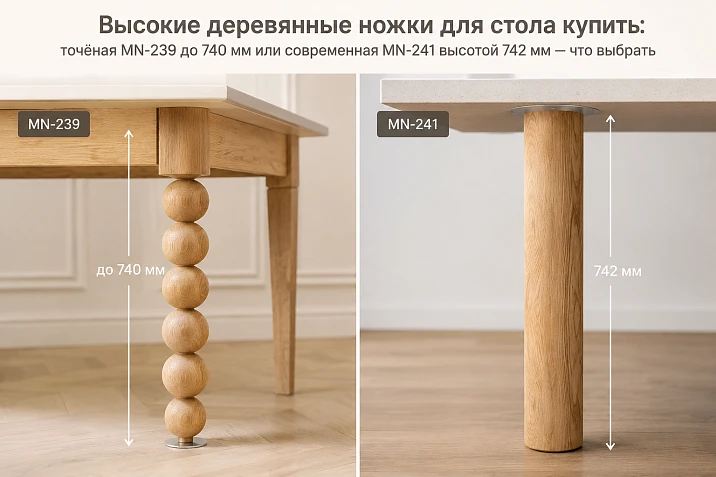
High wooden table legs are bought not only for their appearance. The final seating, structural rigidity, comfort at the table, and how harmoniously the tabletop will look in the interior depend on their height, cross-section, shape, wood type, and attachment method. That is why two supports of similar height — the turned MN-239 up to 740 mm and the modern MN-241 with a height of 742 mm — cannot be considered nearly identical. The two-millimeter difference here is less important than the shape, width, material, and usage scenario.
MN-239 is a turned furniture leg with spherical elements. It is available in three sizes: 423 × 109 mm, 634 × 109 mm, and 740 × 109 mm. The buyer can choose beech or oak, meaning the support can be used not only for a standard dining table but also for lower furniture, intermediate structures, custom tables, chairs, or consoles. This model suits projects that require a pronounced turned shape, a rhythm of round elements, and the ability to pair the legs with a classic, eclectic, or decorative interior.
MN-241 is designed differently. It is a modern beech leg measuring 742 × 160 × 95 mm, prepared for enamel with a "Prestige" quality finish. Its wide architectural form works well under a tabletop or console where the support should be perceived as a large plane rather than a thin turned detail. MN-241 is chosen when a modern silhouette, a noticeable base, and painting in white, black, or another agreed color are needed.
Below, both models are compared by height, shape, wood, finish, and purpose. It also covers how to calculate the final table height with the tabletop, whether a crossbar is needed, why four high legs alone do not guarantee stability, how to check FUR-001 and FUR-012, when it is better to buy individual supports, and when to choose a ready-made underframe. This approach helps not just order beautiful legs but assemble a structure that looks convincing and does not wobble during use.
Short answer.
Choose MN-239 if you need a turned wooden leg made of oak or beech, the ability to select a height of 423, 634, or 740 mm, and to preserve an expressive turned shape. MN-241 is suitable for a full-size table or console with a modern wide support 742 mm high made of beech for enamel. For both models, before purchasing, you need to calculate the final height together with the tabletop, determine the stretcher or other structural scheme, and check the compatibility of the attachment with the specific construction.

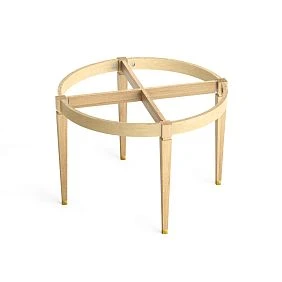
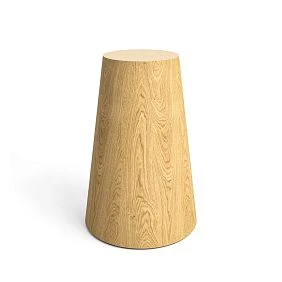
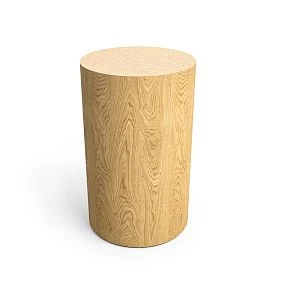
MN-239 or MN-241: the main difference in one minute
The main difference between the models is not the height, but the logic of the shape. MN-239 is built on a turned volume. Spherical elements, diameter transitions, and rounded sections create a decorative rhythm. This leg is clearly visible from the side, noticeable from afar, and can become an independent part of the design. Under a simple tabletop, it adds character, and in a more saturated interior, it supports carved, rounded, or classic details.
MN-241 is perceived as an architectural support. Its dimensions of 742 × 160 × 95 mm show that the model is significantly wider than a regular turned leg. There is no task here to create a series of rounded transitions. On the contrary, the support emphasizes flatness, mass, and modern geometry. It suits a table or console where the base should be visually large but not overloaded with ornament.
MN-239 can be ordered in oak or beech and choose from three heights. This gives more freedom in purpose and finish. Oak allows preserving the texture under tinting, oil, or other compatible coating. Beech is suitable for enamel and projects where the wood grain should not be the main focus. MN-241 is only confirmed in beech, with preparation for enamel. Therefore, it is purchased primarily for painted modern furniture.
A buyer who needs a support about 740 mm high is essentially comparing MN-239 740 × 109 mm and MN-241 742 × 160 × 95 mm. The difference in height practically does not determine the choice. Much more important are the width, shape, finishing method, apron design, and how heavy the tabletop will be installed on top.
| Criterion | MN-239 | MN-241 |
|---|---|---|
| Type | Turned furniture leg | Modern wide furniture leg |
| Dimensions | 423 × 109, 634 × 109 or 740 × 109 mm | 742 × 160 × 95 mm |
| Wood | Oak or beech | Beech |
| Preparation | For the selected finish considering the wood | "Prestige", for enamel |
| Shape | Turned composition with spherical elements | Broad architectural geometry |
| Main scenario | Tables, chairs, designer furniture, various heights | Full-size tables and consoles |
| Main advantage | Three heights and choice of oak or beech | Large modern form under enamel |




What is a high furniture leg and why one height is not enough
A high furniture leg is usually a separate support that allows you to assemble a table, console, dressing table, workstation, or other structure with a noticeable clearance from the floor. But the height of the part does not determine the finished furniture by itself. The final level of the tabletop consists of the leg length, the thickness of the top panel, the design of the apron, mounting plate, underlayment, and other components. Even two supports of almost the same length can give different seating due to the connection method.
For a dining table, it is important not only to achieve the usual height but also to preserve knee space. A too-deep apron or a thick tabletop can reduce the free opening. If the leg is attached directly to the panel without an apron, another question arises: will there be enough rigidity under lateral load. Therefore, the choice between MN-239 and MN-241 begins with a sketch of the entire structure, not with a single product card.
The cross-section also affects the result. The turned MN-239 has a maximum size of 109 mm along the specified profile. It appears relatively compact and leaves more free space under the table. MN-241 has a width of 160 mm and a depth of 95 mm. This support takes up more space in the corner area and visually supports the tabletop more strongly. On a small table, four wide legs can come close to each other and reduce the usable opening.
The mass of the tabletop must correspond not only to the strength of the wood but also to the entire load-bearing scheme. It cannot be stated that a specific leg automatically suits heavy stone, solid wood, or a large panel without calculation. The load is transmitted through the fasteners, apron, connections, and supports to the floor. If one component is weaker than the others, it will determine the reliability of the furniture.
Therefore, high legs are considered as part of the structure. The buyer chooses the shape and material, while the craftsman determines the mounting points, diagonal rigidity, distance between supports, and allowable load. This order allows preserving both appearance and stability.
Our factory also produces:
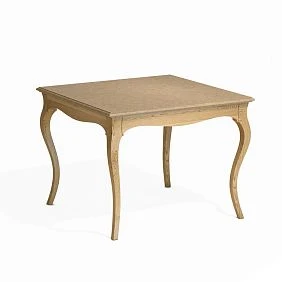
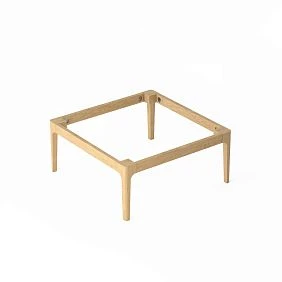
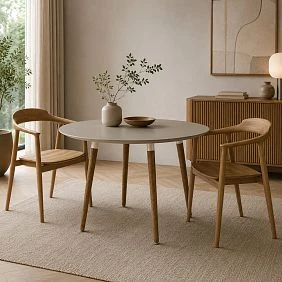
When to buy a turned furniture leg MN-239
Get Consultation
When a decorative shape is needed
MN-239 is suitable for a table that should look expressive even without a carved apron and complex tabletop. The spherical elements create rhythm, read well in profile, and connect the furniture with classic, transitional, and eclectic interiors. Such a leg can become the main decorative element, so the other structural details can be made calmer.
On a long dining table, turned supports soften the strict rectangle of the tabletop. On a small table, they add volume and turn a simple structure into an author's piece. It is important to maintain scale: a too-massive tabletop can visually overwhelm the legs, while a too-thin one can look accidental next to pronounced turning.
When height selection matters
MN-239 is available in heights of 423, 634, and 740 mm. This allows using one stylistic motif in furniture of different levels. The 423 mm option may suit a lower structure, 634 mm for an intermediate scenario, and 740 mm for a full-size table. However, the purpose cannot be determined solely by the leg size: the final result depends on the tabletop and the mounting assembly.
This variability is especially convenient for a furniture collection. The designer can repeat the shape on a table, console, chair, or other piece, changing the height. This way, the interior gains a kinship of details without literally repeating one item.
When oak is needed
If the task is to show the natural grain, it is logical to order MN-239 from oak or beech, choosing oak for tinting. The texture of oak reveals rounded areas well: light and shadow change across the surface, and the wood grain adds depth. The legs can be matched in shade to the tabletop, doors, floor, or other decor.
An oak support is especially appropriate under a tabletop made of wood or veneer with a noticeable grain. Full texture matching is not required, but the shade and degree of gloss should be coordinated. If the tabletop is already ready, it is useful to make a tinting sample on the wood before finishing the entire set.
When beech is needed for enamel
Beech is chosen if the turned shape needs to be painted with opaque enamel. White, black, gray, or colored options preserve volume and shadows but remove the wood grain. This helps adapt a classic turned shape to a more modern interior.
Enamel in the color of the tabletop makes the structure cohesive. Contrasting enamel turns the legs into an independent graphic element. In both cases, the surface of all four supports must be prepared and painted using the same system to avoid differences in shade and gloss.
When the project requires custom furniture
MN-239 is suitable for a workshop that wants to independently determine the apron, tabletop, finish, and attachment. The support provides a ready-made turned shape but leaves design freedom. The buyer does not waste time making a complex profile from scratch and can focus on assembly and final finishing.
If the model matches the project, you can buy a turned furniture leg MN-239, after first selecting the height and wood type. Before placing an order, it is necessary to determine how many supports are needed and what mounting unit will be used.
When to buy a modern furniture leg MN-241
When a large architectural support is needed
MN-241 is chosen not for its turned decoration, but for its wide shape. The size of 742 × 160 × 95 mm makes the support a noticeable part of the base. Under a thin tabletop, it creates a contrast between the flat top and the massive vertical. Under a larger slab, it supports its scale and helps the table look cohesive.
The wide support is well-suited for a modern console, writing desk, or dining table with a minimalist geometry. It can echo the planes of facades, wall panels, doors, and other straight-lined details. At the same time, MN-241 is not overloaded with carving, so color and proportions take center stage.
When enamel is planned
MN-241 is confirmed from beech, with "Prestige" quality processing and preparation for enamel. This makes it an obvious choice for painted furniture. You can create a white base for a light tabletop, black for a contrasting modern table, gray or colored for an individual project palette.
The exact color and coating technology are selected separately. Preparation "for enamel" does not mean the support can be installed without a final coating if the project requires painting. Before installation, priming, enamel application, and drying according to the chosen system must be arranged.
When the table should look modern
The modern shape of MN-241 works best where the interior is built on simple volumes. It pairs with a rectangular tabletop, a laconic apron, solid-color facades, and large planes. Against a background of slats, stone, glass, or painted MDF, such a leg remains noticeable but does not introduce additional ornament.
If the interior is already rich with wood grain, routing, or decor, MN-241 can balance the composition. It creates a calm, large support and does not compete with other details.
When assembling a console
For a wall-mounted console, a wide leg can be particularly expressive. But here, the depth of the furniture is important. The support 160 × 95 mm must fit under the tabletop, leaving room for the apron, wall attachment, and free passage. A console often has less depth, so a drawing is mandatory.
You cannot assume that two legs are automatically sufficient for a console. The wall-mounted structure must be securely connected to the wall or have another load-bearing scheme. The number of supports depends on the project. If a specific model is needed, you can buy the modern furniture leg MN-241, but the fastening and stability are calculated separately.
MN-239 740 mm vs MN-241 742 mm
When comparing larger sizes, the height is almost the same: 740 and 742 mm. After adding the tabletop, the two-millimeter difference is almost always lost against the overall thickness of the structure, flooring, glides, and tolerances. Therefore, choosing a model solely by height is incorrect.
MN-239 has a more compact profile and decorative turning. It suits a table where more free space should remain between the legs. MN-241 is wider and is perceived as a large plane. It can visually reduce the opening under the table, especially if the tabletop is short.
MN-239 is available in oak or beech. MN-241 is made of beech. If the project requires a natural oak texture, the choice obviously shifts towards MN-239. If a wide painted support is needed, MN-241 offers a more precise fit for the task.
The turned shape of MN-239 adds rhythm and tradition. MN-241 supports modern architecture. There is no universally better option here. The right model is the one that matches the scale of the tabletop, the interior, and the structural scheme.
Main conclusion: at a height of 740–742 mm, the decisive factors are shape, width, wood, and table construction. The two-millimeter difference should not determine the purchase.
When you need MN-239 with a height of 423 mm
The 423 × 109 mm option cannot be automatically called a leg for a coffee table or other specific furniture without considering the tabletop thickness and purpose. But this height is suitable for projects that require a noticeably lower structure than a standard dining table. This could be a custom table, low console, bench, or other item designed to individual specifications.
The turned profile retains its decorative quality even at a lower height. On a compact item, spherical elements become visually more noticeable, so the tabletop should not be too small. A full-size mockup helps check the proportions.
Attaching a low leg is often perceived as simpler, but lateral stability still depends on the distance between the supports and the apron. If the legs are placed close to the center, the furniture may tip over. Their placement is chosen based on the dimensions of the tabletop and the expected load.
When MN-239 with a height of 634 mm is needed
The 634 × 109 mm option is suitable for intermediate structures. It can be used for a table of non-standard height, a vanity table, a console, a workstation, or other furniture where the final level is calculated separately. You cannot simply add a regular tabletop and consider the structure standard: the seating must match the chair, armchair, or usage scenario.
This height is useful when the turned shape MN-239 is needed, but the larger size of 740 mm creates too tall an item. For example, a thick tabletop or a high under-table block may raise the top surface above the desired level. In such a case, an intermediate support helps maintain proportions.
Before ordering, it is helpful to simulate the final height on the wall or using a temporary structure. The person should check the position of their hands, knees, and chair. The number on the product page does not replace real ergonomics.
How to calculate the final table height
The basic formula is simple: leg height plus the thickness of all elements above it. But in a real project, each layer must be listed. This could include a mounting plate, an apron assembly, a substrate, a tabletop, a decorative frame, and an adjustable foot. Some components are included in the leg height, while others are added above or below.
For MN-239 740 mm and MN-241 742 mm, a thick tabletop can raise the work surface significantly higher than the support length. If the project is designed for specific chairs, the height is checked together with them. Not only the tabletop level is important, but also the lower edge of the apron, which determines the legroom.
A console is calculated using a different logic. It does not require prolonged seating, but the height must match the mirror, wall decor, outlets, and items that will sit on top. A vanity is linked to the seat and mirror height. A desk is linked to seating and working posture.
The most common mistake is choosing legs based on a familiar number without considering the tabletop. Before purchasing, you should create a cross-section of the structure with exact dimensions. If the diagram is not ready yet, it's better not to drill or select fasteners.
Is a stretcher needed for tall legs?
The apron connects the legs to each other, supports the tabletop, and resists lateral wobbling. For tall, separate supports, it often becomes an important part of the structure. However, it cannot be said that a specific model always requires the same apron. The width, thickness, material, and connection method depend on the tabletop, the distance between the legs, and the load.
MN-239 with a compact cross-section can be connected with aprons in a way that preserves free space under the table. MN-241 is wider, so the apron placement must account for the geometry of the flat support. In both cases, you need to understand where the fasteners go and whether there is enough wood around the mounting point.
A table without an apron is possible with a different engineering scheme: a rigid under-table frame, metal ties, a massive slab with calculated fasteners, or a ready-made base. However, simply screwing four long legs to the tabletop does not guarantee stability. The higher the supports and the greater the distance to the floor, the more noticeable the lateral load on the connection.
If the project raises doubts, it is useful to calculate the rigidity of a table on tall legs. An engineering article helps to understand the role of connections and not reduce the design to just choosing beautiful supports.
How to avoid wobbling of a high table
Spread the legs wide enough
The closer the supports are to the center, the smaller the stable contour. Legs are usually placed closer to the corners, leaving technological gaps. The exact position depends on the tabletop, overhangs, apron, and space for those sitting.
Connect the supports with a rigid frame
Girders or other frames must resist shear. A rectangular frame without sufficient rigidity can deform into a parallelogram. Joints, diagonals, and fasteners are calculated as a single system.
Do not rely on a single bolt alone
A stud or screw can hold a leg against lifting but poorly resists rotation if the mounting node does not fix orientation. For the wide MN-241, the rotation issue is especially important: the support must maintain a given direction.
Consider the weight of the tabletop
A heavy top plate increases the load on fasteners during movement and rocking. It can improve stability against tipping but simultaneously create large moments in the nodes. Therefore, 'the heavier, the more stable' is an oversimplified rule.
Check the floor
An uneven floor causes one leg to hang or transfers load unevenly. Leveling feet and adjustment solve small differences, but their presence and compatibility must be confirmed separately. Do not use random wedges that shift over time.
Do not move the table by the tabletop without calculation
When lifting a heavy table, the load on the connections changes. The structure is moved in a way that does not break the legs. A large item is better carried by several people or disassembled if the components are designed for disassembly.
FUR-001 or FUR-012: how to choose a fastener
The provided diagram shows two hardware options: Fastening kit FUR-001 и Mounting plate FUR-012. They cannot be automatically assigned to MN-239 or MN-241 without checking the mounting node, product card, and table structure.
FUR-001 is associated with an M8 stud and insert. Such a node can be used to attach a furniture leg to the structure if the dimensions, load direction, and material are compatible. However, a single threaded point does not always provide sufficient protection against rotation and wobbling. Additional structural measures are needed.
FUR-012 includes a mounting plate and an M8 stud as per the provided diagram. The plate distributes the fastener across the tabletop or under-table element area, but its suitability depends on the thickness, material, and screw placement. On a thin or weak board, the fastener may not achieve the required depth.
The correct question is not 'which kit is better', but 'which node is designed in my structure'. The fastening option should be selected considering the tabletop, apron, mounting location, leg orientation, and serviceability. Before ordering, check the dimensions in the cards and, if necessary, clarify compatibility with a STAVROS manager or technician.
How many legs to order
For a standard rectangular table, four supports are often used, but this is not a universal rule. A long tabletop may require additional support, a central frame, or another under-table structure. A console may have two legs and a wall mount, four legs, or a complex base. The quantity is determined by the project.
If four MN-239 are purchased, all supports must be of the same height, wood, and finish batch. The same applies to four MN-241. Mixing 740 and 742 mm in one structure, expecting to compensate for the difference with random shims, is not allowed. Different models also differ in the shape of the mounting unit.
For furniture production, it is useful to order a spare support if the project is large and involves subsequent maintenance. However, the decision depends on the budget and order conditions. The spare leg should be stored in suitable conditions and have the same finish.
Before placing an order, compile a list: article number, size, wood, quantity, finish, fasteners, aprons, and tabletop. This reduces the risk that the craftsman receives a beautiful set but discovers incompatibility only during assembly.
Individual legs or ready-made underframe
Individual legs provide maximum freedom. The buyer determines the distance between supports, the shape of the apron, the tabletop material, and the finishing method. This approach suits a furniture workshop, a designer, and a person assembling a custom piece from a drawing.
The main challenge is engineering responsibility. It is necessary to ensure rigidity, calculate fastenings, and check the load. The price of four legs is not the final cost of the table. The tabletop, apron, hardware, finishing, assembly, and possible reinforcements are added.
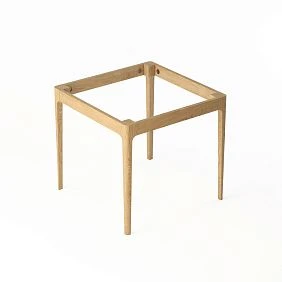
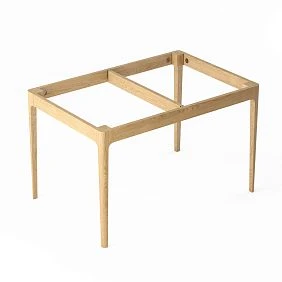
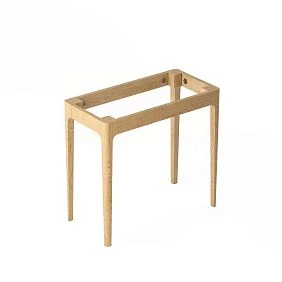
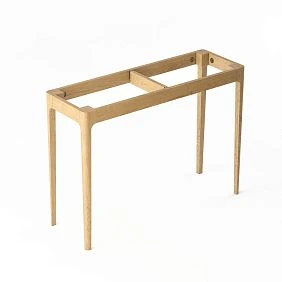
A ready-made underframe reduces the number of decisions. In it, the supports are already combined by a frame or structure. This is convenient when it is more important to quickly get a ready-made base than to individually position each leg. But a ready-made underframe limits the shape and size.
To understand the difference, it is useful to read how to choose a furniture support for a table. The new article solves a narrower task — choosing between MN-239 and MN-241, while the general material helps compare individual legs with other types of bases.
Oak or beech for table legs
Oak for tinting
Oak is available for MN-239. It is chosen when you need to preserve the natural grain. Tinting helps match the legs with the tabletop, floor, doors, or other wooden elements. On spherical areas, the texture looks especially lively because the direction of light reflection changes.
The oak support does not have to exactly copy the tabletop grain. Matching the overall temperature of the shade and the degree of gloss is important. Complete mechanical replication of natural wood is impossible and unnecessary.
Beech for enamel
Beech is available for both models and is especially logical under opaque enamel. It allows you to focus on the form. For MN-239, enamel emphasizes turning and shadows; for MN-241, it emphasizes flatness and architecturality.
If four legs are painted separately from the tabletop, the color sample must be agreed upon in advance. The same enamel code may look different on different substrates and with different levels of gloss.
Beech for tinting
Tinting beech is possible within a suitable finishing system, but the visual result differs from oak. If a pronounced grain is needed, oak usually provides a more obvious pattern. The exact choice is best made based on samples, not the color name.
Why you cannot choose the wood species based only on price
The wood species is linked to the finish and design. A more affordable option may require a complex attempt to imitate a texture that is not present in the material. It is more rational to choose wood that matches the desired result and then calculate the total cost.
Tinting or enamel
Tinting preserves the wood grain. It suits oak MN-239 and projects where legs should look like part of wooden furniture. The shade can be matched to the tabletop, but a sample is needed before finishing. Different areas of wood absorb the coating unevenly.
Enamel creates a uniform color. It suits beech and especially MN-241, prepared for painting. A white support can visually lighten the table, black can make the base graphic, and colored can connect the furniture with the interior palette.
Contrast finishing changes the perception of shape. Dark MN-241 under a light tabletop looks more massive. MN-239 in the color of the tabletop becomes calmer, while in a contrasting shade it becomes more decorative.
It is better to coat the legs before final assembly to treat all sides. The attachment points are protected or prepared according to the technology. A thick layer of enamel in the mounting joint can change the size and complicate assembly.
How to choose a tabletop for MN-239
The turned leg is best revealed when the edge of the tabletop does not completely cover it and does not look overly massive. The edge shape can support rounded elements: a soft chamfer, rounding, or a decorative profile. But this is not a mandatory rule. A straight modern tabletop creates an interesting contrast.
The size of the tabletop determines the distance between the legs. On a short table, four MN-239s may stand too close, and the decorative volumes will feel cramped. On a long one, there will be enough free space between them.
The thickness of the tabletop affects the final height and visual mass. A too thin slab may seem weak next to turned supports, while a too thick one may overwhelm them. A full-size sketch or visualization helps find the balance.
The material of the tabletop must be coordinated with the fastening and load. It cannot be stated that any wood, stone, or glass slab is suitable for MN-239 without calculation.
How to choose a tabletop for MN-241
MN-241 has a wide shape, so it supports a tabletop with straight geometry well. The edge can be laconic, and the slab itself can be solid or with a noticeable texture. The support works as a large vertical and does not require a decorative profile.
The leg width of 160 mm affects the position relative to the edge. A too small offset can make the support visually pressed into the corner. A too large one can reduce the stable contour. The position is calculated together with the apron and seating areas.
If the tabletop is narrow, four MN-241s can reduce legroom. This is especially important on a short table or console. Before ordering, draw a top view and check the actual dimensions.
Material contrast can be a strong advantage. A painted beech leg can support a stone, wooden, or painted tabletop. But the fasteners differ for each material, so a decorative combination does not replace an engineering design.
MN-239 and MN-241 in different interiors
Classic Interior
MN-239 naturally supports classic furniture thanks to its turned shape. Oak tinting, patinated enamel, or a calm white color can connect the legs with doors, frames, and carved decor. MN-241 can also be used in modern classics if the interior is built on large planes without excessive ornamentation.
Modern minimalism
MN-241 suits straight geometry, solid-colored surfaces, and architectural volumes. Enamel in the color of the wall or tabletop makes the supports calm. A contrasting black option creates a graphic base. MN-239 in minimalism is appropriate as a deliberate single decorative gesture.
Eclecticism
In an eclectic interior, MN-239 allows combining a modern tabletop with a traditional turned shape. MN-241, on the contrary, can balance the rich decor of walls and furniture with its calm plane.
Loft and industrial interior
Wooden supports can soften metal and rough surfaces. MN-241 under dark enamel looks architectural. MN-239 in tinted oak adds a craft character. Fasteners and the apron should be visually coordinated if they remain exposed.
Country house
For a wooden interior, MN-239 in oak looks organic and supports natural materials. MN-241 can be used in a more modern country house where wood is combined with painted facades and large planes.
Restaurant, cafe, or showroom
In commercial furniture, repeatability and stability are important. MN-239 creates a recognizable decorative image, MN-241 creates modern architecture. But before ordering a series, you need to test the construction of one prototype under real load.
Practical choice for specific tasks
Need to assemble a dining table
First, determine the size of the tabletop and the number of seats. Then choose the shape: MN-239 for a decorative turned base, MN-241 for a wide modern support. After that, calculate the apron, fastening, and final height. For a long table, check the deflection of the tabletop and the need for central support.
Need to make a console
MN-241 creates an expressive modern console, MN-239 a more decorative one. The depth of the tabletop must accommodate the supports and fastening. If two legs are used, the structure usually requires a reliable connection to the wall or other support.
Need to make a dressing table
The height is chosen together with the seat and mirror. MN-239 634 mm may be interesting for a non-standard design, but the final level depends on the tabletop and drawers. MN-241 742 mm may be too high if there is a thick storage block under the tabletop.
Need to repeat the legs on several items
MN-239 in three heights allows developing one shape into a collection. You can connect a table, a low item, and intermediate furniture. However, each structure is calculated separately.
Need a black modern support
MN-241 made of beech under enamel meets the task. But the color, primer, and gloss level need to be coordinated with the rest of the furniture. Before installation, make a sample on prepared wood.
Need a natural oak leg
Choose MN-239 made of oak. Tinting or oil should preserve the pattern and match the tabletop. If a wide form MN-241 is needed, oak is not confirmed in the provided data.
Need to assemble the table yourself
Ready-made legs eliminate the need for complex turning or joinery to create the form. But the project still requires a drawing, apron, fasteners, and stiffness calculation. Self-assembly should not turn into randomly screwing supports to the slab.
What to buy together with legs
Legs are only part of the kit. For a finished table, you will need a tabletop, aprons or other under-table reinforcement, fasteners, finishing materials, and floor protection elements. In the provided scheme, cards FUR-001 and FUR-012 are confirmed, but their compatibility with the specific structure needs to be checked.
It is useful to open the category in advance and Buy wooden furniture legs after comparing other models. If an individual finish is needed, you can choose unpainted furniture legs and compare MN-239, MN-241, and adjacent options.
| What to add to the purchase | Why this is needed | What to Check | For which scenario |
|---|---|---|---|
| Tabletop | Forms the work surface and sets the overall mass of the furniture. | Size, thickness, material, deflection and attachment method. | Table, console, vanity table. |
| Aprons or rigid frame | Connect the supports and reduce lateral sway. | Cross-section, material, joints, legroom. | High tables on four separate legs. |
| buy the FUR-001 mounting kit | Consider the M8 stud and insert nut for the appropriate joint. | Compatibility with leg, apron, tabletop and load. | Detachable or hidden threaded connection. |
| Buy mounting plate FUR-012 | Distribute the fastening over the base area. | Thickness and material of the board, screw depth, anti-rotation protection. | Design where the plate is verified by calculation. |
| Finishing materials | Protect the wood and achieve the desired color. | Compatibility with oak or beech, shade sample, application technology. | Enamel, tinting, oil, or another agreed system. |
| Floor glides or floor protection | Protect the coating and compensate for minor unevenness. | Compatibility, height, load and impact on the final level. | Any table on a hard or sensitive floor. |
How not to confuse a leg with a ready-made underframe
MN-239 and MN-241 are separate furniture supports. They do not include a tabletop, aprons, or an automatically calculated frame. The buyer receives a form from which furniture can be assembled, but not a ready-made base.
An underframe is a more complete structure in which the supports are connected by a frame or other load-bearing element. It can lead to a finished table faster, but limits the freedom of size and shape.
The error occurs when a buyer sees a tall leg and assumes four pieces are enough. After delivery, it turns out that fasteners, aprons, joinery connections, and finishing are needed. Before ordering, a full list of components must be compiled.
If it is not possible to calculate the structure, a ready-made underframe may be more rational. If a unique shape is important, MN-239 or MN-241 offer more freedom.
Mistakes when buying high legs
Choosing only by height
MN-239 740 mm and MN-241 742 mm are almost the same length, but completely different in shape, width, and finish. Height is only one parameter.
Do not account for the tabletop thickness
The final furniture will be taller than expected. All structural elements need to be added together.
Ignore the apron
Four legs without rigid connection can wobble. The structural scheme is developed before ordering.
Consider any fastener compatible
FUR-001 and FUR-012 are options, not an automatic recommendation. The mounting node is checked against the design.
Buy four legs of different wood types
Oak and beech differ in texture and behavior during finishing. The set must be coordinated.
Choose MN-241 for a natural oak result
In the provided data, MN-241 is confirmed only in beech. For oak, consider MN-239.
Buy MN-239 423 mm as a "ready height for a coffee table"
The thickness of the tabletop and components change the final level. The purpose is determined by the drawing.
Do not consider the width of MN-241
Four supports 160 × 95 mm can reduce the opening under a small tabletop.
Paint after assembly without preparation
It is difficult to evenly treat internal surfaces and components. Finishing should be planned in advance.
Do not make a tinting sample
The color of oak and beech changes after coating. A sample helps avoid unexpected shades.
Do not calculate a heavy tabletop
Mass affects fasteners and wobbling. Load is checked across the entire system.
Placing legs too close to the center
The stable contour decreases, increasing the risk of tipping over.
Placing legs too close to the edge
There may not be enough space for the stile and fasteners, and the wood around the joint will weaken.
Buying only four legs without the rest of the kit
Additional parts will be needed for assembly. A full specification saves time.
Who MN-239 suits and who MN-241 suits
| Situation | What to choose | Why |
|---|---|---|
| A turned decorative shape is needed | MN-239 | Spherical elements create a distinct rhythm. |
| A wide modern support is needed | MN-241 | Size 160 × 95 mm forms a large architectural plane. |
| Need oak for tinting | MN-239 | Model available in oak or beech. |
| Need beech for enamel | Both models | The choice is determined by the shape and scale. |
| Need height 423 or 634 mm | MN-239 | MN-241 is only confirmed in the 742 mm size. |
| Modern painted console | MN-241 | The wide form for enamel supports modern geometry. |
MN-239 will not suit a buyer who only needs a wide flat architectural support. MN-241 is not suitable for a project where oak texture or heights of 423 and 634 mm are mandatory. Both models require a separate table structure and finish according to the project.
What you don't need to do from scratch if you have ready-made STAVROS legs
Turning MN-239 with spherical transitions requires equipment, templates, and experience. By purchasing a ready-made leg, the master does not manually turn four identical elements and does not risk profile differences. It remains to choose the height, wood, and finish.
MN-241 also removes the task of making a wide complex shape. The master can focus on the tabletop, apron, and attachment. This is especially important in a custom project where production time is limited.
A ready-made support does not turn the project into simple assembly without calculation. It solves a decorative and production task, but the engineering scheme remains with the manufacturer. The commercial route looks like this: choose a model — determine the quantity — calculate the frame — check the fasteners — agree on the finish — order the set.
How to buy MN-239 and MN-241 at STAVROS
First, open the product cards and compare the shape. For the turned model with three heights, you can view the dimensions of MN-239. For the modern support, open the card and view the MN-241 leg with a height of 742 mm.
Then select the wood. For MN-239, oak or beech is available. For MN-241, beech is confirmed. If you need tinting with a pronounced texture, consider the oak MN-239. If you need enamel, both models can be part of a painted project, but MN-241 is directly prepared for enamel.
After that, calculate the tabletop, apron, number of supports, and fasteners. Do not buy FUR-001 or FUR-012 until you check the mounting node. If in doubt, clarify the parameters with the STAVROS manager and the craftsman.
If the selected models do not fit in shape or size, open the STAVROS furniture legs catalog. Broad queries like "buy furniture legs" and "buy wooden furniture legs" should lead directly to the category where it is easier to compare different supports.
How to prepare legs for finishing and assembly
Before applying the coating, all four supports need to be unpacked, inspected, and laid out in the order they will be used. Check the article number, height, wood, shape orientation, and surface condition. If the set consists of MN-239, compare the arrangement of spherical elements and ensure one size version is selected. For MN-241, it is especially important to uniformly determine the front side and the direction of the wide plane.
Legs should not be immediately screwed to the tabletop just for a trial fit if the fasteners will leave irreversible holes. First, perform a dry assembly on a temporary template or work frame. This allows checking the distance between supports, legroom, and how the shape looks under the chosen tabletop. The wide MN-241 may require a larger edge offset than the turned MN-239.
Before finishing, clean the surface from dust and prepare it according to the chosen system's technology. Do not uncontrollably change the sanding quality, especially on the turned transitions of MN-239. Too aggressive hand sanding can smooth out the profile boundaries and make the four legs visually different. On MN-241, uneven sanding may show up after enamel as varying gloss or waves on the wide plane.
It is better to create a finishing sample before processing the entire set. For oak MN-239, check how the stain reveals the texture on straight and rounded sections. For beech under enamel, evaluate the primer, coverage, color, and gloss level. Examine the sample next to the tabletop under both daylight and artificial lighting.
Seating areas and threaded joints are protected from excessive coating layers. Enamel, varnish, or oil should not interfere with the installation of hardware. At the same time, exposed wooden areas cannot be left unprotected if the project requires full finishing. The sequence is coordinated with the master: first a trial assembly, then disassembly and coating, and after complete drying, final installation.
How to test a prototype before manufacturing the entire set
For a single table, it is useful to assemble a temporary prototype, and for a series of furniture, it is practically mandatory. It shows what is not visible in the product card: the actual space between the legs, stability under lateral load, seating comfort, the appearance of the apron, and the combination of finish with the tabletop. The test is conducted before producing all tables or final painting of a large set.
The prototype table is placed on a level floor and checked diagonally. Then a lateral load is carefully applied in different directions. If the structure noticeably turns into a parallelogram, the problem lies in the braces and connections, not in the appearance of the legs. Increasing the number of screws without changing the structural scheme may not solve the wobbling.
Comfort for the person is also checked. The chair is moved up to the table, and the position of the knees relative to the apron and the distance to the wide MN-241 are evaluated. On a short tabletop, flat supports may take up more space than expected. Turned MN-239 usually leave a more open space, but their decorative thickenings also need to be considered.
If the table will be used in a cafe, restaurant, hotel, or showroom, the prototype is tested in a real scenario: repeated movement, floor cleaning, seating from different sides, contact with shoes and chairs. Only after this are the fasteners, finish, and number of supports for the series approved.
How to combine legs with different types of tabletops
Wooden tabletop
Wood allows assembling a solid piece from one material but requires coordination of wood movement and fastening. The tabletop may change dimensions with humidity fluctuations, so the connection should not hinder the natural movement of the material if the design allows it. Oak MN-239 pairs well with natural texture, while beech legs can be painted with enamel and made contrasting.
Tabletop made of MDF or veneered board
Such a board provides more uniform geometry and is convenient for enamel or veneer. But the fastening must account for the thickness and density of the material. The mounting plate cannot be screwed with screws that go through or hold poorly in the board. For MN-241, a painted tabletop and legs can form a single monolithic look.
Stone or heavy composite tabletop
A heavy slab cannot be attached to wooden legs in a random pattern. Usually, a separate rigid frame or a calculated underframe is required to distribute the mass. MN-239 or MN-241 can be a decorative part of such a base, but the feasibility of use is confirmed by the designer. The weight of the stone increases the requirements for connections when moving the table.
Glass tabletop
Transparent glass makes the stretchers, plates, and upper parts of the legs visible. Therefore, the technical assembly becomes part of the design. Special safe fastening compatible with glass is required. It is not allowed to drill or press the glass slab with ordinary furniture fittings without a professional project.
Thin modern tabletop
A thin top combines particularly expressively with a wide MN-241, but visual lightness should not be achieved at the expense of strength. A hidden frame may be required under the slab. MN-239 next to a thin tabletop creates a contrast between the decorative support and the laconic top; it is important to check whether the slab looks too fragile relative to the turning.
How to store and transport a set of legs
Before assembly, all supports are stored in a dry room with suitable conditions, away from direct heat, water, and sudden changes. You cannot leave one leg near a heating device and the rest in another part of the room. Uneven conditions can change the geometry and humidity of the set.
MN-239 is placed so that the spherical elements do not hit each other. Soft pads that do not leave marks are used between the parts. MN-241 is protected along wide planes and corners. After applying enamel or tinting, the packaging material must be compatible with the coating and not stick to it.
When transporting, the legs are secured from moving inside the packaging. The heavy tabletop is transported separately and should not put pressure on the supports. The set of fasteners is marked by article numbers so that FUR-001, FUR-012 and other elements do not get mixed up. It is useful to keep the working drawing and the list together with the order.
After delivery, the supports are inspected before assembly. If damage to the coating is found, it is repaired before installation, when access to all sides is free. Assembly should not be used as a way to hide a defect inside the structure.
Final selection table for MN-239 and MN-241
| Buyer's task | Recommended option | What to check before ordering |
|---|---|---|
| Dining table with turned supports | MN-239 with a height of 740 mm | Final height, apron, tabletop, and legroom. |
| Modern table with wide surfaces | MN-241 742 mm high | Width of 160 mm, orientation of supports, and enamel painting. |
| Low or intermediate designer furniture | MN-239 423 or 634 mm | Purpose, fit, and thickness of all elements above the leg. |
| Natural oak texture | MN-239 in oak | Tinting sample and combination with countertop. |
| Colored or black architectural support | MN-241 made of beech for enamel | Primer, color, gloss level, and protection of seating areas. |
| Project without a ready engineering calculation | First develop the structure | Rigidity, fasteners, load, and the need for a ready-made underframe. |
How to coordinate legs with the actual room space
Even a correctly calculated table can be uncomfortable if its supports are not tied to the room layout. Before ordering, mark the dimensions of the tabletop and the position of the legs on the floor. Such a simple mockup shows whether there is a passage, whether a chair can be pulled out, and whether the wide MN-241 interferes with a person's movement at the end.
For the dining area, not only the table itself but also the trajectory of chairs is considered. The turned MN-239 usually takes up less space in a corner, but its spherical thickenings can also be near the legs of a seated person. MN-241 has a pronounced wide plane, so the position of the support relative to the seating area needs to be checked especially carefully.
For a wall console, the distance to the baseboard is important. If the leg must stand flush against the wall, the baseboard can push it away and change the position of the tabletop. The solution is planned in advance: make a cutout, change the depth, leave a technological gap, or choose a different scheme. You cannot accidentally trim a finished support without checking how it will affect strength and finish.
In a room with an uneven floor, determine in advance whether an adjustable foot is needed. It adds height and can change the appearance of the lower part of the leg. For the turned MN-239, the visible foot should be neatly integrated into the profile; for the wide MN-241, it should be positioned so that the support does not appear raised above the floor.
If the table will be placed near a door, radiator, panoramic window, or kitchen island, check opening and cleaning. A full-scale mock-up helps to understand whether the chosen model suits the room before purchasing four supports and manufacturing the tabletop.
FAQ: Questions about MN-239 and MN-241
Which leg is better for a dining table — MN-239 or MN-241?
MN-239 is suitable for a turned decorative base, MN-241 for a wide modern support. Stability depends not only on the model but also on the apron, tabletop, fastening, and leg placement.
What is the difference between heights of 740 and 742 mm?
The difference is 2 mm and is usually less important than the tabletop thickness and node design. The choice should be determined by shape, wood, and project.
What wood is MN-239 made from?
MN-239 is available in oak or beech. Oak is chosen to preserve the texture, beech is often used under enamel.
What wood is MN-241 made from?
MN-241 is confirmed to be made of beech, with a "Prestige" quality finish and preparation for enamel.
What sizes are available for MN-239?
Sizes 423 × 109, 634 × 109, and 740 × 109 mm are confirmed.
What is the size of MN-241?
Size 742 × 160 × 95 mm is confirmed.
Can MN-241 be painted black?
The model is prepared for enamel. The specific color and coating system must be agreed upon and executed according to the technology.
Can MN-239 be tinted?
Yes, it is especially logical to choose oak and make a test tinting sample. The exact coating composition depends on the project.
Is a stretcher needed for legs about 740 mm high?
In many designs, a stretcher or other rigid frame is needed for stability. The exact solution is determined by calculation.
Can the legs be screwed directly to the tabletop?
Sometimes the design allows direct attachment through calculated plates or nodes, but simple screwing without verification does not guarantee rigidity.
Is FUR-001 compatible with MN-239?
Compatibility cannot be guaranteed without checking the card and mounting node. FUR-001 should be considered as a mounting option with a stud and M8 insert nut.
Does FUR-012 fit MN-241?
Need to check the dimensions, tabletop thickness, and mounting scheme. The mounting plate is not assigned automatically.
How many legs do I need to buy for a table?
Four are often used, but a long or heavy table may require a different scheme. The quantity is determined by the project.
Are high legs suitable for a heavy tabletop?
Only after calculating the entire structure. The mass is transferred through the fasteners, apron, and supports.
How to prevent the table from wobbling?
Place the legs wide enough, connect them with a rigid frame, check the fasteners and the floor. Use diagonal braces if necessary.
What to choose for a classic interior?
MN-239 is more suitable due to its turned shape. MN-241 can work in modern classics with large surfaces.
What to choose for a modern interior?
MN-241 usually better suits minimalist architecture. MN-239 can be used as a contrasting decorative element.
Can I use MN-239 423 mm for a coffee table?
The possibility depends on the tabletop thickness and desired final height. The leg size does not automatically determine its purpose.
Will MN-239 634 mm fit a vanity table?
It may fit after calculating the seating, tabletop thickness, and drawer block. You need to check the final height with the chosen seat.
Individual legs or a ready-made underframe — which to choose?
Individual legs offer design freedom but require calculations. A ready-made underframe leads to a finished base faster but limits the shape.
Where to buy wooden furniture legs?
In the STAVROS category, you can compare MN-239, MN-241, and other models by height, shape, wood, and delivery condition.
What should be checked before ordering?
SKU, size, wood, quantity, finish, tabletop, apron, fasteners, and final height of the structure.
Result: MN-239 or MN-241
MN-239 and MN-241 are close in maximum height but solve different design tasks. MN-239 is a turned support with spherical elements, three heights, and a choice of oak or beech. It suits decorative tables, furniture collections, and projects with tinting or enamel. MN-241 is a wide modern beech leg 742 × 160 × 95 mm, prepared for enamel. It works well under a table or console with a large architectural form.
For a standard high table, compare MN-239 740 mm and MN-241 742 mm not by two millimeters, but by width, shape, and material. Before ordering, calculate the tabletop thickness, apron, legroom, and fasteners. Four individual legs alone do not guarantee stability.
If you need oak and a natural texture, choose MN-239. If you need a wide painted support, MN-241 is more suitable for the task. For an intermediate or low structure, MN-239 offers sizes 634 and 423 mm.
On the STAVROS website, you can open both cards, compare parameters, and select a set. A conscious route — shape, height, wood, tabletop, rigidity, fastening, and finish — helps you get not a set of parts, but well-thought-out furniture that matches the interior and maintains stability during use.