Article Contents:
- What exactly we are buying: NPU-040 is a carved decorative overlay, not a molding and not just "furniture decor"
- Why the question of quantity is truly commercial here
- The main principle: you need to count not "by the number of doors," but by the number of justified decorative zones
- Why the slat wall changes the decision more than it seems at first glance
- What the article should solve in practice
- Where to start: first you need to understand the structure of the lower row of the library
- Option 1. Identical independent doors
- Option 2. Two central doors and two outer utilitarian sections
- Option 3. Wide facades with internal drawers or asymmetry
- Option 4. One large central block of lower facades
- Left and right
- Top and bottom
- To the handle or push mechanism
- To adjacent decor and slatted wall
- Bottom row of two facades
- Bottom row of three facades
- Bottom row of four facades
- Bottom row of six facades
- Scenario A. Four facades of 380 mm
- Scenario B. Four facades of 520 mm
- Scenario C. Four facades of 700 mm
- Opening of facades
- Passage next to the library
- Cleaning and maintenance
- Step 1. Record the configuration of the bottom row
- Step 2. Measure the width and height of each facade
- Step 3. Mark handles, profiles, and structural lines
- Step 4. Make a template of 250 × 126 mm
- Step 5. Look at the library together with the slat wall
- Step 6. Compare at least three layouts
- Step 7. Check usability
- Step 8. Only after this, calculate the cart
- Conclusion 1. Buy 4 overlays
- Conclusion 2. Buy 2 overlays
- Conclusion 3. Do not buy NPU-040 for lower facades
- Library against a smooth wall
- Library against a slatted wall
- Library in a narrow niche between slats and an opening
- Mistake 1. Buying by the number of doors
- Error 2. Not trying the 250 × 126 mm template
- Error 3. Ignoring the slat wall
- Error 4. Counting only the facade width
- Error 5. Forgetting about the 19 mm thickness
- Error 6. Buying 'with a margin'
- Option 1. Leave the library without overlays
- Option 2. Look for other decor in the overlays category
- Option 3. Work not with facades, but with the wall or framing
- Dark facades
- Light facades
- Contrasting color of overlays
- Can you immediately buy NPU-040 at one piece per lower facade?
- For the four lower facades, what is more often better: 2 or 4 overlays?
- When is one NPU-040 really appropriate?
- Is it necessary to always check the 250 × 126 mm template?
- If the facades are narrow, will simply reducing the number of overlays help?
- Can you rely only on the width of the facade?
- What to do if NPU-040 is liked, but looks heavy on the facades?
- Are additional links to related sections needed in such an article?
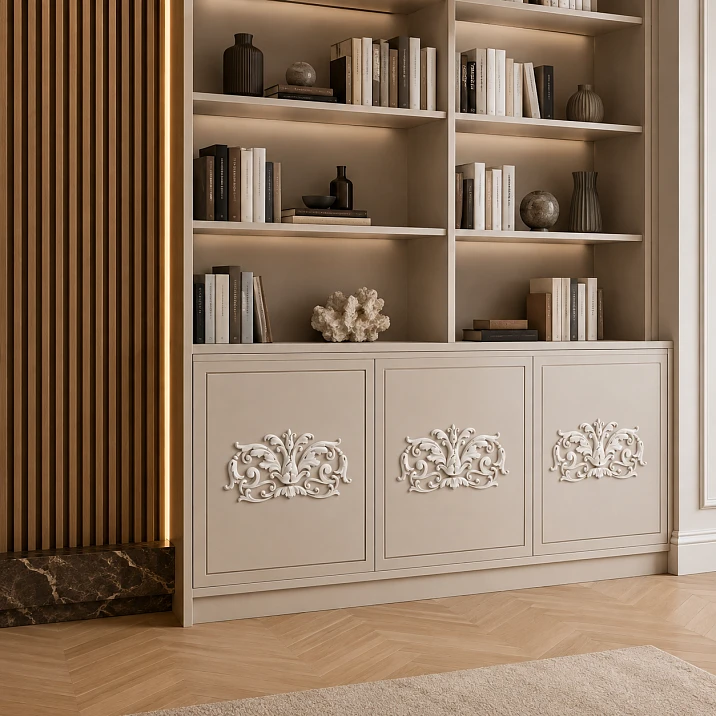
A built-in library next to a slat wall almost always creates the same question. You want to add a classic accent to the lower solid facades, but it is unclear how to buy decor: one overlay for each door, only on the central pair, or just limit yourself to one accent. For such situations, the carved decorative overlay NPU-040 made of polyurethane looks like a logical candidate: in the STAVROS card, it is directly shown as an element for furniture, cabinets, built-in systems, and wall compositions.
In this article, we deliberately fix only one product option — NPU-040 measuring 250 × 126 × 19 mm at a price of 2,320 ₽ per piece. We do not analyze the smaller version 170 × 86 × 13 mm here, because the task is different: not to choose between two sizes, but to understand how many large NPU-040 overlays to buy for the lower row of a built-in library, if there is already an active slat wall nearby.
The short answer is this: the number of NPU-040 is calculated not by the principle of “how many doors — that many overlays,” but by the number of facades on which, after measurement, a normal free field remains, and by the degree of ornamental saturation that the library can withstand next to the slats. On one library, one overlay is justified, on another — two, on a third — four, and on a fourth, the right decision would be to refuse NPU-040 altogether.
If after checking you see that the large decor really fits and does not overload the furniture, you can buy the carved decorative overlay NPU-040 made of polyurethane already in the quantity that matches your composition, rather than taken by inertia.
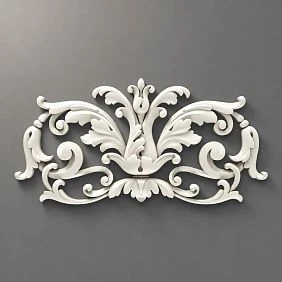
What exactly are we buying: NPU-040 is a carved decorative overlay, not a molding and not just "furniture decor"
The term matters here. NPU-040 is a carved decorative overlay made of polyurethane. It is not a molding, does not replace the frame trim of a facade, and does not solve structural tasks of furniture. Its purpose is to provide a local relief accent on the plane of a facade, wall panel, cabinet door, or built-in library.
The STAVROS card for NPU-040 confirms two sizes:
-
170 × 86 × 13 mm;
-
250 × 126 × 19 mm.
For this article, only the second option matters — 250 × 126 × 19 mm. The price of this version at the time of setting the task is 2,320 ₽/pc. It is based on this size and this cost that we build practical scenarios.
Let's briefly record the initial data in a table:
| Parameter | NPU-040 for this article |
|---|---|
| Product type | Carved decorative overlay |
| Material | Polyurethane |
| Size | 250 × 126 × 19 mm |
| Price | 2,320 ₽/pc. |
| Application object | lower fronts of the built-in library |
| The main question | how many overlays to put on the lower row next to the slatted wall |
This fixation is needed so that the article does not spread into a general theory about furniture molding. We are solving a very specific customer task: how many NPU-040 units to buy for the lower fronts of the built-in library.




Why the question of quantity is truly commercial here
At first glance, the difference between two and four overlays seems purely decorative. But in money, it is already noticeable.
If NPU-040 250 × 126 × 19 mm costs 2,320 ₽ per piece, then the basic cart options are as follows:
| Quantity of NPU-040 | Cost |
| 1 pc. | 2 320 ₽ |
| 2 pcs. | 4 640 ₽ |
| 3 pcs. | 6 960 ₽ |
| 4 pcs. | 9 280 ₽ |
| 6 pcs. | 13 920 ₽ |
That is why the article should lead not to an abstract phrase "the overlay fits furniture," but to a very specific next step:
-
buy 1 overlay if the library needs one compositional center;
-
buy 2 overlays if the accent on two central facades works better;
-
buy 4 overlays if each lower facade should become an independent repetition;
-
do not buy any if a large relief next to the slatted wall turns out to be superfluous.
A built-in library is an expensive and visually significant interior element. A mistake here shows immediately: too frequent decor cheapens the look, while an underestimated rhythm of the slatted wall starts to argue with the furniture. Therefore, the question of the quantity of NPU-040 is not a minor detail, but part of forming the correct cart.
Our factory also produces:
The main principle: you need to count not "by the number of doors," but by the number of justified decorative zones
This is the main thesis of the entire article.
Buyers often proceed from simple logic: if the library has four lower facades, then four overlays are needed. But this scheme works only when several conditions coincide at once:
-
each facade is truly independent and compositionally equal;
-
the width of each facade allows for a normal margin around the overlay;
-
handles, profiles, or joints do not interfere with centering;
-
the adjacent slat wall does not make the ornament repetition too frequent;
-
the bottom row of the library is in principle designed for the rhythm of "one door — one decor."
If at least one of these conditions is not met, the number of overlays is reconsidered. And here a more precise rule appears: the number of NPU-040 equals the number of those decorative zones where the overlay simultaneously fits, looks appropriate, and does not create visual overload next to the slats.
This approach avoids the typical mistake of buying a set of overlays for all doors at once and then trying to convince yourself that the frequent repetition still "looks fine."
Get Consultation
Why a slat wall changes the decision more than it seems at first glance
If the built-in library stood against a smooth, solid-colored wall, you could afford more decorative overlays. The slat wall changes the context. It already contains:
-
a pronounced vertical rhythm;
-
shadow gaps;
-
own texture;
-
splitting the plane into repeating modules;
-
noticeable visual activity even without additional decor.
That is why next to slats, the rule is not "the more ornament, the richer the furniture," but the rule of rhythm balance. The bookcase already has verticals of the posts, division into top and bottom, its own facades, and often handles. If on top of this a large NPU-040 appears on each lower facade, the number of accent points quickly grows.
Hence an important conclusion: a slatted wall reduces the allowable saturation of ornament on adjacent furniture. This is not a ban on NPU-040, but an adjustment of quantity. Often it is next to slats that two overlays turn out to be stronger and more expensive in perception than four.
What the article should solve in practice
After reading, a person should be able to answer four questions:
-
On which lower facades does a large NPU-040 physically fit with a normal field around it?
-
What rhythm of repetitions can a specific bookcase withstand next to a slatted wall?
-
Is it necessary to repeat the decor on each facade, or is it better to limit it to the central group?
-
Exactly how many NPU-040 units to add to the cart — 1, 2, 4, 6, or 0?
If the article doesn't lead to such an answer, it remains just a product review. That's not enough for a commercial page.
Where to start: first, you need to understand the structure of the bottom row of the library
Before trying on the overlays, the library needs to be disassembled not by taste, but by construction. Bottom facades vary greatly, and this is exactly what determines the amount of decor.
Option 1. Identical independent doors
This is the most straightforward case. For example, you have four identical blank facades 450–550 mm wide, of the same height, with the same handles. Such a system is best suited for a scenario where the overlay is repeated in a series. But even here, repetition is not mandatory on all four facades: the decision depends on the free field and the intensity of adjacent slats.
Option 2. Two central doors and two outer utilitarian sections
Often, in a built-in library, the central part is compositionally stronger, while the side modules adjoin a wall, radiator, niche, or are more loaded with hardware. In such cases, it makes sense to consider exactly two overlays on the central facades, rather than a full repeat on all doors.
Option 3. Wide facades with internal drawers or asymmetry
Here, the number of overlays can no longer be calculated simply by the number of external doors. If the facades are asymmetric, handles are offset, or the bottom of the library is divided into zones with different functions, a uniform repeat of NPU-040 may look mechanical.
Option 4. One large central block of lower facades
Sometimes the library visually has a common lower volume, and the doors work as a single mass. Then a scenario with one central overlay or a pair of overlays only in the center of the composition is possible. But such a solution depends on the width of the facades and the overall furniture architecture.
The meaning of this stage is simple: before discussing the number of NPU-040, you need to understand whether the lower facades of the library are a series of identical objects or only look that way at first glance.
Why the size 250 × 126 × 19 mm cannot be assessed "by eye"
The large NPU-040 seems compact until you apply it to a real facade. In a photo, the difference between the 170-millimeter and 250-millimeter versions is not always noticeable. On furniture, it is already critical.
Therefore, the size 250 × 126 × 19 mm should be perceived as three separate parameters:
-
the long side of 250 mm — it determines the horizontal scale of the element in the chosen orientation;
-
the short side of 126 mm — it affects the height of the occupied field;
-
the thickness of 19 mm — it sets the relief protrusion and affects interaction with handles and adjacent protruding parts.
Important: if the orientation of the product on your facade is interpreted differently, the conclusions need to be checked on a template. But in a typical scenario for lower library facades, it is precisely an overlay that is perceived as an element with a long horizontal side.
This leads to a critically important rule: NPU-040 should not be purchased for lower facades just because 250 mm "seems a bit small." On a narrow door, such a size can take up almost the entire central field, while on a wide one, it may instead become a point accent.
A paper template of 250 × 126 mm is a mandatory step before purchasing
Until a paper template has been placed on the facade, any discussion about the number of overlays remains speculative. What is needed is not a small sketch, but a real rectangle of 250 × 126 mm that can be applied to each door in the lower row.
The template solves several tasks at once:
-
shows whether there is physically space for the overlay;
-
allows you to assess the distance to handles and edges;
-
helps you see how appropriate the repetition is across all facades;
-
gives you the opportunity to compare one, two, and four accents in real life;
-
allows you to evaluate the scale against the slatted wall.
It is better to make two templates:
-
one flat paper one — for overall geometry;
-
the second on cardboard or with a backing — to at least roughly feel the 19 mm protrusion.
Such a mockup is also useful because the lower library facades are often viewed in motion — sitting, standing, from the aisle, at an angle. The template helps to understand whether the decor is seen as a standalone accent or turns into too frequent a repeating detail.
How to check the free space around NPU-040
Free space is not just the remainder between the facade edges and the template. For furniture next to a slat wall, it is the comfortable space that matters, where the overlay looks built-in rather than squeezed in.
Check in four directions:
Left and right
The overlay should not "hang" too close to the joint of adjacent facades or to the outer library post. If there is almost no side space, the decor starts to look like a randomly glued ornament.
Top and bottom
The lower row of the library often has a plinth, a crossbar, a milled profile, or a framed part of the facade. The NPU-040 should not stick to either the top line of the facade or the bottom plinth.
To the handle or push mechanism
If there are handles on the facades, a clear compositional gap must remain between them and the overlay. If the system is handleless, it is necessary to assess whether the overlay will fall into the convenient opening zone.
To the adjacent decor and slatted wall
A library next to an active wall is already in a saturated context. Therefore, the free field needs to be checked not only on the facade, but also in the interior around it.
In practice, this means a simple thing: if only a geometric rectangle is found on the facade, it does not mean that a good place for NPU-040 has been found.
Quick reference table: when a large NPU-040 usually looks confident, and when it is borderline
Below is not a universal standard, but a practical table for initial assessment. It helps to quickly understand in which zone the solution is more often comfortable, and in which it already requires caution.
| Width of one facade | How NPU-040 250 mm is usually perceived |
| up to 320 mm | almost always cramped for a large version |
| 350–400 mm | borderline, need an exact template and handle check |
| 420–500 mm | often a work area for one overlay on a facade |
| 520–650 mm | comfortable for one overlay with a calm composition |
| from 700 mm | the overlay can become a point accent, not the only center of the facade |
But width alone is not enough. The facade height, handle type, frame, profile, and adjacent slats can change the conclusion. So the table is not a solution, but only a guideline.
When the scheme “one overlay per facade” works
This option seems the most natural, and sometimes it is indeed the best.
It works when:
-
all lower facades are the same width and height;
-
each facade reads as a separate independent door;
-
each facade has a calm central field for a 250 × 126 mm template;
-
handles do not interfere with centering;
-
the library itself is quite strict, and the repetition of decor is needed precisely as an ordered rhythm;
-
the slat wall is on the side, rather than capturing the entire composition as the main visual accent.
In this scenario, repeating NPU-040 on each facade works as a systemic solution. It creates a neat series and brings the bottom row into a single field. But here too, it is important to look at the overall saturation: if the library is large and the slats are active, four large overlays may already seem excessive.
That is why the scheme "one overlay per door" is not automatic, but only works if the seriality of the furniture is indeed stronger than the rhythm of the wall.
When only two overlays on the central facades will work better
For a built-in library next to slats, this is one of the strongest scenarios.
Why? Because it solves two tasks at once:
-
gives furniture a decorative accent;
-
does not turn the bottom row into a frequent ornamental grid.
Two overlays on the central facades are especially appropriate if:
-
the library is symmetrical;
-
the central part of the composition is visually more important than the side ones;
-
the slatted wall already creates a high level of rhythm;
-
the outer facades are close to a wall, opening, lamp, or another active element;
-
you want the decor to work as a local accent rather than a continuous pattern.
This is also noticeable in money: 2 × 2,320 ₽ = 4,640 ₽, which is half the cost of a set for four identical doors. But the savings here are secondary. The main thing is composition. Often, it is two NPU-040s that make a library look more cohesive and expensive to the eye than four.
When a single central overlay is justified
This option is less common, but it is not exotic. One NPU-040 can work if the lower row of the library is perceived not as a set of independent doors, but as a single compositional base.
The scenario with a single overlay is appropriate when:
-
the central part of the lower tier forms a common field;
-
one overlay can become the compositional center of the entire built-in system;
-
the library itself is already rich in architecture, and repeating the decor is unnecessary;
-
the slatted wall is very active, and you want to minimize additional ornamentation;
-
the handles and joints of the facades do not disrupt the idea of the central accent.
But this solution also carries a risk. If the facades read as separate doors, a single NPU-040 may look not like a center, but like a random exception. Therefore, one element is justified not "because you want to save money," but only if the library truly allows such a hierarchy.
When the right answer is not to install the NPU-040 at all
This is a mandatory section for an honest commercial article.
It's better to skip the overlay if:
-
the lower facades are too narrow, and the field for 250 × 126 mm remains tight;
-
next to a slatted wall, the furniture already looks active enough;
-
the facades are overloaded with handles, profiles, glass sections, or routing;
-
the library is modern and minimalist, and a single classic carved element on it looks out of place;
-
the lower row is used intensively, and the 19 mm protrusion interferes with convenient opening or cleaning;
-
repeating the decor on each facade makes the composition too fragmented;
-
one or two overlays look random and do not tie the composition together.
In this case, the best result is 0 pieces. This is not a selection failure, but a well-considered decision. The ability to decline a product for a specific scenario is part of professional choice.
If after such a conclusion you still want to look at other options, you can Buy decorative polyurethane overlays in the category and look for a different character or scale of decor there.
Main quantity schemes: 2, 3, 4, and 6 facades
To make the article truly helpful for assembling an order, let's examine typical configurations of the lower row of the built-in library. These are not repetitive arithmetic exercises, but different compositional cases.
Lower row with two facades
With two doors, the choice is usually between two options:
-
2 overlays — one for each door;
-
0 overlays — if the library next to the slats already looks sufficiently rich.
One overlay rarely works here, because with two equal facades, a single decor easily disrupts symmetry. But if the central part of the library is arranged non-standardly and one facade is compositionally dominant, such a variant is theoretically possible.
Bottom row of three facades
Here an interesting choice appears:
-
3 overlays — for a systematic rhythm on each facade;
-
1 overlay — as a central accent on the middle door;
-
0 overlays — if the furniture and wall are already active.
For three facades, one central accent often looks more convincing than trying to hang NPU-040 on all three.
Bottom row of four facades
This is exactly the scenario that most often raises a question from the buyer. For four facades, three schemes usually compete:
-
4 overlays — one on each door;
-
2 overlays — only on the central pair;
-
0 overlays — if the repetition next to a slat wall becomes too frequent.
One overlay on four fronts is rare and requires a very specific composition. For most libraries, the main dilemma is precisely between 2 and 4.
Bottom row of six fronts
Here, automatic full repetition is especially dangerous. Six large carved elements next to an active slat wall easily turn furniture into a too-frequent ornamental grid. Therefore, for six fronts, the following schemes often work better:
-
2 overlays — on the central fronts;
-
4 overlays — on the two central pairs, if the library is very wide;
-
0 overlays — if the very size of the composition already requires restraint.
A full set of six NPU-040 is possible, but this is already a fairly saturated solution that needs to be very carefully checked on site.
How the actual width of the fronts affects the number of overlays
The number of NPU-040 cannot be separated from the width of the doors. The same set of “four fronts” can yield two opposite conclusions.
Scenario A. Four facades of 380 mm
On such doors, a large NPU-040 will work almost at its limit. If there are also handles or a frame, each overlay will take up too significant a part of the field. Against the background of slats, four repeating elements can create a feeling of crampedness.
Conclusion: it is often better to limit yourself to the central pair or abandon this model.
Scenario B. Four facades of 520 mm
Here, one overlay per door is perceived more calmly. Each leaf retains a noticeable field. But the result still depends on the slatted wall: if the bookcase is placed close to a very active lamella composition, four accents may turn out to be slightly excessive.
Conclusion: both 4 and 2 overlays are possible; the overall saturation decides.
Scenario C. Four facades of 700 mm
On such wide facades, NPU-040 already looks like a fairly restrained element. Full repetition on all doors is more often safer. But even here, one should not forget that the furniture itself may require a more complex composition: one overlay on a wide facade does not always gather the field convincingly enough.
Conclusion: 4 overlays are acceptable, but you need to check whether each of them becomes too small a point for such a scale.
The meaning of these scenarios is one: the number of NPU-040 is determined not by the number of facades itself, but by the ratio of the overlay size to the scale of each door.
What to do with handles if they are already installed
Handles are one of the main factors that break the perfect repeat pattern. Especially if they are not centered or have their own active silhouette.
Three things need to be checked:
-
Geometric conflict. The overlay should not press against the handle or hang in close proximity to it.
-
Compositional conflict. Even if there is enough space, the handle and NPU-040 together can create too fragmented a pattern.
-
Operational conflict. The 19 mm relief should not interfere with a comfortable grip.
If handles are already installed and do not allow placing the overlay calmly on each facade, this is a strong argument for reducing the amount of decor. Often it is the handles that suggest that on four facades, not a full repeat but two central overlays will work better.
Do you need to consider the height of the lower facades
Yes. The mistake of many articles about furniture molding is that they discuss only the width in detail. For NPU-040, height is no less important.
If the facade is low, a 126 mm overlay on the short side can take up too significant a part of the vertical field. Then even a wide door does not save the situation: the element starts to look pressed against the top or bottom line.
Therefore, when trying on, you need to assess not only side gaps, but also vertical fields:
-
whether air remains at the top;
-
whether the overlay sticks to the plinth from below;
-
whether it intersects with a structural lintel or frame.
In a library next to slats, this is especially important because the vertical rhythm of the wall already enhances the perception of height. An overlay squeezed vertically looks even heavier.
Thickness 19 mm: a small number that changes the conclusion
On furniture near the wall and in areas of constant use, thickness matters. 19 mm is no longer just a "pattern on a plane." It is a relief element that protrudes forward and participates in everyday use.
Thickness needs to be considered in three scenarios:
Opening facades
If doors open frequently, a palm, clothing, or objects in hands may catch on the protruding decor.
Passage near the library
In a narrow room, the lower row of furniture sometimes ends up in the walking path. Then the protruding relief can be more of a hindrance than the number suggests.
Cleaning and maintenance
The more overlays, the more relief areas that need to be wiped and navigated around. For a family library, this is not a trivial matter.
Therefore, when choosing the number of NPU-040, you should ask yourself not only "is it beautiful," but also how many protruding relief points in the lower row I actually need.
Why the "less but stronger" scheme often wins near a slat wall
This principle deserves a separate explanation. It determines many of the article's conclusions.
A slat wall already creates an expensive, active, and modern backdrop. If on top of that the library gets too many classic carved repeats, the elements start to compete instead of supporting each other.
In such a situation, the following scheme often works better:
-
fewer overlays;
-
more air around each;
-
stronger emphasis on the center of the composition;
-
fewer repetitions on the periphery.
That is why in practice, 2 overlays on four facades often look better than 4 overlays on the same facades. The furniture remains noble, the decor is readable, and the slats do not get an extra visual rival.
This is not a universal rule, but for libraries next to a slatted wall, it works surprisingly often.
How to frame the choice as a clear purchase decision
To make the article truly commercially useful, let's summarize the main options in a table.
| Situation | Usually a reasonable amount of NPU-040 | Why |
| 2 identical wide facades, calm furniture | 2 pcs. | each door can carry its own accent |
| 3 facades, central module is the main one | 1 or 3 pcs. | depends on whether a single center or full rhythm is needed |
| 4 facades next to an active slat wall | usually 2 pcs. | the central pair usually looks calmer than a full repeat |
| 4 wide facades near a calmer wall | 4 pcs. | systematic rhythm can be justified |
| 6 facades, the library is very wide | 2 or 4 pcs. | full repetition often overloads the bottom |
| facades are narrow or overloaded with hardware | 0 pcs. | The large NPU-040 does not receive a normal field |
Such a table does not replace a template, but helps quickly understand which range of solutions you are heading towards.
Step-by-step algorithm: how to determine the number of NPU-040 before ordering
This section is the practical core of the article.
Step 1. Record the configuration of the bottom row
Count the number of facades and determine which ones are truly equal to each other and which differ in role.
Step 2. Measure the width and height of each facade
Do not average "by eye." If the outer doors are narrower than the central ones, this immediately affects the number of possible overlays.
Step 3. Mark handles, profiles, and structural lines
Check that they are not taking up space under the NPU-040.
Step 4. Make a template 250 × 126 mm
Apply it to each facade of the lower row and assess where it actually fits.
Step 5. Look at the library together with the slat wall
Assess how active the interior becomes if the overlays are repeated on all doors.
Step 6. Compare at least three schemes
For four facades, this is usually: 4 overlays / 2 overlays / 0 overlays. For three — 3 / 1 / 0.
Step 7. Check operation
Think about whether the 19 mm thickness interferes with opening, passage, and cleaning.
Step 8. Only after this, calculate the basket
If the best scheme is two overlays, don't buy four "just in case." If the best is zero, don't buy one just because you like the product.
How many NPU-040 to buy for four facades: three most common conclusions
Since the four-door lower section of the library is common, let's note the three most likely outcomes.
Conclusion 1. Buy 4 overlays
Suitable if:
-
the facades are wide enough;
-
the handles don't interfere;
-
the library itself is quite calm;
-
the slat wall doesn't dominate the whole composition;
-
full repetition really ties the bottom row together.
Cost: 9,280 ₽.
Conclusion 2. Buy 2 overlays
Suitable if:
-
the central part of the library is more important than the sides;
-
active rails nearby;
-
four repeats make the facades too fragmented;
-
we want an accent, not a full ornamental grid.
Cost: 4,640 ₽.
Conclusion 3. Do not buy NPU-040 for the lower facades
Suitable if:
-
the large version is cramped in size;
-
the decor conflicts with handles or frames;
-
the library is already saturated;
-
Next to a slatted wall, stucco molding looks superfluous.
Price: 0 ₽.
These three scenarios are more useful than a dozen conditional examples with a similar conclusion.
When the same library can give different answers depending on the wall
This is an important nuance. Sometimes a buyer thinks that the number of overlays depends only on the furniture. In reality, two identical cabinets may require different amounts of decor due to the surroundings.
Library by a smooth wall
Furniture carries more visual weight, so a full repeat of NPU-040 across the facades often looks natural.
Library by a slatted wall
Part of the visual activity has already been taken on by the wall, so furniture decor has to be dosed.
Library in a narrow niche between slats and an opening
Here even two overlays can be stronger than needed, because the zone itself is small and saturated.
Hence another practical conclusion: the number of NPU-040 cannot be discussed in isolation from the library's place in the interior. And for this article, the slat wall is not a background for SEO, but a real selection variable.
What mistakes are most often made when purchasing NPU-040 for library facades
Mistake 1. Buying by the number of doors
Why it happens: it seems logical to associate one facade with one overlay.
What it leads to: decor multiplies automatically, even if the furniture is already active.
How to avoid: count decorative zones, not panels.
Mistake 2. Not trying the 250 × 126 mm template
Why it happens: in photos, the product seems small.
What it leads to: on a real facade, the overlay turns out to be cramped.
How to avoid: use a full-size paper mockup.
Mistake 3. Ignoring the slat wall
Why it happens: furniture is considered separately.
What it leads to: the rhythm of the slats and the rhythm of the overlays start to conflict.
How to avoid: check the library together with the wall from a normal viewing point.
Mistake 4. Counting only the width of the facade
Why it happens: this is the most obvious dimension.
What it leads to: the overlay may fit in width but be cramped in height.
How to avoid: evaluate both directions and the position of the handles.
Mistake 5. Forgetting about the 19 mm thickness
Why it happens: the number looks modest.
What it leads to: protruding decor interferes with use or cleaning.
How to avoid: check not only the flat template, but also the relief depth.
Mistake 6. Buying "with a reserve"
Why it happens: you want to avoid mistakes and take more.
What it leads to: extra overlays remain without logical use.
How to avoid: first approve the scheme 1, 2, 4, or 6, then place the order.
How asymmetry in the bottom row changes the number of overlays
So far, we have mostly considered fairly clean symmetrical schemes: two, three, four, or six identical facades. In practice, built-in libraries are often more complex. One edge module may be narrower due to a partition, another wider due to a technical niche, and the middle part may be the main storage area. In such furniture, you cannot mechanically transfer a solution from a symmetrical composition.
If the bottom row is asymmetrical, it is useful to ask yourself three questions:
-
Which facades are truly the main ones visually?
-
Where will the decor be perceived as part of the overall composition, and where as a random repetition?
-
Aren't you trying to forcibly equalize facades of different roles with identical overlays?
For example, a library may have two wide central facades and two narrow side ones. Formally, there are four doors. But compositionally, it's not "four identical zones," but two main and two auxiliary ones. In this case, two NPU-040 on the central facades will look logical, while a full repetition on all four doors becomes debatable.
Conversely, if the asymmetry is slight but all facades still read as a single series, repetition can be maintained. The key is not to replace analysis with habit. Asymmetric furniture requires decisions based on the roles of facades, not their quantity.
Can decorative and neutral facades be mixed in one bottom row?
Yes, and for a library next to slats, this is often the best scenario. Buyers sometimes fear that if some facades have decor and others don't, the furniture will look "unfinished." In reality, it all depends on the logic of distribution.
The mixed scenario works well if it has a clear system. For example:
-
only the two central doors are decorated;
-
the outer facades remain smooth;
-
only the facades under the central display part of the library are decorated;
-
the side technical sections remain neutral.
This approach is especially useful when the library stands next to a slat wall and is already in an active environment. The mixed scheme allows preserving the merits of NPU-040 as an accent without turning the bottom row into a continuous ornamental strip.
It becomes a bad solution when the choice looks random: for example, one overlay ended up on the first facade, and the remaining doors are empty without any compositional reason. But if the user understands why the decor is applied only to the center or only to the main zone, the scheme looks not simplified but professionally dosed.
If at the bottom there are not doors but drawers: should NPU-040 be counted the same way
Not always. The bottom row of the library is sometimes arranged as a block of pull-out drawers rather than regular doors. From a decor perspective, this changes the situation.
Drawers have two differences:
-
handles are more often actively involved on their facades;
-
the horizontal rhythm becomes more fragmented already due to the divisions themselves.
Because of this, a full repetition of NPU-040 on each drawer is used more cautiously. Even if the overlay fits geometrically, too many horizontal facades make the bottom of the furniture multi-layered: the drawer gaps are read separately, the slat wall separately, and the overlays separately. As a result, the ornament ceases to be an accent and turns
How to make a decision if doubt remains between two options
Sometimes, after all measurements, the user still hesitates between two schemes. For example, between 2 and 4 overlays on four facades. In such a situation, it is useful not to overthink endlessly, but to conduct a short comparative test.
Take three photos:
-
with templates on all facades;
-
only with templates on the central pair;
-
without templates.
Then look at them not up close, but from the usual viewpoint of the room. Even better — show the images to a second person without explaining in advance which option you consider correct. If the person immediately says that the full series looks too frequent, and the central pair looks assembled, this is a strong signal in favor of two overlays.
This technique is important because the conclusion is born not from choice fatigue, but from comparing options at the same distance. In a real interior, a library is rarely viewed with the nose to the facade. It is perceived from the passage, from the sofa, from the table area. And it is from this distance that the decision about the number of NPU-040 should be made.
How to document measurements to avoid mistakes when ordering
When choosing between different numbers of overlays, it is useful not to rely on memory. The minimum set of fixation before ordering is as follows:
-
photo of the entire library with the slat wall;
-
photo of the bottom row without templates;
-
photo with templates on all facades;
-
photo with templates only on the central group;
-
recording of the width and height of each facade;
-
marking which facades have handles and which do not;
-
final decision: 1 / 2 / 4 / 6 / 0.
This may seem like a small detail, but it is precisely because of the lack of such fixation that buyers often return to doubts and order more than needed. When the decision is fixed, placing an order becomes easier and calmer.
What to buy together with NPU-040 if the decision has already been made
If the check showed that the large NPU-040 is indeed suitable, it is useful to immediately think through adjacent product routes. First, you may need not only the overlay itself, but also other interior design elements. Second, the article should logically connect the product choice with the overall catalog structure.
If you have already approved the idea of carved accents, it makes sense to additionally look at:
-
Buy decorative polyurethane overlays — if after the first fitting an alternative character of decor is needed;
-
You can buy ready-made stucco matching the Baroque style. Calculate the quantity: linear meters of cornices and moldings, number of rosettes, pilasters, consoles, corner elements. Add a ten to fifteen percent allowance for trimming. — if the project as a whole is built around polyurethane decor, not just a single library;
-
order polyurethane moldings and decor — if after fitting it becomes clear that facades suit not a single overlay, but a calmer frame solution;
-
buy slat panels for walls for interior finishing — if work with the library goes in parallel with selecting the slat wall itself.
Such a block is useful because it shifts the article from the format "choose only the number of overlays" to a full user journey: from a specific SKU to related project categories.
When a calmer accent system suits the library better than NPU-040
This section is needed not to reject the product, but to honestly separate scenarios. A large carved overlay works well when the library needs a local classic accent. But there are situations where furniture requires different logic.
For example, a calmer system turns out to be better if:
-
the library already has framed facades and an additional carved center seems redundant;
-
there is too active a slat wall, mirror, sconce, or other decorative object nearby;
-
the entire interior composition leans toward modern minimalism;
-
the lower facades are small, and the ornament should be introduced not as a point, but as a thin line.
In such cases, the question "how many NPU-040 to buy" may end with the answer "none, because a different type of decor suits the library." This is also a quality result of the article. It protects against a purchase that would not enhance the project.
What to do if the large NPU-040 seems too active
Even if the idea of furniture decor itself is appealing, the conclusion may be that the 250 × 126 × 19 mm version is excessive for this library. In that case, there are three reasonable directions.
Option 1. Leave the library without overlays
This is especially appropriate if the slat wall already serves as an accent.
Option 2. Look for other decor in the overlay category
If the idea of the molded element itself is important, but the scale of NPU-040 is not suitable, it makes sense to return to the section and You can buy ready-made stucco matching the Baroque style. Calculate the quantity: linear meters of cornices and moldings, number of rosettes, pilasters, consoles, corner elements. Add a ten to fifteen percent allowance for trimming. already after a new selection by size and character of the relief.
Option 3. Work not with facades, but with a wall or framing
Sometimes a decorative accent is better transferred not to furniture, but to an adjacent plane. For example, you can order polyurethane wall decor and distribute the ornament in the interior differently, without overloading the lower doors of the library.
This is an important part of the article: it should not forcibly lead the user to only one card.
Is it necessary to link the number of overlays to the number of upper sections of the library
Usually not. The main mistake is trying to mechanically repeat the architecture of the entire library on the lower row. If the top consists of many shelves, glass doors, or books, this does not mean that the lower facades should also get frequent decor.
The lower row is a separate compositional layer. It can:
-
maintain strict repetition;
-
work as a calm base under an active top;
-
have only a central accent;
-
remain neutral.
That is why the number of NPU-040 is determined by the logic of the lower blind facades, not by the number of shelves or sections of the library as a whole.
How the color of facades affects the number of overlays
Color does not change geometry, but it changes the perception of saturation.
Dark facades
On them, the relief usually reads nobly, but noticeably. If the adjacent slat wall is also dark and textured, full repetition of overlays may seem too dense.
Light facades
The relief looks softer, sometimes even more delicate. This allows using more overlays without a feeling of heaviness, but only if the library itself is not overloaded with architecture.
Contrasting coloring of overlays
This technique sharply increases the activity of the decor. If NPU-040 will stand out in color, the number of overlays should almost always be reduced.
That is, color affects not the possibility of installation, but the saturation threshold. The more active the relief presentation, the more careful one should be about fully repeating it on each facade.
How built-in libraries with different depths affect the perception of NPU-040
Furniture depth is rarely discussed in such articles, although it is important in the interior. A low library with a shallow bottom row perceives the relief differently than a massive built-in wardrobe-library.
On a deeper system, the lower facades look more substantial. There, NPU-040 can be more appropriate and even necessary. On a light, visually thin library, a protruding carved element sometimes seems excessive.
Therefore, if the library was designed as a strict modern plane, repeating large overlays on each facade should be evaluated more carefully.
When it is useful to link the article with slatted panels through interlinking
Since the library stands exactly next to the slatted wall, the article should provide not only product-related but also adjacent commercial transitions. This is useful both for the user and for the site structure.
If a person is still at the stage of choosing wall finishes or plans to continue the project, it is appropriate to suggest buy slat panels for walls for interior finishing as an independent next step. This does not deviate from the NPU-040 topic, but preserves the interior context.
Separately, a path for a more subdued classic framing can be provided — order polyurethane moldings and decor, if after the check it turns out that the library is better suited not to an overlay on each facade, but to a more restrained system of accents.
A good commercial article routes the user through several logical paths, rather than closing the choice within a single card.
Practical example of selection for a library with four lower facades
Let's take a situation close to reality. The built-in library has four lower facades of equal height. The wall on the right is finished with slats. The facades are relatively calm, but handles are already installed. After trying the template, it turns out:
-
NPU-040 fits geometrically on each door;
-
on the outer facades, the field is more tense due to proximity to the uprights;
-
on the central facades, the overlay looks freer;
-
Four repeating elements next to the rails create too frequent a pattern.
In this case, the buyer has two formally functional carts:
-
4 pcs. = 9,280 ₽;
-
2 pcs. = 4,640 ₽.
But the best compositional conclusion is 2 pieces for the central pair. Why? Because this option gives the library a decorative center without spreading the ornament across the entire bottom. It simultaneously reduces the purchase cost and improves the visual result.
Here it is important to see the logic: the decision that '2 is better than 4' comes not from saving money, but from analyzing the rhythm of the wall and facades.
What to consider a truly successful selection outcome
A successful selection is not one where you managed to use as much decor as possible. A successful selection is one where:
-
the number of overlays is logically connected to the architecture of the bottom row;
-
each overlay has a calm field around it;
-
the decor does not conflict with the handles and joints;
-
the rhythm of the library does not conflict with the slat wall;
-
the cost of the purchase matches the real need;
-
the user can immediately understand how many pieces to order.
If after trying on and comparing the layouts you see that the library looks better with two overlays, then exactly 2 pieces are the correct result, even if physically four could be placed.
Decision tree: how to quickly arrive at the correct quantity
| Question | Yes | No |
| Is there a calm field on the facade measuring 250 × 126 mm? | go to the next question | do not install NPU-040 on this facade |
| Is there a handle/frame nearby that does not interfere with the composition? | go to the next question | reduce the quantity or decline |
| Does the slat wall support a full repeat on all facades? | a full set can be considered | switch to a selected group |
| Are the central facades compositionally stronger than the outer ones? | choose 2 overlays more often | a uniform repeat can be considered |
| After fitting, does the decor improve the library rather than complicate it? | purchase the approved quantity | decline NPU-040 |
This tree is convenient because it doesn't allow jumping straight to purchase. First, the field is checked, then the rhythm, then the quantity.
What to ultimately buy most often: typical configuration recommendations
If we summarize the practice, we get these guidelines:
-
2 facades — most often 2 overlays or 0;
-
3 facades — often 1 or 3;
-
4 facades next to a slatted wall — very often 2;
-
4 facades near a calmer wall — 4 are possible;
-
6 facades — more often 2 or 4, not 6.
These are not strict rules, but working probabilities. They help avoid starting the selection with the maximum.
Why this article doesn't duplicate the product card
The NPU-040 card explains what this product is, shows dimensions, material, and application area. But it does not answer the question:
how many large pads 250 × 126 × 19 mm to place specifically on the lower facades of the built-in library next to the slat wall.
This article solves a specific problem:
-
links the pad size to the number of facades;
-
takes into account the rhythm of the slat wall;
-
provides scenarios 1 / 2 / 4 / 6 / 0;
-
translates the choice into cost;
-
explains when it is better to refuse the product.
That is, its value is not in retelling characteristics, but in a ready-made decision on quantity and purchase.
Bottom line: the quantity of NPU-040 is determined not by the number of doors, but by the scale of the facades and the strength of the adjacent slat wall
The carved decorative overlay NPU-040 measuring 250 × 126 × 19 mm is indeed suitable for furniture facades, built-in wardrobes, and bookcases. However, in a situation where a built-in bookcase stands next to a slat wall, the decision on quantity cannot be made automatically.
The correct sequence is as follows. First, you need to measure the lower facades, check the handles and structural lines, apply the 250 × 126 mm template, and assess which doors retain a normal free field. Then it is important to see how many ornamental repeats the bookcase can handle next to an active slat wall. Only after that does it make sense to choose between one, two, four, or more overlays.
For many bookcases next to slats, the best result comes not from a full repeat, but from two overlays on the central facades. For others, a series on each facade is justified. And in some cases, the right answer is not to buy NPU-040 at all.
The main practical conclusion is simple: you should buy not as many overlays as there are doors, but as many as truly improve the composition of the lower row and do not overload the furniture next to the slat wall.
FAQ
Can you immediately buy NPU-040 one piece for each lower facade?
Only after checking. If the facades are wide, identical, and there is no overly active slat rhythm nearby, such a repeat can be successful. But automatically counting "one door = one overlay" is not worth it.
For four lower facades, what is often better: 2 or 4 overlays?
Next to a slat wall, 2 overlays on the central facades very often win. A full set of 4 pieces is possible, but it often looks heavier.
When is one NPU-040 truly appropriate?
When the lower row of the bookcase is perceived as a single compositional base, and one overlay can become a central accent without feeling random.
Is it mandatory to check the 250 × 126 mm template?
Yes. Without a full-size template, it's easy to make mistakes in scale, distance to handles, and perception against the slat wall.
If the facades are narrow, would simply reducing the number of overlays help?
Not always. If the large NPU-040 itself is cramped on each facade, reducing the quantity doesn't solve the scale issue. In that case, it's better to abandon this model for that row.
Can I rely only on the facade width?
No. You need to consider the facade height, handles, the 19 mm thickness, and the overall rhythm of the library next to the wall.
What to do if NPU-040 is appealing but looks heavy on the facades?
Either abandon the decor on the furniture, or move to the category Buy decorative polyurethane overlays and look for a different character or size after a new fitting.
Are additional links to related sections needed in such an article?
Yes. For the user, transitions are logical not only to the NPU-040 card, but also to the general catalog of moldings, wall decor, slat panels, and the molding section.