








































































Article Contents:
- First, separate the decorative plane from the engineering one: where NPU-042 is generally acceptable
- Why you cannot cover the grille even partially
- Why an inspection hatch cannot be considered a regular panel
- What you get on ducts 180–300 mm wide
- 180 mm duct: physically fits, but a mockup is needed
- 200 mm duct: 30 mm of free margin on each side
- 220–250 mm duct: a full free margin appears
- Box 280–300 mm: you can choose between an overlay and a frame
- One NPU-042 as a central accent
- Two overlays vertically
- Three overlays
- Four overlays — that's already a different design system
- When the frame is still better
- When NPU-042 is more logical than a frame
- Why you should look not only from the front
- A photo with a template is more useful than memory
- Connection with furniture
- Connection with the door
- Is the removal method preserved
- Is the mounting hardware not blocked
- Does the relief not touch the adjacent surface
- Can the box be serviced without destroying the finish
- Painting to match the box
- Contrast painting
- Complex multi-color finishing
- Moldings "just in case" are not needed
- Several NPU-042 units are also not a mandatory set
- Box 180 × 2600 mm, grille high
- Box 220 × 2600 mm with a fully blind front
- Box 250 mm next to a kitchen tall cabinet
- Box 300 mm between smooth walls
- The hatch is located at the bottom
- Removable top panel
- The ventilation grille is positioned strictly in the center
- 1. Clear width of the blind front surface
- 2. Height of the continuous blind area
- 3. Distance to technical boundaries
- 4. Removal of adjacent objects
- 5. Distance from which a person sees the box
- Kitchen-living room
- Entry Hall
- Hallway
- Technical area or bathroom
- Bedroom or study
- Commercial interior
- "140 mm is less than the width of the box, so it fits"
- Overlay on top of the ventilation grille
- The seam of the inspection hatch is blocked
- Center of the entire wall instead of the center of the free zone
- Two or three parts were purchased at once
- The 14 mm relief is not taken into account
- Frame added to the 180–200 mm front without a mockup
- Sharp contrast chosen based on a small sample
- Identical boxes were recognized as identical without checking
- Installation started before the final installation of the grille
- Purchase made only because of the price of 2,010 ₽
- The box is being "hidden" with too much decor
- Can NPU-042 be installed directly on a ventilation grille?
- Does a 180 mm wide box fit?
- What will it look like on a 200 mm box?
- And on a 250 mm box?
- Which front is considered suitable?
- Can NPU-042 be installed on a revision door?
- Can it be installed on a fully removable panel?
- How many NPU-042 units are needed for one tall cabinet?
- How to calculate two overlays?
- How to calculate three?
- Is it mandatory to make a frame?
- When is molding better?
- Can NPU-042 be painted to match the wall color?
- What will a contrasting color provide?
- Should the 14 mm relief be taken into account?
- What to do if the box is exactly 140 mm wide?
- And if the box is 350–400 mm?
- Can several boxes be finished the same way?
- How much do two NPU-042 cost?
- And three?
- What is the stated production time?
- Can I buy just one piece?
- Is NPU-042 only suitable for a ventilation box?
- What is more important — perfect symmetry or access for inspection?
- Do I need to buy glue along with the cover?
- Can the NPU-042 be mounted after the painting is completed?
- Where can I see other decorative options for the wall?
- Where can I see all polyurethane moldings?
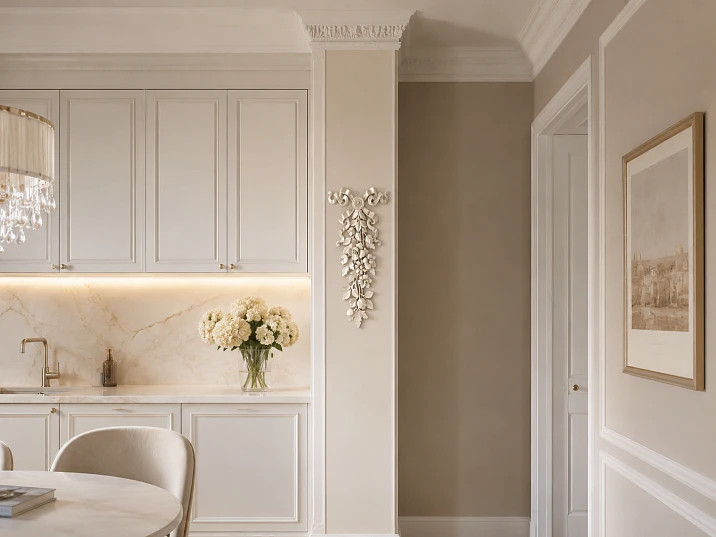
After renovation, the ventilation box often remains the most "technical" spot in an already assembled interior. The walls are painted, the baseboard is installed, doors and furniture are selected, but a narrow vertical protrusion 180–300 mm wide looks as if the finishing on it was simply not completed. Attempting to frame such an edge with a full molding frame quickly runs into geometry: the frame needs two side lines, top and bottom, an inner field, and space for neat corner joints. On a narrow front panel, all of this can be cramped.
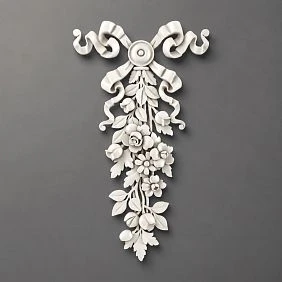
For the blind decorative part of the box, there is a calmer option — a single carved decorative overlay NPU-042 made of polyurethane, sized 140 × 243 × 14 mm, installed along the central axis. It does not turn the box into a complex stucco structure and does not require surrounding every edge with profiles. At the same time, the technical protrusion gains a deliberate decorative center and begins to be perceived as part of the wall.
But there is a condition more important than any beauty. NPU-042 can only be considered for a blind surface that is not involved in ventilation and does not block access to serviceable components. If the front panel has a ventilation grille, removable hatch, inspection door, fasteners for a serviceable panel, or another element that must open and be removed, the decorative overlay must not interfere with its operation. First, the technically free zone is determined, and only then — the place for decor.
The size of NPU-042 makes the topic especially convenient for calculation. The product width is 140 mm. So, for a front panel of 180 mm, after centering, only 20 mm of free surface will remain on each side; at 220 mm — 40 mm on each side; at 300 mm — already 80 mm on each side. This simple arithmetic immediately shows why the phrase "the box is wider than 140 mm, so the overlay fits" is insufficient. Physically fitting and looking good are different things.
As of the check, NPU-042 140 × 243 × 14 mm costs 2,010 ₽, the material is polyurethane, the product can be ordered individually, and the average production time for custom orders is stated as 3–7 days. After measuring and a full-size trial, you can buy the carved overlay NPU-042 in the required quantity — one for a single box or several for repeating blind panels.
First, we separate the decorative plane from the engineering one: where NPU-042 is even permissible
The main mistake when working with a ventilation duct appears even before choosing the size. A person sees a smooth painted surface and perceives it as an ordinary wall. But the appearance says nothing about the purpose of the hidden structure.
One duct can completely cover an unchangeable shaft and have a separate ventilation grille on the front side. Another can include an inspection door. A third is made with a fully removable front panel. A fourth only visually resembles a ventilation duct, although other utilities run inside. The decorative solution for all four cases cannot be the same.
It is more convenient to mentally divide the duct into three zones.
The first is the working ventilation zone. This includes the grille, opening, diffuser, louvered part, and any surface through which air must pass. NPU-042 must not overlap this zone, even partially.
The second is the service zone. This is the inspection hatch, door, removable cover, access to the filter, valve, fasteners, or another maintainable element. Decoration here is possible only when it does not impair opening, removal, and reinstallation. If there is no such confidence, this area should be considered inaccessible for overlay.
The third is the blind decorative plane. This is what interests us in this article. This is a section of the front panel that does not let air through, does not open for maintenance, and should not be removed separately. On such a surface, one vertical NPU-042 can replace a complex system of four molding sides.
| Duct section | Can NPU-042 be placed | What to check before fitting |
|---|---|---|
| Blind front panel | Yes, if the surface is suitable in size | Width, height, center, adjacent edges |
| Ventilation grille | No | The decor must not cover the air vent |
| The area directly in front of the grille | Only if the free operation of the unit is maintained | Actual geometry and maintenance |
| Access hatch | Not automatically | Must fully open and remain accessible |
| Removable decorative panel | Possible | The overlay should not interfere with removal, gripping, or fastening. |
| Area with visible fasteners | After inspection | Fasteners must remain serviceable |
| Side blind edge | Possible as a separate composition | Width and visibility from the main points of the room |
This approach immediately removes the false problem of "where to glue the overlay." First, you need to prove that the chosen location is truly decorative. If it is technical, the question of purchasing NPU-042 in that area is closed regardless of how beautiful it looks.




Why the grille cannot be covered even partially
A narrow duct encourages placing the overlay exactly in the center. If the grille is on the same axis, sometimes the idea arises to raise the carved decor above it or overlap part of the ornament onto the grille frame. This should not be done. The decorative task must not change the purpose of the ventilation unit.
Even if the gaps between the ornament parts visually appear free, NPU-042 is not a ventilation grille. Its shape is not intended to replace the working part of ventilation. The correct scheme is to place the overlay in a separate blank field or abandon it on this face.
Our factory also produces:
Why an access hatch cannot be considered an ordinary panel
An access door may not be opened for months, so it is easy to forget about it after renovation. But the function of the hatch manifests itself precisely at the moment when access to utilities is needed. If the decorative overlay crosses the seam, covers the opening point, or prevents the door from being removed, the aesthetic finish turns into a technical problem.
If NPU-042 is planned specifically on the plane of the removable door, not only the size 140 × 243 mm needs to be checked. Answers to other questions are needed: does access to the mechanism remain, does the 14 mm relief increase the likelihood of touching the adjacent surface, can the panel be grasped by hand or with a tool in the intended place, is the fastener blocked. Only after this can the decorative overlay be considered compatible with a specific door.
Get Consultation
140 mm is not the "minimum box width," but the width of the overlay itself
The most useful figure in the NPU-042 card for this topic is 140 mm. It immediately sets the geometry of the front panel.
If the box has exactly 140 mm across the front, the overlay theoretically matches its width. But this does not mean that such placement is successful. The side edges of the product will be almost at the very edges of the panel. The ornament will cease to be perceived as an independent detail, and a small marking error, corner unevenness, or visual asymmetry will become more noticeable.
Therefore, not only the condition needs to be considered:
W ≥ 140 mm,
where W is the width of the blank front panel.
It is much more useful to calculate the free field after centering:
S = (W − 140) ÷ 2,
where S is the approximate side offset on each side.
This is not a standard or a mandatory technical gap. The formula is needed for comparing options and preliminary layout.
What you get on boxes 180–300 mm wide
| Width of the blank front panel | Width of NPU-042 | Free after subtracting the overlay | Approximately on each side when centered |
|---|---|---|---|
| 180 мм | 140 мм | 40 мм | 20 мм |
| 190 мм | 140 мм | 50 мм | 25 мм |
| 200 мм | 140 мм | 60 мм | 30 мм |
| 220 мм | 140 мм | 80 мм | 40 мм |
| 240 мм | 140 мм | 100 мм | 50 мм |
| 250 мм | 140 мм | 110 мм | 55 мм |
| 280 мм | 140 мм | 140 мм | 70 мм |
| 300 мм | 140 мм | 160 мм | 80 мм |
This table does not decide for you which option is "correct." It shows that on a 180 mm box and a 300 mm box, the same NPU-042 works completely differently.
On a 180-millimeter panel, the ornament takes up about 78% of the width. The side margins turn out to be very small. Visually, the overlay almost fills the front.
At 220 mm it occupies about 64% of the width. A more noticeable colored frame from the box surface itself appears.
At 300 mm the NPU-042 occupies less than half the width. Here it is already perceived as a central medallion on an independent vertical plane.
180 mm box: it physically fits, but a mockup is needed
20 mm on each side is a little. This option may be appropriate if dense filling is exactly what is required, but buying the product without trying it out is risky.
Pay special attention to checking:
-
the evenness of the two vertical edges;
-
whether the box reads the same from the front and at an angle;
-
whether the adjacent wall eats up part of the visible width;
-
whether there is a protruding grille or hatch above and below;
-
whether the ornament seems cramped.
A full-size template is practically mandatory here.
Box 200 mm: 30 mm of free margin on each side
Thirty millimeters already create a more distinct boundary between the overlay and the side edges. But on a narrow technical ledge, this strip still feels compact.
If the interior is rich with other molding, such a dense solution can support the overall character. If the room is calm and modern, even NPU-042 at 140 mm wide may prove too active.
Box 220–250 mm: a full free margin appears
At 220 mm width, we get 40 mm of free margin on each side; at 250 mm, 55 mm. The ornament remains the main focus but no longer looks almost equal to the entire front surface.
It is in this range that the advantage of a single overlay over a small frame of moldings becomes clear. A frame construction would require two more vertical profiles on the edges and horizontal parts, while NPU-042 uses the central field and keeps the box corners calm.
Box 280–300 mm: you can choose between an overlay and a frame
At 300 mm, there remains 80 mm around the centered NPU-042. Now there is enough space to seriously compare two different ideas:
-
a single carved overlay in the center;
-
a narrow molding frame with a calmer inner field.
Here, the choice is determined not by a lack of space, but by the character of the interior.
If you want minimal intervention, a single NPU-042 preserves more clean surface.
If the cabinet should read as an architectural panel, you can buy polyurethane moldings and build the frame after precise size verification.
Height 243 mm: a single overlay, a vertical group, or an entirely empty plane
The second important figure is 243 mm. It shows that NPU-042 is compact enough in height to be used as a single center on a tall cabinet or repeated several times.
But a tall cabinet does not mean it needs to be filled from floor to ceiling. A narrow vertical surface often looks better when the decor occupies only part of the height, leaving a calm painted plane around it.
First, measure not the entire height of the cabinet, but the continuous blank zone, free from grilles, hatches, switches, baseboards, cornices, and other details. Let's denote it as H.
For a single NPU-042, the minimal geometric check is obvious:
H > 243 mm.
But, as with width, equal sizes alone do not create a good composition. The overlay requires free space above and below.
One NPU-042 as a central accent
This is the basic and most calm scenario. The tall box is painted in the wall color, and the carved overlay is placed in the zone that a person sees first.
This scheme has several practical advantages. There is no long chain of repetitions, no need to coordinate many gaps, the technical protrusion does not become a decorative "column," and inspection and ventilation zones above or below are easier to leave free.
For boxes in the hallway, kitchen-living room, and corridor, one detail is a reasonable starting point. Only if the pattern truly gets lost, a group is considered.
Two overlays vertically
Two NPU-042 are justified if the blank field is noticeably elongated and one element looks like a random small dot.
If a gap G is set between two elements, the total height of the group will be:
2 × 243 + G.
For example, with a purely illustrative gap of 200 mm:
486 + 200 = 686 mm.
This is not a recommendation to make the gap exactly 200 mm. The example shows the calculation principle.
At the price at the time of checking, two NPU-042:
2 × 2 010 = 4 020 ₽.
Three overlays
For three elements with equal gaps:
3 × 243 + 2G.
With a conditional G = 200 mm:
729 + 400 = 1,129 mm.
Cost of three items:
3 × 2 010 = 6 030 ₽.
Such a group already becomes an independent decorative system. On a narrow box, it may be too busy.
Four overlays is already a different design system
With four NPU-042 and conditional gaps of 200 mm:
4 × 243 + 3 × 200 = 972 + 600 = 1,572 mm.
Cost:
4 × 2 010 = 8 040 ₽.
At this level, it is more correct to compare not "one or four overlays" but different finishing systems. Perhaps, instead of a long series of identical parts, it is worth looking at where you can buy wall decor, and choose a solution designed for a larger field.
One NPU-042 versus a molding frame: what is really simpler on a narrow box
The main choice here is not "overlay or nothing." There are at least three scenarios:
-
leave the box only painted;
-
install one NPU-042;
-
assemble a frame from moldings.
| Criterion | Only painting | One NPU-042 | Frame made of moldings |
|---|---|---|---|
| Required front width | Minimal | Need a field for 140 mm and side margins | Need two side lines and an inner field |
| Visual complexity | Low | Ornamental center | Geometric system |
| Working with angles | No | No frame corners | Need to design connections |
| Front 180–220 mm | Suitable | Needs a fitting | It often turns out to be cramped |
| Front 250–300 mm | Suitable | Suitable | Now you can fully compare |
| Risk of overload | Minimal | Medium | Depends on the profile width |
| Grille on the front | Left free | Only a separate blank field | Ventilation must not be blocked |
| Inspection door | Preserves the function | Only after checking | Requires precise alignment with seams |
On a box 180–200 mm, a frame may prove difficult not technically, but compositionally. Two vertical lines at the edges visually narrow the central part even more. If the molding itself is expressive, the small front starts to look like a miniature furniture panel.
One NPU-042 works differently. The outer edges of the box remain clean, while the pattern is concentrated in the middle.
When a frame is still better
NPU-042 should not become a universal replacement for moldings. A frame wins when the box is wide enough, adjacent walls are already divided by identical panels, you need to continue existing geometry, or the interior is built on strict rectangular lines.
In such a case, a single carved overlay may feel foreign in style.
When NPU-042 is more logical than a frame
A single overlay is especially appropriate when the front is narrow, a frame would leave too small an inner field, the box is already painted and you don't want to rebuild a complex scheme, you need one vertical accent, or carved decor is already present on adjacent furniture.
Paper template 140 × 243 mm: check before purchase
A product photo shows the pattern but says almost nothing about the scale on a specific box. The simplest test is a 1:1 template.
Cut out a rectangle 140 × 243 mm from cardboard, thick paper, or joined sheets. If you can roughly replicate the silhouette of the overlay, even better: a solid rectangle visually weighs more than a real carved piece.
Mark the central vertical axis on the template.
On the box, find the center of the blank front panel:
X = W ÷ 2.
Align the axes.
Why you should look not only from the front
A narrow box is often placed in a corner. A person rarely stands directly in front of it. From the sofa, one side edge is visible, from the hallway another, and from the kitchen the box is perceived diagonally.
When viewed at an angle, the frontal width visually decreases. NPU-042 may appear denser relative to the surface.
Check the template:
-
from the main point of the room;
-
from the nearest passage;
-
up close;
-
with evening lighting on.
If the overlay looks good only strictly in the center, but from the side it almost "sticks" to the edge, the size or position should be reconsidered.
A photo with a template is more useful than memory
Take a photo of the box with one NPU-042.
Then take a shot with two templates.
Remove everything and photograph the clean box.
This makes it easier to see whether the decor actually improves the surface, or whether the desire to fill it arose only because the protrusion seemed "unfinished."
Where to place one NPU-042 in height
The most obvious answer is "in the center of the box." But the center of the full height does not always coincide with the visual center.
Let's imagine a box 2600 mm high. There is a baseboard at the bottom. Above it is a ventilation grille. The top adjoins the cornice. Placing the overlay strictly in the geometric center of the entire structure is possible only after checking these objects.
It is often more useful to define a free blind field between technical elements.
If, for example, such a zone has a height of 1100 mm, then with central installation of the NPU-042:
(1100 − 243) ÷ 2 = 428.5 mm of free space above and below.
This is not a height standard. The calculation only shows the principle of centering within a specific field.
Connection with furniture
If a tall cabinet, console, or kitchen tall unit stands nearby, the box is perceived together with the furniture. The overlay can be visually linked to a clear horizontal line—for example, with the center of a furniture panel. But technical zones still take priority.
Connection with the door
In the hallway, the box is often located next to the doorway. The position of the NPU-042 should be checked relative to the trim. Almost matching but still different levels can look more random than clearly separated ones.
Can the NPU-042 be installed on a removable decorative panel
Even a face panel that looks blank may be removable as a whole. In this case, the overlay cannot be considered separately from the panel's mechanics.
Is the removal method preserved?
If the panel is removed by gripping the side edge, the central NPU-042 may not interfere. If the surface needs to be pried or shifted through the front area, the 14 mm relief becomes significant.
Is the fastener not covered?
If access to the fastener is under the future overlay, the placement is not suitable.
Does the relief not touch the adjacent surface?
The panel may not be removed strictly toward you, but may first need to be shifted. The full movement path must be checked.
Can the box be serviced without destroying the finish?
If the overlay must be torn off for access, the decorative scheme is chosen incorrectly. Maintenance must remain possible after the renovation is completed.
14 mm relief: a small number that changes light and junctions
Width 140 and height 243 mm determine the dimensions. The 14 mm relief determines how the overlay works with light and adjacent surfaces.
On a flat painted box, this is clearly visible. The protrusion itself catches side lighting differently than the main wall. The carved NPU-042 adds another layer of light and shadow.
If the overlay is painted in the color of the wall, the pattern does not disappear. It is created by shadows.
If you make it contrasting, the decorative center becomes much more active. On a 180–200 mm box, contrast can almost completely draw attention to the technical protrusion.
In the color of the wall or as a separate shade
Painting to match the box
This approach is suitable when the task is to remove the technical nature of the protrusion, not turn it into a bright panel. The box and NPU-042 read as one architectural surface.
Contrast painting
Contrast turns the overlay into an independent medallion. This can support furniture hardware, carved door decor, or other details.
On a narrow front, this option must be checked with a mockup.
Complex multi-color finish
On a size of 140 × 243 mm, many colors can fragment the pattern. If you want to highlight individual parts of the relief, it is better to make a sample first.
Several identical boxes: how to count NPU-042
If similar technical protrusions repeat, you can use one overlay for each suitable box.
Number of NPU-042 = number of technically and compositionally suitable blank panels.
| Number of boxes | NPU-042 | Cost at price 2,010 ₽ |
|---|---|---|
| 1 | 1 pc. | 2 010 ₽ |
| 2 | 2 pcs. | 4 020 ₽ |
| 3 | 3 pcs. | 6 030 ₽ |
| 4 | 4 pcs. | 8 040 ₽ |
| 5 | 5 pcs. | 10 050 ₽ |
But the same external size does not guarantee the same construction. One box may have a revision, another may have a grille. Each one needs to be checked.
What to buy together, and what is not required to buy
The basic idea of this article is deliberately simple: NPU-042 does not automatically require surrounding it with additional molding.
| What to consider | When this is needed | What it provides | Link |
|---|---|---|---|
| NPU-042 | Blank front panel fits the size | One carved center | buy the carved overlay NPU-042 |
| Decorative overlays | NPU-042 does not fit the scale | Different size of single decor | Buy decorative polyurethane overlays |
| Moldings | The front is wide enough for a frame | Geometric framing | buy polyurethane moldings |
| Decor for Walls | A large surface is being decorated | More cohesive wall composition | buy wall decor |
| Polyurethane stucco molding | The project covers multiple zones | Selection of related product groups | You can buy ready-made stucco matching the Baroque style. Calculate the quantity: linear meters of cornices and moldings, number of rosettes, pilasters, consoles, corner elements. Add a ten to fifteen percent allowance for trimming. |
| Stucco decor | Need a wider selection | Comparison of other product types | Buy Molded Decoration |
Moldings "just in case" are not needed
If the point of the project is precisely to avoid a complex frame, you don't need to buy profiles without a ready-made scheme at the same time. First decide whether one overlay is enough.
Several NPU-042 units are also not a mandatory set
A tall box does not have to have repeating decor. Start with one piece.
NPU-042 or another decorative overlay: how not to buy the right type but the wrong scale
NPU-042 has one considered size — 140 × 243 × 14 mm. This simplifies the choice but limits the possibility of adjustment.
If the box front is 150 mm, after centering only 5 mm will remain on each side. This option is too tight to buy without comparison.
If the front is 400 mm, 130 mm will remain on each side. NPU-042 might already look too small.
In both cases, it's better Buy decorative polyurethane overlays after comparing other models, than forcing NPU-042 to solve any task.
Practical scenarios: one size on different boxes
Box 180 × 2600 mm, high grille
On a blind section, NPU-042 leaves 20 mm on each side.
The main risk is visual tightness. A template is needed.
Box 220 × 2600 mm with a fully blind front
40 mm remains on each side. You can first test one NPU-042, and then — only if necessary — a vertical pair.
Box 250 mm next to a kitchen tall cabinet
55 mm on each side. The geometry is calmer, but a furniture context appears. If the tall cabinet already has expressive decor, the box should not compete with it.
Box 300 mm between smooth walls
80 mm of free space on each side. Here it makes sense to compare a single overlay and a molding frame.
The hatch is at the bottom
The overlay must not cross it. If there is a separate blank field above, NPU-042 can be centered exactly within it.
Removable top panel
Decor is allowed only where it does not interfere with the removal path.
The ventilation grille is located strictly in the center
The central axis is occupied by a functional element. NPU-042 is moved to another blank field or is abandoned.
Five measurements to take before ordering
The width of the front is only the first parameter. It is better to make a small map of the box.
1. Net width of the blank front surface
Measure exactly the visible plane between the edges. If the edges are covered by protruding profiles, the actual decorative width is less than the structural width.
It is useful to take the size at the bottom of the intended zone, at the level of the center of the overlay and above.
2. Height of the continuous blind zone
Do not measure from floor to ceiling if there is a grille or hatch within that height.
Suppose you get three fields:
-
720 mm;
-
410 mm;
-
860 mm.
NPU-042 with a height of 243 mm geometrically fits into all three, but they will be perceived completely differently.
3. Distance to technical boundaries
Separately measure the distance to the grille, hatch, fasteners, and the edge of the removable panel.
There is no universal decorative standard here. The point of the measurement is to avoid overlapping functions.
4. Offset of adjacent objects
The 14 mm relief needs to be considered near furniture, doors, and removable panels.
If a cabinet door opens next to a box, check its trajectory.
5. Distance from which a person sees the box
At arm's length, the NPU-042 looks quite large. Across a large kitchen-living room, it looks much more compact.
Write down the main viewing points and check the layout from them.
Viewing distance changes the decision about quantity
In a narrow corridor, a single NPU-042 reads in detail. Two or three can quickly overload the protrusion.
In a large kitchen-living room, the box is sometimes visible from several meters away. One overlay may seem smaller, but that doesn't necessarily mean a second one is needed. First, check the height position, color, and other models.
If the box is visible both from afar and up close, the composition must hold up at both distances.
A good practical method is to take photos of the template from each key point and note the distance. Comparing the shots gives more information than an abstract assessment like "it seems small."
The edges of the box also participate in the composition.
The two side faces of a technical protrusion are rarely perceived the same way. One may adjoin a long wall, the other may face a passage. One is lit, the other is in shadow.
Therefore, a geometrically centered overlay can sometimes appear shifted.
First, mark the strict center. Then, if something visually bothers you, check an alternative position with the template.
On a 180–200 mm box, shifting the NPU-042 requires particular caution: the side margins are already small. A shift of 10–15 mm can make the asymmetry very noticeable.
How the NPU-042 behaves in different rooms
Kitchen-living room
The technical box is often located near tall cabinets, an exhaust hood area, or a transition between the kitchen and living room.
If the furniture has paneled fronts or decorative routing, a single NPU-042 can tie the box into the overall interior. But turning the protrusion into an imitation of another cabinet is not necessary.
Check the opening of adjacent facades and the position of the ventilation grille.
Hallway
In the hallway, the box is visible from a short distance. The size 140 × 243 mm is read quite confidently.
The main risk here is an excess of details: trims, mirror, console, handles, and carved overlay all end up in one small field.
Corridor
In a long corridor, the box at the end is perceived frontally and from afar, while the side one is perceived at an angle.
If identical protrusions are repeated, NPU-042 can become a common decorative motif. But each box is still checked separately.
Technical area or bathroom
Here, engineering access is especially important. The presence of filters, pipes, valves, and hatches requires a strict separation of decorative and service parts.
Bedroom or study
A box in a living room is usually better kept calm. One NPU-042, painted together with the wall, can add relief without a bright contrasting spot.
Commercial interior
If there are ten or twenty identical boxes, it makes sense to first create one pilot protrusion. A scale error repeated in series will cost more than a single preliminary fitting.
Decision tree: NPU-042, molding, another overlay, or nothing
Is there a grille or access panel in the selected area? Exclude this zone from decorating.
Is the blank front wider than 140 mm? If not, NPU-042 of this size is not suitable.
Does the template look cramped? Look for a smaller overlay or leave the surface smooth.
Does the template seem too small? First check a different installation height and viewing distance. If the issue persists, compare a larger decor.
Is the cabinet wide, and are adjacent walls already divided by frames? Perhaps molding is more logical.
Is the cabinet narrow, and does the frame fragment the front? A single NPU-042 gains the advantage.
Is the panel removable? Check access and movement trajectory.
Does one overlay already look complete? Stop. Additional decor is not mandatory.
The order here is fundamental: first the function and dimensions of the cabinet, then the decorative item.
Errors when choosing NPU-042: cause, consequences, and verification
"140 mm is less than the width of the box, so it fits"
The cause is comparing only two digits.
On a front of 150–180 mm, the overlay may appear visually cramped.
The solution is to calculate side margins and use a template.
Overlay over a ventilation grille
You want to hide the grille as a technical detail.
But the decor should not interfere with ventilation.
The solution is a separate blank panel.
The seam of the inspection hatch is covered
After painting, it is easy to miss it.
The consequence is problems with access.
Before marking, the hatch needs to be opened and its full outline marked.
Center of the entire wall instead of the center of the free zone
The box is measured from floor to ceiling, ignoring the grille or furniture.
As a result, the overlay ends up in the wrong place.
Two or three parts are bought at once
A tall box seems empty, and one tries to fill it with quantity.
It is better to check one first.
Relief of 14 mm is not taken into account
As a result, the overlay interferes with the adjacent door or removable panel.
You need to check not only the front dimension, but also the depth.
The frame has been added to the front 180–200 mm without a layout.
Too many lines appear on a small surface.
First, compare one NPU-042 and a clean paint finish.
The sharp contrast was chosen based on a small sample.
After installation, the ornament becomes the main object of the technical protrusion.
It is better to paint the template.
Identical boxes were recognized as identical without checking.
One of them may have a hidden access panel.
Each object is checked separately.
Installation started before the final installation of the grille
The final frame of the ventilation element changes the free field.
It is better to take measurements based on the finished geometry.
The purchase was made only because of the price of 2,010 ₽
The small cost compared to repairs does not make an unsuitable size suitable.
They try to "hide" the box with too much decor
As a result, it attracts even more attention.
The minimal solution should be checked first.
When NPU-042 is really worth ordering
NPU-042 fits well when the box has a separate blank front zone, its width allows placing a 140 mm with acceptable side margins, the height of the free area is more than 243 mm, the 14 mm relief does not interfere with adjacent elements, and the carved character supports the interior.
This scheme is especially logical after completed renovation. There is no need to rebuild the wall system: one piece can decorate a narrow protrusion.
When it is better to refuse NPU-042
The purchase is not needed if the decor crosses ventilation or inspection access.
NPU-042 should not be used when the front is almost exactly 140 mm and the pattern looks cramped.
In a minimalist interior, a flat painted box can be more convincing than a carved ornament.
On a very wide and tall panel, NPU-042, on the contrary, can get lost. Then it is better to look at other Polyurethane decorative appliques or larger wall decor.
How to order NPU-042 without extra items
Before ordering, go through a short check:
- find exactly the blind zone;
- measure its width;
- calculate the side margins using the formula
(W − 140) ÷ 2; - measure the free height;
- check 243 mm at full scale;
- mark the grille, hatch, and removable parts;
- make a template 140 × 243 mm;
- view it from the main points of the room;
- take into account the 14 mm relief;
- determine the quantity;
- only then place your order.
If all conditions are met, you can order NPU-042 140 × 243 × 14 mm.
If the size doesn't fit, there's no need to adjust the interior to the product. It's more rational Buy decorative polyurethane overlays of a different scale.
If the front is wide enough and the interior requires a geometric frame, you can buy polyurethane moldings and forgo the single carved center.
FAQ: questions before purchasing NPU-042 for a ventilation box
Can NPU-042 be placed directly on the ventilation grille?
No. The carved overlay must not cover the ventilation opening or interfere with the grille's operation. It requires a separate blank field.
Is a box 180 mm wide suitable?
NPU-042 with a width of 140 mm fits. When centering, about 20 mm will remain on each side. Buying without a template is risky: the composition may turn out to be too dense.
What will it look like on a 200 mm box?
There will be 60 mm of total free width left, that is, about 30 mm on each side.
And on a 250 mm box?
There will be 110 mm left, or about 55 mm on each side.
What front is considered suitable?
There is no universal number. You need to compare the 140 mm overlay with the actual panel, adjacent edges, and viewing distance.
Can NPU-042 be installed on an access door?
Only if the overlay does not interfere with full opening or removal and does not cover the fasteners.
Can it be installed on a fully removable panel?
Perhaps, if after adding the 14 mm relief the panel still comes off freely and access to the fasteners remains.
How many NPU-042 are needed for one tall box?
It's better to start with one. Several pieces are only needed when a full-size fitting shows that one element is indeed lost.
How to calculate two overlays?
The total height of the group is 2 × 243 + G, where G is the selected gap. With a conditional G = 200 mm, it will be 686 mm.
How to calculate three?
3 × 243 + 2G. With conditional gaps of 200 mm each — 1,129 mm.
Is it necessary to make a frame?
No. The point of the scheme in question is precisely to use one carved overlay instead of a complex frame.
When is molding better?
When the cabinet is wide enough and the adjacent walls are already decorated with molding geometry, or the carved accent does not match the room's style.
Can NPU-042 be painted to match the wall color?
Yes. In this case, the pattern is read primarily through relief and light and shadow.
What will a contrasting color give?
The overlay will become significantly more visually active. On a 180–200 mm front, this is especially noticeable.
Do I need to account for the 14 mm relief?
Yes. It affects light and shadow and may interfere with the movement of a removable panel or an adjacent door.
What to do if the cabinet is exactly 140 mm wide?
Do not buy automatically. There is practically no free side space. Better to compare a smaller overlay or leave the surface smooth.
And if the box is 350–400 mm?
NPU-042 may look small. A template is needed; if necessary, it's worth comparing larger overlays or wall decor.
Can several boxes be styled the same way?
Yes, if each one is technically suitable and the repetition is truly needed for the interior. The presence of hatches and grilles is checked separately.
How much do two NPU-042 cost?
At a price of 2,010 ₽ per piece at the time of checking — 4,020 ₽.
And three?
6 030 ₽.
What production time is indicated?
The average production time for custom orders at the time of checking is 3–7 days. Before purchasing, you should check the current information again on the product page.
Can I buy one piece?
Yes. NPU-042 is sold individually.
Is NPU-042 only suitable for a ventilation duct?
No. Here, one specific scenario is discussed. NPU-042 is a carved decorative polyurethane overlay that can also be used on other suitable decorative surfaces.
What is more important — perfect symmetry or access for inspection?
Access. If the geometric center intersects with the serviceable area, the decorative layout needs to be changed.
Do I need to buy adhesive along with the overlay?
The product card includes adhesive mounting, but the specific compound and preparation depend on the actual substrate and existing finish.
Can NPU-042 be installed after painting is completed?
This depends on the condition of the coating and the chosen fixation system. Before installation, compatibility of the substrate and the mounting method must be checked.
Where can I see other decorative options for the wall?
If the task is already broader than one box, you can buy wall decor and compare larger compositions.
Where can I see all polyurethane moldings?
If several interior zones are being designed, you can You can buy ready-made stucco matching the Baroque style. Calculate the quantity: linear meters of cornices and moldings, number of rosettes, pilasters, consoles, corner elements. Add a ten to fifteen percent allowance for trimming. after compiling the overall project.
A narrow box does not need to be masked at any cost — it needs to be made a clear part of the wall
Designing a ventilation box starts not with a decorative cover, but with a technical surface map. Where does the air pass? What opens? What is removed? Where is the fastening? Which part is truly blank?
If after this check a flat front panel 180–300 mm wide remains, NPU-042 becomes a clear option. Its size of 140 × 243 × 14 mm is compact enough for a narrow vertical protrusion and at the same time noticeable as an independent carved center.
On a 180 mm front, after centering, about 20 mm remains on each side, on 220 mm — 40 mm, on 250 mm — 55 mm, on 300 mm — 80 mm. These values do not replace a mockup, but allow you to understand the scale in advance.
The main advantage of the scheme is the absence of the need to build a complex frame where there is little space for it. The box can be left painted along with the wall, and one NPU-042 can be placed along the central axis of the free blank field.
If the mockup shows that one piece is not enough, the quantity is increased deliberately and the group is calculated by height. If the overlay looks cramped, a different scale is chosen. If the front is wide enough and the interior requires strict geometry, the option with moldings is compared.
Before purchasing, check five parameters: free width, free height, absence of a ventilation function at the installation site, accessibility of the inspection hatch, and a 14 mm relief relative to adjacent surfaces. After that, you can buy the carved overlay NPU-042 specifically for the box where it actually works.
STAVROS company allows you to choose a specific NPU-042, other Polyurethane decorative appliques, Moldings made of polyurethane and larger wall decor. For a technical box, this approach is especially useful: do not add more molding than necessary, but use a ready-made part where it does not interfere with the engineering structure and truly improves the proportions of the narrow front panel.