Article Contents:
- Wooden baluster L-120: the card contains four dimensions, not two
- Why the entry "baluster 1000×86" works for a sketch but is weak for an order
- The article number matters more than the everyday name "baluster 86 mm"
- The L-120 drawing is checked not on its own, but against adjacent components
- Why the same height of 1000 mm does not mean interchangeability
- One component at a 1:1 scale is more useful than twelve guesses
- The handrail cannot be checked only against the top number on the card
- Beech or oak is chosen after confirming the L-120 itself
- A batch of 12 L-120: how much does an error in an incomplete specification cost?
- What to order together with L-120, and what cannot be added automatically
- When L-120 does not need to be ordered yet
- Errors in the L-120 specification and how to prevent them
- If the quantity changed after the estimate, the old line cannot simply be multiplied
- Receiving an L-120 batch: what to check before handing it over to the installer
- Final specification for the seller
- Questions before ordering L-120
- What is the full size of L-120?
- Can the estimate leave "baluster 1000×86 mm"?
- What do D=58 and G=70 mean?
- Can the purpose of the dimensions be understood from a photo?
- Will L-120 fit any handrail?
- Can it be replaced with another baluster 1000 mm high?
- How much does one L-120 made of beech cost?
- How much does an oak L-120 cost?
- How much do 12 beech L-120s cost?
- How much do 12 oak L-120s cost?
- What is included in these amounts?
- Is it necessary to order one baluster for a trial fit?
- What to write to the manager besides the size?
- Where to choose balusters if L-120 has not been approved yet?
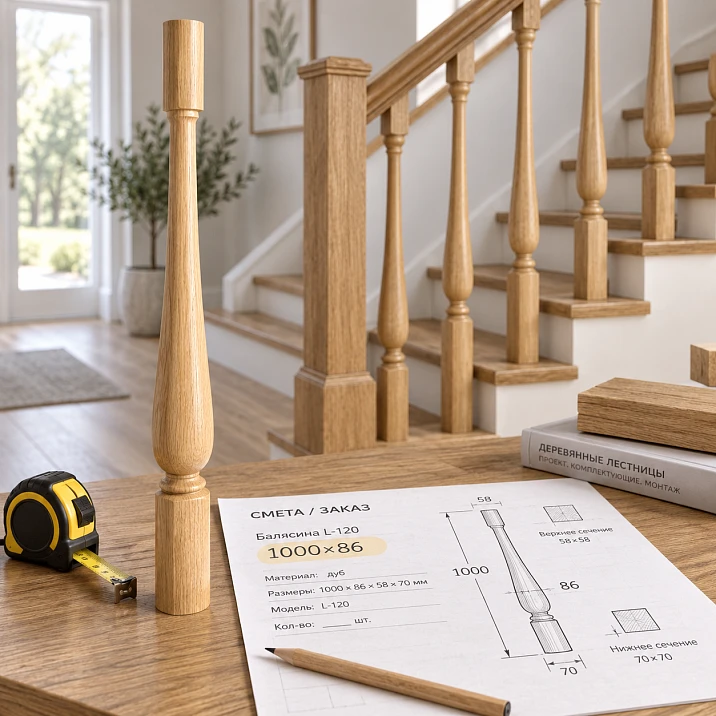
The staircase has already reached the procurement stage. The preliminary list has a short line: "baluster 1000×86 mm — 12 pcs." It is convenient for calculating the quantity and requesting an approximate price. The problem starts when the manager opens the card of a specific L-120 and sees not two, but four dimensional parameters: 1000×86×58×70 mm.
Ordering a batch based only on the entry "1000×86" is risky. Matching height and one cross-sectional dimension do not yet prove that the exact geometry intended for the staircase project has been selected. The specification must retain the L-120 article number and the full set A×B×D×G, and the purpose of local dimensions should be confirmed against the official drawing and the joint design.
This is especially important when it comes not to a single part, but to a series of balusters. An error that seems like a minor misunderstanding on one item turns into an expensive rework in a batch of 12 pieces. Therefore, before payment, three documents must be aligned: the staircase list, the product card, and the working drawing of the assemblies.
For a specific model, the first product line should read as buy a wooden baluster L-120, not just "baluster 86 mm".
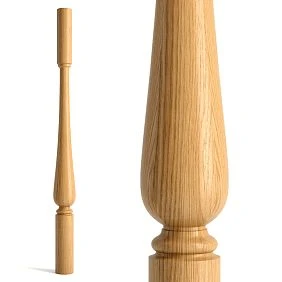
Wooden baluster L-120: the card contains four dimensions, not two
In the L-120 card, the size is written as A×B×D×G = 1000×86×58×70 mm. The material is beech or oak. The sanding quality is "Prestige". In the shown configuration, preparation "for enamel" is indicated.
| Parameter | Confirmed value | What cannot be assumed without a drawing |
|---|---|---|
| A | 1000 мм | Which part of the product does A measure in the mounting assembly |
| B | 86 мм | Is B the width of the upper or lower platform |
| D | 58 мм | Does D refer to the groove, neck, or another local part |
| G | 70 мм | Which specific section of the geometry does G describe |
Such a notation is more useful than the household designation "1000×86" because it preserves the identity of a specific SKU. It does not force the buyer to guess which of the remaining dimensions are "unimportant."
It is especially dangerous to rename D or G on your own. If the manufacturer's table designates a parameter with a letter, that letter should be carried over to the working specification until the drawing provides an exact interpretation. The phrase "58 mm is surely the top" seems convenient, but in procurement it is already an unverified technical statement.
The price of one L-120 at the time of preparing the material is 9,160 RUB in beech and 16,470 RUB in oak. The average production time for the shown configuration is 5–10 days. These figures help to make a budget but do not resolve the compatibility issue.




Why the notation "baluster 1000×86" is suitable for a sketch but weak for an order
A brief caption on a conceptual drawing has the right to be simplified. A designer sometimes only needs to show the height and overall scale. A procurement list serves a different function: it must unambiguously order a specific part.
If only "1000×86" is carried over into the final specification, several meanings may be lost at once.
The first is the article number. There are many balusters about one meter high, and two matching dimensions do not make different models interchangeable.
The second is local geometry. Two products may have the same overall height and maximum width, but differ in the parts that fit into the top and bottom joints.
The third is the connection with the handrail and base. A staircase craftsman works not with an abstract rectangle of 1000×86, but with the actual shape of the part.
The fourth is the completeness of the project. The baluster must be in one system with posts, handrail, bottom support, and installation method.
Therefore, the short notation can be left in the presentation, but in the order it must be replaced with the full line. If the designer has not yet confirmed D and G, the correct action is to return the question to them, not to cross out two parameters as unnecessary.
Our factory also produces:
The article number is more important than the common name "86 mm baluster."
Let's compare two formulations.
Bad request:
Wooden balusters 1000×86 mm, beech, 12 pcs.
From it, it is unknown which specific model is needed, what local dimensions are provided, and what should be considered the standard upon acceptance.
Work order:
L-120 / A×B×D×G 1000×86×58×70 mm / beech / "Prestige" / quantity per approved list.
The second line creates a common language for the customer, manager, and stair master. If a geometry question arises later, all parties discuss the same L-120.
This is also useful during acceptance. On site, you don't have to prove that "we meant something like this." You can verify the marking, material, declared size range, and quantity.
If a person is still choosing a model rather than ordering a specific SKU, it's more logical to first Buy wooden balusters go through the category and only after selection move the article into the specification. Mixing the selection stage and the ordering stage is dangerous: the category answers "what fits," the card answers "what exactly we are buying."
Get Consultation
The L-120 drawing is checked not on its own, but in relation to adjacent components.
The full size range is needed not for the sake of a neat table. It must be linked to the actual staircase.
Before purchasing, the designer or master checks at least three zones: the lower base of the baluster, the upper connection with the handrail, and the proximity to stair posts or transition elements.
For each component, the question is formulated the same way:
which part of L-120 is included in the connection → what size of this part is needed → where is it confirmed on the drawing → does it match the staircase project.
It is not possible to declare in advance that 86, 58, or 70 mm is the width of the groove, seating area, or neck. If such information is needed for manufacturing the mating part, it is taken from the official drawing, not from a product photo.
Special attention should be paid to situations where the lower base has already been manufactured for L-120 or a groove in the handrail has been prepared. Here, the error is discovered late: the product may arrive correct, but the surrounding parts have already been made to an incorrectly understood size.
If adjacent elements are still being selected, in a separate section of the catalog you can buy wooden stair posts. But related products from the L-120 card should not be automatically turned into a ready-made set. The compatibility of a specific post with a specific railing scheme is still confirmed by the project.
Why the same height of 1000 mm does not mean interchangeability
Height is one of the most noticeable parameters of a baluster, so a buyer can easily start considering it the main identifier. This is convenient, but not sufficient.
Two balusters with a height of 1000 mm may differ in:
-
width and depth of individual sections;
-
shape of the upper and lower parts;
-
to the place where the decorative or smooth zone ends;
-
to the method of joining with adjacent elements;
-
to the visual scale;
-
to the project requirements for treatment before installation.
Even if the overall A matches, this does not mean that the old model can be replaced with L-120 without adjusting the joints. Equality of one digit does not replace a drawing.
For the same reason, the size 1000×86 cannot be used as a universal filter for ordering. It may work well in an initial search, but the final line must contain the specific L-120 and the entire confirmed set of parameters.
If the required task is exactly Buy wooden balusters for the staircase, first compare models according to the project, rather than choosing any part with a height of 1000 mm.
One joint at a 1:1 scale is more useful than twelve guesses
Before ordering a batch, it is worth checking at least one typical joint at full scale. This does not mean that you must necessarily buy one baluster separately. The check can start with an official drawing, a section printout, or an accurate template, if the designer can prepare it.
On the diagram, mark:
-
the lower part of L-120;
-
the upper part;
-
mating element;
-
installation direction;
-
the required installation gap, if provided for by the project;
-
the position of the adjacent post or handrail.
A cardboard or wooden full-size mock-up helps assess the location and external scale, but does not prove the strength of the railing. It does not replace the designer's calculation and does not allow you to independently assign fasteners.
A good inspection result is not the phrase "it should fit," but a signed joint according to which the craftsman can manufacture the mating parts and then accept the delivery.
If different types of sections are used at the site — for example, a straight flight and a landing — one mock-up cannot automatically be applied to all locations. You need to ensure that the joint geometry is repeated.
The handrail cannot be checked only against the top number from the card
Another typical mistake is trying to select a groove or handrail joint based on a single number B, D, or G. To do this, you first need to understand the shape of the upper part of L-120 from the drawing.
The handrail may have its own profile and mounting system. Therefore, the task is not reduced to the formula "the baluster width must be less than the handrail width." The specific connection method matters.
Before starting the work, the craftsman must confirm:
-
which part of the L-120 fits the handrail;
-
whether an additional transition piece is required;
-
which dimension actually participates in the joint;
-
how the design line of the railing is preserved;
-
whether the final height changes after processing the ends.
The article does not prescribe a universal groove depth or fastener length. Such values depend on the approved staircase structure.
If this data is not yet ready, purchasing a batch before the design review does not speed up the work—it simply shifts the risk to installation.
Beech or oak is chosen after confirming the L-120 itself
Once the model geometry is aligned, you can proceed to material and finishing.
L-120 is available in beech and oak. For the shown configuration, the card indicates "Prestige" and "under enamel" preparation. "Prestige" refers to the quality of sanding, not the name of a finished color.
The "under enamel" preparation also does not mean the product is already painted. In the order, you need to separately confirm who performs the final finishing, what result is required, and whether this work is included in the specific invoice.
If the entire staircase is designed with a translucent finish, you cannot automatically assume that the shown "under enamel" configuration matches the task. You need to clarify the available execution and agree on it before payment.
To understand the difference between preparation and sanding, it is useful to check quality of wood and sanding, and transfer the already agreed option into the specification.
Batch of 12 L-120: how much does a mistake in an incomplete specification cost
Suppose the designer has already calculated that a specific staircase requires 12 L-120 balusters. This is a training example of an order composition, not a recommendation for any staircase.
At a price of 9,160 ₽ for a beech L-120:
12 × 9 160 = 109 920 ₽.
For oak at 16,470 ₽:
12 × 16 470 = 197 640 ₽.
The difference between the two batches:
197 640 − 109 920 = 87 720 ₽.
| Material | Price of 1 L-120 | 12 pcs. |
|---|---|---|
| Beech | 9 160 ₽ | 109 920 ₽ |
| Oak | 16 470 ₽ | 197 640 ₽ |
| Difference | — | 87 720 ₽ |
This table clearly shows why specification clarification cannot be postponed. An error in one local size multiplies by the number of products.
But the amounts above are only the price of balusters. They cannot automatically include posts, handrails, fasteners, finish coating, delivery, or installation.
Conversely, there is no need to buy a thirteenth or fourteenth L-120 "just in case" if the project does not require a reserve. The quantity is determined by the approved bill of materials and the logic of the specific staircase.
What to order together with L-120, and what cannot be added automatically
The L-120 card shows related stair posts and other elements. This is a useful hint for checking the stylistic and design system, but not a ready-made railing specification.
Before ordering, three groups should be separated.
Mandatory items per the project. They are already present in the approved bill of materials and are needed for assembling the specific staircase.
Checked mating elements. Their selection depends on the L-120 drawing and the project — for example, posts or a handrail.
Optional decor. It cannot be added just because it is shown nearby in the catalog.
This approach protects against the reverse error: after detecting an incomplete specification, there is no need to compensate for uncertainty with extra items. The documentation is corrected first.
If the project is still at the selection stage, you can Buy wooden balusters through the general section and compare available models. If L-120 is already approved, there is no need to return to endless selection; a technical check of this specific model is required.
When L-120 does not need to be ordered yet
Even at a suitable price, the purchase should be postponed if the project does not answer the basic questions.
Do not place an order if only 1000×86 mm items remain on the list and no one has confirmed that L-120 is indeed meant.
Do not place an order if the official drawing has not been cross-checked with the top and bottom nodes.
Do not place an order if the staircase craftsman plans to make grooves or bases "on site after delivery," but the cost of possible rework is not agreed upon.
Do not place the order if the material and future finishing are still changing, and the order is critical to the external match of the entire staircase.
Do not place the order if the quantity of 12 is not taken from the project, but simply from an old estimate after changing the step or flight length.
And do not place an oak batch just because "oak is better": with a difference of 87,720 ₽ between twelve items, the choice of material should be tied to the finishing and the overall staircase system.
An order deferred by one stage is cheaper than twelve correctly manufactured parts that do not fit an improperly prepared joint.
Errors in the L-120 specification and how to prevent them
Error: leave only 1000×86.
Why it occurs: these numbers seem sufficient for identification.
Consequence: part of the geometry of a specific L-120 is lost.
How to prevent: transfer A×B×D×G in full.
Error: independently interpret D=58 and G=70.
Why it occurs: there is a desire to quickly attach numbers to grooves and platforms.
Consequence: mating parts may be manufactured based on an incorrect assumption.
How to prevent: use the official drawing.
Mistake: considering all balusters with a height of 1000 mm as interchangeable.
Why it occurs: height is perceived as the main parameter.
Consequence: another profile may not match in local geometry.
How to prevent: record the article number.
Mistake: first ordering 12 pieces, then designing the connections.
Why it occurs: the desire to reserve production time.
Consequence: risk of reworking the batch or the staircase.
How to prevent: first a standard unit, then the order.
Error: treating "Prestige" as a finished coating.
Why it occurs: the word is perceived as the name of a completed finish.
Consequence: finishing work disappears from the estimate.
How to prevent: separately record sanding, preparation, and finishing.
Error: automatically adding posts from the related products block.
Why it occurs: the catalog shows them next to L-120.
Consequence: a set not confirmed by the project is purchased.
How to prevent: check each adjacent item against the list.
If the quantity changed after the estimate, the old line cannot simply be multiplied.
Incomplete specification is especially dangerous when the project changes after the preliminary estimate. For example, the first estimate had 12 balusters, but after adjusting the railing length or platform layout, the craftsman received a different quantity. In such a situation, you cannot leave the old line "1000×86" and just replace 12 with 14.
You need to re-check that it is specifically the purchase volume that changed, not the type of node. If the new part of the staircase has a different connection to the handrail, a different lower base, or a different transition to the post, the same L-120 may require a separate application check.
A useful sequence is as follows:
-
the designer issues the current bill of quantities;
-
it retains the full article number L-120;
-
the quantity is linked to specific positions on the plan;
-
standard nodes are checked for compliance with the L-120 drawing;
-
only after this is the commercial estimate updated.
If the quantity becomes 14, the price is calculated after this confirmation. For beech, the arithmetic will be 14 × 9,160 ₽, for oak — 14 × 16,470 ₽. But the very appearance of two additional items must be explained by the project, not by rounding "with a margin."
This approach is also useful for partial replacement. If one baluster is damaged before installation, first determine whether the same version can be re-ordered, rather than taking any part with matching 1000×86 mm dimensions.
Acceptance of batch L-120: what to check before handing over to the installer
After delivery, it is important not to proceed directly to installation. The batch must be checked against the same specification that was used for ordering.
Check the quantity, article number, material, declared size range, quality of sanding, and agreed surface preparation. If the products are distributed across several sections of the staircase, it is useful to pre-mark groups according to the project without changing the factory designation of the product.
Dimensional inspection is carried out according to the agreed drawing and the master's method. There is no need to turn a household tape measure into a tool for independently confirming all local geometric parameters if the drawing requires a different measurement point.
Separately inspect for transport damage and the condition of the surface before applying the finish. If there is any doubt about geometry or completeness, it is better to record it before cutting, drilling, and painting. After irreversible processing, it is much more difficult to determine that the batch does not match the project.
Acceptance ends not with the phrase "they seem the same," but with a clear decision: the batch matches the order and can be handed over to the installer, or a specific issue is returned to the seller or designer before work begins.
Final specification for the seller
When the project is approved, the request should be short but unambiguous:
Baluster L-120
Size A×B×D×G: 1000×86×58×70 mm
Material: beech
Grinding: "Prestige"
Quality of blank/finish: confirm
Quantity: 12 pcs per approved list
Production time: confirm
Delivery: confirm
If oak is selected, material and price change, other parameters remain in the same structure.
The stair master receives a different set of data: official drawing L-120, lower node, upper node, handrail drawing, selected posts, installation step, quantity, and final design height of the railing.
Thus, the seller is responsible for supplying a specific product, and the master is responsible for its application in the approved structure. These tasks should not be mixed in one phrase "baluster 1000×86".
Before paying for the batch, it is useful to check the payment and delivery terms for balusters, because the production time and the actual date of receipt at the site are not the same thing.
After verifying the drawings, material, preparation, and quantity, you can order balusters L-120 already according to the full specification, not based on two convenient numbers from the early estimate.
Questions before ordering L-120
What is the full size of L-120?
The card specifies the size A×B×D×G 1000×86×58×70 mm.
Can I leave "baluster 1000×86 mm" in the estimate?
As a short label on an early sketch, yes. For the final purchase, it is better to keep the article L-120 and the full size range.
What do D=58 and G=70 mean?
According to one trade table, the purpose of these sizes cannot be safely determined. They need to be read from the official drawing of the product.
Can the purpose of dimensions be understood from a photo?
No. A photo helps assess the appearance, but it does not confirm the exact mounting geometry.
Will the L-120 fit any handrail?
Such universal compatibility does not follow from the card. The top assembly needs to be checked against the drawings of the specific system.
Can it be replaced with another baluster 1000 mm high?
Only after checking the entire geometry and connections. The same height by itself does not prove interchangeability.
How much does one L-120 made of beech cost?
At the time of writing the article — 9,160 ₽ for the shown version.
How much does an oak L-120 cost?
At the time of writing the article — 16,470 ₽ for the shown version.
How much do 12 beech L-120 cost?
At the current product price — 109,920 ₽. This is an example of a batch after a project-based quantity calculation.
How much do 12 oak L-120 cost?
At the current product price — 197,640 ₽.
What is included in these amounts?
Only the cost of 12 balusters at the specified prices. Posts, handrails, fasteners, coating, delivery, and installation are calculated separately if needed.
Is it necessary to order one baluster for a sample?
Not necessarily. First, you can check the official drawing and standard connection detail. If a physical sample is required, it is decided in advance whether it will later be included in the final quantity.
What should I write to the manager besides the size?
Item number L-120, full A×B×D×G, material, sanding, agreed preparation, quantity, requirements for deadline and delivery.
Where to choose balusters if L-120 is not yet approved?
If a specific SKU has not been selected yet, it is better to start with the baluster category, compare models with the project, and only then form the final product line.