Article Contents:
- What Are Window Casing Patterns and Why Are They Needed
- Decorative Function and Architectural Image
- Facade Individualization
- Connection with Traditional House Carving
- Combination with Cornices and Facade Decor
- What Types of Window Casing Patterns Exist
- Geometric patterns
- Plant ornaments
- Traditional Russian Patterns
- Classical Symmetrical Ornaments
- Modern Decorative Patterns
- Why Wooden Window Trim Patterns Are the Most Expressive Solution
- How to Choose Patterns for Window Trims
- By House Style
- By Window Size and Proportions
- By Carving Saturation
- By material
- By Combination with Facade Decor
- Window Trim Patterns for Wooden Houses, Timber Houses, and Cottages
- For a wooden house
- For a timber house
- For a log house
- For a dacha
- For a Cottage with Decorative Facade
- What's Better to Buy: Ready-Made Trim with Patterns or Separate Decorative Elements
- Ready-Made Trim with Patterns
- Individual decorative overlays and ornaments
- When to choose a set and when to opt for individual decor
- How to complement patterns for window casings
- Mistakes when selecting patterns for casings
- Where to buy patterns for window casings
- Systematic approach — the main rule
- What to look for when choosing
- Prices — guidelines
- Why STAVROS is suitable for selecting patterns for casings
- Conclusion
- FAQ: frequently asked questions about patterns for window casings
There is one detail that instantly gives a house its face. Not the roof, not the foundation, not the color of the walls—but how the windows are framed. The window opening is the first thing a person looks at when approaching a house. And it is here that patterns for window trims decide everything: whether this house has character, history, soul—or if it's just a construction project.
Today, you can buy patterns for window trims in a wide variety of styles: from modest geometric ornaments to intricate openwork carvings with floral motifs. But the main thing is to understand which pattern your house needs, how it relates to the overall facade image, and what material it's best made from.
This is exactly what this article helps with. Here—everything about what wooden patterns for window trims are available, how to choose them, what mistakes to avoid, and how to assemble a unified facade ensemble from ornamentation, cornices, and house carvings.
If you're already looking for carved patterns for window trims—it means you're seriously thinking about the house's image. And that's right.


What are patterns for window trims and why are they needed
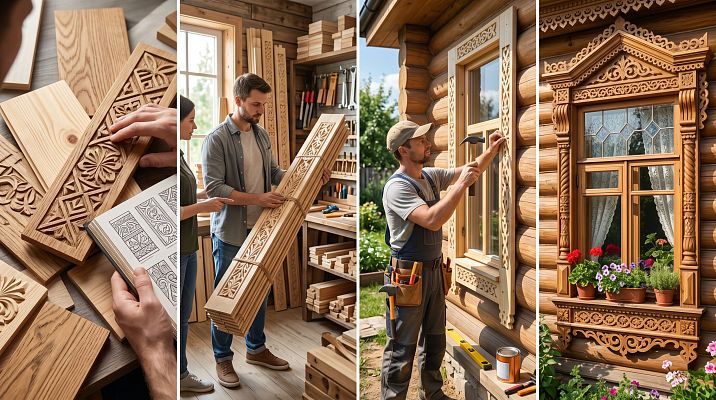
Patterns on window trims are decorative ornaments applied to the surface of the window framing through mechanical milling, hand carving, or overlay assembly from ready-made carved elements. Essentially, it's a way to turn a simple profile strip into an artistic object.
But why is all this needed? The answer lies in several dimensions.




Decorative function and architectural image
A bare trim on a facade is just a frame. A trim with a pattern is a statement. Decorative patterns for window trims structure the window opening, making it complete, legible, and individual. They set the tone for the entire facade—from the gate to the roof ridge.
In traditional Russian wooden architecture,patterns on wooden house mouldingscarried not only an aesthetic load but also a symbolic one. Solar signs, plant weaves, geometric diamonds — each ornament was part of the language with which the house 'spoke' to the surrounding world.
Our factory also produces:


Individualization of the facade
In the era of standard cottages and identical settlements, patterns for window trims are the most accessible way to make a house recognizable. Two neighboring houses can be built according to the same design, but with different window patterns they look completely different.
Get Consultation
Connection with the tradition of house carving
Wooden patterns on housesis a centuries-old Russian tradition that is now experiencing a well-deserved revival. Owners of wooden houses, cottages, and dachas are increasingly returning to this language — not out of nostalgia, but because it works. Wood with carving on the facade looks more expensive, more complex, and more alive than any other facade finish.
Combination with cornices and facade decor
Wooden patterns on mouldingsbecome especially expressive in a system: a casing with an ornament +wooden cornicewith coordinated decor + elementshouse carvingaround the perimeter of the facade. This is no longer just decoration — this is architecture.
What patterns are there for window casings
Pattern classification is not dry theory. It's a practical guide that will help you choose what suits your home.
Geometric patterns
The simplest and most universal at the same time. Diamonds, squares, triangles, zigzags, chess motifs, grids of intersecting lines. Geometric patterns for window trims are clarity, strictness, rhythm. They look good on houses with laconic architecture: straight lines, minimal decor, neat facade.
The relief depth of geometric ornaments is usually small — 5–12 mm. This makes them convenient to execute and durable in operation: less relief — fewer points of moisture accumulation.
Geometric patterns pair well withwooden moldingwithout carving: simple cornice + geometric trim = laconic classic facade.
Plant Ornamentation
Leaves, stems, flowers, acanthus tendrils, grape vines, hops, daisies, sunflowers — plant ornaments for window trims are the richest and most common group. It is this language that dominates traditional house carving.
Plant patterns can be executed in two manners:
-
Flat-recessed (pierced): contrasting play of silhouettes, plenty of air and light. Looks good from a distance.
-
Volumetric, relief: three-dimensional leaves, flowers with detailed elaboration. Requires greater blank depth but provides the richest visual effect.
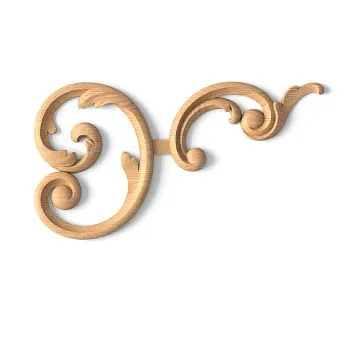
Carved wooden ornament – this is an art that preserves traditions of the past and finds its place in modern interiors. It can decorate any space, adding style, elegance, and individuality. Use wooden ornaments to create expressive accents, decorate facades, furniture, and walls, and you will transform your space, making it unique and irreplaceable!of the plant type is what first comes to mind when people say 'Russian wooden house.' It is organic, recognizable, and endlessly diverse in execution.
Traditional Russian Patterns
Russian window casing patterns are a world of their own. It's not just ornamentation — it's encoded symbolism from folk art.Wooden patterns on mouldingsin the Russian style include:
-
Solar signs (circles, rosettes, diamonds with a dot) — symbols of the sun and warmth;
-
Running wave — a symbol of water and life;
-
Woven pattern — infinity and protection;
-
Horse (stylized) — on the tops of casings, on the fascia boards;
-
Birds — symbols of goodness and spring.
wooden ornamentin traditional Russian execution — is what makes a house not just beautiful, but homey. Such a casing is not decor, it's a statement of identity.
Classical symmetrical ornaments
A strict axis of symmetry, mirror layout, clear repeating modules—classical symmetrical ornaments for window trims are closest to the European architectural tradition. Palmette, egg-and-dart, laurel wreaths, acanthus—this is the language of Empire and Classicism.
Such patterns are well-suited for cottages in European style, country houses with proper architecture, facades with columns or pilasters.Carved wooden decorationIn classical execution—it is always expensive and prestigious.
Modern decorative patterns
Modern interpretations are geometric abstraction, Scandinavian motifs, Japanese patterns, minimalist patterns with clear lines. Beautiful patterns for window trims in a contemporary style—for homeowners who value relevance.
Such patterns are often executed using laser cutting: precision, repeatability, the ability to realize any ornament.Decorative Wooden PatternsWith modern motifs—an excellent solution for houses in contemporary or Scandinavian eclectic style.
Why wooden patterns for window trims are the most expressive solution
Windows are decorated in different ways: plastic overlays, gypsum elements, aluminum profiles. Why specifically wood?
Living texture. Wood reflects light differently than any artificial material. The finest fibers create a play on the surface that changes depending on the angle of light. The ornament on a wooden window trim 'lives' throughout the day—in the morning, at noon, and at sunset it looks different.
Relief depth. Wooden patterns for window trims made from solid wood can have a relief from 5 to 40 mm. This provides real volume, genuine shadow, sculptural expressiveness — something thin polymer overlays cannot achieve.
Versatility in finishing. Wooden patterns for architraves accept any coating with precise, predictable results: white enamel, tinted to resemble weathered oak, ochre, dark green—wood 'works' with any color.Solid Wood Itemscan be repainted when changing the concept — without replacing elements.
Durability. Properly treated wooden ornament on the facade lasts for decades. Antiseptic impregnation + finishing coating (oil, varnish, or enamel) protect the solid wood from moisture, ultraviolet radiation, and biological damage.Wooden itemscan be restored locally if necessary, without complete dismantling.
Systematic approach. Buying wooden patterns for window trims made from the same wood species aswooden corniceand elementshouse carving— means assembling a facade ensemble, not a set of random details.
Eco-friendliness and naturalness. Wood is the only completely natural facade material. Outdoors, this is not just an argument in favor of ecology — it's a real quality: solid wood does not emit toxic substances under the influence of ultraviolet radiation and temperature fluctuations.
How to choose patterns for window trims
Before buying — analysis. The main thing here is not to fall in love with a beautiful picture, but to choose what will organically fit into your specific house.
By house style
This is a fundamental criterion. How to choose patterns for window surrounds — start by understanding the architectural character of the facade:
| House style | Recommended pattern |
|---|---|
| Traditional wooden house | Russian ornament, plant-based interlace, openwork carving |
| Timber house, eco-style | Geometry or simple plant motifs, open texture |
| Classic cottage | Symmetrical classical ornament, acanthus, palmettes |
| Country house in folk style | Traditional Russian motifs, solar signs, birds |
| Modern house, contemporary | Concise geometry, Scandinavian patterns |
By window size and proportions
How to choose patterns for window casings considering size — the principle is simple: the scale of the ornament should match the scale of the window.
-
Small window (up to 80 cm wide): small repeating ornament or simple geometry. A large ornament will 'overwhelm' the window.
-
Standard window (80–120 cm): medium-scale pattern, floral motif, or symmetrical layout.
-
Large window (from 120 cm): large ornament with a pronounced central motif, volumetric relief is possible.
Important: the width of the casing affects the permissible scale of the ornament. Narrow casing (40–60 mm) — only a border pattern along the edge. Wide (80–120 mm) — full ornamental decor.
By carving density
Three levels:
-
Light (edge bevel, slight milling): minimal relief, emphasis on the profile shape. Suitable for houses with concise architecture.
-
Medium (contour or flat-relief carving): clear ornament, moderate depth. A universal option.
-
Rich (three-dimensional carving, openwork through-carving): maximum expressiveness. For houses with a rich decorative program on the facade.
Which ornament to choose for window trims in terms of richness — the rule is one: the simpler the architecture, the richer the pattern can be. And vice versa: complex facade architecture does not need an overloaded window trim.
By material
Choosing wood species for facade patterns:
-
Pine: affordable, easy to work with. Requires high-quality impregnation and painting for facade conditions. Good for painted window trims.
-
Larch: dense, resinous, naturally resistant to moisture. An excellent choice for open facades without additional protection.
-
Oak: maximum hardness, durability, beautiful grain. Facade oak with oil-wax coating is a premium option for many years.
-
Maple: light, uniform texture, takes tinting well.
wooden ornament made from solid wood is always the best choice in terms of durability and visual quality compared to MDF or polymer analogues.
On combination with facade decor
How to systematically select patterns for window casings:
-
Identify what other decorative elements are present on the facade:wooden cornice, pediment decorations, corner elements.
-
The casing pattern should be coordinated with the cornice ornament: not identical (that would be monotonous), but from the same 'family' of motifs.
-
Trimming Items— plain profile strips without carving — visually connect the decorative elements.
-
Adddecorative elementsinto the tops of casings — 'towels' and valances — to complete the look.
Patterns for window casings on a wooden house, timber house, and cottage
Each type of house dictates its own decorative logic. Let's break it down by clusters.
For a wooden house
Patterns for window casings on a wooden house are typically traditional Russian or floral ornamentation. A wooden house is a natural material, and the decor should 'speak' the same language: organic weaves, natural motifs, possibly — openwork through-carving.
Wooden patterns on windowsin traditional execution — is a wide casing with side posts and an upper crosspiece, each carrying its own motif. Side posts — a vertical rhythmic weave. Upper crosspiece — an accent ornament with a central medallion.
BuyWooden casingwith a traditional pattern means giving the house a voice that speaks the language of Russian wooden architecture.
For a timber house
Patterns for window trims on a timber house should consider the horizontal rhythm of the wall material itself—the rows of timber inherently create texture. Therefore, trims for a timber house are chosen with an ornament that does not compete with this texture but complements it.
Optimal: a geometric ornament with a pronounced vertical accent (compensates for the horizontality of the timber) or a moderate floral motif with medium relief.Carved wooden items occupy a special place in this regard. Wood carving not only emphasizes the aesthetics of a room but also gives it warmth, lively energy, and uniqueness. In modern interiors, carved elements are widely used due to their unique properties and adaptability to any style—from classic to minimalism.for a timber house—strict, laconic, with good carving depth that reads well against the rich texture of the walls.
For a log house
A log cabin is the most 'saturated' facade: each log carries its own texture. Patterns for window trims on a log house should be either very rich (so as not to get lost against the background of the logs) or, conversely, deliberately laconic (as a contrast).
The traditional choice for a log house is a wide trim with volumetric or openwork carving, clearly visible from a distance.Patterns wooden window casingsfor a log house—typically larger in ornamental scale than for timber or frame houses.
For a dacha
Patterns for window trims on a country house are the most creative field. A dacha allows greater freedom: traditional Russian motifs, folk ornaments, floral weaves, and playful geometric patterns are all appropriate here.
A country house trim is a place for experimentation.Decorative Wooden Patternswith floral or folk motifs will create that very feeling of an 'authentic dacha,' which is valued today no less than modern design.
For a cottage with a decorative facade
Patterns for cottage window casings are a matter of stylistic unity. If the cottage is executed in a European classical style, the casings should 'speak' the same architectural language: symmetry, classical motifs, precise proportions.
wooden ornamentin a European classical key — palmettes, laurel branches, Ionic motifs — works excellently in combination withwooden window cornicesand pediment decor.
What is better to buy: ready-made casings with a pattern or separate decorative elements
This question arises for most buyers. Let's honestly examine both options.
Ready-made casings with a pattern
Buying casings with a pattern for windows as a ready-made kit is the simplest scenario. The casing already carries an ornament: it is either applied by milling directly onto the board or assembled from applied carved elements at the factory.
Advantages:
-
quickly and without additional installation;
-
The ornament is already coordinated with the profile;
-
You can see the result immediately.
Disadvantages:
-
Less flexibility in choosing the ornament;
-
You cannot replace the pattern without replacing the casing.
Separate decorative overlays and ornaments
Buy decorative overlays for casings and assemble the composition yourself — this is the path for those who want maximum flexibility. A smooth or profiled casing is taken and complemented with overlay carved elements:carved casings for windows, corner rosettes made ofcarved decor elements, decorative inserts.
Buy Wooden Patterns in the form of separate overlay elements — this means assembling a unique composition that no neighbor will have.
Advantages:
-
absolute flexibility in choosing the ornament;
-
ability to combine different motifs;
-
only the decor can be replaced without changing the main casing.
Disadvantages:
-
requires a bit more time for installation;
-
need to plan the composition in advance.
When is it better to take a set, and when — separate decor
Set (ready-made casing with ornament) — when you need to quickly decorate several windows in a unified style, when you don't want to deal with assembly, when the chosen ornament is already available in the catalog.
Separate carving elements for casings — when a unique look is needed, when the facade already has a specific style of house carving that needs to be coordinated with, or when you want to update the ornament on already installed casings.
What to complement window casing patterns with
One casing is the beginning of a conversation. Full-fledged facade decor is a dialogue between several elements.
House carving.Patterns wooden window casings— part of a broader system.House Carvingincludes cornice boards, friezes, wind boards, and pediment decor. The more elements of the system are coordinated with each other, the more cohesive the facade appears.
Cornices.wooden corniceabove the window — a horizontal 'cap' that covers the casing from above and completes the window ensemble.buy wooden cornicewith a profile coordinated with the ornament of the casing — an important step toward a cohesive look.wooden cornicecan carry its own ornament or be smooth — depending on the richness of the overall decorative program.
Carved ornaments and overlays.Decorative Wooden Patternsin the form of applied elements — these are corner rosettes, medallions, decorative inserts. They are installed at the top of the casing ('forehead'), at the junctions of the side posts and the upper crosspiece, as well as at the lower ends ('sills' of the casing).
Facade decor.Buy facade wooden decor for windows— means adding a window sill board with ornament, side brackets, and decorative bars. This turns the window opening into an independent architectural object.
Molding products.wood trim items— profile strips, glazing beads, coves — connect decorative elements into a unified system.Wooden trimmade from the same wood species as the main casings, covers all transitions and joints, ensuring visual integrity.
What to buy together with casing patterns — a short list:
-
Wooden casingwith ornament or for overlay decor;
-
wooden cornice— coordinated with the pattern;
-
Carved wooden decoration— corner rosettes for the top;
-
Decorative Wooden Patterns— overlay elements for additional accents;
-
Trimming Items— for finishing the perimeter.
Mistakes in choosing patterns for window trims
Five mistakes that make even beautiful decor look unconvincing on a facade.
Too small an ornament on a large facade. If the house is tall, the windows are large, and the trim pattern is small — it simply gets lost. How to choose patterns for window trims considering scale: the ornament should be 'readable' from a distance of 10–15 meters. A small detail at this distance turns into visual noise.
Overloaded decor on a simple house. Openwork carving with a multi-level ornament — on a small country house with a low ceiling looks like a carnival costume on an office worker. The scale of the decor should match the scale of the architecture.
Poor combination with the cornice. A trim with a floral ornament + a cornice with a geometric pattern in a different scale — this is a style conflict that catches the eye immediately. Which ornament to choose for window trims: first determine the style of all the facade decor, then choose the ornament for each element.
Choosing only by picture without considering scale. A photo of a trim in a catalog is one thing, but the same trim on your specific facade is another. Always request dimensions and correlate them with the actual sizes of the window and facade.
Mixing incompatible styles. Russian ornament + classical palmettes + Scandinavian geometric patterns on one facade — this is visual chaos. A facade should have one stylistic language, in which all decorative elements are its words.
Where to buy patterns for window trims
Practical section for those ready to move from selection to purchase.
A systematic approach is the main rule
Buy window casing patterns from a supplier whose single catalog includes both the casings themselves, as well as ornaments, cornices, house carving, and millwork — this is the only way to guarantee a facade system, not a set of random parts.
Patterns for casings from the manufacturer mean transparency regarding materials, a unified style across collections, and the ability to order exactly the element you need without unnecessary compromises.
What to look for when choosing
-
Wood species: larch, oak — for exposed facades; pine — for painting with high-quality impregnation;
-
Carving depth: for exterior use — minimum 8–10 mm, otherwise the pattern gets visually 'washed out' in the rain;
-
Processing quality: clear edges of the ornament, absence of splits, smooth surface;
-
Collection style: the ornament should have a continuation in the cornices, millwork, and house carving from the same supplier;
-
Catalog with dimensions: a catalog of casing patterns with prices must contain the exact dimensions of each element — without this, it's impossible to calculate the set.
Prices — guidelines
| Product type | Material | Approximate price |
|---|---|---|
| Casing with ornament (linear meter) | Spruce | 600–1,200 RUB |
| Casing with ornament (linear meter) | Oak/larch | 1,500–4,000 RUB |
| Overlay ornament (element) | Spruce | 400–900 RUB |
| Overlay ornament (element) | Oak | 800–2,500 RUB |
| Corner rosette for finial | Pine / oak | 500–2,000 RUB |
| Window cornice with ornament (linear meter) | Pine / oak | 800–3,500 rub. |
How much do patterns for window casings cost — a full set for one window (2 side + top casing + cornice + corner rosettes): from 3,000 to 20,000 rubles depending on wood species, complexity of the ornament, and window size.
Order patterns for window casings for non-standard sizes or non-standard ornaments — a custom order that is executed according to a drawing or sample.
Why STAVROS is suitable for choosing patterns for casings
STAVROS is a manufacturer that has everything needed for complete wooden facade design gathered in one catalog.
Patterns wooden window casings, Wooden ornaments, wooden ornament in different styles,Carved wooden ornament – this is an art that preserves traditions of the past and finds its place in modern interiors. It can decorate any space, adding style, elegance, and individuality. Use wooden ornaments to create expressive accents, decorate facades, furniture, and walls, and you will transform your space, making it unique and irreplaceable! of plant and geometric types — all this is part of the systematic catalog. Next to the ornaments —wooden cornice, buy wooden cornice with the required profile,Trimming Items for finishing,Decorative Wooden Patternsfor additional accents andCarved wooden decoration in the form of rosettes.
This means: one supplier, one wood species, a unified style — and a facade that looks designed, not assembled from different sources.
Go to the catalog house carving, of solid woodanddecorative elements — to select patterns for window casings, coordinate them with cornices and facade decor, and achieve the house image you envisioned from the start.
Conclusion
Patterns for window casings are not just decoration on top of the house. They are its face. It is the ornament on the window framing that creates the memorable, recognizable image that makes you want to stop and take a closer look.
To buy wooden patterns for window casings is to choose a material that lives, not imitates life. Wood breathes on the facade, ages beautifully, accepts any finish, and creates a visual weight that cannot be replicated with synthetic materials.
The best result is always systematic: casing pattern + cornice with coordinated decor + elements of house carving on the facade + trim. Only then does the house acquire an integrity that is immediately visible — and that lasts for years.
STAVROS offers exactly this approach: fromwooden patterns for window casingsanddecorative elementstowooden cornices, wood trimandwooden ornaments — everything in one catalog, everything from solid wood, everything in a unified system.
FAQ: frequently asked questions about patterns for window casings
Which ornament is best suited for a wooden house?
Traditional plant-based or Russian ornament is the most organic choice. It 'speaks' the same language as the wall material itself. For modern wooden houses, geometric patterns or Scandinavian motifs are acceptable.
Can ornament be installed on an already finished casing?
Yes. Overlay decorative elements—rosettes, ornamental inserts, corner overlays—are mounted onto the finished surface with adhesive and finishing nails. This allows updating the facade without replacing the main elements.
How to protect wooden ornament from weather?
Mandatory scheme: antiseptic impregnation (2–3 coats) → primer → finish coating (alkyd enamel, oil-wax composition, or acrylic varnish for exterior work). Coating renewal—every 5–7 years depending on climate.
What carving depth is optimal for facade application?
For exterior conditions—minimum 8–10 mm relief depth. With less depth, the pattern visually disappears in rainy lighting and at a distance. For volumetric facade carving—15–25 mm or more.
How much does a set of patterns for casings on one window cost?
Approximately: a set (2 side + 1 top casing with ornament + cornice + corner rosettes) made of pine—3,000–8,000 rubles. Made of larch or oak—8,000–25,000 rubles. Depends on window size, ornament complexity, and wood species.
Can a non-standard ornament be ordered?
Yes. Most manufacturers of wooden facade decor accept orders based on drawings or sketches. The cost of a custom order is approximately 30–60% higher than a standard one.
How to choose between a ready-made casing with an ornament and applied elements?
Готовый наличник — быстрее и проще. Накладные элементы — гибче и позволяют создать уникальную композицию. Если в каталоге есть нужный орнамент — берите готовое. Если хотите что-то особенное — собирайте из накладных элементов.