Article Contents:
- Confirmed specifications of MLD-003U and MLD-027U-1
- What is corner molding and what problem does it solve
- Why the corner size determines the frame scale
- MLD-003U or MLD-027U-1: direct comparison
- When to choose MLD-003U 218 × 218 mm
- Large frame on the wall
- Wide boiserie panel
- Large mirror
- Solid furniture front
- Commercial interior
- Interior door
- Chest of drawers or dresser
- Cabinet and display case
- Mirror frame
- Niche and compact wall panel
- Several frames of different scales
- 84 мм
- 124 мм
- 164 мм
- 204 мм
- Calculation sequence
- One central frame
- Two symmetrical frames
- Three frames on the long wall
- Frame above the cabinet
- Frame around the TV area
- Frame on the door
- Furniture set decor
- Commercial display case
- Use 84 mm on a large wall
- Mix MLD-003U and MLD-027
- Mix MLD-027U-1 and MLD-003
- Order different breeds
- Paint without a test swatch
- Count only the outer perimeter
- Do not create a cutting map
- Start installation without dry layout
- Confuse decor with construction profile
- Do not account for fittings
- Use all sizes of the series at once
- Example 1. Frame defined by outer contour
- Example 2. Frame defined by inner field
- Example 3. Two identical frames
- Example 4. Central and side frames
- Example 5. Frame on the facade
- Example 6. Frame around a mirror
- Classic Interior
- Neoclassicism
- Modern Interior
- Eclecticism
- Commercial interior
- Interior in wall color
- Surface defined
- Series selected
- Exact size selected
- 1:1 template created
- Quantity calculated
- Straight parts list compiled
- Slat length checked
- Material selected
- Sanding agreed
- Mounting materials selected
- Hardware checked
- Current cards checked
- How is MLD-003U different from MLD-027U-1?
- Which angle to choose for a large wall frame?
- Which size of MLD-027U-1 is suitable for a door?
- Can MLD-003U be used on a facade?
- How many angles are needed for one frame?
- How to calculate straight molding?
- Can I connect MLD-003U with MLD-027?
- Can I connect MLD-027U-1 with MLD-003?
- What to choose: beech or oak?
- Do I need to paint the parts before installation?
- Will the elements fit for an external corner of the wall?
- Is a 45-degree cut required?
- How to choose the size for a mirror?
- How can I check the scale before purchasing?
- Do I need to buy glue together with the frame?
- Where to buy MLD-003U and MLD-027U-1?
- Wall check
- Door check
- Facade check
- Mirror check
- Scale check
- Series check
- Material check
- Finishing check
- Quantity check
- Installation check
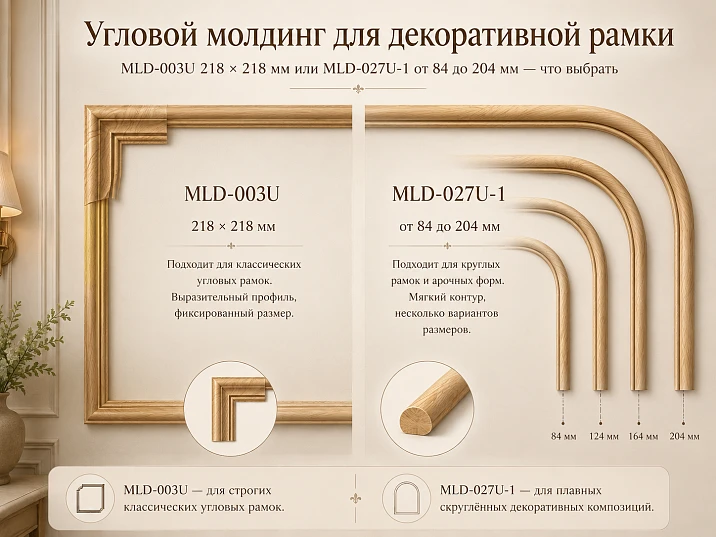
When you need to buy a corner molding for a wall frame, door, mirror, or furniture front, a beautiful pattern alone is not enough. The corner sets the scale of the entire composition, occupies part of the inner field, and must precisely continue with a compatible straight profile. MLD-003U and MLD-027U-1 solve the same decorative task but belong to different systems. MLD-003U is produced in a fixed size of 218 × 218 × 15 mm and is designed for a large frame. MLD-027U-1 forms a size range of 84, 124, 164, and 204 mm with a thickness of 13 mm, making it easier to adjust to a door, mirror, front, or several frames of different formats.
The second fork concerns the straight molding. MLD-003U is used together with MLD-003 in size 35 × 12 mm. MLD-027U-1 is combined with MLD-027, which is available in sections 14 × 9 and 20 × 12 mm. These pairs cannot be arbitrarily mixed. Matching material or a similar pattern does not guarantee the same width, height, and joint point. Therefore, first choose the frame system, then count the corners and straight sections, and only then form the cart.
Both models are available in beech or oak. For beech, preparation for enamel is confirmed; for oak, for tinting. MLD-003U can have a "Standard" or "Prestige" sanding, MLD-027U-1 — "Prestige". These parameters affect the future finish and how smooth the joints between the corner and the straight strip will look. It is better to choose all parts of one frame in the same wood species and under one coating system, and do a test paint before painting.
The practical purchase route starts with a full-size mockup. On the wall, door, or front, mark the outer contour, attach four paper corners 1:1, and connect them with strips imitating the straight profile. This test shows whether MLD-003U overloads a small surface, whether MLD-027U-1 84 mm gets lost on a large wall, and how much space remains inside the frame. After the mockup, you can accurately determine the model, size, number of corners, and length of the straight molding.
Short answer. For a large wall frame, wide boiserie panel, large mirror, or massive front, MLD-003U 218 × 218 × 15 mm is more often chosen together with MLD-003 size 35 × 12 mm.
For a door, compact front, niche, or series of frames of different sizes, MLD-027U-1 is more convenient: 84, 124, 164, or 204 mm together with MLD-027. The corner cannot be selected separately from the straight profile; the size is checked with a 1:1 template.
Select MLD-003U 218 × 218 mm Select MLD-027U-1 from 84 to 204 mm Buy Decor for Moldings
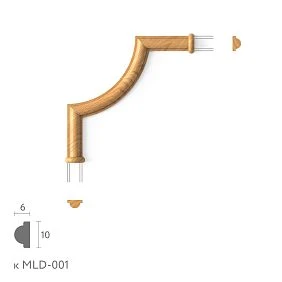
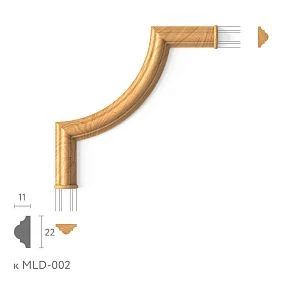
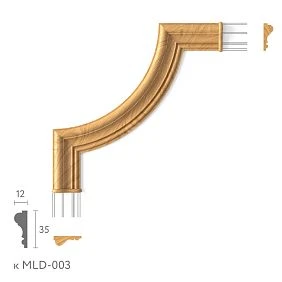
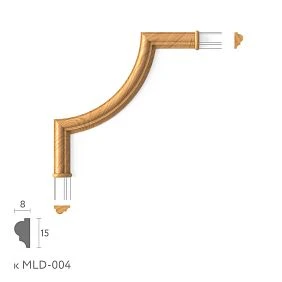
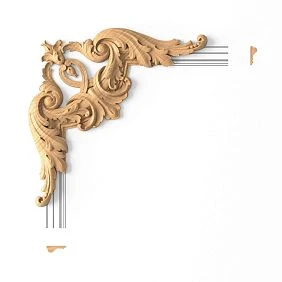
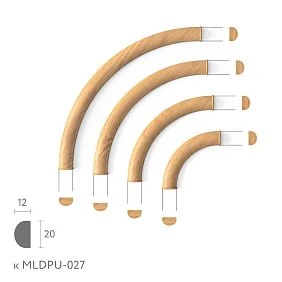
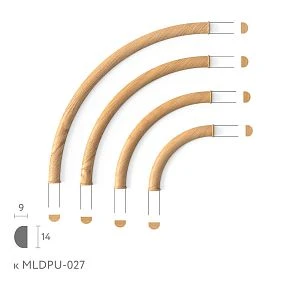
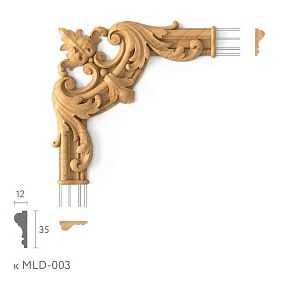
Confirmed specifications for MLD-003U and MLD-027U-1
| Parameter | MLD-003U | MLD-027U-1 |
|---|---|---|
| Type | Large decorative corner element | Size series of decorative corners |
| Size | 218 × 218 × 15 mm | 84 × 84 × 13; 124 × 124 × 13; 164 × 164 × 13; 204 × 204 × 13 mm |
| Additional D × L | Not highlighted separately in the diagram | 23 × 117; 23 × 174; 23 × 231; 23 × 287 mm |
| Size options | One | Four |
| Material | Beech or oak | Beech or oak |
| Sanding | "Standard" or "Prestige" | «Prestige» |
| Beech | For enamel | For enamel |
| Oak | For tinting | For tinting |
| Compatible profile | MLD-003 35 × 12 mm | MLD-027 14 × 9 or 20 × 12 mm |
| Main scale | Large frame, panel, mirror, wide facade | From compact facade to large frame |
| Product card | Buy large corner molding MLD-003U | Buy corner molding MLD-027U-1 |
The main difference is already visible in the table: MLD-003U sets one large scale, while MLD-027U-1 allows choosing between four levels. Therefore, MLD-003U should not be perceived as simply the largest version of MLD-027U-1. It has a different compatible profile, different thickness, different sanding system, and a different frame character. Even MLD-027U-1 204 mm, close in external size to 218 mm, remains part of the MLD-027 kit.
The thickness of the corner is also evaluated together with the straight profile. The difference between 15 and 13 mm is small in itself, but the final joint depends on the width and height of the strip. MLD-003 has a large cross-section of 35 × 12 mm, MLD-027 has a more delicate one of 14 × 9 or 20 × 12 mm. If you mix series, the visual transition and fit are not confirmed.




What is a corner molding and what problem does it solve
The corner molding in this article is a ready-made flat decorative element for a frame composition. It is placed on a wall, door, furniture facade, panel, or around a mirror and connects with straight moldings. Such a corner helps form an ornamental turn without the need to join two decorative strips directly at the frame's vertex with a regular miter cut. In this case, the straight sections are still cut to length and precisely joined with the finished element.
These models should not be confused with a construction corner, tile profile, plaster guide, PVC external corner, or stretch ceiling baguette. MLD-003U and MLD-027U-1 do not cover a protruding wall edge and do not protect a slope. They work on a plane as part of a decorative frame. If the task is to "cover a wall corner," first determine whether frame decor or a construction profile is needed.
A ready-made corner affects not only the pattern but also the geometry of the frame. It occupies a square area, reduces the length of straight sections, and changes the internal size. The larger the element, the more free background it requires. That is why four corners cannot simply be added to a pre-calculated external perimeter: first, they are placed on the drawing, then the distances between the joint points are measured.
Our factory also produces:
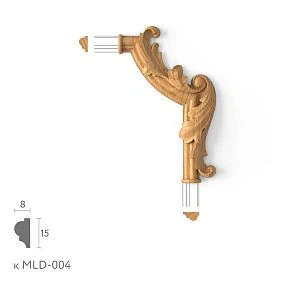
Why the size of the corner determines the scale of the frame
MLD-003U, measuring 218 mm, is noticeable from a distance. On a large wall, this is an advantage: the corner supports the wide MLD-003 profile and does not get lost among furniture, doors, and architectural lines. On a small facade, the same size can occupy too large a share of the surface. Four large corner areas can almost cover the internal field or intersect with handles and edges.
MLD-027U-1 allows you to change the scale while maintaining the overall logic of the drawing. The 84 mm size is suitable for a compact frame, 124 mm for a door or cabinet, 164 mm for a middle panel, and 204 mm for a large composition. This is not a strict assignment, but a guideline. On a narrow tall door, 124 mm may look more convincing than 164 mm, and on a wide facade, 164 mm may appear calmer than 204 mm.
Viewing distance changes the impression. A small corner looks detailed up close but may dissolve on a living room wall. A large corner reads well from several meters away, but next to small furniture it seems heavy. Therefore, the layout is evaluated from the room entrance, from the sofa, at the door, and close to the surface. The same template can give a different feel from different points.
The size of the corner also affects the intervals between adjacent frames. MLD-003U requires more space, especially if two frames are next to each other. The MLD-027U-1 series is more convenient for a dense grid, but too small a size also creates a problem: the ornament looks random and does not support the straight profile. The goal is not minimal space consumption, but proportionality of all parts.
Get Consultation
MLD-003U or MLD-027U-1: direct comparison
| Scenario | MLD-003U + MLD-003 | MLD-027U-1 + MLD-027 |
|---|---|---|
| Large wall frame | Strong option: 218 mm corner and 35 × 12 mm profile | The 204 mm size will work if a more flexible system is needed |
| Door | May turn out to be too massive | Sizes 84, 124, or 164 mm are usually easier to fit in |
| Furniture front | For a wide facade or large decorative panel | 84–164 mm are convenient for a pedestal, cabinet, and chest of drawers |
| Mirror | Large expressive frame | The size can be selected to match the mirror area |
| Multiple frames | One size limits scaling | Four sizes allow building a hierarchy |
| Boiserie | Supports wide margins and a noticeable accent | Suitable for a more delicate grid |
| Main risk | Overload a small surface | Choose too small an angle for a large wall |
In comparison, there is no universal winner. MLD-003U is chosen not because it is larger, but because the project requires a large accent and a wide straight profile. MLD-027U-1 is chosen not only for compactness, but for dimensional flexibility. Sometimes its 204 mm version suits a large frame better than MLD-003U if a more delicate MLD-027 is needed.
Before purchasing, it is useful to compare both systems on the same contour. Make two paper mockups: MLD-003U with a strip width close to MLD-003, and the selected MLD-027U-1 with a strip for MLD-027. Such a comparison shows not just a single angle, but the entire character of the future frame.
When to choose MLD-003U 218 × 218 mm
Large frame on the wall
A large angle is confidently read on a spacious plane and helps highlight the central panel, TV area, or area behind the headboard. Before ordering, check the distances to the ceiling, baseboard, sockets, sconces, and adjacent furniture. If there is little free space, the frame will look cramped.
Practical conclusion: first look at MLD-003U and its exact size, then add to the mockup the straight molding MLD-003. If both elements look proportional on the actual surface, the system is suitable.
Wide boiserie panel
MLD-003U supports a majestic central panel and wide straight sections. On a multi-frame wall, it is best used as a dominant scale rather than repeated too often. Otherwise, large corners will start competing with each other.
Practical conclusion: first look at MLD-003U and its exact size, then add to the mockup the straight molding MLD-003. If both elements look proportional on the actual surface, the system is suitable.
Large mirror
The 218 mm corner is suitable for a prominent frame of a large mirror. It is necessary to decide in advance where the mirror's supporting structure is and where the decorative frame is located. The molding does not replace the mirror mounting and should not cover the useful reflective area without calculation.
Practical conclusion: first look at MLD-003U and its exact size, then add to the mockup the straight molding MLD-003. If both elements look proportional on the actual surface, the system is suitable.
Massive furniture front
On a wide cabinet door or a large dresser panel, MLD-003U can become the main motif. Measure the distance to handles, hinges, edges, and adjacent fronts. The four corners must fit with straight sections, maintaining sufficient internal space.
Practical conclusion: first look at MLD-003U and its exact size, then add to the mockup the straight molding MLD-003. If both elements look proportional on the actual surface, the system is suitable.
Commercial interior
In a hall, showroom, or salon, a large corner is noticeable from a distance and supports the scale of the space. At the same time, the frame should be evaluated together with signs, display windows, lighting, and visitor flow, so that the decor does not become visual noise.
Practical conclusion: first look at MLD-003U and its exact size, then add to the mockup the straight molding MLD-003. If both elements look proportional on the actual surface, the system is suitable.
When to choose MLD-027U-1
Interior door
The size series helps maintain the verticality of the panel and not overload the area around the handle. For a small frame, consider 84 or 124 mm; for a wide tall door, 164 mm. The 204 mm option requires a large free field.
Before ordering choose MLD-027U-1 in size from 84 to 204 mm and connect the template with the strip corresponding to MLD-027. Evaluating the corner without a straight profile is insufficient.
Chest of drawers or dresser
On a compact facade, the corner should support the pattern rather than covering most of the plane. Sizes 84 and 124 mm fit more easily next to handles. On a wide facade, you can compare 164 mm and 204 mm.
Before ordering choose MLD-027U-1 in size from 84 to 204 mm and connect the template with the strip corresponding to MLD-027. Evaluating the corner without a straight profile is insufficient.
Cabinet and display case
If the facades are of different sizes, MLD-027U-1 allows you to keep one motif and change the scale. However, in a row of identical doors, it is better to repeat the same size so that the composition remains calm.
Before ordering choose MLD-027U-1 in size from 84 to 204 mm and connect the template with the strip corresponding to MLD-027. Evaluating the corner without a straight profile is insufficient.
Mirror frame
The size is chosen based on the external format and the required open field. For a medium mirror, 164 mm is often suitable, for a large one — 204 mm. A small corner may get lost, while a too large one may reduce the reflective area.
Before ordering choose MLD-027U-1 in size from 84 to 204 mm and connect the template with the strip corresponding to MLD-027. Evaluating the corner without a straight profile is insufficient.
Niche and compact wall panel
In a limited area, a size of 84 or 124 mm helps to assemble a frame without a feeling of tightness. You need to check the depth of the niche, adjacent slopes, and how the straight MLD-027 will pass near the edges.
Before ordering choose MLD-027U-1 in size from 84 to 204 mm and connect the template with the strip corresponding to MLD-027. Evaluating the corner without a straight profile is insufficient.
Several frames of different scales
The series is convenient for central and side panels. Usually two sizes are enough, for example 164 and 124 mm. Using all four on one wall is only worth it with a clear hierarchy.
Before ordering choose MLD-027U-1 in size from 84 to 204 mm and connect the template with the strip corresponding to MLD-027. Evaluating the corner without a straight profile is insufficient.
How to choose one of the four sizes of MLD-027U-1
| Size | Approximate scenario | What to Check |
|---|---|---|
| 84 × 84 × 13 mm | Small facade, compact frame, narrow decorative area | Will the corner get lost next to a straight profile |
| 124 × 124 × 13 mm | Door, cabinet, small wardrobe, small mirror | Distance to handles, hinges, and edges |
| 164 × 164 × 13 mm | Medium wall frame, panel, wide facade | Is there enough internal space and free background |
| 204 × 204 × 13 mm | Large frame, big mirror, wide panel | Compare with MLD-003U 218 mm as a complete system |
84 мм
The minimal option is suitable where every centimeter of surface matters. It helps preserve an open field on a small door, but may look too small on a large wall. The combination with MLD-027 is tested on a mockup: the corner and the strip should be perceived as a single pattern.
The full-size template should be viewed not only up close. Step back to a normal distance, return the furniture to its place, and check if the desired scale is maintained under daylight and evening lighting.
124 мм
The intermediate size is convenient for a door, cabinet, and small wardrobe. It is more noticeable than 84 mm, but does not yet require a large free field. Special attention is paid to handles and hinges: the decorative contour should not interfere with the operation of the furniture or door.
The full-size template should be viewed not only up close. Step back to a normal distance, return the furniture to its place, and check if the desired scale is maintained under daylight and evening lighting.
164 мм
The size is suitable for a medium wall panel, large facade, or mirror. It already forms a noticeable accent and requires sufficient internal field. If the frame is narrow, the four corners may visually converge, so checking the outer and inner contour is important.
The full-size template should be viewed not only up close. Step back to a normal distance, return the furniture to its place, and check if the desired scale is maintained under daylight and evening lighting.
204 мм
The largest variant of the series is close in external size to MLD-003U, but differs in system. It is chosen together with MLD-027, not as a replacement for the corner for MLD-003. The comparison should be made on pattern, thickness, straight profile, and overall character of the frame.
The full-size template should be viewed not only up close. Step back to a normal distance, return the furniture to its place, and check if the desired scale is maintained under daylight and evening lighting.
Why the corner cannot be purchased separately from the straight molding
The finished corner forms a decorative turn, but the straight sides of the frame are created by a compatible profile. For MLD-003U, MLD-003 is confirmed; for MLD-027U-1, MLD-027. If you buy the corner and select the strip later from a photo, the joint may not match in width, height, relief, and fit.
Matching the breed does not solve the geometric problem. Beech with beech or oak with oak may differ in profile. Also, similar sizes do not guarantee compatibility. You need to check the series, drawing, cross-section of the straight plank, corner thickness, and connection point.
For a large frame, you can buy wooden molding MLD-003 together with MLD-003U. For the size series buy wooden molding MLD-027 for MLD-027U-1. In the straight profile card, check the available cross-sections and length, then create a cutting map.
If the selection principle is not yet clear, it is useful to first read how to select a corner for a straight molding. The general material explains the system, and this article helps choose a specific pair.
How to calculate four corners and straight sections
For one closed rectangular frame, usually four corner elements are needed. For two separate frames, eight. But straight molding cannot be calculated only by the outer perimeter. Each corner occupies part of two sides, so the length of the planks is determined between the joint points.
First, choose which size is the starting point: the outer contour of the frame or the inner field. On the drawing, place the four corners in real size. After that, measure the top, bottom, and two side straight sections. When changing MLD-027U-1 from 84 to 204 mm, the length of the straight parts will change, even if the outer contour remains the same.
Next, compile a list of parts by length. The total footage does not indicate whether all sides can be obtained from actual planks. A long side may require a separate blank, and the remainder can be used for the short side of another frame. A cutting map helps use material wisely and identify length shortages in advance.
A trimming allowance is needed, but its amount depends on the length of the planks, the number of frames, and the complexity of the joints. You cannot assign a single percentage for any project. It is more reliable to first lay out all parts across blanks, then add a reserve for adjustments and possible errors.
For multiple frames, the calculation is performed for each one separately. After that, the parts lists are combined and checked for usable leftovers. This approach is more accurate than simply multiplying the perimeter and reduces the risk of purchasing extra linear meters.
Calculation sequence
- fix the outer contour or inner field;
- select MLD-003U or the exact size MLD-027U-1;
- place four corners on a 1:1 drawing;
- measure distances between joint points;
- compile a list of top, bottom, and side parts;
- verify the length of the straight molding in the card;
- collect cutting map;
- add design allowance;
- separately calculate glue and finishing materials.
What to buy together with corner elements
| What to add | Why | For which scenario | What to Check |
|---|---|---|---|
| MLD-003U | Four corners of large frame | Large wall, mirror, panel, wide facade | Size 218 × 218 × 15 mm, material, sanding |
| MLD-003 | Straight sections of large frame | Kit with MLD-003U | Section 35 × 12 mm, length and cutting |
| MLD-027U-1 | Four corners of selected size | Door, facade, mirror, frames of different formats | 84, 124, 164 or 204 mm |
| MLD-027 | Straight sections of the dimensional system | Kit with MLD-027U-1 | Cross-section 14 × 9 or 20 × 12 mm |
| TYTAN mounting adhesive | Fixation on a prepared base | When the composition suits the project materials | Instructions, base, coating, and application area |
| Mounting and finishing materials | Joint preparation and finish | Enamel for beech or oak tinting | Compatibility of compounds and test coating |
A frame kit is not a set of random items. Corners and straight slats must match in series, wood species, and surface preparation. If parts are ordered at different times or finished with different compounds, differences may appear in shade, gloss, and texture.
Glue is chosen according to instructions and substrate. Product availability in a category does not mean automatic compatibility with any painted wall, door, or furniture front. Before use, check the surface, operating conditions, and manufacturer's recommendations for the compound.
For preparing joints and finish, you can select materials for installation and finishing of moldings. First, conduct a test on a sample, then finish the entire kit in one system.
Beech for enamel or oak for tinting
Beech is chosen when an opaque enamel is needed and the frame should match the color of the wall, door, or facade. Preparation for enamel is confirmed, but the specific coating technology depends on the chosen system. A test coating shows coverage, evenness, and the match of the corner with the straight slat.
Oak is chosen when natural texture is important and tinting is planned. The wood grain becomes part of the decor, so it is better to order parts of one frame consistently and finish them simultaneously. Texture differences are natural, but sharp variation is best assessed before installation.
Mixing beech and oak in one frame is not advisable without a separate design solution. The same color on screen does not guarantee the same behavior during finishing. For oak, it is important not to lose the texture if the buyer chose it specifically for the grain.
MLD-003U is available in "Standard" or "Prestige" finish, MLD-027U-1 — "Prestige". The angle preparation level should be coordinated with the straight profile and future coating. It is not possible to evaluate only the front side of one element.
Dry layout, installation and finishing
Before applying glue, all parts are laid out dry. The corners are temporarily fixed according to the markings, checking horizontal, vertical and diagonal alignment. Then the straight strips are fitted. If the frame is skewed, correction is performed before installation, not trying to compensate with glue.
A ready-made corner helps form a decorative turn without the usual miter cut of two straight moldings at the apex. However, the straight sections themselves need to be precisely cut to length and carefully joined to the corner. It is useful to study in advance when to use a ready-made corner element instead of a 45° miter cut.
The base must be level, clean and suitable for the chosen compound. On a painted wall, check the strength of the coating. On the door, consider the handle, hinges, seal and door leaf movement. On the facade, the frame should not interfere with opening or intersect with hardware.
The order of painting before or after installation depends on the project technology. In any case, the joints, corners and straight sections should form a single surface. A test paint and dry assembly help to see the problem before irreversible fixation.
After installation, the frame is evaluated not only up close. Check the overall contour, equal offsets, matching joints and how the decor is perceived together with furniture and lighting. A small unevenness may be unnoticeable near the wall but clearly visible along a long horizontal line.
How to place one or more frames
One central frame
For one large panel, MLD-003U creates a strong contour. It is important to leave equal or intentionally different margins around the frame, not pressing it against the ceiling, baseboard, or furniture. MLD-027U-1 is suitable if a more delicate scale is needed.
For testing, use paper corners and painter's tape. The layout allows you to change the size and margins without purchasing extra material.
Two symmetrical frames
Check the distance between the nearest corners. Large MLD-003U may visually merge if the interval is small. The MLD-027U-1 size series facilitates a tight symmetrical layout.
For testing, use paper corners and painter's tape. The layout allows you to change the size and margins without purchasing extra material.
Three frames on a long wall
The central panel can be wider, the side ones narrower. The corner size can be kept the same for calmness or use two levels. All four sizes on one wall usually create unnecessary fragmentation.
For testing, use paper corners and painter's tape. The layout allows you to change the size and margins without purchasing extra material.
Frame above the console
The contour is linked to the width of the furniture and the axis of the light fixture, painting, or mirror. The corner should not intersect with items on the console. Before ordering, the furniture is placed in its final position.
For testing, use paper corners and painter's tape. The layout allows you to change the size and margins without purchasing extra material.
Frame around the TV zone
The decor should not interfere with the screen mounting, cables, or access to outlets. Large MLD-003U is suitable for a big wall, but the inner field is calculated with a margin around the television.
For testing, use paper corners and painter's tape. The layout allows you to change the size and margins without purchasing extra material.
Frame on the door
Indentations from edges and handle are observed. For multiple doors, one size and the same frame height are repeated to make the corridor look cohesive.
For testing, use paper corners and painter's tape. The layout allows you to change the size and margins without purchasing extra material.
Furniture set decor
The same angle is repeated on identical facades. On facades of different widths, the size can be changed, but the pattern and finish must remain connected.
For testing, use paper corners and painter's tape. The layout allows you to change the size and margins without purchasing extra material.
Commercial display case
The frame should support the product, not compete with it. The angle size is evaluated under working lighting and with a filled display case, not just on an empty facade.
For testing, use paper corners and painter's tape. The layout allows you to change the size and margins without purchasing extra material.
How not to confuse these products with similar items
The term "corner molding" can refer to a decorative frame detail, a construction profile, a tile corner, a ceiling baguette, or a protective overlay. MLD-003U and MLD-027U-1 are wooden decor for a flat composition. They do not cover the wall edge and do not replace a plaster corner bead.
A ready-made corner element also differs from two straight moldings joined at 45 degrees. It has its own ornament and size, so it occupies part of the sides and affects the inner field. The calculation of a frame with ready-made corners is done separately.
MLD-003U and MLD-027U-1 cannot be considered interchangeable just because the largest sizes are close. Compatible straight profiles differ, and the joint system is confirmed only within its own pair.
If tr
Use 84 mm on a large wall
A small angle can get lost from a distance and weaken the composition.
Correction starts with the drawing, template, and checking product cards before placing an order.
Mix MLD-003U and MLD-027
The geometry of their joint is not confirmed.
Correction starts with the drawing, template, and checking product cards before placing an order.
Mix MLD-027U-1 and MLD-003
A wide profile cannot be considered a universal extension of any angle.
Correction starts with the drawing, template, and checking product cards before placing an order.
Order different species
Beech and oak differ in texture and finish. It is better to assemble the set in one material.
Correction starts with the drawing, template, and checking product cards before placing an order.
Paint without a test swatch
Shade and gloss may differ on the corner and straight plank.
Correction starts with the drawing, template, and checking product cards before placing an order.
Count only the outer perimeter
Corners already occupy part of the sides. Straight sections are measured between joints.
Correction starts with the drawing, template, and checking product cards before placing an order.
Do not create a cutting map
Total length does not show whether actual planks are enough for long sides.
Correction starts with the drawing, template, and checking product cards before placing an order.
Start installation without dry layout
Errors in diagonals and offsets are harder to fix after gluing.
Correction starts with the drawing, template, and checking product cards before placing an order.
Confuse decor with construction profile
These models do not cover a protruding wall corner or slope.
Correction starts with the drawing, template, and checking product cards before placing an order.
Do not account for hardware
On a door or facade, the frame may intersect with a handle, hinge, or edge.
Correction starts with the drawing, template, and checking product cards before placing an order.
Use all sizes of the series at once
Without a clear hierarchy, the composition becomes fragmented and random.
Correction starts with the drawing, template, and checking product cards before placing an order.
Who each option suits, and who needs a different product
MLD-003U suits a buyer who needs a large frame with an independent corner accent. It is appropriate on a spacious wall, wide panel, large mirror, or massive facade if there is enough free space for the 218 mm element.
MLD-027U-1 suits those who need flexibility. Four sizes allow transferring one motif to a door, cabinet, wardrobe, mirror, and wall panel. The series is especially useful for a project with multiple frame formats.
Both options may be unnecessary if the interior requires a simple frame made only of straight molding. A ready-made decorative corner adds ornament and takes up space. In a minimalist composition, this is not always needed.
These products are not suitable for protecting an external building corner, finishing a slope, tile, or stretch ceiling. For such tasks, choose a specialized profile.
How to buy a corner molding and assemble a kit on STAVROS
For a large system, open the card and buy MLD-003U 218 × 218 mm after checking the material, sanding and scale. Then add MLD-003 and calculate the straight sections according to the drawing.
For a flexible system, go to the card and select MLD-027U-1 with size 84, 124, 164 or 204 mm. After selecting, add MLD-027 of the required cross-section. Do not design a corner without a confirmed straight profile.
Determine the number of frames. For one closed rectangular frame, four corners are usually needed. The straight molding is calculated between the joint points, then a cutting map is made and a design allowance is added.
Choose birch for enamel or oak for tinting. It is better to order all parts of one frame in a coordinated manner. Before final finishing, perform a test paint-out and check the alignment of corners with the planks.
Add compatible glue and materials only after checking the base and instructions. Before payment, double-check the current characteristics, availability, configuration and order conditions in the STAVROS cards.
How to compare MLD-003U 218 mm and MLD-027U-1 204 mm
The most complex fork occurs between MLD-003U 218 mm and the largest MLD-027U-1 204 mm. The difference in external size is only 14 mm, so the buyer may think the models are almost identical. In practice, you need to compare not two squares, but two complete systems. MLD-003U connects with MLD-003 measuring 35 × 12 mm, and MLD-027U-1 connects with MLD-027 measuring 14 × 9 or 20 × 12 mm. The width of the straight profile changes the character of the frame more than the small difference between the corners.
MLD-003U with a wide straight molding creates a heavier and more architectural contour. It requires a large plane and calm offsets. MLD-027U-1 204 mm can occupy almost the same corner area, but the straight sections remain more delicate. As a result, the frame looks large at the corners but less massive along the sides. This option is useful for a large mirror, wide door, or panel where the corner should be prominent and the straight contour not too heavy.
Make two layouts of the same external size. In the first, use a 218 mm corner and a 35 mm strip; in the second, use a 204 mm corner and a 14 or 20 mm strip. Compare the internal field, contour density, and distance to adjacent objects. This test helps choose a system based on actual impression, not a 14 mm difference.
Also consider the finish. The wide MLD-003 is more noticeable in the wall color and shows stronger contrast when tinted. The thinner MLD-027 blends more easily into the enamel and leaves the corners as the main motif. Therefore, the final choice depends on whether the frame should read as a single wide architectural line or as a lighter composition with expressive corner elements.
Examples of frame calculation without inventing universal norms
Example 1. Frame defined by external contour
Suppose the designer has fixed the external rectangle on the wall. First, place the selected corners at the four vertices at a 1:1 scale. Then mark the points where a straight molding attaches to each corner. The distance between these points will be the length of the straight section. If you replace MLD-027U-1 84 mm with 164 mm, the external frame remains the same, but all straight sections become shorter and the internal field decreases.
In all examples, the final size is obtained from the drawing and actual junction points. These diagrams explain the calculation order but do not replace the dimensions of a specific project.
Example 2. Frame defined by internal field
Sometimes it is more important to preserve the free area around a mirror, panel, or TV. Then first fix the internal rectangle. Place the corners outside this field, after which the external contour is obtained. When switching to a larger corner, the external dimensions will increase. This calculation is especially important near trims, ceiling cornices, and adjacent furniture.
In all examples, the final size is obtained from the drawing and actual junction points. These diagrams explain the calculation order but do not replace the dimensions of a specific project.
Example 3. Two identical frames
If two identical panels are needed on the wall, first calculate one completely, then duplicate the set. For two closed rectangular frames, eight corners are usually required. Straight parts can be combined into a common cutting map: the remainder from the long side of the first frame sometimes fits the short side of the second. But this is checked against the actual lengths of the slats.
In all examples, the final size is obtained from the drawing and actual junction points. These diagrams explain the calculation order but do not replace the dimensions of a specific project.
Example 4. Central and side frames
For the central panel, a large size can be chosen, and for the side ones, a smaller one. But each format is calculated separately. You cannot simply reduce the number of linear meters proportionally to the width of the wall, because the corners occupy different areas. First, determine the dimensions of each type of frame, then combine the list of straight sections.
In all examples, the final size is obtained from the drawing and actual junction points. These diagrams explain the calculation order but do not replace the dimensions of a specific project.
Example 5. Frame on a facade
On a furniture door, the initial boundary often becomes the indentation from the edge, handle, and hinges. The corners are placed inside the safe zone. After that, the straight sections are measured. If the internal field turns out to be too small, you need to reduce the size of the MLD-027U-1 or abandon ready-made corners in favor of a simpler solution.
In all examples, the final size is obtained from the drawing and actual junction points. These diagrams explain the calculation order but do not replace the dimensions of a specific project.
Example 6. Frame around a mirror
First, determine the useful reflective area. Decorative corners and moldings are positioned so as not to unnecessarily cover it. With a large MLD-003U, the outer contour can increase significantly, so you need to check the wall, the mirror mounting, and the distance to the light fixtures.
In all examples, the final size is obtained from the drawing and actual junction points. These diagrams explain the calculation order but do not replace the dimensions of a specific project.
Choosing a frame according to interior style
Classic Interior
MLD-003U supports large fields, symmetry, and noticeable frame decor well. Oak under tinting emphasizes the wood texture, beech under enamel helps connect the decor with the wall. It is important not to overload the room with several large frames without free gaps.
Style does not cancel measurements. Even a pattern suitable in character needs to be checked on a specific wall, door, or facade with a full-size template.
Neoclassicism
Both systems are suitable, but the choice depends on the scale. MLD-003U creates a more formal center, MLD-027U-1 helps make a calm grid on doors and walls. Often one size of the series and even repeating indents are enough.
Style does not cancel measurements. Even a pattern suitable in character needs to be checked on a specific wall, door, or facade with a full-size template.
Modern interior
The finished ornament is used sparingly. MLD-027U-1 84 or 124 mm is easier to integrate into a laconic facade without turning it into a heavy classical panel. A monochrome enamel can make the relief part of the wall's architecture.
Style does not cancel measurements. Even a pattern suitable in character needs to be checked on a specific wall, door, or facade with a full-size template.
Eclecticism
A large corner can connect modern furniture with classical architecture, but the project must have a common color or material. Random mixing of oak tint, white enamel, and several corner sizes creates inconsistency.
Style does not cancel measurements. Even a pattern suitable in character needs to be checked on a specific wall, door, or facade with a full-size template.
Commercial interior
In a showroom or salon, decor is evaluated from a distance and under artificial light. MLD-003U is suitable for the main wall, MLD-027U-1 for doors, display cases, and repeating panels. The frame should not compete with the product, logo, or navigation.
Style does not cancel measurements. Even a pattern suitable in character needs to be checked on a specific wall, door, or facade with a full-size template.
Interior in wall color
Beech under enamel allows the relief to be noticeable through light and shadow, rather than color contrast. The corner size still remains important: a large element will be actively readable even in the same tone as the wall.
Style does not cancel measurements. Even a pattern suitable in character needs to be checked on a specific wall, door, or facade with a full-size template.
Checklist before adding items to cart
Surface determined
Recorded where the frame will be: wall, door, mirror, facade, or panel. Free spaces and the location of adjacent elements have been measured.
If the item is not confirmed, it is better to stop placing the order and clarify the project than to correct the set after delivery.
Series selected
For the large system, MLD-003U with MLD-003 is specified. For the dimensional system, MLD-027U-1 with MLD-027 is specified. No series mixing.
If the item is not confirmed, it is better to stop placing the order and clarify the project than to correct the set after delivery.
Exact size selected
For MLD-027U-1, one of four sizes is fixed. The wording "approximately average" is insufficient for calculation.
If the item is not confirmed, it is better to stop placing the order and clarify the project than to correct the set after delivery.
1:1 template created
Four corners are placed on a real surface or on an accurate drawing. The inner field has been checked.
If the item is not confirmed, it is better to stop placing the order and clarify the project than to correct the set after delivery.
Quantity counted
Each closed rectangular frame typically has four corners. The number of frames is confirmed.
If the item is not confirmed, it is better to stop placing the order and clarify the project than to correct the set after delivery.
List of straight parts compiled
Lengths of top, bottom, and side sections between junction points recorded.
If the item is not confirmed, it is better to stop placing the order and clarify the project than to correct the set after delivery.
Slat lengths checked
Cutting map accounts for actual workpieces, not just total footage.
If the item is not confirmed, it is better to stop placing the order and clarify the project than to correct the set after delivery.
Material selected
Birch under enamel or oak under tinting chosen uniformly for all parts of the set.
If the item is not confirmed, it is better to stop placing the order and clarify the project than to correct the set after delivery.
Sanding approved
Preparation of corners and straight moldings matches the future finish.
If the item is not confirmed, it is better to stop placing the order and clarify the project than to correct the set after delivery.
Mounting materials selected
Glue and compounds checked against substrate, coating, and instructions.
If the item is not confirmed, it is better to stop placing the order and clarify the project than to correct the set after delivery.
Hardware checked
On doors and furniture, the frame does not interfere with handles, hinges, or opening.
If the item is not confirmed, it is better to stop placing the order and clarify the project than to correct the set after delivery.
Current cards have been verified
Before payment, dimensions, availability, configuration, and order terms have been rechecked.
If the item is not confirmed, it is better to stop placing the order and clarify the project than to correct the set after delivery.
What data to prepare for an accurate kit selection
To get a detailed consultation, prepare more than just a general phrase like "need a frame for the wall." Specify the width and height of the surface, desired outer contour, inner field dimensions, and number of frames. For a door or facade, additionally note handles, hinges, edges, and opening direction. For a mirror, provide its actual size and the placement method of the decorative contour.
Attach a photo of the surface taken straight on and a general shot of the room. The frontal image helps see proportions, while the general shot shows viewing distance and nearby objects. Along with the photo, it's useful to provide a diagram with dimensions because camera perspective distorts scale. A single image without numbers does not allow reliable selection between angles of 84, 164, 204, or 218 mm.
Separately record the chosen finish. For beech, specify the planned enamel and desired color; for oak, indicate the tinting direction and desired degree of texture preservation. If the frame must match an existing door or furniture, prepare a sample or a quality photo taken in daylight. A shade name without a sample can be interpreted differently.
If the project includes multiple frames, create a simple table: frame designation, outer size, inner size, corner model, number of corners, and lengths of straight sections. Such a document helps avoid mixing kits and simplifies the cutting map. For repeating frames, it's enough to calculate the type once and specify the number of repeats.
Before payment, ask to verify the selected cards, material, sanding, compatible straight profile, and current availability. The more accurate the initial data, the lower the risk of buying a large corner for a small facade, ordering an unsuitable molding length, or mixing up MLD-003U with MLD-027.
FAQ: frequent questions about MLD-003U and MLD-027U-1
How is MLD-003U different from MLD-027U-1?
MLD-003U has one size 218 × 218 × 15 mm and is used with MLD-003. MLD-027U-1 is available in four sizes from 84 to 204 mm and pairs with MLD-027.
Before ordering, the current parameters and availability must be rechecked in the product card.
Which angle to choose for a large wall frame?
Compare MLD-003U 218 mm and MLD-027U-1 204 mm together with their straight profiles. MLD-003U creates a larger system.
Before ordering, the current parameters and availability must be rechecked in the product card.
Which size of MLD-027U-1 is suitable for a door?
84 or 124 mm are more often considered, for a wide door — 164 mm. The decision is checked with a 1:1 template.
Before ordering, the current parameters and availability must be rechecked in the product card.
Can MLD-003U be used on a facade?
Yes, if the facade is large enough and the angle does not interfere with handles, hinges, and edges.
Before ordering, the current parameters and availability must be rechecked in the product card.
How many angles are needed for one frame?
For a closed rectangular frame, usually four angles are needed.
Before ordering, the current parameters and availability must be rechecked in the product card.
How to calculate the straight molding?
Place the corners on the drawing at actual size and measure the distances between the joint points.
Before ordering, the current parameters and availability must be rechecked in the product card.
Can MLD-003U be connected to MLD-027?
Should not. The confirmed pair is MLD-003U — MLD-003.
Before ordering, the current parameters and availability must be rechecked in the product card.
Can MLD-027U-1 be connected to MLD-003?
Should not. For MLD-027U-1, MLD-027 is confirmed.
Before ordering, the current parameters and availability must be rechecked in the product card.
What to choose: beech or oak?
Beech is confirmed for enamel, oak for tinting. The choice depends on the required finish.
Before ordering, the current parameters and availability must be rechecked in the product card.
Do I need to paint the parts before installation?
The order depends on the project. In any case, first do a test paint and dry layout.
Before ordering, the current parameters and availability must be rechecked in the product card.
Are the elements suitable for an external wall corner?
No, this is a flat frame decor, not a construction profile for a wall edge.
Before ordering, the current parameters and availability must be rechecked in the product card.
Is a 45-degree miter cut needed?
The ready-made corner replaces a decorative turn of two straight strips, but the sections themselves are cut to length and joined with the element.
Before ordering, the current parameters and availability must be rechecked in the product card.
How to choose the size for a mirror?
Estimate the external size, the required open field, and the viewing distance. For a large mirror, compare 204 and 218 mm.
Before ordering, the current parameters and availability must be rechecked in the product card.
How to check the scale before purchasing?
Make four paper corners at 1:1 scale and connect them with strips simulating molding.
Before ordering, the current parameters and availability must be rechecked in the product card.
Do I need to buy glue together with the frame?
For installation, a compatible compound is needed, but its applicability is checked against the base and instructions.
Before ordering, the current parameters and availability must be rechecked in the product card.
Where to buy MLD-003U and MLD-027U-1?
Both models are available on the STAVROS website. In the product cards, check the size, material, finish, and compatible profile.
Before ordering, the current parameters and availability must be rechecked in the product card.
Result: a large fixed corner or a size series
MLD-003U and MLD-027U-1 help assemble a frame with a ready-made decorative corner, but work at different scales. MLD-003U 218 × 218 × 15 mm is intended for a large composition and pairs with MLD-003 35 × 12 mm. MLD-027U-1 offers a choice of 84, 124, 164, and 204 mm and comes with MLD-027.
For a large wall, wide paneling, large mirror, or massive facade, start with MLD-003U. For a door, cabinet, wardrobe, niche, or a series of frames of different sizes, start with MLD-027U-1. But the scenario name does not replace a template on the actual surface.
Before purchasing, select a compatible series, define the outer and inner contour, calculate the four corners and straight sections, agree on the material and finish, then choose the adhesive. This order helps to obtain a complete set without mismatched joints and excess waste.
On STAVROS, you can compare both cards, straight moldings, and installation materials. An informed choice turns individual parts into a frame that matches the scale of the wall, door, mirror, or furniture.
Extended project check before ordering
Wall inspection
Measure not only the width and height of the free area but also the position of the baseboard, ceiling cornice, sockets, switches, sconces, and furniture. The decorative frame should have its own space and not intersect with functional elements.
This check takes less time than correcting an already purchased or glued set and helps to formulate a precise question for the STAVROS manager.
Door check
Record the distances to the handle, hinges, edge, and casing. Open the door fully and ensure the decor does not interfere with the wall, stopper, or adjacent furniture.
This check takes less time than correcting an already purchased or glued set and helps to formulate a precise question for the STAVROS manager.
Facade check
Mark the hinges, handles, gaps between doors, and the opening direction. On a small facade, four corners can take up a significant portion of the area.
This check takes less time than correcting an already purchased or glued set and helps to formulate a precise question for the STAVROS manager.
Mirror check
Determine the useful reflective area and method of attachment. The decorative frame should not replace the load-bearing structure.
This check takes less time than correcting an already purchased or glued set and helps to formulate a precise question for the STAVROS manager.
Scale check
View the layout from several distances. A detail that is convincing up close may get lost in the overall room.
This check takes less time than correcting an already purchased or glued set and helps to formulate a precise question for the STAVROS manager.
Series check
Compare MLD-003U with MLD-003, and MLD-027U-1 with MLD-027. Do not select a profile based on approximate similarity.
This check takes less time than correcting an already purchased or glued set and helps to formulate a precise question for the STAVROS manager.
Material check
Choose one wood species for corners and straight slats. Coordinate beech for enamel or oak for tinting.
This check takes less time than correcting an already purchased or glued set and helps to formulate a precise question for the STAVROS manager.
Finish test
Make a test paintout, evaluate the color under daylight and artificial light, and check the joint.
This check takes less time than correcting an already purchased or glued set and helps to formulate a precise question for the STAVROS manager.
Quantity check
Count four corners for each closed rectangular frame and compile a list of straight pieces.
This check takes less time than correcting an already purchased or glued set and helps to formulate a precise question for the STAVROS manager.
Installation check
Perform a dry layout, check diagonals, and only then proceed to fixation.
This check takes less time than correcting an already purchased or glued set and helps to formulate a precise question for the STAVROS manager.