










































































Article Contents:
- What exactly you are buying: NPU-490 — a decorative overlay in the shape of a water lily leaf
- Confirmed characteristics of NPU-490
- When it's more interesting 100 × 110 mm
- When you can watch 128 × 140 mm
- Option 1. Central position
- Option 2. Slightly above center
- Option 3. Slightly below center
- Can NPU-490 be used on a cabinet under the sink?
- Will NPU-490 be damaged by water splashes?
- Can NPU-490 be placed where water constantly flows down the door?
- What size of NPU-490 should I choose for the cabinet?
- How much does NPU-490 cost?
- What material is NPU-490 made of?
- What does NPU-490 depict?
- Can NPU-490 be glued onto an already painted facade?
- What should I do if the paint on the cabinet near the sink has already bubbled?
- Do I need to remove all the paint before installing NPU-490?
- What Adhesive to Use?
- Won't the 6 mm interfere with opening the door?
- Can NPU-490 be placed next to a furniture handle?
- Can a handle be placed directly on top of NPU-490?
- Is it better to use one sheet or one sheet per door?
- Can different sizes of NPU-490 be used on the same cabinet?
- What size is best for a small cabinet?
- What size is best for a wide facade?
- Can NPU-490 be painted to match the cabinet color?
- What is better for a bathroom — contrasting NPU-490 or matching the facade color?
- Will water accumulate in the relief?
- How do I care for NPU-490?
- Can NPU-490 be used on kitchen furniture?
- What should I do if no NPU-490 size fits?
- Can NPU-490 be complemented with molding?
- Is a spare NPU-490 needed?
- Where to buy NPU-490?
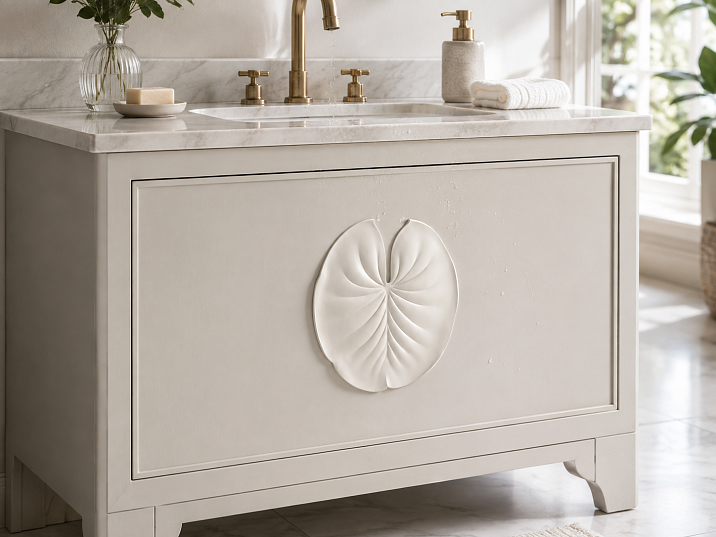
The vanity under the sink is already installed and painted, but the smooth facades look too plain. It's too late to change the furniture, ordering new doors is pointless, and a small relief accent could completely change the impression. In the catalog, I liked NPU-490 — a decorative polyurethane overlay in the shape of a water lily leaf, but a very practical question arises: is it worth adding such decor to bathroom furniture at all if water splashes regularly hit the facade?
Yes, NPU-490 can be considered for such a task. Polyurethane is chosen especially well here: the manufacturer directly states the possibility of using the overlay for furniture facades, bathrooms, and kitchens. But the moisture resistance of the part itself is only half the answer. The vanity is already painted, so before ordering, it is necessary to assess the condition of the coating, choose the right place on the facade, check the mounting compound, and decide how the finished decorative surface will be protected.
There is also a second question, no less important: which NPU-490 to buy? The model has two sizes — 100 × 110 × 6 mm and 128 × 140 × 6 mm. The small and large overlays differ not only in price. On a specific furniture facade, they give a completely different scale. Where 100 × 110 mm look like a neat accent, 128 × 140 mm can take up too much of the door. On a wide facade, the situation can be the opposite: the small leaf gets lost, while the large one confidently holds the center of the composition.
Therefore, a good result begins not with choosing "smaller or bigger," but with a real fitting. Take the door dimensions, make two paper templates, apply them to the painted vanity, and only then decide which buy decorative overlay NPU-490.
And one more fundamental clarification. The moisture resistance of polyurethane does not mean that you can forget about the furniture itself. If water gets on the overlay, the polyurethane decor and the painted furniture facade work as a single structure. The weak point may not be the NPU-490 leaf, but the old paint, the facade edge, the mounting layer, or the damaged base underneath.
That is why what is needed here is not fear of the bathroom or blind faith in the word "moisture-resistant," but a normal practical check.

What exactly you are buying: NPU-490 — a decorative overlay in the shape of a water lily leaf
NPU-490 is not a furniture handle, protective panel, or special water-repellent trim. It is a decorative polyurethane overlay in the shape of a water lily leaf, intended primarily to create a relief accent.
On furniture, such a detail works differently than molding.
Molding defines a line: it frames the facade, forms a border, and divides a large surface into fields.
NPU-490 works as an independent shape. It can be placed in the center of a door, shifted higher or lower in the composition, used as a single large overlay, or the motif can be repeated across several facades.
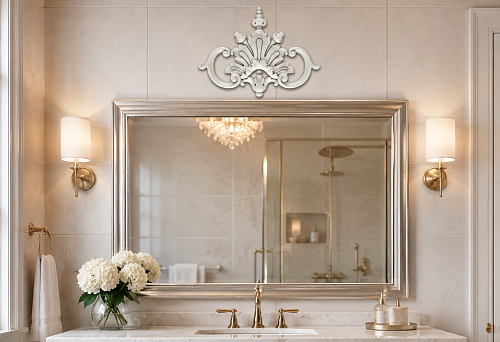
The water lily leaf shape is especially interesting for the bathroom. Here, the botanical pattern does not look out of place: it naturally connects with the theme of water, calm natural plasticity, and the soft lines of the sink, mirror, lighting, and plumbing. But this does not mean the overlay should automatically be placed on any vanity under the washbasin. First, proportions need to be checked.




Confirmed characteristics of NPU-490
| Parameter | Option 1 | Option 2 |
|---|---|---|
| Article number | NPU-490 | NPU-490 |
| Product type | Decorative overlay | Decorative overlay |
| Shape | Water lily leaf | Water lily leaf |
| Material | Polyurethane | Polyurethane |
| Size | 100 × 110 × 6 mm | 128 × 140 × 6 mm |
| Price at the time of writing the article | 1 180 ₽ | 1 750 ₽ |
| Application | Furniture facades, interior decor | Furniture facades, interior decor |
| Suitable for bathroom | Yes, given proper installation and the condition of the base | Yes, given proper installation and the condition of the base |
| Main check | Scale relative to the facade | Scale relative to the facade |
| Thickness | 6 мм | 6 мм |
| Product card | order NPU-490 made of polyurethane | order NPU-490 made of polyurethane |
It's better to check prices again in the product card before purchasing. But the dimensions for a preliminary fitting can already be used right now.
Our factory also produces:


Water on the facade is not a reason to automatically refuse a polyurethane overlay
When it comes to decor in the bathroom, three completely different situations are often mixed up.
The first is high air humidity.
The second is periodic splashes from the sink.
The third is constant direct wetting, when water regularly flows over the surface or lingers on it.
For a vanity cabinet, the second scenario is most typical. A person washes their hands, water from their fingers gets on the doors, children splash it more strongly, and after washing, individual drops remain. During cleaning, the front is wiped with a damp cloth.
It is in such real life that furniture must work.
Polyurethane NPU-490 is chosen for such an environment much more calmly than a material that reacts critically to every change in humidity. But one should not draw the following erroneous conclusion: since the overlay itself is moisture-resistant, water no longer matters at all.
It does.
Moisture contacts not only the polyurethane.
It gets on the paint.
It can linger at the edges of the decorative element.
It comes into contact with the mounting joint.
It gets on the front itself.
And if the door coating already has damage, the problem must be solved before gluing the decor.
Therefore, the phrase "NPU-490 can be used in the bathroom" means: the material of the overlay itself is suitable for a damp room. It does not mean: "you can pour water on any old cabinet, glue decor onto the first composition you find, and forget about the condition of the surface."
This is an important difference.
Get Consultation
First, inspect the cabinet without any decor.
The cabinet is already painted. This means that the existing coating is the starting point of the project.
Do not rush to apply the beautiful overlay.
Look at the door from the side in good lighting.
Are there any bulges?
Are there any cracks?
Is the paint peeling near the edge?
Is there a trace from regular splashes?
Has the surface near the handle softened?
Is there any damage near the top edge of the facade?
Has the geometry of the door itself changed?
If the facade is well preserved, you can proceed to decorative fitting.
If the coating is already damaged by water, NPU-490 should not be used as a way to hide the problem.
The relief can hide the stain from view, but it cannot restore a weak base.
First, furniture.
Then, decor.
Polyurethane is moisture-resistant, but the finished assembly consists not only of polyurethane.
This is perhaps the most useful principle for the entire article.
Imagine a simple structure:
facade → its existing coating → mounting compound → NPU-490 → decorative finish of the overlay.
Each layer has its own task.
If polyurethane withstands a humid environment, but the paint is peeling off the facade, one overlay won't fix the situation.
If the coating is durable, but an unsuitable mounting material is used, the joint may be weak.
If everything is secured correctly, but rough drips are left at the edges, the decorative element will look like a glued-on patch.
Therefore, for the bathroom, the entire system is evaluated.
It is this approach that allows using Polyurethane decorative appliques on furniture meaningfully, not experimentally.
If water only gets in splashes from the sink
For a regular cabinet, this is the most understandable scenario.
A few drops after washing up do not turn the facade into a shower wall.
If the cabinet is initially designed for use in a bathroom, its coating is intact, and water does not constantly stand on the surface, NPU-490 can be considered quite calmly.
Here, the location is more important.
The higher the overlay is located directly under the edge of the sink, the greater the likelihood that drops will regularly remain in the relief.
This does not mean that installation is prohibited.
But there will be more cleaning.
If the same sheet can be lowered slightly lower in the composition and removed from the most active splashing zone, such an option is usually more practical.
Decor should not unnecessarily complicate the normal use of the bathroom.
If water really flows down the facade
A completely different picture.
The sink is installed in such a way that water regularly overflows over the edge.
The joint near the countertop is not sealed.
After each wash, streaks run down the door.
The bottom part of the cabinet is constantly wet.
In such a situation, the NPU-490 issue is secondary.
First, the cause of constant wetting needs to be eliminated.
Even if the polyurethane pad itself withstands moisture, the furniture base may be less resistant. Constant water can get where the decorative element has nothing to do with: edges, joints, holes for hardware.
Therefore, NPU-490 is a moisture-resistant decor for furniture facades, not a way to compensate for a malfunctioning wet zone.
Two sizes of NPU-490: a small sheet and a large sheet solve different tasks.
The model does not just have a "small and large price."
There are two different compositional roles.
100 × 110 × 6 mm — a more compact option.
128 × 140 × 6 mm — noticeably larger.
Both are 6 mm thick, so the main choice is based on the facade area.
When 100 × 110 mm is more interesting
The compact NPU-490 is especially convenient if the cabinet is small.
For example, two narrow doors.
A low drawer front.
A cabinet with large handles that already require visual space.
A facade where you want to add a water lily leaf but keep enough smooth surface around it.
The smaller overlay fits more easily into a complex composition.
She does not require all furniture to obey only her.
When can you view 128 × 140 mm
The large NPU-490 starts working more confidently on a wide door.
If the facade is almost empty, the handle is small, and the cabinet itself is massive, a small overlay may look too cautious.
Then the size 128 × 140 mm creates a more noticeable botanical accent.
But the word "larger" does not mean "more expressive in all cases."
On a narrow door, a large overlay may come close to the edges, hinge side, adjacent facade, or handle.
That is why the size cannot be chosen from a catalog.
Comparison of two sizes in practice
| Situation | 100 × 110 × 6 mm | 128 × 140 × 6 mm |
|---|---|---|
| Narrow door | Usually easier to place | Requires careful fitting |
| Wide smooth facade | May look delicate | Creates a more noticeable accent |
| Large handle nearby | Leaves more free space | May start competing with the handle |
| Need several overlays | Gives a calmer repetition | Creates a rich rhythm |
| Small cabinet | Often more convenient in scale | May overload the facade |
| Large cabinet | A light accent is possible | Better holds a large surface |
| Decor in the color of the facade | Restrained relief | More readable light and shadow |
| Contrasting decor | Already quite noticeable | Becomes a strong center |
This is not a table of rigid rules.
This is a reason to do a fitting.
The most accurate fitting costs almost nothing
You don't need to have a designer's spatial imagination.
Cut out two paper rectangles:
100 × 110 mm;
128 × 140 mm.
Attach them to the cabinet.
It will immediately become clear how much the scale differs.
Then you can slightly round or trim the template, based on the actual shape of the water lily leaf.
Secure the paper with masking tape.
Leave for a day.
Use the bathtub as usual.
In the morning, look at the composition again.
Sometimes a variant that seems too small at first turns out to be much calmer in a daily interior.
Sometimes the opposite: after a few looks, it becomes obvious that a compact overlay gets lost on a wide door and you need the 128 × 140 mm size.
After such a check, you can already make sense NPU-490 100 × 110 mm buy or choose a larger modification in the same card.
The facade size is just the beginning: find its free decorative field
Suppose the door is 400 mm wide.
Can you place an NPU-490 with a width of 128 mm on it?
Physically, there is almost certainly room.
But that says nothing about the composition.
The same door may have a handle.
There is milling along the edge.
The countertop overhangs from above.
There is a decorative trim at the bottom.
Next to it is a second door.
Therefore, what is needed is not the overall facade size, but the free space.
It is this that determines the actual fit.
Measure the space between:
the edge of the facade;
the handle;
the existing relief;
the grip zone;
the adjacent door.
If the water lily leaf fits only mathematically, but is visually compressed on all sides, choose a smaller size.
Thickness of 6 mm for a furniture facade: a slight relief still needs to be checked.
Both NPU-490 have a thickness of 6 mm.
At first glance, this is a little.
And indeed, such an overhang allows the overlay to be considered as furniture decor, not as a heavy volumetric element.
But furniture is constantly moving.
Doors open.
Drawers slide out.
A hand passes near the facade.
Even 6 mm needs to be checked in a specific design.
Be especially careful — if the cabinet has:
two doors with a small gap between them;
the doors open at a wide angle relative to each other;
the overlay is placed close to the side panel;
a handle is located nearby;
there is a drawer above the hinged doors.
The universal phrase “6 mm won’t hurt anyone” would be incorrect.
The movement of real furniture is checked.
Make a three-dimensional mockup, not just a paper one
Paper shows the area.
But it doesn't show the thickness.
To understand the behavior of the 6-millimeter relief, glue a thin layer of cardboard or another material of approximately matching thickness to the paper mockup.
There's no need to reproduce the entire sheet exactly.
The main thing is to get the protrusion.
After that, open the cabinet several times.
Check the adjacent door.
Grab the handle with a wet hand.
Check whether the finger lands on the decorative zone.
This test is especially useful if the NPU-490 is planned close to the hardware.
Where to place the water lily sheet on the cabinet facade
The most obvious point is the center.
But the center is not always the best place.
A furniture front has its own logic.
If the handle is on top, a decorative overlay may look better lower down.
If the handle is centered, the sheet has to find another place.
If the door is tall, the accent can be raised slightly relative to the geometric center.
If the cabinet has two doors, two NPU-490s can work symmetrically.
Therefore, before gluing, mark at least three options with painter's tape.
Option 1. Central position
Works well on a smooth front without other expressive details.
Especially if the handle is small or placed separately.
Option 2. Slightly above center
Visually, this can make a low cabinet appear lighter and tie the decor to the sink and mirror area.
But too high a position increases contact with splashes.
Option 3. Slightly below center
Practical if the upper part of the facade is in an active wet zone.
This way the sheet remains noticeable but is less involved in daily contact with water and hands.
Don't look for mathematical universality.
Look at the specific furniture.
Place one sheet or two?
On a single-door cabinet, the question is almost resolved: one NPU-490 is usually perceived as a complete accent.
A choice appears on the two doors.
You can place one panel on each door leaf.
You can create one common center — but then you need to carefully ensure that the individual overlay does not hinder opening and does not cross the joint.
In most cases, repeating one piece per door is simpler and more logical.
Two identical NPU-490 create a rhythm.
But here too, you need to assess the scale.
Two large overlays of 128 × 140 mm on a small cabinet can visually fill almost the entire front plane.
Two pieces of 100 × 110 mm give more breathing room.
Make both versions out of paper.
Do not buy four overlays until you have seen at least two at full scale on your furniture.
Three doors — no longer just decor, but a rhythm
If there are three facades, each overlay begins to be perceived not separately.
The eye sees a row.
The slightest error in height becomes noticeable.
Different orientation of leaves — that too.
Therefore, for multiple facades, a common marking line is needed.
Check the same distance from the top or bottom edge.
Do not rely only on handles if they are installed with slight deviations.
Decor should bring the furniture together, not highlight old imperfections.
Overlay on a drawer: pay special attention to hands
If there are pull-out drawers under the sink, the NPU-490 can also be considered for them.
But here the decorative zone more often intersects with the grip.
A person pulls the drawer toward themselves.
Fingers slide across the facade.
Sometimes the hand is wet.
If the sheet is directly under the handle, the relief may be constantly felt by the fingers.
Before installation, conduct a household test.
Grab the handle.
Open the drawer ten times.
Not neatly for checking, but with a habitual movement.
If the palm constantly hits the layout, the position should be changed.
Why it's better to remove the overlay from the most active grip zone
Hands are often wet on bathroom furniture.
This means more contact with the surface.
If the NPU-490 is placed right where a person touches the facade every time, it gets dirty faster, and the complex relief has to be cleaned more often.
Why create extra work for yourself?
Let the decorative detail be near the functional zone, but not inside it.
This is especially relevant for a small cabinet where there is little free surface.
Sometimes shifting by a few centimeters solves both the design and the usability issue.
Can water get trapped in the leaf relief
Any relief surface collects drops differently than a smooth plane.
This is normal.
On a flat painted facade, water quickly runs down.
On a decorative pattern, individual drops may linger in recesses and along the edges of the relief.
There is no need to dramatize this property, but it is worth taking into account.
If the NPU-490 is located directly under a spot where splashes constantly fly, the decorative element will need to be wiped more often.
If the overlay is installed lower or to the side of the direct water trajectory, maintenance becomes easier.
This is why choosing the location is more important than the abstract debate about whether molding is allowed in a bathroom.
What moisture resistance of NPU-490 means in everyday use
Practically, it means that the very idea of a polyurethane sheet on furniture in a bathroom does not contradict the material.
Increased air humidity does not force you to abandon the decorative solution.
Splashes from the sink are also not an automatic prohibition.
Wet cleaning is acceptable as a natural part of use, provided the finish is suitable.
But the product should not be turned into a constantly flooded area just because it is polyurethane.
A good interior works not at the limit of the material's properties, but with a reasonable margin.
If the cabinet is made of painted MDF
This is a common but not the only option, so first clarify the material of your specific furniture.
If the facade is indeed made of painted MDF, then when installing NPU-490, the preservation of the paint layer and the protection of the edges are of primary importance.
The overlay itself is glued not to 'MDF in general,' but to an already existing painted surface.
This means the mounting compound interacts with the coating.
If the paint holds firmly, that is one initial situation.
If swelling or micro-cracks have already appeared near the sink, choose a different one.
Without inspecting the facade, you cannot give honest advice based only on the material name.
If the facade is laminated
Such a cabinet requires different surface preparation than a painted one.
But in our topic, the furniture is already painted, so there is no need to mix different technologies into one universal instruction.
If after careful inspection it turns out that the coating is not paint but film or another material, stop and choose installation specifically for the actual surface.
Do not transfer recommendations from one facade to another.
The coating has been in use for several years: this is even useful information
New paint almost always looks good.
A facade that has lived next to a sink for several years is much more indicative.
If after this time it:
has not swollen;
has not cracked;
has not changed geometry;
has no delaminations;
withstands wet cleaning normally,
this is a good sign of the existing system's resistance to real-world use.
In such a situation, adding a decorative overlay usually raises fewer questions than trying to decorate an already damaged door.
The coating has started to deteriorate: first repair
Do not glue NPU-490 over the delamination.
Do not use a beautiful sheet as a cover over swollen paint.
Do not cover a crack with a decorative part without understanding why it appeared.
The wet zone does not forgive mistakes.
A weak area will remain weak, even if high-quality polyurethane is on top.
Sometimes the right decision is to temporarily forgo decor and first put the furniture in order.
How to mount NPU-490 on an already painted cabinet
The main requirement for the mounting compound is compatibility with both sides of the joint at once:
polyurethane overlay;
the actual coating of the facade.
You cannot choose an adhesive based on only one side.
The phrase "suitable for polyurethane" does not yet guarantee that the composition works correctly with a specific enamel or other furniture coating.
Therefore, before installation, it is useful to study the recommendations on how which adhesive for stucco decor it fits your task, and if in doubt, clarify the compatibility of specific materials.
Be especially cautious about promises like "bonds everything."
It is easier to check this on a small test piece than on a finished facade composition.
Do not start installation without a test area
If there is an invisible part of the furniture or a separate sample of the coating, it is useful to test the chosen system on it.
How does the surface behave?
Does the paint soften?
Does its gloss change?
How well does the joint hold after full cure strength according to the instructions of the selected compound?
Such a check is especially valuable on an expensive cabinet that you don't want to repaint a second time.
Why you shouldn't apply too much glue "for reliability"
Excess compound doesn't automatically make the work stronger.
On the contrary, when pressed, it can squeeze out at the edges.
On a smooth furniture facade, a bulge around a thin 6 mm overlay is very noticeable.
And in the bathroom, there's another downside: an uneven edge is harder to clean properly.
Installation must be neat.
NPU-490 should be perceived as part of the facade, not as an item glued on top of it.
Before gluing, make control markings
You have already determined the position with the paper mockup.
But when the paper is removed, the eye easily makes mistakes.
Use easily removable alignment marks.
Mark the axis.
Position of the top point.
Side reference points.
If there are two overlays, mark both before starting installation.
Do not install the first one permanently, and then try to adjust the second one "by eye."
Furniture symmetry is read very quickly.
How to finish NPU-490 if the cabinet is already painted.
The calmest option is to bring the decorative element closer to the color of the facade.
Then the water lily leaf is read through light and shadow, rather than a contrasting spot.
On a light facade, the relief appears softly.
On a dark one, shadows can become deeper and more expressive.
But the exact painting technology cannot be assigned without knowing the coating of the existing furniture and the material system used.
Therefore, first determine:
what the cabinet is painted with;
what result is needed in terms of gloss;
what preparation system is recommended for the overlay itself and the chosen paint.
The main goal is that after the work is completed, the leaf looks like part of the furniture.
Why color matching still doesn't guarantee finish matching
Two surfaces can be the same shade and still look different.
One is matte.
The other is semi-matte.
One is smooth.
The other reflects light more strongly.
On a relief surface, the difference becomes especially noticeable.
Therefore, if NPU-490 is painted separately, compare it with the facade not only by color.
Look at it under the lighting that is actually used in the bathroom.
Especially in the evening, when the lights near the mirror create side glare.
Contrasting water lily leaf: beautiful, but more demanding
NPU-490 doesn't have to be hidden in the color of the cabinet.
You can make the leaf a visual accent.
For example, a light element on a dark door or vice versa.
But contrast sharply increases placement requirements.
Any misalignment becomes more obvious.
Different levels of two overlays on paired doors immediately catch the eye.
Additionally, a contrasting relief visually appears larger.
Therefore, 128 × 140 mm in a contrasting color can dominate more strongly than the same size painted to match the facade.
Try on not only the size, but also the future color.
For this, it is enough to paint the paper mockup in a similar shade.
A water lily leaf and the theme of water: do not turn the idea into literal decor
The connection of the NPU-490 shape with the bathroom is truly beautiful.
Water lily.
Water.
Sink.
Mirror.
But you don't need to fill the room with dozens of leaves just for thematic consistency.
One precise botanical motif can say more than many repetitions.
Especially on a compact cabinet.
If there is one leaf, it becomes an accent.
If there are two of them, symmetry appears.
If there are four or six, an ornamental system is already formed, requiring support in other interior details.
One NPU-490 on a wide central door
If the cabinet has one large door, it is almost an ideal platform for testing the idea.
Try both sizes.
The small 100 × 110 mm will leave a large calm field around itself.
The large 128 × 140 mm will more strongly connect the facade with the plant theme.
Choose not by price, but by which scale works better with the width of the door, the sink, and the mirror above it.
Two NPU-490 on symmetrical facades
For two identical doors, usually one model and one size are needed.
Do not place 100 × 110 mm on the left and 128 × 140 mm on the right, even if one door gets splashed with water a bit more.
The composition should maintain rhythm.
If two elements are required, you can first order one for a physical fitting, and after confirming the scale, order the second. Or order two at once if the paper mockup has already given a confident result.
Large overlay on each small door: a typical mistake
Each individual NPU-490 is beautiful.
But furniture is evaluated as a whole.
If a small cabinet has two narrow doors and a 128 × 140 mm sheet is installed on each, too little smooth surface may remain.
Instead of a light natural motif, a dense ornament will appear.
Therefore, the large size should be especially carefully tried on in pairs.
Small overlay on a huge cabinet: the opposite mistake
A large cabinet with wide fronts can "swallow" NPU-490 100 × 110 mm.
The product won't get worse.
The scale will simply be lost.
If there is a lot of empty surface around, 128 × 140 mm may look more convincing.
And sometimes even a large NPU-490 is not enough, and then the decorative system is supplemented with a frame.
NPU-490 inside a molding frame
This is already a more architectural approach to furniture.
First, a frame is built along the front.
A water lily leaf is placed inside it.
As a result, NPU-490 gets its own field and doesn't look randomly glued onto a smooth door.
If you want not just to add one detail, but to completely redesign the character of the cabinet, you can look at buy polyurethane moldings for furniture and assemble a composition in a single material.
But here it is especially important not to overload small furniture.
A vanity cabinet under the sink is usually significantly more compact than a wardrobe.
On it, the frame and central decor should leave enough free space.
Molding in the bathroom requires the same logic as an overlay
Polyurethane material is suitable for a humid environment, but the entire finished system still depends on the base, installation, and finishing.
You don't need to think that adding molding automatically makes the structure dozens of times more complex.
The principle is the same.
Clean layout.
Durable facade coating.
Proper installation.
Neat finishing.
If all this is observed, you can assemble a truly cohesive polyurethane furniture decor, not a set of disparate parts.
NPU-490 on a cabinet without handles
If the facades open by pressing, the decorative trim gets more freedom.
There is no metal handle competing with the panel.
You can place NPU-490 closer to the center.
But another limitation appears: the press zone.
If a person opens the facade every time by pressing exactly where the sheet is, the relief will constantly come into contact with the hand.
This is inconvenient and pointless.
First, determine the actual press point.
Place the decor outside of it.
NPU-490 next to a regular furniture handle
If the handle is already installed and there are no plans to change it, try the overlay together with it.
Not separately.
There are three possible outcomes.
First: the handle and the sheet perfectly divide their roles.
Second: they are too close and visually compete.
Third: the handle physically overhangs the relief, or the hand touches the overlay.
Only the first option is suitable for installation without further rework.
With a long handle, it is especially easy to overload the facade.
A long metal bracket by itself creates a strong horizontal line.
NPU-490 is an organic plant form.
On a small door, these two elements may start to compete.
Try a smaller size.
Or change the vertical position of the sheet.
If the composition still looks cramped, perhaps the overlay is not needed for this particular facade.
Giving up an extra detail is also part of good design.
With a small handle-button, there is more freedom.
A compact button takes up less space and does not create a long line.
In that case, the water lily leaf is easier to place nearby.
Sometimes the handle and the plate even form a common vertical axis.
But do not try to automatically mount the handle via NPU-490.
A decorative plate and furniture hardware solve different tasks, unless the card and the construction directly confirm another option.
Caring for NPU-490 in the bathroom should be simple.
If a decorative element requires a special ritual every time after washing your face, then the place is chosen poorly.
In a normal scenario, regular careful care of the furniture front and the decorative surface in accordance with its finish coating is sufficient.
It's better not to leave regular splashes to dry for weeks.
But fanatically wiping every drop immediately shouldn't be necessary either.
Properly placed decor fits into the regular bathroom cleaning routine.
The relief should be wiped gently
The water lily leaf has a pattern.
Strong mechanical impact is not needed here.
The main task is to remove water and household dirt without damaging the finish.
The type of cleaning agent should be chosen based on the specific coating used on the overlay and facade.
You shouldn't assume that the chemical resistance of a painted surface automatically equals the resistance of the polyurethane itself.
The principle of the whole system applies again.
Toothpaste, cosmetics, and soap — sometimes more important than plain water
The bathroom is not just humidity.
The following can get on the facade:
toothpaste splashes;
soap;
cosmetic products;
drops of care liquids;
cleaning compounds during cleaning.
Therefore, it is better not to place the decorative overlay where the contents of the countertop constantly flow onto it.
If there is a choice between two equally beautiful places, a calmer area is usually more practical.
If the sink is used by small children
Then the amount of water on the facade is almost always higher.
And the decorative composition should be designed specifically for the real family, not for a photo of the bathroom after cleaning.
Choose a position lower or to the side of the active splash line, if possible.
Also check whether children use the relief as a convenient point to grab the door.
The decorative overlay should not turn into a handle.
Guest toilet and main family bathroom — different modes
In the guest toilet, the vanity is used several times a day.
In the family bathroom — dozens of times.
The same NPU-490 will experience completely different loads.
Therefore, for the main bathroom, the following are especially valuable:
correct positioning;
free access for cleaning;
distance from the resting area
Neoclassical vanity: NPU-490 feels especially confident
Neoclassicism has a good balance.
The facade is structured but not overloaded.
Relief is present but does not fill the entire surface.
NPU-490 fits here naturally.
The small size can be used as a central insert.
Large — as a standalone ornament on a wide door.
If you add a thin polyurethane molding, you get a finished furniture composition.
Classic bathroom: watch the number of details
In a classic interior, there is a temptation to add more.
Another molding.
Another rosette.
More gilding.
Another ornament.
NPU-490 is expressive enough on its own.
On a small cabinet, a plant leaf can work better than a complex multi-element scheme.
Stopping in time is also a professional skill.
Eco-mood without literal 'green' decor
The water lily shape is connected to nature by itself.
Therefore, it is not necessary to paint the overlay green.
In the color of the cabinet, it still retains its natural plasticity.
Sometimes it is the solid-color version that looks much more mature and calmer.
Light creates the pattern.
Shadow emphasizes the veins and relief.
Color does not have to explain to the viewer that it is a leaf.
What to buy together with NPU-490
If the task is simple, the shopping list should also be simple.
| What to look at | When needed | What to pay attention to |
| buy decorative overlay NPU-490 | One or more water lily leaves are needed on the facade | Choose 100 × 110 or 128 × 140 mm |
| Buy decorative furniture overlays | NPU-490 is not suitable in scale or additional decor is needed | Compare shape, size, and thickness |
| Polyurethane decorative appliques | The product type "overlay" is specifically needed | Do not mix random ornaments |
| You can buy ready-made stucco matching the Baroque style. Calculate the quantity: linear meters of cornices and moldings, number of rosettes, pilasters, consoles, corner elements. Add a ten to fifteen percent allowance for trimming. | Not only the cabinet is updated, but also the bathroom interior | First determine the overall composition |
| buy polyurethane moldings for furniture | A frame around NPU-490 is needed | Check the free field of the facade |
| molded decoration adhesive | Before final installation | Check compatibility with the cabinet coating |
There is no need to buy everything from the table.
It shows a possible route.
For one smooth cabinet, two NPU-490 and a suitable mounting system may be enough.
When one NPU-490 is enough
If the cabinet is single-door and the facade has a good size, one sheet often completes the task.
Especially when:
the handle is small;
the furniture itself already has an expressive color;
the mirror and plumbing fixtures are quite active;
there is not much other decor in the bathroom.
You don't need to add molding just because it exists.
A single leaf can look much more modern.
When to consider other decorative overlays
NPU-490 may be appealing in the catalog but not suit a specific cabinet.
This is normal.
The reasons can be very practical.
Both sizes are too large.
The shape conflicts with the handle.
The sheet does not fit between the existing milling.
The cabinet is too narrow.
Need to cover an elongated defect.
There is already another ornament that the water lily does not match.
Instead of forcing the facade to accept NPU-490, it is better Buy decorative furniture overlays of a different size or pattern.
Product selection should follow the furniture.
Not the furniture after the product.
When instead of an overlay, a molding is better
Sometimes a smooth facade seems empty not because there is a lack of ornament in the center.
He lacks structure.
Then the central leaf may not solve the problem.
The molding frame creates geometry.
The door becomes visually more cohesive.
And only after that it is decided whether an NPU-490 is needed inside the frame.
If in doubt, make two mockups.
The first one is just the leaf.
The second one is a paper frame plus the leaf.
The difference becomes obvious.
The overlay must not cover the technological gaps.
Do not install the NPU-490 so that it overlaps the joint between the doors.
Even if it seems that a beautiful panel could connect the two doors.
The cabinet must open independently.
The decorative element is attached to a specific facade and moves with it.
If you want to create a unified composition across two doors, it is better to use two separate overlays with clear symmetry.
Do not place the panel too close to the bottom edge.
The lower part of the facade is more often exposed to wet floor cleaning, accidental impacts, and contact with feet.
Additionally, overly low decor visually "drops" the composition.
Exceptions are possible, but they must be deliberate.
In most cases, the NPU-490 will find a more neutral spot closer to the central part of the facade.
The upper zone is also not always the best
Too high a position brings the panel closer to the countertop and sink.
There are more splashes here.
Less free space.
The sheet may look squeezed between the handle and the top edge.
Therefore, mark the position on the facade and look at the cabinet from the usual entry point to the bathroom, not just standing half a meter away from it.
Why sheet orientation matters
NPU-490 has a recognizable natural shape.
Even if it is close to symmetrical, the direction of the relief is readable.
On two doors, the same orientation can create a calm repetition.
Mirror or reversed layout — a more dynamic composition.
Don't make this decision with glue already on the part.
Rotate the paper templates.
Photograph the options.
Look at it later with fresh eyes.
Photography helps you see what the eye misses.
When you stand in front of your furniture for a long time, you get used to it.
Through the camera, the composition is perceived differently.
Take a photo of the cabinet with the paper NPU-490.
Then reduce the image on the screen.
This makes it easier to assess the overall balance.
If only huge leaves are visible on the thumbnail, the size or contrast is likely too strong.
If the decor disappears completely, a larger option may be needed.
The large NPU-490 does not necessarily look heavier
If the facade is wide and the overlay is painted in the same color, 128 × 140 mm may look calmer than a small contrasting plate of 100 × 110 mm.
Size is only one factor.
Perception is also influenced by:
color;
light;
position;
surroundings;
handles;
moldings;
the size of the cabinet.
Therefore, do not draw conclusions based only on millimeters.
Why 6 mm can be an advantage specifically on furniture
On furniture facades, overly deep decor sometimes starts to live its own life.
It protrudes more strongly.
It collects shadows more strongly.
It affects the grip more.
The 6 mm thickness of NPU-490 allows for a relief without turning the sheet into a massive three-dimensional structure.
But this advantage is only revealed when installed in the right place.
If 6 mm already conflicts with the adjacent facade, even such a thickness is unacceptable for specific furniture.
Consider the mirror above the cabinet
A cabinet is rarely perceived on its own.
There is a mirror above it.
Lamp.
Sink.
Mixer.
Possibly wall sconces.
If the mirror has a complex decorative frame, another rich ornament on the vanity may be superfluous.
If the mirror is very simple, NPU-490 will, on the contrary, add the missing character.
The entire vertical composition should be evaluated.
From the floor to the light above the mirror.
Connection with the sink shape
A rounded bowl and a water lily leaf have a natural plastic connection.
With a strict rectangular sink, the leaf creates a contrast between geometry and nature.
Both solutions can be good.
They're just different.
Don't look for a rule like "only this decor for this sink."
Look for the character that the whole bathroom needs.
Black faucet and plant relief
Contrasting metal plumbing already strongly affects the interior.
If the faucet, handles, and mirror have black lines, NPU-490 can be left in the facade color without introducing another accent color.
Then the vanity gets relief, while the metal group retains its graphic role.
If you make the leaf itself contrasting, the interior becomes significantly more active.
First try this on a mockup.
Brass hardware: not necessarily gild the overlay
A common temptation is that if the handles are brass, then the panel should be made gold.
Not necessarily.
In the color of the facade, NPU-490 can give a much more subtle result.
The brass will remain hardware.
The panel will be an architectural relief.
It is the separation of roles that often makes furniture visually more expensive.
White cabinet: the relief is read by light
On a white facade, white NPU-490 does not disappear.
It becomes calmer.
The relief catches side light.
The recesses become grayer.
The bulges are lighter.
This is especially noticeable with side sconces near the mirror.
So before looking for a contrasting color, see how a solid-color sheet behaves in the actual lighting of the bathroom.
Dark cabinet: attention to water marks
Dark facades often show dried droplets more clearly.
Decorative relief here adds another surface to maintain.
This doesn't make NPU-490 a bad idea.
Just the installation location should be chosen especially wisely.
If white water marks always remain right under the sink, it's better not to place complex decor in the most problematic spot.
Mistake #1: considering moisture resistance as permission for any installation
Polyurethane is suitable for damp rooms.
But the connection to the furniture still needs to be done correctly.
You cannot glue NPU-490 over peeling paint and explain the future problem by bathroom humidity.
The base was weak.
Mistake #2: buying a large size because it is "more beautiful"
In the catalog, a large sheet shows more relief.
On a small cabinet, it can fill almost the entire facade.
First, a mockup of 128 × 140 mm.
Then, the decision.
Mistake #3: choosing a smaller size just to save money
There is a price difference, but the wrong scale is more noticeable than the cost difference.
If 100 × 110 mm really gets lost on a large facade, savings won't make the composition better.
Mistake #4: not checking the wet zone
A beautiful spot for the overlay may coincide with the point where water splashes after every hand wash.
Move the layout a few centimeters and compare.
Sometimes the practical option looks even better.
Mistake #5: forgetting about hands
The overlay should not interfere with opening the cabinet.
The embossed sheet next to the handle is checked with a real grip.
Mistake #6: gluing immediately after unpacking without a dry fit
Even if the dimensions are known in advance, the actual part must be held against the facade before final installation.
Paper helps choose the product.
The product itself confirms the decision.
Mistake #7: trying on one overlay when you need two
On a two-door cabinet, the pair determines the result.
Immediately place two paper templates.
Mistake #8: hiding facade damage with an overlay
NPU-490 — decor.
Not a repair of a weak base.
Swelling and peeling are eliminated first.
Mistake #9: not checking the finish
The overlay is painted the correct color, but has a different gloss.
The result looks foreign.
Evaluate the entire finish, not just the shade.
Mistake #10: mixing too many different ornaments
A water lily leaf has its own character.
If there are already rosettes, acanthus, geometric frames, and complex handles nearby, another shape can create a mismatch.
Sometimes it's better to remove one element than to add two more.
Mistake #11: considering the bathroom exclusively as a decorative room
The cabinet is used every day.
It is opened with wet hands.
They wipe it.
They touch it.
Household chemicals are stored nearby.
Any decoration must withstand real life not only in material but also in placement.
Mistake #12: gluing an element too close to the edge
Even if there is physically space, a small remainder of free surface near the edge can look accidental.
Moreover, furniture edges are often the most sensitive to water.
Give the decor visual space.
Who NPU-490 is really suitable for
This model is especially interesting if the cabinet is already painted and in good condition, but its fronts seem too plain.
If you want to change the furniture without replacing the doors.
If the interior allows for a botanical motif.
If polyurethane is deliberately chosen for a wet area.
If one of the two sizes fits well on the actual facade.
If the installation location does not coincide with the permanent grip zone.
If the overlay does not interfere with opening.
If installation can be done on a durable existing surface.
Then NPU-490 meets the task very precisely.
In which cases it is better to choose a different decor
This particular model is not suitable if both sizes are inconvenient.
If the leaf looks too large.
If the shape is not supported by the interior.
If the hardware is already very decorative.
If the facade has active milling.
If there is little free flat space.
If the furniture surface is damaged.
If the only possible place is constantly flooded with water.
In that case, it is wiser to open the section Buy decorative furniture overlays and look for another scale or pattern.
For those who do not need applied decor at all
There are cabinets that look good precisely when smooth.
Minimalist facade.
Hidden profile instead of a handle.
Monolithic stone sink.
Very strict bathroom geometry.
Adding a water lily leaf can destroy this integrity.
You don't need to buy decor just because technically it can be glued on.
NPU-490 should improve specific furniture, not just be present on it.
Practical scenario: a small two-door cabinet
Two identical doors.
A small round sink.
The handles are located closer to the center.
First of all, I would try two templates 100 × 110 mm.
One on each door.
The large size is also worth checking, but buying it without a mockup is risky: two sheets of 128 × 140 mm may take up too much area.
If the small NPU-490s provide the desired relief and leave air around, the task is solved.
Practical scenario: a wide cabinet with one door
Here, the size 128 × 140 mm already looks significantly more interesting.
Especially if the facade is large and smooth.
But before ordering, check where the handle is.
If it runs through the center, the sheet may need an offset.
If the handle is small and positioned higher, the NPU-490 can be placed lower to create a clear vertical composition.
Practical scenario: three drawers under the sink
With three horizontal fronts, a rhythm emerges.
It's not necessary to install an NPU-490 on every drawer.
Sometimes a single sheet on the widest bottom front looks more convincing than three repeats.
Sometimes the opposite—three small overlays create an interesting sequence.
Mockups will provide the answer faster than any words.
Practical scenario: water constantly hits the top drawer
If the top front gets wet every day, it's not necessary to install an NPU-490 there specifically.
Move the main decorative accent lower.
The furniture is still perceived as a whole.
This is a good example of how practicality can improve the composition.
Practical scenario: the cabinet is already painted in a complex color
For example, deep green, gray-blue, or warm beige.
This is where the solid-color NPU-490 can look especially striking.
Texture is added without a new color.
But finding a perfectly matching finish on already finished furniture is sometimes harder than it seems.
First, a test sample.
Then, the final painting of the part.
Practical scenario: you only want one small accent
Take both paper sizes.
Start with 100 × 110 mm.
If it doesn't get lost, maybe no more is needed.
A small sheet often gives a more modern sound.
Practical scenario: the facade looks empty even with a large sheet
Then the problem is most likely not the size of the NPU-490.
The facade lacks structure.
Consider the option with a molding frame.
And only after that decide whether a sheet is needed inside it.
Practical scenario: the cabinet stands flush against the wall
If the outermost door opens near a wall, the relief on its outer part requires additional checking.
Don't look only at the closed furniture.
Open the door to the actual working angle.
Make sure the NPU-490 does not touch adjacent surfaces anywhere.
Practical scenario: the furniture is used in a children's bathroom
Here I would especially appreciate the smaller size and placement out of the reach zone.
Not because a large handle is bad.
It's just that the less the decorative element is involved in daily opening and closing with wet hands, the calmer the operation.
Practical scenario: guest bathroom
In a guest room, you can afford a more accent-oriented option.
Large sheet 128 × 140 mm.
Contrasting trim.
A more complex frame.
The load on the furniture is lower, while the decorative role of the room is higher.
But even here, the size of the facade remains the main constraint.
Do you need to buy a spare NPU-490?
For a single decorative element, a spare is usually not required automatically.
If two identical parts are installed on the cabinet, order the required quantity.
If the project is large and NPU-490 is repeated on several pieces of furniture, an additional element is sometimes convenient as a reserve.
But you don't need to buy extra overlays just out of fear of the bathroom.
The material is chosen specifically with the possibility of use in a damp room in mind.
How to calculate the quantity
For a regular cabinet, the calculation is elementary.
One single-leaf door — usually one overlay.
Two identical doors with a symmetrical layout — two.
Three facades — from one to three depending on the composition.
There is no rule of "one sheet per door."
Don't count furniture parts.
Count the decorative layout.
Can NPU-490 be combined with other leaves?
You can, but carefully.
With plant decor, it's especially easy to get the effect of a botanical collection instead of furniture.
If NPU-490 is already the main leaf, additional elements should support it, not compete.
For a small cabinet, one type of overlay is usually enough.
Why it's useful to open the catalog even after choosing NPU-490
Because comparison confirms the decision.
Sometimes a person sees NPU-490 first and immediately falls in love with it.
After viewing others polyurethane decorative overlays it becomes clear: yes, the water lily leaf is the best fit.
And sometimes a detail is found that more precisely matches the narrow facade.
A catalog is not needed to necessarily change your choice.
It is needed so that the choice stops being random.
Why polyurethane decor is especially interesting for ready-made furniture
New furniture is designed as a whole.
Decor can be incorporated at the facade stage.
With a ready-made cabinet, the situation is different.
The body already exists.
The color is chosen.
The sink is installed.
The hardware works.
You need to change the appearance without ruining everything else.
An overlay element is good precisely because of the pinpoint nature of the intervention.
A new facade is not required just for the sake of relief.
There is no need to redesign the cabinet.
If the NPU-490 fits in scale and operating conditions, it is added to the existing furniture.
How to buy NPU-490 without unnecessary alterations
The procedure is very simple.
First, measure the facade.
Then make two mockups.
After that, choose the location.
Check the handles.
Check the movement of the doors.
Assess the actual wet zone.
Inspect the existing covering.
Decide whether the overlay will match the facade color.
Select a compatible mounting system.
And only now open the card to buy decorative overlay NPU-490.
Thus, the purchase becomes the final action, not the beginning of an experiment.
FAQ: answers to popular questions about NPU-490 on bathroom furniture
Can NPU-490 be used on a cabinet under the sink?
Yes. NPU-490 is made of polyurethane, and its use is intended, among other things, for furniture facades and bathrooms. However, you need to check the condition of the cabinet itself, the mounting material, and the installation location.
Will NPU-490 be damaged by water splashes?
Polyurethane was chosen specifically as a moisture-resistant material. Ordinary splashes near the sink are not in themselves a reason to refuse NPU-490. But the finished structure also includes the facade coating, glue, and the overlay finish, so the entire assembly needs to be evaluated.
Can NPU-490 be installed where water constantly flows down the door?
If water really regularly flows down the facade, it is better to first eliminate the cause of constant wetting. The decorative overlay does not replace proper protection of the furniture itself from leaks and improper operation of the wet area.
What size of NPU-490 should I choose for the cabinet?
The card offers 100 × 110 × 6 mm and 128 × 140 × 6 mm. The best way to choose is to make paper mock-ups of both sizes and apply them to the actual facade.
How much does NPU-490 cost?
At the time of writing the article, the 100 × 110 × 6 mm option costs 1,180 ₽, and the 128 × 140 × 6 mm option costs 1,750 ₽. Before ordering, the current price must be re-checked in the product card.
What material is NPU-490 made of?
NPU-490 is made of polyurethane. It is this material that allows the decorative overlay to be considered for use in the bathroom and kitchen.
What does NPU-490 depict?
This is a decorative overlay in the shape of a water lily leaf with a plant-like relief pattern.
Can NPU-490 be glued onto an already painted facade?
Such installation can be considered if the existing coating adheres firmly and the chosen mounting adhesive is compatible with both the polyurethane and the specific paint or other finish of the facade.
What to do if the paint on the cabinet near the sink has already blistered?
First, repair the facade. NPU-490 should not be used to hide a weak or peeling coating.
Is it necessary to remove all the paint before installing NPU-490?
There is no universal answer. It all depends on the condition and type of the existing coating and the requirements of the chosen mounting system. A well-preserved painted facade and a deteriorating coating require different approaches.
Which glue should I use?
A compound compatible with the polyurethane decor and the actual furniture coating is needed. Before installation, you can study the material molded decoration adhesive and check the characteristics of the selected product.
Won't 6 mm interfere with opening the door?
On most free facades, such a relief looks compact, but universal compatibility cannot be guaranteed. Check adjacent doors, side panels, and the opening trajectory using a 3D mockup.
Can NPU-490 be placed next to a furniture handle?
Yes, if the overlay does not interfere with the grip and visually matches the handle. Be sure to try both elements together.
Can a handle be placed directly on top of NPU-490?
The decorative overlay should not be considered a standard structural base for hardware without separate confirmation of such a scheme. It is safer to separate decorative and functional tasks.
Is it better to use one sheet or one sheet per door?
It depends on the cabinet design. On one door, one accent is natural. On two identical facades, two identical overlays often provide clear symmetry. But both options should first be checked with a mockup.
Can different sizes of NPU-490 be used on the same cabinet?
Technically, items of the same article are available in two sizes, but on identical symmetrical doors, different scales more often disrupt the rhythm. Different sizes are more interesting to consider on facades that truly differ in dimensions and role.
Which size is better for a small cabinet?
Usually, it's best to first try 100 × 110 mm. But even this option needs to be checked at full scale: small cabinets vary greatly in door width and handle placement.
Which size is better for a wide facade?
128 × 140 mm can work more confidently on a large smooth surface. However, the larger option should not come too close to edges, handles, or neighboring decor.
Can NPU-490 be painted to match the cabinet color?
Such a decorative approach is possible and often helps visually unify the overlay with the furniture. The specific preparation and painting system is selected based on the polyurethane and the actual facade coating.
What is better for a bathroom — a contrasting NPU-490 or one matching the facade color?
If a calm architectural relief is needed, the facade color usually makes the decor softer. A contrasting sheet becomes a standalone accent and requires especially precise marking.
Will water accumulate in the relief?
The textured surface holds individual drops differently than a smooth facade, so it is better not to place the overlay at a point of constant direct splashing if there is an equivalent calmer spot.
How to care for NPU-490?
Care depends primarily on its finish coating. In a regular bathroom, it is enough to regularly remove water and household dirt using a gentle method suitable for the finish used.
Can NPU-490 be used on kitchen furniture?
Yes, the NPU-490 card also provides for use in the kitchen area due to the properties of polyurethane. But kitchen dirt differs from bathroom dirt, so the requirements for the finish and care may be different.
What to do if no NPU-490 size fits?
Do not try to squeeze the sheet onto the facade. Open the section where you can Buy decorative furniture overlays, and choose a different size or shape.
Can NPU-490 be supplemented with molding?
Yes. If a smooth facade lacks structure, you can consider Polyurethane moldings for furniture and create a frame around the central overlay.
Do you need a spare NPU-490?
For a regular cabinet, the quantity provided by the composition is sufficient. There is no need to automatically buy a spare due to use in the bathroom.
Where to buy NPU-490?
Both sizes are in the same STAVROS listing: buy decorative overlay NPU-490. Before ordering, select the desired size and check the current price again.
NPU-490 in the bathroom: the right question is not "is polyurethane afraid of water," but "is the whole system assembled correctly"
A cabinet under the sink does not become an unsuitable place for decorative molding just because water is nearby. NPU-490 has exactly the property important for this task: the overlay is made of polyurethane, and its use is intended on furniture facades, in the bathroom, and in the kitchen.
But you still shouldn't buy a water lily sheet based only on the word "moisture-resistant."
Check the furniture.
The coating must be durable.
Blisters and damage are repaired first.
Then choose the size.
100 × 110 × 6 mm is suitable where a more compact accent is needed.
128 × 140 × 6 mm works better on a large smooth surface.
Both options are better to cut out from paper first.
After that, find a place where fewer direct splashes reach, but where the sheet remains clearly visible.
Check the handle.
Check the opening.
Simulate the 6 mm thickness.
Decide on the color.
Select a molding to match the existing covering.
Only after these steps should you order NPU-490 made of polyurethane.
If everything matches, there is no need to replace an already painted cabinet or order new facades just for a decorative relief. The overlay is added to the existing furniture and turns an ordinary smooth door into a more expressive surface.
If NPU-490 turns out to be too large, too small, or conflicts with the handles, the solution is also simple: don't force it to fit. In the catalog, you can Buy decorative furniture overlays of a different scale, and for a more complex remodel, complement the facade with polyurethane moldings with a molding frame.
STAVROS allows you to start from the specific furniture rather than an abstract catalog: choose a shape, compare two sizes of NPU-490, check other overlays, and assemble as much decor as a particular cabinet actually needs.
This is how a moisture-resistant decorative overlay becomes not a random decoration near the sink, but a part of the furniture—appropriate in scale, convenient for daily use, and aligned with the real conditions of the bathroom.