Article Contents:
- What is confirmed for KPU-110
- First, decide where KPU-110 physically lies
- Molding on the wall around the mirror
- Molding partially overlaps the mirror
- Molding is on a separate substrate
- Three frames
- One common frame
- Error 8. Placing KPU flush against the slats
- Can you make a common frame if three mirrors have different widths?
- Do you need to install KPU-110 between mirrors with a common frame?
- Can you make only vertical KPU lines without top and bottom frames?
- What to do if one mirror is taller than the other two?
- Can KPU-110 be used around mirrors in the bathroom?
- How to calculate KPU if the distance between mirrors is not 50 but 80 mm?
- Can you first buy three strips and then buy the rest later?
- If one common frame requires four slats, why not make it from three with joints?
- Can KPU-110 be painted to match the color of slat panels?
- Where can I see a wider profile for a common mirror composition?
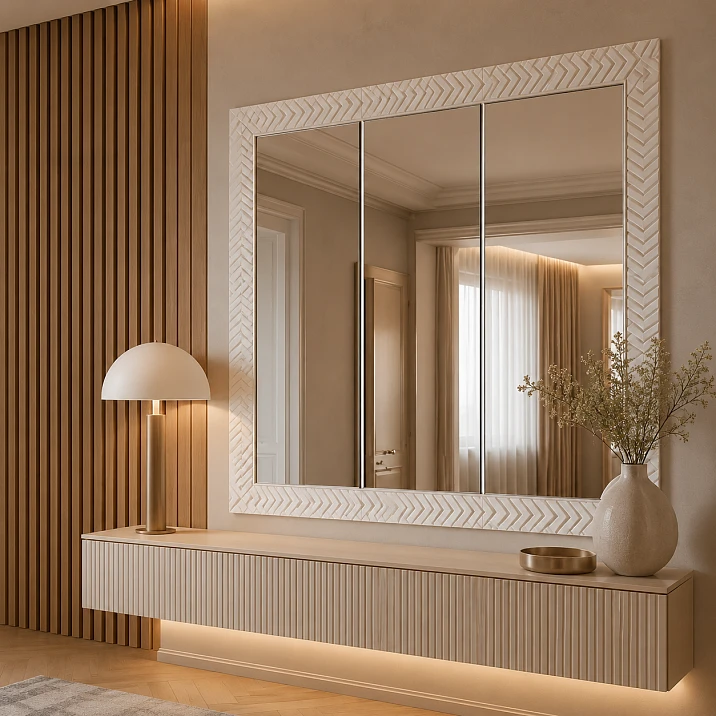
Three narrow vertical mirrors next to a slat wall already create their own rhythm. Adding decorative molding to them should be done carefully: the same KPU-110 can either neatly assemble the mirror composition or turn the wall into a set of too frequent verticals.
Here there are two truly different solutions.
Option A — three independent frames. Each mirror gets four sides of KPU-110 and reads as a separate object.
Option B — one common frame. Three mirrors remain inside a common outer contour and are perceived as a single mirror panel.
The difference between them is not only stylistic. It changes:
-
the number of two-meter strips;
-
order cost;
-
number of corners;
-
the number of potential joints;
-
free space in the gaps between the mirrors;
-
the frequency of vertical lines next to the rails;
-
the complexity of the layout;
-
the scope of future repairs if one section is damaged.
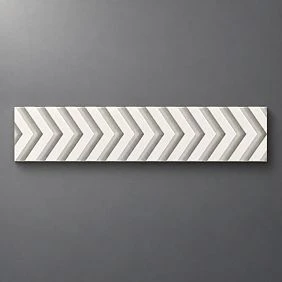
KPU-110 from STAVROS belongs to decorative polyurethane moldings. The current product card shows dimensions A × C × L = 20 × 4 × 2000 mm, material — polyurethane, current price 4,360 ₽ per one two-meter strip.
For the original example with three mirrors 350 × 1200 mm, the rough total perimeter of three separate mirrors is indeed:
3 × 2 × (350 + 1200) = 9300 mm, or 9.3 linear meters.
But buying moldings using the formula 9300 / 2000 = 4.65 → 5 strips Impossible.
Each mirror has two vertical sides of 1200 mm. There are six such segments in total. Two segments of 1200 mm do not fit into one 2000 mm strip. Already for this reason, for three separate frames, at least six strips are required, even before specifying the corner geometry.
At a price of 4,360 ₽:
6 × 4 360 = 26 160 ₽.
For one common frame around a compact group of the same mirrors, the consumption can be reduced to four, and for a narrower common group — to three strips.
Therefore, the direct answer is:
Next to a slat wall, one common frame should be checked first if three mirrors are meant to be perceived as a single panel and the gaps between them are narrow. Three separate frames are justified if each mirror is truly meant to be an independent object and there is enough space between the mirrors for two strips of KPU-110. The quantity is ordered only after the cut-list — a list of specific segments, not based on a single perimeter.
What is confirmed for KPU-110
| Parameter | KPU-110 |
|---|---|
| Product type | decorative linear molding |
| Material | Polyurethane |
| Size A | 20 мм |
| Size C | 4 мм |
| Length L | 2000 мм |
| Current price | 4,360 ₽/pc. |
| Basic task of the article | frame composition on the wall around mirrors |
| Quantity | is calculated based on cutting |
On STAVROS pages for linear profiles, parameter A is used as the profile width, C as the protrusion height, and L as the strip length. For KPU-110, this gives 20 mm of face width, 4 mm of relief, and 2000 mm of length.
After calculating a specific layout, you can Buy decorative polyurethane molding KPU-110.
It is important to maintain the correct product type. KPU-110 is a linear profile. The article can discuss the framing function, but there is no need to rename a specific SKU to baguette or molding just for the sake of a search phrase.




First, decide where the KPU-110 is physically located.
The phrase "to frame a mirror" allows for several different mounting schemes.
Our factory also produces:
Linear profile on the wall around the mirror
This is the main scenario of the article.
The mirror has its own mounting. KPU-110 is mounted on the wall surface next to the mirror edge and performs only a decorative function.
This makes it easier to divide responsibility:
-
the mirror is held by the standard mounting system;
-
KPU creates the contour;
-
the linear profile does not hold the mirror;
-
A decorative profile does not have to protect the edge of the glass.
Get Consultation
The trim partially overlaps the mirror.
This option cannot be considered automatically acceptable. It needs to be checked separately:
-
compatibility of the adhesive with the mirror surface;
-
impact on the reflective layer;
-
possibility of subsequent dismantling;
-
actual pattern of the profile;
-
how neat the transition from the wall to the glass looks.
The article does not use this scheme as a baseline.
The trim is on a separate backing.
If the mirrors are built into a decorative panel, the KPU can lie on a painted MDF substrate or another designed surface.
Then all frame dimensions are calculated based on this substrate, not automatically based on the mirror glass size.
Before ordering, you need to precisely determine on which plane the 20-millimeter KPU-110 strip will lie.
Why three mirrors next to the slats already create a strong vertical rhythm
A slat wall works through repetition:
slat — gap — slat — gap.
Three narrow mirrors add three more vertical fields.
If each mirror gets a separate frame, six vertical side lines of KPU-110 will appear.
That is, three levels of vertical rhythm appear side by side at once:
-
frequent slats of the slat wall;
-
vertical edges of three mirrors;
-
six vertical sides of three frames.
One common frame reduces the third level to two outer verticals.
This does not mean that a common frame is always better. But next to an active slat wall, it is usually a calmer starting point for a layout.
Three separate frames emphasize repetition more strongly.
A common one emphasizes the unity of the group more strongly.
It is this design difference that is then tested through cost and expense.
Gaps between mirrors and rhythm: will three separate frames even fit
Suppose KPU-110 is installed on the wall outside the mirror contour.
Profile width is 20 mm.
In the gap between two adjacent mirrors, the following meet:
-
the right side of the first mirror's frame — 20 mm;
-
the left side of the second frame — 20 mm.
Only two profiles occupy:
20 + 20 = 40 mm.
If the distance between mirror edges is 50 mm, after two KPUs remains:
50 − 40 = 10 mm of clean wall strip.
This is already a very tight joint.
If the gap is 40 mm, the two profiles actually converge with each other.
If the gap is 30 mm, two independent frames in such a scheme physically begin to intersect: 40 mm of profile needs to be placed in a 30-millimeter strip.
Therefore, individual frames cannot be chosen just by taste.
First, the actual net distance between the mirrors is measured.
| Gap between mirrors | Two KPUs of 20 mm each | What remains |
| 30 мм | 40 мм | profiles conflict |
| 40 мм | 40 мм | no free field |
| 50 мм | 40 мм | 10 мм |
| 70 мм | 40 мм | 30 мм |
| 100 мм | 40 мм | 60 мм |
This is not a table of "normal indents." It shows pure geometry.
The visually comfortable field is determined by the layout.
For the overall frame, there are no KPUs inside the gaps between the mirrors. Therefore, the original gaps are fully preserved.
An overall frame does not mean that the mirrors must touch each other
Three mirrors can remain as separate panels with noticeable gaps.
The overall KPU outline simply frames them as one panel.
For example:
mirror 350 mm → gap 50 mm → mirror 350 mm → gap 50 mm → mirror 350 mm.
Width of the mirror group:
350 × 3 + 50 × 2 = 1150 mm.
Inside the common frame, three separate vertical mirrors are still visible.
But the decorative line runs only on the outside.
Thus, the internal gaps become part of the composition, not a place for four more vertical strips of molding.
Before calculating the strips, determine the control size of the frame
There is a fundamental difference between three values:
-
mirror size;
-
frame inner opening size;
-
frame outer size.
If KPU-110 has a face width of 20 mm and its inner edge coincides with the mirror edge, the outer frame dimension increases by 40 mm on each axis:
20 mm on the left + 20 mm on the right;
20 mm on top + 20 mm on the bottom.
For a 350 × 1200 mm mirror, the outer dimension of such a frame will be:
390 × 1240 mm.
If the designer says “frame 350 × 1200 mm” and means the outer dimension, the calculation will be different.
Therefore, in the working sketch, it is mandatory to indicate what the numbers refer to:
internal light size / external size / profile axis.
This is exactly what prevents the error when the total footage seems to be calculated correctly, but the finished frame turns out to be 40 mm wider and taller than expected.
Three separate frames 350 × 1200 mm: why rough 9.3 m turns into six slats
First, it is useful to keep the original user calculation.
For three mirrors 350 × 1200 mm, the total glass perimeter is:
3 × 2 × (350 + 1200) = 9300 mm.
This is a good reference for understanding the scale.
But if the KPU-110 lies outside the mirror and its inner edge coincides with the edge of the glass, for a frame with miters you need to take into account the face width of 20 mm.
In the selected calculation scheme, the external dimension of one frame is:
390 × 1240 mm.
For three frames you need:
-
6 vertical parts of 1240 mm each;
-
6 horizontal parts of 390 mm each.
Total length along the long sides of the parts:
6 × 1240 + 6 × 390 = 9780 mm.
This is already closer to a real cut-list than 9.3 m around the mirror perimeters.
Now the main thing — we lay out the parts on two-meter planks.
Two verticals:
1240 + 1240 = 2480 mm — they don't fit into one KPU-110.
So, each of the six vertical parts requires its own plank.
A horizontal 390 mm easily adds to a vertical:
1240 + 390 = 1630 mm.
Therefore, six horizontal parts can be distributed across the same six blanks.
Summary:
6 KPU-110 slats.
Cost:
6 × 4 360 = 26 160 ₽.
This is an example where the formula 9780 / 2000 = 4,89 again pushes toward five slats, although five are physically insufficient.
The reason is not a lack of total length, but six long parts of 1240 mm each, which cannot be paired into a two-meter blank.
One common frame around the same group: four slats instead of six
Now we take the same mirrors:
-
350 × 1200 mm;
-
three pieces;
-
two intervals of 50 mm each.
Total width of the mirror group:
350 × 3 + 50 × 2 = 1150 mm.
If the inner edge of KPU-110 runs along the outer rectangle of the group, the inner size of the overall frame:
1150 × 1200 mm.
With a profile width of 20 mm, the outer dimension:
1190 × 1240 mm.
For the overall frame, only four parts are needed:
-
2 × 1240 mm;
-
2 × 1190 mm.
Total length:
4860 mm.
If dividing only by 2000:
4860 / 2000 = 2.43 — it seems that three planks are enough.
But we check the cutting layout again.
All four parts are longer than 1000 mm.
Any pair exceeds the two-meter length:
-
1240 + 1240 = 2480 mm;
-
1190 + 1190 = 2380 mm;
-
1240 + 1190 = 2430 mm.
Therefore, each side requires a separate plank.
Summary:
4 × KPU-110 = 17 440 ₽.
Difference with three separate frames:
26 160 − 17 440 = 8 720 ₽.
That is, in a specific scheme, the common frame reduces the order by two slats.
More important is something else: it removes four internal vertical KPU lines from the gaps between the mirrors.
Comparison of two baskets for three mirrors 350 × 1200 mm
| Parameter | 3 separate frames | 1 common frame |
| Mirrors | 3 × 350 × 1200 mm | the same |
| Gaps between mirrors | 50 мм | 50 мм |
| Internal dimension | 350 × 1200 mm each | 1150 × 1200 mm |
| Calculated external dimension with KPU outside | 390 × 1240 mm each | 1190 × 1240 mm |
| Main parts | 6 × 1240 + 6 × 390 | 2 × 1240 + 2 × 1190 |
| Minimum order for cut-list | 6 slats | 4 strips |
| Cost of KPU-110 | 26 160 ₽ | 17 440 ₽ |
| Difference | — | Savings 8,720 ₽ |
| Vertical KPU lines | 6 | 2 |
| KPU in inter-mirror gaps | Present | No |
The calculation refers to a specifically defined geometry: KPU lies on the wall outside the mirrors, the inner edge of the profile coincides with the boundary of the mirror field, and the corners are assembled as a frame.
If the project specifies a different inner offset, outer offset, or profile position, the lengths are recalculated.
When a common frame can indeed require only three strips
Four strips for a 350 × 1200 mm group arise not because a common frame is “always four-strip.”
The reason is that both of its sides exceed 1000 mm.
Let's take three narrower mirrors:
-
the width of each is 280 mm;
-
the height is 1200 mm;
-
Two gaps of 50 mm each.
Group width:
280 × 3 + 50 × 2 = 940 mm.
If the KPU is located outside and adds 20 mm on both sides, the external size of the overall frame:
980 × 1240 mm.
Now the two horizontal parts can be combined:
980 + 980 = 1960 mm.
They take up one plank.
Two vertical parts of 1240 mm each require one more each.
Total:
3 planks = 13,080 ₽.
At the same time, three separate frames still have six vertical sides with a height of more than 1000 mm, and with this scheme they require a minimum of six strips.
That makes 3 versus 6.
This creates a situation that the user intuitively expects: a common frame can indeed cost roughly half as much with KPU-110.
But this depends not on the number of mirrors itself, but on the actual width of the entire group and the packing of parts into 2000 mm blanks.
A mirror length of 1200 mm creates a hard constraint for individual frames
Three vertical mirrors always have six vertical sides.
If the calculated length of each such side is more than 1000 mm, two verticals no longer fit into one KPU-110 strip.
This leads to a simple commercial filter:
6 long verticals > 1000 mm each → a minimum of 6 two-meter blanks, if each side must be solid.
That is why the total footage poorly predicts the order.
For mirrors 700–900 mm high, the picture may change: two verticals sometimes fit into one whip, and separate frames become more economical.
This variable really changes the decision, so the height needs to be considered separately.
Mirror height, 2000 mm limit, and joint locations
Instead of a series of identical detailed calculations, it is better to compare several typical cases in one table.
For example, we assume:
-
three mirrors 350 mm wide;
-
two gaps of 50 mm each;
-
KPU-110 goes outside the mirror field;
-
the face size of KPU is 20 mm;
-
the sides of the frames are cut as whole pieces.
| Size of one mirror | Separate frames | Common frame | Main reason |
| 350 × 900 mm | 5 slats | 3 planks | the verticals of a separate frame can already be combined differently |
| 350 × 1200 mm | 6 slats | 4 strips | sides of the common frame are all >1000 mm |
| 350 × 1500 mm | 6 slats | 4 strips | long verticals still require separate slats |
| 350 × 1900 mm | 6+ slats after checking angles | 4+ slats | sides approach the 2000 mm limit |
The last line is deliberately not turned into an exact basket without a working drawing. With an internal height of 1900 mm and the profile outside, the long vertical point will be about 1940 mm, meaning one part still fits within 2000 mm, but there is little room left for technological trimming and fitting. An actual cut-list is needed here.
Boundary of a solid side: when a transverse joint appears on the vertical
If the inner edge of KPU-110 aligns with the mirror and the frame is assembled with 45-degree angles, the external long dimension increases by 40 mm.
For internal height H:
long side ≈ H + 40 mm.
To keep the part solid:
H + 40 ≤ 2000.
Hence, in this specific geometry:
H ≤ 1960 mm.
That is, a mirror up to about 1960 mm high still allows obtaining a vertical side from a single two-meter plank, if the chosen measurement line is exactly this and the actual cut confirms it.
For a taller mirror, the following will be required:
-
a transverse joint;
-
a different frame geometry;
-
a different profile of greater length;
-
a change in the offset.
This is more important than adding a “10% margin.”
Additional percentages do not turn a two-meter plank into a part 2100 mm long.
A joint on the long side cannot be assigned only based on material remnants.
If the side exceeds 2000 mm, the question arises of where to join the two parts.
The most economical cutting layout may suggest a joint at a random point.
But the frame around the mirror very clearly shows horizontal seams.
The joint is especially noticeable:
-
on the top horizontal line;
-
in the center of the long vertical at eye level;
-
under the side lighting;
-
on the contrast-colored profile.
Before ordering, check the KPU-110 pattern on the card and in the 3D model.
The available specifications do not include a confirmed pattern repeat value, so it cannot be guaranteed that two pieces will always align "without losing the pattern" at a fixed interval.
If the pattern needs to be matched, material consumption may increase.
The article does not invent a universal allowance for this.
Why a cheaper overall frame can leave more offcuts
There is a paradox that clearly demonstrates the weakness of calculating by "waste percentage."
In the considered scheme of three separate frames, the following are purchased:
6 × 2000 = 12,000 mm of KPU-110.
The calculated sum of part lengths is about 9780 mm.
Conditional remainder before accounting for actual cuts and fitting:
12,000 − 9780 = 2220 mm.
For one common frame, the following are purchased:
4 × 2000 = 8000 mm.
The estimated total of four parts is about 4860 mm.
Conditional remainder:
8000 − 4860 = 3140 mm.
That is, the common frame requires two fewer slats and costs 8720 ₽ less, but nominally leaves more unused length.
This is not a cutting error.
The reason is that four parts of 1190/1240 mm cannot be paired into 2000 mm slats. This results in four relatively large remnants.
Two practical conclusions follow from this.
First: minimum waste and minimum number of purchased slats are different tasks. For the budget, the latter is more important.
Second: remnants of the common frame may have useful length for:
-
test cuts;
-
a paint sample;
-
checking glue;
-
small additional decor on the same object.
But they cannot be used in the estimate of another node in advance, until the actual lengths after installation and the need for pattern adjustment are known.
Therefore, in the order it is better to have two lines:
| Indicator | Separate frames | Common frame |
| Purchased | 12,000 mm | 8,000 mm |
| Estimated to go into parts | 9780 мм | 4860 мм |
| Nominal remainder | 2220 мм | 3140 мм |
| Planks | 6 | 4 |
| Cost | 26 160 ₽ | 17 440 ₽ |
This table is more useful than the abstract "add 10% margin": the real economy is determined by packing segments into two-meter slats.
Visual load next to a slat wall: three objects or one panel
After calculating the cost, the main design choice remains.
Three separate frames say:
here are three independent mirrors.
One common frame says:
here is one composition of three mirror fields.
Next to a slat wall, this difference is especially noticeable.
Three frames
Advantages:
-
support repetition;
-
are suitable if the mirrors are spaced far apart;
-
each mirror can have its own axis;
-
it is easier to replace one mirror without changing the visual boundary of the entire group.
Disadvantages:
-
six vertical sides of the KPU appear;
-
two profiles appear inside each of the two gaps;
-
more corners;
-
more details;
-
higher cost;
-
more places where the slightest marking error becomes noticeable.
One common frame
Advantages:
-
only two outer verticals of the KPU;
-
clean gaps between mirrors are preserved;
-
the group works more calmly next to the rails;
-
fewer details;
-
fewer corners;
-
usually lower consumption.
Disadvantages:
-
need to very precisely align the overall rectangle;
-
three mirrors should be perceived as a single group;
-
if one mirror is significantly shifted, the common frame emphasizes the asymmetry;
-
the outer contour can become large and approach the rails, sockets, or furniture.
That is, saving on linear footage is not the only reason to choose a common frame.
The main thing is what object a person should see: three mirrors or one panel.
A width of 20 mm next to narrow mirrors works differently than around one large mirror.
KPU-110 is a narrow profile.
On one large mirror, a width of 20 mm can look almost like a graphic line.
On three small mirrors, it repeats multiple times.
If you make three separate frames, the total area of the decorative line increases not due to the width of the KPU itself, but due to the number of contours.
In gaps of 50 mm, two 20-millimeter strips leave only 10 mm of wall.
Visually, this is already almost a double line.
One common frame uses the same 20 mm, but only along the outer perimeter.
Therefore, the same KPU-110 in two schemes is perceived as decor of different saturation.
The indentation from the slatted wall cannot be set by the width of the KPU.
Let the mirror group be located next to the slat panels.
The question arises: how much smooth wall should be left between the outermost slat and the frame?
You cannot automatically take:
20 mm, because the width of the KPU is 20 mm.
The slat and the molding have different visual functions.
A separate smooth pause is needed if:
-
the slats are dark;
-
KPU is contrasting;
-
the mirror reflects the slat wall itself;
-
the profile has a noticeable ornament;
-
a wall lamp is located nearby.
If the frame comes too close to the last lamella, the two systems may merge.
The correct method is a mockup.
On the wall, mark:
-
the edge of the slat zone;
-
outer edge of the frame;
-
the inner edge of the frame;
-
Mirror.
Then several positions are compared.
The article does not invent a universal indent.
A mirror can reflect the slats and double their visual frequency.
This is a separate feature that a regular panel does not have.
If three mirrors stand opposite part of a slatted wall, another vertical rhythm appears in the reflection.
Then the real composition may look like this:
slats on the wall → frames → mirror edges → reflected slats.
Three separate KPU frames in such a situation especially easily overload the wall.
A single common frame is usually calmer, because the internal gaps do not receive an additional decorative profile.
But if the mirrors reflect an empty light wall, the load is lower, and three separate frames may look more appropriate.
Therefore, the layout is checked not only on a switched-off mirror — a mirror always reflects something.
It is useful to stand at the main viewing point and photograph the actual reflection.
For broader context, you can look at the STAVROS material about mirror panels and polyurethane moldings. In this article, the task is already narrower: three specific mirrors, KPU-110, and a comparison of two schemes.
Depth, angles, and light: what the frontal layout does not show
KPU-110 protrudes above the mounting plane by approximately 4 mm according to parameter C.
But the mirror also has thickness and a mounting method.
It can:
-
be glued almost flush;
-
stand on a backing;
-
have hidden mountings;
-
protrude from the wall;
-
be located in a niche.
If the front plane of the mirror is noticeably in front of the KPU, the decorative frame may appear recessed.
If the KPU protrudes more, the mirror may look inserted inside the frame.
Neither option can be assessed only from the front.
Before installation, measure:
D₁ — distance from the wall to the front surface of the mirror;
D₂ — protrusion of KPU-110 from the same wall.
For KPU, D₂ per the card is 4 mm.
If D₁ More than 4 mm, the mirror protrudes more than the profile.
If less, KPU protrudes more.
This does not mean "good" or "bad." But the side profile of the composition should be seen in advance.
KPU-110 should not hold the mirror or mask improper installation
The frame function is decorative.
The mirror must have its own safe mounting system designed for its size and weight.
Trim should not be used as:
-
glass clamp;
-
support shelf;
-
edge retainer;
-
element that holds the mirror from falling;
-
way to cover up an installation defect.
If the mirror is installed unevenly, KPU will emphasize the difference in gaps.
First, the mirrors are aligned.
Then a decorative contour is built.
A common frame is especially sensitive to the height difference of three mirrors
A separate frame can follow each mirror independently.
A common frame creates one common top and one bottom line.
If three mirrors are installed at different levels, this will become more noticeable.
Before the common frame, measure:
-
the height of the top edge of each mirror;
-
the height of the bottom;
-
verticality;
-
two gaps;
-
the total width of the group;
-
the diagonals of the outer rectangle.
If the difference is small, a common frame can visually discipline the composition.
If the mirrors noticeably "wander", first fix the installation.
Trim should not be a tool for masking a crooked mirror layout.
Three separate frames require more corners — and more places for error
Each rectangular frame has four corners.
Three frames — 12 corners.
One common one — 4 corners.
If a classic 45° miter cut is used, the number of precise corner joints is reduced by three times.
This affects not only labor costs.
Each corner can show:
-
gap;
-
profile mismatch;
-
height difference;
-
damage to the ornament;
-
difference in color.
The KPU-110 has a decorative pattern, so before serial cutting it is useful to make one test corner on a leftover piece or sample.
There is no need to promise a perfect match of the pattern without checking the actual profile.
The starting point of cutting can affect the appearance of the corner
If the molding has a repeating pattern, two pieces of the same length cut from different parts of the plank may arrive at the corner with a different phase of the pattern.
The KPU-110 card has a 3D model available, but the confirmed repeat length is not specified in the main characteristics.
Therefore, the article does not introduce a number like:
"the pattern repeats every 80 mm."
Correct order:
-
view the actual profile;
-
determine how noticeable the repetition is;
-
decide whether the fit is important;
-
only then finalize the cutting layout.
If matching the pattern requires shifting cuts, the minimal cut-list may change.
This needs to be considered before purchasing, especially for three separate frames with 12 corners.
A common frame reduces not only material usage but also the number of potential visible joints
In the example 350 × 1200 mm:
separate frames — 12 sides;
common — 4 sides.
Even if all sides are shorter than 2000 mm and there are no transverse joints, the number of corner joints remains different.
For painting in the wall color, this is less noticeable.
For a contrasting color, it is more noticeable.
If KPU-110 is planned to be dark on a light wall, any angle inaccuracy will be graphically visible.
In such a scenario, a common frame often wins also in terms of execution quality.
Color of KPU-110: separate frames are better to start with monochrome
Three frames already provide many lines by themselves.
Therefore, the safest first mockup is KPU in the wall color.
Then the trim is read:
-
by shadow;
-
by 4 mm relief;
-
with a line 20 mm wide.
But it does not create six more contrasting verticals.
For the overall frame, there are more options.
It can be:
-
in the color of the wall;
-
in the color of the slat panel backing;
-
in the color of the slats themselves;
-
contrasting.
If the KPU is painted in a wood tone, it is only a color connection. The polyurethane profile does not become a wooden frame and does not automatically reproduce the texture of solid wood.
Side light affects three frames more than one.
The KPU-110 has a projection of 4 mm.
In even light, the profile looks thin.
With side lighting, each vertical casts its own shadow.
Three separate frames give:
-
six vertical shadows;
-
six reflected light boundaries at the mirrors;
-
additional shadows along the horizontals.
One common frame — only two outer vertical shadows.
If wall sconces are placed next to the mirrors, the difference becomes especially noticeable.
Therefore, the check is performed in the evening with the real light turned on.
Wall sconces between mirrors can make separate frames physically impossible.
Sometimes, narrow lamps are placed in the two gaps between three mirrors.
Then the 40 mm needed only by two adjacent KPUs is not the full width.
Space must be left:
-
for the sconce body;
-
for the mounting cup;
-
for the electrical outlet;
-
for the visual field around the luminaire.
In such a composition, the overall frame is usually simpler because the internal gaps remain free of trim.
If the sconces are on the outer sides of the group, conversely, the overall frame can approach them more closely.
The decision is made based on the full wall elevation.
If the mirrors are already installed, first measure the actual group, not the design drawing.
For a finished wall, the design dimensions become only a reference.
After installation, the following may change:
-
two gaps between mirrors;
-
height of the upper edges;
-
position relative to the slat panels;
-
distance to the socket or wall lamp;
-
actual depth of the mirror;
-
indent from the floor or console.
Therefore, for the overall frame, measure at least:
-
the far left mirror;
-
the far right;
-
the upper boundary of the entire group;
-
lower boundary;
-
both intervals;
-
diagonals of the overall rectangle;
-
distance to the slat wall.
For three separate frames, each mirror is additionally measured individually.
If the widths of 348, 351, and 350 mm differ, you cannot mechanically cut three identical sets without deciding whether the decorative frame should replicate the actual geometry or visually align it.
If the mirrors are not yet installed, it is more advantageous to design the frames and glass simultaneously
At the design stage, you can decide in advance which option is needed.
For three separate frames, the gap between mirrors is important.
If you want to leave at least G millimeters of clean wall between two KPU, minimum mirror gap with a 20 mm profile:
S = 20 + G + 20.
For example, if the designer wants 30 mm of clean field between frames:
S = 20 + 30 + 20 = 70 mm.
This is not a universal 70 mm standard.
This is a calculation for a specifically specified desired field of 30 mm.
For a common frame, there is no such requirement: inside a group of KPU there is none, and the distance between mirrors is chosen based on the composition of the reflective strips themselves.
Therefore, if the mirrors have not yet been ordered, the decision "common or separate" is better made before manufacturing the mirrors.
Asymmetric gaps are more noticeable inside a common frame
Let's imagine:
-
between the first and second mirror 45 mm;
-
between the second and third — 60 mm.
Without an external frame, a person may not immediately notice the difference.
A common frame creates a strict outer rectangle, and inside it the asymmetry becomes more noticeable.
Three separate frames partially break up the group and can visually hide a small difference, because each mirror gets its own outline.
But using separate frames specifically to mask poor installation is not necessary.
If the overall concept is a single panel, it is better to first align the gaps.
The trim is mounted to the wall, so the base needs to be checked separately from the mirror.
In the main scenario, KPU-110 lies on the wall plane.
It can be:
-
painted;
-
plastered;
-
faced with a panel;
-
made of MDF;
-
another decorative surface.
The mounting compound is selected not only for polyurethane, but also for this base.
If the frame partially runs along a painted wall and partially along another panel, one continuous segment ends up on two different surfaces. This solution requires a separate compatibility check.
The best scenario for a precise frame is one flat, stable mounting plane around the entire perimeter.
If you need a selection of other profiles, you can Buy polyurethane trim after checking the actual wall.
Three separate frames are harder to maintain and repaint.
Each separate frame has internal vertical sides between
Mistake 8. Placing KPU flush against the slats.
Why it happens: there is a desire to combine materials.
Consequence: the decorative profile begins to visually blend with the outermost lamella.
Check: layout with a smooth pause.
How to avoid: give the two systems their own boundaries.
When it's better not to buy KPU-110 around three mirrors
Molding is not needed if the mirrors and slat wall already form a complete rhythm.
Also, it's better to skip KPU-110 if:
-
the gaps between the mirrors are too small for separate frames, and a common frame doesn't work compositionally;
-
the mirror protrudes far forward and the 4-millimeter profile looks recessed;
-
there are already many moldings and stucco decorations nearby;
-
the slat wall itself is the main accent;
-
the mirrors have their own factory frame;
-
there is no continuous smooth mounting plane around the group;
-
one side of the future frame requires a complex joint that cannot be neatly aligned;
-
the 20 mm profile is visually too thin for a large overall composition;
-
the reflection doubles the rhythm of the slats and makes three separate frames overloaded;
-
the budget for 4–6 slats does not match the actual visual effect.
In these cases, 0 KPU-110 slats is a normal commercial result.
When three separate frames are justified
They are worth checking if:
-
the mirrors are far enough apart from each other;
-
each mirror is associated with its own object — a console, sconce, door, or furniture section;
-
the wall is large and the three objects do not look fragmented;
-
the slat zone is at a distance;
-
the KPU is painted calmly;
-
six vertical lines do not compete with the slats;
-
the budget for six slats is acceptable;
-
12 corners can be assembled neatly;
-
service access to each mirror is maintained.
Then three frames emphasize a deliberate repetition.
When one common frame is stronger
The overall outline is logical if:
-
the mirrors form a dense group;
-
gaps of 40–70 mm;
-
there is an active slatted wall nearby;
-
clean internal clearances must be maintained;
-
three mirrors work as one panel;
-
it is important to reduce the number of corners;
-
we want to reduce the KPU order;
-
the overall rectangle is geometrically precise;
-
the mirrors are at the same height;
-
the outer frame does not conflict with the sconces and furniture.
For the original 350 × 1200 mm with 50 mm gaps, this scheme requires 4 slats instead of 6 and reduces the KPU cost from 26,160 to 17,440 ₽.
If KPU-110 seems too thin for the overall frame
The overall panel width can exceed a meter.
A 20 mm profile at this scale sometimes looks very delicate.
You don't need to solve this with a double KPU line automatically.
First, compare:
-
KPU-110 in a contrasting color;
-
KPU-110 in the wall color;
-
a wider trim;
-
a molding of a different profile;
-
no frame at all.
In the section polyurethane molding You can choose a different linear decor, and the overall catalog moldings from polyurethane Useful if the task grows into a more complex wall composition.
How to choose between three frames and one: algorithm before ordering
-
Measure each mirror.
-
Measure the two gaps between mirrors.
-
Check the position of the group relative to the slat wall.
-
Determine the mounting plane of the KPU.
-
Measure the mirror's offset from the wall.
-
Compare it with the relief of KPU-110 4 mm.
-
Make a mockup of three separate frames with a 20 mm strip.
-
Check what remains between two adjacent frames.
-
Make a second layout — one common frame.
-
Look at the reflection of the slats in the mirrors.
-
Turn on real evening light and sconces.
-
Decide whether the mirrors should read as three objects or one panel.
-
Record the inner and outer dimensions of the chosen frame.
-
List all whole segments.
-
Lay them out on 2000 mm rails.
-
Check the sides close to 2000 mm.
-
Evaluate the places of corners and possible joints.
-
Check the KPU-110 pattern on a sample or 3D model.
-
Calculate the cost of the basket.
-
Only after that place the order.
If a specific option is selected, you can order KPU-110 20 × 4 × 2000 mm in the calculated quantity.
Decision matrix: three frames or one
| Condition | What to check first |
| Gap between mirrors < 40 mm | common frame |
| Gap around 50 mm | common frame and density of the individual scheme |
| Mirrors are far apart | Separate frames |
| Each mirror is associated with its own sconce/item | Separate frames |
| Nearby is a frequent slat wall | common frame |
| The slats are visible in the reflection | Check the overall frame first |
| Need to minimize the number of corners | Overall |
| The overall group is asymmetrical | First align the mirrors |
| One mirror is often removed/replaced | Check service access for both circuits |
| KPU seems too thin around the large panel | Compare another profile |
| Budget is critical | count cut-list, not footage |
| The composition is complete even without a frame | Do not buy KPU |
Result: for three mirrors 350 × 1200 mm, the solution is not "5 or 6", but 6 versus 4
For the original group of three mirrors 350 × 1200 mm, it is important to separate two calculation levels.
Rough perimeter of three mirrors:
9.3 linear meters.
But separate frames made of KPU-110 with external profile placement give six long vertical parts. Therefore, the minimum order in the considered scheme is 6 two-meter strips, not 5.
Cost:
26 160 ₽.
If the mirrors are placed with 50 mm gaps and united by one external frame, the internal dimension of the group is 1150 × 1200 mm, and the calculated external one is 1190 × 1240 mm.
All four sides are longer than 1000 mm, so 4 strips are needed for cutting.
Cost:
17 440 ₽.
The difference:
8 720 ₽.
But the commercial choice should not be reduced to saving money.
Three frames are needed when each mirror is a separate object.
One common frame is stronger when three mirrors are a single panel, especially next to an active slat wall.
And one more criterion can resolve the issue before cost: with separate frames, two 20 mm KPU strips are placed in each inter-mirror gap. If the gap is less than 40 mm, the basic scheme already geometrically conflicts.
Therefore, the final order is as follows:
gaps → visual role of the group → mirror depth → frame scheme → working dimension → cut-list → number of slats → cost.
If KPU-110 is suitable, it can be ordered on the product page. If the overall contour is desired to be different in scale or ornament, it is worth browsing the entire polyurethane trim assortment.
For the adjacent wall, available Slatted panels for interior finishing, but their rhythm is better coordinated with the mirror composition before there are too many decorative verticals.
FAQ
Can a common frame be made if the three mirrors have different widths?
It is possible if their outer group still forms a meaningful rectangle. But the width differences will become more noticeable within a strict common outline, so first you need to check the mirror placement with a mockup.
Do we need to place KPU-110 between the mirrors with a common frame?
No. The point of a common frame is precisely that KPU runs along the outer perimeter of the group. The internal gaps can be left smooth.
Is it possible to make only vertical KPU lines without the top and bottom frame?
Such a composition can be designed, but it is no longer a frame. You need to separately check where the lines start and end and whether they begin to repeat the slat wall too literally.
What to do if one mirror is higher than the other two?
First, decide whether the different height is an intentional composition. If not, the common frame will emphasize the mistake. If yes, perhaps separate frames will better support the independence of the mirrors.
Can KPU-110 be used around mirrors in a bathroom?
You need to check the conditions of the specific room, the base, the covering, and the mounting system. This article examines an interior composition and does not establish universal acceptability for a wet area.
How to calculate KPU if the gap between mirrors is 80 mm instead of 50 mm?
For the overall frame, the total width of the group changes. For individual ones, the clear gap between two profiles increases. After measuring, the cut-list needs to be rebuilt; simply adding 60 mm to the total length does not replace the cutting layout.
Can I first buy three slats and then purchase the rest later?
For a project with multiple frames, this is inconvenient: the cutting plan is better designed for the entire set. If batch, finish shade, or logistics matter, it is wiser to order the confirmed quantity after full calculation.
If one overall frame requires four slats, why not make it from three with joints?
Because four sides of 1190/1240 mm cannot be obtained as whole pieces from three 2000 mm blanks. Artificially cutting the sides into shorter parts will add transverse joints only to save one slat and will require separate pattern approval.
Can KPU-110 be painted to match the color of slat panels?
A close shade can be used as a color link, but the polyurethane profile does not become wooden and does not replicate the texture of solid wood. A real paint sample next to the panel is useful.
Where can I see a wider profile for a general mirror composition?
You can compare other models in the section STAVROS polyurethane molding and the common material about moldings for mirrors.