Article Contents:
- What is a turned furniture part
- Turned, carved, and geometric parts are not the same thing
- Which turned parts furniture production needs
- Legs and Supports
- Posts and tall turned parts
- Discs, bushings, rings, and spacers
- Modular parts
- When a custom part is justified
- The base axis is the foundation of all geometry
- Critical dimensions and decorative dimensions
- Size A × B × D: procurement requires more than just the SKU
- Why the product card must be read together with the drawing
- One model can have a large size range
- How to create your own size family
- When you cannot simply stretch the profile by height
- Oak
- Oak
- Material must be part of the SKU configuration
- Unfinished part or finished coating — two different production schemes
- Without coating
- With a ready-made coating
- Finish must be a separate BOM field
- What “quality hardware” means in serial production
- Four legs of one item are controlled as a set
- How to match legs to furniture
- When a separate coating reference is needed
- A sample is useful not only for a non-standard part
- A furniture prototype tests a turned part in a real context
- MN-093 as an example of a short turned leg for upholstered furniture
- A prototype is also needed for a catalog leg
- Turned legs for upholstered furniture
- Turned legs for case goods
- Turned support for a table
- Turned posts and decorative verticals
- The modular system reduces the number of SKUs
- When the modular system does not replace a one-piece support
- Mounting hole — part of the standard configuration
- The mounting assembly is checked on a prototype
- If one profile is used in several sizes
- How to calculate a batch of turned parts
- Gross requirement is not equal to purchasing
- Reserve is calculated by risk, not by a universal percentage
- What to check on a pilot batch
- The pilot checks the process, not just the product
- Marking, LOT, and incoming inspection of turned parts
- A new batch is stored separately until ACCEPTED
- It is not necessary to measure every dimension on every part
- Four parts for one furniture unit are better checked as a set
- Repeat order: no “same legs as in spring”
- When a repeat order requires a new prototype
- For a non-standard part, the data set is broader
- B2B channel and technical files
- How to aggregate total volume across multiple models
- A common forecast does not require a single delivery
- A COMMON SKU increases both profit and risk
- Wood materials for furniture: a turned profile cannot be separated from the raw material
- Error: fasteners are selected during assembly
- Error: the prototype is immediately treated as the production reference
- Error: a new batch is mixed with the old one before acceptance
- Error: the order is formulated as “same as last time”
- When it is better not to buy or develop a turned part
- When a turned part should remain a LOCAL SKU
- When a modular system is better than custom
- When a different selection scenario is needed
- If you need to choose a leg by style and furniture type
- If you need a custom support to your own dimensions
- If you need a signature stand made of modules
- How to tell that a family is truly unified
- COMMON SKU and LOCAL SKU
- Control sections
- Profile template
- Height control stand
- Visual inspection of four parts together
- When custom starts to pay off
- Why a wholesale order is better planned with a program
- Commercial route: from catalog to series order
- What to provide for a commercial quote
- Front and rear legs differ in height or profile
- One profile, but two heights in a single furniture program
- One size, but beech and oak
- Same leg, but different finish
- The catalog matches in shape, but the seating area does not fit
- Master card for a turned part: what to keep after approval
- What to do when removing a furniture model
- What to do when adding a new furniture model
- Packaging of turned parts must preserve geometry and finish
- What are turned parts for furniture?
- How does a turned part differ from a carved one?
- What turned elements are used in furniture production?
- Where to buy turned furniture legs wholesale?
- How to choose the material for a turned leg?
- Beech or oak — which to choose?
- Can I order a turned part from a drawing?
- How to ensure an identical profile in a large batch?
- Is it necessary to make a prototype?
- How to calculate the number of parts per furniture series?
- Can one turned leg be used for different models?
- What should I do if I need the same shape but a different height?
- Should four legs be stored as one set?
- What fasteners are needed for a turned leg?
- How should a batch be labeled?
- How should a repeat order be placed?
- Final scheme: from profile to repeat order
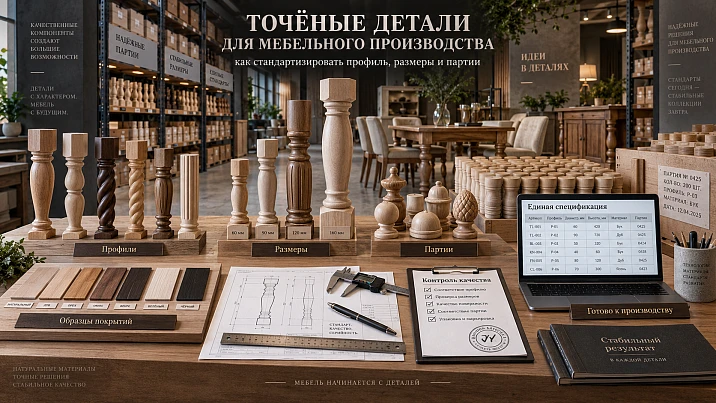
A single turned leg can look perfect even with a slight deviation in the profile. Four legs on the same dresser will already show the difference in height, diameter, the transition between sections, or surface quality. In a run of hundreds of furniture pieces, minor instability turns into a systemic problem: some cabinets sit higher, fasteners require adjustment, and visually identical models begin to differ.
Therefore, turned elements for furniture production should be considered not as decorative items, but as reproducible components. Each part must have a profile, axis, dimensions, material, mounting zone, article number or internal Part ID, an approved sample, inspection rules, and batch history.
The working sequence looks like this: furniture model → turned part → profile → axis → height and diameters → fit → beech/oak → finish → SKU → drawing → approved sample → prototype → pilot batch → LOT → incoming inspection → repeat order.
This article is intended primarily for the process engineer, designer, and procurement department of a furniture factory. If you need an overview of the range of legs by style and furniture types, it is better to use a separate catalog guide to carved and turned furniture legs. Here the task is different: to turn the selected turned part into a stable serial SKU.
What is a turned furniture part
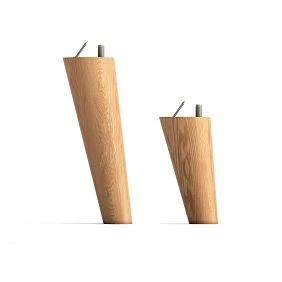
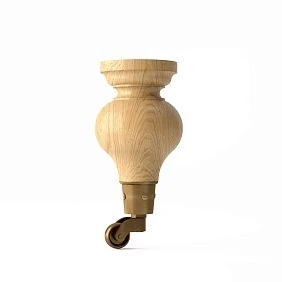
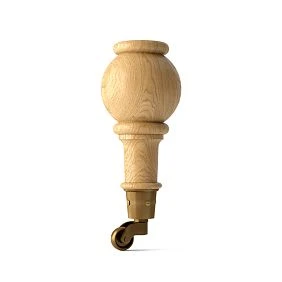
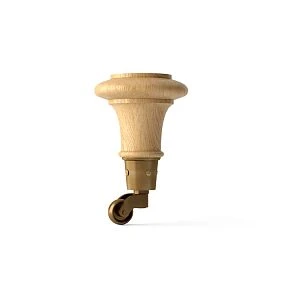
A turned part is built around an axis of rotation. The workpiece rotates, and the cutting tool forms the profile relative to the central axis. That is why diameters, height, the position of characteristic transitions, and the alignment of mounting elements are especially important for such products.
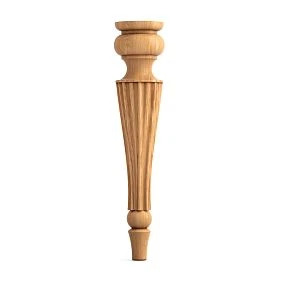
Typical turned geometry may include cylindrical sections, cones, spheres, necks, discs, fillets, steps between diameters, smooth transitions, and a seating cylindrical or flat zone.
For a furniture factory, what matters is not the artistic term but the method of description. The wording "turned classic leg" does not make it possible to reproduce the part. The wording "height 180 mm, base diameter D, transitions at coordinates A/B/C, seating zone of such-and-such length" already becomes a production specification.




Turned, carved, and geometric parts are not the same thing
A turned part gets its main shape by rotation around an axis. Its profile can be described by a sequence of diameters and coordinates.
A carved part creates a three-dimensional ornament that is not reducible to a body of revolution: leaves, scrolls, relief, asymmetrical motifs.
A geometric part may have planes, facets, a square, polygonal, or other cross-section that cannot be produced by conventional axial turning as a single operation.
It is useful to open before purchasing catalog of turned furniture legs and verify whether the required shape actually qualifies as turned. Incorrect classification leads to an incorrect description of the technology and requirements.
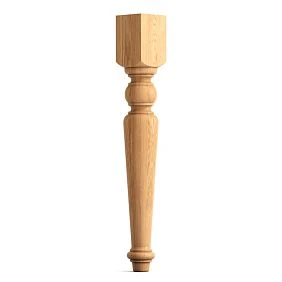
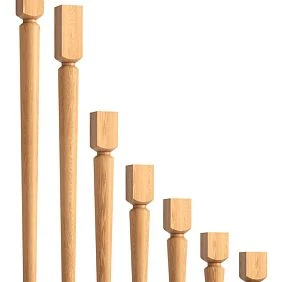
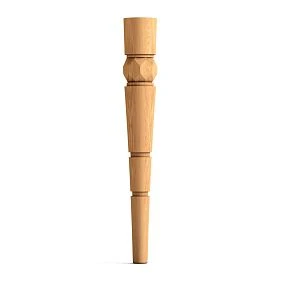
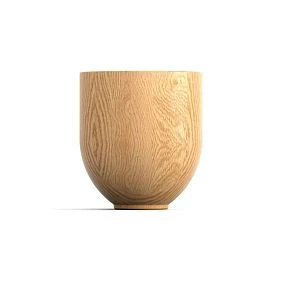
Our factory also produces:
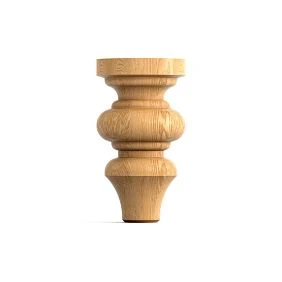
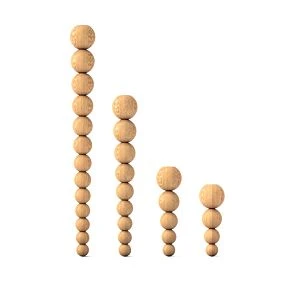
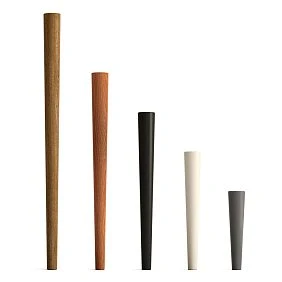
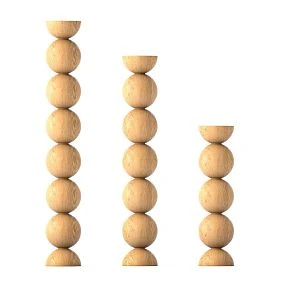
What turned parts does furniture production need
Turning in furniture is not limited to a short leg for a cabinet. Serial production uses furniture legs, supports, tall posts, discs, bushings, rings, spacers, balls, and other axisymmetric elements.
Legs and supports
For a series, not only the external proportions are critical, but also the mounting zone: overall height, diameter or cross-section of the upper part, hole, thread, stud, plate, and glide.
Posts and tall turned parts
The longer the part, the more noticeable the misalignment and the difference in diameter along its sections. For a tall support, the straightness of the overall axis and the stability of the profile are especially important.
Discs, bushings, rings, and spacers
These elements can work as standalone modules, intermediate parts, or decorative transitions on a common axis.
Modular parts
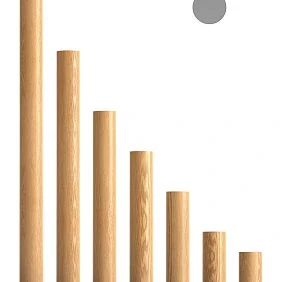
STAVROS "Constructor" System demonstrates a different approach: instead of one long unique part, standard elements are used that are combined in posts, supports, and other structures.
Get Consultation
Catalog turned part or custom — which is more rational
A new turning profile only makes sense when the ready-made catalog does not solve the task. Developing a custom part adds a drawing, prototype, approval, a new master-card, and a separate history of repeat orders.
| Scenario | Catalog item | Custom part |
|---|---|---|
| A suitable profile already exists | More rational | often unnecessary development |
| Non-standard height required | Check the size range | If the range does not cover the task |
| A unique fit is needed | Only if compatible | May be necessary |
| Signature profile of the collection | If the catalog fits | Justified with genuine uniqueness |
| Need to launch a series quickly | Advantage | A development cycle will be required |
For initial search, use catalog of furniture legs and supports. If the task goes beyond standard sizes or profile, the separate process is discussed in detail in the article about making furniture legs to your own dimensions and style.
When a custom part is justified
- non-standard height affects the product;
- a custom mounting area is needed;
- the part is a signature element of the collection;
- a historical or existing profile needs to be replicated;
- standard sizes do not cover the model range;
- the series is large enough to justify a separate development.
The profile of a turned part must be described by a drawing
For serial production, the shape cannot be described in words like "baluster with three collars," "classic leg," or "with a smooth taper." These formulations are suitable for discussing a concept, but not for a repeat batch.
The working drawing must show:
- overall height;
- diameters of characteristic sections;
- coordinates of transitions along the height;
- fillet radii;
- lengths of cylindrical and conical sections;
- geometry of the seating zone;
- holes;
- thread or fastener fit;
- base surfaces;
- Part ID and REV.
For repeatability, it is especially important to tie all dimensions to a common axis and clear datums. If a diameter is specified in three different places from different local datums, the process engineer has to interpret the drawing. The less interpretation, the more stable the series.
The base axis is the foundation of all geometry
For a turned part, the central axis defines the logic of the profile. Diameters, coaxiality, hole position, and symmetry of transitions are evaluated from it. For a mounting part, this is especially critical: the locating hole must belong to the same geometric system as the outer profile.
Conditional structure:
AXIS Z
DATUM A = upper locating plane
A → overall height
A → start of profile
AXIS Z → diameters D1 / D2 / D3
AXIS Z → center of mounting hole
If the profile axis and the mounting axis are offset, even a beautiful part may visually "strike" after installation.
Critical dimensions and decorative dimensions
Not all dimensions are equally important for furniture. It is useful to divide them by function.
| Dimension type | Example | Risk if deviated |
|---|---|---|
| Mounting | Leg height | Furniture height changes |
| Mounting | Top zone diameter | Fastener or fit mismatch |
| Mounting | Hole / thread | Assembly impossible |
| Connecting | Adjacent module diameter | A step appears |
| Decorative | Disc width | The visual rhythm changes |
| Decorative | Fillet radius | The profile character changes |
Installation parameters are usually controlled more strictly because they determine compatibility. Decorative dimensions also need repeatability limits, but you cannot automatically require the same level of precision for all areas of a part.
Size A × B × D: procurement needs more than just a SKU
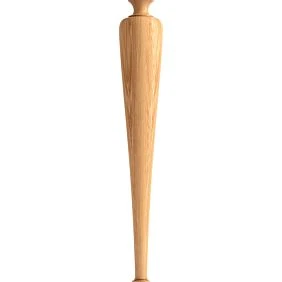
A good example of a dimensional family is turned furniture leg MN-027In the current product card, a single model is presented in several sizes and two wood species at once.
The size range by A × B × D includes, in particular:
| A, mm | B, mm | D, mm | Materials |
|---|---|---|---|
| 80 | 47 | 43 | Beech / Oak |
| 100 | 58 | 53 | Beech / Oak |
| 120 | 70 | 64 | Beech / Oak |
| 140 | 82 | 75 | Beech / Oak |
| 160 | 93 | 85 | Beech / Oak |
| 180 | 105 | 93 | Beech / Oak |
For the BOM, the entry MN-027 is insufficient. A full configuration is required:
MN-027 / A80 / B47 / D43 / BEECH
MN-027 / A120 / B70 / D64 / OAK
MN-027 / A180 / B105 / D93 / OAK
One model is not one purchasing item. Size and material change the physical part, cost, weight, and application area.
Why the product card should be read together with the drawing
A photograph shows the style but does not reveal the real scale. Two versions of MN-027 may look almost identical on screen, although they differ by more than twice in height. For a designer, A/B/D and the actual installation geometry matter more.
One model can have a large size range
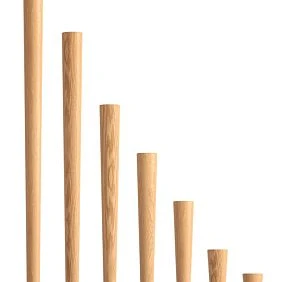
Another useful example is turned furniture leg MN-194. In the current product card, the profile is preserved, while the height varies from 100 to 600 mm with a constant B dimension of 60 mm.
| A, mm | B, mm | Materials |
|---|---|---|
| 100 | 60 | Beech / Oak |
| 150 | 60 | Beech / Oak |
| 250 | 60 | Beech / Oak |
| 350 | 60 | Beech / Oak |
| 450 | 60 | Beech / Oak |
| 600 | 60 | Beech / Oak |
For a furniture collection, this is an important behavior pattern: the same visual profile can cover different products without creating a new design from scratch.
How to create your own size family
If a factory designs a furniture series, it is useful to use an internal gradation:
LEG-S
LEG-M
LEG-L
LEG-XL
At the same time, the following are preserved:
- the common profile language;
- the material;
- finish;
- assembly logic.
Only what a specific piece of furniture needs changes: height, and if necessary, individual diameters. Such a system preserves the recognizability of the collection and reduces the number of independent designs.
When a profile cannot simply be stretched in height
The proportions of a turned part do not always scale linearly. If a 100 mm high leg is stretched to 600 mm, the necks, discs, and transitions may become visually incorrect. Therefore, a dimensional family must be designed, not generated by simply scaling a CAD model.
For each size, it is necessary to check:
- the placement of decorative transitions;
- visual rhythm;
- diameter;
- installation area;
- overall stability and function in the furniture.
Material and finish of the turned component
In a production request, "wood" is too general a word. Beech and oak are widely used in the STAVROS turned leg catalog. Both materials can be used in furniture, but they look and behave like different procurement configurations.
Beech
Beech is worth considering where a relatively calm, uniform surface and subsequent finishing are needed. In serial furniture, it is often convenient as a base for painting or tinting, if the chosen technology provides for it.
Oak
Oak is chosen when the natural wood texture should be a noticeable part of the product. It is especially expressive under clear and tinting finishes, but the final appearance depends on the specific finish.
Instead of a "which is better" rating, ask the question: should the buyer see the natural wood grain, or should the turned component work primarily through its shape and painted profile?
The material must be part of the SKU configuration
Correct:
LEG-M / MN-027 / OAK / A120
LEG-M / MN-027 / BEECH / A120
Incorrect:
MN-027 / wood
If the same furniture is produced in an oak and a beech version, these are two procurement configurations even with identical dimensions.
An unpainted component or a finished coating — two different production schemes
In the STAVROS catalog, a significant portion of furniture legs are offered as unpainted products. For a factory, this is not an "unfinished product" but a separate technological scenario: geometry and sanding come from the supplier, while color and finish are formed within the furniture production itself.
Without a finish
This option is convenient if:
- the factory has its own painting line;
- the legs must exactly match the facade color;
- one SKU is used in several color versions;
- the wood needs to be tinted to match a specific collection;
- the finish is part of the overall furniture production technology.
With a ready finish
A ready-made finish is convenient when the component must arrive at assembly already completed. In that case, the supplier is responsible not only for the geometry but also for the agreed-upon surface appearance.
Finish must be a separate BOM field
The same profile in natural wood, under enamel, with tinting, or with a ready painted coating are different production configurations.
It is useful to store the following in the BOM:
SKU
SIZE
MATERIAL
FINISH
APPROVED SAMPLE
If the geometry does not change, the internal design family can be the same, but the purchasing positions must differ.
Supplier and quality of turned components
For a B2B customer, a furniture hardware manufacturer is evaluated not by the number of photos in the catalog, but by the ability to reproduce the required configuration several months later.
Before approving a supplier, it is useful to check:
- Is there a stable SKU.
- Are drawings or exact dimensions published.
- Is the material clear.
- Are there several size versions and how are they coded.
- How the finish is described.
- Is it possible to obtain a sample or a test position.
- Can the same configuration be reordered?
- Is there a B2B channel for production orders?
- Are the lead times clear for a specific volume?
- Can a batch be linked to a LOT or another supply identifier?
For STAVROS, the manufacturer can use a section for furniture manufacturers, while technical files — catalogs, DWG and 3D models. This allows linking the actual product to its own design documentation.
What is “quality hardware” in serial production?
Quality furniture hardware is not a marketing promise. For a turned part, quality translates into measurable criteria:
- consistent overall height;
- stable diameters;
- repeatability of characteristic transitions;
- clean seating area;
- fastener compatibility;
- surface without random changes in sanding degree;
- consistent material within an approved batch;
- stable finish;
- no undeclared SKU substitution.
The phrase “quality hardware” becomes useful only after the factory has defined its own CTQ — critical to quality.
The four legs of a single item are checked as a set
A single leg may not reveal a slight profile difference. On a dresser, table, or sofa, several identical supports are installed at once, and the human eye quickly notices the inconsistency.
Before assembly, it is useful to compare four parameters:
| Check | Why it is important |
|---|---|
| Overall height | The item should not wobble or change dimensions |
| Key diameters | The legs should look like one series |
| Position of discs and necks | The visual rhythm is immediately apparent |
| Surface and finish | The difference is especially noticeable on adjacent parts |
For a batch of 500 chairs, that is already 2,000 legs. A factory needs not four magnificent parts, but 2,000 units in a consistent geometry. Therefore, batch repeatability matters more than the perfection of a single sample.
How to match legs by furniture
If a batch has acceptable natural wood variation, the factory can match four legs into visually coordinated sets. But such sorting must not be used to mask geometric instability. Height and mounting dimensions must meet technical requirements regardless of the wood grain.
Approved sample and prototype: how to approve a configuration
After choosing the configuration SKU + size + material + finish it is useful to keep a physical approved sample. Subsequent batches are compared not with a photo of the card, but with the documentation and the reference sample.
On the reference card:
- supplier SKU;
- internal Part ID;
- size;
- the material;
- finish;
- approval date;
- furniture models where it is used;
- BOM revision;
- photo of the sample.
The approved sample must not go into current assembly. Its job is to remain a point of comparison.
When a separate finish reference sample is needed
If the factory purchases unfinished parts and applies the finish itself, the geometric sample and the finish sample may be different objects. The first captures the profile and surface, the second — the color, sheen, and final appearance after finishing.
A sample is useful not only for a custom part
Even a catalog SKU should reasonably be physically verified before ordering a large batch if it becomes a cross-cutting component of a furniture collection. For project work, you can use STAVROS product samples, and for a specific leg, arrange a test purchase or a single unit.
A furniture prototype tests the turned part in a real context
You cannot give final approval to a leg based only on the technologist's desk. It must be installed on a real piece of furniture or an accurate prototype of the carcass.
Checked:
- actual overall height of the furniture;
- visual mass of the support;
- relationship of the profile to the carcass;
- seating area;
- fasteners;
- access for installation tools;
- stability;
- position relative to the base or upholstered part;
- finish next to other materials.
MN-093 as an example of a short turned leg for upholstered furniture
Turned leg MN-093 in the current product page it measures 100 × 90 × 66 mm and is available in beech and oak. Such a compact scale makes sense to consider for a sofa, armchair, pouf, or bench — but the final choice depends on the design of the specific frame.
On a prototype of upholstered furniture, you need to check the new seat height, the position of the lower frame, installation, and clearance. If a 60 mm leg was used before, replacing it with a 100 mm one changes the product by 40 mm in height — this is not a cosmetic adjustment.
A prototype is also needed for a catalog leg
A catalog SKU reduces the risk of developing new geometry, but it does not automatically prove compatibility with your furniture. Therefore, the logic remains:
catalog → specific size → test installation → approved configuration → series.
Turned parts in different types of furniture
A single profile should not be evaluated in isolation from the product. A short leg for upholstered furniture, a tall table leg, and a decorative post can all be turned, but the requirements for them differ.
Turned legs for upholstered furniture
For sofas, armchairs, and ottomans, the following are checked:
- seat height after installing the support;
- strength of the lower frame;
- position of the mounting plate;
- the leg's offset from the edge;
- visual scale relative to the soft volume;
- floor clearance;
- glide and contact with the floor covering.
In upholstered furniture, the leg is often fully visible, so a mismatch in profile between the four supports becomes noticeable especially quickly.
Turned legs for case furniture
In the current catalog, the use of turned supports covers dressers, wardrobes, and cabinets. For such furniture, the leg must be matched to a rigid panel or wooden carcass.
Checked:
- bottom thickness;
- mounting plate;
- access to the stud or fastener;
- final height;
- base position;
- visual continuation of the front;
- offset from the corners.
If a series includes a cabinet and a dresser, one family of turned supports can work on both models — but only after checking the height and load of each construction.
Turned support for a table
A tall table leg is sensitive to the overall length, the diameter of the upper mounting zone, and the straightness of the axis. Here it is no longer enough to evaluate only the decorative profile.
For a table, the following are critical:
- the actual height of the tabletop after assembly;
- the cross-section of the upper part;
- the method of connection to the apron or base;
- stability;
- the repeatability of the four supports;
- the geometry of the entire frame.
If a tall support becomes part of a complex assembly, it is sometimes more rational to consider a ready-made base or frame rather than just a separate leg.
Turned posts and decorative verticals
In display cases, shelving units, partitions, and custom furniture, a turned element may function not as a leg but as a vertical post. In that case, the main risk is not the mounting height of the furniture, but rather alignment, the joining of modules, and the repeatability of a long vertical.
Modular system “Constructor”: when you don’t need one long unique part
Sometimes the task looks like “we need a custom turned post,” but in fact it can be assembled from standardized elements. STAVROS “Constructor” section includes turned and geometric solid wood elements that are used in furniture, posts, rods, and other structures.
Instead of one complex part, you can build a sequence:
base → module → divider → module → finial.
This approach offers several advantages:
- fewer unique parts;
- easier to change the composition;
- standard modules are easier to reorder;
- one element can be used in several products in the collection;
- repairing a single module is easier than replacing the entire long part.
The modular system reduces the number of SKUs
A single ball, disc, bushing, or adapter element can be used:
- in the decorative stand;
- in a furniture support;
- in a column;
- in a baluster composition;
- in another item in the collection.
In the master BOM, it becomes a COMMON SKU, and the uniqueness of different products is created by the sequence of modules.
When a modular system does not replace a solid support
Modules should not be considered a universal alternative to a solid load-bearing part. If an element bears a load, the solution must be confirmed by an engineer.
Checked:
- type of connection between modules;
- central axis or rod;
- load;
- stability;
- mounting area;
- possibility of connection loosening during use.
If a solid leg is structurally simpler and more reliable for a specific piece of furniture, modular decor should not complicate the assembly solely for the sake of variability.
An in-depth analysis of this approach is covered in a separate article about assembling a rack, support, and custom furniture from STAVROS modules.
Fastening a turned leg is a separate structural assembly
For serial production, it is not enough to choose a beautiful leg. The complete mounting assembly must be fixed:
leg → stud → mounting plate → body → glide.
The specific composition depends on the model, but each physically purchased item must have its own BOM line.
Used to select related parts hardware for furniture legs and handles.
The mounting hole is part of the standard configuration
If the hole diameter, depth, or thread changes, the compatibility of the entire mounting assembly changes. Even if the outer profile of the leg remains the same, this is already a different technical configuration.
Therefore, it is useful to store the following in the master card of a turned part:
MOUNT TYPE
HOLE DIAMETER
HOLE DEPTH
THREAD
PLATE SKU
STUD SKU
FOOT SKU
The mounting assembly is checked on a prototype
On the test furniture, you need to make sure that:
- the tool has access to the fasteners;
- the plate does not conflict with the drawer or frame;
- the stud has the required length;
- the leg seats without skewing;
- the glide does not noticeably change the height;
- four supports provide a stable plane.
BOM and batch calculation for turned parts
If a piece of furniture uses different front and rear legs, they must have different Part IDs, even when they belong to the same design series.
| Part ID | Supplier SKU | Size | Material | Finish | QTY |
|---|---|---|---|---|---|
| LEG-F | MN-___ | ___ | Beech | unfinished | 2 |
| LEG-R | MN-___ | ___ | Beech | unfinished | 2 |
| STUD-F | FUR-___ | ___ | Metal | — | 2 |
| PLATE-F | FUR-___ | ___ | Metal | — | 2 |
For four identical legs, the BOM is simpler:
LEG-01 / MN-027 / A120 / B70 / D64 / OAK / QTY 4
But even here, size and material cannot be omitted.
If one profile is used in several sizes
The design family can be stored separately:
DESIGN FAMILY = LEG-CLASSIC-01
PURCHASE SKU 1 = MN-194 / A150 / B60 / BEECH
PURCHASE SKU 2 = MN-194 / A350 / B60 / BEECH
At the design level, it is one family. In the warehouse, they are different physical items. This is exactly how turned elements for furniture production preserve the common language of the collection without mixing dimensional SKUs.
How to calculate a batch of turned parts
Basic formula:
number of parts per item × furniture plan = gross requirement.
For example, a factory produces 500 chairs, each requiring four identical legs:
500 × 4 = 2000 legs.
If at the same time the same leg is also used on 100 banquettes, 4 pieces each:
2000 + 400 = 2400 legs gross.
Gross requirement is not equal to purchasing
Next, the warehouse is taken into account:
NET REQUIREMENT =
GROSS REQUIREMENT
- FREE ACCEPTED STOCK
+ PRODUCTION RESERVE
If there are 180 legs in stock, but 80 are reserved for service, the free balance is 100. Service reserve cannot be deducted from a new purchase.
Reserve is calculated by risk, not by a universal percentage
The reserve is influenced by:
- lead time;
- batch volume;
- damage statistics;
- price;
- ability to use the remainder in the next production run;
- number of models depending on the SKU;
- availability of an approved alternative;
- packaging.
If a machined part is COMMON to several programs, its shortage can halt several lines at once. Such an SKU requires more mature planning.
Pilot batch, LOT and repeat order
A single prototype confirms that the chosen configuration is fundamentally suitable for the furniture. It does not yet prove that the supplier can consistently reproduce the profile in dozens or hundreds of units. For a new or non-standard configuration, an intermediate stage is needed: prototype → pilot batch → validation → serial lot.
The size of the pilot batch cannot be set as a universal number. It depends on risk. For a simple catalog leg in a new size, a small test batch may be sufficient. For a new non-standard support with a complex profile and its own fastening, more repetitions will be needed to see production variability.
What to check on a pilot batch
- spread of overall height;
- repeatability of key diameters;
- position of necks, discs and transitions;
- installation area;
- threads and holes;
- the quality of sanding;
- surface after finish;
- packaging;
- marking;
- convenience of incoming inspection;
- assembly speed on real furniture.
If assemblers are forced to grind, ream or sort parts manually, the series is not yet stabilized. Such manual compensation hides the problem rather than solving it.
The pilot verifies the process, not just the product
A successful first leg may be the result of special manual finishing. The task of the pilot batch is to understand whether the same result can be repeated through the standard production route.
After the pilot, it is useful to record:
ACCEPTED
REWORK
SCRAP
MAIN DEFECTS
CYCLE ISSUES
PACKAGING ISSUES
ASSEMBLY ISSUES
If the main problem is systemic, the serial order is postponed until the technology or drawing is corrected.
Marking, LOT and incoming inspection of turned parts
A serial batch must be traceable. Packaging can be marked according to the scheme:
COLLECTION / SKU / SIZE / MATERIAL / FINISH / LOT / QTY
For example:
CLASSIC-A / MN-027 / A120-B70-D64 / OAK / RAW / LOT-09 / QTY-100
If one model has different sizes, SIZE is mandatory. If oak and beech are purchased at the same time, material should also be visible without opening the entire box.
The new batch is stored separately until ACCEPTED
There is no need to immediately mix new legs with the old remainder. First, the batch undergoes incoming inspection. If a change in finish or geometry is detected, the factory will be able to localize the problem.
Minimum check:
| Parameter | What is confirmed |
|---|---|
| SKU | The correct model has arrived |
| Size | The required configuration A/B/D or another scheme |
| Material | Beech, oak, or an agreed-upon option |
| Quantity | Compliance with documents |
| Height | Critical dimension |
| Diameters | Profile Reproducibility |
| Installation | Hole, thread, mounting area |
| Surface | Sanding and visible defects |
| Finish | Comparison with approved sample |
It is not necessary to measure all dimensions on every part
The inspection plan depends on the batch size and the criticality of the parameters. However, CTQ parameters must be checked according to the factory's internal quality plan. If height directly affects the stability of the furniture, it receives more attention than an inconspicuous decorative radius.
Four parts per furniture unit are best checked as a set
Even with normal statistical control, it is useful to selectively assemble actual sets of four legs and install them on a reference base. Such a test quickly reveals accumulated variation that is not always noticeable when measuring a single part.
Repeat order: no more “same legs as in spring”
A repeat purchase must reproduce the configuration, not the memory of it. For each accepted item, the following are saved:
- supplier SKU;
- size;
- material;
- finish;
- approved sample ID;
- last accepted LOT;
- BOM revision;
- furniture models where the part is used.
Repeat RFQ:
SKU: MN-027
SIZE: A120 / B70 / D64
MATERIAL: OAK
FINISH: RAW
PREVIOUS LOT: LOT-09
NEW QTY: 1200
NEED DATE: ___
Price, lead time, and availability are rechecked. But the technical specification is not rebuilt from scratch.
When a repeat order requires a new prototype
A repeat prototype is needed if:
- the size has changed;
- the material has changed;
- the finish has changed;
- the mounting hole has changed;
- supplier has changed;
- an alternative SKU is offered;
- the previous LOT had a critical complaint;
- the part is now used in a new furniture design.
If nothing has changed and the previous batch was accepted, the repeat order can proceed according to the approved master card.
Commercial inquiry and overall procurement program
For a catalog item, a strong inquiry looks like this:
SKU + size + material + finish + quantity + required date.
For example:
MN-194
A350 / B60
BEECH
RAW
QTY 400
NEED DATE 15.11.2026
If you need turned furniture parts wholesale, it is useful to additionally specify the annual forecast and the models where the item is used. This allows the purchase to be considered as a program rather than a random one-off order.
For a custom part, the data set is broader
Required:
- drawing or physical sample;
- the material;
- critical dimensions;
- finish;
- prototype quantity;
- pilot quantity;
- serial quantity;
- annual forecast;
- need date;
- delivery city.
The feasibility of manufacturing a specific geometry, tooling, minimum batch size, and lead time must be confirmed separately.
B2B channel and technical files
After selecting a configuration, you can use working conditions for furniture manufacturers. Technical data for standard groups is available via catalogs and DWG STAVROS.
Wider wood and MDF products section helps check whether a suitable component already exists in other categories — for example, a modular element or a ready-made frame.
How to aggregate total volume across multiple models
If the same SKU is used in multiple models, the buyer should calculate the total requirement rather than sending several small requests.
Example:
- dresser: 200 units × 4 legs = 800;
- cabinet: 300 × 4 = 1200;
- bench: 100 × 4 = 400.
Total:
800 + 1200 + 400 = 2400 legs gross.
This is how the total volume of turned components becomes a single procurement program.
A total forecast does not require a single delivery
You can fix:
ANNUAL FORECAST: 2400
LOT-1: 800
LOT-2: 800
LOT-3: 800
This helps the supplier plan production, and the factory avoid overloading the warehouse.
COMMON SKU increases both benefit and risk
If one leg is used across five models, a shortage will halt several programs at once. For such a component, the following are especially important:
- forecast;
- safety stock;
- approved alternative;
- last accepted lot;
- lead time control;
- fast repeat RFQ.
Unification is only useful together with mature inventory management.
Wood materials for furniture: a turned profile cannot be separated from the raw material
The queries "materials for furniture manufacturing" and "wood materials for furniture" in this topic are needed not for a general overview of species, but for understanding production compatibility. In the specification, materials for furniture manufacturing are linked to a specific Part ID and finish. A turned profile does not exist in a vacuum: the wood blank affects processing, appearance, finish, and batch repeatability.
Before approving a turned part, the following are fixed:
- type of wood;
- surface requirements;
- visible sides;
- whether the material will be covered with enamel;
- should the texture remain visible;
- who performs the finishing;
- should parts be sorted by tone;
- can the material be replaced without a new revision.
If wooden furniture components go into one collection, it is useful to coordinate not only each SKU separately, but also the overall material system. Such wooden furniture components are more convenient to approve using a single material/finish board. Oak handles, oak legs
Error: fasteners are selected during assembly
Cause: the leg is considered a standalone part. Consequence: the stud, plate, and hole may be incompatible. Prevention: the mounting assembly is stored together with the LEG SKU.
Error: the prototype is immediately considered the production reference
Cause: the first part fit. Consequence: process repeatability has not been verified. Prevention: pilot batch and validation.
Error: a new batch is mixed with the old one before acceptance
Cause: the appearance is similar. Consequence: LOT traceability is lost. Prevention: quarantine until ACCEPTED.
Error: the order is formulated “like last time”
Cause: the supplier is an acquaintance. Consequence: six months later, no one is sure which size and finish were approved. Prevention: repeat-order package.
When a turned part is better not to buy or develop
Not every piece of furniture benefits from a turned element. Sometimes a geometric or carved support better matches the design. Sometimes the case should stand on a hidden plinth at all. There is no need to introduce a turned part just to use a beautiful catalog SKU.
Purchase or development should be abandoned if:
- the existing construction is not designed for such a support;
- changing the height worsens ergonomics;
- the mounting area of the case is insufficient;
- the profile conflicts with the visual language of the furniture;
- another standard SKU solves the same task more simply;
- the run is too small to justify new tooling;
- the factory cannot consistently reproduce the finish;
- no time for prototype and pilot;
- the part is load-bearing, but its design has not yet been validated.
When a turned part should remain a LOCAL SKU
If an unusual leg is a signature element of one model, there is no need to force it onto the entire collection. A COMMON component is only worthwhile when it suits several products without compromise.
When a modular system is better than custom
If uniqueness can be achieved by combining standard elements, modular wooden elements sometimes make it possible to avoid a new Part ID and a separate turned profile. But the structural suitability of the assembled system must be verified separately.
When a different selection scenario is needed
The site already has materials that answer related questions. The new page remains a production B2B guide on the repeatability of a turned part.
If you need to choose a leg by style and furniture type
Use an overview of carved and turned legs for tables, chairs, and sofas. There, the central task is assortment and selection.
If you need a custom support to your dimensions
Use material about custom furniture legs. There, the path from a sketch or sample to a non-standard model is explored in greater depth.
If you need a designer rack made of modules
Use a guide to wooden blanks and the “Constructor” system.
Here the central question remains one: how to turn the selected profile into a repeatable serial component with a clear SKU, size, reference standard, and LOT.
How to standardize turned elements at the level of a furniture collection
One of the strongest production strategies is not to choose legs separately for each item, but to create a family of turned components. For a factory, turned elements for furniture production are more advantageously described as a managed library of sizes and profiles rather than as one-off design solutions. Then the visual identity of the collection is built on a repeatable profile, while variability is based on a controlled size.
For example:
| Internal code | Application | Height | Material | Status |
|---|---|---|---|---|
| LEG-S | Nightstand / bench | Small | Beech / Oak | COMMON |
| LEG-M | Dresser / armchair | Medium | Beech / Oak | COMMON |
| LEG-L | Console / table | High | Beech / Oak | COMMON |
| LEG-X | Flagship model | Unique | Oak | LOCAL |
At the same time, the factory can link each internal position to a specific catalog SKU. If the size range is already covered by MN-194 or MN-027, there is no need to create new geometry. If not, the new turned part receives a separate Part ID and its own prototype/pilot cycle.
How to tell that a family is truly unified
Turned furniture parts of different sizes must retain the recognizable features of one family:
- characteristic profile transitions;
- proportional arrangement of discs and necks;
- the material;
- finish;
- assembly logic;
- connection with other elements of the collection.
But the same profile should not be scaled mathematically without visual verification. A taller version may require a different length of the cylindrical section or a different proportion of the decorative zone.
COMMON SKU and LOCAL SKU
COMMON is used by several items. LOCAL exists in only one model. The goal is not to eliminate LOCAL, but to understand its reason. If a unique profile is a signature element of a flagship table, it is justified. If a separate SKU appeared only because two designers worked independently, it should be reconsidered.
How to control the profile in a large batch without excessive measurements
Measuring every point of the profile on every part is impractical. Control should be tied to critical parameters and risk.
Control sections
For a turned leg, several characteristic heights can be selected:
Z0 — seating zone
Z1 — first diameter
Z2 — neck
Z3 — maximum disc
Z4 — lower transition
Z5 — lower support zone
At these levels, diameters and transition positions are checked. This approach is simpler than trying to mathematically describe the entire decorative contour with a single general formula.
Profile template
For a serial molding or turning profile, a physical template can be useful, as it quickly shows rough deviation. It does not replace a measuring tool, but it speeds up incoming inspection and allows suspicious parts to be identified.
Height inspection stand
If the main concern is the overall height of four legs, a simple flat stand with an upper reference plane quickly shows the spread between parts. For a large batch, this is more practical than measuring the entire profile each time.
Visual inspection of four parts together
A turned profile is perceived rhythmically. Therefore, it is useful to lay out part of the batch as four identical legs side by side. This quickly reveals offset necks, different disc diameters, and uneven finish.
Economics of a turned part and serial procurement
When choosing between a standard SKU and a custom one, you need to consider more than just the price of a single leg. The cost system may include:
- drawing development;
- prototype creation;
- tooling;
- turning program;
- manual finishing;
- finish;
- incoming inspection;
- packaging;
- service reserve;
- remaining stock after removing the model;
- cost of future replacement.
If a ready-made catalog SKU is 150 rubles more expensive but requires no new tooling and can be reordered for years, it may prove more economically rational than a custom part for a small batch.
When custom starts to pay off
Custom development becomes more interesting if:
- the volume is large enough;
- the part is repeated across several models;
- a proprietary profile creates a commercial differentiator;
- the tooling is used multiple times;
- the size range covers several products;
- there is a long-term forecast.
Without a specific RFQ, it is impossible to name a universal break-even volume. It depends on geometry, material, tooling, and finish.
Why a wholesale order is better planned as a program
When a factory wants turned parts for furniture wholesale, it is more effective to show the supplier not a single order for 400 pieces, but a production program:
Q1 — 400
Q2 — 600
Q3 — 600
Q4 — 400
ANNUAL — 2000
This way, not only the price of the first batch is discussed, but also repeatability, schedule, and raw material availability.
Commercial route: from catalog to serial order
If a factory needs turned furniture legs wholesale, it is better to build the route from technical compatibility.
- open turned legs section.
- Choose a design family.
- Check the actual dimensions on the product page.
- Determine the material.
- Check the mounting hardware.
- Buy a test quantity or arrange a sample.
- Install on a furniture prototype.
- Approve the configuration.
- Calculate the total volume.
- Submit RFQ via B2B section for manufacturers.
If the request is phrased as "buy turned furniture legs for 500 dressers," the manager still needs the size, material, and finish. Quantity without configuration does not allow for an accurate commercial quote.
What to submit for a commercial quote
| Field | Example |
|---|---|
| SKU | MN-027 |
| Size | A120 / B70 / D64 |
| Material | Oak |
| Finish | RAW / approved option |
| Quantity | 1200 |
| Application | Dresser / 4 pcs. per item |
| Need date | Required date |
| Forecast | Next batch |
This is how the request "wooden furniture parts wholesale" turns into a production specification.
Edge cases and master card for a turned part
Front and rear legs differ in height or profile
For an armchair, sofa, or bench, the front and rear supports may differ. It is a mistake to store them as a single line item "legs — 4 pcs." Even if both parts belong to the same style, their production identity is different.
More correctly:
LEG-F / SKU / SIZE-F / MATERIAL / FINISH / QTY 2
LEG-R / SKU / SIZE-R / MATERIAL / FINISH / QTY 2
If the front leg is turned and the rear leg is geometric, the product type must also be visible in the documentation. On the packaging, it is useful to distinguish FRONT/REAR so that the assembler does not rely only on the photo.
One profile, but two heights in one furniture program
Suppose a series includes a chest of drawers and a bedside table. The leg design is the same, but the bedside table requires 120 mm, while the chest of drawers requires 180 mm. This is one design family, but two physical positions.
Master-data:
FAMILY: LEG-CLASSIC-01
SKU-A: MN-027 / A120 / B70 / D64
SKU-B: MN-027 / A180 / B105 / D93
Purchasing and the warehouse should not combine these positions. But the designer and product manager may consider them part of one visual language of the collection.
One size, but beech and oak
If the furniture is produced in two material versions, for example "beech for enamel" and "oak for transparent tinting," the size does not change, but the SKU configuration is still separated.
Reason:
- different purchase price;
- different appearance;
- different finish;
- different approved samples;
- different stock balances.
You cannot keep a single combined stock balance of “MN-027 A120 — 300 pcs.” if it contains 180 beech and 120 oak legs. For production, these are different materials.
Same leg, but different finish
Two collections may use the same size of oak leg, but one series gets a light tint and the other a dark one. At the level of turned geometry, it is one profile. At the purchasing level, it is two items:
MN-XXX / OAK / FINISH-LIGHT
MN-XXX / OAK / FINISH-DARK
If the factory purchases unfinished legs and finishes them in-house, the separation already occurs within the internal production route. But the as-built BOM of the finished furniture must still know which finish was actually applied.
The catalog matches by shape, but the mounting area does not match
This is an important case. Visually, the leg may be perfect, but the upper part is insufficient in size or the mounting interface does not match. Then the SKU cannot be considered suitable based on appearance alone.
Three solutions are possible:
- modify the body construction if it is safe and reasonable;
- select another catalog item;
- approve an individual configuration.
The decision is made by the designer before a large order.
Master card of a turned part: what to store after approval
When an item becomes APPROVED, it must have a master card. This is especially useful for wooden furniture components that are used in several collections.
| Field | What to store |
|---|---|
| Internal Part ID | Internal factory code |
| Supplier SKU | Supplier SKU |
| Type | Turned / other type |
| Size | A / B / D or another scheme |
| Material | Beech / Oak |
| Finish | RAW / finish code |
| Mount | Hole, thread, associated fastener |
| Approved sample | Physical reference ID |
| Used in models | Furniture list |
| Last accepted LOT | Last accepted batch |
| Alternative | Approved substitute, if any |
| Status | ACTIVE / SERVICE / ARCHIVE |
This card lets you quickly answer the question: where the part is used, how many models will stop during a shortage, which finish is considered the reference, and whether another size can be used.
What to do when a furniture model is discontinued
If the furniture is discontinued, the specific SKU does not necessarily become unnecessary. It may remain COMMON in other models or be used for service.
Before moving to ARCHIVE:
- check the usage list;
- calculate the service reserve;
- determine the free stock;
- save approved sample;
- do not delete LOT history;
- lock the latest procurement configuration.
What to do when adding a new furniture model
A new model first checks the existing library. The designer must not automatically create a new leg.
Algorithm:
- check existing design families;
- find a suitable height;
- check the installation area;
- assemble a prototype;
- if an existing SKU fits — make it COMMON;
- if it doesn't fit — only then introduce a new LOCAL SKU.
This way, components for furniture production grow in a controlled manner, and the nomenclature doesn't get filled with nearly identical legs.
Packaging of turned parts must preserve geometry and finish
For a serial batch, packaging is part of production compatibility. Long and shaped elements can be damaged not only by impacts but also by mutual friction inside the box. The painted surface is sensitive to contact marks, while protruding discs and necks are sensitive to localized impacts.
On a pilot batch, it's useful to check:
- how many parts are in one package;
- whether there are dividers;
- whether parts press against each other with protruding areas;
- whether the SKU / SIZE / MATERIAL / LOT marking is preserved;
- whether it's convenient for the warehouse to recount the contents;
- whether a single part can be removed without damaging the others;
- whether the appearance of the finish changes after transportation.
If the legs come without a coating, the packaging must primarily protect the geometry and the surface intended for the future finish. If the component arrives ready for assembly, the requirements for coating protection become higher. Discrepancies caused by transportation should not be confused with turning defects — their causes and corrective actions are different.
FAQ: turned parts for furniture production
What are turned parts for furniture?
These are wooden elements whose basic shape is built around an axis of rotation: furniture legs, supports, posts, balls, discs, bushings, rings, spacers, and other axisymmetric components. For serial production, not only the outer profile matters, but also stable dimensions, fit, material, and batch repeatability.
How does a turned part differ from a carved one?
In a turned part, the basic geometry is formed by rotating the workpiece around an axis. A carved part has three-dimensional ornamentation that cannot be reduced to a body of revolution. In practice, a single product may combine several technologies, but the specification must make clear which geometry is the base one.
Which turned elements are used in furniture production?
Most often — legs for case goods and upholstered furniture, tall table supports, posts, decorative modules, discs, bushings, balls, and transition elements. Some of these parts can be found as standard SKUs, some can be assembled from modules, and non-standard geometry can be ordered separately.
Where to buy turned furniture legs wholesale?
STAVROS has a separate catalog of turned furniture legs and a B2B section for manufacturers. Before placing a wholesale order, you need to specify the exact SKU, size, material, finish, and quantity.
How to choose the material for a turned leg?
The choice depends on the design and finishing technology. Beech is often considered for a calm, uniform surface and subsequent painting or tinting. Oak — when a pronounced natural texture matters. The decision is made based on the specific furniture and finish.
Beech or oak — which to choose?
There is no universally best species. If the legs will be painted with opaque enamel and the texture is not part of the product, beech may be the rational choice. If the wood should remain visible, oak often gives a more expressive grain pattern. For a serial collection, it is better to test both species on a physical sample.
Can a turned part be ordered from a drawing?
For a non-standard item, you first need to prepare a drawing or sample, material, dimensions, fit, and series forecast, then obtain confirmation of production feasibility. The in-depth scenario of a custom order is covered in a separate article about furniture legs by their dimensions.
How to ensure an identical profile in a large batch?
Lock down the drawing, critical sections, approved sample, and incoming inspection plan. On the pilot batch, verify repeatability of height, diameters, and transitions. In the serial batch, monitor CTQ parameters and maintain LOT traceability.
Do I need to make a prototype?
For a new configuration — yes, especially if the part affects the furniture height, mounting, or signature design. Even a catalog SKU is worth putting on a prototype if it is being used in a specific model for the first time.
How do I calculate the number of parts for a furniture series?
The quantity per item is multiplied by the production plan. Then the free accepted warehouse stock is subtracted and the production reserve is added. Service reserve is calculated separately and should not reduce the new purchase.
Can one turned leg be used for different models?
Yes, if the requirements for height, mounting, proportions, and load are the same. If one item requires a different height, it is better to use a size family of the same profile rather than force one SKU to work everywhere.
What should I do if I need the same shape but a different height?
First check the size range of the catalog model. MN-027 and MN-194 show that one model can have several sizes. If the required height is not available, then discuss a custom configuration or a separate size.
Should four legs be stored as one set?
In the warehouse they can be counted individually, but in assembly it is useful to control a set of four parts: the same height, profile, and finish. This is especially important for chests of drawers, tables, and upholstered furniture.
What fastener is needed for a turned leg?
Depends on the specific SKU and frame construction. A stud, mounting plate, glide, and other elements are possible. Related items should be selected in the catalog of furniture hardware for fastening and recorded in the BOM.
How should a batch be labeled?
At minimum: SKU, size, material, finish, LOT, and quantity. If one SKU has multiple sizes, SIZE must be visible on the packaging without additional searching.
How should a repeat order be placed?
Provide the supplier SKU, size, material, finish, previously accepted LOT, new quantity, and need date. The wording "the same legs as before" is insufficient for a serial process.
Final inspection and repeat order scheme
| Check | Status |
|---|---|
| Part type determined: turned / carved / geometric | OK / HOLD |
| Standard catalog verified | OK / HOLD |
| Specific SKU or Part ID selected | OK / HOLD |
| Dimensional configuration locked | OK / HOLD |
| Material defined | OK / HOLD |
| Finish defined | OK / HOLD |
| Mounting zone and hole verified | OK / HOLD |
| Associated fasteners added to BOM | OK / HOLD |
| Approved sample saved | OK / HOLD |
| Prototype installed on real furniture | OK / HOLD |
| Pilot batch accepted | OK / HOLD |
| CTQ parameters defined | OK / HOLD |
| Series volume calculated | OK / HOLD |
| Production reserve separated from service reserve | OK / HOLD |
| RFQ contains SKU / size / material / finish | OK / HOLD |
| LOT marking approved | OK / HOLD |
| Repeat-order package saved | OK / HOLD |
Final scheme: from profile to repeat order
- Determine whether a turned part is actually needed.
- Check ready-made turned models.
- Choose a size range or develop a custom profile.
- Lock the central axis, height, diameters, and transitions.
- Determine installation-critical dimensions.
- Choose beech, oak, or another confirmed option.
- Determine the finish.
- Record the full SKU/Part ID in the BOM.
- Select fasteners.
- Obtain a physical sample.
- Install the part on the furniture prototype.
- Verify four identical legs as a set.
- Form a pilot batch.
- Conduct repeatability validation.
- Calculate gross requirement.
- Subtract the free accepted balance.
- Add production reserve.
- Generate RFQ.
- Accept the serial LOT through incoming inspection.
- Save the last accepted lot and master card.
- Repeat the purchase by configuration, not by photograph.
This is how turned elements for furniture production become a full-fledged part of a serial engineering system. Profile, height, diameter, fit, material, and finish no longer exist as a set of verbal agreements. They are recorded in the BOM, confirmed by a physical sample, and reproduced in the next batch.
For a factory purchasing turned furniture parts serially, this is the main result of standardization: not just to buy a beautiful leg, but to get a component that can be reordered in six months or a year without re-selecting the geometry and manual approval.
After fixing the SKU, size, material, and finish, you can pass the exact production requirement to STAVROS and receive a commercial quote for a test, pilot, or serial batch.