Article Contents:
- Wooden furniture leg MN-243 740 mm: what the product card confirms before purchase
- Size MN-243 764×240×45×740 mm
- Wooden leg MN-243 made of beech
- Oak furniture leg MN-243
- Why 764 mm and 740 mm cannot be confused
- Design for a table without an apron
- Tabletop 20 mm: 760 mm
- Countertop 24 mm: 764 mm
- Countertop 30 mm: 770 mm
- Countertop 35 mm: 775 mm
- Countertop 40 mm: 780 mm
- Countertop 45 mm: 785 mm
- Countertop 50 mm: 790 mm
- Height of already purchased chairs
- Seat height
- The thickness of the apron is absent, but the geometry of the support remains
- Free space for knees
- Growth of key users
- Dining table and work desk are different scenarios
- Place the tabletop on temporary supports
- Get exactly 780 mm to the top surface
- Place real chairs underneath
- Check elbows, shoulders, and knees
- Check seating for two people of different heights
- Check for more than one minute
- Countertop 20–30 mm
- Countertop 40 mm after actual fit check
- Project specifically designed for a surface of 775–780 mm
- Chairs already selected for the final height
- Countertop thickness still unknown
- Chairs have not been chosen yet
- Fit at 780 mm not verified
- Project specifies only 740 mm without countertop thickness
- Contractor mistakenly took dimension A=764 mm as the height
- Additional layer or structure under the countertop is planned
- A thick protective floor pad is planned
- The table should serve as a permanent workstation
- MN-243 is not an ordinary straight turned leg
- The geometry is related to the diagonal brace
- The lower 20–30 mm cannot automatically be considered "extra"
- Why a response from the manufacturer or furniture designer is needed before modification
- Beech furniture leg for opaque finish
- Oak wooden support
- Why the material does not change the height of 740 mm
- When to choose by finish, not by geometry
- Why such an example is more useful than an abstract "standard table"
- Why height compatibility is not yet equal to structural compatibility
- What to check before placing a joint order
- Why the quantity is determined by the table structure
- A pair of MN-243 as two side supports
- Why you cannot transfer the rule of ordinary four legs
- How to check the design before ordering
- Don't forget about additional elements under the leg
- Check the actual position of the support pad after installation
- Why you shouldn't automatically add or subtract millimeters without a mockup
- Check along the long side
- Check at the end
- Check by moving the chair away
- Checking multiple chairs
- Check the chairs
- Check seat softness
- Identify the primary user
- Do not compensate for poor height with a random cushion
- Why mockup first, then cart
- Why a cheap 20 mm mistake can make an expensive table uncomfortable
- How much does a mistake cost if you buy first and check later
- Option A. Change the chairs
- Option B. Change the support
- Option C. Redesign the structure
- What not to do
- MN-243 is suitable
- The shape of MN-243 is liked, but the height is not suitable
- Not clear yet
- Mistake 5. Buying oak before resolving the height issue
- Mistake 6. Automatically ordering four MN-243
- Mistake 7. Shortening the structure yourself
- Mistake 8. Testing only one user
- Error 9. Ignoring end seats
- Error 10. Considering ST-030 compatibility only by height
- Error 11. Choosing countertop thickness after purchasing supports without recalculation
- Error 12. Considering price more important than layout
- Error 13. Use the floor height up to the finished finish
- Error 14. Not accounting for soft seat sagging
- Error 15. Checking height without the actual countertop, even though it's already purchased
- Error 16. Fitting the chair to the table at any cost
- 1. Record the actual countertop thickness
- 2. Use MN-243 height 740 mm
- 3. Add up the dimensions
- 4. Add only elements that actually increase height
- 5. Make a mockup at 780 mm
- 6. Place a real chair
- 7. Sit at the mockup
- 8. Check the second seat
- 9. Check the end seat
- 10. Solve material
- 11. Solve quantity
- 12. Check thrust bearings
- 13. Check price and availability
- 14. Create specification
- What is the height of the wooden support MN-243?
- Why do the dimensions of MN-243 list both 764 and 740 mm?
- What will be the table height with MN-243 and a 40 mm countertop?
- Will a table height of 780 mm be possible?
- Will MN-243 fit a 24 mm tabletop?
- What will be the height of MN-243 with the ST-030 tabletop?
- Can MN-243 be shortened?
- What wood is MN-243 made from?
- What to choose — beech or oak?
- How many MN-243 units should be ordered for a table?
- Which table is MN-243 designed for?
- Can I buy MN-243 for a table without a crossbar?
- How can I check the table height before buying legs?
- Which legs should I buy for a tabletop 40 mm thick?
- Is a FUR-022 floor protector needed?
- Where can I buy wooden table legs?
- How to order MN-243 with delivery?
- How much do wooden furniture supports MN-243 cost?
- Is a height of 780 mm suitable for everyone?
- What to do if the 780 mm table turned out to be a bit too high?
- How does seat height affect things?
- Do I need to take into account the softness of the seat?
- Can MN-243 be used for a work desk?
- Do I need to add 5 mm of the FUR-022 foot pad to the height?
- Why can't I just rely on the "standard table height"?
- Which is more cost-effective: beech or oak?
- Can I order the legs first and choose the chairs later?
- Why can't MN-243 be considered a regular leg?
- Do I need to account for the tabletop thickness in the request to the manager?
- Can I buy MN-243 for a very heavy stone tabletop?
- What to do if 40 mm is only a decorative edge of the tabletop?
- Can I use one MN-243 instead of two?
- Do I need to buy FUR-022 right away?
- What is more important — a beautiful oak or the correct height?
- Question 1. Is the tabletop thickness really 40 mm in the mounting area?
- Question 2. Does the nominal surface of 780 mm suit the project?
- Question 3. Is the actual chair already known?
- Question 4. Is the seating position at 780 mm comfortable?
- Question 5. Is there enough free space under the table?
- Question 6. Is the number of supports confirmed by the design?
- Question 7. Was the material chosen after checking the height?
- Question 8. Are the footrest and other additional elements taken into account?
- Question 9. Price and availability checked on the day of order?
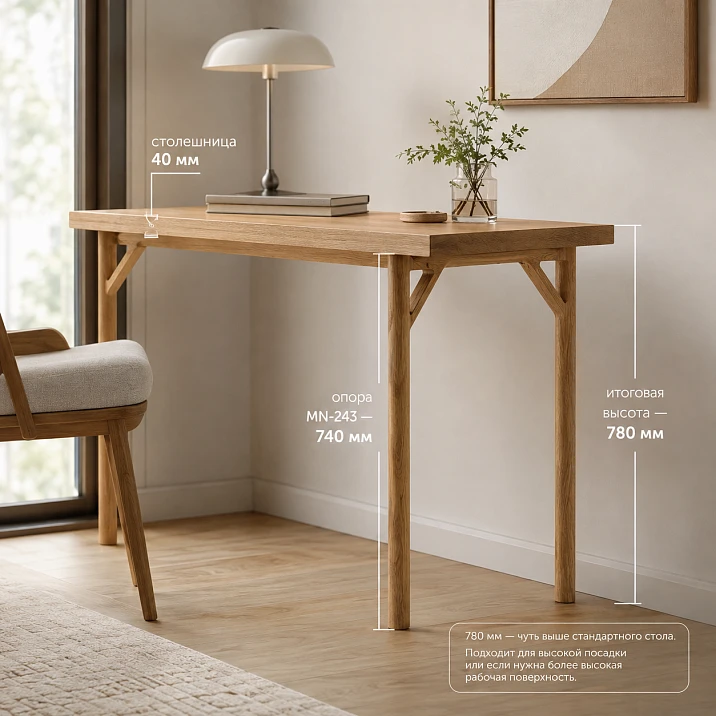
The tabletop has already been purchased. Its thickness is 40 mm. In terms of shape and style, the wooden furniture support MN-243, which has a height of 740 mm listed in its card, was liked. The arithmetic is simple: 740 + 40 = 780 mm. At this point, the main question arises before purchase: will a table with a height of 780 mm be comfortable specifically with the already chosen chairs and for the people who will sit at it, or should another support be sought?
The number 780 mm by itself does not make the table either right or wrong. It is the geometric result of combining a specific support and a specific tabletop. It should be evaluated not in isolation from the interior, but together with the chair seat height, actual seating posture, free space for knees, height of the main users, table purpose, and additional elements under the supports.
In the case of the MN-243, this is especially important because it is not an ordinary straight turned leg that can be perceived as a simple vertical block. The card shows a spatial side support for a table without aprons: it has a vertical part, a diagonal connection, and a horizontal mounting part. Therefore, the idea "if the table is high, we'll just saw off 20 mm from the bottom" should not become an automatic solution. Changing the geometry of such a support affects not only the height but the entire structural assembly.
Before buy wooden supports MN-243, it is useful to perform a simple check: temporarily position the tabletop so that its upper surface is exactly at the 780 mm mark, place real chairs, and sit at the mockup for a few minutes. Such a test provides more practical information than arguing about whether 780 mm is considered a "high table" at all.
If the seating is comfortable, shoulders do not rise, elbows do not have to be held unnaturally high, and knees have enough space, the 780 mm mark itself is not a reason to refuse MN-243. If the mock-up feels clearly too high, it is better to stop before payment and compare other supports, rather than relying on subsequent reworking of the finished wooden structure.
The formula for a preliminary calculation is simple:
H of the finished table = H of the support + tabletop thickness + elements that actually add height to the structure.
For the pair in question:
740 mm + 40 mm = 780 mm.
But this formula only answers the question "what will the geometric height be." The question "will it suit a person" is answered only by a seating test.
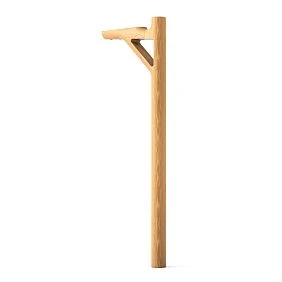
Wooden furniture support MN-243 740 mm: what the product card confirms before purchase
Before discussing height, it is necessary to clearly understand what MN-243 is.
The following parameters are confirmed for the product card:
| Parameter | MN-243 |
|---|---|
| Dimensions A×B×C×D | 764×240×45×740 mm |
| Working height | 740 мм |
| Material | Beech / Oak |
| Beech price at the time of check | 6 600 ₽ |
| Oak price at the time of check | 7 690 ₽ |
| Purpose | Support for tables without tsargi |
| Quality | Prestige |
| Installation | three hidden holes with countersinks |
| Made to order | 5–10 days |
| Delivery | Across Russia |
The card separately explains that the height of 740 mm is designed to obtain a finished work surface of approximately 750–780 mm after installing the tabletop. That is, a 40 mm tabletop leads exactly to the upper limit of the range that the manufacturer itself associates with this support.
This is an important circumstance: the 780 mm option is not a random combination that is obviously outside the declared logic of the product. But this does not mean that it suits every person and every chair.




Size MN-243 764×240×45×740 mm
MN-243 simultaneously features the numbers 764 and 740 mm. They should not be confused.
In the product card, the size is written as A×B×C×D = 764×240×45×740 mm. However, the working height of the support is specified as 740 mm.
A buyer who quickly glances at the card may mistakenly take the first size, 764 mm, as the vertical height. Then with a 40 mm tabletop, they will get 804 mm in the calculation and decide that the support is too high.
For calculating the finished surface, you must use the height of 740 mm.
This is a simple example of why you cannot add any numbers from the dimension line before purchasing furniture parts. You need to understand which dimension refers to the vertical.
Our factory also produces:
Wooden leg MN-243 made of beech
The beech MN-243 at the time of checking costs 6,600 ₽ and is available in Saint Petersburg in a quantity of 9 pieces.
Beech is suitable for projects where a covering finish is planned or a calmer material is needed under the chosen finish. But choosing beech does not change the geometry: the height remains 740 mm.
Therefore, if a 40-mm tabletop has already been purchased, regardless of whether beech or oak is chosen, the calculation remains the same:
740 + 40 = 780 mm.
The material should be chosen after the height issue is resolved, not instead of it.
Get Consultation
Oak furniture support MN-243
Oak MN-243 currently costs 7,690 RUB and is available in Saint Petersburg in a quantity of 8 pieces.
Oak is logical if the support must maintain a natural wood theme: an oak tabletop, furniture, wall panels, doors, or other decor.
But even here, the material does not compensate for an ergonomics error. If the 780 mm mockup is uncomfortable, more expensive oak will not make the table more correct.
Why 764 mm and 740 mm cannot be confused
This is one of the most dangerous minor mistakes in such a purchase.
In furniture specifications, the overall dimension of a complex part must always be separated from the functional size.
MN-243 has a diagonal and a horizontal part, so the overall size in one direction may be larger than the net height.
For ordering, it is useful to write down separately:
-
article number — MN-243;
-
dimensions A×B×C×D — 764×240×45×740 mm;
-
working height — 740 mm;
-
tabletop thickness — 40 mm;
-
nominal surface height — 780 mm.
Then neither the manager, nor the furniture maker, nor the customer will mix up the values.
Design for a table without an apron
MN-243 is intended for tables without an apron.
This means that under the tabletop there is no usual apron frame, which in many classic tables additionally reduces legroom.
From an ergonomic point of view, this is useful: the vertical mark of the bottom of the tabletop becomes more important than the height of the lower edge of the apron.
But the absence of a stretcher does not mean that you can forget about the design altogether. You need to check:
-
where the horizontal part of the MN-243 itself runs;
-
whether it falls into the knee zone;
-
how the two side supports are positioned;
-
what the width of the tabletop is;
-
where people will sit at the ends;
-
whether additional ties are provided.
In other words, a stretcherless design simplifies one problem but does not eliminate the need to check the space under the table.
Wooden table legs for a 740 mm table: what will be the final height with different tabletops
One of the most useful ways to understand MN-243 is not to discuss its height in a vacuum, but to immediately combine it with the thickness of the tabletop.
| Tabletop thickness | Height of MN-243 | Nominal surface height |
|---|---|---|
| 20 мм | 740 мм | 760 мм |
| 24 мм | 740 мм | 764 мм |
| 30 мм | 740 мм | 770 мм |
| 35 мм | 740 мм | 775 мм |
| 40 мм | 740 мм | 780 мм |
| 45 мм | 740 мм | 785 мм |
| 50 мм | 740 мм | 790 мм |
The table shows an important pattern: every additional 5 mm of tabletop thickness almost directly raises the finished work surface by the same 5 mm, if there is no additional structure between the support and the tabletop that increases the height.
For a 20 mm countertop, the result is 760 mm.
For 24 mm — 764 mm.
For 30 mm — 770 mm.
For 40 mm — 780 mm.
That is why you cannot first choose a support based on its attractive shape and then roughly match a countertop. In this case, it is the opposite: the countertop is already purchased, its 40 mm are fixed, so you need to check MN-243.
Tabletop 20 mm: 760 mm
This option is closer to the lower part of the range that the card references.
For many dining scenarios, it may be convenient, but there is still no universal conclusion. The chair, seat thickness, and person's height remain important.
Tabletop 24 mm: 764 mm
This is a particularly interesting example because the STAVROS range includes the ST-030 tabletop with a thickness of 24 mm, which the MN-243 card displays in the related products block.
Calculation:
740 + 24 = 764 mm.
This set shows well why you need to calculate the finished surface, rather than separately discuss the "leg height."
Tabletop 30 mm: 770 mm
This results in an intermediate option.
If a person is hesitating between 30 and 40 mm, the difference in the finished surface is 10 mm. In theory, this seems like a small number, but when sitting at a specific chair, it can already be noticeable.
Tabletop 35 mm: 775 mm
This is almost the upper part of the range specified by the card.
It is also better to verify such a mark with an actual fitting.
Tabletop 40 mm: 780 mm
The main scenario of the article.
Geometrically, this is an acceptable combination within the range that the MN-243 card guides toward.
But 780 mm is already a value that cannot be chosen solely from a table. Here, a mockup with real chairs is especially important.
Tabletop 45 mm: 785 mm
This option already exceeds the upper limit of 780 mm mentioned by the card.
This does not mean an automatic prohibition, but it becomes an additional signal: before purchasing MN-243, a conscious check is needed.
Tabletop 50 mm: 790 mm
Even more so.
If the countertop is massive and has 50 mm, the buyer should not simply add up the numbers and hope that "five or ten millimeters won't matter."
With such thickness, looking for a different support may be more rational than reworking MN-243.
Countertop 40 mm and wooden support MN-243: why 780 mm cannot be assessed only by the table
The number 780 mm is the beginning of the solution, not the end.
The convenience of a table is determined by the "table — chair — person" system.
Height of already purchased chairs
If the chairs are already available, that is a big advantage.
There is no need to rely on abstract tables. You can check the real pair.
The countertop is temporarily set at a height of 780 mm and a specific chair is placed under it.
After that, the following become clear:
-
elbow position;
-
angle at the shoulders;
-
position of the forearms;
-
distance between the thighs and the lower surface of the tabletop;
-
comfort of getting in and out from under the table;
-
feeling of a high or low surface.
That is why it is unprofitable for a buyer who has already purchased a tabletop to order MN-243 before such a test.
Seat height
The same 780 mm works differently with different chairs.
If the seat is higher, the distance from the seat to the surface decreases.
If the seat is low, the table feels higher.
But you need to measure not only the passport height of the frame. A soft seat can sag under a person.
Therefore, the actual seating is more useful than the catalog figure.
The apron thickness is absent, but the support geometry remains.
MN-243 is designed for a table without an apron.
In a classic table with an apron, the space for knees is often determined not by the top surface, but by the bottom of the apron.
Here, this frame is absent, which provides more freedom.
But the horizontal and diagonal parts of MN-243 still need to be checked against the chair and leg position.
Especially if people will sit at the ends.
Free knee space
Even if the height of the top surface is comfortable, the table may be uncomfortable due to the bottom geometry.
Need to check:
-
distance from the seat to the bottom of the tabletop;
-
position of the horizontal part of the support;
-
width between the side supports;
-
ability to move the chair away;
-
knees of the person sitting at the end.
This is especially important for a narrow countertop.
Height of primary users
A family may have two people with noticeably different heights.
One finds 780 mm normal, the other constantly raises their shoulders.
Therefore, a good mockup is tested not only on the project owner.
If the table is designed for a family, at least two primary users sit at it.
Dining table and work table are different scenarios
At the dining table, a person spends one type of time and changes position more often.
At the work table, one may sit for hours.
For the work table, height requirements should be evaluated even more strictly, especially if a keyboard is used.
MN-243 is called a support for a table without a crossbar, not a specialized adjustable office base. If the project turns into a permanent workstation, a mockup is mandatory.
The main conclusion here is simple:
780 mm is the geometric result of combining specific parts; comfort is checked with a specific chair and a specific person.
Buy legs for the tabletop: first make a mockup at a height of 780 mm
Before purchasing, there is no need to build a real table.
A functional height mockup is needed.
If a person is going to buy legs for the tabletop, but already knows that the tabletop is 40 mm, checking takes less time than subsequent rework.
Place the tabletop on temporary supports
You can use stable sawhorses, a temporary frame, or other safe supports.
The goal is not to model MN-243 in shape, but to get the top surface at the exact height.
Get exactly 780 mm to the top surface
The measurement is taken from the finished floor to the top surface of the tabletop.
If there is carpet, pads, or another layer under the temporary supports, this is taken into account.
Use real chairs
You cannot check 780 mm while sitting on a random stool if the interior will have soft armchairs with a different seat height.
Use the chair that will actually be placed at the table.
Check elbows, shoulders, and knees
The person sits naturally.
If you have to raise your shoulders, the table may be too high.
If elbows drop too low relative to the surface, the opposite problem may exist.
Knees should not conflict with the lower part of the structure.
Check the seating of two people of different heights.
If the table is for family use, it's better to test with at least two people.
If one is 165 cm tall and the other is 190 cm, their sensations may differ noticeably.
Check for more than one minute
In the first five seconds, a person often adapts to almost any height.
You need to sit for a few minutes, put your hands on the table, try simulating eating, working with a laptop, or writing.
If after a few minutes there is a desire to raise your shoulders, put something on the chair, or lower the surface, this is a real signal.
Buy table legs: when MN-243 740 mm fits without compromise
If the buyer is looking for where legs for a table to buy, MN-243 can be considered as a specific option, but not only by design.
Tabletop 20–30 mm
In this range, the finished surface is 760–770 mm.
This falls within the range that is directly indicated on the card as a reference after installing the tabletop.
But even here, it is worth checking the chairs, especially if they have a non-standard height.
Tabletop 40 mm after a real fit check
This is exactly our scenario.
If the 780 mm mockup is comfortable, there is no need to reject MN-243 just because the surface turned out to be at the upper limit of the stated range.
The project is specifically designed for a surface of 775–780 mm
Sometimes the height is predetermined by the design and the chairs.
Then MN-243 works especially logically.
The chairs are already matched to the final height.
This is the best commercial scenario.
A person knows:
-
seat height;
-
The thickness of the tabletop;
-
final 780 mm;
-
real sensations.
After this, the purchase becomes predictable.
When the wooden furniture leg MN-243 does not need to be ordered yet
The thickness of the tabletop is still unknown
Without it, the height of the finished table cannot be determined.
Chairs not yet selected
If the interior is built around a specific furniture set, it is wiser to at least know the seating range of future chairs.
The seating at 780 mm has not been checked
If a 40-millimeter tabletop has already been purchased, this is the main test.
The project specifies only 740 mm without the tabletop thickness
A drawing in which the designer wrote "table height 740" may turn out to be ambiguous.
Need to determine whether a support or a finished surface was meant.
The contractor mistakenly took size A=764 mm as the height
This can completely change the choice.
An additional layer or structure under the countertop is planned
For example:
-
metal mounting plate;
-
decorative backing;
-
spacer rail;
-
additional support system.
If it actually increases the height, it needs to be added to the formula.
A thick protective foot pad is planned
An additional element under the foot can also affect the actual mark, although the specific change needs to be checked against the actual node.
The table should serve as a permanent workstation.
Then the height decision needs to be evaluated even more strictly.
Can the wooden support MN-243 be shortened if the table turned out to be too high?
The most dangerous idea arises after purchase: "It turned out to be 780 mm, inconvenient; let's saw off 20 mm from the bottom."
For MN-243, such advice cannot be given automatically.
MN-243 is not an ordinary straight turned leg.
With an ordinary vertical leg, a person might assume that the lower end is a relatively independent section.
In MN-243, the shape is connected to the spatial structure.
The geometry is connected to the diagonal brace.
The card shows the power triangle:
-
horizontal mounting part;
-
diagonal brace;
-
vertical post.
Changing the length of the vertical section may affect the position of the lower end relative to the entire support.
The bottom 20–30 mm cannot be automatically considered "extra"
Even if visually there seems to be a wood allowance at the bottom, this does not mean the manufacturer permits shortening.
May change:
-
appearance;
-
stability;
-
geometry of the pair of supports;
-
position of the foot pad;
-
contact with the floor;
-
warranty logic of the product.
Why before modification you need a response from the manufacturer or furniture designer
If after the mock-up it turns out that exactly 760–765 mm of finished surface is needed, and the tabletop is already 40 mm, it is more correct to first compare other supports.
If MN-243 is fundamentally important for the design, the question of modification should be asked to the manufacturer or designer before cutting.
The article should not turn a complex support into a "block that can be sawed off."
Wooden legs for tabletop: beech or oak MN-243
After the height is checked, a normal question about the material arises.
Beech furniture leg for covering finish
Beech is often chosen if the support will be painted.
In this case, the wood texture is not the main visual argument.
The buyer gets the same MN-243 geometry and can fit it into the color scheme.
Oak wooden support
Oak is logical for natural finishing.
If the countertop is also oak, you can build a solid wood composition.
But matching the wood species does not guarantee an exact shade match. The finish needs to be coordinated separately.
Why the material does not change the height of 740 mm
This is fundamental.
Beech and oak have the same working height.
Therefore, the material choice is made after ergonomics.
When to choose by finish rather than geometry
If the 780 mm layout is comfortable, the geometry question is closed.
Then you can compare:
-
whether the support will be painted;
-
is visible texture needed;
-
how it matches the tabletop;
-
how the budget is allocated.
For a wide selection, you can Buy wooden furniture legs through the main category, if MN-243 does not fit in height or shape.
Before natural finishing, it is useful to look at materials and quality of wooden furniture supports.
MN-243 and tabletop ST-030 24 mm: a ready example of 764 mm height
The MN-243 card itself shows the ST-030 tabletop in related products.
ST-030 has a specified thickness of 24 mm.
Therefore, here you can perform a completely specific calculation:
740 + 24 = 764 mm.
Such an example is more useful than the abstract expression "standard table height."
Why such an example is more useful than an abstract "standard table"
It connects two real items.
The buyer sees where the figure came from.
Why height compatibility is not yet equal to structural compatibility
Even if 764 mm is convenient, you need to check separately:
-
tabletop size;
-
support layout;
-
the distance between them;
-
fasteners;
-
the load;
-
the rigidity of the entire structure.
Height is only one layer of compatibility.
What to check before placing a joint order
If the project is built specifically around ST-030, it is useful to verify its dimensions, material, and actual structural scheme.
You can buy ST-030 tabletop only after it is confirmed that it fits not only in height but also in the table design.
Buy furniture legs: one MN-243 or a pair
MN-243 cannot be considered a regular vertical leg, of which you automatically need four.
According to the card, this is a lateral spatial support.
Why the table design determines the quantity
The number of supports depends on:
-
tabletop dimensions;
-
span length;
-
material;
-
weight;
-
of the structural scheme;
-
stiffness requirements.
Pair MN-243 as two side supports
For a typical table without aprons, it is logical to consider MN-243 specifically as a lateral support.
More often, the design assumes a pair of such elements located on two sides of the tabletop.
But the article cannot be turned into a universal statement that "two are always needed." The final quantity should match the specific layout.
Why the rule of ordinary four legs cannot be transferred
If a user enters "buy furniture legs," they may be accustomed to the classic layout of four vertical elements.
MN-243 is arranged differently.
Therefore, when calculating the quantity, first study the structure, not multiply the price by four.
How to check the design before ordering
Need a sketch from below.
On it, mark:
-
countertop dimension;
-
two assumed supports;
-
distance from edges;
-
mounting zones;
-
possible seating locations on the ends;
-
all additional connections.
This article does not repeat the detailed instructions for the three mounting holes, because such intent is already covered by a separate material.
Recommended foot pad FUR-022: check it before final height calculation
Card MN-243 recommends foot FUR-022.
For FUR-022, the size 30×30×5 mm and its purpose as a sliding floor protector for floor protection have been confirmed.
This means that during design, one cannot completely forget about the additional element under the support.
But one also cannot automatically say "add exactly 5 mm to the table height" without checking the actual installation method.
Do not forget about additional elements under the leg
Some glides protrude below the support by their full thickness, others are partially recessed or installed so that the actual addition differs.
Therefore, the formula must be precise:
H of the finished table = 740 + tabletop thickness + actual addition of all lower and upper elements.
Check the actual position of the glide after installation
If FUR-022 indeed adds millimeters to the vertical, for a 40 mm tabletop, the finished surface may become slightly above 780 mm.
This is exactly why it is useful to make a mockup taking into account the actual assembly.
Why you should not automatically add or subtract millimeters without a layout
The nominal thickness of a part is not always equal to its effective vertical addition.
It is better to look at the real diagram once.
If a glide is required by the design, you can buy the foot pad FUR-022 together with the supports.
Wooden furniture support MN-243 and three hidden holes: what to check, but not to repeat the old article
The card indicates three hidden mounting holes with countersinks.
For the current article, it is enough to check four things:
-
The thickness of the tabletop;
-
the permissible fastening depth;
-
position of the mounting part;
-
the impossibility of the fastener exiting onto the front surface.
Detailed marking, symmetry, and selection of specific screws should remain in a separate material about MN-243 installation.
Here, this information is needed only as a filter before purchase.
If the countertop is 40 mm, it does not automatically mean that any fastener of suitable length is safe. You need to consider the thickness of the mounting part of the support itself and the actual depth of entry.
How to check the free space under the table with MN-243
A height of 780 mm may be comfortable from above, but the table can still turn out to be uncomfortable from below.
Therefore, it is useful to supplement the mockup with the side contour of MN-243.
Check along the long side
Sit in the usual place.
Check whether the horizontal part of the support interferes with the legs.
Check at the end
If a chair is planned at the end, this point is especially important.
Diagonal geometry can affect the space differently than a regular vertical leg.
Check with pulling the chair away
A comfortable table is not just about the seated person's position.
You need to be able to sit down and stand up freely.
Check multiple chairs
If the table is large, the outermost seats may be closer to the support than the central ones.
What to do if 780 mm is comfortable for one person but too high for another
This is a real family scenario.
You don't always need to change the supports right away.
Check the chairs
Sometimes the problem is not the table, but a seat that is too low.
If another chair solves the issue and matches the interior, it may be more rational.
Check the softness of the seat
A tall soft chair may sag under load.
Determine the primary user
If the table is a family dining table, the solution should be a compromise.
If it is a work table used by one person, you can focus on that person.
Do not compensate for poor height with a random cushion
If everyone constantly has to add an extra cushion for proper seating, it's a sign that the base geometry is flawed.
Price of wooden furniture legs MN-243: compare only after resolving the height issue
At the time of checking, the card shows:
-
beech — 6,600 ₽;
-
oak — 7,690 ₽.
If a specific table uses a pair of side supports, the product cost for the pair is:
-
beech: 13,200 ₽;
-
oak: 15,380 ₽.
This is a calculation based on the price at the time of checking, not a permanent price. Before ordering, you need to reopen the product page and check availability, as stock may change.
Why mockup first, then cart
The difference between beech and oak is 1,090 ₽ per support. The buyer can spend a long time choosing the material, comparing finishes, and calculating the budget, but still not check the actual seating at 780 mm.
This is the wrong order.
An ergonomics error makes saving or overpaying for the wood species pointless. If the table is uncomfortable, the fact that the oak was chosen very well by shade no longer saves the project.
Why a cheap 20 mm mistake can make an expensive table uncomfortable
The difference between a 20 and 40 mm tabletop is only 20 mm.
But the final surfaces differ:
-
760 mm;
-
780 mm.
On paper, this is a small number. In real seating, the difference can be noticeably felt.
Therefore, it is precisely a small geometric parameter that can decide the fate of an expensive product.
How much does a mistake cost if you buy first and check later
Suppose a pair of oak MN-243 is ordered.
Product value at the price at the time of inspection — 15,380 ₽.
After assembly, it turns out that the table feels high.
Then additional actions arise:
-
dismantling;
-
consultation on the admissibility of modification;
-
possible modification;
-
re-finishing;
-
re-installation;
-
risk of changing the symmetry of the two supports;
-
risk of damaging the countertop.
Even if the shortening operation itself is theoretically possible, it is already a much more complex path than a 15-minute mock-up before purchase.
Scenario 1: countertop 40 mm, chairs already purchased, 780 mm is comfortable
This is the simplest case.
Procedure:
-
layout confirmed;
-
height comfortable;
-
knee clearance is suitable;
-
End faces checked;
-
Material selected;
-
number of supports confirmed;
-
support feet accounted for;
-
fastening depth checked;
-
order can be placed.
In such a scenario, there is no reason to change MN-243 for an abstract idea that "the table should be lower."
The point of the article is precisely not to replace real verification with general assumptions.
Scenario 2: countertop 40 mm, low chairs, 780 mm feels high
There is more than one solution here.
Option A. Change the chairs
Rational if they have not been purchased yet.
Need to check whether a higher seat resolves the seating without other issues.
Option B. Change the support
Rational if MN-243 is not yet paid for.
In this case, it is better to return to the wooden legs category and compare models of lower height.
Option C. Redesign the structure
Only with the involvement of the manufacturer or a furniture designer.
Sawing off MN-243 yourself is a weak solution because the support shape is complex.
What not to do
Do not buy MN-243 "just because you really like it," expecting that the installer will solve the height problem later.
This shifts uncertainty to the most expensive stage.
Scenario 3: countertop 40 mm, work desk
Here, height requirements are stricter.
Need to simulate real work.
Place a laptop or keyboard, adjust the chair as it will be used, and spend at least 15–20 minutes at the mockup.
Check:
-
position of wrists;
-
elbow position;
-
shoulder tension;
-
distance to the screen;
-
the need to raise the chair;
-
position of the feet.
If for comfort you have to raise the chair so that your legs lose proper support, the geometry of the system may be unsuccessful.
If the main work scenario is primary, it is better to choose a comfortable height, even if it means giving up a specific support model.
Scenario 4: tabletop 40 mm, dining table, high chairs
In that case, 780 mm may turn out to be a quite comfortable mark.
Especially if the seating is free and there is no apron under the table.
That is why the article should not declare 780 mm a mistake.
The dining scenario is checked not only statically.
You need to:
-
sit down;
-
move the chair;
-
put your hands;
-
imitate eating;
-
try to stand up;
-
check the neighboring person.
If everything is natural, the height works.
Scenario 5: countertop 45–50 mm
Here the finished surface comes out to 785–790 mm even before accounting for additional elements.
This is already a reason to compare other supports especially carefully.
If the person still chooses MN-243, a mockup is mandatory.
In the case of a 50-millimeter countertop, it is useful to make two mockups:
-
790 mm;
-
desired alternative height.
A live comparison will quickly show whether it makes sense to look for another support.
Scenario 6: chairs are not selected yet, but MN-243 needs to be ordered now
This scenario occurs during phased furnishing of an interior.
Here it is better not to guess.
Allowed:
-
determine the desired seat height of future chairs;
-
find several real models;
-
place a temporary chair with a comparable seating position;
-
only after that, secure the supports.
If this is not possible, the risk remains.
The more expensive the tabletop and finish, the less reason to accept it without testing.
Scenario 7: one person is significantly taller than the other
Suppose the primary users are 165 and 192 cm tall.
The same height of 780 mm will be perceived differently.
There is no need to find the perfect mark for each person — a shared dining table is always a compromise.
But the mock-up helps to understand whether the compromise is acceptable.
You can check at the same time:
-
two chairs with different seat heights;
-
two positions;
-
possibility to adjust one of the chairs.
How to choose between MN-243 and another support after the mockup
After the test, the solution can be reduced to three options.
MN-243 is suitable
We buy a specific product.
Height confirmed, can move on to material, finish, and quantity.
The shape of MN-243 is liked, but the height is not suitable
We do not automatically rework the product.
First, we ask the manufacturer about the admissibility of modification or look for another model.
Not clear yet
Open the category buy unpainted wooden furniture legs and compare several options.
This is how the catalog is used as intended: as a real selection step, not as a formal internal link.
How to order wooden supports MN-243 after checking the finished height
After the mockup, the manager needs a proper specification.
Base entry:
MN-243 → beech/oak → 764×240×45×740 mm → quantity → tabletop thickness
Error 5. Buying oak before resolving the height issue
Material won't fix ergonomics.
How to prevent: first a mockup, then choose the wood species.
Error 6. Automatically ordering four MN-243
MN-243 is a side support, not a classic turned leg.
How to prevent: verify the table's construction.
Error 7. Shortening the construction yourself
The geometry is more complex than a regular block.
How to prevent: get a response from the manufacturer or designer.
Error 8. Testing only one user
For a family table, a compromise is needed.
Mistake 9. Ignoring end seats
Diagonal geometry can affect seating.
Mistake 10. Considering ST-030 compatibility only by height
740 + 24 = 764 mm, but the structure needs to be checked separately.
Error 11. Choosing the countertop thickness after purchasing the supports without recalculating
Each millimeter of thickness raises the finished surface.
Error 12. Considering the price more important than the layout
First the fit, then the material and cost.
Error 13. Using the floor height before the final finish
If the finishing coating is not yet laid, the final mark may change.
Error 14. Not accounting for the sagging of a soft seat
The rated chair height and the actual seating position may differ.
Error 15. Checking the height without the actual countertop, even though it has already been purchased
This deprives the test of its main advantage.
Error 16. Adjusting the chair to the table at any cost
If you have to choose a deliberately uncomfortable chair just for the sake of MN-243, it's better to reconsider the support.
When it's better not to buy MN-243
MN-243 should not be ordered right now if at least one of the critical points remains unknown:
-
actual tabletop thickness;
-
total height;
-
seat height;
-
seating comfort;
-
number of supports;
-
tabletop design;
-
mounting depth;
-
need for a footrest;
-
material;
-
finish;
-
seating diagram by ends;
-
finished floor level.
A particularly strong stop signal — the tabletop is already 40 mm, and the 780 mm mockup hasn't been checked by anyone yet.
When MN-243 can be confidently purchased
A strong specification looks like this:
-
The 40 mm countertop is already available;
-
MN-243 working height confirmed as 740 mm;
-
The final height of 780 mm has been calculated;
-
real chairs tested;
-
At least two users have checked the seating;
-
There is enough space under the table;
-
The number of side supports is structurally approved;
-
Beech or oak was chosen deliberately;
-
The floor protector is taken into account;
-
The fasteners do not extend to the front side;
-
The finished floor is already known;
-
Price and availability have been checked before payment.
In this state, the order is no longer an experiment.
Final check before purchase
Before payment, you can go through a short algorithm.
1. Record the actual thickness of the countertop
Not "about 40", but the real value.
If the countertop has already been purchased, measure it at several points if the design allows for local variations.
2. Use the height of MN-243 740 mm
Not 764 mm.
764 mm is another dimension of the product, not the working vertical height.
3. Add up the dimensions
740 + 40 = 780 mm.
4. Add only elements that actually increase the height
Do not automatically add the nominal thickness of the support pad without understanding the installation.
5. Make a mockup of 780 mm
Use a real countertop or a flat temporary surface.
6. Place a real chair
Not a random stool.
7. Sit at the mockup
Check shoulders, elbows, knees, position of forearms, and the feeling of height.
8. Check the second place
If the table is a family table, a second user is needed.
9. Check the end seat
Especially if a full chair is planned at the end.
10. Solve material
Beech or oak.
11. Decide on the quantity
Based on the actual structural scheme, not out of habit of "four legs."
12. Check the glides
Are FUR-022 needed and how exactly do they affect the actual height.
13. Check the price and availability
The card is valid only at the time of viewing.
14. Prepare the specification
And only after that make the purchase.
Practical decision table
| Condition | MN-243 740 mm + tabletop 40 mm |
|---|---|
| Nominal height | 780 мм |
| Chairs are already available | create a real mockup |
| Chairs not selected yet | first determine the seating position |
| 780 mm is comfortable | you can proceed to order |
| 780 mm feels high | compare other supports |
| Beech or oak | does not affect the height |
| Thrust bearing | take into account actual installation |
| Need to shorten | first coordinate with manufacturer/designer |
| Number of supports | determined by the table design |
| Work desk | test longer and stricter |
| Dining table | check actual seating and end positions |
Why the mockup is the main tool for this purchase
In furniture design, they often try to solve ergonomics by calculating down to the last millimeter.
Calculation is needed, but it does not replace the human body.
MN-243 and a 40 mm tabletop give a very specific 780 mm. This allows for an almost perfect test before purchase.
There is no need to wait for furniture manufacturing.
There is no need to guess.
There is no need to argue whether such a height is normal "by standard."
You can simply set the plane at the desired mark and get the answer.
That is why this article is built around preliminary testing, not around general advice about furniture legs.
Why 780 mm might be normal specifically in a particular interior
There are several reasons.
First, chairs may be higher than average in seat height.
Second, the table may be used by tall people.
Third, the absence of an apron provides more free space underneath.
Fourth, the table may be part of an interior where a higher surface is coordinated with adjacent furniture.
But none of these factors can be assumed automatically.
It needs to be checked.
Why 780 mm may be uncomfortable
The reverse reasons are also clear.
Low chairs.
Short users.
Working scenario with keyboard.
Thick additional elements under the countertop.
Support feet that actually increase the height.
Low seating position of the soft chair.
Therefore, a good article should not advertise MN-243, but give a person a way to make a decision.
Can a 40 mm countertop be considered too thick for MN-243
No.
The card for the MN-243 itself orients the support to a finished surface of approximately 750–780 mm.
At 40 mm, the upper limit of this range is reached.
That is, 40 mm is not automatically an incompatible thickness.
But precisely because the result reaches the upper mark, checking the fit becomes especially useful.
Influence of the finished floor
If the project is assembled before the renovation is finished, one must not forget about the finished floor level.
Suppose the mockup was made based on the subfloor, and then a covering was added.
The height from the finished floor to the countertop will decrease by the thickness of the new layer.
This can improve or change the seating position.
Therefore, the final check should preferably be done from the actual finished floor, or the future level should be taken into account in the calculation.
Influence of the carpet
A carpet under the table and chairs can change the feeling of the seating position not so much by absolute height, but by the movement of the chair.
A thick carpet makes movement difficult and slightly changes the level of individual support points.
For the final interior test, it is useful to take into account the actual floor covering.
Should one be guided by the kitchen countertop nearby
Not necessarily.
If there is a kitchen island or a work surface of a different height nearby, the two horizontal lines may visually be compared.
But the ergonomics of a dining table are determined by its own scenario.
You cannot raise the table just to match the adjacent line if it is uncomfortable to sit at it.
What to do if the designer insists on 780 mm, but the user finds it uncomfortable
Ergonomics should be checked again on the correct chair.
If the discomfort is confirmed, the design solution must be reconsidered.
Furniture exists for use, not just for rendering.
The visual appearance can be preserved through a different support, changing the chair model, or recalculating the structure.
Should MN-243 be ordered in one batch
If two wooden supports with visible texture are used, it is reasonable to purchase them at the same time if possible.
This simplifies the selection of finishes.
But an absolute match of natural wood is still not guaranteed.
If the supports will be painted with opaque enamel, the tonal difference of raw wood has less visual significance after finishing.
How to work with oak and a countertop made of a different wood species
There is no need to try to "mask" the difference in wood only by the name of the species.
If the countertop is, for example, ash, and the supports are oak, the composition can be good with a coordinated finish.
If a close tone is required, samples are made.
If contrast is needed, it is accepted deliberately.
Material MN-243 is selected based on the finished visual result.
How not to confuse an order of beech and oak
The specification describes the material in text, not just in code.
For example:
MN-243 / oak / 740 mm / 2 pcs. / for tinting / tabletop 40 mm.
This is especially useful if the project is managed by several people.
How to check two supports for symmetry without repeating the installation article
Before ordering, it is enough to determine that the structure assumes two identical side supports.
After receiving them, they are compared visually and by dimensions.
Detailed marking of fasteners belongs to a separate installation material.
In this article, it is only important not to confuse the quantity and type of support.
Why you cannot calculate the quantity based only on price
If one MN-243 costs 6,600 or 7,690 ₽, the buyer may intuitively think that two are expensive and try to solve the structure with one.
This cannot be done.
The quantity is determined by the stability and the table design.
The price does not replace the construction.
How to calculate the budget with support pads
If the project uses a pair of MN-243 and two FUR-022, two support pads are added to the estimate.
If the construction requires a different quantity, it is calculated based on the actual need.
The point is not the large amount, but not forgetting the mandatory small detail when ordering.
When it is useful to order a finish sample
If the oak supports must match the tone of the tabletop, the sample is especially useful.
Test the finished system:
-
preparation;
-
tinting;
-
oil or varnish;
-
degree of gloss.
You shouldn't compare only raw oak with a finished countertop.
How to check the height with a soft armchair
The soft seat needs to be tested with a person.
Without load, it might be, for example, at one mark, but under weight it can sag.
Therefore, measuring with a ruler to the top point of the cushion doesn't replace sitting down.
How to check the height with a rigid wooden chair
Here the geometry is more stable.
You can measure the seat height and immediately compare two chairs.
But even here, the shape of the seat and backrest affects posture.
Can adjustable floor glides be used
If the project considers another regulated element, that is already a separate decision.
You cannot automatically replace the recommended FUR-022 without checking compatibility.
Adjustment can help with an uneven floor, but it also changes the height.
Do we need to make a template for the MN-243 itself?
For height, a plane of 780 mm is sufficient.
To check the end seating and space under the table, it is useful to reproduce the side contour of the support according to the drawing.
This will give a more accurate result.
What to do if the tabletop has a bevel?
The bevel does not change the top mark if the thickness at the center remains 40 mm.
But visually, the edge may appear thinner.
This does not affect the calculation of 740 + 40 if the mounting thickness is indeed 40 mm.
What to do if the countertop has a thickened edge
Then you need to determine the actual thickness at the support attachment point.
If 40 mm is only a decorative edge, and the central plane is thinner, simple addition may be incorrect.
This is a critical boundary scenario.
Before ordering, the structural thickness in the installation area is measured.
What to do if the countertop is non-uniform in thickness
For example, a solid frame and a thinner central part.
The surface height is determined by the top, but fastener compatibility is determined by the thickness at the support area.
Both figures should be in the specification.
Edge case: there is a metal plate under the countertop
If it is installed between MN-243 and the countertop and actually adds vertical thickness, it needs to be included in the formula.
For example:
740 + 5 + 40 = 785 mm.
But only if the plate really works as a five-millimeter spacer.
Edge case: the countertop is lowered into the mounting position
If the design provides for partial recessing of the support, the final height may be less than a simple addition.
Such a project requires a drawing.
The formula 740 + 40 cannot be used without checking the joint.
Edge case: the floor has a slope
Leveling feet may be needed for compensation.
In this case, the actual height may vary slightly across different angles of the table.
The main goal is to achieve a stable, horizontal tabletop.
Boundary scenario: the table stands on the carpet with only part of its supports.
This is not recommended, because the two sides may get different support in terms of height.
If the carpet goes under the table, it is better for the support conditions to be the same.
Boundary scenario: chair with armrests.
Here you need to check not only the person's seating, but also the ability to push the chair in.
The armrests may press against the underside of the tabletop or the horizontal part of the structure.
A height of 780 mm sometimes helps, but a mockup gives the exact answer.
Boundary scenario: the table is used by children.
A high surface may be uncomfortable for a child.
If the table is a family one, a child's chair or special seating solves the issue separately.
But 780 mm cannot be considered a universal height for all ages.
Edge case: bar seating
MN-243 should not be automatically used as a bar support just because 780 mm seems taller than usual.
The product's purpose is a table without aprons.
Bar scenarios require different ergonomics.
Edge case: very long tabletop
With a large length, not only the height matters, but also the deflection of the tabletop and structural rigidity.
The number and position of supports should be determined by a furniture designer.
Edge case: heavy stone countertop
The card confirms the designation of MN-243 as a furniture support, but the article plan does not contain a confirmed permissible load for a specific heavy stone slab.
Therefore, such a set cannot be automatically recommended.
A separate structural calculation is needed.
Edge case: glass countertop
The mounting requirements differ.
The mere fact of suitable height does not imply compatibility.
What to pass on to the furniture maker
Short work package:
-
item MN-243;
-
size 764×240×45×740 mm;
-
material;
-
quantity;
-
tabletop thickness;
-
constructive thickness in the attachment zone;
-
total height;
-
floor protector model;
-
a layout diagram;
-
type of finish.
This reduces the risk that one specialist calculates 740 mm, while another calculates 764 mm.
What to pass to the designer
The designer needs:
-
final height 780 mm;
-
real chairs;
-
material of supports;
-
finish;
-
position relative to the edge of the tabletop;
-
visual connection with other furniture.
What to provide to the STAVROS manager
A specific request is useful for the manager:
MN-243 / oak or beech / quantity / availability / lead time / delivery / accompanying FUR-022.
The question of comfort at 780 mm should be resolved before this.
FAQ
What is the height of the wooden support MN-243?
Working height — 740 mm.
Why do the dimensions of MN-243 show both 764 and 740 mm?
Because the A×B×C×D line describes several dimensions of a complex spatial support. For vertical table calculation, a height of 740 mm is used.
What will be the table height with MN-243 and a 40 mm tabletop?
Nominally 780 mm: 740 + 40.
Will a table height of 780 mm be achieved?
Yes, if there are no additional elements that increase the vertical mark, or their effect is zero. Support feet and other components must be accounted for actually.
Will MN-243 fit a 24 mm tabletop?
In height, it will be 764 mm. Structural compatibility must be checked separately.
What will be the height of MN-243 with the ST-030 tabletop?
ST-030 has a thickness of 24 mm, so the nominal surface will be 764 mm.
Can MN-243 be shortened?
It cannot be automatically assumed that such a support can be safely sawed off. The geometry includes a diagonal and a horizontal part. Any modification must be coordinated with the manufacturer or a furniture designer.
What wood is MN-243 made from?
Beech and oak are confirmed on the card.
What to choose — beech or oak?
They are the same in height. The choice depends on the finish, interior task, and budget.
How many MN-243 units need to be ordered for a table?
The quantity is determined by the design. MN-243 is a side spatial support, so the rule of four regular legs cannot be automatically applied.
What table is MN-243 intended for?
For a table without aprons.
Can I buy MN-243 for a table without a frame?
Yes, that is exactly the purpose indicated on the card.
How to check the table height before buying legs?
Place the tabletop on temporary stable supports at the calculated mark, put a real chair underneath, and check the seating.
Which legs should I buy for a 40 mm thick tabletop?
You first need to determine the desired height of the finished table. MN-243 will nominally give 780 mm. If this height is comfortable, the model fits this criterion.
Is a FUR-022 floor protector needed?
The MN-243 card recommends FUR-022. The decision depends on the floor and the project, but this element should be considered before final ordering.
Where can I buy wooden table legs?
If you need MN-243 — in the card for this support. If the model is still being compared — in the table legs category.
How to order MN-243 with delivery?
Select material, quantity, check availability and delivery conditions, then place an order via the product card.
How much do wooden furniture legs MN-243 cost?
At the time of checking, beech costs 6,600 ₽, oak — 7,690 ₽. The price needs to be re-checked before ordering.
Is the height of 780 mm suitable for everyone?
No. This is not a universal ergonomic constant. You need to check the specific person and the specific chair.
What to do if a 780 mm table turned out to be slightly too high?
If MN-243 has not been purchased yet, it is better to compare other legs. If already purchased — do not shorten it yourself without coordinating the design.
How does seat height affect it?
The higher the seat, the smaller the vertical distance to the surface. Therefore, the same table feels different with different chairs.
Do I need to account for the softness of the seat?
Yes. A soft seat sinks under a person and changes the actual seating position.
Can I use MN-243 for a work desk?
Technically, the support is designed for a desk without a modesty panel, but the ergonomics of a permanent workstation need to be checked separately, especially at a height of 780 mm.
Do I need to add the 5 mm of the FUR-022 glider to the height?
Not automatically. You need to understand the actual installation method and the real vertical addition.
Why can't I just rely on the "standard table height"?
Because the project already has a specific tabletop, a specific support, and specific chairs. The actual mockup is more accurate than the general standard.
What is more cost-effective: beech or oak?
If comparing only the price at the time of checking, beech is cheaper. But the material should be chosen based on finish and design after the height itself has been confirmed.
Can I order the supports first and choose the chairs later?
Yes, but the risk of seating height error is higher. If the tabletop is already 40 mm, it's wiser to at least know the height range of the future chairs first.
Why can't MN-243 be considered a regular leg?
Because it's a spatial support with a diagonal brace and a horizontal mounting part.
Do I need to account for the tabletop thickness in the request to the manager?
Yes. This helps immediately fix the calculated height of the finished surface.
Can I buy MN-243 for a very heavy stone tabletop?
The provided plan does not include a confirmed allowable load for such a scenario. For a heavy stone tabletop, a separate structural calculation is needed.
What to do if 40 mm is only the decorative edge of the tabletop?
Measure the actual structural thickness in the mounting area. If it differs, recalculate the joint and check the fasteners.
Can one MN-243 be used instead of two?
The quantity is determined by the table's construction. For a typical trestle table, MN-243 is considered as a side support, but the final layout needs to be confirmed against the specific tabletop.
Do I need to buy FUR-022 right away?
If this recommended foot is chosen, it's convenient to include it in one order. But first, you need to make sure it suits the floor and the mounting layout.
What matters more — beautiful oak or the correct height?
The correct height. The material is chosen only after the ergonomics are confirmed.
Conclusion
With an already purchased 40 mm tabletop, the decision on MN-243 starts not with the material or the price.
First, you need to add up the actual dimensions:
740 mm height of MN-243 + 40 mm tabletop = 780 mm finished surface.
Then this figure is checked in person.
If the real chairs fit, shoulders and elbows are in a comfortable position, knees have enough space, and end seats do not conflict with the support geometry, MN-243 can be purchased without trying to "fix" its height.
If 780 mm feels high, it's better to stop before paying. Don't count in advance on sawing off 20–30 mm from a complex side wooden support. It's simpler and safer to compare other models or agree on a special solution with the manufacturer.
Beech and oak have the same height of 740 mm, so choosing the wood species doesn't solve the ergonomic issue. It only begins after the mock-up.
The ST-030 tabletop with a thickness of 24 mm shows another useful example: 740 + 24 = 764 mm. This clearly confirms how much the final surface depends on the thickness of the top part.
Before the final order, you also need to decide on the number of side supports, check the FUR-022 foot, ensure sufficient tabletop thickness for fasteners, and review the current price and availability again.
After such a check, buy wooden supports MN-243 it can be treated as a concrete, verified part of the project, rather than a beautiful detail whose height will need to be corrected after assembly.
Decision tree: buy MN-243 or return to choosing supports
When all the initial data is collected, the decision is convenient to make using a sequential scheme.
Question 1. Is the tabletop thickness really 40 mm in the mounting area?
If yes, we move on.
If not, and 40 mm is only a decorative edge, first we measure the actual structural thickness at the MN-243 installation location. This affects not only the finished height, but also the allowable fastener depth.
Question 2. Does the nominal surface of 780 mm suit the project?
If the designer and users have already accepted this exact mark, we can proceed to the physical check.
If the project requires, for example, 750–760 mm, the MN-243 with a 40-mm countertop no longer matches the task by simple geometry. In this case, it is wiser to compare other supports before purchasing.
Question 3. Is the actual chair already known?
If yes, we make a 780 mm mockup and test the seating.
If not, do not make a final decision based only on the catalog picture. First, at least determine the seat height range of the chairs that are actually being considered.
Question 4. Is the seating at 780 mm comfortable?
If yes, the height question can be considered closed.
If not, you need to understand the reason. Perhaps the chair is too low. Perhaps the surface is indeed high. Perhaps the issue is related to the work scenario, not the dining one.
Question 5. Is there enough free space under the table?
We check not only the top surface, but also the position of the horizontal and diagonal parts of MN-243.
If the end positions conflict with the support, one good height is not enough.
Question 6. Is the number of supports confirmed by the design?
If the project involves a pair of side MN-243s and the tabletop is designed for such a scheme, the quantity can be considered.
If the tabletop is very long, heavy, or unusual in material, a separate rigidity calculation is needed.
Question 7. Was the material chosen after checking the height?
If 780 mm is comfortable, beech or oak is chosen.
If the height is not suitable, the debate about the wood species is stopped and they return to choosing the model.
Question 8. Are the thrust bearing and other additional elements accounted for?
You need to understand not only their nominal size, but also the actual position after installation.
Question 9. Were the price and availability checked on the day of the order?
If yes, the specification is ready.
If not, we reopen the card: the price saved in the article is the price at the time of the check, not a promise for the future.
Such a decision tree protects against the most common sequence of errors: first buy a beautiful support, then select a chair for it, then discover an uncomfortable height, and finally try to rework an already finished structure.
Checking the set "MN-243 + 40 mm tabletop + chair": what to record after the mockup
It is better not to end the mockup with a subjective conclusion like "seems fine."
It is useful to make a short inspection passport.
| Parameter | Result |
|---|---|
| Tabletop thickness | 40 мм |
| Support height | 740 мм |
| Nominal surface | 780 мм |
| Chair model | ___ |
| Seat height without load | ___ mm |
| Sitting under load | comfortable / high / low |
| Knees | free / conflict |
| Elbows | natural / have to raise shoulders |
| End position | convenient / conflict |
| Primary user | ___ |
| Secondary user | ___ |
| Footrest accounted for | Yes / no |
| Solution | MN-243 fits / compare another support |
Such a table is especially useful in a project where the decision is not made by one person. The designer may see one thing, the client another, the furniture maker a third. The passport moves the discussion from the category of "seems high" to a specific set of observations.
Why you shouldn't make a decision based on a single seat height number
Sometimes they try to derive comfort only from the difference between the top of the chair and the tabletop.
This is a useful reference point, but not a complete answer.
Two chairs of the same height can give different seating due to:
-
seat shapes;
-
backrest angles;
-
depth;
-
softness;
-
pelvis position;
-
armrests.
Therefore, the real test remains the main one.
What to do if the 780 mm mockup is borderline comfortable
There are situations when a table does not seem clearly high, but it cannot be called ideal either.
In such a case, it is useful to make a second mockup, for example at 770 or 760 mm, and compare the sensations over several minutes.
If the difference is barely noticeable, MN-243 can be left in the project if it fits better in terms of design and construction.
If at 760–770 mm the seating suddenly becomes more natural, that is a strong argument to look for a different support.
Comparing two actual heights is better than trying to logically convince yourself that "20 mm means nothing."
What to do if the chairs will be replaced in a few years
A table usually lasts longer than one set of chairs.
Therefore, when choosing a borderline height, it is worth avoiding a solution that only works with one very specific seat model.
If 780 mm is comfortable with a normal range of chairs, it is a sustainable solution.
If comfort only appears with an unusually high chair, future furniture replacement could become a problem.
Why a 40-millimeter tabletop by itself is not a reason to reject MN-243
A thick tabletop is often chosen deliberately: for a massive visual edge, durability, natural wood, or a specific design.
MN-243 at this thickness gives 780 mm, and the card itself guides the support to a surface up to this mark.
Therefore, the task is not to declare 40 mm a "too thick countertop," but to check the final system.
If the system works, there is no problem.
If it doesn't work, the element that can still be changed without losing the already purchased countertop is replaced.
Commercial solution after all checks
After the mockup, three clear paths remain.
Path 1. MN-243 fits completely.
Specific material, quantity, and accompanying elements are specified.
Path 2. The height doesn't fit, but a wooden support for the table is needed.
The buyer returns to the category and compares other models.
Path 3. The height fits, but the material or price is not satisfactory.
One can compare beech, oak, and other wooden supports without changing the already confirmed ergonomic task.
This is the correct sequence of commercial choice: first compatibility, then material and cost, and not the other way around.