Article Contents:
- Short answer: PR-001 or PR-002
- What is a profiled handrail and why its size is so noticeable
- Confirmed specifications of PR-001 and PR-002
- How PR-001 differs from PR-002
- The main difference is the profile scale 86 × 67 and 74 × 60 mm
- When to buy a massive handrail PR-001
- For a wide staircase in a spacious hall
- For massive carved balusters
- For large starting and turning posts
- For classic and formal interiors
- When the handrail needs to be clearly visible from a distance
- For beech under enamel in a large composition
- For oak under stain
- For medium-scale railing
- For a small hallway
- For balusters of medium and compact cross-section
- For calm classic and neoclassical styles
- When PR-001 seems too heavy
- For a long line that you don't want to weigh down
- Measure the handrail line, not the room length
- Consider landings separately
- Check the connection to the posts
- Don't try to avoid every joint at any cost
- Don't order all sections the same length
- Beech for enamel
- Oak for tinting
- Grand entrance hall of a private house
- Small stair hall
- Living room with an open staircase
- Interior in calm neoclassicism
- Hotel, restaurant, or representative space
- A new staircase is being built from scratch
- Only the handrail on the finished railing is being changed
- The staircase is assembled from new balusters and old posts
- Need to lighten a too heavy balustrade
- Need to reinforce the too weak top line
- Requires a white painted fence
- Requires an oak staircase with visible texture
- Need a long handrail up to 5000 mm
- Table of 'what to buy together'
- Do not confuse the handrail with the under-rail plank
- Do not confuse the two profiles by photo
- Do not confuse with the round profile
- Do not consider PR-001 and PR-002 as ready-made wall-mounted kits
- Do not confuse material and finish
- Do not consider all lengths to be identical in design
- Mistake 1. Choosing only based on a photo
- Mistake 2. Thinking that a 12 mm difference is unnoticeable
- Mistake 3. Choosing the largest profile as the "most beautiful"
- Mistake 4. Choosing PR-002 only for compactness
- Mistake 5. Not buying PR-003
- Mistake 6. Not matching the top of the baluster with the rail
- Error 7. Ordering length based on room size
- Error 8. Not accounting for landings and turns
- Error 9. Not checking the workpiece type by length
- Error 10. Confusing beech and oak
- Error 11. Buying trim separately from the sample
- Error 12. Considering the handrail as a complete railing kit
- Error 13. Using a profile as a wall-mounted one without checking
- Error 14. Not checking the possibility of carrying in
- Error 15. Leaving the choice of posts to the last stage
- PR-001 is suitable when
- PR-001 may not be suitable when
- PR-002 is suitable when
- PR-002 may not be suitable when
- Which handrail is larger: PR-001 or PR-002?
- Which handrail is better to buy for a large staircase?
- Will PR-002 suit a classic interior?
- Are PR-001 and PR-002 available in the same lengths?
- What does "spliced handrail" mean?
- What wood are PR-001 and PR-002 made from?
- What finish should I choose for beech?
- What finish should I choose for oak?
- Is the under-rail strip PR-003 included with the handrail?
- Can PR-001 or PR-002 be installed as a wall-mounted handrail?
- Which handrail is more comfortable to hold?
- How to know if PR-001 won't be too large?
- Can PR-002 get lost over large balusters?
- How to calculate the required handrail length?
- Should I buy a handrail with extra length?
- Can I connect several short handrails instead of one long one?
- How to check the compatibility of the handrail and balusters?
- What to choose for a painted white staircase?
- What to choose for an oak staircase?
- Which handrail is best for a small hall?
- Does the sanding quality differ between models?
- Can I order PR-001 with a length of 5000 mm?
- Should I choose posts and balusters at the same time as the handrail?
- Where can I see all handrail options?
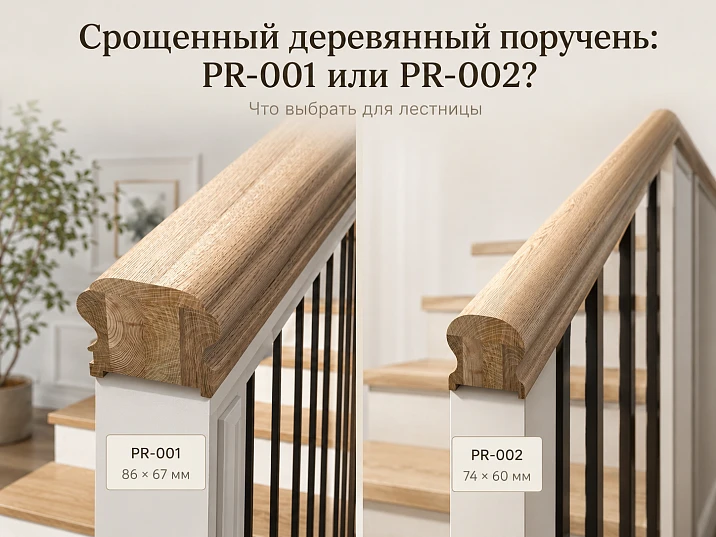
When you need to buy a finger-jointed wooden handrail for a new staircase or reconstruction of an existing railing, the difference between profiles PR-001 and PR-002 cannot be assessed just from a photo. Both models are made of glued beech or oak solid wood, are available in the same size range with lengths from 1500 to 5000 mm, and can be used with the under-rail strip PR-003. However, the top line of the staircase looks different with them: PR-001 has a large cross-section of 86 × 67 mm, while PR-002 has a more compact one of 74 × 60 mm.
The difference of 12 mm in width and 7 mm in height seems small when the handrails are considered as separate short samples. On a flight of three, four, or five meters in length, the scale becomes noticeable. The wider PR-001 emphasizes the upper boundary of the balustrade more strongly, better matching large posts and massive carved balusters. PR-002 forms a lighter line, does not overload a medium-scale railing, and suits rooms where a large profile might look heavy.
Handrails and railings should be chosen as a connected system. The handrail is the top element that the hand touches, but its appearance and fit depend on the balusters, posts, under-rail strip, flight length, turns, landings, and future finishing. Therefore, the correct question is not simply "which wooden handrail is better," but "which of the two profiles suits a specific staircase, its proportions, and the design assembly."
In the STAVROS catalog, you can study both models separately, compare available lengths, and choose the material. For a large classic balustrade, the finger-jointed handrail 86 × 67 mm PR-001is intended. For a moderate-scale railing, consider the handrail for wooden staircase PR-002.
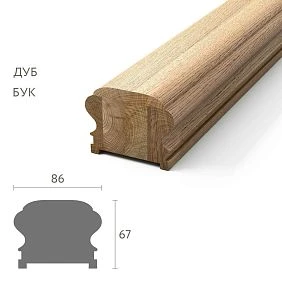
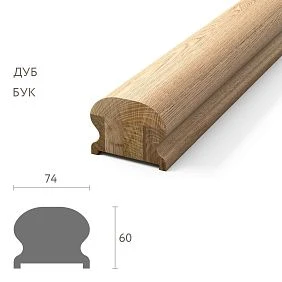
Short answer: PR-001 or PR-002
PR-001 and PR-002 are profiled wooden handrails for staircase railings. They are offered in beech or oak in lengths of 1500, 2000, 2500, 3000, 3500, 4000, 4500, and 5000 mm.
PR-001 measuring 86 × 67 mm chosen for wide staircases, large posts, massive balusters, and interiors where the railing should be perceived as a substantial architectural part of the room.
PR-002 measuring 74 × 60 mm suitable for medium-scale staircases, more compact balusters, and calm classical or neoclassical interiors. The profile remains shaped and expressive, but the top line looks lighter.
For both models, a separate selection is made Handrail Support Bar PR-003. It participates in forming the upper railing assembly between the balusters and the handrail. Compatibility, attachment method, and assembly design must be coordinated with the staircase project.
Quick link to products:
- Buy handrail PR-001
- Buy handrail PR-002
- buy the under-handrail plank PR-003
- View all handrail profiles




What is a profiled handrail and why its size is so noticeable
A profiled handrail differs from a simple rectangular strip or round blank by its well-thought-out cross-section. Its shape consists of several transitions, rounded edges, and protrusions. These lines create a finished top of the railing and help connect the handrail with the decorative shaping of balusters and posts.
The buyer sees primarily a long horizontal or sloping line. It completes the balustrade and unifies many vertical elements. Even beautiful balusters can look disjointed if the top profile does not match them in scale. A too narrow handrail gets lost above large details, while an overly massive one looms over thin balusters and makes the railing visually heavy.
PR-001 and PR-002 solve the same main task but distribute mass differently. PR-001 with a width of 86 mm forms a noticeable top strip. Its height of 67 mm allows the profile to be well readable from the side. This handrail suits compositions where the staircase occupies a significant part of the hall and must maintain expressiveness when viewed from a distance.
PR-002 with a width of 74 mm and a height of 60 mm is more compact. It also has a shaped profile, so it does not turn the railing into a minimalist structure. The difference lies not in the presence or absence of decoration, but in its scale. The model suits those cases when you want a classic character without excessive massiveness.
It is important not to confuse the handrail with the entire railing set. The railing is a system that may include the handrail, balusters, support posts, a sub-rail strip, and other design elements. Buying one top profile without checking the other parts can easily lead to incompatibility in width, fit, or overall proportions.
Our factory also produces:
Confirmed characteristics of PR-001 and PR-002
| Characteristic | PR-001 | PR-002 |
|---|---|---|
| Type | Profiled wooden handrail | Profiled wooden handrail |
| Profile size | 86 × 67 mm | 74 × 60 mm |
| Parameter E | 60 мм | 60 мм |
| Available lengths | 1500–5000 mm | 1500–5000 mm |
| Size step | 500 мм | 500 мм |
| Up to 2500 mm | Solid lamella blank | Solid lamella blank |
| Over 2500 mm | Finger-jointed blank | Finger-jointed blank |
| Material | Glued beech or oak array | Glued beech or oak array |
| Sanding quality | Prestige | Prestige |
| Beech | For enamel | For enamel |
| Oak | For tinting | For tinting |
| Handrail support strip | PR-003, purchased separately | PR-003, purchased separately |
| Visual scale | Large | Moderate |
| Main Scenario | Massive classic balustrade | Lighter medium-scale railing |
A uniform range of lengths simplifies comparison. The buyer does not have to choose PR-001 just because the required length is missing from PR-002, or vice versa. Both models are available in sizes 1500, 2000, 2500, 3000, 3500, 4000, 4500, and 5000 mm. The main criterion becomes the profile, not the length.
However, the finished size cannot be ordered solely based on the approximate length of the stair flight. It is necessary to consider the actual geometry, joint locations, turns, landings, connections with posts, and installation allowances provided by the project. The calculation is performed according to the drawing, not based on a photo or the total area of the room.
Get Consultation
How PR-001 differs from PR-002
| Selection criterion | PR-001 86 × 67 mm | PR-002 74 × 60 mm |
|---|---|---|
| Perception of the top line | Pronounced and massive | Lighter and neater |
| Combination with balusters | Large and richly decorated models | Medium and compact models |
| Combination with pillars | Massive carved or turned columns | Moderate-scale pillars |
| Space | Spacious hall, wide staircase | Small or medium hall |
| Stylistic character | Classic, Baroque, formal neoclassicism | Calm classic, neoclassical |
| View from a distance | Reads well as an architectural line | Does not overload the overall composition |
| Selection by length | 1500–5000 mm | 1500–5000 mm |
| Material selection | Beech or oak | Beech or oak |
| Individual baluster | Requires selection of PR-003 | Requires selection of PR-003 |
This table does not mean that PR-001 is only allowed for a large house, and PR-002 only for a small one. Architectural scale is not determined by a single area. The width of the flight, the distance between balusters, the dimensions of the starting and turning posts, the height of the room, the richness of the carving, and the distance from which a person usually sees the staircase are all important.
For example, a relatively small hall can have high ceilings, a large opening, and a massive wooden staircase. In such a space, PR-001 can look appropriate. Conversely, a spacious modern living room with thin balusters and restrained finishing may pair better with PR-002.
Therefore, the size of the room is only the first filter. The final choice is made based on the proportions of the entire balustrade.
The main difference is the profile scale of 86 × 67 and 74 × 60 mm
PR-001 is 12 mm wider than PR-002. The height difference is 7 mm. The percentage difference is noticeable, but what matters more than arithmetic is how it manifests on the finished railing.
Width affects how much the handrail protrudes relative to the balusters and the sub-rail strip. The larger the profile, the more confidently it outlines the top boundary. PR-001 can balance tall balusters with elaborate carving and large posts, which might otherwise seem too heavy in relation to a thin top.
Height determines the side silhouette. The handrail is viewed not only from above. On a staircase, most of the profile is visible from the side, especially from the lower floor. The additional 7 mm of PR-001 makes the shaped form more noticeable, enhances the shadow under the protruding parts, and creates a deeper transition between the top of the handrail and the assembly below it.
PR-002 does not look flat or inconspicuous. Its cross-section of 74 × 60 mm remains a fully profiled solution. However, the line is calmer. On a medium-density railing, it does not compete with the balusters and does not create a feeling of an excessively large top piece.
A good way to make a preliminary assessment is to draw the actual dimensions of both profiles on cardboard or thick paper and apply the template to the balustrade drawing to scale. It is even more useful to study a full-size cross-section and evaluate it by hand. From a single image in a catalog, it is impossible to reliably understand how comfortable a particular person will find gripping the handrail and how the profile will feel in daily use.
One cannot automatically claim that a smaller handrail is always more comfortable and a larger one is more reliable. Grip comfort depends on the profile shape, hand size, and user characteristics. Structural reliability is determined not only by the cross-section but also by the material, mounting assembly, supports, connections, and installation quality.
When to buy the massive handrail PR-001
Massive wooden handrail for staircase PR-001 It deserves attention when the staircase should look not like an auxiliary structure, but a noticeable architectural part of the interior.
For a wide staircase in a spacious hall
On a wide flight, the thin top line sometimes gets lost. This is especially noticeable in a two-story space, where the staircase is viewed from different levels and a great distance. PR-001 creates a more pronounced contour and helps maintain the integrity of the railing.
This does not mean that any wide flight automatically requires the largest handrail. The profile needs to be compared with the balusters and newel posts. But all else being equal, the 86 × 67 mm size supports a large scale better than 74 × 60 mm.
For massive carved balusters
Balusters with intricate carvings, large vases, floral motifs, or developed turned shapes visually require a convincing finish. A too compact top can seem random. PR-001 forms a frame that gathers the vertical details into one system.
Before purchasing, it is useful match balusters to the handrail not by a single style name, but by the actual cross-section, height, shape of the top part, and the designed connection method.
For large starting and turning newel posts
Newel posts are usually more noticeable than regular balusters. They mark the beginning of a flight, a turn, or a landing and can have a complex silhouette. If the post is massive, a compact handrail can sometimes look too weak next to it.
For such a composition, it is worth Select posts for PR-001 handrail. Not only the decorative motifs matter, but also the dimensions of the area the handrail is intended for.
For a classic and formal interior
PR-001 works well where the interior is built on large wooden elements: tall door portals, wide cornices, expressive panels, massive furniture. The handrail continues this scale and does not look like a thin strip against the background of other details.
In classic design, the size of the profile is not only about decorativeness. It helps build hierarchy: large posts set anchor points, balusters create repetition, and the handrail unites them from above. PR-001 makes the final line substantial enough.
When the handrail needs to be clearly visible from a distance
In an open hall, people rarely view the staircase only up close. It is visible from the entrance, from the living room, from the second floor. At a distance, small transitions are lost, and the overall mass becomes more important. A wide handrail maintains a noticeable silhouette.
If the staircase is hidden in a narrow corridor and is always perceived from a close distance, this argument is less significant. There, an overly large profile might, on the contrary, visually bring the railing closer to the passage.
For beech under enamel in a large composition
In the confirmed configuration, beech is intended for enamel coating. The painted surface makes the wood grain less noticeable, so the form is read primarily through volume, light, and shadow. The large profile of PR-001 allows the handrail's architecture to be expressed more vividly even with uniform paint.
Before ordering, check the available material and preparation options in the product card. Handrail PR-001 made of beech for enamel should be selected simultaneously with other painted parts so that the entire staircase receives a coordinated finishing system.
For oak to be tinted
Oak is chosen when you need to emphasize the natural grain and get a tinted surface. On a wide profile, the texture is noticeable over a large area. PR-001 can become one of the main wooden lines of the interior.
The shade cannot be chosen in isolation. It is matched with steps, risers, floor, doors, furniture, and other wooden elements. Even a beautiful tone can look alien if the color temperature and saturation differ greatly.
When it is better to choose the compact PR-002
Buy handrail PR-002 is reasonable when a full profiled top is needed without excessive massiveness.
For medium-scale railing
Most home staircases do not require an extremely large top line. If the flight has a moderate width, the balusters are not overloaded with carving, and the posts maintain a medium cross-section, PR-002 helps to achieve a proportional system.
It doesn't look like a simplified replacement for PR-001. It's a standalone profile for a different visual task. Its width of 74 mm is enough for the handrail to read as a finished wooden element, but not so large that the top of the railing dominates the entire interior.
For a small hall
In a compact space, the staircase is close to the person. All details appear larger than in a spacious hall. The 86 × 67 mm profile can take up too much attention, especially with frequent baluster placement.
PR-002 helps maintain a free perception of space. It supports the classic form but leaves more air between visually dense parts of the railing.
For medium and compact cross-section balusters
When balusters are thin or have an elongated silhouette, a large handrail can seem to overhang. PR-002 is easier to coordinate with such verticals. The top line remains noticeable but does not overwhelm the repeating elements.
Choosing wooden balusters made of oak and beech, you need to check the top cross-section and the connection method. Matching the wood species alone does not guarantee compatibility.
For calm classic and neoclassical styles
Not every classic interior requires palace-like massiveness. In modern neoclassicism, decorative lines are often made cleaner, and the amount of carving is reduced. PR-002 suits this approach: the profile retains plasticity but looks more restrained.
It can be combined with painted balusters, tinted steps, or a system where wood is used sparingly. The specific combination depends on the project and the chosen material.
When PR-001 seems too heavy
Sometimes both handrails are technically suitable for the project, and the choice remains visual. If the wide sample seems excessively large next to the baluster, PR-002 allows reducing the top mass without switching to a completely different shape.
It is especially useful to compare models not separately, but together with a fragment of the baluster and rail. The same handrail can look large on a thin base and quite balanced on a massive one.
For a long line that you don't want to weigh down
On a long straight flight, even a moderate profile creates a noticeable strip. The longer the length, the stronger the horizontal or diagonal is perceived. PR-002 can be expressive precisely due to its length, so the extra width of PR-001 is not always necessary.
Availability of sizes up to 5000 mm allows you to choose finger-jointed handrail 74 × 60 mm for a long section, but the actual number of parts and connection points are calculated according to the project.
How to evaluate grip comfort before ordering
The handrail is in constant contact with the hand, so it cannot be evaluated only as a decorative molding. Width and height are important, but they do not provide a complete answer without considering the profile shape.
PR-001 is wider, but this does not mean that the palm should completely cover all 86 mm. The profiled shape may have a working top part and side transitions. PR-002 is more compact, but the specific feel also depends on which area the person holds when going up and down.
The best way to test is with a full-size sample. It should be grasped by hand as the user would on a real ladder. It's helpful to have several family members evaluate the profile: adults with different hand sizes, elderly people, and those who will use the ladder daily.
You cannot replace such a check with the conclusion that "less means more convenient." A profile that is too compact or rounded may also not suit a particular user. Likewise, a large handrail can have a comfortable working area.
The installation height should also be considered, but it is determined by the entire railing design. Even a comfortable profile will feel wrong if it is poorly positioned relative to the steps and the user. Therefore, the dimensions of the handrail, balusters, posts, and components must be checked together.
If there is no physical sample, request an accurate cross-section drawing. Print it at a 1:1 scale and transfer the outline onto a dense material. Such a mock-up will not reproduce the tactile properties of wood and rounded edges, but it will help understand the overall dimensions.
How to choose a handrail for balusters
The buyer often starts with balusters because the carving or turned shape attracts the most attention. Then they try to add any handrail they like to them. This order can lead to a mismatch in scale.
The handrail and balusters should be evaluated based on four characteristics:
- Width of the top part of the baluster. It should be consistent with the design component and the rail.
- Overall massiveness. A large vase or carved central part requires a more substantial finish.
- Installation density. Frequently placed balusters create a dense strip, so an overly large top can overload it.
- Shape character. Soft classic handrail transitions pair better with details related in plasticity than with a completely random pattern.
For large balusters, PR-001 often becomes the natural choice. Its width helps connect repeating verticals. PR-002 suits medium-scale balusters and compositions where the top should not dominate.
However, there is no universal rule of 'thick baluster — only PR-001'. For example, a large baluster may be used sparingly, with large gaps, and the overall interior remain restrained. Then PR-002 can maintain balance. The decision is made based on visualization or an assembled fragment.
At the configuration stage, it is useful to assemble a staircase railing kit not as separate purchases, but as a single specification. It includes article numbers, material, quantity, lengths, finish type, and intended installation locations.
How to match the handrail with stair posts
A stair post draws more visual attention than a regular baluster. It can end a flight, mark a turn, or form the start of a railing. The handrail meets it at a specific angle and should look like part of one system.
For PR-001, posts capable of supporting a large profile are typically chosen. This does not necessarily mean maximum size or an abundance of carving. The upper part, where the handrail meets, and the overall silhouette are more important.
PR-002 pairs best with posts of moderate scale. If the post is very large and the handrail compact, the transition needs particularly careful design. Sometimes contrast looks intentional and neat, but without a project, it may feel like parts from different sets.
Before ordering, it is recommended to to select wooden stair posts and compare them with the selected handrail on a single drawing. Check not only the front view but also the side profile, the height of the connection point, and the direction of the flight.
If the staircase has multiple turns, different sections cannot be considered in isolation. The same handrail must run through the entire system or have pre-designed transitions. Randomly connecting parts on site often looks less neat than a pre-calculated joint.
How to choose the handrail length for a flight and landing
Both models are available in lengths:
- 1500 mm;
- 2000 mm;
- 2500 mm;
- 3000 mm;
- 3500 mm;
- 4000 mm;
- 4500 mm;
- 5000 mm.
A step of 500 mm allows you to select a blank closer to the required size. But you cannot choose the nearest length "by eye". The actual need depends on the geometry of the flight and the connection method.
Measure the handrail line, not the room length
The inclined section is longer than its horizontal projection. If you only measure the distance along the floor, the handrail may not be long enough. For calculation, use the design installation line along the flight.
Consider platforms separately
The horizontal handrail of the platform and the inclined handrail of the flight can be separate parts. Their connection points must be determined before ordering. You cannot expect an unprepared installer to neatly handle any transition on site.
Check the connection to posts
Part of the length may be used in a design connection with a post or transition element. The specific allowance depends on the joint. A universal figure cannot be given here.
Do not avoid every joint at all costs
A long continuous line is visually appealing, but choosing the maximum workpiece is not always rational. Transportation, the ability to bring it indoors, stairwell turns, and design connections must be considered. Sometimes several pre-calculated sections are more convenient than one long part.
Do not order all sections of the same length
Even a seemingly symmetrical staircase may have differences in actual geometry. Each flight and platform is measured separately, and then a list is compiled.
Solid-laminate or finger-jointed handrail
In the size range PR-001 and PR-002, two types of workpieces are used by length.
For sizes up to 2500 mm, solid-lamella blanks are used. This means that individual lamellas run along the length of the part without longitudinal finger-jointing.
For sizes over 2500 mm, blanks that are finger-jointed along the length are used. This design allows the production of long handrails 3000–5000 mm from glued laminated timber.
The term "finger-jointed" is sometimes mistakenly perceived by the buyer as an indication of low quality or randomly glued scraps. In reality, it is a constructive method of manufacturing a long wooden blank. The product should be evaluated based on the stated technology, quality of processing, geometry, and suitability for the chosen finish.
When choosing between lengths of 2500 and 3000 mm, one cannot automatically consider the shorter model preferable just because of the solid-lamella design. If the project requires a part 3000 mm long, purchasing a shorter blank will create an additional joint. One should compare not abstract types of blanks, but the final result on a specific section.
For enamel, the visibility of joints depends on the quality of preparation and finishing. For tinting, the wood structure remains more noticeable, so the location and perception of the finger-jointing may matter to the buyer. Before a large order, it is worth clarifying the appearance features of the finished blank and aligning expectations.
Glued laminated timber should also not be confused with solid timber from a single piece of wood without gluing. PR-001 and PR-002 are made from glued laminated beech or oak. This is a confirmed characteristic of both models.
Why is the handrail support bracket PR-003 needed?
The under-rail plank is located in the upper node of the railing and helps connect the handrail to the balusters. It is not automatically included as part of PR-001 or PR-002: it is purchased separately.
The buyer sometimes orders a handrail, assuming that all necessary elements are already included in the kit. This is one of the most common mistakes. The handrail product page describes the profile itself, while the complete railing assembly is configured separately.
Plank for wooden handrail PR-003 requires design verification. It is necessary to ensure that its parameters, the placement of balusters, and the connection with the selected handrail match the drawing.
The practical role of the plate is not only decorative filling. It forms an intermediate element of the assembly. Thanks to this, the top of the balustrade can be assembled as a coordinated system, rather than trying to directly attach each baluster to a random surface of the handrail.
For PR-001 and PR-002, one model PR-003 is used, but this does not eliminate the need for verification. The difference in the external dimensions of the handrails affects the overall appearance of the assembly, even if parameter E for both models is 60 mm.
When choosing, it is necessary to compare:
- the width and shape of the handrail;
- the parameters of the under-rail strip;
- the upper cross-section of the baluster;
- the installation step;
- the connection method;
- the points of abutment to the posts;
- future finishing of all elements.
The material helps to understand in detail the role of this element how the subrail holds the handrail and assembles the railing. However, the final decision on the mounting assembly is made according to the design of the specific staircase.
Beech for enamel or oak for tinting
PR-001 and PR-002 are available in beech and oak. In the confirmed product scheme, beech is intended for enamel, and oak for tinting. This allows you to choose not only the profile but also the character of the finished surface.
Beech for enamel
Beech is suitable for projects where the staircase railing should have a smooth painted appearance. Enamel hides the natural color of the wood and shifts the focus to the shape.
For PR-001, this means more pronounced architectural plasticity. Light and shadow on the large cross-section emphasize the profile transitions. This option can be used in light classic interiors where the handrail, balusters, and posts are painted in the same system.
PR-002 made of beech under enamel looks lighter. It is suitable for neoclassical solutions where a decorative form is needed but excessive massiveness is undesirable.
When ordering, it is important not just to choose the word "enamel". It is necessary to coordinate surface preparation, the actual finish option, and the combination with other parts. If balusters, posts, and handrails come from different batches or are finished at different times, a uniform result requires careful technological work.
Oak for tinting
Oak is chosen when you want to preserve the visible texture of the wood. Tinting changes the shade but should not turn the surface into a fully opaque coating.
Oak handrail for large staircase PR-001 creates a wide strip of natural wood. It is especially noticeable next to oak steps and large posts.
PR-002 made of oak retains the same material but reduces the visual mass. It can be chosen if natural texture is important and a wide top line does not suit the room.
You cannot select a tint only by the shade name. The same color is perceived differently under different lighting and next to other materials. It is useful to compare the sample with flooring, steps, doors, and furniture directly in the room.
Grand entrance hall of a private house
In a spacious hall, the staircase often becomes the central part of the first floor. It is visible from the entrance and connects several zones. PR-001 here helps create a pronounced frame above carved balusters.
The large profile works well with massive starting posts. The top line does not dissolve against the background of a high ceiling and large wall planes. If oak is used for tinting, the handrail additionally emphasizes the natural character of the staircase.
PR-002 can also be used in a spacious hall if the design is based on lighter neoclassicism. The choice is determined not by the prestige of the model, but by proportions.
Small stair hall
When the staircase is located between walls or next to a narrow passage, a person constantly sees the railing up close. In such a situation, PR-002 is often perceived as calmer. It does not reduce the actual width of the passage by itself, but visually takes up less space.
PR-001 may be appropriate if the other details are also large, but this needs to be checked in the visualization. A simple desire to make the staircase "richer" by using the widest handrail can lead to overload.
Living room with an open staircase
An open staircase becomes part of the living room interior. Here, the handrail is compared not only with the steps, but also with furniture, wall panels, doors, and cornices.
In a classic living room with massive furniture, PR-001 supports the overall scale. In a more modern space, PR-002 allows maintaining a wooden railing without turning it into a dominant decorative object.
Interior in calm neoclassicism
Neoclassicism often uses symmetry and traditional profiles, but reduces the amount of heavy decor. PR-002 follows this logic. It remains shaped, but the top line looks lighter.
PR-001 can be used in formal neoclassicism with high ceilings and large openings. Therefore, the style name does not replace scale checking.
Hotel, restaurant, or representative space
In a commercial interior, the staircase is viewed by many people, and its line should be clearly readable from different points. PR-001 can give the railing architectural expressiveness.
But a commercial project imposes additional requirements on design, installation, and operation. Choosing a profile does not replace professional calculation and coordination of the entire system.
PR-002 is suitable for more intimate spaces where a classic character is needed without massive decor: a small hotel, a restaurant with a restrained interior, a salon, or a showroom.
Practical choice for different tasks
A new staircase is being built from scratch
When designing from scratch, it's easiest to coordinate all elements in advance. First, determine the width of the flight, the geometry of the landings, and the interior style. Then choose balusters and posts, after which compare PR-001 and PR-002 on the overall drawing.
For a large system, it's reasonable to consider PR-001. For a moderate one, PR-002. However, the final decision is made after checking the joints and full-size sections.
Only the handrail on the finished railing is being changed
Replacing one element is more complicated than it seems. The new profile must match the existing rail, balusters, posts, and connection points. You cannot choose PR-001 or PR-002 based solely on a similar appearance.
You need to take measurements of the current joint and compare them with the model drawing. It may be necessary to modify connections or other details. Such work should be coordinated with a specialist.
The staircase is assembled from new balusters and old posts
In a mixed system, first evaluate the largest preserved elements—usually the posts. If they are massive, PR-001 may better support them. But the top of the balusters and the rail must also match the chosen solution.
Need to lighten an overly heavy balustrade
When the project already has a lot of carving, large balusters, and dark wood, additional massiveness of the handrail can overload the composition. PR-002 helps reduce the weight of the top line.
However, you cannot expect a single compact handrail to fully correct mismatched proportions. Sometimes it is necessary to reconsider the balusters, their spacing, or the size of the posts.
It is necessary to strengthen a too weak top line
If large posts and balusters end with a thin handrail, the railing may look unfinished. PR-001 adds a convincing frame. Its profile is especially noticeable on long flights.
Requires a white painted railing
For beech under enamel, the choice between models is made based on scale. PR-001 reveals the shape more strongly due to its developed cross-section. PR-002 creates a lighter painted outline.
An oak staircase with visible texture is required
Both models are available in oak for tinting. PR-001 provides a larger visible area of wood, PR-002 reduces massiveness. The shade and pattern need to be coordinated with the steps and other oak elements.
A long handrail up to 5000 mm is needed
Both models are produced up to 5000 mm, so length does not determine the choice between them. For sizes over 2500 mm, a finger-jointed blank is used. The main thing is to check the possibility of delivery, carrying in, and installation of the long part.
What to buy together with the handrail
One handrail does not make a finished railing. For a complete system, you need to select related elements in advance and check their compatibility.
The first addition becomes Handrail Support Bar PR-003. It is purchased separately and participates in connecting the top node.
Next, balusters are selected. Their size and pattern should match the scale of the handrail. For PR-001, larger models are often considered, for PR-002 — moderate ones, but the final choice depends on the project.
Posts form the support points. They cannot be left for the last stage because the handrail connection points affect the geometry of the entire line.
It is useful to open the STAVROS handrail catalog and consider models within the same product system, rather than looking for random blanks with unknown parameters.
Table "What to buy together"
| What to add | Why this is needed | What to Check |
|---|---|---|
| Handrail Support Bar PR-003 | Forms an intermediate node between the handrail and balusters | Parameters, landing, compatibility and installation method |
| wooden balusters | Fill the railing and set a repeating pattern | Section, height, top part, material and spacing |
| Staircase posts | Complete flights and landings, form support points | Adjoining zone size, style, and scale |
| Other handrail profiles | Allow checking if PR-001 or PR-002 is really needed | Shape, section, lengths, and purpose |
| Finishing materials per project | Create a uniform color and protect the surface | Compatibility with wood and product preparation |
| Mounting elements as per the project | Provide system connection | Do not select without a drawing and calculation |
Finishing and mounting materials should not be purchased from a universal list in an article. Their type depends on the project, base, staircase design, and chosen technology.
How not to confuse PR-001 and PR-002 with similar products
Do not confuse the handrail with the under-rail strip
PR-001 and PR-002 are top profiles. PR-003 is a separate strip used in the assembly under the handrail. It does not replace the handrail and is not automatically included in its price or package.
Do not confuse the two profiles by photo
In the image without scale, PR-001 and PR-002 may appear almost identical. Check the article number and cross-section:
- PR-001 — 86 × 67 mm;
- PR-002 — 74 × 60 mm.
Do not confuse with the round profile
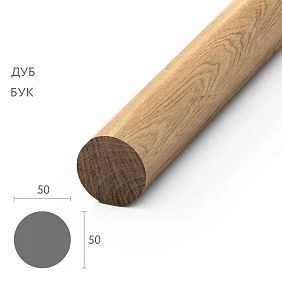
If you need a round handrail with a diameter of 50 mm, you should consider PR-004, not PR-001 or PR-002. The difference between round and shaped forms is detailed in the article round PR-004 or profiled PR-002.
Do not consider PR-001 and PR-002 as ready-made wall-mounted kits
The main scenario considered is a stair railing with balusters and a handrail plank. The possibility of wall mounting depends on the project, fasteners, and base. You cannot purchase the profile as a ready-made wall handrail without checking the assembly.
Do not confuse material and finish
Beech and oak are wood species, while enamel and tinting are methods of forming the appearance. In confirmed options, beech is intended for enamel, oak for tinting. You cannot assume any finish without checking the product card.
Do not consider all lengths to be identical in construction
Up to 2500 mm, solid lamella blanks are used; over 2500 mm, finger-jointed ones are used. This must be considered when agreeing on the appearance and project.
How to calculate the quantity, lengths, and joints
The calculation begins by dividing the railing into separate sections. These typically include inclined flights, horizontal landings, turns, and connections to posts. Each section is assigned its actual design length.
Then, check whether the section can be covered by a single available blank. For example, for a line around 2700 mm, the nearest longer length would be 3000 mm. However, the decision depends on the required allowances and the method of end processing.
If a section is longer than 5000 mm, it will need to be divided. The connection point cannot be assigned randomly. It must be coordinated with the structure and visually justified.
When calculating, it is useful to create a table:
- section number;
- installation location;
- actual length;
- required blank;
- handrail article;
- the material;
- finish type;
- left connection;
- right abutment;
- connected posts and rail.
Such a document reduces the risk of confusing identical-looking parts of different lengths.
You cannot sum all the meters and divide them by the length of the longest workpiece. This may give nice arithmetic but does not account for actual turns and joints. Each line is calculated separately.
It is necessary to check logistics. A five-meter handrail must pass through gates, doors, stairwells, and turns. If it cannot be brought into the room, the theoretical absence of a joint will provide no practical benefit.
The amount of sub-rail is calculated for the corresponding sections, but its joints and dimensions also require a separate list.
Preparation for installation and finishing
The handrail is a long profiled part. Before installation, it must be stored so as not to create accidental loads or damage. Specific storage and preparation conditions are clarified with the manufacturer and the specialist responsible for finishing.
Before starting work, check:
- the article number of each part;
- length;
- the material;
- the surface condition;
- compliance with the drawing;
- the installation direction;
- adjacent areas;
- presence of PR-003 and other elements;
- the readiness of balusters and posts;
- technology of future finishing.
Do not start painting or tinting before a test assembly if the project requires fitting. Installation operations may require processing of ends and joints.
When finishing, it is important to work not with a single handrail separately, but with a system of samples. The color is checked on the same wood species and with the same preparation method. The sample is examined under daylight and artificial lighting.
After installation, care depends on the actual coating. A universal product for any wooden surface cannot be recommended. Harsh household chemicals or abrasives may damage the finish. Care instructions are linked to the specific enamel, tint, and protective coating.
The handrail is regularly touched by hands, so the surface must remain clean and pleasant to the touch. When damage occurs, first determine whether only the top layer or the wood itself is affected, and then choose a restoration method.
Mistakes when purchasing PR-001 and PR-002
Mistake 1. Choosing only by photo
Without a specified scale, two profiles look similar. The buyer may order PR-001 expecting a moderate size, or PR-002 expecting a massive top line.
Solution: compare cross-sections of 86 × 67 and 74 × 60 mm in actual size.
Mistake 2. Thinking that a difference of 12 mm is unnoticeable
On a short fragment, the difference indeed does not seem large. On a multi-meter line, it affects the overall mass.
Solution: evaluate the handrail in the visualization of the entire balustrade, not separately.
Mistake 3. Choosing the largest profile as 'the most beautiful'
Size does not equal quality or expressiveness. PR-001 can overwhelm thin balusters and a small hallway.
Solution: choose proportionally to the posts, balusters, and the room.
Mistake 4. Choosing PR-002 just for compactness
Sometimes a lighter profile gets lost over a large carved system.
Solution: check if the top line is sufficiently expressed in the overall view.
Error 5. Not buying PR-003
The handrail is ordered separately, and only on site do they find out that the selected assembly requires a sub-rail bracket.
Solution: in advance assemble the top assembly of the stair railing according to the project.
Error 6. Mismatch between the top of the baluster and the rail
The same wood species does not automatically guarantee compatibility.
Solution: check the actual dimensions and drawings of all parts.
Error 7. Ordering length based on room size
The length of the inclined flight differs from the horizontal projection.
Solution: calculate the installation line according to the project.
Error 8. Not accounting for landings and turns
The buyer sums up the total length but does not define individual sections and joints.
Solution: create a list for each flight and landing.
Error 9. Not checking the workpiece type by length
Expectations for a solid-laminate part are transferred to a five-meter model.
Solution: consider that over 2500 mm the workpiece is finger-jointed along the length.
Error 10. Confusing beech and oak
The material is chosen only by price or name, without linking to the finish.
Solution: consider beech for enamel, oak for tinting, as specified in the approved configuration.
Error 11. Buying the finish separately from the sample
The color is chosen from the screen and an exact match with existing steps is expected.
Solution: approve a real sample on the selected wood.
Error 12. Considering the handrail a ready-made railing kit
They order one profile without balusters, posts, strips, and installation diagram.
Solution: assemble the kit before placing the order.
Error 13. Use the profile as a wall-mounted one without verification
A handrail is purchased for wall mounting without a confirmed attachment point.
Solution: approve the base, fasteners, and drawing with a specialist.
Error 14. Not checking the possibility of carrying in
A long part does not fit through the entrance, turn, or stairwell.
Solution: plan the delivery route to the installation site in advance.
Error 15. Leave the selection of posts for the final stage
The handrail has already been purchased, but suitable attachment points have not been determined.
Solution: simultaneously assemble a set of posts, balusters, and handrail.
Who PR-001 suits, and who should choose PR-002
PR-001 is suitable when
- the staircase is wide and clearly visible from a spacious room;
- massive carved or turned balusters are used;
- the starting and turning posts are large in scale;
- the interior is built on pronounced classical details;
- the top of the railing should be clearly readable from a distance;
- a wide oak line for tinting is required;
- the painted handrail must preserve the developed architectural form;
- the full-size sample is convenient for users.
PR-001 may not be suitable when
- the balusters are very thin;
- the hall is narrow and all details are viewed up close;
- the interior requires a maximally light line;
- the large profile overlaps the visual role of other elements;
- the design node does not match the model parameters.
PR-002 will be suitable when
- the railing has a medium scale;
- a curly but not heavy top line is needed;
- balusters are more compact;
- the room is small or moderate in size;
- the interior belongs to calm classic or neoclassical style;
- a long handrail should not look overly massive;
- oak for tinting or beech for enamel in a lighter proportion is required.
PR-002 may not be suitable when
- large posts require a more substantial finish;
- balusters are rich in massive carving;
- the staircase is perceived from a great distance and the compact top gets lost;
- the customer expects a maximally expressed architectural line;
- the design node is designed for a different profile.
An honest choice does not involve finding a universal winner. PR-001 and PR-002 are designed for different proportions. The buyer needs not the "best handrail", but a profile that matches their staircase.
How to buy a handrail for STAVROS
It is convenient to start with the section where you can Buy a handrail for stairs and compare available profiles.
Then open the PR-001 and PR-002 cards in adjacent tabs. Check:
- article number;
- section size;
- required length;
- the material;
- finishing preparation option;
- blank type for selected length;
- compatibility with PR-003;
- current ordering conditions.
After selecting a profile, compile a complete list of sections. Do not limit yourself to the total meter count. Specify a separate length for each flight and landing.
Then add the handrail, balusters, and posts. All elements must be coordinated according to the drawing. If the staircase is already built, prepare photos and exact dimensions of existing components.
If the choice between 86 × 67 and 74 × 60 mm remains unclear, ask for help comparing models based on your project. Plans, sections, visualizations, and data on selected balusters are useful.
Before finalizing the order, double-check the possibility of bringing in long parts and the finishing sequence. This approach is more reliable than buying individual elements one by one without a general list.
Additional information on model selection can be compared with the general material on Solid wood handrails for stairs and home railings. However, when placing an order, refer to the current cards of specific products.
FAQ: questions about PR-001 and PR-002
Which handrail is larger: PR-001 or PR-002?
PR-001 is larger. Its profile measures 86 × 67 mm. The size of PR-002 is 74 × 60 mm. PR-001 is 12 mm wider and 7 mm taller.
Which handrail is better to buy for a large staircase?
For a wide staircase with massive balusters and large posts, PR-001 is often more suitable. However, the final choice should be verified against the drawing and the overall proportions of the railing.
Is PR-002 suitable for a classic interior?
Yes. PR-002 has a profiled shape and suits calm classic and neoclassical styles. It looks lighter than PR-001 but does not become a simple rectangular handrail.
Are PR-001 and PR-002 available in the same lengths?
Yes. Both models are available in lengths from 1500 to 5000 mm in increments of 500 mm: 1500, 2000, 2500, 3000, 3500, 4000, 4500, and 5000 mm.
What does "finger-jointed handrail" mean?
For lengths over 2500 mm, finger-jointed blanks are used. This is a method of manufacturing a long handrail from glued laminated timber. Up to 2500 mm, solid lamella blanks are used.
What wood are PR-001 and PR-002 made from?
Both models are made from glued laminated beech or oak.
Which finish should I choose for beech?
In the confirmed configuration, beech is intended for enamel. The current preparation and finishing parameters must be checked in the product card before ordering.
Which finish should I choose for oak?
Oak is intended for tinting, which preserves the visible wood grain. The specific shade is best confirmed using a real sample.
Is the handrail bracket PR-003 included with the handrail?
No, PR-003 is selected and purchased separately. Before ordering, its compatibility with the balusters and the design assembly must be checked.
Can PR-001 or PR-002 be installed as a wall-mounted handrail?
These models are primarily considered as elements of a stair railing with balusters and a handrail support bar. The possibility of wall mounting depends on the project, base, and fasteners. Without a separate calculation, they cannot be considered a ready-made wall-mounted kit.
Which handrail is more comfortable to hold?
There is no definitive answer without a sample. PR-002 is more compact, but comfort depends on the profile shape and hand size. It is better to evaluate the full-size cross-section with several future users.
How to know if PR-001 won't be too large?
Compare the 86 × 67 mm profile with the actual dimensions of balusters and posts. It is useful to make a full-scale template or use a visualization of the entire balustrade.
Can PR-002 get lost over large balusters?
Yes, if the balusters and posts are very large in scale. In that case, PR-001 can better complete the railing. But the decision depends on the density of balusters and the overall composition.
How to calculate the required length of the handrail?
Each inclined flight, landing, and turn is calculated separately according to the design installation line. You cannot use only the horizontal length of the room or the total footage.
Do I need to buy a handrail with extra length?
The required allowance depends on the connection points and end processing. A universal margin cannot be assigned. The length is coordinated with the installer according to the drawing.
Can I connect several short handrails instead of one long one?
The technical feasibility depends on the project. Each additional joint must be calculated and carefully executed. The line should not be divided solely for the sake of purchasing shorter blanks without coordination.
How to check the compatibility of the handrail and balusters?
You need to compare the drawings, the top section of the balusters, the parameters of the handrail bracket, the handrail profile, and the installation method. Matching material is not enough.
What to choose for a painted white staircase?
Both beech models can be considered for enamel. PR-001 will provide a more massive architectural line, PR-002 a lighter one. The choice depends on the scale of the balusters and the room.
What to choose for an oak staircase?
Both models are available in oak for tinting. For a large classic staircase, PR-001 is often chosen, for a more restrained one, PR-002.
Which handrail is better for a small hall?
More often PR-002, since its profile is more compact. But if the staircase and posts are massive, PR-001 can also be proportional. A visualization check is mandatory.
Is the sanding quality of the models different?
The confirmed specifications for both models indicate «Prestige» sanding.
Can I order PR-001 with a length of 5000 mm?
Yes, this length is included in the size range. A blank over 2500 mm will be finger-jointed in length. Before ordering, check the possibility of delivery and carrying in.
Do I need to choose posts and balusters at the same time as the handrail?
Yes. This reduces the risk of mismatches in size, style, material, and mounting assembly. The handrail cannot be considered a separate decorative strip.
Where can I see all handrail options?
All available models are collected in the catalog of wooden handrails for railings.
Result: which finger-jointed wooden handrail to buy
PR-001 and PR-002 are made from the same wood species, have the same range of lengths, and are used in the same staircase railing logic. Therefore, the choice cannot be reduced to material or availability of the required size.
PR-001 86 × 67 mm creates a prominent top line. It suits a wide staircase, massive balusters, large posts, and an interior where the balustrade should look architecturally substantial.
PR-002 74 × 60 mm retains a shaped character but looks lighter. It better aligns with medium-scale railings, compact balusters, and calm classic or neoclassical styles.
For both models, it is necessary to separately check the sub-handrail strip PR-003, balusters, posts, lengths of individual sections, and the connection method. Up to 2500 mm, solid-laminate blanks are used; over 2500 mm, finger-jointed lengthwise. Beech is intended for enamel, oak for tinting.
Before ordering from STAVROS, compare the cross-sections at full scale, compile a list for each flight and landing, agree on the top assembly, and only then select the specific article. This approach allows you to purchase not a random wooden profile, but a handrail that truly matches the staircase proportions and assembles with other elements into a complete railing.