Article Contents:
- Why the handrail wobbles is not due to the handrail itself
- What is a handrail bracket and how it differs from a regular batten
- Where a handrail bracket is used: scenarios and situations
- When a handrail bracket is mandatory: specific cases
- Balusters have height deviations
- The handrail needs to be laid evenly along the entire length of the flight
- Need to hide the mounting joint
- The railing is assembled from prefabricated parts
- Reinforcement of the connection is required without visual weighting
- How to choose the size of the under-rail plank
- How to determine the required length
- How to select a plank for the handrail
- Long flight and joining planks
- Turning sections
- Oak or beech: what to choose for the under-rail plank
- Under-rail plank made of oak
- Under-rail plank made of beech
- Main rule: do not mix wood species
- How the handrail bracket connects the handrail, balusters, and posts into a single system
- Typical mistakes when choosing and installing
- What to buy together with the handrail bracket
- Density of the key joint: how the handrail bracket affects the rigidity of the entire railing
- The handrail bracket as a style element
- About the Company STAVROS
- Frequently Asked Questions
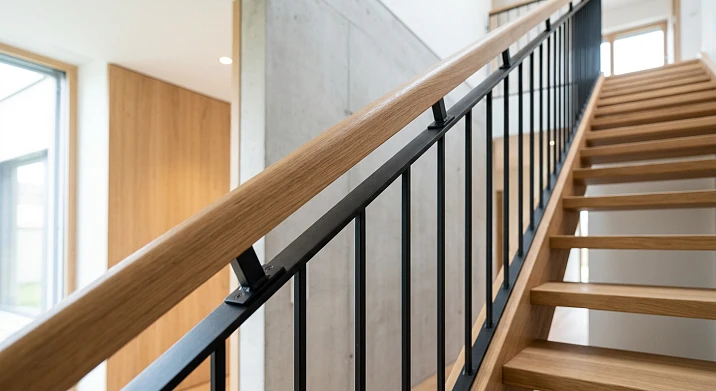
The handrail can be flawless in shape. The balusters can be expensive, turned with millimeter precision. The posts can be massive, reliable, and installed perfectly straight. But if you miss one small element in the fastening joint, the entire harmonious picture falls apart: the handrail line becomes wavy, gaps appear between the wooden verticals and the horizontal support, creaking occurs, a feeling of looseness, and the visual axis of the railing loses its strictness. What's happening? The answer, as a rule, is one: the handrail bracket is missing.
It is this hidden, almost invisible element that holds the entire structure in the correct position. Not the handrail. Not the baluster. Not the fastener. The bracket, which is placed between the balusters and the handrail, creates an even seating surface, dampens deviations, eliminates gaps, and turns a set of individual parts into a single, geometrically precise railing system.
This article is about it. Not about the staircase in general, not about handrails as such, and not about how to choose a baluster. Here, the discussion is about a specific joint, a specific element, and why Handrail Support Bar PR-003 from STAVROS is not an addition to the order, but a mandatory part of any properly assembled wooden staircase.
Why the handrail wobbles not because of the handrail
This is one of the most common paradoxes in installing staircase railings. A person buys a good wooden handrail for the stairs, proper solid wood balusters, installs everything level—and still gets a feeling of instability. The handrail slightly "wanders." The top line either rises or falls. At several points, a gap appears between the bottom plane of the handrail and the top ends of the balusters.
The reason is not the quality of the material or an installer's mistake. The reason is the absence of an intermediate element that should smooth the transition between vertical posts and a horizontal support. It is this task that a wooden handrail bracket solves.
Even with perfect trimming, balusters have slight height deviations — within fractions of a millimeter, but this is enough so that a handrail placed directly on them does not lie flat. It will rest on the highest points, leaving gaps between the others. The handrail bracket absorbs these deviations: its lower plane presses against the tops of the balusters and is fixed, while the upper plane creates a perfectly flat surface for laying the handrail.
Now the handrail rests on the bracket, not directly on the balusters. The load is distributed evenly. The top line of the railing becomes straight, without dips or rises. That is why, if you want to buy a handrail for a staircase and get a result, not just a beautiful element — the handrail bracket should be in the same order.
Interestingly, most people who complain about the quality of a finished staircase — creaking, handrail play, a feeling of "looseness" — have actually encountered not poor materials, but a missing installation component. You can eliminate the play of a wooden handrail without disassembling the entire railing — just add a bracket, fix it along its entire length, and lay the handrail correctly.




What is a handrail bracket and how does it differ from a regular batten
The question seems simple at first glance. But this is where the confusion begins, which ultimately leads to rework.
A handrail bracket is a wooden element of rectangular cross-section that is placed on top of the balusters and serves as an intermediate mounting layer between them and the handrail. It performs several functions at once: it levels the seating plane, receives fasteners from the upper ends of the balusters, and creates a rigid base for laying the handrail.
How is this fundamentally different from a regular construction batten? First, geometry. A regular batten is not designed for a precise cross-section for a specific handrail. Its width, height, and straightness are not guaranteed with the accuracy required in the "baluster — handrail" assembly. Second, material. A batten can be made of pine with a high resin content or from an overdried blank that will crack when a screw is driven in. Third, style. In a staircase railing, all parts must be from the same wood species, the same grade, with the same geometry — otherwise, the joint line between the handrail and the hidden element will be "readable" even after finishing.
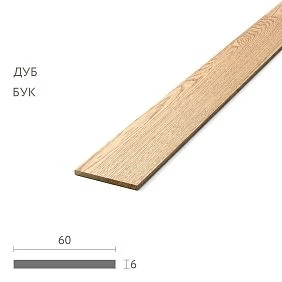
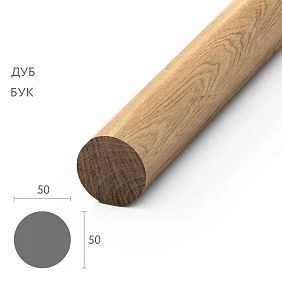
Handrail Support Bar PR-003 from STAVROS is made of solid beech and oak with a cross-section of 60 × 6 mm. These are precise dimensions for actual handrails from the same catalog — which makes it a system component, not just a "piece of wood under the handrail."
Choosing a handrail bracket for a handrail is, strictly speaking, the key to a straight railing line. That is why in the STAVROS catalog of wooden handrails for stairs, the PR-003 bracket is placed in the same category as handrails PR-001, PR-002 и PR-004This is not a coincidence — it's the logic of the system.
Our factory also produces:
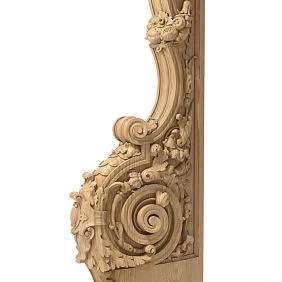

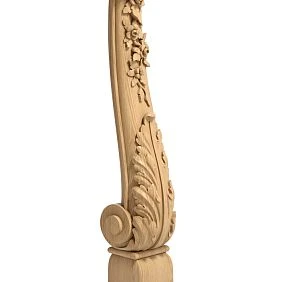
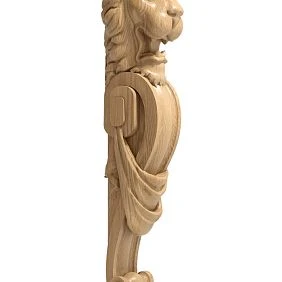
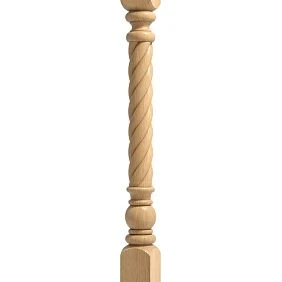
Where is the handrail bracket used: scenarios and situations
The query "buy handrail bracket" may seem narrow at first glance. But if you look at who exactly is searching for this element and why, the picture becomes much broader.
Wooden staircase in a private house. The most common case. A new staircase is assembled from ready-made components — posts, balusters, handrail, and fasteners. Without the bracket under the handrail, assembly either requires complex individual adjustment of each baluster in height or results in an uneven handrail line even with quality installation.
Restoration of an old staircase. Over time, the handrail has dried out, cracked, or been replaced. When removing the old handrail, it is often found that the lower mounting layer is either missing or rotted. Buying a handrail bracket for replacement is the right and logical decision before laying a new handrail.
Replacing balusters while preserving the handrail. Balusters are changed — from pine to oak, from one style to another. This often changes the height of the upper ends. A handrail bracket made of oak or beech takes on the task of a new leveling pad.
A project with increased aesthetic requirements. When the staircase is not just a functional element but an interior accent, a detail for photography, or part of a design project: here, a smooth line without dips is especially important. A wooden staircase railing where the top runs without waves is a sign of proper assembly, and the bracket is one of the key performers here.
Stair railing with turning sections. Where the handrail changes direction, the complexity of assembly increases many times over. The handrail bracket helps level the transition zones and ensure correct connection of elements at turning points.
Projects for painting with enamel or tinting. If the finish coating is opaque enamel, the task is not to make the wood uniform in color, but to ensure flawless geometry. A bracket made of beech — a dense, non-porous wood with a smooth surface — is ideal for this scenario.
If you want to buy a wooden handrail for a staircase and get a finished, professionally assembled result — the handrail bracket should be on your list from the very beginning. Not after installation, not "just in case," but right away.
Get Consultation
When a handrail bracket is mandatory: specific cases
There are situations where a railing simply cannot be considered correctly made without a bracket under the handrail. This is not a matter of perfectionism — it is a constructive necessity.
Balusters have height deviations
Even with ideal trimming of balusters using a template, height deviations are inevitable. Wood is a living material: one part has slightly dried out, another has absorbed moisture, a third has been cut with a half-millimeter error. Cumulatively, these deviations create an unstable seating surface. The bracket compensates for them — it is fixed to the balusters with a slight compression, leveling out the difference.
The handrail needs to be laid evenly along the entire length of the flight
A long flight is the most vulnerable spot. If a wooden handrail for a staircase is laid on 12–15 balusters without an intermediate support, it will inevitably sag slightly in the middle or create a visual 'hump'. The bracket under the handrail creates a continuous, evenly supported surface, eliminating this effect.
Need to hide the installation joint
The ends of the balusters, fixed at the top node, are not the most aesthetic element of the structure. If the handrail is laid directly on them, the boundary is visible even after final finishing. The bracket covers the entire top installation row, creating a neat, uniform layer between the balusters and the handrail.
The railing is assembled from ready-made parts
When a wooden staircase railing is assembled from standard components — balusters, posts, handrails — without individual adjustment to the project, geometric variability is inevitable. The bracket is the 'buffer' of the system, which absorbs assembly inaccuracies and provides a smooth result.
Connection reinforcement is required without visual weighting
Attaching balusters to the handrail via a sub-rail strip is more reliable than a direct connection: screws go through the end of the baluster into the strip, not directly into the handrail. This reduces the load on the handrail, eliminates the risk of cracking, and does not require additional overlays or metal elements that would disrupt the unified wooden appearance of the railing.
If you are looking for information on how to properly and reliably attach balusters to a handrail, the answer includes the strip as a mandatory intermediate element.
How to choose the size of the sub-rail strip
The question of size is one of the most practical, and it deserves a separate discussion.
Handrail Support Bar PR-003 from STAVROS is produced in three lengths: 1500, 2000, and 2500 mm with a cross-section of 60 × 6 mm. These are standard sizes designed for most real staircases in private homes.
How to determine the required length
The length of the strip should correspond to the length of the handrail section over a specific flight. If the flight is short, a 1500 mm strip is sufficient. A long flight will require several strips with proper joining.
It is better to join strips in places that will be covered by the handrail and not visible from the outside. A good option is to join in the area where the baluster is located: this will hide the seam and add an additional fixation point.
Important point: when calculating the number of strips, always include a small margin. Trimming at the angle of the flight, end cutting, precise matching to the turning section—all of this requires material beyond the calculated length. Standard practice is to add 10–15% of the calculated length.
How to choose a rail bracket
Section 60 × 6 mm is the standard for most profile handrails available in the catalog of wooden handrails for staircases STAVROS. The 60 mm width provides sufficient contact area with the lower plane of the handrail, and the 6 mm thickness ensures the necessary rigidity without adding excessive height to the assembly.
If you have already chosen a handrail from the STAVROS catalog, the PR-003 bracket is structurally compatible with it. This is a system solution designed by the manufacturer.
Long flight and bracket joining
On long flights where the total handrail length exceeds 2500 mm, brackets are joined. The joint must be precise: a cut at 90° or at an angle corresponding to the bevel of the balusters in the connection area. Do not join brackets in the middle of a span between two balusters — there is no support there, and the joint will widen over time. Always join over a baluster or post.
Turning sections
At a staircase turn where the handrail changes direction, the rail bracket is cut to the turning angle. Here it is important to take the geometry of the turning assembly in advance and allow for material margin: cutting at an angle requires precision and often several trial fits.
Oak or beech: what to choose for a rail bracket
This is not purely an aesthetic question. The choice of wood species for the bracket affects the mechanical properties of the assembly, compatibility with other railing elements, and the final coating.
Oak sub-rail strip
Oak is a dense, porous wood with a pronounced natural texture. Its main advantages are:
-
high hardness and mechanical strength;
-
holds screws well even in thin sections;
-
expressive grain pattern visible under varnish and tinting compounds;
-
suitable for railings in "natural wood", "classic", and "modern with wood" styles;
-
compatible with oak balusters and oak handrails.
An oak wooden sub-rail strip is a choice for prestigious projects where a wooden handrail for a staircase is finished with a clear or semi-transparent coating. Here, it is important that all parts — both visible and hidden — are made of the same wood species: then even minor gaps in the joints will not disrupt the overall tone.
Buying an oak handrail for a staircase and an oak strip for it is not a whim, but a rule that ensures color uniformity under any finish coating.
Beech sub-rail strip
Beech is a dense, non-porous wood with a smooth surface and a calm grain pattern. Its main features are:
-
excellent geometric stability when stored properly;
-
smooth, uniform surface that accepts enamel and primer well;
-
neutral color without pronounced tones — ideal for painting;
-
high compressive strength — important for a plank that bears the load of the handrail;
-
standard choice for railings under white or colored enamel.
A beech subrail plank is better suited for projects where the staircase railing is painted in a single tone — white, gray, black, RAL color. In this case, the wood grain is irrelevant; only the geometry and surface cleanliness after coating matter.
Main rule: do not mix wood species
If the handrail and balusters are made of oak, the plank must be oak. If beech, then beech. Mixing species in one assembly leads to different material behavior during humidity changes: oak and beech expand and shrink differently, which over time causes cracks at joints and geometric distortion.
Mixing oak, beech, and random pine in one staircase railing is a serious mistake that is difficult to fix later without complete disassembly.
How the handrail bracket connects the handrail, balusters, and posts into a single system
A stair railing is not a set of beautiful parts. It is a mechanical system with a clear hierarchy of elements and joints. And each joint has its own task.
Posts are the support points of the system. They fix the beginning of the flight, the turning point, and the end of the railing. Stair posts bear the main lateral load and set the vertical axis. Without rigidly standing posts, any railing will wobble regardless of the quality of the other elements.
Balusters are a rhythmic vertical row between posts. They provide intermediate support to the railing and fill the space between posts. Fastening wooden balusters to the handrail through a bracket distributes the force evenly among all verticals — without concentrating the load at a single point.
The handrail bracket is a transitional horizontal element. It receives the upper ends of the balusters, creates a flat plane, and transfers the load to the handrail. Without it, the balusters and handrail work in different planes — and this is physically noticeable.
The handrail is the top element that receives the load from the hand. It must lie flat, not sag, and not 'wander' when leaned on. When there is a bracket underneath, the handrail has continuous support along its entire length — and this is what provides the feeling of solidity for the entire railing.
The fastening of the baluster to the stair handrail through a bracket looks as follows: the upper end of the baluster rests against the lower plane of the bracket and is fixed with a self-tapping screw from bottom to top through the baluster into the bracket. The bracket, in turn, is pressed against the handrail and fixed with glue and/or self-tapping screws through the lower groove of the handrail. The handrail lies on top of the bracket and is fixed on both sides.
This joint — 'baluster — bracket — handrail' — is what distinguishes a properly assembled wooden stair railing from a set of parts simply fastened next to each other.
It is important to think through the assembly order in advance: first, the posts are set, then the balusters are installed along a stretched cord, after that the bracket is applied and adjusted, and only then the handrail is laid. Final fastening is done after the final level check. Any deviation from this sequence adds complexity and reduces the accuracy of the result.
Typical Errors in Selection and Installation
Practice shows that most problems with stair railings are introduced at the stage of selecting parts. Here are the mistakes that occur most often:
Buying a handrail without a mounting strip. This is the most common mistake. A person sees a beautiful wooden handrail for stairs, orders it, receives it — and only during installation realizes something went wrong. The handrail sits unevenly. The installer says: "a strip was needed." Ordering, shipping, waiting — all this time and money beyond the plan.
Replacing the mounting strip with a regular batten. A batten is not a strip. The geometry is wrong, the cross-section is different, the wood species is random. The result is an unpredictably unstable base that behaves differently than a profiled part.
Not accounting for the flight length. Buying one strip of 2000 mm for a flight of 3200 mm inevitably leads to a joint in an unfortunate place. You need to calculate in advance, with a margin.
Joining the strip in a visible place. The joint should be under the handrail, above a baluster or post. A joint in the middle of the span is a weak point and a visual defect.
Mixing wood species. We already discussed this above, but it's worth repeating: oak, beech, and pine in one railing is not a problem immediately, but a year or two after installation.
Ignoring the cross-section. A strip with a non-standard cross-section is incompatible with a profiled handrail. Buying a wooden handrail for stairs and using it with an incompatible strip means getting a gap in the lower groove of the handrail that cannot be aesthetically fixed.
Not accounting for the staircase angle. For flights with a non-standard slope, it may be necessary to bevel the lower plane of the strip. This needs to be planned in advance — with a planer or router.
Cutting balusters without a single line. Even if there is a strip, but the balusters are cut at different heights, the strip will lie crooked. Cutting is always done to a single horizon, checked against a taut string or laser level.
Not allowing for length margin. Standard rule: +15% to the calculated length. Cutting, waste from end trimming, precise fitting at the turning point — all this "eats up" material.
Skipping the final coating of the strip. The strip is hidden under the handrail, but that doesn't mean it doesn't need treatment. Without coating, the wood absorbs moisture and changes geometry. Primer and a final layer are mandatory, even for hidden elements.
What to buy together with the under-rail plank
If you came for the plank, it means you are assembling a stair railing. And that means the plank is not the only part you need. Here is a logical list of elements for a complete set:
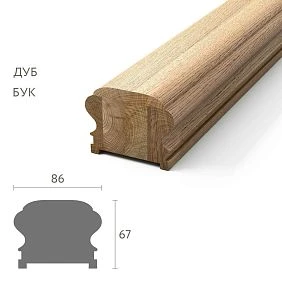
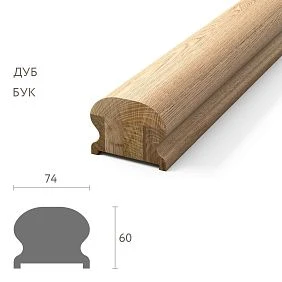
Stair handrail. Without it, the plank is not needed. The STAVROS catalog offers finger-jointed handrail PR-001, finger-jointed handrail PR-002 и Stair handrail PR-004 — each for a different project and budget.
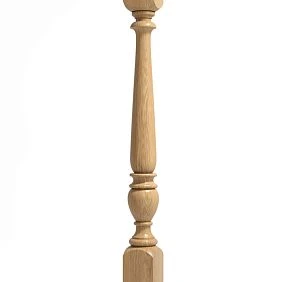
Balusters. The plank is attached to them from below. The STAVROS catalog has over 50 models balusters for staircases: turned, carved, classic, modern. You need to choose in the same wood species as the handrail and plank.
Posts. Without support staircase posts no railing system will be rigid. Posts are installed at the beginning, end, and turning points.
Fasteners and materials for installation and finishing. Screws, glue, primer, varnish or enamel. All of this is available in the section Mounting and finishing materials — and it's better to order them in the same order to avoid waiting for separate delivery.
Carved decor. If the project involves a classic or custom staircase — a full range of carved decor STAVROS allows you to add details that will turn a functional structure into a true interior accent.
A smart approach is to order everything staircase components from one source, in one type of wood, with the same level of processing. This is how you achieve a result that looks like a system, not a set of randomly selected parts.
Density of the key node: how the handrail bracket affects the rigidity of the entire railing
The rigidity of a staircase railing is not an abstraction. It is a specific physical property that is felt with every touch of the handrail.
When a person leans on the handrail, the force is transmitted downward — through the handrail, through the bracket, through the balusters, to the base. If there is a weak link in this chain, it creates play. Usually, the weak link is the top node: the connection point between the baluster and the handrail.
If the baluster is attached directly to the handrail — through the top end into the handrail groove — the contact area is small. The screw enters the handrail groove at an angle, and under lateral force, this connection starts to 'wobble'.
When a strip is placed between the baluster and the handrail, the situation changes radically:
-
the end of the baluster rests against the strip across its entire plane — this is contact not at a point, but over an area;
-
the strip is pressed against the handrail along its entire length — the load is distributed evenly;
-
each baluster contributes to rigidity through the strip, rather than working in isolation;
-
the handrail does not bear point loads — it is uniformly supported along its entire span.
This is a fundamentally different mechanics. That is why wooden railings with a strip feel monolithic — they are monolithic in terms of load distribution.
If you want to eliminate handrail play without removing it — in some cases this is possible precisely by tightening or adding a strip to the existing assembly. But it is, of course, more correct to incorporate the strip at the assembly stage.
Under-handrail strip as a style element
There is another aspect that is rarely discussed directly but is important: the under-handrail strip affects the aesthetics of the railing.
When you look at a finished staircase, you see a smooth line of the handrail. You see a uniform rhythm of balusters. You see a neat joint where the vertical meets the horizontal. All of this is, in part, thanks to the strip.
Without it, in the same place you would see the ends of balusters protruding at different heights, small gaps, and an uneven line. This is what is called a "broken handrail line" — and this is exactly what a buyer of a wooden staircase does not expect to get.
A flat, neat transition from vertical to horizontal parts is the "line without a dip" from the title. It is achieved not by expensive parts or complex installation. It is achieved by the correct selection of each element of the system — including the smallest and most inconspicuous one.
The handrail support strip made of oak for an oak handrail with oak balusters is not just a set of pieces of wood of the same species. It is a system in which each element knows its place, and the result is visible to the naked eye.
About the company STAVROS
STAVROS is a manufacturer of wooden decorative products and staircase components with a history of more than twenty years. The company was founded in 2002 by two artists — Andrey Ragozin and Evgeny Tsapko — and within a year of its founding, it participated in the reconstruction of the Konstantinovsky Palace in Strelna. Later, the craftsmen worked with cultural heritage sites: the Hermitage, the Alexander Palace, the Trinity-Izmailovsky Cathedral, and the Sheremetev Mansion.
Today, STAVROS produces a wide range of balusters, posts, handrails, handrail support strips, and carved decor from solid oak, beech, and pine. Production is located in St. Petersburg, showrooms are in St. Petersburg and Moscow. Delivery is carried out throughout Russia and the CIS countries. In the STAVROS catalog, the handrail support strip PR-003 is placed in the same category as handrails PR-001, PR-002, and PR-004 — because it is a system solution, not scattered items.
If you are assembling a staircase railing and want to get a smooth, rigid, aesthetically finished result — STAVROS gives you the opportunity to order the entire system in one place: from posts to the strip, from balusters to the final coating.
Frequently asked questions
What is a handrail support strip?
A handrail support strip is a wooden element of rectangular cross-section that is laid on top of the balusters and serves as an intermediate support layer between them and the handrail. It levels the mounting plane, takes the fastening of the upper ends of the balusters, and provides the handrail with a continuous, even support along the entire length.
Why is a handrail support strip needed if the handrail can be mounted directly on the balusters?
Direct mounting of the handrail on the balusters is possible but problematic: even minor deviations in the height of the baluster ends result in an uneven handrail line, gaps, and a feeling of looseness. The strip absorbs these deviations and creates a level base.
Can a sub-handrail strip be replaced with a regular construction batten?
Technically — sometimes yes, practically — it's a weak solution. A regular batten doesn't have the required cross-section, its geometry isn't guaranteed, and the wood species may not match the other railing elements. This leads to geometry and compatibility issues.
What sizes are available for the sub-handrail strip PR-003?
The PR-003 strip from STAVROS is available in three lengths: 1500, 2000, and 2500 mm with a cross-section of 60 × 6 mm. These are standard sizes for most staircases in private homes.
Which is better — oak or beech for a sub-handrail strip?
Oak — for projects with transparent or semi-transparent coatings where texture and color matter. Beech — for painting with enamel when a smooth surface and stable geometry are needed. The main rule: the wood species of the strip must match the species of the handrail and balusters.
How to attach balusters to the handrail through the sub-handrail strip?
The top end of the baluster is fixed into the lower plane of the strip with a screw from bottom to top. The strip is then pressed against the handrail and secured through the lower groove of the handrail with glue or screws. The handrail is placed on top and finally fixed after leveling.
Is it necessary to coat the strip with a finish if it's hidden under the handrail?
Yes, absolutely. Without coating, the wood absorbs moisture and changes geometry. A primer and one coat of varnish or oil are enough — this will protect the strip from warping and maintain the rigidity of the assembly for a long time.
What to buy together with the handrail support strip?
Handrails, balusters, stair posts, fasteners and materials for installation and finishing. All these elements are available in the STAVROS catalog in the staircase components section. It is better to order everything in one set — of the same wood species and the same level of processing.