








































































Article Contents:
- Wooden handrails for stairs: how to choose a solid wood profile for a private home and stair railing
- Handrail, railing, guardrail: understanding the terms
- What is a wooden handrail for stairs: function and form
- Safety and support
- Decorative function
- Connecting role
- STAVROS product catalog: what is available for wooden handrails
- Wooden handrail profile: how to choose the right shape
- Profile geometry: what matters for the hand
- Classification of profiles by shape
- Profile and interior style
- Handrail material: oak, beech and other hardwood species
- Oak: hardness, status, character
- Beech: density and precision
- Other hardwood species for handrails
- Handrail for stairs in a private house: selection specifics
- Staircase to the second floor
- Wooden handrails in a private house: child safety
- Wall-Mounted Handrail
- Double-height space railing
- How to choose a handrail for balusters and stair posts
- Handrail and Balusters: Visual Unity
- Handrail and posts: proportions and transitions
- Underhandrail Strip: Why It Is Needed
- Dimensions, Length, and Joints of a Wooden Handrail
- Handrail length
- Handrail Joint
- Handrail height from steps
- Stair Width and Number of Handrails
- Finishing a Wooden Handrail: From Varnish to Tinting
- Clear varnish
- Toning + varnish
- Oil and Oil Wax
- White or Colored Enamel
- Coordinating Finish with Interior
- Classic staircase styles and handrail profiles
- Classicism and neoclassicism
- Baroque and Neo-Baroque
- Provence and Italian Country
- Modern classicism
- Country and Scandinavian
- How to match handrails with flooring, doors, and home decor
- Handrail and flooring
- Handrail and doors
- Handrail and wooden moldings
- Mistakes to avoid when choosing a wooden handrail for stairs
- Where to buy wooden handrails for stairs STAVROS
- Frequently asked questions about wooden handrails for stairs
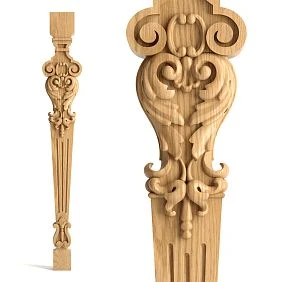
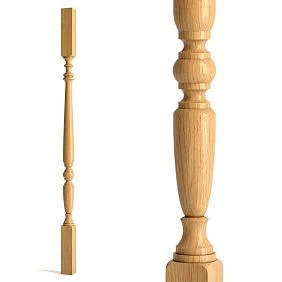
Wooden handrails for stairs: how to choose a solid wood profile for a private home and stair railing
There are details that don't catch the eye — but their absence or wrong choice is felt instantly. A wooden handrail for stairs is exactly such a detail. Your hand touches it twice a day, every day. When going up and when going down. And if the profile is uncomfortable, the material is cold, and the surface is rough — irritation builds up, although a person often cannot explain why the staircase "doesn't feel right."
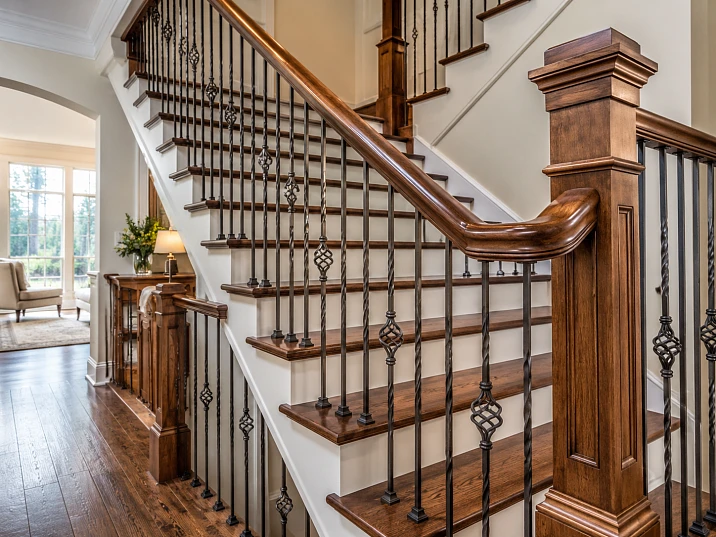
A handrail is not decor. It is an element of safety and tactile comfort that is also a visible part of the stair railing. It holds the structure "on top," unites balusters and support posts into a single line, sets the horizontal rhythm of the entire staircase. And at the same time — in a classic home — it must be beautiful.
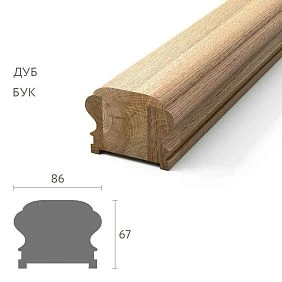
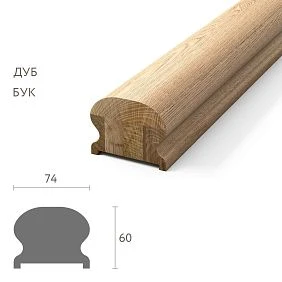
If you are looking for where to buy wooden handrails for stairs — STAVROS stair handrails this is a professional answer to the question: here are models PR-001, PR-002, PR-003, and PR-004 made of solid wood, for different profiles, styles, and application scenarios.
This article provides a complete breakdown: what a wooden handrail is, how to choose a profile, which material to prefer, how to match it with balusters and posts, what to pay attention to during installation, and why it is the handrail — not the baluster or the post — that determines the final character of the staircase.




Handrail, railing, guardrail: understanding the terms
Before discussing the choice — one necessary distinction. The terms "handrail," "railing," and "guardrail" are often used as synonyms, although they are different things.
A stair guardrail is the entire safety system along the edge of the stair flight: posts, infill, and the top element.
Railing is a traditional folk word that in everyday life means the entire guardrail as a whole. In professional terminology, railing is often identified specifically with the top horizontal element.
A handrail is the upper horizontal part of a railing. It is the element that the hand holds onto. It rests on balusters and is attached to posts.
Balusters are vertical elements that fill the space between the handrail and the stair structure. They create the rhythm of the railing.
Posts are large supporting vertical elements at the beginning, end, and turns of the staircase.
A handrail bracket is a horizontal element installed between the balusters and the handrail, ensuring precise spacing and uniformity.
The article focuses specifically on the handrail as an independent product element. STAVROS Staircase Components and Elements include all the listed elements, but the handrail is in a separate category.
Our factory also produces:
What is a wooden handrail for a staircase: function and form
A wooden handrail performs two tasks simultaneously — and it is in this duality that its complexity lies.
Get Consultation
Safety and support
The handrail is a safety element. When climbing stairs, the hand rests on it, relieving some of the load from the legs. When descending, it prevents loss of balance. For the elderly, children, and people with disabilities, a handrail is not an option but a necessity.
A good solid wood handrail made of solid wood holds without play, without creaking, and without wobbling. This is a requirement for both installation and the quality of the product itself.
Decorative function
In a classic private home interior, a solid wood handrail is a visually significant element. It runs along the entire flight of stairs, occupies a considerable length, and is always in view. A well-chosen profile, coordinated with the balusters and the overall style of the home, turns the staircase into an architectural element, not just a functional structure.
Connecting role
The handrail is the "thread" that ties all vertical railing elements into a single line. Without a handrail, balusters are just a set of individual posts. The handrail unites them into a cohesive, rhythmic structure.
STAVROS product catalog: what is available for wooden handrails
At STAVROS, stair handrails are a separate product category with specific items.
Main section: STAVROS wooden stair handrails — models PR-001, PR-002, PR-003 (handrail strip), PR-004.
Parent section: Staircase Components and Elements — balusters, posts, handrails and related elements.
Balusters: STAVROS wooden balusters for stairs — for matching with the handrail.
Carved decor: STAVROS carved decor — parent section for stylistically related elements.
Mouldings: wooden moldings STAVROS — for related profile products made of solid wood.
Moldings and baseboards: Solid wood moldings, cornices, and baseboards — for matching the handrail profile with interior moldings.
All solid wood: Solid Wood Items — for the systematic selection of wooden elements.
Wooden handrail profile: how to choose the right shape
The handrail profile is the cross-section. It is the profile that determines how comfortably the hand grips the handrail, how organically it fits into the staircase style, and how it looks in the interior.
Profile geometry: what matters for the hand
The correct profile of a wooden handrail is not an abstract concept. It is physiology. The average person's hand creates a natural "cup" when gripping: four fingers below, thumb above. The handrail should match this shape.
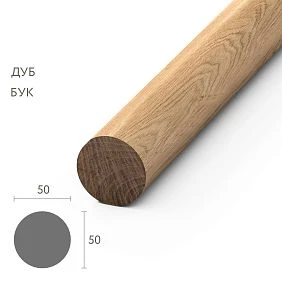
Handrail width: optimal is 50–70 mm. A handrail wider than 80 mm is uncomfortable: the hand does not fully grip it. A handrail narrower than 45 mm is not a reliable enough support.
Profile height: 40–55 mm is a universal range. A flat handrail with a height of 25–30 mm is more decorative than functional.
Top shape: a slightly convex or rounded surface is most comfortable for gripping. Sharp edges on the top of the profile cause discomfort with regular use.
Edges: all edges of the profile should be smoothed. Sharp edges are a source of hand fatigue with constant use.
Classification of profiles by shape
| Profile | Description | Application |
|---|---|---|
| Oval | Slightly elongated vertically | Classic, neoclassic |
| Rounded rectangle | Geometric, neat | Modern Classic |
| Shaped (with bottom cutout) | Profile with decorative ribs | Classic Interiors |
| Pear-shaped | Narrowed at the bottom, widened at the top | Baroque, decorative staircases |
| Handrail support strip | Narrow horizontal rail | Baluster–handrail joint |
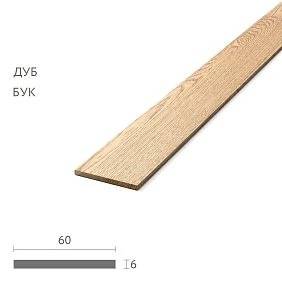
In the STAVROS catalog, PR-004 is a profiled handrail made of solid wood for a classic staircase. PR-003 is a sub-rail strip that ensures a precise mounting joint between balusters and the handrail.
Profile and interior style
For a classic or neoclassical home: a shaped profile with a bottom cutout, decorative ribs, or rounded transitions. The handrail looks "furniture-like" rather than "construction-like."
For modern classic: a rectangular profile with smoothed corners — strict, concise, but not cold.
For Provence or country style: an oval or pear-shaped profile with soft roundings. No geometric rigidity.
For a minimalist interior with wood: a rectangular profile with thin chamfers. Simplicity that reads as intentional.
Handrail material: oak, beech, and other solid wood species
Handrail material is not just aesthetics. It's durability, tactility, wear resistance, and reaction to humidity. Let's prioritize.
Oak: hardness, status, character
A wooden handrail made of oak is a choice that needs no explanation. Oak's hardness on the Brinell scale is among the highest of hardwoods. This means an oak handrail will not dent from finger pressure, will not wear out over years of intensive use, and will not deform with humidity fluctuations in the home.
Oak texture is expressive, with characteristic medullary rays that create a natural pattern. Under clear varnish or tinting, it is a living surface with an individual character.
For a classic staircase in a private home, for a hall with oak parquet, for a study and library — an oak handrail is an obvious solution.
Beech: density and neatness
Beech is slightly softer than oak, but significantly denser than spruce and pine. The pattern of beech is fine, uniform, without sharp contrasts. It is a neutral "background" that accepts any tinting well.
A beech handrail is a good solution for staircases where a light, neat profile without a dominant texture is needed. For white or cream finishes, beech behaves predictably.
Disadvantage: beech is more sensitive to humidity than oak. In homes with unstable humidity, good protective finishing is needed.
Other solid wood species for handrails
Ash: elastic, with a characteristic wavy pattern. For accent staircases with expressive surface texture.
Pine: a soft wood. For handrails — only in light country or rustic scenarios, where marks from use are perceived as the "living history" of the wood.
Maple: light, dense, with a neutral pattern. For Scandinavian and light interiors.
For most private homes with a classic interior — oak or beech. These species provide the right combination of strength, tactile feel, and aesthetics. Solid wood products STAVROS professional-grade wood with controlled moisture content is used.
Handrail for a staircase in a private home: specifics of selection
A staircase in a private home is not a staircase in an apartment building. The logic is different: daily use by the whole family, high aesthetic requirements, the need to integrate the staircase into the overall interior of the house.
Staircase to the second floor
A staircase to the second floor is a central architectural element of the hall or living room. If the staircase is open, it is visible from several rooms. A solid wood handrail, coordinated in style and finish with the floor, doors, and baseboards, creates a cohesive interior.
For an open staircase to the second floor with classic decor — a profiled handrail with a shaped cross-section, dark walnut stain, turned decorative balusters in a unified style.
Wooden handrails in a private home: child safety
In a home with children, the handrail is primarily a safety element. Requirements:
-
Fence height from steps: 900–1000 mm
-
The handrail must be held without play — regular check of fasteners
-
The profile should be comfortable for a child's hand: not too wide
-
No sharp edges or protruding elements
Standard fence height for a private house is 900 mm from the step to the top surface of the handrail. For the second floor with an open railing — 1000–1100 mm.
Wall-mounted handrail
In narrow stairwells or on stairs with one side against a wall, a wall-mounted wooden handrail is installed. It is attached to the wall via bracket holders, without balusters or posts.
A wall-mounted handrail requires:
-
Proper attachment to a load-bearing wall (not just into plaster)
-
A gap from the wall of 40–60 mm — for ease of grip
-
A continuous line — without breaks within a single flight
-
Smooth surface without protruding elements
The profile of a wall-mounted handrail is typically more compact: width 45–55 mm, height 35–45 mm. It should fit comfortably in the hand without the involvement of balusters in the structure formation.
Second light railing
An open double-height living room is a beautiful architectural solution that requires railing around the perimeter of the second floor. Here, the handrail runs along the horizontal railing, not along an inclined flight.
For horizontal railing, the following are important:
-
Structural rigidity — the handrail on a horizontal railing experiences lateral load
-
Height: 1000–1100 mm from the floor level of the second floor
-
Aesthetics: this handrail is clearly visible from below, from the living room
How to choose a handrail for balusters and stair posts
A handrail is never chosen in isolation. It is part of a system: balusters below, posts at the edges, and a handrail bracket as a connecting element.
Handrail and balusters: visual unity
Main principle: the style of the handrail should match the style of the balusters.
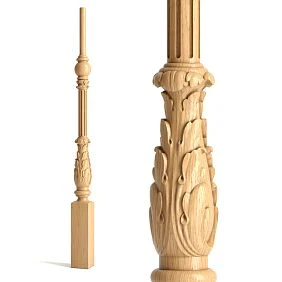
If the balusters are turned, with decorative necks and turned "vases" in the center, the handrail should have a shaped profile, soft curves, and a "furniture-like" character. A strict rectangular handrail on such balusters will look like an element from a different set.
If the balusters have a geometric profile, straight lines, and no decorative "bulges," the handrail should have a rectangular or slightly rounded profile. Clean lines in combination.
STAVROS wooden balusters for stairs — a large catalog from which you can select balusters that are stylistically coordinated with a specific handrail model.
Handrail and posts: proportions and transitions
A newel post is the most massive vertical element of the staircase. It is 3–5 times larger in cross-section than the balusters and significantly richer in decoration.
The handrail enters the newel post through a special groove or is attached to it from the end. The "handrail–newel post" transition is a critical installation unit that needs to be planned in advance:
-
The handrail should not "get lost" in the newel post — the end must be finished
-
The height of the newel post above the handrail (finial) is from 50 to 150 mm
-
The style of the newel post top is coordinated with the style of the entire staircase
Handrail bracket: why it is needed
Under-rail strip (PR-003 in the STAVROS range) is a horizontal profile element installed on top of the upper ends of balusters, with the handrail then mounted onto it.
Why is an under-rail strip needed:
-
Creates an even gap between the handrail and balusters
-
Conceals the mounting points of baluster fasteners
-
Simplifies aligning the handrail along the line
-
Adds a decorative horizontal line to the railing
In a classic staircase with wooden balusters and a profiled handrail, the under-rail strip is a standard mounting element. Without it, fixing the handrail directly onto the balusters requires significantly greater installation precision.
Dimensions, length, and joints of a wooden handrail
Practical parameters that determine how much material is needed and how to perform proper installation.
Handrail length
The length of one handrail is determined by the length of the staircase flight. For calculation:
Handrail length = flight length along the hypotenuse × 1.0 + 5% margin
With a flight length of 4 m horizontally and a height of 3 m, the hypotenuse will be about 5 m. The handrail needs to be 5.25 m long including the margin.
Standard delivery lengths for wooden handrails: 2.4 m, 3.0 m, 4.0 m. For long flights, joining is required.
Handrail joint
A joint on a straight section is technically not difficult, but visually it should be almost invisible. Rules:
-
The joint is made strictly along the axis of the baluster or post
-
The ends of the joined handrails are at 90°, with precise fitting
-
After installation, fill the gap with putty, followed by sanding and finishing
For corner joints (at stair turns), shaped elements are used: corner blocks or turned transitions. These are professional installation solutions that require precise marking.
Handrail height from steps
Standard for a private residential house: 900 mm from the step surface to the top point of the handrail. This is a comfortable height for most adults.
For the railing of the second floor landing: 1000–1100 mm from the floor level.
When the staircase has a slope, the handrail must be parallel to the flight. The height of 900 mm is measured perpendicular to the step surface.
Stair width and number of handrails
According to regulations for a private house, one handrail on one side is sufficient. But for stairs wider than 1.2 m, handrails on both sides are recommended.
A wall-mounted handrail on the other side of the stairs (against the wall) is a convenient and safe addition even if there is a main railing with balusters.
Wooden handrail finishing: from varnish to tinting
Handrail finishing is a decision made in the context of the entire staircase and the whole interior.
Clear varnish
Preserves the natural color and texture of the wood. For oak under a clear glossy varnish, it gives a rich amber hue with a pronounced grain pattern.
Matte varnish gives a more modern look. It hides minor scratches. For a handrail used daily, matte varnish is more practical than glossy.
Important: a handrail made of oak or beech under varnish must be pre-sanded to a grit of 180–240. Any roughness under varnish becomes more pronounced.
Tinting + varnish
Changes color while preserving texture. For a classic staircase in dark tones — tinting to walnut, wenge, or American walnut.
Critically important: handrails, balusters, and posts must be tinted in the same batch. Different batches produce different shades even when using the same colorant.
Oil and oil-wax
Eco-friendly finish. The surface "breathes," remains matte and tactilely warm. Regular maintenance — applying a fresh layer of oil once a year.
For a handrail that is touched by hand several times a day, oil creates a pleasant tactile contact — without the feeling of a "plastic" coating.
White or colored enamel
For neoclassical and Provencal interiors — white enamel on a wooden handrail. Hides the texture, emphasizes the profile.
Important: for use under enamel, a handrail made of beech or MDF profile behaves more predictably than oak: the open pores of oak under white paint may require multiple priming coats.
Coordinating the finish with the interior
The handrail is not an isolated element. Its finish must be coordinated:
-
With the finish of balusters and posts (mandatory — identical)
-
With the finish of steps (preferably — similar)
-
With the finish of the flooring (coordinated)
-
With the finish of wooden doors (preferably — in a unified color scheme)
-
С moldings and baseboards of the interior
Classic staircase styles and handrail profiles
The interior style dictates the handrail style. This is not a subjective question — it is architectural logic.
Classicism and neoclassicism
Figurative handrail profile with a bottom cutout, rounded edges. Dark tinting. Turned balusters with classic decor. Massive posts with ball or urn-shaped tops.
In this context, the handrail is one of the horizontal 'lines' of a classic interior, like a cornice or molding. It should have a decorative profile, not be a 'planed strip'.
Baroque and Neo-Baroque
Rich profile with several decorative ribs. Lacquered oak with dark tint. Balusters with several decorative "necks". Posts with carved tops. For this style — STAVROS carved decor will provide additional decorative elements.
Provence and Italian Country
Oval or pear-shaped profile with smooth transitions. White or cream enamel. Curved balusters. A feeling of "homeyness" and coziness.
Modern classic
Rectangular profile with thin chamfers. Minimal decorative ribs. Light or gray tint. Geometric balusters with straight lines.
Country and Scandinavian
Simple oval profile. Light oil or matte varnish without tint. Balusters with a simple turned profile. A feeling of natural, unfinished wood.
How to combine handrails with floors, doors, and home decor
A staircase in a private home is a transitional architectural element that connects floors and is visible from several areas.
Handrail and floor
Dark oak handrail on light parquet — contrast. Beautiful and modern in a neoclassical interior.
A light beech handrail on a dark parquet floor is an inversion. Unconventional, but with the right design, very expressive.
A handrail matching the parquet is the safest, most traditional solution.
Handrail and doors
If the doors in the house are made of solid wood with a dark tint, a handrail in the same color scheme creates a unified language of wooden interior elements.
The style of the door casing profile and the handrail profile can 'echo' each other: if the casing has decorative ribs, similar ribs on the handrail will create a stylistic connection.
Handrail and wooden moldings
A handrail is a horizontal wooden element. Baseboards, moldings, and casings are also horizontal (and vertical) wooden elements. In a classic interior, they should all be coordinated in finish.
wooden moldings STAVROS — baseboards, casings, and trims that form the wooden 'contour' of the interior. Moldings coordinated with the handrail turn wooden elements from a set of parts into an architectural statement.
Mistakes when choosing a wooden handrail for a staircase
1. Choosing a profile without considering grip comfort. A profile that looks nice but is uncomfortable to hold is a daily annoyance. Try the profile with your hand before buying.
2. Taking too wide a profile. A handrail wider than 80 mm is decorative but not functional. The hand cannot grip it with reliable support.
3. Not matching the handrail with the balusters. Different styles of handrail and balusters create visual inconsistency that is hard to "unsee".
4. Ignoring the subrail strip. Without the correct joint between balusters and handrail, installation is more difficult and the result is less neat.
5. Not accounting for joints on a long flight. A single handrail for the entire flight is ideal. If a joint is necessary, ensure its proper placement (over a baluster) and finishing.
6. Choosing finish in isolation from balusters and posts. All railing elements should be stained from the same batch, otherwise color mismatch is inevitable.
7. Not checking the railing height. A height of 900 mm per standards is the minimum. For children's safety, 950–1000 mm is better.
8. Leaving sharp ends of the handrail untreated. The end of the handrail at a post or wall should be rounded or covered with a decorative element.
9. Using soft wood for a heavily used staircase. Pine on the main staircase of a house with children results in a surface with scratches and dents within one season.
10. Not guiding the buyer to the actual STAVROS product section. Choosing a wooden handrail is not an abstract question. It involves specific models PR-001, PR-002, PR-003, PR-004 with parameters.
Where to buy wooden handrails for STAVROS stairs
To select and order:
-
STAVROS wooden stair handrails — PR-001, PR-002, PR-003, PR-004
-
Staircase Components and Elements — full set: balusters, posts, handrails
-
wooden balusters for staircases — for matching in a set
-
STAVROS carved decor — decorative elements for a classic staircase
-
Wooden trim — coordinated profile elements
-
Solid wood moldings, cornices, and baseboards — for interior coordination
-
Solid Wood Items — the entire wooden catalog
Frequently asked questions about wooden handrails for stairs
What is a wooden handrail and how is it different from a railing?
A handrail is the upper horizontal part of the stair railing that the hand holds. Railing is a broader term: the entire railing system, including balusters, posts, and the handrail.
Which wooden handrail profile is the most comfortable?
Optimal width is 50–70 mm, profile height is 40–55 mm, the top surface is slightly convex or rounded. All edges must be smoothed. STAVROS offers several profiles: PR-001, PR-002, PR-004.
Which is better for a handrail: oak or beech?
Both options are good. Oak is harder, with expressive texture, more stable under humidity changes. Beech is dense, with a neutral pattern, takes staining well. For the main staircase of a classic house, oak is the preferred choice.
What is a handrail bracket and is it necessary?
The handrail bracket (PR-003) is a horizontal element between the balusters and the handrail. It simplifies installation, hides baluster fasteners, and creates a neat assembly. For staircases with wooden balusters, it is recommended.
At what height should the handrail be?
For a staircase flight in a residential building — 900 mm from the stair surface. For the second floor landing railing — 1000–1100 mm.
How to hide the handrail joint?
Make the joint over a baluster, with the most precise fitting of the ends. After installation — wood putty, sanding, final finish to match the handrail.
Can I buy a handrail without balusters and posts?
Yes. The handrail is an independent product item. At STAVROS, it is sold separately in the section handrails for staircases.