Article Contents:
- PR-004 or PR-002: which handrail to buy
- What is a stair handrail and why the profile affects the entire project
- The handrail defines the grip character
- The handrail unites balusters and posts
- Length determines the number of joints
- The handrail cannot be chosen without a mounting scheme
- For wall-mounted installation
- For a comfortable round grip
- For a modern and minimalist interior
- For a section about 2400 mm
- For round wooden molding
- When PR-004 does not cover the task
- For installation over balusters
- For a classic staircase
- For a long staircase flight
- For large posts and massive fencing
- For an oak handrail up to 5000 mm long
- When PR-002 is not suitable
- Measure the finished section
- Consider the start and end
- The allowance for fitting must be deliberate
- It is better to place joints at controlled points
- PR-004 2400 mm long
- PR-002 from 1500 to 5000 mm
- Transportation and drift
- Buy one long or several short
- What does a solid-lamella blank mean
- What does finger-jointing along the length mean
- Finger-jointed does not mean defective
- When to choose a length up to 2500 mm
- When a length over 2500 mm is more rational
- How the finish affects the choice
- What to clarify before ordering
- Beech for opaque enamel
- Why beech is convenient for a uniform color
- Oak for oil, varnish, or tinting
- Buy a round oak handrail
- How to match oak to steps
- Can oak be painted with enamel
- Can beech be coated with clear varnish
- Why it's better to order the entire set in one batch
- Dimensions of PR-003
- Why the bracket should be included in the order immediately
- How PR-003 connects balusters to the handrail
- How to choose the length of the plank
- Material of the plank
- Where to buy PR-003
- When PR-003 is not needed
- Modern Interior
- Modern classicism
- Classic staircase
- Art Deco
- Scandinavian and light interior
- Commercial space
- Divide the staircase into sections
- Create a length list
- Do not sum meters without considering joints
- Add PR-003 separately
- Count the balusters and posts
- Calculate the finishing
- Wall-mounted PR-004
- PR-002 on balusters
- Turns and landings
- Joints of long profiles
- Useful material about installation
- Handrail and round molding
- Handrail and subrail plank
- Handrail and baluster
- PR-002 and solid timber
- Laminated and solid from one piece
- Wall-mounted handrail and handrail on balusters
- Need a handrail on the wall along a straight flight
- Need a handrail on the wall with a landing
- Need to assemble a classic balustrade
- Need a long straight handrail without a noticeable joint
- Need to preserve natural oak
- Need a white stair railing
- Need to update an existing staircase
- Need a handrail for a narrow staircase
- Need a handrail for a hotel or restaurant
- Need to connect a round wall-mounted handrail and a wide balustrade
- Choosing only by shape in a photo
- Buying PR-002 without PR-003
- Expecting that any PR-002 is spliced along the length
- Expecting that solid-laminate means a solid trunk
- Ignoring the length of PR-004
- Ordering a long PR-002 without checking the entry
- Mixing beech and oak under a clear finish
- Oak under dense enamel without reason
- Random joint in the grip zone
- Purchasing a handrail without posts and balusters
- Installation without checking the wall
- Thick finish
- Lack of test paint
- Attach the staircase plan
- Mark the material and finish
- Make a separate list of components
- Check the logistics of long parts
- Record the quantity and purpose of leftovers
- Which handrail is best for a wall?
- Which handrail is best for balusters?
- What is the size of PR-004?
- What lengths are available for PR-002?
- What materials are both models made from?
- Is PR-003 needed for PR-004?
- Is PR-003 needed for PR-002?
- What are the dimensions of PR-003?
- Are all PR-002 spliced along the length?
- What does solid-laminate mean?
- Can PR-004 be used on a long flight?
- Can I order PR-002 with a length of 5000 mm?
- Which handrail looks lighter visually?
- Which profile suits a classic staircase?
- Which handrail to choose for white enamel?
- Which handrail to choose for oil or stain?
- Can PR-004 and PR-002 be combined on one staircase?
- How to calculate the number of handrails?
- Where is the best place to place the joint?
- Do I need to buy balusters at the same time as PR-002?
- What to check before payment?
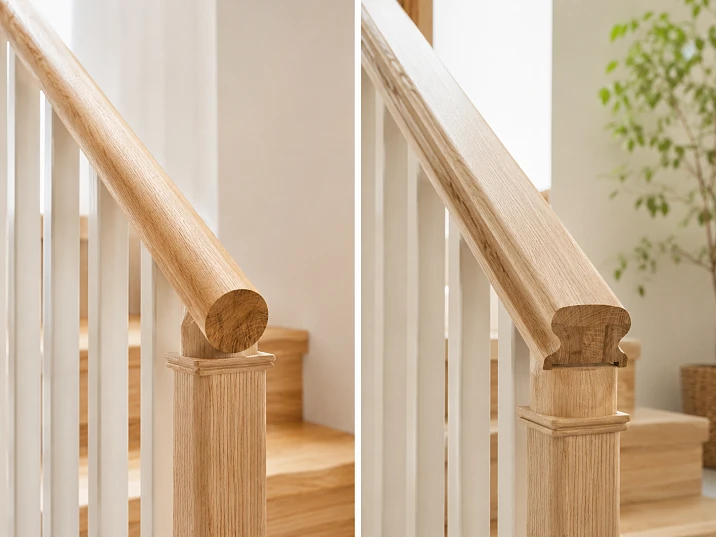
Comparison of two handrails made of beech and oak for different staircase railing schemes
PR-004 or PR-002: which handrail to buy
Short answer: For a wall-mounted section, a minimalist staircase, or a comfortable round grip, choose PR-004 with a diameter of 50 mm and a length of 2400 mm. For a railing with balusters, a more massive classic profile, or a section up to 5000 mm long, PR-002 with a cross-section of 74 × 60 mm is better suited. To install PR-002 on top of balusters, a sub-rail strip PR-003 is required separately.
Buy PR-004 Buy PR-002 View all handrails
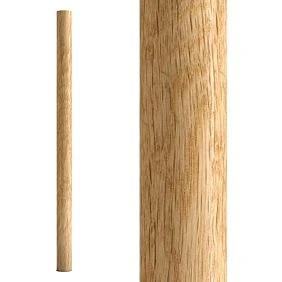
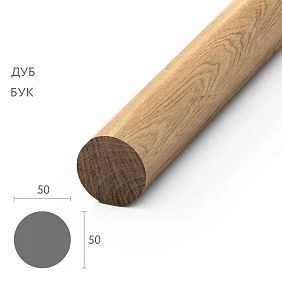
PR-004 — round, diameter 50 mm. Convenient for a self-supporting wall handrail and a minimalist grip line.
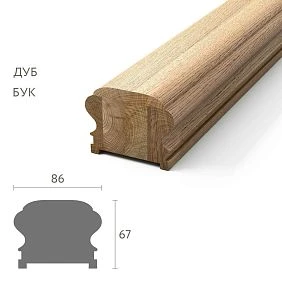
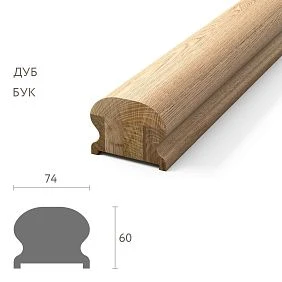
PR-002 — wide profile 74 × 60 mm. Designed for a more massive railing and installation on top of balusters.
2400 mm or length up to 5000 mm. PR-004 covers a standard section of about 2.4 m, PR-002 helps reduce the number of joints on a long flight.
Beech or oak. Beech is chosen for opaque enamel, oak for oil, varnish, or semi-transparent tinting.
PR-003 for PR-002 is sold separately. The sub-rail connects the wide handrail to a row of balusters and must be included in the kit in advance.
The short and long PR-002 are manufactured differently. Sizes 1500–2500 mm are made from a solid lamella blank, options over 2500 mm are made from a finger-jointed blank.
Buying a wooden handrail for a staircase is not difficult until the buyer starts matching the profile to the actual railing layout. The round PR-004 and the wide PR-002 are made of beech or oak, but serve different purposes. The first is convenient to use as a wall-mounted handrail with a clear round grip. The second forms the top architectural line of the balustrade and works together with balusters, posts, and a sub-rail.
The mistake occurs when the choice is based only on appearance. The round profile seems universal and light, but the length of the current option is 2400 mm. On a long flight, you will need to plan joints or a different scheme. PR-002 offers lengths from 1500 to 5000 mm, but has a more massive cross-section of 74 × 60 mm and requires a separate PR-003 strip for installation on balusters. Therefore, one product cannot be automatically replaced by another without changing the project.
The shape also affects the grip. A diameter of 50 mm is comfortable to grasp with the hand around the entire circumference. The wide shaped PR-002 is perceived differently: the palm rests on the top part of the profile, and the handrail visually completes the row of balusters. For a wall-mounted staircase without a balustrade, the round option usually looks lighter. For a classic design with large posts, the wide profile creates a more convincing top line.
The material is chosen together with the future finish. Beech under opaque enamel allows you to get white, gray, black, or another color without the need to preserve the wood grain. Oak under tinting, oil, or clear varnish emphasizes the pores and ties the handrail to the oak steps, balusters, and posts. It is better to order all staircase elements in the same wood species and finish them in one batch.
For wall mounting and a comfortable round grip, you can buy the round wooden handrail PR-004 with a diameter of 50 mm. For a railing with balusters and a long section, you can buy wooden handrail PR-002, having included the under-rail strip in the order in advance.




What is a stair handrail and why the profile affects the entire project
A handrail is the upper part of a stair railing or a separate element on the wall that a person holds onto when ascending and descending. For the buyer, it is simultaneously a zone of constant hand contact, a long visible line, and part of the railing's load-bearing system. Therefore, the profile cannot be chosen like ordinary decorative molding.
Our factory also produces:
The handrail defines the grip character
The round PR-004 is grasped by the hand from all sides. The user does not search for a comfortable section of the profile: the circumference is the same along the entire length. The PR-002 is wider, so the palm rests on top and partially wraps around the side. For some stairs, this feels more substantial, but requires checking a real sample or drawing.
Get Consultation
The handrail unites balusters and posts
In a balustrade, the top line connects dozens of vertical elements. If the handrail is too light next to large posts, the railing looks unfinished. A profile that is too massive above thin balusters visually presses down on the row. The PR-002 with a section of 74 × 60 mm is suitable for a more architectural system. The PR-004 is more often chosen for a wall or a minimalist structure.
The length determines the number of joints
Each joint requires precise fitting, pattern matching, careful finishing, and a reliable connection. The current PR-004 with a length of 2400 mm is convenient for a standard section, but a long flight may require several elements. The PR-002 is available up to 5000 mm, thus allowing a reduction in the number of connections, although a long profile requires special attention during transportation and installation.
The handrail cannot be selected without a mounting scheme.
The wall-mounted element is attached to the wall through suitable supports and a base. The handrail on balusters connects to the row through the under-rail part and design fasteners. For PR-002, a separate PR-003 is provided in the card. For PR-004, such a strip is not specified as mandatory, so the main comparison scenario is a standalone round profile versus a wide handrail for a balustrade.
Confirmed characteristics of PR-004 and PR-002
| Parameter | PR-004 | PR-002 | What this means for the buyer |
|---|---|---|---|
| Shape | Round | Wide shaped profile | PR-004 is lighter and more neutral; PR-002 is more noticeable and architectural. |
| Cross-section | Diameter 50 mm | 74 × 60 mm | The round one is comfortable to grip, the wide profile completes the balustrade more strongly. |
| Current length or range of lengths | 2400 мм | From 1500 to 5000 mm | For a long flight, PR-002 reduces the number of joints. |
| Material | Beech or oak | Beech or oak | The stone can be matched with steps, balusters, and posts. |
| Preparation | Beech under enamel, oak under tinting | Beech under enamel, oak under tinting | The choice depends on whether the texture will be covered or preserved. |
| Primary application | Wall-mounted handrail, round profile for grip | Stair railing with balusters | The models belong to different installation schemes. |
| Handrail support strip | Not specified as mandatory | PR-003 is purchased separately | For PR-002, the cost and quantity of the plank are included in the kit in advance. |
| Workpiece type by length | Specified in the card | 1500–2500 mm — solid lamella; over 2500 mm — finger-jointed lengthwise | The card name PR-002 does not mean that short sizes are necessarily finger-jointed. |
The table shows that the choice starts not with style, but with the scheme. If the handrail goes separately along the wall, PR-004 is usually closer to the task. If it should cover the top of a row of balusters and connect with large posts, PR-002 fits the structural logic better.
How PR-004 differs from PR-002 in a finished staircase
| Criterion | Round PR-004 | Wide PR-002 |
|---|---|---|
| How it feels to the hand | Uniform round grip around the entire circumference | Palm rest on the upper part of a wide profile |
| What it looks like | Light, concise line | Massive architectural finish |
| Where it works best | On a wall, in a modern or calm interior | On balusters, in a classic or solid railing |
| Working with length | Current element 2400 mm; a long section will require joints | You can choose a length up to 5000 mm and reduce the number of joints |
| Connection with balusters | The main comparison scenario is a separate wall-mounted profile | Designed for a system with balusters and PR-003 |
| Risk of error | Not accounting for the number of joints and wall attachment | Forgetting the underhandrail strip or choosing a profile too heavy for the row |
PR-004 wins not because the round shape is universally more convenient, but because it honestly solves a compact task: provides a clear grip and does not require a massive balustrade. PR-002 wins where the handrail should become part of the staircase architecture, pass over a long row, and connect the balusters with the posts.
If a buyer chooses only by the price of one linear piece, they do not see the full set. PR-002 is supplemented with PR-003, fastening, balusters, posts, and finishing. PR-004 will require wall-mounted holders or another design system that is not in the list of confirmed references in the article. A correct comparison is made for a finished staircase, not for two separate product cards.
When to buy round PR-004 with a diameter of 50 mm
PR-004 is suitable when a simple grip, calm shape, and independent line are expected from the handrail. A circle with a diameter of 50 mm does not create a pronounced lower profile and does not require visual support from large balusters. Such an element looks natural on a wall, on a small section, and in an interior where the staircase should not be overloaded with decorative details.
For wall mounting
The most straightforward scenario for PR-004 is a handrail along the wall. It helps a person hold on to the closed side of the flight, where there is no full balustrade. The round shape has no "front" or "back" side for gripping, so it remains comfortable along the entire section.
Before ordering, you need to measure the actual length of the wall, mark the beginning and end of the handrail, and account for the landing, turn, and mounting points. The actual element has a length of 2400 mm. If the section is longer, you will need to plan a joint or divide it into several independent segments. You cannot assume that a round profile is automatically supplied in any length.
For such a scenario, you can choose a wooden wall-mounted handrail made of beech or oak and then coordinate the mounting with the wall base.
For a comfortable round grip
A diameter of 50 mm sets a specific thickness. The handrail does not look like a thin rail and does not turn into a wide shelf. The hand wraps around the circumference, and the fingers do not encounter sharp edges. This is useful where the handrail is used frequently and the user needs a clear shape without ornate transitions.
It is better to evaluate the grip not from a photo. If possible, compare a 50 mm diameter cylinder with familiar objects or make a simple mockup. A person with a small hand and a person with a large hand may perceive the profile differently. For a public or family project, the solution should be comfortable for the main group of users.
For a modern and minimalist interior
The round profile easily combines with smooth walls, simple stair geometry, and minimal decor. In white enamel, it almost blends into a light wall. In oak with a clear finish, it becomes a warm natural line. On a dark wall, light oak provides contrast, while painted black beech supports a graphic staircase.
PR-004 is suitable not only for modern interiors. In a classic space, a round wall-mounted handrail can be a secondary element that does not compete with the grand balustrade on the other side of the flight. The main thing is to coordinate the material and color.
For a section about 2400 mm
If the wall length is close to 2400 mm, one element helps avoid an intermediate joint. But before ordering, the final length after finishing is still measured, taking into account the ends and the method of fastening. The handrail should not accidentally butt into the wall or block the passage.
For a shorter section, trimming will be needed. The cut piece can only be used where its length and quality suit another part of the project. Do not assume in advance that the remainder is suitable for a turn or a second wall without an exact plan.
For round wooden molding
The buyer sometimes looks not for the word "handrail", but for the opportunity to buy round wooden molding. PR-004 matches this shape, but remains a stair product with a specific purpose. It should not be automatically used as a furniture post, cornice, or random blank. The construction and finish must correspond to the role of a handrail.
If needed Round wooden handrail 50 mm buy can be in the PR-004 card, after selecting beech or oak.
When PR-004 does not cover the task
The round profile does not replace a wide handrail over large balusters if the project is designed for a sub-rail plank and massive posts. On a long flight of 2400 mm, it may be insufficient. In a classic balustrade, PR-004 can look too light. In these cases, compare PR-002 or other models in the category.
When to buy the wide PR-002 with a section of 74 × 60 mm
PR-002 is chosen not just for greater width. Its shape is designed to complete a full stair railing, accept a sub-rail plank, and visually connect balusters with posts. The 74 × 60 mm section makes the profile noticeable even on a long flight.
For installation on top of balusters
The main scenario is a handrail for balusters. Under it, PR-003 is placed, which connects the top of the row to the handrail. This system helps assemble a clearer and more repeatable joint than randomly fitting each baluster directly to the shaped profile.
When choosing, you need to know in advance the width of the row, the profile of the balusters, the location of the posts, and the length of the plank. If PR-003 is forgotten, the installation diagram will be incomplete. Therefore handrail for balusters 74 × 60 mm it is ordered not separately from the railing, but as part of the specification.
For a classic staircase
The wide shaped profile works well next to turned, carved, and large square balusters. It creates an upper shadow, emphasizes the length of the flight, and supports massive newel posts. In light enamel, the handrail looks grand; in oak with tinting, it looks solid and natural.
For a very light modern railing, PR-002 may be excessive. If the balusters are thin, the space is small, and the staircase should look almost weightless, a round PR-004 or another laconic profile would be more appropriate.
For a long staircase flight
PR-002 is produced in lengths from 1500 to 5000 mm. This allows you to select an element closer to the actual size of the section and reduce the number of joints. A long handrail is especially useful on a straight balustrade or flight where a joint would fall into a noticeable central point.
However, a length of 5000 mm requires checking delivery, entry, turns in the room, and the ability to safely work with the element on site. Sometimes two shorter sections with a properly designed joint are more practical than one very long one. The decision depends on the object, not on the desire to completely avoid joints.
For large posts and massive fencing
If the starting and turning posts have a large cross-section, PR-002 matches their scale better. The handrail does not get lost against the background of the supports and creates a clear transition between them. However, the post profile must be compatible with the end connection, and the wood species and finish must match the rest of the system.
For an oak handrail up to 5000 mm long
Oak PR-002 for tinting suits a project where the handrail should preserve the texture and connect with the oak steps. For long lengths, it is important to understand the workpiece construction: over 2500 mm, finger jointing along the length is used. This is a normal production scheme, but the buyer must know about it before choosing a clear finish.
In the card, you can buy a long handrail for a staircase and choose the material considering the future finish.
When PR-002 is not suitable
It may be too massive for a narrow staircase, a simple wall-mounted section, or an interior without balusters. If the buyer only needs a comfortable grip on the wall, adding PR-003 and a wide profile complicates the task without benefit. For a short, concise line, PR-004 is more rational.
How to choose the handrail length and avoid mistakes with joints
The handrail length is not just the distance from the first to the last step. On a real project, there are landings, turns, end terminations, connections to posts, and wall sections that cannot be measured with a single straight line. The earlier the length is tied to the drawing, the lower the risk of ordering a beautiful profile that will have to be assembled from inconvenient short fragments.
Measure the finished section
Measurements are taken after the finished geometry of the wall, steps, and posts is known. Rough plaster, cladding, decorative panels, and final thickness can change the actual length. For a new house, it is useful to compare design dimensions with actual ones before ordering.
Consider the start and end
The handrail does not always start exactly above the first step and end above the last. The ends may approach a wall, post, or turning element. The length depends on the chosen joint. You cannot simply take the flight size and add an arbitrary allowance without understanding where the cut will be.
The allowance for fitting must be deliberate
A small allowance is useful for precise end cutting, but too large an allowance increases cost and creates unnecessary waste. The specific value is determined by the craftsman after the drawing. It is impossible to assign a universal number for all stairs in an article because the end shape and connection angle differ.
It is better to place joints at controlled points
If one element is not enough, the joint should not fall into a random area of constant grip or a place of maximum visibility. It can be tied to a turn, post, or other structural point, if the design allows. The joint requires precise geometry and identical finishing of both parts.
PR-004 2400 mm long
For a section up to 2.4 m, one element is usually simpler to install and finish. For a longer wall, you need to decide whether to use two pieces, divide the handrail into independent zones, or choose a different profile. You should not assume that the length can be infinitely extended with invisible joints.
PR-002 from 1500 to 5000 mm
A wide profile allows for more precise selection of the section length. Short options are suitable for small areas and fence fragments. Long ones are suitable for straight flights and balustrades. However, the longer the product, the more important access to the site, the ability to bring it in, and the availability of space for safe finishing.
Transportation and bringing in
A profile 5000 mm long may not fit into an elevator, stair landing, narrow corridor, or doorway. Before ordering, the route from the unloading point to the installation site is measured. Sometimes one long element is technically good but physically cannot get inside the room.
Buying one long or several short ones
One long handrail reduces the number of joints and makes the line smoother. Several short ones are easier to transport, bring in, and process. The decision is made together with the craftsman responsible for the connections and installation. For a complex project, it is useful to create a map of all segments with article numbers and lengths.
Solid-lamella or finger-jointed PR-002
The name of the PR-002 card contains the word "finger-jointed", but this does not mean that any size is made from a blank that is finger-jointed along the length. The card provides a specific rule: sizes 1500, 2000, and 2500 mm are made from a solid-lamella joinery blank, while options over 2500 mm are made from a blank that is finger-jointed along the length.
What does a solid-lamella blank mean
The lamellas run the entire length of the element without end finger-jointing along the profile. This does not mean that the handrail is carved from a single solid log. The joinery blank is still formed from lamellas, but they are solid along the length. For transparent finishes, the pattern is perceived as more extended.
What does finger jointing mean
For sizes over 2500 mm, a workpiece is used where individual sections are joined along the length. This technology allows obtaining a long stable profile from wood. It is important for the buyer to know this in advance, especially if they choose a light transparent tint, where the joints may read differently.
Finger jointed does not mean defective
A technological joint is part of the structure of a long product, not a random repair. But the external result depends on the species, selection of lamellas, and finish. For enamel, differences in pattern are concealed. For oak under a transparent coating, transitions should be evaluated as a feature of a long workpiece.
When to choose a length up to 2500 mm
If the area allows assembling a handrail without an inconvenient central joint and a solid lamella structure is important, the shorter option may be preferable. It is also easier to transport and bring in. However, several separate elements will require joints already on site, so you cannot look only at the workpiece.
When a length over 2500 mm is more rational
On a long straight flight, one element reduces the number of installation joints. Finger jointing occurs at the factory as part of the workpiece, rather than being formed from random pieces on site. This can provide a more controlled line than joining several short handrails after delivery.
How finish affects the choice
An opaque enamel visually unifies the surface and hides differences in pattern. Oak tinting preserves the structure, so joint locations may be more noticeable. This is not a reason to refuse a long PR-002, but a reason to coordinate the shade and make a test sample.
What to clarify before ordering
Check the selected length, material, and finish type. If the appearance of the joint is critical, ask the manager before payment. For a complex staircase, it is helpful to provide a drawing and mark the areas that will be most visible.
In the card, you can choose an oak handrail up to 5000 mm long and compare the length with the workpiece manufacturing rule.
Beech or oak: the material is chosen based on the finish of the entire staircase
Both models are available in beech and oak. The wood species affects the grain, preparation method, and how well the handrail matches the steps, balusters, and posts. Choosing material for only one part is unwise: the hand sees and feels the handrail, but the eye perceives the entire set.
Beech for opaque enamel
Beech is suitable for white, gray, black, and colored painting. An opaque layer hides the natural grain and allows the handrail to blend with painted balusters, walls, or risers. Round PR-004 in the wall color looks calmer. Wide PR-002 under contrasting enamel becomes a noticeable top line.
Why beech is convenient for a single color
If the handrail, balusters, and posts must be painted the same color, one wood species simplifies priming and finish application. Different woods may absorb material differently and show texture under enamel. A beech set is more predictable for opaque finishing.
Oak for oil, varnish, or tinting
Oak is chosen when the texture should remain visible. The pores and grain emphasize the length of the profile. On PR-004, the fibers run along the round surface and create a warm line. On PR-002, the wide planes show the oak more strongly and connect the handrail to the massive steps.
Buy a round oak handrail
For a wall-mounted staircase with natural steps, you can buy a round oak handrail and select a tint based on a sample of the existing wood. Matching by color name is not enough: a real test stain is needed.
How to match oak to the steps
Wood of the same species does not guarantee an identical shade. The result is affected by the material's age, cut, sanding, and finish. It is better to prepare a step sample or a painted fragment and compare it with the handrail test piece. For a long PR-002, the entire row is finished simultaneously.
Can oak be painted with enamel
Technically possible, but the pronounced texture ceases to be the main advantage. If a dense color is required, beech is usually more rational. Oak is chosen for enamel only when required by a unified structure or existing elements.
Can beech be coated with clear varnish
Beech has a calmer grain, but the option for enamel may include lamellas not selected for a clear finish. If the buyer needs a natural surface, it is better to clarify the possibility and quality of preparation, rather than assuming any beech blank is ready for varnish.
Why it's better to order the entire set in one batch
The handrail, PR-003, balusters, and posts must match in wood species and appear similar after finishing. If part is purchased later, the grain and shade may differ. Ordering simultaneously helps distribute the wood and perform a single test stain.
Is the under-rail strip PR-003 needed
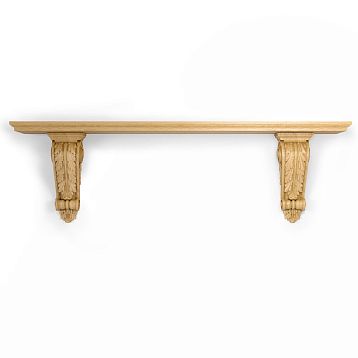
For PR-002, the under-rail strip PR-003 is purchased separately. It is not an optional decorative accessory, but part of the system connecting the handrail to the balusters. It creates an intermediate base to which the row is attached and helps form a neat bottom line for the wide profile.
Dimensions of PR-003
Length options of 1500, 2000, and 2500 mm with a cross-section of 60 × 6 mm are confirmed. Material is beech or oak. The quantity and combination of lengths are calculated based on railing sections, not automatically by the number of handrails.
Why the strip should be included in the order immediately
If PR-002 is already purchased and PR-003 is not calculated, installation may stop. The strip must match the handrail and balusters in wood species, length, and finish. Late additional purchase increases the risk of material differences and delays assembly.
How PR-003 connects balusters to the handrail
The strip forms the lower part of the system to which the upper ends of the balusters are brought. The specific connection method depends on the project and installation. The article should not replace a working drawing, but the buyer must understand: PR-002 without PR-003 is not a complete set for typical installation on balusters.
How to choose the length of the plank
It is divided by sections, turns, and joints. One PR-002 with a length of 5000 mm does not mean that there is a single PR-003 of the same length. Several planks of 1500–2500 mm will be required, connected according to the project. Their joint locations need to be coordinated with the handrail and the row of balusters.
Plank material
For an oak handrail and oak balusters, choose oak. For a painted beech set, choose beech. Different wood species under a transparent coating will be noticeable, and under enamel they may show the structure differently.
Where to buy PR-003
To assemble the railing, you can buy the under-handrail plank PR-003 in confirmed sizes and match it to the material of PR-002.
When PR-003 is not needed
For a separate wall-mounted PR-004, this plank is not specified as mandatory. If the round handrail is used in another system, the installation must be designed separately. The PR-002 set cannot be transferred to PR-004 without compatibility verification.
How a handrail changes the character of a staircase
Modern interior
In a modern staircase, the round PR-004 usually looks more natural. It creates a simple line, does not add a heavy bottom profile, and easily combines with a smooth wall, minimalist steps, and minimal decor. In white or gray enamel, the handrail can almost blend into the wall. In oak, it becomes a warm contrast.
Modern Classic
Both models can work, but in different roles. PR-004 is suitable for the wall side, where a calm grip without additional decor is needed. PR-002 completes the balustrade with wooden balusters and posts. This combination allows not making both sides of the staircase equally massive.
Classic staircase
The wide PR-002 better supports large balusters, carved posts, and substantial steps. Its profile is visible from afar and creates a finished top line. The round PR-004 can be used on the wall as a secondary element, matching the color of the main railing.
Art Deco style is renowned for its love of ornamentation, symmetry, and refined details. The molded decoration NPU-422 can become an excellent complement to geometric motifs and contrasting color combinations characteristic of this style. Try highlighting it with metallic paint or patina — and you’ll get an eye-catching detail that’s hard to look away from.
PR-002 with geometric balusters and a dark or contrasting finish can work in Art Deco. The wide profile supports architecturality. PR-004 is appropriate in a more restrained version, especially in a dark color or natural oak next to metal details.
Scandinavian and light interior
The round oak PR-004 with a clear coating looks lighter and closer to a simple natural form. PR-002 may be too massive if the staircase is small. But in light beech enamel, the wide profile can balance a large balustrade without looking heavy.
Commercial space
In a hotel, restaurant, salon, or public area, the handrail is chosen not only by style but also by intensity of use, railing scheme, and project requirements. PR-004 is convenient for the wall and a clear grip. PR-002 is suitable for the main balustrade. All components must be calculated by a specialist.
How to calculate a set of handrails for a staircase
The calculation begins by dividing the staircase into separate straight and turning sections. For each fragment, the length, model, material, end type, and connection method are determined. You cannot buy total footage without a cut map: part of the length may be unusable due to joint direction or required end cutting.
Divide the staircase into sections
Separately record the wall side, balustrade, landing, turn, and second-floor horizontal railing. One project can simultaneously use PR-004 and PR-002. It is not a mistake if the round profile goes along the wall and the wide one is above the balusters.
Create a length list
Opposite each section, indicate the finished size and the selected product length. For PR-004, this is 2400 mm. For PR-002, you can choose a size from 1500 to 5000 mm. After that, the master determines the remnants and the possibility of using them.
Do not sum meters without considering joints
Two sections of 1200 mm theoretically fit into one PR-004 of 2400 mm, but end cutting, allowance, and the nature of the ends may make such division impossible. Similarly, a long PR-002 cannot be automatically cut into several parts without evaluating the pattern and project.
Add PR-003 separately
The handrail bracket has its own size range and is not included in PR-002. For each section with balusters, the lengths of PR-003 are calculated. Its joints do not necessarily have to fully coincide with the handrail joints, but the scheme must be coordinated.
Count the balusters and posts
PR-002 works in the system. After selecting the length, you need to know the number of balusters, starting and turning posts. If these elements have not been selected yet, it is too early to buy the handrail: the profile may not match the scale of the row or the mounting node.
Calculate the finish
The area and length of the handrail affect the volume of primer, enamel, oil, or varnish. Exact consumables are not specified in the article because there are no confirmed links or characteristics. They are selected by the craftsman based on the coating system and wood species.
Installation: what needs to be decided before ordering
Handrail installation depends on the base, railing layout, length, turns, and finishing method. The article helps prepare for the purchase but does not replace a working project. This is especially important for stairs where the handrail is involved in safety and constantly bears the load from the hand.
Wall-mounted PR-004
It is necessary to determine the wall material, location of embedded parts, distance from the surface, height, and number of supports. The fastening must withstand regular force and not loosen. Specific brackets are not provided in the SEO scheme, so they cannot be invented or recommended without confirmation.
PR-002 on balusters
First, the row is mounted and leveled, then PR-003 and the wide handrail are prepared. The top ends of the balusters must match the line of the flight. Inaccurate cutting of one part disrupts contact and creates a visible break.
Turns and landings
Changing direction requires a separate node. It cannot be formed by random end-cutting after receiving the goods. The turn must be included in the drawing along with the post or other connecting element. Each section determines its own length.
Joints of long profiles
The connection must be precise, strong, and visually neat. On oak under a transparent coating, a mismatch in the pattern is more noticeable. On enamel, a geometric defect
Useful material about installation
For a buyer preparing a working diagram, it is useful to study installing a round wooden handrail. This material helps to understand the layout and installation logic, but a specialist still checks the specific project.
How to choose a profile if one comparative article is not enough
PR-004 and PR-002 cover two clear forks, but the handrail category is wider. If neither the round diameter of 50 mm nor the wide section of 74 × 60 mm matches the project, there is no need to fit the staircase to these two models. There are other handrails and PR-003 in the catalog.
General principles of shape, scale, and style are revealed in the material about how to choose a wooden handrail profile. After reading, you can return to the cards and check the specific model.
For a general commercial selection, it's better to open the category and buy handrails for stairs, comparing PR-004, PR-002, PR-001 and the sub-rail strip.
What to buy together with the handrail
A handrail is rarely purchased as a single part. PR-004 requires a designed wall mounting and finishing. PR-002 — PR-003, balusters, posts, fasteners, and a finishing system. The set must be assembled before payment, otherwise installation will stop due to a missing element or the products will be from different wood species.
| What to add | Why this is needed | For which scenario | What to Check |
|---|---|---|---|
| Sub-rail strip for handrail PR-003 | Connects PR-002 with a row of balusters | Stair railing with a wide handrail | Material, lengths 1500–2500 mm, cross-section 60 × 6 mm, and number of joints |
| wooden balusters for staircase | Form a series under PR-002 | Balustrade, march and platform fencing | Height, cross-section, style, wood species and compatibility with PR-003 |
| Support posts for the handrail | Complete the beginning, end and turns of the railing | PR-002 and a full balustrade | Scale, cross-section, connection, material and finish |
| Catalog of oak and beech handrails | Allows comparison of other profiles | PR-004 or PR-002 does not fit the shape | Section, length, purpose and compatible parts |
| Fasteners and glue per project | Provide connection to the base, balusters and posts | Both models | Wall material, wood, load and master's technique |
| Enamel, oil, varnish or tint | Protect the wood and tie the set by color | Beech under enamel, oak under clear or semi-transparent finish | System compatibility and test coating |
Especially important for PR-002 select balusters for handrail PR-002 and simultaneously to buy staircase postscorresponding to a broad profile scale.
How not to confuse a handrail with similar products
Handrail and round molding
PR-004 has the shape of a round molding, but is intended for a staircase. An ordinary cylinder of unknown purpose may not have the necessary preparation, length, and surface quality. For a constant grip area, it is better to choose a profile with a clear card and material.
Handrail and handrail bracket
PR-003 does not replace PR-002. This is a thin intermediate part 60 × 6 mm, which is installed under a wide handrail and connects it to the balusters. It cannot be used as an independent grip.
Handrail and baluster
A baluster is a vertical element. A handrail is a horizontal or inclined top line. The same wood species does not make the parts interchangeable. Their geometry and load differ.
PR-002 and solid timber
A wide cross-section of 74 × 60 mm does not mean a simple rectangular timber. PR-002 has a shaped profile and is designed for hand contact and connection with the sub-rail system. A random blank does not replicate this shape.
Finger-jointed and solid from one piece
A solid-lamella carpentry blank consists of lamellas running lengthwise without end joining. This is not a single solid piece of trunk. This distinction is important for correct expectations regarding the pattern and construction.
Wall-mounted handrail and handrail on balusters
They can be made from the same wood, but require different fasteners and kits. PR-004 more often solves the wall-mounted task. PR-002 is designed for balusters and PR-003. The scheme cannot be changed after purchase without reworking the project.
Practical choice for different tasks
Need a handrail on the wall along a straight flight
First, measure the finished length of the wall and check if the section fits within 2400 mm. If so, PR-004 allows for one smooth, continuous line without an intermediate joint. Choose beech for enamel or oak for tinting, then coordinate the brackets and anchors with the wall. If the section is longer, decide in advance where the joint will be and whether it will fall into the constant grip zone.
Need a handrail on the wall with a landing
Do not try to cover the turn with one straight element. Divide the staircase into inclined and horizontal sections, determine the ends of each handrail, and only then calculate PR-004. Possibly, two separate segments will look neater than a complex joint. The end shape and fastening must be provided in the project.
Need to assemble a classic balustrade
Start not with the length of PR-002, but with the posts and balusters. Determine their cross-section, material, and quantity, then select a wide handrail and PR-003. The profile 74 × 60 mm should match the scale of the row. If the balusters are very thin, a wide handrail may look heavy.
Need a long straight handrail without a noticeable joint
Consider PR-002 with a length over 2500 mm. One long element reduces the number of mounting joints, but it will be spliced along the length as part of the workpiece. Check the insertion route, finish, and how the splice will be perceived under a transparent coating.
Need to preserve natural oak
Choose oak for the handrail, strip, balusters, and posts. Make a single test stain and finish the set in one batch. For PR-004, the pattern will follow the round surface; for PR-002, it will follow the wide shaped profile. Dark tinting emphasizes pores and joints more strongly.
Need a white stair railing
Beech under enamel is more rational. For the wall, PR-004 will create a light white line. For the balustrade PR-002, PR-003, balusters and posts are painted in one system. It is important not to flood the shaped profile with a thick layer of primer and enamel, otherwise the edges will become softer.
Need to update an existing staircase
Take measurements of the old handrail, but do not copy them automatically. Check the distance between posts, the seating of balusters, the condition of the wall, and the possibility of using a new strip. The old profile may have had a different cross-section. If balusters are retained, PR-002 must be compatible with their top part and PR-003.
Need a handrail for a narrow staircase
Round PR-004 usually takes up less visual space and suits the wall. Wide PR-002 can reduce the feeling of air above the balustrade, especially near large posts. But the final decision depends on the width of the flight and where the railing runs.
Need a handrail for a hotel or restaurant
In a public interior, the project is checked against safety requirements and intensity of use. PR-004 is convenient as an additional wall-mounted grip. PR-002 suits a grand balustrade. The material, coating, and joints must withstand regular contact and maintenance.
Need to connect a round wall-mounted handrail and a wide balustrade
Using two models on the same staircase is possible. PR-004 runs along the wall, PR-002 — above the balusters. To avoid a random look, choose the same wood species and a similar finish. The round profile remains functional, the wide one — architectural.
Mistakes when buying a handrail
Choosing only by shape in a photo
The round profile seems small, the wide one — massive, but the actual effect depends on the length of the flight and adjacent details. Make a full-size cross-section from cardboard and attach it to the baluster or wall. This helps assess the scale before ordering.
Buying PR-002 without PR-003
The mounting kit turns out to be incomplete. The under-rail plank is purchased separately and has its own lengths. It needs to be calculated simultaneously with the handrail.
Expecting that any PR-002 is finger-jointed in length
Sizes 1500, 2000, and 2500 mm are made from a solid-laminate blank. Only options over 2500 mm are finger-jointed in length. The card name does not override this rule.
Expecting that solid-laminate means a solid log
The joinery blank consists of lamellas. The difference lies in the absence of longitudinal end-jointing for short sizes, not in being made from a single log.
Ignoring PR-004 length
The customer plans a straight section of 3.5 m and expects one round profile, although the actual size is 2400 mm. Joints and additional elements need to be resolved before purchase.
Ordering long PR-002 without checking clearance
An element up to 5000 mm does not fit into the room. Measure the elevator, turns, stairwells, and doors. Sometimes shorter parts are more practical.
Mixing beech and oak under a transparent finish
Handrails, balusters, and posts differ in texture. Even close tinting does not make the species identical. For a natural set, choose one material.
Oak under dense enamel without reason
Expressive texture is covered. If an opaque color is needed, beech is usually more rational and easier to match with painted parts.
Random joint in the grip area
An uneven joint is felt by hand and quickly becomes noticeable. The position of joints is set on the drawing, not determined after cutting.
Purchasing a handrail without posts and balusters
Later it turns out that the profile does not match in scale. For PR-002, the entire set must be considered simultaneously.
Installation without checking the wall
Wall-mounted PR-004 is attached to a base capable of bearing the load. Weak finishing or lack of embedded parts may require a different system. Fasteners cannot be chosen solely by appearance.
Thick finishing
On PR-002, shaped transitions lose clarity, and on PR-004, the circle becomes uneven to the touch. Primer and finish are applied evenly, with surface control.
Lack of a test paint sample
Oak after oiling or tinting turns out darker than expected, and white enamel differs from balusters. A sample is made before the entire batch.
Who PR-004 is suitable for
- for a buyer who needs a round handrail with a diameter of 50 mm;
- for the wall-mounted side of the stair flight;
- for a section about 2400 mm;
- for a minimalist modern or light interior;
- for a beech handrail under opaque enamel;
- for an oak profile under oil, varnish, or tinting;
- for a staircase where the handrail should not look massive;
- as an additional grip next to the main balustrade.
Who is PR-002 suitable for
- for a staircase railing with balusters;
- for a classic, neoclassical, or architectural interior;
- for sections with a length from 1500 to 5000 mm;
- for a project where the number of installation joints needs to be reduced;
- for a large row of balusters and massive posts;
- for a set with a handrail bracket PR-003;
- for an oak staircase with visible texture;
- for a painted beech railing.
When it's better to choose a different profile
- 50 mm diameter is inconvenient for users of a specific object;
- 74 × 60 mm section is too massive for balusters;
- a length or shape not available in the product cards is needed;
- the project requires a metal or combined handrail;
- existing posts are not compatible with the selected profile;
- a special turning or finishing element is required;
- the staircase has complex geometry that cannot be assembled with straight segments;
- the customer is not ready to pre-design the fastening and finishing.
What to Check Before Ordering
- wall-mounted installation or railing with balusters;
- round diameter 50 mm or wide section 74 × 60 mm;
- the finished length of each section;
- the number and position of joints;
- delivery and insertion route for a long element;
- beech for enamel or oak for tinting;
- length of PR-003 for all sections of PR-002;
- models and quantity of balusters;
- starting, turning, and support posts;
- method of attachment to a wall or railing;
- finishing and test paint;
- current price, availability, lead time, and configuration in the card;
- ability to use leftovers after trimming;
- compliance of the working project with safety requirements.
How to buy PR-004 or PR-002 for STAVROS
Start with the diagram. If the handrail goes along the wall, measure the section and compare it with the length of PR-004 2400 mm. If it is installed on top of balusters, determine the length of the row, select PR-002 and immediately calculate PR-003. After that, choose the wood species and finish.
To compare all profiles, you can choose a handrail for a wooden staircase in the category. If a decision has already been made, go to the specific model's card and check the size, material, and current conditions.
For PR-002, the next step will be a bracket for attaching the handrail to the balusters, then balusters and posts. For PR-004, the wall mounting with the base material needs to be separately approved.
It's better to hand over a complex project to a manager along with a drawing, a length list, and photos of the location. This helps to check which size to choose, how many joints there will be, whether a long element will fit into the room, and whether PR-003 has been forgotten.
How to prepare a request for an accurate order
A good handrail request does not consist of a single phrase "need an oak profile", but of a short list. It specifies the model, length of each section, material, future finish, and application scheme. For PR-004, the wall-mounted location is separately noted. For PR-002 — balusters, posts, and the quantity of PR-003.
Attach a staircase plan
The plan should show straight flights, landings, turns, and horizontal railings. Each section gets a number. Next to it, indicate the finished length and the selected commercial size. This diagram helps avoid confusing the short full-slat PR-002 with the long finger-jointed version.
Specify the material and finish
Write down beech under enamel or oak under stain. If the staircase is already partially manufactured, attach a photo and a finish sample. For oak, a test swatch is useful; for enamel, the color code and gloss level. The same shade on screen does not replace a physical sample.
Create a separate list of components
For PR-002, list PR-003, balusters, and posts. For PR-004, the designed wall mounting. Fasteners and finishing materials are selected based on the base and the craftsman's technique, so they cannot be added to the cart randomly just because they relate to staircases.
Check the logistics of long parts
If PR-002 with a length of 3500–5000 mm is selected, the request should specify the object's constraints: floor, elevator, door width, and turns. The manager will see that the buyer has assessed not only the flight length but also the actual possibility of delivering the profile to the installation site.
Record the quantity and purpose of remnants
A cut-off after adjustment should not be considered a full second part in advance. If the remnant is planned to be used on a landing or another section, its length, trimming direction, and surface quality must be checked on the drawing. This way, the total footage turns into a clear set, not a collection of random pieces.
FAQ: questions about PR-004 and PR-002
Which handrail is better for a wall?
More often PR-004. The round diameter of 50 mm provides a comfortable grip and does not require a massive system with balusters.
Which handrail is better for balusters?
PR-002. It has a profile of 74 × 60 mm and is installed with a sub-rail plate PR-003.
What is the size of PR-004?
The current option is 2400 × 50 mm, where 50 mm is the diameter of the round profile.
What lengths are available for PR-002?
The card offers eight options from 1500 to 5000 mm. The specific length should be selected according to the section list.
What materials are both models made of?
Made of beech or oak. Beech is chosen for enamel, oak for tinting and transparent finish.
Is PR-003 needed for PR-004?
In the PR-004 card, it is not listed as mandatory. For non-standard installation, compatibility is determined by the project.
Is PR-003 needed for PR-002?
Yes, for installation with balusters it is purchased separately.
What are the dimensions of PR-003?
1500, 2000, and 2500 mm with a cross-section of 60 × 6 mm. Material: beech or oak.
Are all PR-002 finger-jointed along the length?
No. Sizes 1500, 2000, and 2500 mm are made from a solid lamella blank. For sizes over 2500 mm, finger-jointing along the length is used.
What does solid lamella mean?
The slats run the full length without end joining. This does not mean they are made from a single solid piece of the trunk.
Can PR-004 be used on a long flight of stairs?
Yes, if the design includes several sections and neat joints. One actual element has a length of 2400 mm.
Can I order PR-002 with a length of 5000 mm?
This size falls within the confirmed range. Before ordering, you need to check delivery access, transportation, and the features of the joined blank.
Which handrail looks visually lighter?
PR-004. The round profile with a diameter of 50 mm looks calmer than the wide PR-002.
Which profile suits a classic staircase?
Most often PR-002, especially next to large balusters and posts. But the final choice depends on the entire project.
Which handrail should I choose for white enamel?
Beech. This applies to both models.
Which handrail should I choose for oil or stain?
Oak, if you need to preserve the pronounced wood texture.
Can PR-004 and PR-002 be combined on the same staircase?
Yes. PR-004 can go along the wall, PR-002 above the balusters. It's better to choose one wood species and a coordinated finish.
How to calculate the number of handrails?
Divide the staircase into straight sections, specify the finished length of each, select product sizes, and only then calculate the elements and leftovers.
Where is the best place to place the joint?
At a design point where it does not interfere with the grip and can be securely connected. There is no universal place for any staircase.
Do I need to buy balusters at the same time as PR-002?
It is advisable. This makes it easier to check the scale, material, fit, and finish of the entire railing.
What should I check before payment?
Model, length, material, finish, blank type, PR-003, balusters, posts, joint diagram, and current card conditions.
Result: PR-004 for a round wall-mounted handrail, PR-002 for a wide railing with balusters
PR-004 and PR-002 cannot be compared only as a thin and thick handrail. The round PR-004 with a diameter of 50 mm is suitable for a wall-mounted section, a minimalist staircase, and a length of about 2400 mm. The wide PR-002 74 × 60 mm completes the balustrade, is offered in lengths up to 5000 mm, and requires a separate PR-003.
Beech is chosen for opaque enamel, oak for oil, varnish, or tinting. For PR-002, the actual blank rule must be considered: up to 2500 mm it is solid-lamella, above that it is finger-jointed lengthwise. A long element reduces the number of installation joints but requires checking for delivery access and finishing.
on the Stavros website you can view all STAVROS handrails, go to the PR-004 and PR-002 cards and assemble a set with PR-003, balusters, and posts. A conscious choice of profile helps achieve a comfortable grip, a solid top line, and a railing without random mismatches in length, wood species, and installation.