Article Contents:
- Wooden overlay N-422 and soft insert: two different parts of the headboard
- Which N-422 will fit over the soft part — without being tied only to the mattress width
- Remove the upholstery without touching the carving: checking access and removal path
- Access to connections
- Removal path
- Return after reupholstering
- Can the N-422 be added over fabric on an already finished bed?
- Can the fabric be changed without access to the back of the headboard?
- Can two soft inserts be used instead of one?
- Is it allowed to replace thin fabric with a more voluminous one during the next reupholstery?
- Should a second insert be ordered right away for seasonal changes?
- Can a removable insert be considered a removable cover for washing?
- Is it necessary to re-dye N-422 when changing the fabric?
- What documents should be passed to another craftsman after several years?

To later replace the fabric without removing the carved decor, the soft part of the headboard must be designed separately from the rigid base on which the overlay is attached. The insert must have its own connections and a clear removal path. If the fabric is clamped under a permanent ornament, a mere promise of "we'll reupholster later" is not enough: repairs will require returning to the furniture's construction.
Consider a new project: above the soft backrest, the client wants to place one wooden overlay N-422, and change the textile as needed. This is a hypothetical scenario, not a ready-made manufacturer configuration. We select the decor size, mark its location on the rigid part, and include the removability of the insert in the task for the furniture maker—before the headboard is manufactured.
The result should be clear without additional explanations: the carving remains on its base, the soft insert is handed to the upholsterer separately, then returned to the agreed position. At the same time, keeping the ornament in place does not always mean completing the work without moving the bed away from the wall.
Wooden overlay N-422 and soft insert: two different parts of the headboard
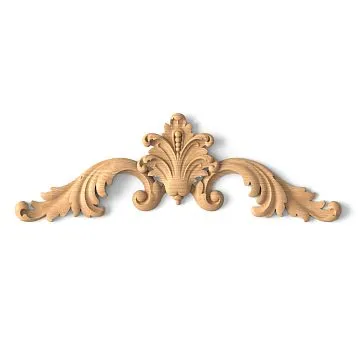
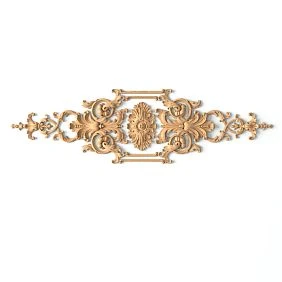
N-422 is a decorative wooden piece. It is available in beech and oak, with "Standard" and "Prestige" sanding, and several sizes. The buyer can buy the wooden overlay N-422, but the rigid part of the headboard and the removable insert are ordered within a separate furniture project.
| Part of the project | Purpose | What to coordinate |
|---|---|---|
| Rigid decorative part | Base for placing carving | Material, geometry, attachment to furniture or wall |
| Overlay N-422 | Decorative design | Execution, position, method of reliable fixation |
| Soft insert | Fabric-upholstered part of the headboard | Base, filling, edge, independent attachment and removal |
In this scheme, the overlay does not hold the soft insert and does not replace the load-bearing elements of the bed. The fabric and filling also do not become a base for thread attachment. Each connection has its own task: permanent elements maintain position, serviceable ones allow the upholstered part to be removed.
Ask the furniture maker to show this in a cross-section. It should distinguish the insert base, soft layers, decorative base, and the N-422 itself. If these parts merge into one conventional spot, it is impossible to verify future reupholstery from the drawing.
The position of the ornament relative to the head and pillows is assessed separately. A beautiful center on the front sketch may end up in the zone of normal contact when a person sits in bed. The height is chosen together with the mattress and usual seating position, and the reliability of fixation is confirmed by the contractor. The overlay's dimension table does not specify mass, mounting points, or universal fastener length.




Which N-422 will fit above the soft part — without being tied only to the mattress width
The mattress width is needed for overall layout but does not determine the free space for the ornament. The headboard itself may be wider than the sleeping area, have side posts, or a shaped top. For selection, its outer contour and the actual rigid field above the insert are needed.
| Width A | Height B | Depth C |
|---|---|---|
| 790 мм | 225 мм | 16 мм |
| 877 мм | 250 мм | 18 мм |
| 965 мм | 275 мм | 20 мм |
Compare three contours on one layout. For example, with a conditional external headboard width of 1600 mm, a centered overlay 790 mm wide leaves:
(1600 − 790) / 2 = 405 mm on each side.
This distance on the sketch is from the extreme points of the ornament to the outer boundaries of the headboard. It is not a mounting offset and does not prove that the entire overlay rests on a suitable base. If there are posts or curves within these 1600 mm, the free area will be different.
Check the height of the field, not just the width. A long piece may fit between the side edges but extend onto the soft part with the lower section of the pattern. Depth is also considered in the cross-section: it affects the mutual position of the thread, fabric, and the removal path of the insert.
A full-size paper contour is suitable for initial fitting. It shows scale but does not replace checking the attachment. The printout is measured after printing, then its position is marked relative to the actual boundary of the upholstery. Final coordinates are transferred from the approved drawing, not from a photo of the mockup.
If no option leaves room for an independent soft part, it is better to change the decorative field or Buy decorative furniture overlays another shape. You should not trim the selected ornament for a random size match without coordinating with the manufacturer.
Our factory also produces:
Remove the upholstery without touching the carving: we check access and the removal path
The word "removable" in the order needs to be explained through actions. The furniture maker shows where the insert is released from, how it is taken out, and how it is returned. All operations are considered with the N-422 installed, not on a bare base to which the decoration will be added later.
Get Consultation
Access to connections
Start with the question: where does the craftsman work from? Possible access from the front, side, or back is determined by the design, not by the desire to hide the fastener at any cost. The position of the hand, the tool's placement, and the ability to support the insert at the moment of release are important.
A visible fastener head does not yet mean convenient access. In front of it may be a side post, below it the bed base, and nearby a fixed part of the decor. They check not only the ability to bring the tool but also to perform the intended movement. There is no need to assign the type of connection in advance: first, the performer chooses a solution for the specific base and mass of the soft part.
If access is provided from the back, the position of the bed during servicing is marked on the room plan. Can the craftsman move it without removing the headboard fixed to the wall? Do nightstands or other permanent elements interfere? The requirement to keep the N-422 in place does not itself prohibit moving the bed, but such a procedure must suit the owner.
Removal path
The next check begins after releasing the connections. The insert must come out of the surrounding structure entirely. The cross-section indicates the direction and sequence of movements, including intermediate positions. Checking only the final position in front of the headboard misses a possible collision along the way.
If the selected component requires first lifting the insert, the upper decorative part must not overlap this movement. If the part is brought forward at an angle, the position of its top edge relative to the thread is considered. For side removal, check the adjacent post and the space near the bed. These are design check options, not ready-made instructions for any headboard.
Conditional example: the connection is released after lifting the insert by 12 mm, but only 8 mm remains to a fixed obstacle in that direction. That's 4 mm short even without accounting for working clearance. Externally, the insert sits evenly, but the intended removal is impossible. Both dimensions here are illustrative and do not relate to N-422 or any specific hardware.
Do not plan to compensate for lack of space by strongly compressing the upholstery or bending a carved element. If the operation requires such force, the component must be reconsidered. The working clearance is set by the installer based on the final contour, covering, edge, and chosen connection.
Return after reupholstering
Returning the part should be no harder than removing it, but this is checked separately. The project records the initial position, orientation, and method of confirming that connections are fully installed. Nice fabric fit does not prove reliable fastening of the base.
After replacing the textile, compare the finished insert with the agreed dimensions. New fabric, filling, and edge finishing must not arbitrarily increase its volume. Even a preserved wooden base does not guarantee the outer contour matches after the upholsterer's work.
| Check | What the installer must demonstrate |
|---|---|
| Access | Where they work with connections and how the insert is supported |
| Removal | Full path of the part without affecting N-422 |
| Return | Insertion position and confirmation of its fixation |
| Environment | Which items are moved and what space is freed up |
Also plan a place where the removed part will be placed before packaging. For a large insert, passage through the door and transportation may be a separate task. This is discussed before manufacturing, especially if the bed is assembled in the room and in its finished form it does not fit through the opening.
Where the fabric ends: piping, padding, and wooden overlay
The soft part has two contours: the rigid base and the final upholstery. In a furniture drawing, it is not enough to specify the dimensions of the first and write 'upholster with fabric' next to it. You need to define the finished thickness, corner shape, edge, and its position relative to the decorative base.
Piping, if provided, is included in the outer dimension of the insert. The same applies to fabric-wrapped side sections. The upholsterer must see where additional volume is acceptable and where it will block the removal path or access to the connection. There is no universal allowance for this place: the decision depends on the chosen fabric and edge treatment method.
Check where the textile itself is secured. It should not transition from the removable base to the fixed decorative part in such a way that they cannot be separated without cutting the fabric. Hiding a messy edge under a permanent overlay is convenient only until the first reupholstery. The fix is to finish the upholstery on the insert and coordinate independent finishing of its border.
In the specification, a useful note is: 'Material replacement is allowed while maintaining the agreed outer contour; increasing thickness and changing piping require re-verification.' This leaves freedom to choose the fabric but does not promise compatibility with any new padding.
Suitable Materials for installing wooden decor are selected after developing the joints. Glue for a permanent overlay does not become a way to create a removable connection for the soft part. Nor should both tasks be combined with one general instruction 'secure everything reliably': in one case, it is necessary to maintain position, in the other, also to ensure the intended maintenance.
Wood and fabric are chosen together, but finished according to different specifications.
Attach a fabric sample to the coating sample on the selected wood. Evaluate the combination under the lighting of the future bedroom, not just on the phone screen. Note the wood color, gloss, appearance of carving recesses, and direction of the textile pattern. Approving two materials separately does not mean you will like their proximity.
At STAVROS, wood species, glue-lamination quality, and sanding are different parameters. "Under enamel" and "under tinting" describe the selection of wood lamellas. "Standard" and "Prestige" refer to surface treatment; "Prestige" includes detailed hand sanding. These designations do not mean a finished color or applied varnish. Before ordering, it is useful to discuss separately quality of wood and sanding.
For a semi-transparent finish, separately confirm the appropriate quality of the blank. The note "oak, Prestige" does not replace this decision. For an opaque coating, agree on the expected result with the finisher: they need information about the original surface and the accepted material system, not just the desired shade.
Coordinate the order of work with a trial assembly. Before irreversible finishing, geometry is checked; final coating and upholstery are done according to an agreed sequence. During assembly, access points must not disappear, and the finish must not join parts intended to be separated. The contractor also determines when the coating is ready for contact with fabric, packaging, and mounting fixtures.
If it is difficult to coordinate the position of the ornament, you can order selection of decor for the headboard. This service relates to the artistic solution and specification of decorative elements. Designing the base, fixing the insert, and mounting the headboard remains a separate task for the furniture maker.
Keep the fabric labeling and finish sample. In a few years, the chosen textile may become unavailable, so the possibility of replacement should be tied to the geometry of the insert, not to a promise to find exactly the same material. For a future upholsterer, a diagram of the finished part and its edge is more useful than a single photo of the overall bed view.
The price of the N-422 overlay and the cost of the entire headboard
The price of a decorative part is only one line in the budget. Below is the cost of one N-422 as a "Prestige" finish per the card as of September 6, 2026. Identical sizes are compared, not the minimum prices of different versions.
| Size N-422, mm | Beech, "Prestige" | Oak, "Prestige" |
|---|---|---|
| 790 × 225 × 16 | 26 180 ₽ | 28 810 ₽ |
| 877 × 250 × 18 | 34 570 ₽ | 38 510 ₽ |
| 965 × 275 × 20 | 41 280 ₽ | 46 800 ₽ |
For a hypothetical project with one overlay 790 × 225 × 16 mm, the difference between oak and beech is:
28 810 − 26 180 = 2 630 ₽.
This is the difference in the price of the decoration, not the increase in cost of the finished bed. The cost of the coating, base, and upholstery work must be requested separately. One should not assume that switching to a smaller size solves the budget issue until this option is checked against the headboard layout.
It is convenient to divide the full estimate by the parts and work to be purchased:
| Estimate line | What needs to be determined |
|---|---|
| N-422 | Size, wood, preparation, one piece |
| Rigid part of the headboard | Design and manufacture of the base |
| Base of the soft insert | Shape, dimensions, and preparation for upholstery |
| Filling and fabric | Materials, edge finishing, upholsterer's work |
| Joints | Permanent and serviceable components per project |
| Wood finishing | Sample and approved covering |
| Assembly and receipt | Inspection, packaging, delivery, and installation |
If the workshop includes fasteners and trial assembly in the manufacturing cost, there is no need to add them again as a separate amount. However, the proposal should make it clear that these works are indeed provided. The phrase "headboard with decor" does not disclose either the removable insert or its verification.
The second N-422 is not a mandatory repair spare. To check the covering, a suitable wood sample can be discussed without purchasing another large ornament. If it is decided to first buy the overlay itself for fitting, specify that this piece will then be used in the finished headboard: it cannot be counted both as a sample and as a second necessary part.
A demountable solution may require additional work during manufacturing. Its payback after the first fabric change cannot be promised: two workshop proposals with the same external result and a clear composition of subsequent maintenance must be compared. The practical goal here is to preserve the decor during repairs, and the economic result is assessed based on actual rates.
Check before finish: one cycle of removing and installing the soft part
Include a demonstration in the trial assembly acceptance. Before final finishing, the contractor must show one full cycle: prepare access, release connections, remove the insert, and reinstall it. The position of permanent decor during the check must match the design.
Checking only the uncovered base is incomplete. It does not account for the fabric edge and the finished thickness. In the trial assembly, these areas must be reproduced to an agreed extent, and after final upholstery, the fit must be confirmed. Otherwise, a comfortable mock-up will turn into a tight knot only after all surfaces are finished.
Observe not the craftsman's speed, but the sequence. Does he have to pry the edge through the thread? Can the insert be supported while the last connection is released? Does N-422 remain stationary? Does the soft part return to the specified boundaries without forced compression or misalignment? Each such check answers a separate question.
Do not require a home test with a jerk or arbitrary additional load. The removal cycle confirms the serviceability of a specific assembly but does not replace furniture safety testing and does not prove unlimited durability of detachable connections. The responsible contractor determines the order of structural inspection.
Preserve the sequence in photographs or a short video with his explanations. The images must show the points where connections are released and the direction of movement, not just the already removed insert. Mark the orientation of the part and the intended tool. The instructions will be useful to another craftsman who, in a few years, will have to work without the furniture's author.
If at this stage the insert cannot be removed without removing N-422, the design requirement is not met. The joint must be changed before finishing, rather than recording a workaround technique involving bending the decor in the instructions.
When to postpone purchasing N-422
Do not order the overlay before design approval if the thread overlaps the only possible removal path or falls into the contact zone during normal seating. Changing the height of the decorative field may solve the problem, but it must first be checked on the overall layout.
Another reason to stop is unclear responsibility for the soft part. The seller confirms the product, the upholsterer knows how to replace the fabric, but no one designs the removable joint. In such a case, there is not yet a complete manufacturing specification for the furniture, even if all materials are selected.
For an already finished headboard, a separate check is required. It cannot be assumed that an overlay will turn existing solid upholstery into a serviceable insert. The possibility of preserving the base, organizing access, and transferring the fabric edge is assessed by a furniture maker. Sometimes it is wiser to forgo additional carving than to redo functional furniture for its installation.
If it is specifically the silhouette that does not fit, you can to buy carved wooden decor for another agreed field. But replacing the ornament does not solve the problem of inaccessible connections: the construction of the soft part still needs to be finished.
Order N-422 and the headboard: two specifications instead of the line "bed with decor"
The first specification refers to the purchase of the decoration. For the considered example, the request looks like this:
N-422 / 790 × 225 × 16 mm / beech / "Prestige" sanding / confirm the quality of re-gluing / 1 pc. Packaging, shipping time, and delivery should be specified separately. Purpose — decorative overlay on the rigid part of the headboard; the furniture scheme is coordinated with its manufacturer.
Size and material in the actual order are replaced with those selected in the project. Before payment, the full line is verified, not just the article number: a desired pattern of a different size is not an agreed replacement. Study in advance the payment and delivery terms for the overlay. The completion date of the entire furniture must be coordinated with the workshop's work.
The second specification is for the headboard. It records the dimensions and structure of the rigid part, the position of N-422, the base of the insert, permanent and detachable connections, the full removal path, and necessary actions in the room. A front view, a cross-section, and the order of trial assembly are attached.
Within this task, a section is allocated for the upholsterer: base shape, finished outer dimension, thickness, filling, fabric, pattern direction, and edge finishing. A separate note prohibits moving the upholstery attachment to a fixed decorative part without re-approval. Samples and the final scheme must have clear markings so that the workshop does not work from an outdated sketch.
Before handing over for production, check the junction of two specifications: the selected overlay is indeed the one shown in the drawing; its attachment location is provided; removal of the insert is indicated. When these conditions are met, you can order overlay N-422 for a specific location. Confirm the current price and completeness in the order.
Questions before purchasing an overlay for a soft headboard
Can N-422 be added over fabric on an already finished bed?
The existing upholstery cannot be considered a ready-made attachment base. The furniture maker must check the structure underneath it and determine whether it is possible to separate the permanent decor from the replaceable textile. If the fabric remains clamped by the decoration, the task of its independent replacement will not be solved, even with externally neat installation.
Can the fabric be changed without access to the back side of the headboard?
Only if such a procedure is provided for by the design. For a headboard that cannot be moved away or removed from the wall, the limitation must be communicated to the furniture maker in advance. He checks the possibility of a different arrangement of connections. From a photo of the front side, front-facing serviceability cannot be confirmed.
Can two soft inserts be made instead of one?
This is a separate design solution. Two parts may be more convenient for carrying, but require a coordinated central joint, independent fixation, and verification of removal for each. It is also necessary to determine the fabric direction and the type of edge. The presence of a single central N-422 does not establish the number of soft elements beneath it.
Is it allowed to replace the thin fabric with a more voluminous one at the next reupholstery?
The new material is approved based on the finished part, including corners and piping. The unchanged base size does not yet confirm that the increased external volume will fit into the previous assembly. The upholsterer is given the maximum contour and access scheme; changes beyond the approved boundaries are checked with the furniture maker.
Should I order a second insert right away for seasonal changes?
First, confirm the ease of removal and determine where the spare part will be stored. The second insert is an additional order, not a mandatory part of the N-422 configuration. It is made to the same approved fitting parameters, but is checked separately after upholstery: identical bases may result in different external contours.
Can the removable insert be considered a removable cover for washing?
No. The insert is removed together with its base, and the method of replacing or cleaning the fabric depends on the upholstery construction and the requirements of the chosen material. The ability to hand the part to an upholsterer does not mean permission to wash it entirely. If a replaceable cover is specifically needed, that is a separate condition of the task.
Is it necessary to repaint N-422 when changing the fabric?
Not necessarily: preserving the wooden part allows it to be considered separately. The new fabric is compared with the existing finish. If the shades do not match or the wood requires restoration, finishing work is discussed separately; reupholstery itself is not a reason to automatically include repainting in the estimate.
What documents should be passed to another craftsman in a few years?
Provide the insertion diagram, final dimensions, joint photos, removal sequence, fabric marking, and wood finishing details. It is useful to keep the manufacturer's contact and the designations of the hardware used. Even with this data, before starting work, the craftsman inspects the actual condition of the furniture rather than assuming it has remained unchanged.